

Blog
Beyond RAG: Document Intelligence 4.0 for Complex Workflows
RAG is broken for complex workflows. Discover its 5 fatal flaws and the future: Document Intelligence 4.0.

Blog
RAG is broken for complex workflows. Discover its 5 fatal flaws and the future: Document Intelligence 4.0.
The enterprise AI world has been swept up in RAG fever. Walk into any boardroom where document processing is being discussed, and you'll hear the same promises: "RAG will revolutionize how we handle documents," "It's like having a super-smart assistant that knows everything in our files," "We can finally unlock all that trapped data." The consulting firms are selling it, the vendors are building it, and executives are buying it.
But here's the uncomfortable truth that's starting to emerge from real-world implementations: RAG is fundamentally broken for complex enterprise document workflows. Not flawed, not incomplete, but fundamentally broken at its core when applied to the messy, interconnected, context-heavy world of business documents.
After working with hundreds of enterprises struggling with their RAG implementations, we've seen the same story play out repeatedly. Companies spend months setting up their retrieval systems, vectorizing their documents, and fine-tuning their embeddings. The demos look impressive. The proof-of-concepts show promise. Then reality hits, and the system crumbles under the weight of actual business complexity.
This isn't another article about optimizing RAG parameters or choosing better embedding models. This is about recognizing that we've been solving the wrong problem entirely. The future of enterprise document intelligence isn't about better retrieval, it's about true contextual understanding. Welcome to Document Intelligence 4.0.
To understand why RAG fails in enterprise environments, we need to understand what it was actually designed to solve. RAG emerged from the academic world as a solution to a specific problem: how to give large language models access to information beyond their training data. It was brilliant for that narrow use case. If you wanted to ask questions about a specific research paper or query a well-structured knowledge base, RAG worked beautifully.
But somewhere along the way, the enterprise software world made a catastrophic assumption: if RAG works for simple question-answering, it must work for complex document processing workflows. This assumption has cost businesses millions in failed implementations and continues to drive misguided AI strategies across industries.
The fundamental flaw in this reasoning becomes clear when you examine what enterprise document processing actually requires. Real business documents don't exist in isolation. They're part of intricate webs of relationships, dependencies, and contextual nuances that RAG's retrieve-then-generate approach simply cannot handle.
Consider a typical mortgage application process. When a loan officer reviews an application, they're not just extracting data points from individual documents. They're synthesizing information across credit reports, bank statements, employment verification, property appraisals, and regulatory requirements. They're understanding relationships between different pieces of information, identifying inconsistencies that might indicate fraud, and making contextual judgments based on industry knowledge that goes far beyond what any single document contains.
RAG approaches this challenge by trying to retrieve relevant chunks of information and then asking a language model to make sense of them. But this retrieve-first methodology creates a cascade of failures that become apparent only when you scale beyond simple use cases.
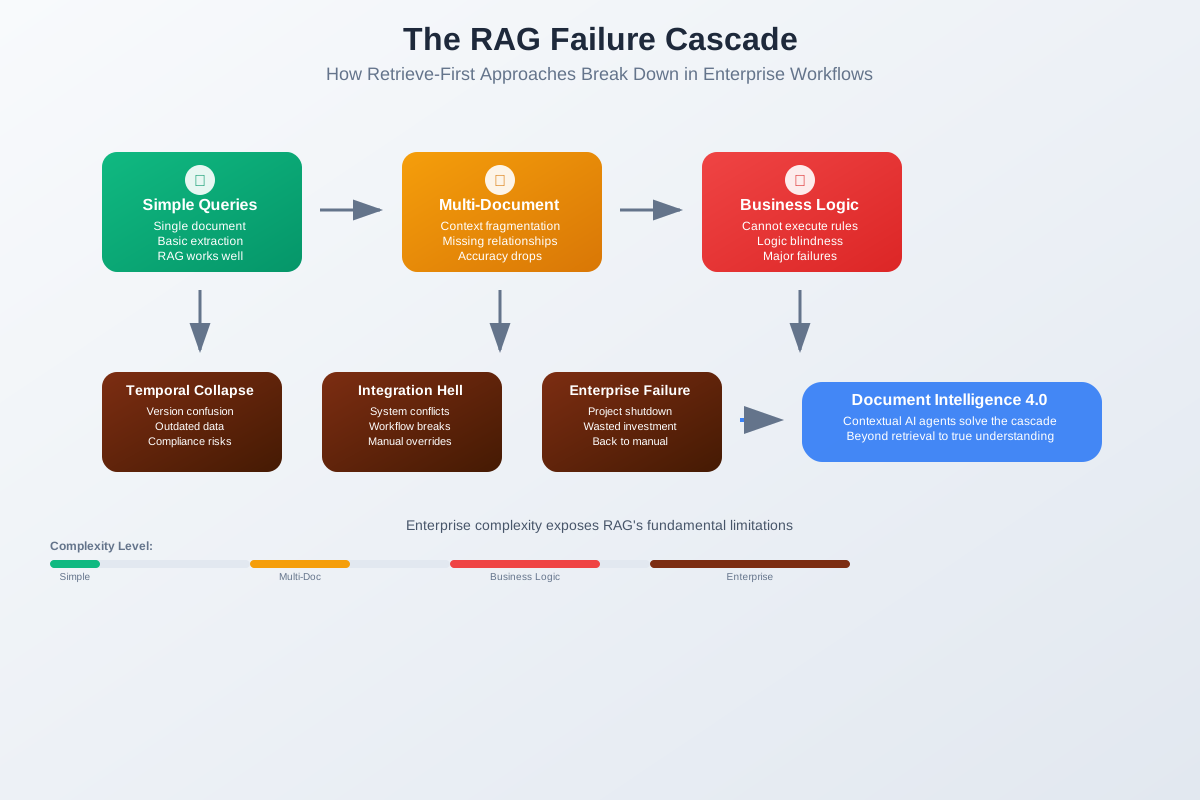
RAG's core mechanism of breaking documents into chunks and retrieving relevant pieces destroys the very thing that makes documents meaningful: their internal context and structure. When you fragment a contract into retrievable chunks, you lose the relationships between clauses, the hierarchical structure of terms, and the contextual dependencies that legal professionals rely on.
We've seen this play out dramatically in legal document processing. A law firm implemented a RAG system to help associates research contract provisions. The system could successfully retrieve clauses about termination rights, but it consistently missed the interconnected provisions that modified those rights based on other sections of the contract. The result wasn't just inaccurate, it was dangerous. Associates were getting incomplete information that could have led to serious legal malpractice issues.
This isn't a technical problem that can be solved with better chunking strategies or smarter retrieval algorithms. It's a fundamental architectural flaw. Documents aren't collections of independent facts waiting to be retrieved. They're cohesive narratives with internal logic, cross-references, and contextual dependencies that emerge from their structure as complete entities.
Enterprise workflows rarely involve single documents. They require understanding relationships across multiple document types, each with different structures, purposes, and contextual frameworks. RAG systems struggle desperately with these multi-document scenarios because they treat each retrieval as an independent operation.
In financial services, we've observed RAG implementations attempting to process loan applications that involve dozens of supporting documents. The system might successfully extract an applicant's income from a pay stub and their employment status from a verification letter, but it fails to understand that these pieces of information need to be reconciled against each other and validated for consistency. When discrepancies exist between documents, RAG systems either miss them entirely or get confused by conflicting retrieved information.
The problem becomes exponentially worse when you add regulatory requirements, policy documents, and business rules that need to be applied contextually. RAG systems end up with a massive coordination problem, trying to juggle retrieved information from multiple sources without any understanding of how these pieces fit together in the broader business process.
Business documents exist in time. Contracts have effective dates, amendments supersede previous versions, and regulatory requirements evolve. RAG systems, focused on retrieving the "most relevant" information, systematically ignore these temporal relationships.
We've encountered insurance companies where RAG systems would retrieve outdated policy language or superseded regulatory requirements simply because the text similarity was high. In one case, a claims processing system was still applying coverage rules from policies that had been amended months earlier. The RAG system didn't understand that the retrieved information had been invalidated by subsequent changes.
This temporal blindness isn't just an oversight in implementation, it's baked into RAG's core architecture. Retrieval mechanisms optimize for similarity, not for validity or currency. They can't distinguish between a current regulation and a historical version that happens to contain similar language.
Perhaps the most damaging limitation of RAG in enterprise environments is its complete inability to understand and apply business logic. RAG systems can retrieve information about business rules, but they can't execute them in context with the documents they're processing.
Consider a procurement workflow where purchase orders need to be validated against multiple policies: spending limits, vendor approval status, budget availability, and compliance requirements. A RAG system might successfully retrieve the text of each policy, but it cannot operationalize that information into actionable business logic that gets applied to the specific purchase order being processed.
This leads to a frustrating situation where RAG systems can tell you what the rules say but can't tell you whether those rules are being followed. They become expensive information retrieval systems that still require humans to do all the actual decision-making and process execution.
Enterprise document processing doesn't happen in a vacuum. Documents flow through complex systems: ERPs, CRMs, workflow engines, and regulatory platforms. RAG systems, designed around the retrieve-and-generate paradigm, are notoriously difficult to integrate into these existing workflows.
The problem isn't technical compatibility, it's conceptual mismatch. Business systems expect clear inputs and outputs, deterministic processing, and reliable state management. RAG systems provide probabilistic outputs based on retrieval quality, with no clear way to handle the uncertainty and variability that's inherent in their approach.
We've seen enterprise IT teams spend months trying to wrap RAG systems in enough error handling and validation logic to make them suitable for production workflows. The result is typically a Rube Goldberg machine of safeguards and workarounds that defeats the purpose of automation in the first place.
Let's step away from theoretical limitations and examine what actually happens when enterprises deploy RAG-based document processing in real-world scenarios. The stories are remarkably consistent across industries, and they paint a picture of a technology that's fundamentally misaligned with enterprise needs.
A Fortune 500 manufacturing company recently shared their experience implementing a RAG system for processing supplier contracts. The initial pilot looked promising. The system could answer basic questions about contract terms, extract key dates, and summarize obligations. The vendor demos were impressive, and the business case seemed solid.
But when they moved to production with real contract portfolios, the cracks began to show. The RAG system would confidently retrieve information about termination clauses while missing the specific conditions that triggered those clauses. It could find warranty terms but couldn't determine how they applied to specific product categories. Most critically, it couldn't understand the interplay between different contract sections that modified each other's meanings.
The breaking point came when the system processed a complex master service agreement with multiple amendments. The RAG retrieval kept pulling language from the original agreement while ignoring the amendments that had fundamentally changed the terms. When the procurement team discovered that they'd been operating under incorrect contract interpretations for weeks, they shut down the system entirely.
This pattern repeats across industries. A healthcare system implemented RAG for processing patient records, only to discover that the system couldn't understand the relationships between different medical documents or apply clinical guidelines contextually. A financial services firm tried using RAG for regulatory compliance, but found that the system couldn't distinguish between current and superseded regulations, leading to compliance gaps.
The problem isn't that these companies chose the wrong vendors or implemented RAG poorly. The problem is that RAG's architectural assumptions are incompatible with the reality of how business documents function in enterprise environments.
Understanding the limitations of RAG is just the beginning. The real question is: what comes next? The answer lies in recognizing that enterprise document processing requires a fundamentally different approach, one that prioritizes contextual understanding over information retrieval.
Document Intelligence 4.0 represents a paradigm shift from the retrieve-and-generate model to a contextual-understanding model. Instead of breaking documents into chunks and hoping to retrieve the right pieces, this new approach treats documents as complete contextual entities that need to be understood in their entirety and in relationship to other documents and business processes.
The core principle of Document Intelligence 4.0 is context preservation. Rather than fragmenting documents for retrieval, advanced AI systems maintain the full contextual integrity of documents while building dynamic understanding of their relationships to other documents, business rules, and workflow requirements.
This shift requires several fundamental changes in how we approach document AI:
Holistic Document Understanding: Instead of chunking documents, AI agents analyze complete documents to understand their internal structure, cross-references, and contextual dependencies. A contract isn't a collection of clauses to be retrieved; it's a coherent legal instrument with internal logic that needs to be preserved.
Multi-Document Orchestration: Document Intelligence 4.0 systems understand that business processes involve multiple related documents that need to be processed together. They maintain awareness of document relationships, validate consistency across sources, and apply business logic that spans multiple document types.
Temporal Awareness: These systems understand that documents exist in time, with versions, amendments, and evolution. They can distinguish between current and historical information, understand the impact of changes, and maintain accurate state across document lifecycles.
Business Logic Integration: Perhaps most importantly, Document Intelligence 4.0 systems don't just extract information from business rules, they operationalize those rules into executable logic that gets applied contextually to documents as they're processed.
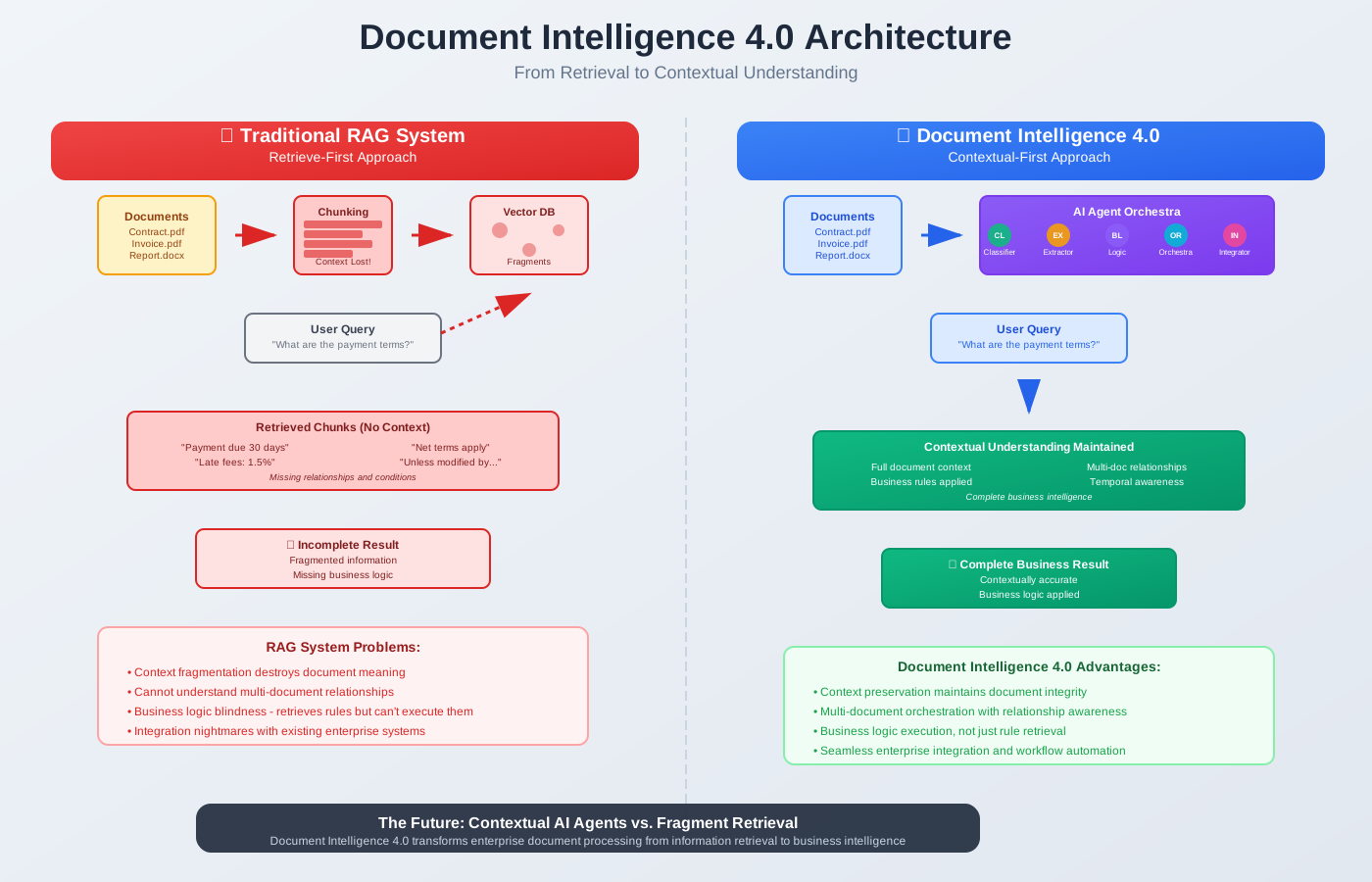
The implementation of Document Intelligence 4.0 requires a fundamentally different technical architecture than RAG systems. Instead of retrieval mechanisms and vector databases, it relies on specialized AI agents that are designed to understand and maintain context throughout document processing workflows.
These AI agents operate very differently from traditional RAG systems. Rather than retrieving information and passing it to a language model, they maintain persistent understanding of document contexts, business rules, and workflow states. They're designed to think more like human domain experts who understand how documents relate to each other and to business processes.
Consider how a human expert processes a complex insurance claim. They don't just extract information from individual documents. They maintain awareness of the policy terms, understand how the claim details relate to those terms, validate that supporting documentation is consistent and complete, and apply business rules that might depend on multiple factors across different documents. They do all of this while maintaining context about the broader workflow and regulatory requirements.
AI agents in Document Intelligence 4.0 systems work similarly. They maintain contextual awareness throughout the entire document processing workflow, understanding not just what information exists in documents but how that information relates to business objectives, regulatory requirements, and operational constraints.
This contextual approach solves the fundamental problems that plague RAG implementations. Because AI agents maintain complete document context, they don't suffer from fragmentation problems. Because they understand document relationships, they can handle multi-document workflows effectively. Because they're designed around business process integration, they can operationalize business rules rather than just retrieving information about them.
The technical implementation involves several key components that work together to maintain contextual understanding. Document classification agents ensure that incoming documents are properly categorized and routed within their business context. Entity extraction agents identify and validate information while maintaining awareness of document structure and relationships. Business logic agents apply rules and constraints that depend on multiple factors across different documents and systems.
The theoretical advantages of contextual document intelligence become most compelling when you see them applied to real enterprise challenges. Companies that have moved beyond RAG to contextual AI approaches are seeing transformational results in areas where traditional document AI consistently failed.
A global logistics company recently implemented a Document Intelligence 4.0 system for processing shipping documentation. Their previous RAG-based solution had struggled with the complex relationships between bills of lading, customs declarations, insurance certificates, and regulatory compliance documents. The RAG system could extract information from individual documents but couldn't validate consistency across the entire shipment documentation set or apply the complex business rules that determine routing, customs clearance, and delivery scheduling.
The contextual AI system transformed their operations. Instead of treating each document as an independent source of information to be retrieved, the AI agents maintain awareness of the complete shipment context. They understand how information in the bill of lading relates to customs requirements, how insurance coverage affects routing decisions, and how regulatory constraints in different countries impact the entire shipment workflow.
The results were dramatic. Processing time for complex international shipments dropped by 78%, while accuracy in compliance validation improved to near-perfect levels. Most importantly, the system could handle edge cases and exceptions that had previously required extensive manual intervention. When documentation discrepancies arise, the AI agents understand the business context well enough to suggest corrections or alternative approaches rather than simply flagging problems for human review.
Similar transformations are happening across industries. A pharmaceutical company replaced their RAG-based regulatory submission system with contextual AI agents that understand the relationships between clinical trial data, regulatory requirements, and submission timelines. The new system doesn't just extract information from regulatory guidelines; it applies those guidelines contextually to specific submission scenarios, identifying potential issues before they become compliance problems.
The difference in outcomes reflects the fundamental architectural advantages of contextual understanding over information retrieval. When AI systems maintain complete context and understand document relationships, they can participate meaningfully in business processes rather than just supporting them with extracted information.
One of the most compelling advantages of Document Intelligence 4.0 over RAG approaches is how naturally it integrates into existing enterprise systems. While RAG systems require extensive workarounds to fit into business workflows, contextual AI agents are designed from the ground up to operate within existing enterprise architectures.
The integration advantage comes from the fundamental design philosophy difference. RAG systems are built around the academic paradigm of question-answering, which doesn't map well to business process requirements. Document Intelligence 4.0 systems are built around business process integration, with AI agents that understand workflow states, system interactions, and operational requirements.
This design philosophy translates into practical integration capabilities that solve real enterprise challenges. AI agents can maintain state across different systems, coordinate with workflow engines, and provide the deterministic outputs that business systems require. They understand that enterprise documents don't exist in isolation but as part of larger business processes that span multiple systems and organizational boundaries.
Consider how a Document Intelligence 4.0 system integrates into a typical enterprise loan origination platform. Instead of sitting alongside existing systems as an independent document processing service, contextual AI agents integrate directly into the loan workflow. They understand where each document fits in the origination process, how document validation relates to underwriting decisions, and how processing outcomes affect downstream systems like pricing engines and compliance platforms.
This deep integration capability enables AI agents to participate in exception handling, workflow optimization, and continuous process improvement in ways that RAG systems simply cannot. When unusual scenarios arise, AI agents can suggest workflow modifications, flag potential issues before they cascade through systems, and adapt their processing approach based on real-time business conditions.
The integration benefits extend to data management and system architecture as well. Because contextual AI agents maintain persistent understanding rather than relying on retrieval, they don't require the complex vector database infrastructures that RAG systems demand. They can work with existing document storage systems, leverage current security frameworks, and operate within established data governance policies.
The business case for transitioning from RAG to Document Intelligence 4.0 becomes compelling when you examine the total cost of ownership and operational impact of each approach. While RAG implementations might appear less expensive initially, the hidden costs of managing their limitations often make them more expensive over time.
RAG systems require substantial ongoing investment in infrastructure, data preparation, and system maintenance. Vector databases need constant tuning, embedding models require regular updates, and retrieval quality demands continuous monitoring and adjustment. More importantly, RAG systems require extensive human oversight to catch the errors and gaps that are inherent in their approach.
The operational costs are often even higher. When RAG systems fail to understand document relationships or miss critical business context, human experts must step in to correct errors, validate outputs, and handle exceptions. These interventions don't just add direct labor costs; they create bottlenecks that slow down entire business processes and reduce the automation benefits that justified the AI investment in the first place.
Document Intelligence 4.0 systems have different cost structures that often result in better total economics. While the initial implementation might require more sophisticated AI capabilities, the operational benefits compound quickly. Because contextual AI agents understand business processes and maintain document relationships, they require less human oversight and can handle more complex scenarios autonomously.
The economic benefits become most apparent in scenarios involving high-value business processes. In financial services, the ability to process loan applications accurately without human intervention can save thousands of dollars per application while reducing processing time from days to hours. In legal services, contextual understanding of contract relationships can prevent costly errors that might result in litigation or regulatory penalties.
These economic advantages are driving rapid adoption among enterprises that have experienced RAG limitations firsthand. Companies that initially implemented RAG systems are increasingly recognizing that the limitations aren't technical problems to be solved but fundamental architectural constraints that require a different approach.
As Document Intelligence 4.0 capabilities become more widely available, companies still relying on RAG-based approaches are facing increasing competitive disadvantages. The limitations that were acceptable when everyone was struggling with document AI are becoming serious business risks as some organizations achieve significantly better outcomes with contextual approaches.
In competitive markets, the ability to process documents faster, more accurately, and with better business context integration translates directly into market advantages. Companies with Document Intelligence 4.0 capabilities can offer better customer experiences, faster service delivery, and more reliable operations than competitors still struggling with RAG limitations.
We're seeing this competitive dynamic play out across industries. Insurance companies with contextual document processing can offer faster claims resolution and more accurate risk assessment than competitors using RAG systems. Financial services firms with Document Intelligence 4.0 capabilities can provide faster loan approvals and better regulatory compliance than organizations still struggling with information retrieval approaches.
The competitive pressure is particularly intense in regulated industries where document processing accuracy directly affects compliance and risk management. Organizations that can't reliably process regulatory documents, maintain compliance documentation, or validate complex business relationships are finding themselves at significant disadvantages compared to competitors with better document intelligence capabilities.
This competitive reality is accelerating the transition away from RAG approaches. Companies that might have been satisfied with incremental improvements from RAG systems are recognizing that they need transformational capabilities to remain competitive in their markets.
For enterprises currently struggling with RAG limitations or considering document AI investments, the transition to Document Intelligence 4.0 requires strategic planning and phased implementation. The good news is that this transition doesn't require scrapping existing investments entirely, but it does require a fundamental shift in approach and expectations.
The most successful transitions start with identifying specific business processes where RAG limitations are causing the most significant problems. These high-impact use cases provide clear justification for investment in better approaches and demonstrate the value of contextual document intelligence in ways that executives can understand and measure.
Common starting points include processes that involve multiple related documents, require business rule application, or demand high accuracy in complex scenarios. Contract management, regulatory compliance, and financial document processing are often ideal candidates because they highlight RAG's limitations while offering clear success metrics for contextual approaches.
The technical transition typically involves replacing RAG components with AI agent architectures that can maintain context and integrate with existing business systems. This doesn't necessarily require replacing entire document processing platforms, but it does require implementing AI capabilities that are designed around business process integration rather than information retrieval.
Change management is particularly important during these transitions because the capabilities of Document Intelligence 4.0 systems often enable business process changes that go beyond just improving document processing efficiency. Organizations need to be prepared to adapt their workflows to take advantage of the enhanced capabilities that contextual document intelligence provides.
Training and adoption strategies should focus on helping business users understand not just how to use the new systems but how to think about document processing differently. When AI agents can maintain context and apply business logic, users can delegate more complex tasks and focus on higher-value activities that require human judgment and creativity.
Looking ahead, the trajectory is clear: enterprises that continue to invest in RAG-based approaches for complex document processing will find themselves increasingly disadvantaged compared to organizations that embrace contextual document intelligence. The limitations of retrieve-and-generate architectures aren't temporary technical challenges to be overcome; they're fundamental constraints that require different approaches.
Document Intelligence 4.0 represents the beginning of this new era, but the evolution will continue as AI capabilities advance and business requirements become more sophisticated. The next generation of document processing systems will likely incorporate even more advanced contextual understanding, predictive capabilities, and autonomous decision-making that transforms how enterprises handle information-intensive processes.
The organizations that recognize this shift and begin transitioning now will have significant advantages as these capabilities mature. They'll have operational experience with contextual document intelligence, integrated systems that can evolve with advancing AI capabilities, and business processes that are optimized to leverage the full potential of intelligent document processing.
The choice facing enterprise leaders isn't whether to invest in document AI, but whether to continue struggling with the limitations of retrieval-based approaches or embrace the transformational potential of contextual document intelligence. For organizations serious about leveraging AI to transform their operations, Document Intelligence 4.0 isn't just an improvement over RAG it's the foundation for the next generation of intelligent enterprise systems.
The future belongs to organizations that understand documents not as collections of information to be retrieved, but as contextual entities that exist within complex business relationships and processes. RAG was a valuable stepping stone in the evolution of document AI, but it's time to move beyond retrieval to true contextual understanding. The companies that make this transition successfully will define the next era of enterprise intelligence.

Head IT Operations - Co Founder of Artificio
See it in your SAP environment
Bring us a document, a process, or a bottleneck. We'll show how Artificio captures, validates, and posts into SAP — then scale from there.
Security & compliance
ISO 27001:2013 certified, SOC 2 Type 2 compliant, GDPR and HIPAA ready. Every agent action is logged, auditable, and runs in isolated environments.