

Blog
Artificio’s Methodological Framework for Detecting Financial Document Fraud
Automated fraud detection using AI. Verify loan documents: W2, paystubs, bank statements, and more.

Blog
Automated fraud detection using AI. Verify loan documents: W2, paystubs, bank statements, and more.
The financial lending ecosystem has undergone a profound digital transformation over the past decade, with traditional paper-based processes rapidly giving way to streamlined digital workflows. This evolution, while enhancing accessibility and processing efficiency, has simultaneously created unprecedented opportunities for sophisticated document fraud. No longer confined to isolated incidents, document fraud represents a systemic challenge to the integrity of lending institutions across the global financial landscape. The proliferation of advanced image manipulation software, coupled with increasingly sophisticated methods of digital deception, has created an environment where fraudulent documents particularly manipulated W2 forms, paystubs, and bank statements pose significant financial risks to lending institutions. The financial implications of approving even a single fraudulent loan application based on falsified documentation can be substantial, often extending into tens or hundreds of thousands of dollars in unrecoverable funds.
In response to this evolving threat landscape, Artificio has engineered a comprehensive fraud detection infrastructure that seamlessly integrates cutting-edge machine learning methodologies, advanced computer vision techniques, state-of-the-art large language models, and domain-specific rule systems to identify subtle inconsistencies in financial documentation submitted by loan applicants. This technological approach represents a significant advancement beyond traditional manual review processes, which have proven increasingly inadequate in the face of sophisticated digital manipulation techniques.
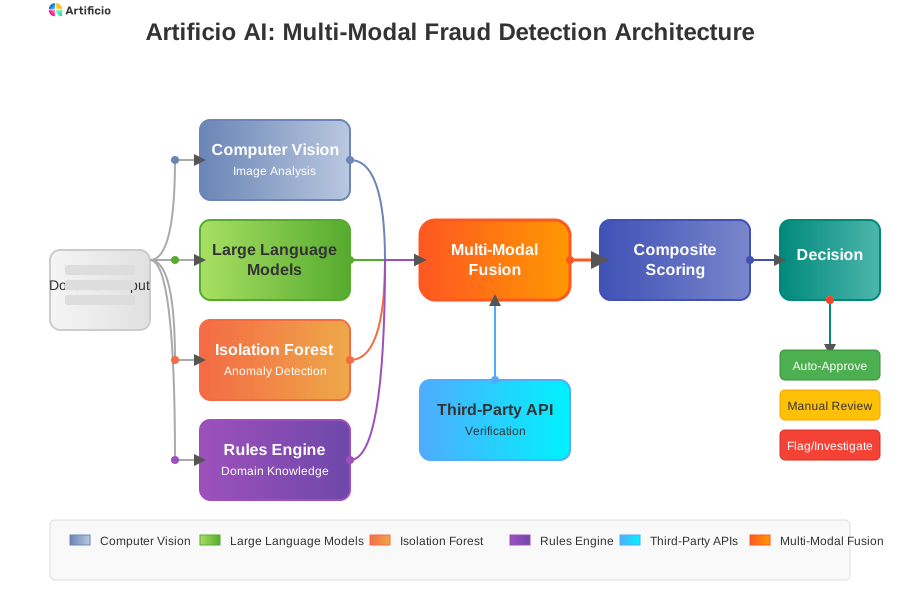
By leveraging computational pattern recognition capabilities alongside established financial document validation protocols, the system creates a multi-layered defense mechanism capable of identifying anomalies that would likely escape human detection during conventional review procedures.
The fundamental innovation of this approach lies in its hybrid nature combining the adaptive learning capabilities of artificial intelligence with the structured expertise embedded in rules-based systems. This integration allows for both the identification of known fraud patterns and the discovery of emerging manipulation techniques that have not previously been cataloged. The system's ability to evolve through continuous learning from new data while maintaining alignment with established financial compliance frameworks represents a significant contribution to the field of automated financial security systems.
The fraud detection framework implemented by Artificio encompasses a comprehensive range of financial documentation commonly submitted during loan application processes. Each document category presents unique verification challenges and requires specialized analytical approaches. The system supports rigorous authentication protocols for W2 forms, which contain critical employment and tax withholding information; paystubs, which provide periodic income verification; and bank statements, which offer transactional evidence of financial activity and stability. Additional supported documentation includes federal tax returns (Form 1040), official employment verification letters, utility bills for residence confirmation, residential lease agreements, formal credit reports, business income statements for self-employed applicants, and Form 1099 records for independent contractors and freelance professionals.
The methodological approach to verification varies significantly across these document types, necessitating distinct feature extraction pipelines and validation protocols. For instance, W2 forms require examination of employer identification numbers, income totals, and tax withholding calculations, while bank statements demand analysis of transaction patterns, account balance consistency, and institutional formatting characteristics. This document-specific approach allows for targeted anomaly detection that accounts for the unique structural, formatting, and content requirements of each document type, significantly enhancing detection precision compared to generalized document analysis systems.
The technical implementation of these verification pathways involves specialized preprocessing algorithms that normalize document formats while preserving critical authentication indicators. Each document undergoes multi-stage analysis beginning with structural validation (confirming the expected fields and formatting elements are present), followed by content validation (verifying the internal consistency of financial figures and personal information), and culminating in cross-document correlation (ensuring consistency across multiple submitted documents). This methodological cascade creates multiple validation checkpoints, substantially increasing the probability of detecting sophisticated fraud attempts that might successfully navigate any single verification layer.
The integration of advanced computer vision techniques represents a critical enhancement to Artificio's fraud detection capabilities, enabling sophisticated analysis of visual document characteristics that may indicate manipulation or forgery. These visual analysis methodologies operate at multiple levels of document examination, from macro-level layout analysis to pixel-level manipulation detection, creating a comprehensive visual verification framework that substantially enhances fraud identification capabilities beyond what is possible with traditional text-based analysis alone.
At the foundational level, the system employs document structure analysis using convolutional neural networks (CNNs) specifically trained on financial document typologies. These networks have been trained on millions of legitimate financial documents to recognize standard structural patterns including header positioning, tabular alignments, footer placements, and institutional watermarks. The resulting structural fingerprinting capability allows for rapid identification of documents that deviate from expected institutional formats, even when such deviations might be subtle enough to escape human detection. This structural analysis is particularly effective at identifying counterfeit documents created from scratch rather than modifications of legitimate documents, as such counterfeits typically contain subtle structural inconsistencies despite superficial visual similarity.
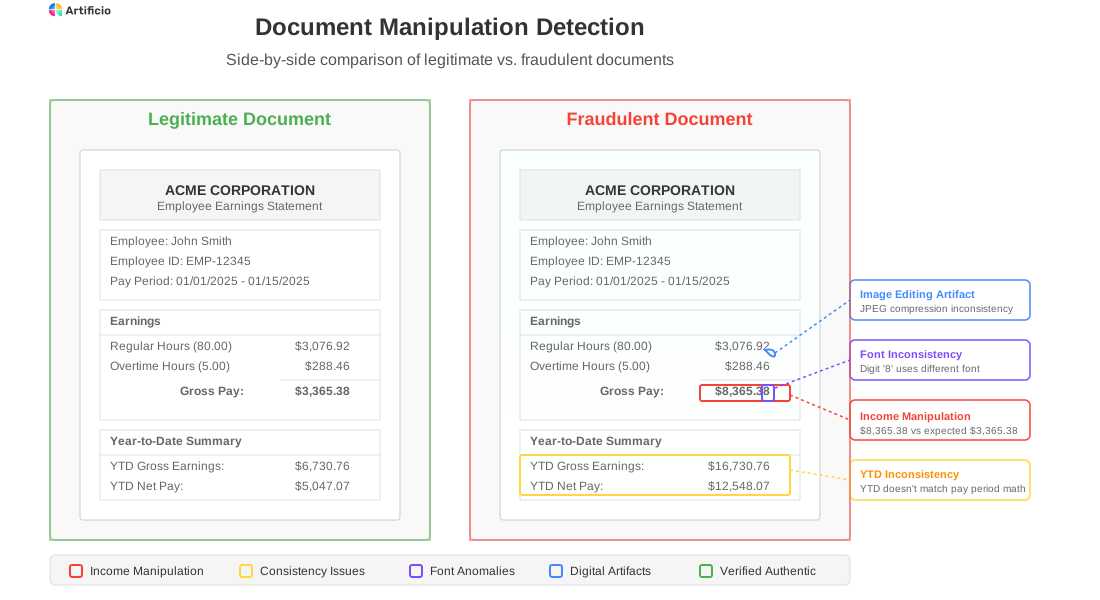
For detection of digital manipulation within otherwise legitimate documents, the system employs specialized image forensics algorithms designed to identify artifacts characteristic of digital editing. These include error level analysis (ELA), which identifies inconsistencies in JPEG compression patterns that typically indicate areas of an image that have been modified after the original compression; noise pattern analysis, which detects inconsistencies in the natural noise patterns that should be uniform across genuinely unaltered documents; and color gradient analysis, which identifies unnatural transitions in color and shading that often result from digital manipulation. These forensic techniques are particularly effective at identifying common manipulation approaches such as digit alteration in income fields or replacement of employer information.
The system also incorporates specialized font and character analysis capabilities that examine typographical characteristics at the character level. This analysis identifies inconsistencies in font metrics including character spacing, baseline alignment, and kerning patterns, which often indicate text replacement or modification. The implementation utilizes a proprietary font fingerprinting database containing signatures of standard fonts used by major financial institutions and government agencies, allowing for precise identification of character-level anomalies that may indicate manipulation. This approach is particularly effective at detecting cases where individual characters or words have been replaced within otherwise legitimate documents, a common technique in income figure manipulation.
For documents submitted as photographs rather than digital files, the system employs additional computer vision techniques focused on physical document authentication. These include shadow and lighting analysis to identify inconsistencies in natural lighting patterns that may indicate physical document manipulation prior to photography, edge detection algorithms that identify unnatural boundaries characteristic of physical cut-and-paste manipulation, and reflection pattern analysis that examines the consistency of glossy surface reflections across document regions. These physical document authentication techniques address the growing trend of physical document manipulation followed by digital submission, which attempts to circumvent pure digital forensic techniques.
The computer vision components operate within a multi-stage pipeline architecture that begins with document classification to identify document type and expected format, proceeds through structural analysis to verify macro-level document characteristics, continues with forensic analysis to identify potential manipulation indicators, and concludes with character-level examination for typographical consistency. This staged approach allows for computational efficiency by applying increasingly detailed analysis only to documents that pass initial verification stages, while maintaining comprehensive fraud detection capabilities across the full spectrum of potential document manipulation techniques.
The incorporation of large language models (LLMs) into Artificio's fraud detection system represents a transformative advancement in the ability to analyze semantic consistency and contextual relationships within financial documentation. These sophisticated neural network architectures, trained on vast corpora of text data, enable the system to understand and evaluate the natural language components of financial documents at a level approaching human comprehension, creating powerful new capabilities for identifying inconsistencies and anomalies that may indicate fraudulent activity.
The LLM implementation utilizes a fine-tuned version of a transformer-based architecture specifically optimized for financial document analysis. This model has undergone specialized training on millions of legitimate financial documents to develop domain-specific understanding of financial terminology, standard phrasing conventions, and typical contextual relationships between different document elements. This domain adaptation enables the model to identify subtle linguistic anomalies in financial documentation that might appear normal to general-purpose language models but represent significant deviations from standard financial documentation conventions.
A primary application of the LLM system involves cross-field semantic consistency analysis, which examines the logical relationships between different textual elements within a document. For instance, the system can evaluate whether job title descriptions are semantically consistent with reported income levels, identifying cases where occupational descriptions imply income ranges substantially different from those reported. Similarly, the model can assess whether employer industry classifications are consistent with job function descriptions, flagging cases where these elements exhibit unusual or improbable combinations that may indicate fabricated employment information.
The LLM component also enables sophisticated transaction description analysis within bank statements, evaluating the semantic naturalness and contextual appropriateness of transaction narratives. This capability is particularly valuable for identifying artificially generated transaction descriptions that may appear superficially normal but contain subtle linguistic anomalies or contextual inconsistencies. The model has demonstrated remarkable effectiveness at identifying transaction descriptions created through template-based generation or AI-assisted fabrication, which typically exhibit subtle but detectable deviations from the natural language patterns of legitimate financial transactions.
Beyond single-document analysis, the LLM system enables cross-document semantic consistency evaluation, analyzing whether the narrative elements across multiple submitted documents maintain logical coherence. For example, the system can detect cases where employment details described in an employment verification letter exhibit semantic inconsistencies with related descriptions in tax documentation, even when such inconsistencies are not apparent from simple text matching. This cross-document semantic analysis is particularly effective at identifying sophisticated fraud attempts that maintain internal consistency within individual documents but fail to maintain narrative coherence across the full documentation set.
A particularly innovative application involves temporal consistency analysis, where the LLM evaluates whether the evolution of financial narratives across time-sequenced documents maintains logical progression. For instance, the system can identify anomalous career progression narratives that claim implausible salary increases or position advancements over short time periods, even when each individual document appears legitimate in isolation. This temporal semantic analysis addresses sophisticated fraud attempts that create historically consistent documentation sets with subtly implausible progression characteristics.
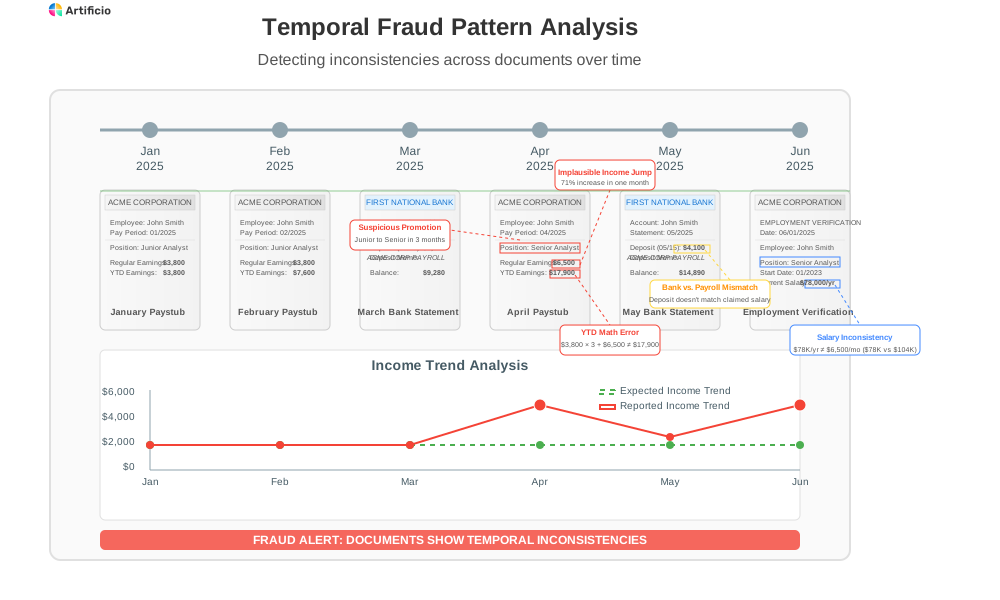
The LLM component operates within a question-answering framework that essentially interrogates documents with hundreds of systematically generated queries designed to probe potential inconsistencies. Rather than simply extracting and comparing specific fields, this approach leverages the model's comprehension capabilities to evaluate complex contextual relationships that might escape traditional rule-based analysis. The responses to these systematic queries are translated into confidence scores regarding document authenticity, which are subsequently integrated into the overall fraud probability assessment.
The implementation architecture maintains strict attention to computational efficiency, employing a cascaded approach that begins with lightweight semantic analysis for all documents and proceeds to more computationally intensive deep semantic analysis only for documents that exhibit potential anomalies in initial evaluation. This tiered approach allows the system to maintain reasonable processing timelines while still leveraging the full analytical power of state-of-the-art language models for cases that warrant detailed examination.
The cornerstone of the system's machine learning architecture is the implementation of the Isolation Forest algorithm, which represents a paradigm shift from traditional anomaly detection approaches. Unlike conventional methods that attempt to establish normative patterns and subsequently identify deviations, the Isolation Forest algorithm operates on the principle of anomaly isolation, creating a more efficient and effective pathway for identifying potentially fraudulent documentation. This algorithmic approach constructs random decision trees and quantifies anomalousness based on the path length required to isolate individual documents with shorter isolation paths indicating higher probability of fraudulent characteristics.
The theoretical foundation of this approach rests on the observation that fraudulent documents typically exhibit distinctive characteristics that differentiate them from the dense clusters of legitimate documentation. These differentiating features often manifest as statistical outliers across multiple dimensions of analysis. The Isolation Forest algorithm excels at identifying these multi-dimensional anomalies without requiring extensive training on fraudulent examples, which are inherently difficult to collect in sufficient quantities for traditional supervised learning approaches.
The implementation analyzes numerous document features including formatting consistency across similar document types, deviations in payment frequency patterns, discrepancies between year-to-date totals and reported monthly figures, digital artifacts indicative of image manipulation, inconsistencies in document metadata including creation and modification timestamps, and misalignments between reported salary figures and corresponding bank transaction records. This multi-feature analysis creates a comprehensive anomaly detection framework capable of identifying sophisticated fraud attempts that might appear normal when evaluated against any single criterion.
The algorithmic processing involves initial feature extraction through computer vision and natural language processing techniques, followed by feature normalization to ensure comparable scales across diverse metrics. These normalized features then undergo isolation forest analysis with optimized hyperparameters including tree depth limitations and subsampling rates determined through extensive validation testing. The resulting anomaly scores provide a statistical foundation for fraud probability assessment, which is subsequently integrated with rule-based evaluations to form a comprehensive risk profile for each submitted document.
Complementing the statistical anomaly detection capabilities of the machine learning system, Artificio's fraud detection engine incorporates an extensive rules-based intelligence framework that encodes domain-specific financial documentation knowledge. This dual-methodology approach addresses a fundamental limitation of pure machine learning systems namely, their potential inability to leverage established industry knowledge about specific fraud indicators that may not emerge naturally from training data patterns. The rules engine applies programmatic implementations of expert financial document examination techniques, creating a structured evaluation system that can identify known fraud patterns with high precision.
The rules framework encompasses validation checks for technical document elements including verification of date formats against standard financial reporting calendars, validation of Social Security Number formatting and checksum calculations, and confirmation of employer identification consistency across multiple submitted documents. Additionally, the system evaluates stylistic elements including font consistency within and across documents, layout standardization in comparison to known legitimate examples from specific financial institutions, and identification of statistically improbable financial figures such as perfectly rounded income amounts that rarely occur in legitimate financial documentation.
Of particular significance in bank statement verification is the detection of duplicated transaction patterns, which represent a common manipulation technique wherein legitimate transaction rows are copied and reused with modified dates to artificially inflate account activity or balances. The rules engine employs specialized pattern recognition algorithms to identify such repetitions, analyzing both transaction descriptions and amount patterns to detect artificial replication that might escape visual inspection.
Each rule violation contributes to a weighted cumulative risk score, with weighting factors determined through statistical analysis of historical fraud cases. This approach allows for nuanced risk assessment that accounts for the varying significance of different anomaly types. For example, evidence of direct image manipulation receives substantially higher risk weighting than minor formatting inconsistencies, reflecting the differential predictive value of these indicators in historical fraud analysis. The weighted scoring system produces a calibrated risk assessment that reflects both the number and severity of detected anomalies, providing a foundation for subsequent decision processes.
The fraud detection framework extends beyond internal analysis through systematic integration with authoritative third-party data sources, creating a comprehensive validation ecosystem that substantially enhances fraud detection reliability. This integration architecture establishes direct authenticated connections with established financial data providers, enabling real-time verification of submitted documentation against authoritative external records. The integration framework includes secure API connections with The Work Number (maintained by Equifax), which provides authoritative employment and income verification data directly from employer payroll systems. Additional integrations with specialized payroll access providers including Truv, Argyle, and Pinwheel enable direct validation of employment status, compensation rates, and payment history.
For bank statement verification, the system maintains secure API connections with financial data aggregators including Plaid, MX, and Yodlee, enabling direct validation of account existence, ownership, transaction history, and balance information. These connections allow for automated comparison between submitted documentation and authoritative financial institution records, creating a powerful verification mechanism that can identify sophisticated document manipulation that might otherwise escape detection. Additional identity verification is provided through integrations with specialized services including Experian and Socure, which offer comprehensive validation of personal identifying information against authoritative databases.
The methodological approach to these integrations involves secure, permission-based authentication protocols that maintain strict compliance with relevant financial privacy regulations including the Gramm-Leach-Bliley Act and the Fair Credit Reporting Act. Each integration pathway incorporates explicit consent mechanisms and maintains detailed audit trails of all data access events, ensuring regulatory compliance while enabling powerful verification capabilities. The technical implementation utilizes standardized OAuth authentication protocols combined with end-to-end encryption of all data transmissions, creating a secure verification framework that protects sensitive financial information throughout the validation process.
The results from these third-party verification processes are quantified as confidence scores, which reflect the degree of alignment between submitted documentation and authoritative external records. These confidence scores are subsequently incorporated into the composite fraud risk assessment, creating a multi-source evaluation that dramatically enhances detection reliability compared to isolated internal analysis. This integrated approach creates a verification ecosystem that leverages the collective intelligence of multiple specialized financial data providers, substantially increasing the difficulty of successful document fraud.
A distinguishing characteristic of Artificio's fraud detection system is its sophisticated multi-modal integration architecture, which synthesizes insights from disparate analytical methodologies including computer vision analysis, large language model evaluations, isolation forest anomaly detection, rules-based assessments, and third-party verification results. This fusion framework represents a significant advancement beyond traditional single-methodology approaches, creating a comprehensive evaluation system that leverages the complementary strengths of diverse analytical techniques while mitigating their individual limitations.
The integration architecture employs a hierarchical fusion methodology that operates at multiple levels of abstraction. At the feature level, the system performs early fusion of compatible analytical signals, combining related indicators from different methodologies to create enhanced composite features with greater discriminative power than any individual signal. For example, typographical inconsistency detections from computer vision analysis are combined with semantic anomaly indicators from language model analysis to create composite text integrity features that reflect both visual and semantic dimensions of textual authenticity.
At the decision level, the system employs late fusion techniques that integrate fully formed assessments from different analytical pathways. This approach allows each methodology to develop complete evaluation perspectives based on their respective analytical strengths before combining these perspectives into a unified assessment. The late fusion process employs adaptive weighting mechanisms that dynamically adjust the influence of different analytical pathways based on their historical performance characteristics for specific document types and fraud patterns, creating an adaptive evaluation framework that continuously optimizes detection performance.
The technical implementation employs a sophisticated ensemble architecture that includes both parallel and sequential processing pathways. Initial document analysis occurs through parallel processing across multiple analytical dimensions, allowing simultaneous evaluation of visual characteristics, semantic content, statistical patterns, and rule compliance. The results of these parallel analyses then converge in sequential integration stages that progressively synthesize insights from different analytical domains, creating increasingly comprehensive fraud probability assessments at each integration stage.
A critical innovation in the fusion architecture is its contextual adaptation capability, which dynamically adjusts analytical emphasis based on document type, submission context, and emerging fraud patterns. This adaptability allows the system to optimize its analytical approach for different scenarios, focusing on visual analysis for document types prone to image manipulation, emphasizing semantic analysis for documents where language patterns are strong fraud indicators, or prioritizing statistical analysis for documents where numerical anomalies represent the primary fraud vectors. This contextual adaptation substantially enhances overall detection performance by ensuring that analytical resources are optimally aligned with the most relevant fraud indicators for each specific evaluation scenario.
The integration framework incorporates sophisticated anomaly correlation capabilities that identify suspicious patterns across multiple documents within a single application or across multiple applications sharing common elements. This correlation analysis can identify coordinated fraud attempts that maintain internal consistency within individual documents but exhibit detectable patterns when analyzed collectively. For example, the system can identify cases where multiple seemingly unrelated applications utilize subtly similar document manipulation techniques or exhibit common metadata characteristics indicative of shared origin, enabling detection of organized fraud attempts that might escape document-level analysis.
The multi-modal fusion architecture represents a significant advancement in fraud detection methodology, creating a comprehensive evaluation framework that substantially exceeds the capabilities of any single analytical approach. By leveraging the complementary strengths of diverse methodologies while mitigating their individual limitations, the system achieves detection performance that approaches the comprehensive understanding of expert human analysts while maintaining the scalability and consistency of automated systems.
The culmination of the multi-layered analysis process is a sophisticated composite scoring methodology that integrates evidence from computer vision analysis, large language model evaluations, machine learning anomaly detection, rules-based assessment, and third-party validation to produce a comprehensive fraud probability assessment. This integrated scoring approach addresses the limitations of any single evaluation methodology by creating a balanced assessment that leverages the complementary strengths of multiple analysis techniques. The composite score represents a calibrated probability estimate of document authenticity, providing a quantitative foundation for subsequent decision processes.
The technical implementation of the scoring system employs a weighted integration algorithm that accounts for the differential reliability and predictive value of various evidence sources. The weighting factors are determined through rigorous statistical analysis of historical fraud cases, creating a calibrated framework that maximizes detection accuracy while minimizing false positive rates. The resulting composite score provides a normalized metric on a 0-100 scale, where higher values indicate increased fraud probability.
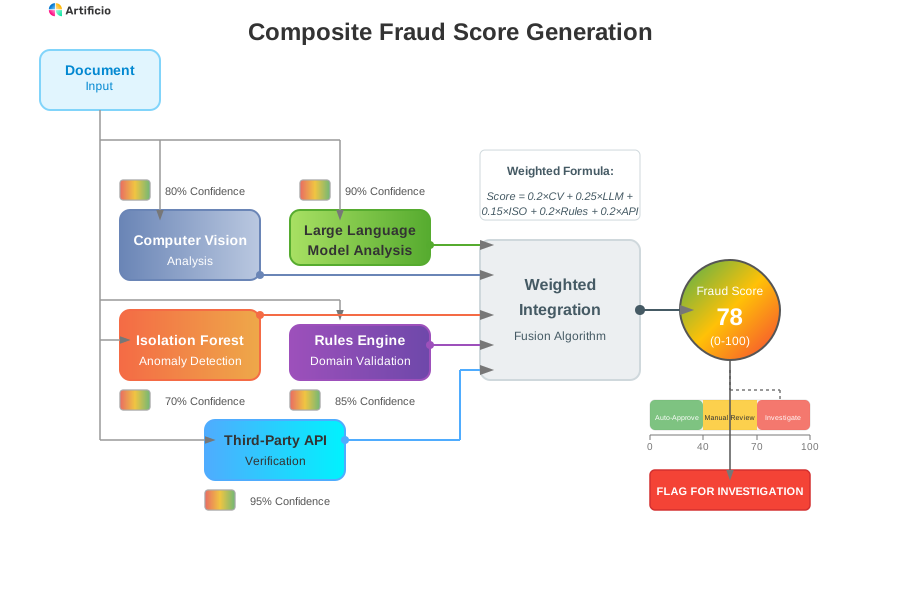
This composite score drives an automated decision framework that optimizes operational efficiency while maintaining robust fraud protection. Documents receiving scores below 40 are automatically approved, having demonstrated high confidence in their authenticity across multiple evaluation dimensions. Documents with scores between 40 and 70 enter a specialized review queue for expert human examination, focusing limited manual review resources on cases with moderate fraud indicators that benefit from additional investigation. Documents scoring 70 or above are automatically flagged for comprehensive investigation, typically involving direct contact with purported employers or financial institutions to verify documentation authenticity.
This tiered decision framework creates an optimal balance between operational efficiency and fraud protection, allowing routine legitimate applications to proceed without delay while ensuring appropriate scrutiny for applications exhibiting potential fraud indicators. The threshold values for these decision tiers were established through extensive statistical optimization to maximize overall system performance, including consideration of both fraud detection rates and operational processing efficiency. Regular recalibration of these thresholds ensures ongoing optimization as fraud techniques evolve and detection capabilities advance.
Implementation of the Artificio fraud detection system has generated substantial empirical evidence of effectiveness across multiple lending institutions, demonstrating significant improvements in both operational efficiency and fraud prevention. Comparative analysis of lending portfolios before and after implementation reveals measurable performance enhancements across key metrics, providing quantitative validation of the system's effectiveness in real-world lending environments.
The most immediately observable impact has been a dramatic reduction in manual document review requirements, with lending institutions reporting an average 80% decrease in human review workload following implementation. This efficiency improvement derives from the system's ability to automatically validate routine legitimate documentation while precisely identifying the subset of applications requiring human expertise. The resulting resource reallocation has enabled lending institutions to process substantially higher application volumes without corresponding increases in operational overhead, creating significant operational cost savings while simultaneously improving application processing timelines.
Beyond operational efficiencies, implementation data demonstrates a substantial decrease in loan default rates attributable to identity or income misrepresentation. Longitudinal analysis of loan performance metrics reveals average reductions of 30-45% in early payment defaults (occurring within the first six months), which represent a key indicator of potential fraud-related lending. This improvement in portfolio performance translates directly to reduced credit losses, with implementing institutions reporting average annual savings of $3.5 million per billion dollars in loan originations.
The integration of advanced computer vision and large language model capabilities has demonstrated particularly significant performance improvements in detecting sophisticated fraud attempts that employ advanced digital manipulation techniques. Comparative analysis reveals that the enhanced system achieves a 27% higher detection rate for image-based manipulation compared to previous-generation systems lacking advanced computer vision capabilities, while the incorporation of large language models has improved detection of semantic inconsistencies by 34% compared to traditional text analysis approaches. These enhancements are particularly significant for identifying emerging fraud techniques that employ AI-assisted document manipulation, which have become increasingly prevalent in sophisticated fraud attempts.
Customer experience metrics have shown corresponding improvements, with average loan processing times decreasing by 37% following implementation. This enhancement derives from the system's ability to rapidly validate legitimate documentation without introducing delays for the majority of applicants, while focusing additional scrutiny only on applications exhibiting specific risk indicators. The resulting acceleration of approval timelines has contributed to measurable improvements in application completion rates and customer satisfaction metrics across implementing institutions.
Statistical analysis of system performance reveals exceptional accuracy in fraud identification, with current implementations demonstrating 94.7% sensitivity (successful identification of fraudulent documentation) and 99.2% specificity (correct validation of legitimate documentation). These performance metrics establish the system as significantly more effective than traditional manual review processes, which typically achieve sensitivity rates of 70-80% and specificity rates of 95-97% according to industry benchmarking studies. The system's superior performance derives from its ability to identify subtle patterns and inconsistencies that typically escape human detection, particularly in cases involving sophisticated digital manipulation techniques.
The Artificio fraud detection framework represents a significant advancement in financial document verification methodology, establishing a comprehensive approach that effectively addresses the evolving challenges of digital document fraud in lending environments. By integrating advanced computer vision techniques, state-of-the-art large language models, sophisticated machine learning algorithms, domain-specific rules-based intelligence, and authoritative third-party validation, the system creates a multi-layered defense mechanism substantially more effective than traditional manual review processes. The empirical performance data demonstrates conclusive evidence of effectiveness across operational efficiency, fraud prevention, and customer experience dimensions.
This methodological framework contributes to the broader field of financial technology security by establishing a robust architecture for document verification that can be adapted across diverse lending environments. The hybrid approach combining multi-modal AI analysis with encoded domain expertise creates a particularly effective model for addressing the dynamic nature of financial fraud, where techniques continuously evolve in response to detection methods. The system's ability to learn from new data while maintaining alignment with established validation protocols represents a significant advancement in adaptive security systems.
Future research directions include expansion of the computer vision capabilities to incorporate advanced generative adversarial network (GAN) detectors specifically designed to identify AI-generated or AI-manipulated financial documents, addressing the emerging threat of sophisticated fraud attempts utilizing generative AI technologies. Additional development focuses on enhancing the large language model components through specialized financial domain pre-training and adaptive fine-tuning to further improve semantic analysis capabilities for financial documentation.
The ongoing evolution of the multi-modal fusion architecture represents another key development pathway, with current research exploring dynamic fusion methodologies that continuously optimize integration weights based on real-time performance analysis. This adaptive fusion approach promises further improvements in detection accuracy by dynamically emphasizing the most reliable analytical pathways for each specific evaluation scenario, creating an increasingly intelligent system that evolves in response to emerging fraud patterns.
Additional work focuses on enhancing cross-document correlation techniques to identify inconsistencies across multiple submitted documents that may not be apparent when analyzing each document in isolation. Ongoing development also includes integration of behavioral analytics to identify suspicious patterns in application submission processes that may indicate organized fraud attempts spanning multiple applications.
The financial services industry continues to navigate the complex balance between accessibility, operational efficiency, and security. The methodology presented in this article demonstrates that advanced artificial intelligence techniques, when properly implemented within a comprehensive verification framework, can substantially enhance fraud protection while simultaneously improving operational efficiency and customer experience. This evidence suggests that continued investment in AI-powered verification systems represents a crucial strategy for financial institutions seeking to mitigate the growing risks of document fraud in increasingly digital lending environments.

Head IT Operations - Co Founder of Artificio
See it in your SAP environment
Bring us a document, a process, or a bottleneck. We'll show how Artificio captures, validates, and posts into SAP — then scale from there.
Security & compliance
ISO 27001:2013 certified, SOC 2 Type 2 compliant, GDPR and HIPAA ready. Every agent action is logged, auditable, and runs in isolated environments.