

Blog
Contract Data Extraction: From Contracts to Strategic Assets
Learn how to transform your contracts into strategic business intelligence. Discover methodologies and technologies for actionable insights.

Blog
Learn how to transform your contracts into strategic business intelligence. Discover methodologies and technologies for actionable insights.
In the contemporary business landscape, organizations accumulate vast repositories of contractual documents throughout their operational lifespans. These contracts ranging from vendor agreements to employment contracts, licensing arrangements to service level agreements constitute not merely legal obligations but repositories of invaluable organizational intelligence. However, this intelligence remains largely untapped when contracts are treated as static documents relegated to filing systems after execution. The transformation of contractual documents from passive legal instruments into dynamic sources of business insights represents a paradigm shift in organizational strategy and operational efficiency. This comprehensive exploration examines the methodologies, technologies, and strategic applications that enable organizations to extract actionable intelligence from their contractual repositories, thereby converting legal obligations into competitive advantages and strategic assets.
The traditional paradigm of contract management has undergone significant transformation in recent decades, evolving from paper-based filing systems to sophisticated digital repositories with advanced analytical capabilities. This evolution mirrors broader organizational changes in information management and reflects the increasing recognition of contracts as strategic assets rather than administrative necessities. Historically, contracts were primarily viewed through a risk-mitigation lens legal instruments designed to protect organizational interests and delineate obligations between parties. While this foundational purpose remains valid, the contemporary understanding of contracts has expanded to encompass their role as information repositories that contain critical business intelligence.
The digitization of contract management represents the first significant evolutionary step in this transformation. By converting physical documents to digital formats, organizations gained improved accessibility, searchability, and storage efficiency. However, digitization alone fails to unlock the full potential of contract repositories. The true evolutionary leap occurs when organizations implement systems and methodologies that enable them to extract, analyze, and operationalize the data embedded within contractual documents. This capability transforms static legal documents into dynamic sources of business intelligence that can inform strategic decision-making across organizational functions.
The contemporary contract management landscape is characterized by increasing integration with broader organizational systems and processes. Forward-thinking organizations now recognize that contract data should not exist in isolation but rather should flow seamlessly into financial systems, operational dashboards, supply chain management platforms, and strategic planning tools. This integration enables a holistic view of organizational commitments, obligations, opportunities, and risks that would be impossible to achieve through traditional contract management approaches.
Contract data extraction operates at the intersection of legal expertise, information management, and technological innovation. At its core, this process involves the systematic identification, capture, processing, organization, and utilization of data elements embedded within contractual documents. These data elements ranging from basic metadata such as effective dates and party information to complex provisions regarding intellectual property rights or indemnification structures constitute the raw material from which business intelligence is derived.
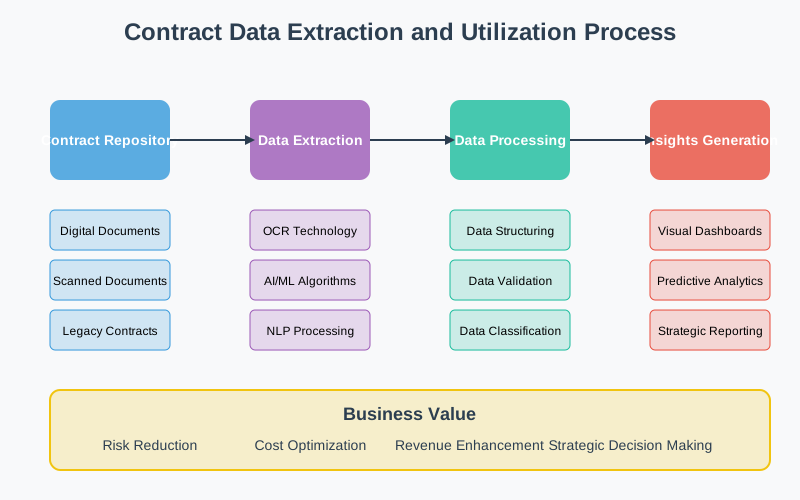
The conceptual framework for contract data extraction encompasses several fundamental dimensions. First, the taxonomic dimension involves categorizing contracts according to meaningful organizational schemas that facilitate analysis and comparison. Common taxonomies include contract type (e.g., procurement, sales, employment), contracting entity (internal organizational unit or external counterparty), geographic jurisdiction, or industry sector. Second, the temporal dimension tracks time-sensitive elements such as effective dates, expiration dates, renewal windows, and notification periods. This dimension enables organizations to manage contractual timelines proactively rather than reactively. Third, the financial dimension captures monetary obligations, payment terms, pricing structures, and financial incentives or penalties. This dimension provides critical inputs for financial planning, budgeting, and revenue forecasting.
Beyond these fundamental dimensions, advanced contract data extraction frameworks incorporate relational, compliance, and performance dimensions. The relational dimension maps interdependencies between contracts and organizational relationships, enabling a comprehensive understanding of the contractual ecosystem. The compliance dimension identifies regulatory requirements, reporting obligations, and certification mandates embedded within contractual language. The performance dimension captures key performance indicators, service level requirements, and quality metrics that define successful contract execution.
Collectively, these dimensions create a multifaceted view of the organization's contractual landscape that transcends traditional document management approaches. Instead of treating contracts as isolated legal instruments, this framework positions them as interconnected nodes in a complex organizational network that can be analyzed, optimized, and leveraged for strategic advantage.
The extraction of meaningful data from contractual documents employs a spectrum of methodological approaches that vary in sophistication, resource requirements, and analytical capabilities. Understanding these methodologies enables organizations to select approaches aligned with their specific needs, resources, and strategic objectives.
Despite technological advances, manual extraction methodologies remain prevalent in many organizations, particularly those with limited contract volumes or specialized extraction requirements. These approaches rely on human expertise to identify, interpret, and record contract data elements. Typically, legal professionals or contract administrators review documents systematically, recording key data points in spreadsheets, databases, or contract management systems. Manual extraction benefits from human judgment and contextual understanding, particularly when dealing with complex or ambiguous contractual language that requires interpretive expertise.
However, manual approaches suffer from significant limitations. The process is inherently time-intensive, often requiring hours per document for comprehensive extraction. Human error introduces inconsistencies and inaccuracies, particularly when extraction is performed by multiple individuals with varying levels of expertise or different interpretive frameworks. Furthermore, manual approaches struggle to scale effectively, creating bottlenecks when organizations experience growth in contract volume or complexity.
Organizations employing manual extraction methodologies can enhance efficiency through standardized extraction templates, clear data dictionaries, and quality control processes. These enhancements provide structure to the extraction process but do not address the fundamental scalability limitations inherent in manual approaches.
Semi-automated extraction methodologies represent a hybrid approach that combines technological tools with human expertise. These approaches typically employ technologies such as optical character recognition (OCR), natural language processing (NLP), and rule-based extraction algorithms to identify potential contract data elements, which are subsequently validated and refined by human reviewers. This combination leverages technological efficiency while maintaining human judgment for complex interpretive tasks.
Common semi-automated approaches include template-based extraction, where systems identify data elements based on their location within standardized contract formats; keyword-based extraction, which identifies relevant clauses or provisions based on linguistic markers; and pattern recognition, which identifies data elements based on structural or semantic patterns. These approaches significantly reduce the time required for extraction while maintaining reasonable accuracy levels, particularly for standardized contract types with consistent structures.
Semi-automated methodologies offer substantial efficiency improvements over purely manual approaches while mitigating the risk of critical errors through human validation. However, they still require significant human intervention, particularly for complex or non-standard contracts, and may struggle with highly variable document formats or ambiguous language.
At the most advanced end of the methodological spectrum, fully automated extraction employs sophisticated artificial intelligence technologies to identify, extract, and categorize contract data with minimal human intervention. These systems utilize machine learning algorithms trained on large contract datasets to recognize patterns, interpret language, and extract relevant data points across diverse contract types and formats.
Modern automated extraction systems incorporate multiple AI technologies, including natural language processing for semantic understanding, computer vision for document structure analysis, and machine learning for continuous improvement based on user feedback and validation. Advanced systems may employ deep learning techniques such as neural networks to improve extraction accuracy for complex or ambiguous contractual provisions.
The most sophisticated automated extraction platforms, such as Artificio CLM, integrate these technologies into comprehensive solutions that can process thousands of contracts in minutes rather than the weeks or months required by manual approaches. These systems not only extract data more efficiently but also organize it within structured frameworks that facilitate analysis and integration with other organizational systems.
While fully automated extraction offers unprecedented efficiency and scalability, its effectiveness depends on several factors, including the quality and consistency of the contract repository, the specificity of extraction requirements, and the sophistication of the technological solution. Organizations implementing automated extraction should carefully evaluate these factors and select solutions aligned with their specific needs and contractual landscape.
The evolution of contract data extraction methodologies has been enabled by advancements in several key technological domains. Understanding these technological enablers provides insights into current extraction capabilities and potential future developments in this rapidly evolving field.
OCR technology forms the foundation of contract data extraction systems by converting physical or scanned documents into machine-readable text. Contemporary OCR solutions transcend simple character recognition to incorporate layout analysis, which preserves document structure including tables, columns, and formatting elements. Advanced OCR systems accommodate diverse document formats, varying image qualities, and multiple languages, enabling extraction from global contract repositories.
The accuracy of OCR technology has improved dramatically in recent years through applications of machine learning algorithms that continuously refine recognition patterns based on validation data. Modern systems achieve character recognition rates exceeding 99% for high-quality documents, although performance may decrease with poor image quality, unusual fonts, or complex formatting. Despite these advances, OCR remains a preliminary step in the extraction process rather than a complete solution, as it enables text searchability without providing semantic understanding or contextual interpretation.
Natural language processing technologies enable systems to analyze, interpret, and extract meaning from textual contract content. NLP capabilities relevant to contract data extraction include named entity recognition, which identifies specific objects such as organizations, individuals, locations, and dates; relationship extraction, which identifies connections between entities; and semantic analysis, which interprets the meaning of contractual provisions within their specific context.
Advanced NLP systems utilize machine learning models trained on legal language to identify contract elements despite variations in terminology or phrasing. These systems recognize that concepts like termination rights or confidentiality obligations may be expressed through diverse linguistic constructions while maintaining consistent legal meaning. Furthermore, modern NLP technologies can identify implicit relationships between contract elements, such as how limitation of liability provisions interact with indemnification clauses, enabling more sophisticated contractual analysis.
The application of transformer-based language models like BERT (Bidirectional Encoder Representations from Transformers) and its derivatives has significantly enhanced NLP performance for contract analysis. These models incorporate contextual understanding that improves accuracy when interpreting legal language with its characteristic complexity, precision, and domain-specific terminology.
Machine learning technologies serve as force multipliers in contract data extraction by enabling systems to improve performance over time through exposure to additional examples. Supervised learning approaches, where systems are trained on labeled contract datasets, provide foundational extraction capabilities that can identify common contract elements across diverse document types. Unsupervised learning techniques enable systems to identify patterns and anomalies without explicit training, particularly valuable when analyzing large contract repositories with unknown characteristics.
The integration of machine learning with domain-specific knowledge enhances extraction accuracy by incorporating legal expertise into algorithmic operations. This integration may occur through explicit rule frameworks that encode legal knowledge or through training processes that utilize expert-validated datasets. The most effective systems combine both approaches, leveraging the efficiency of machine learning with the precision of domain expertise.
Continuous learning capabilities represent a significant advancement in extraction technology, enabling systems to incorporate user feedback and validation to improve future performance. When extraction errors are identified and corrected, these corrections form additional training data that refines the system's extraction algorithms. This iterative improvement process enables organizational extraction capabilities to evolve alongside changing contractual landscapes and business requirements.
Emerging blockchain and distributed ledger technologies offer promising capabilities for contract data management and extraction. Smart contracts self-executing agreements with terms directly written into code inherently integrate contractual obligations with data structures, eliminating the need for traditional extraction processes. These technologies enable real-time visibility into contract performance, automated enforcement of contractual provisions, and immutable audit trails that document the contract lifecycle.
While full-scale implementation of blockchain-based contracting remains limited, organizations are increasingly exploring hybrid approaches that combine traditional contracts with blockchain-enabled verification, authentication, and performance monitoring. These approaches maintain legal conventions while enhancing data accessibility and enforcement capabilities.
The true value of contract data extraction emerges when the extracted intelligence is applied to strategic organizational challenges and opportunities. Advanced extraction capabilities enable numerous applications that transform contracts from legal necessities into strategic assets.
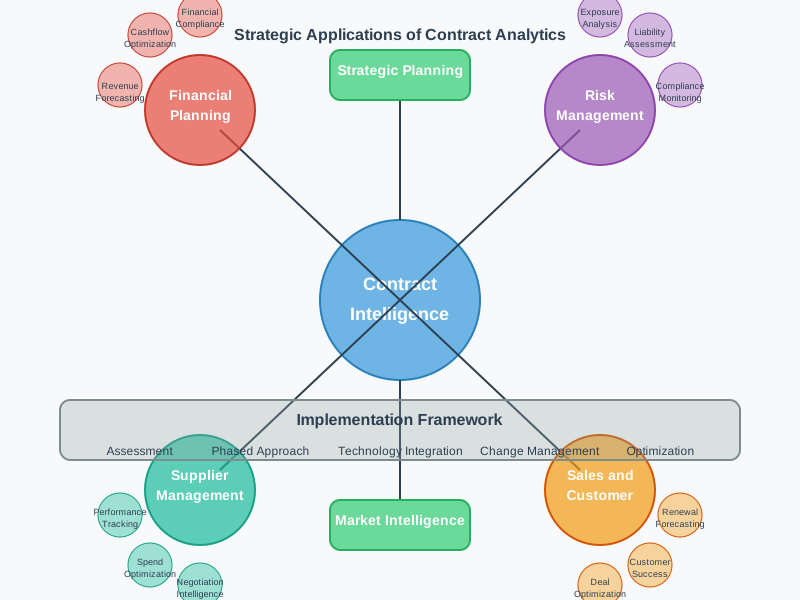
Extracted contract data provides critical inputs for financial planning, budgeting, and revenue management processes. By systematically capturing payment terms, pricing structures, volume commitments, and financial incentives, organizations gain visibility into expected cash flows, revenue recognition timelines, and financial obligations. This visibility enables more accurate financial forecasting, reduced revenue leakage, and improved working capital management.
Contract-based revenue forecasting incorporates factors such as renewal probabilities, price escalation clauses, and performance-based adjustments to provide nuanced projections that transcend simple historical trend analysis. Furthermore, comprehensive contract data enables organizations to identify opportunities for revenue optimization through more consistent enforcement of pricing terms, timely invoicing based on contractual triggers, and strategic timing of renewal negotiations.
Advanced applications in this domain include predictive analytics that forecast renewal rates based on contract characteristics, counterparty profiles, and market conditions. These predictions enable organizations to allocate resources strategically to retention efforts, focusing interventions on high-value contracts with elevated non-renewal risk.
Extracted contract data serves as a foundational element of enterprise risk management by providing visibility into contractual exposures, obligations, and contingent liabilities. Systematic extraction of risk-related provisions including limitation of liability clauses, indemnification structures, insurance requirements, and termination rights enables organizations to quantify and manage their risk portfolio proactively.
In regulated industries, extracted contract data supports compliance assurance by tracking regulatory requirements, reporting obligations, and certification mandates embedded within contractual language. Automated monitoring of these requirements enables timely compliance actions and reduces the risk of regulatory penalties or contract breaches. Furthermore, comprehensive extraction enables organizations to respond rapidly to regulatory changes by identifying contracts affected by new requirements or interpretations.
Advanced risk management applications include scenario analysis, where organizations model the implications of external events (such as regulatory changes, supply chain disruptions, or counterparty defaults) across their contract portfolio. This analysis enables targeted mitigation strategies that prioritize the most significant risk exposures and vulnerabilities.
In procurement contexts, extracted contract data enables sophisticated supplier relationship management and spend optimization. By aggregating contract terms across supplier relationships, organizations can identify inconsistencies in pricing, terms, or service levels that represent optimization opportunities. This aggregated view also facilitates strategic supplier consolidation, volume-based negotiations, and standardization of terms across the supplier ecosystem.
Contract extraction enables performance monitoring against contractual commitments, including delivery timeframes, quality metrics, and service levels. This monitoring supports performance-based supplier management, where resources and opportunities are allocated based on demonstrated capabilities rather than perceived relationships or historical preferences.
Advanced applications in procurement include total cost modeling that incorporates all contractual variables including base pricing, volume discounts, payment terms, warranty provisions, and support costs to enable true apples-to-apples comparison between supplier offerings. This modeling supports more sophisticated sourcing decisions that consider the comprehensive financial impact of supplier selection rather than focusing exclusively on unit pricing.
For customer-facing contracts, extracted data enhances sales effectiveness and customer relationship management by providing insights into buying patterns, negotiation tendencies, and contract utilization. Analysis of historical contract negotiations reveals which terms create friction in the sales process, which concessions are most frequently requested by specific customer segments, and which deal structures correlate with long-term customer success.
Contract utilization data such as service consumption patterns, option exercise frequency, and amendment requests provides early indicators of customer satisfaction and renewal likelihood. These indicators enable proactive intervention and relationship management to address emerging concerns before they jeopardize renewal opportunities.
Advanced applications include personalized renewal offers based on historical contract utilization, negotiation patterns, and competitive positioning. These personalized offers acknowledge the unique value drivers of each customer relationship while protecting organizational margins and strategic interests.
At the enterprise level, aggregated contract data provides valuable inputs for strategic planning and market intelligence. Trend analysis across the contract portfolio reveals evolving market conditions, including shifts in pricing power, changing customer priorities, and emerging competitive threats. These insights enable organizations to adapt their strategic positioning and value propositions to align with market dynamics.
Contract-based market segmentation identifies distinct customer groups based on their contracting patterns, preferences, and value drivers. This segmentation enables more targeted product development, marketing communications, and sales approaches that address the specific needs of each segment.
Advanced strategic applications include predictive modeling that forecasts market trends based on leading indicators within the contract portfolio. For example, changes in requested contract terms may signal shifting customer priorities before these shifts become apparent through traditional market research channels.
Successfully implementing contract intelligence initiatives requires structured approaches that address technological, organizational, and process dimensions. Effective implementation frameworks incorporate several key elements that enable organizations to derive maximum value from their contract data extraction investments.
Implementation begins with comprehensive assessment of the organization's contract landscape, existing management processes, and strategic objectives. This assessment catalogues the contract portfolio's characteristics including volume, diversity, format consistency, and physical/digital distribution to inform methodological and technological decisions. Current contract management practices are evaluated to identify strengths, weaknesses, and integration opportunities. Strategic priorities are clarified to ensure alignment between extraction capabilities and organizational objectives.
Readiness evaluation examines organizational capabilities across several dimensions. Technological readiness assesses existing systems, data structures, and integration capabilities that will support contract intelligence initiatives. Process readiness evaluates workflow maturity, documentation quality, and operational discipline. Organizational readiness examines cultural factors, stakeholder alignment, and change management capabilities that will influence implementation success.
This comprehensive assessment establishes realistic expectations, identifies potential implementation challenges, and guides resource allocation decisions. Organizations with extensive paper-based contracts, inconsistent formats, or limited system integration capabilities may require more extensive preparation before advanced extraction methodologies can be effectively implemented.
Successful contract intelligence initiatives typically employ phased implementation approaches that deliver incremental value while managing organizational change. Initial phases focus on high-priority contract categories with substantial strategic importance or immediate value potential. These focused implementations demonstrate value, generate organizational momentum, and provide learning opportunities before expanding to more complex contract categories.
Common implementation phases include:
Each phase incorporates technology deployment, process refinement, and capability development to ensure sustainable adoption and value realization. This incremental approach manages implementation risks while delivering progressive improvements in contract intelligence capabilities.
Selecting appropriate extraction technologies requires careful evaluation of several factors, including the organization's contract portfolio characteristics, extraction requirements, existing technology ecosystem, and resource constraints. Organizations should consider not only current extraction needs but also future requirements as contract intelligence initiatives mature and expand.
Technology integration strategies should prioritize seamless data flow between contract repositories, extraction systems, and downstream applications that utilize contract data. Integration approaches range from point-to-point connections for specific high-priority workflows to comprehensive API frameworks that enable flexible data exchange across the enterprise architecture. The most sophisticated implementations incorporate contract data within enterprise data lakes or knowledge graphs that support cross-functional analytics and decision support capabilities.
Data governance considerations are essential within integration strategies, ensuring that extracted contract data maintains appropriate security, privacy, and access controls as it flows across organizational systems. These governance frameworks must balance data protection requirements with the need for broad accessibility to maximize the value of contract intelligence.
The human dimensions of contract intelligence initiatives are often more challenging than technological aspects. Effective change management strategies address organizational resistance, process disruption, and capability gaps that may impede adoption and value realization.
Stakeholder engagement should begin early in the implementation process, involving representatives from legal, procurement, sales, finance, and other contract-intensive functions. This engagement builds understanding of varied departmental needs, secures buy-in for implementation priorities, and identifies potential adoption challenges.
Training programs should address both technological capabilities and conceptual understanding, ensuring that users comprehend not only how to operate extraction systems but also how to interpret and apply the resulting intelligence. Advanced organizations establish centers of excellence that provide ongoing support, capture emerging best practices, and drive continuous improvement of contract intelligence capabilities.
Performance measurement frameworks should track both operational metrics (such as extraction accuracy, processing time, and adoption rates) and business outcomes (such as cost savings, risk reduction, and revenue enhancement). These measurements demonstrate the initiative's value while identifying opportunities for further optimization.
The field of contract intelligence continues to evolve rapidly, with several emerging trends poised to transform how organizations extract, analyze, and apply contract data in coming years.
Advances in artificial intelligence are enabling more sophisticated cognitive capabilities that transcend simple data extraction to provide interpretive insights and contextual understanding. These capabilities include:
These cognitive capabilities transform contract analysis from mechanical extraction of predefined data points to intelligent interpretation that generates novel insights and identifies previously unrecognized patterns or implications.
The integration of contract data with advanced predictive analytics enables forward-looking insights that support proactive management and strategic decision-making. Current applications include renewal prediction models that forecast contract extension likelihood based on historical patterns, counterparty characteristics, and performance indicators. Risk prediction frameworks identify potential compliance failures, performance issues, or dispute triggers before they manifest as actual problems.
Emerging applications include negotiation optimization models that recommend terms, concessions, and alternatives based on historical outcomes and counterparty profiles. Value optimization frameworks analyze contract portfolios to identify restructuring opportunities that enhance financial performance, reduce risk exposure, or improve operational efficiency.
The most sophisticated predictive applications incorporate external data sources such as market conditions, competitive intelligence, and counterparty financial health to provide contextually enriched predictions that account for the broader business environment.
Blockchain technologies and smart contracts are gradually transforming traditional contracting processes by enabling self-executing agreements with embedded logic and automated enforcement capabilities. These technologies eliminate traditional extraction requirements by structuring contractual data at creation rather than extracting it after execution.
Current implementations focus primarily on simple, standardized agreements with unambiguous performance conditions and objective verification mechanisms. However, ongoing research is expanding smart contracting capabilities to address more complex agreement types through techniques such as:
As these technologies mature, the distinction between contract execution and data utilization will blur, creating seamless integration between contractual commitments and operational systems.
The convergence of contract intelligence with operational technologies enables automated execution and monitoring of contractual relationships. Integration with Internet of Things (IoT) devices enables real-time performance monitoring against contractual metrics, such as temperature control in logistics contracts or uptime guarantees in equipment leases. Interface with robotic process automation (RPA) enables automatic triggering of operational workflows based on contractual milestones or conditions.
These integrations transform contracts from static legal documents to dynamic blueprints that guide operational execution and performance monitoring. As integration capabilities advance, contracts will increasingly function as operational specifications that directly inform system behaviors rather than requiring human interpretation and implementation.
The transformation of contracts from legal instruments into strategic intelligence assets represents a paradigm shift in organizational management. This transformation enables organizations to extract maximum value from their contractual relationships while minimizing associated risks and administrative burdens. The methodologies, technologies, and applications discussed throughout this exploration demonstrate the multifaceted value proposition of contract intelligence initiatives.
Organizations that successfully implement these initiatives gain competitive advantages through improved decision-making, enhanced operational efficiency, and strategic insights that would be impossible to achieve through traditional contract management approaches. However, realizing these benefits requires thoughtful implementation that addresses technological, procedural, and organizational dimensions while maintaining alignment with strategic objectives.
As contract intelligence technologies continue to advance, the distinction between contractual documentation and operational data will increasingly blur. Forward-thinking organizations are positioning themselves to capitalize on this convergence by developing sophisticated capabilities that extract, analyze, and operationalize contract data across the enterprise. These capabilities transform contracts from legal necessities into strategic assets that drive organizational performance and competitive advantage.
In an increasingly complex and data-driven business environment, the ability to turn contracts into insights represents not merely an operational improvement but a strategic imperative that differentiates leading organizations from their competitors. By investing in contract intelligence capabilities, organizations aren't simply improving contract management they're fundamentally enhancing their ability to execute strategy, manage relationships, and navigate market dynamics in an informed and proactive manner.

Head IT Operations - Co Founder of Artificio
See it in your SAP environment
Bring us a document, a process, or a bottleneck. We'll show how Artificio captures, validates, and posts into SAP — then scale from there.
Security & compliance
ISO 27001:2013 certified, SOC 2 Type 2 compliant, GDPR and HIPAA ready. Every agent action is logged, auditable, and runs in isolated environments.