

Blog
AI's Quiet Revolution: Document Workflows Transformed
Discover how AI is silently revolutionizing mortgage approvals, manufacturing quality, and small business operations, delivering profound impact without fanfare.

Blog
Discover how AI is silently revolutionizing mortgage approvals, manufacturing quality, and small business operations, delivering profound impact without fanfare.
A homebuyer didn't realize her mortgage approval had been processed by artificial intelligence. When she submitted her application on a Tuesday afternoon, she expected the usual two-week wait that had become standard in the lending industry. Instead, the loan officer called her Thursday morning with approval faster than she'd ever experienced before. The officer mentioned improved processing systems, but she had no idea that AI agents had worked through the night, extracting data from her pay stubs, validating her bank statements, and cross-referencing her employment history with unprecedented accuracy and speed.
Two hundred miles away in a sprawling automotive manufacturing facility, a quality inspector photographed equipment nameplates as part of his daily rounds. The metal tags were often scratched, angled awkwardly, or partially obscured by machinery, making the traditional process of manually recording serial numbers, model information, and maintenance schedules both time-consuming and error-prone. The inspector remained unaware that sophisticated AI systems were instantly extracting this critical data with 95% accuracy, automatically updating maintenance schedules, and flagging equipment that required attention. What used to take him four hours of careful transcription now happened in real-time, allowing him to focus on the nuanced safety assessments that truly required human judgment.
Meanwhile, across town in a cramped office above a bustling Italian restaurant, a small business owner uploaded another stack of supplier invoices to her accounting system. As the owner of a boutique catering company, she juggled vendor relationships, menu planning, and client management while struggling to keep up with the endless paperwork that seemed to multiply faster than her revenue. Unknown to her, AI agents were quietly categorizing her expenses, flagging unusual charges, identifying potential duplicate payments, and organizing her financial data with a precision that would have required hours of manual effort.
These aren't stories of flashy AI breakthroughs making headlines or venture capital presentations promising to revolutionize entire industries overnight. They represent something far more significant: AI's most profound and lasting impact happening in the quiet spaces between human decisions, where intelligent systems solve real problems without fanfare, buzzwords, or the need for users to fundamentally change how they work.
While the technology world debates the philosophical implications of artificial general intelligence and journalists write breathless articles about AI replacing human workers, companies like Artificio are methodically building AI agents that work together to intelligently process documents, extract data with precision, and automate complex workflows. These systems create measurable, immediate value today rather than promising transformation sometime in an uncertain tomorrow.
Understanding this distinction between headline-grabbing AI spectacle and practical AI implementation reveals a fundamental truth about technology adoption: the most successful innovations often work so seamlessly that users barely notice they exist. This phenomenon, which we might call "invisible innovation," represents the mature evolution of artificial intelligence from experimental technology to essential business infrastructure.
To understand how invisible AI transformation works, consider what happened at a global leader in testing and inspection services. For decades, quality control inspectors had followed the same routine: photograph equipment nameplates during site visits, then spend hours back at the office manually transcribing serial numbers, model information, maintenance dates, and technical specifications into digital systems. The process was not only time-consuming but fraught with opportunities for human error. A misread character could lead to incorrect maintenance schedules, potential safety issues, or compliance problems.
The company's leadership recognized this bottleneck but faced a classic dilemma. The inspection work itself required human expertise understanding industrial environments, identifying potential safety hazards, making judgment calls about equipment condition. These skills couldn't be automated. However, the data transcription work that consumed so much time was exactly the kind of pattern recognition task that artificial intelligence excels at performing.
Rather than implementing a disruptive technology solution that would require extensive retraining or workflow changes, the company partnered with an AI document processing specialist to create what appeared to be a minor system upgrade. Inspectors continued their familiar routines, taking the same photographs with the same equipment. The only difference was that instead of manually entering data afterward, they could review AI-extracted information for accuracy.
The results were transformative in ways that extended far beyond time savings. The AI-powered document processing solution achieved a 75% reduction in processing time for equipment nameplate data and generated more than 80% cost savings on manual data entry expenses. However, these quantitative improvements represented only the surface level of change.
More significantly, the quality of data improved dramatically. Human transcription, even when performed carefully, introduces errors through fatigue, difficult-to-read text, or simple misreading of characters. The AI system, trained specifically to recognize industrial equipment information, could accurately read text from scratched, angled, or partially obscured nameplates. When the system encountered text it couldn't confidently interpret, it flagged those items for human review rather than guessing.
This improvement in data quality had cascading effects throughout the organization. Maintenance schedules became more reliable, reducing unexpected equipment failures. Compliance documentation became more accurate, eliminating costly penalties from regulatory agencies. Customer confidence increased as projects completed on schedule with fewer complications.
Perhaps most importantly, the inspectors themselves experienced a fundamental shift in their work satisfaction. Instead of spending hours on tedious data entry, they could focus their expertise on what humans do uniquely well: making nuanced judgments about equipment condition, identifying potential safety concerns, and building relationships with clients. The AI didn't replace their skills; it amplified them by removing the routine cognitive burden that had previously consumed so much of their time and attention.
The transformation extended beyond a single company, representing a broader shift occurring across manufacturing industries. Industry analysts predict that by 2025, fifty percent of manufacturers will rely on AI-driven insights for quality control, representing a fundamental change in how industrial processes handle information. The AI isn't replacing human expertise it's amplifying it by handling the routine tasks that previously consumed valuable time and attention.
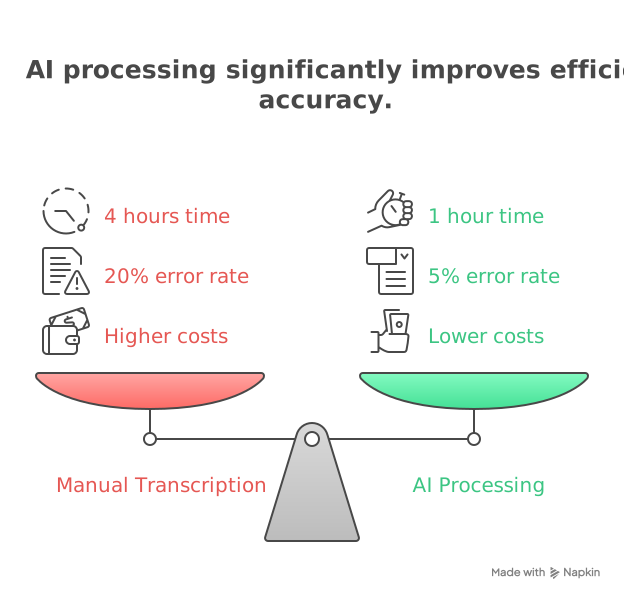
This story illustrates several key principles of successful AI implementation. First, the technology addressed a specific, well-defined problem rather than attempting broad transformation. Second, it integrated seamlessly with existing workflows rather than requiring process redesign. Third, it enhanced human capabilities rather than replacing them. Finally, it delivered measurable benefits that justified continued investment and expansion.
Healthcare represents perhaps the most critical domain for understanding how invisible AI creates profound impact. In this industry, where precision literally saves lives and errors can have devastating consequences, AI document processing is transforming patient care in ways that remain largely invisible to the patients who benefit from them.
Consider the experience of emergency room physicians dealing with patients who arrive with complex medical histories. Traditionally, accessing previous medical records, understanding medication lists, and identifying potential drug interactions required significant time and effort. Emergency room staff might spend precious minutes calling other hospitals, waiting for fax transmissions, or scrolling through poorly organized digital records. During medical emergencies, this delay could mean the difference between optimal and suboptimal care.
AI-powered document processing systems now work behind the scenes to solve these challenges in ways that patients and even some medical staff barely notice. When a patient arrives at the emergency room, AI agents can instantly process their previous medical records, automatically extract relevant information about chronic conditions, current medications, and previous procedures, and flag potential drug interactions or contraindications for proposed treatments.
The technology employs sophisticated optical character recognition that can read and extract data from various types of medical documents regardless of format, language, or image quality. This capability proves essential because medical records come from many different sources: handwritten physician notes, typed reports from various hospitals, prescription labels, insurance documents, and imaging study reports. Each source may use different formats, terminologies, and organizational structures.
Beyond simple data extraction, AI systems apply natural language processing to identify and categorize crucial information from unstructured text in medical documents. The system can differentiate between current medications and historical treatments, identify active versus resolved medical conditions, and extract specific dosage information and administration instructions. This level of semantic understanding transforms scattered medical documentation into a coherent, actionable patient profile.
The system also goes beyond data extraction by verifying and validating information for consistency and correctness. AI algorithms identify anomalies, flag potential issues, and predict missing information. For example, if a patient's medication list includes drugs that typically require regular lab monitoring, but recent lab results aren't available, the system alerts medical staff to this potential gap in care.
For the patient, this invisible technological infrastructure means faster, more informed care. Emergency room physicians can access comprehensive medical histories within minutes rather than hours. Treatment decisions are made with more complete information, reducing the likelihood of adverse drug reactions or missed diagnoses. The patient experiences more coordinated care because all relevant medical information is readily available to the treatment team.
The ripple effects extend throughout the healthcare system in ways that compound over time. Physician efficiency increases because they spend less time hunting for information and more time providing direct patient care. Medical errors decrease because treatment decisions are based on more complete and accurate information. Patient satisfaction improves because care feels more coordinated and personalized.
Administrative benefits prove equally significant. Healthcare institutions can auto-generate and auto-design various healthcare-related documents or fillable forms that can be easily shared or printed, accelerating the documentation process. Electronic signature systems verify authenticity while tracking signature statuses and sending automated reminders for required documents. These improvements reduce administrative overhead while ensuring compliance with healthcare regulations.
The scalability of these systems means they can manage growing data volumes while adapting to the evolving needs of healthcare operations. Advanced security protocols ensure compliance with healthcare data protection regulations while maintaining the confidentiality of sensitive patient information. Comprehensive analytics provide insights that help healthcare administrators identify trends, optimize resource allocation, and improve overall system performance.
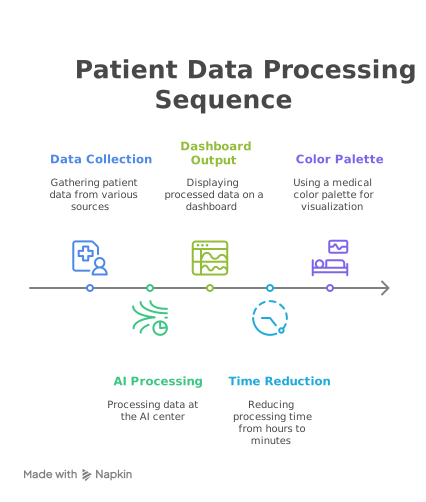
The success of AI in healthcare document processing demonstrates how invisible innovation can have life-saving impact. Patients receive better care not because they interact with futuristic technology, but because mundane information processing tasks happen more quickly and accurately behind the scenes. Medical professionals can focus their expertise on diagnosis and treatment rather than paperwork and data hunting. Healthcare administrators can ensure compliance and optimize operations without massive increases in administrative staff.
This transformation represents a mature understanding of how AI creates value in complex, regulated industries. Rather than promising to replace medical judgment or revolutionize patient care through dramatic technological intervention, these systems make existing healthcare delivery more efficient, accurate, and patient-centered.
Small businesses often face the greatest challenges from administrative overhead because they lack the resources to hire specialized staff for document processing, data entry, and regulatory compliance. For these organizations, every hour spent on paperwork represents an hour not spent on customer service, product development, or business growth. AI document processing systems can transform small business operations, but the most successful implementations work invisibly, allowing entrepreneurs to focus on what they do best.
Consider the experience of a boutique marketing agency with five employees. Before implementing AI document processing, the team dedicated six to eight hours weekly to invoice processing, expense categorization, client contract reviews, and proposal formatting. These tasks, while necessary, consumed nearly twenty percent of one employee's time and created bottlenecks that delayed project starts and client communications.
The agency owner researched various solutions and nearly chose a comprehensive business management platform that promised to revolutionize their operations. However, she ultimately selected an AI document processing system specifically because it required minimal disruption to existing workflows. The decision proved transformative precisely because the technology remained invisible to daily operations.
The AI implementation worked through a series of intelligent agents that handled different aspects of document processing. When team members uploaded invoices from vendors, one AI agent automatically classified them by expense category office supplies, software subscriptions, client entertainment, professional development. Another agent extracted key financial information like amounts, dates, and vendor details, while a third agent compared invoices against existing vendor contracts to flag unusual charges or potential duplicate payments.
Client contract processing became similarly streamlined. AI agents could extract key terms from proposed agreements, identify potential issues or unusual clauses, and create standardized summaries for leadership review. This capability proved especially valuable because the agency worked with clients ranging from small startups to large corporations, each with different contract preferences and legal requirements.
Proposal development, which had previously required significant formatting time, became largely automated. The team could focus on crafting compelling content and strategic recommendations while AI agents handled document formatting, ensured brand consistency, and created professional presentations. The technology could even analyze successful previous proposals to suggest language and approaches that had proven effective with similar clients.
The business impact extended far beyond time savings. With administrative tasks handled efficiently, the agency could take on thirty percent more clients without hiring additional administrative staff. Client satisfaction increased because project timelines accelerated and deliverables maintained consistently high quality. Employee satisfaction improved as team members could focus on creative strategy, client relationship building, and professional development rather than routine administrative tasks.
Financial management became more sophisticated despite the company's small size. AI-generated expense reports provided insights into spending patterns, helped identify cost-saving opportunities, and simplified tax preparation. The agency could track profitability by client and project type, enabling more strategic business development decisions.
Perhaps most significantly, the invisible nature of the AI implementation meant that clients experienced improved service without being aware of technological changes. Response times decreased, deliverables arrived ahead of schedule, and the agency could take on more complex projects because administrative efficiency freed up creative capacity.
The scalability of the solution meant that as the agency grew, the AI systems could handle increased document volumes without proportional increases in administrative overhead. This characteristic proved essential for sustainable growth, allowing the business to expand revenue without being constrained by back-office limitations.
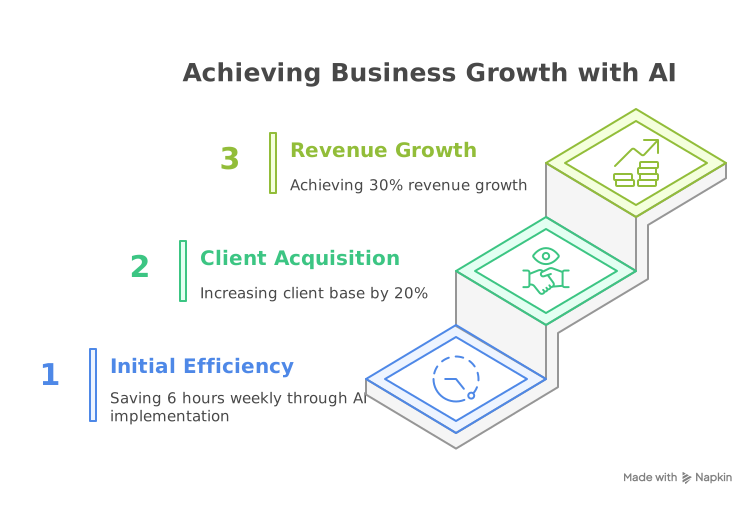
This small business transformation illustrates several crucial principles of effective AI implementation. The technology addressed specific pain points rather than attempting comprehensive business process reengineering. It integrated with existing tools and workflows rather than requiring expensive platform migrations. It delivered immediate, measurable benefits that justified continued investment. Most importantly, it remained invisible to both employees and clients, allowing the business to capture AI benefits without the complexity and risk often associated with technology adoption.
These three stories reveal consistent patterns that explain why some AI implementations succeed while others fail to deliver promised benefits. Understanding these patterns helps business leaders make more informed decisions about AI adoption and implementation strategy.
Successful AI implementations consistently demonstrate a clear division of labor between artificial and human intelligence. In manufacturing quality control, AI excels at reading text from equipment nameplates regardless of image quality or orientation, but human inspectors make judgment calls about equipment condition and safety concerns. In healthcare, AI can extract and organize medical information from diverse document sources, but physicians make treatment decisions based on their clinical expertise and patient interaction.
This division plays to each party's strengths rather than forcing artificial intelligence to attempt tasks it performs poorly. AI systems never experience fatigue when processing thousands of documents, never make transcription errors due to boredom or distraction, and can work continuously without breaks. Human workers excel at understanding context, managing relationships, making creative leaps, and handling exceptional situations that fall outside standard procedures.
The most effective implementations recognize these complementary capabilities and design workflows that leverage both types of intelligence appropriately. Rather than viewing AI as a replacement for human capabilities, successful organizations view it as an enhancement that allows human workers to focus their expertise on higher-value activities.
Pattern recognition represents the foundation of AI's competitive advantage in document processing. These systems can identify text, classify document types, extract structured data from unstructured sources, and detect anomalies or inconsistencies across large volumes of information. They perform these tasks with consistency and accuracy that exceeds human performance, especially when dealing with routine, repetitive work.
However, pattern recognition has limitations that human intelligence addresses effectively. AI systems struggle with context that extends beyond the immediate document, cultural nuances that affect interpretation, creative problem-solving that requires understanding unstated assumptions, and relationship management that depends on emotional intelligence and trust-building.
Understanding these complementary strengths enables organizations to design AI implementations that enhance rather than threaten human workers. Employees become more productive and satisfied when AI handles routine cognitive tasks, freeing them to apply their uniquely human capabilities to more engaging and valuable work.
The most successful AI implementations feel natural to users because they integrate seamlessly with existing workflows rather than requiring fundamental changes to how people work. In each of the stories examined, users continued their familiar routines while AI systems worked behind the scenes to improve speed, accuracy, and efficiency.
This approach eliminates many of the adoption barriers that plague technology initiatives. When employees don't need extensive training to use new systems, adoption happens naturally rather than through forced change management. When business processes don't require complete overhauls, organizations can capture AI benefits without the risk and disruption associated with major transformations.
Seamless integration also reduces the total cost of ownership for AI initiatives. Training costs remain minimal because existing workflows continue largely unchanged. System integration complexity decreases because AI capabilities layer onto existing infrastructure rather than replacing it. Change management challenges diminish because employees experience improvement rather than disruption.
The technical architecture that enables invisible integration requires sophisticated design that prioritizes user experience over technological showcase. The most effective AI document processing systems work through application programming interfaces that connect with existing business software, allowing information to flow between systems without manual intervention. Users interact with familiar interfaces while AI capabilities enhance functionality behind the scenes.
This approach contrasts sharply with AI implementations that require users to learn new software, adapt to different workflows, or integrate multiple systems manually. While such approaches may offer more comprehensive functionality, they often fail to achieve sustainable adoption because the friction of change outweighs the benefits of improvement.
Successful organizations recognize that technology adoption is fundamentally a human challenge rather than a technical one. The most sophisticated AI capabilities are worthless if employees don't use them consistently. Invisible integration solves this challenge by making AI adoption effortless and beneficial from the user's perspective.
Initially, businesses notice immediate benefits from AI implementation: time savings, reduced errors, lower processing costs. However, as AI systems learn and improve through continued use, compound benefits emerge that often prove more valuable than the initial efficiency gains.
Better data quality represents one of the most significant compound benefits. When AI systems extract information more accurately than manual processes, the quality of business data improves across all systems that use that information. Better data enables better decision-making, more accurate forecasting, improved customer service, and more effective strategic planning.
Reduced manual work allows organizations to reallocate human resources to higher-value activities. Employees who previously spent time on data entry can focus on analysis and strategy. Customer service representatives can spend more time solving complex problems rather than processing routine requests. Healthcare workers can provide more patient care rather than managing paperwork.
Improved accuracy builds customer trust and satisfaction over time. When loan applications process faster, mortgage customers develop positive associations with their lenders. When medical records are more complete and accessible, patients experience more coordinated care. When small businesses can respond to client requests more quickly, customer relationships strengthen.
The cumulative impact of these improvements often exceeds the sum of individual benefits. Organizations become more agile because information flows more efficiently. Customer satisfaction increases because service quality improves across multiple touchpoints. Employee retention improves because work becomes more engaging and less frustrating.
These compound benefits create competitive advantages that prove difficult for competitors to replicate. While individual AI capabilities can be copied, the accumulated experience, data quality, and process optimization that develops over time creates sustainable differentiation.
Understanding the compound nature of AI benefits helps organizations set appropriate expectations and investment horizons. While initial returns justify implementation costs, the long-term strategic value often justifies expanded AI adoption across additional business processes.
The contrast between visible and invisible AI innovation reveals important truths about technology adoption and long-term success. While dramatic AI implementations generate headlines and conference presentations, they often suffer from what researchers describe as "pilot purgatory"—they work impressively in demonstrations but fail to scale effectively in production environments.
Research indicates that ninety-one percent of AI projects in manufacturing have not met expectations, either in terms of benefits or implementation success. This failure rate reflects several systemic challenges that plague ambitious AI initiatives. Many organizations attempt to solve complex problems with AI before mastering simpler applications. Others prioritize technological sophistication over practical utility. Still others underestimate the change management challenges associated with significant workflow disruption.
Invisible AI innovation addresses these challenges through a fundamentally different approach that prioritizes sustainability over spectacle. This approach proves more successful because it requires minimal training and change management, integrates with existing systems rather than replacing them, solves specific, measurable problems rather than attempting broad transformation, and allows gradual scaling rather than requiring massive upfront investment.
Traditional technology implementations often require extensive employee training, workflow redesign, and cultural change initiatives. These requirements create friction that can overwhelm the benefits of new capabilities. Employees may resist changes that make their work more complicated, even if those changes promise long-term improvements.
Invisible AI implementation eliminates most training and change management requirements because employees continue working within familiar systems and processes. When AI capabilities enhance existing workflows rather than replacing them, adoption happens naturally through positive experience rather than mandated compliance.
This approach proves especially valuable for organizations with limited training resources or change management expertise. Small businesses, healthcare facilities, and manufacturing operations often lack the internal capacity to manage major technology transitions. Invisible AI allows these organizations to capture advanced capabilities without the complexity typically associated with AI adoption.
Replacing existing business systems with AI-powered alternatives involves significant technical risk, substantial upfront investment, and potential business disruption if implementations don't proceed smoothly. Many organizations attempt such replacements and discover that their existing data doesn't migrate cleanly, their workflows require more customization than anticipated, or their employees need more training than planned.
Invisible AI integration reduces these risks by working with existing infrastructure rather than replacing it. AI capabilities connect to current business software through standard interfaces, allowing gradual capability enhancement without system replacement. If AI features don't perform as expected, organizations can adjust or disable them without losing access to their core business systems.
This approach also allows organizations to test AI capabilities on a small scale before committing to larger implementations. A manufacturing company can implement AI-powered quality control documentation for one production line before expanding to the entire facility. A healthcare organization can start with AI document processing for one department before rolling out capabilities system-wide.
Ambitious AI initiatives often attempt to solve multiple business challenges simultaneously, making it difficult to measure specific benefits or identify problems when implementations don't proceed as planned. Complex projects may deliver some benefits while falling short in other areas, creating ambiguous results that complicate future investment decisions.
Invisible AI implementations focus on specific, well-defined problems with measurable success criteria. Document processing time reduction, error rate improvement, and cost savings can be quantified precisely, providing clear evidence of return on investment. When problems arise, they can be isolated and addressed without affecting other business processes.
This specificity also enables more effective vendor evaluation and selection. Organizations can assess AI capabilities based on concrete performance metrics rather than broad promises about transformation or innovation. Pilot projects can demonstrate actual results under real-world conditions rather than relying on theoretical projections.
Large-scale AI transformations require substantial upfront investment and create significant organizational stress during implementation periods. These characteristics make such projects risky for organizations with limited capital or change capacity. Many promising AI initiatives fail because organizations attempt to scale too quickly without adequately understanding implementation challenges or user needs.
Invisible AI implementations support gradual scaling that allows organizations to learn and adapt as they expand capabilities. Success in one area provides confidence and experience that informs expansion to additional processes. Revenue benefits from early implementations can fund continued investment, creating a self-sustaining improvement cycle.
This organic growth approach also allows organizations to develop internal expertise gradually rather than requiring immediate comprehensive AI knowledge. Employees become comfortable with AI capabilities through positive experience, creating internal advocates who support continued adoption.
The success of invisible AI innovation requires a fundamental philosophy that prioritizes practical value over technological sophistication. This philosophy guides design decisions, implementation strategies, and customer relationships in ways that determine long-term success.
Artificio's approach embodies this philosophy through its focus on AI agents that work together to solve real business problems rather than showcasing cutting-edge technology. The company's automation tools are designed to minimize manual work, reduce turnaround time, and increase operational efficiency without requiring coding skills or extensive technical knowledge.
Traditional AI implementations often require significant technical expertise to configure, customize, and maintain. This requirement creates barriers for small and medium-sized businesses that lack dedicated IT staff or AI specialists. It also slows implementation timelines and increases costs for larger organizations.
Artificio's no-code approach eliminates these barriers by allowing business users to create and customize AI solutions without programming knowledge. Users can configure document processing workflows, set up data extraction rules, and integrate with existing business systems through intuitive interfaces that don't require technical training.
This democratization of AI access proves especially valuable for organizations that understand their business processes better than external consultants but lack the technical skills to implement complex technology solutions. Business users who know exactly what information they need extracted from documents can configure AI systems directly rather than trying to communicate their requirements to technical intermediaries.
The no-code approach also enables faster iteration and improvement. When business users can modify AI configurations directly, they can test different approaches, refine extraction rules, and optimize workflows based on real-world experience. This rapid iteration leads to better outcomes than approaches that require formal change requests and technical implementation cycles.
Rather than requiring wholesale system replacements, Artificio's solutions integrate with existing business systems, databases, and workflows. This integration approach reduces implementation risk, accelerates time to value, and allows organizations to leverage their existing technology investments while adding AI capabilities.
Real-world integration requires sophisticated technical architecture that can work with diverse business software environments. Most organizations use multiple systems for different business functions accounting software for financial management, customer relationship management systems for sales tracking, enterprise resource planning systems for operations coordination. Effective AI integration must work seamlessly with all these systems rather than requiring consolidation onto a single platform.
The integration approach also respects the reality that business systems evolve over time. Organizations periodically upgrade software, change vendors, or add new capabilities. AI solutions that integrate through standard interfaces can adapt to these changes without requiring complete reimplementation.
This flexibility proves essential for long-term AI success. Organizations that invest in AI capabilities want those investments to remain valuable as their business needs and technology environments change. Integration-focused approaches provide this longevity by working with business systems rather than replacing them.
Every AI implementation should focus on specific, measurable improvements rather than abstract promises about transformation or innovation. Artificio's approach emphasizes concrete benefits like reduced processing time, improved accuracy, lower costs, and better compliance that can be quantified precisely and validated through real-world use.
This focus on measurable impact serves several important purposes. It provides clear justification for AI investment based on demonstrable return on investment rather than speculative benefits. It enables accurate assessment of different AI solutions and vendors based on actual performance rather than marketing claims. It allows organizations to identify successful implementations that should be expanded and problematic implementations that need adjustment.
Measurable impact also enables more effective scaling decisions. When organizations can quantify the benefits of AI document processing for accounts payable, they can project the potential benefits of extending those capabilities to other financial processes. When they can measure the time savings from automating quality control documentation, they can estimate the value of applying similar approaches to other operational processes.
The emphasis on concrete benefits creates accountability for AI vendors and implementation partners. Rather than delivering solutions that work in demonstrations but fail in production environments, vendors must ensure their solutions deliver promised benefits under real-world conditions with actual business data and workflows.
As AI document processing proves its value across industries and organizations, the principles of invisible innovation will likely expand to additional business functions and use cases. Understanding this trajectory helps organizations prepare for future opportunities while building on current successes.
The next phase of invisible AI innovation may focus on customer communication processes that currently require significant human time and attention. AI agents could help draft personalized responses to customer inquiries while maintaining human oversight for approval and customization. These systems could analyze customer communication history, identify relevant information from internal systems, and suggest response approaches that match successful previous interactions.
The key to success in customer communication AI will be maintaining the invisible integration approach that has proven effective in document processing. Customers should experience faster, more personalized, more accurate responses without being aware that AI systems are involved in the communication process. Customer service representatives should be able to provide better service more efficiently without learning complex new software or fundamentally changing their work approaches.
AI-enhanced customer communication could also extend to marketing and sales processes. Systems could analyze customer preferences and behavior patterns to suggest personalized offers or communication timing. Sales teams could receive AI-generated insights about customer needs and preferences without having to manually research each prospect's background and requirements.
Regulatory compliance represents another area where invisible AI could create significant value. Organizations in healthcare, financial services, manufacturing, and other regulated industries spend considerable time and resources ensuring adherence to changing regulations. AI systems could monitor regulatory updates, analyze their impact on business processes, and suggest necessary changes to maintain compliance.
These compliance AI systems could work invisibly by integrating with existing business processes to ensure regulatory requirements are met automatically rather than through separate compliance reviews. For example, healthcare document processing could automatically ensure that patient privacy requirements are met while clinical information is extracted and organized. Financial services document processing could automatically flag transactions that require additional reporting or monitoring.
The invisible approach to compliance AI would allow organizations to maintain regulatory adherence without adding complexity to their operational processes. Employees could continue their normal work activities while AI systems ensure that regulatory requirements are satisfied automatically in the background.
AI capabilities could eventually extend to strategic planning and business analytics functions that currently require significant manual analysis and interpretation. AI systems could analyze market trends, competitive intelligence, operational performance data, and customer feedback to identify patterns and opportunities that might be difficult for humans to detect across large volumes of information.
However, strategic planning AI would need to maintain the collaborative approach that characterizes successful document processing implementations. AI systems could identify trends and correlations, but human leaders would maintain responsibility for interpreting those insights, making strategic decisions, and managing organizational change.
The invisible integration of strategic AI would provide business leaders with better information and analytical support without changing the fundamental nature of strategic planning and decision-making. Leaders could access more comprehensive market intelligence, more accurate performance analytics, and more sophisticated competitive analysis while continuing to apply their experience, judgment, and organizational knowledge to strategic challenges.
Supply chain management represents another domain where invisible AI could create substantial value. AI systems could analyze supplier performance data, monitor market conditions, predict potential disruptions, and suggest alternative sourcing strategies without requiring supply chain managers to become AI experts or learn new analytical tools.
Supply chain AI could work invisibly by integrating with existing procurement systems, inventory management software, and supplier relationship management tools. Purchasing decisions could be enhanced with AI-generated insights about supplier reliability, market price trends, and potential quality issues while maintaining human oversight for relationship management and strategic supplier decisions.
The invisible approach to supply chain AI would enable more sophisticated supply chain optimization without the complexity and risk often associated with comprehensive supply chain technology implementations. Organizations could improve supplier performance, reduce inventory costs, and increase supply chain resilience while continuing to work with familiar systems and processes.
While invisible AI innovation offers significant advantages, successful implementation requires careful attention to several challenges and considerations that can determine long-term success or failure.
AI systems are only as effective as the data they process, and many organizations discover that their existing data requires significant cleanup and standardization before AI implementation can succeed. Document processing AI may struggle with inconsistent file formats, poor image quality, or non-standard information layouts that require preprocessing or manual intervention.
Addressing data quality challenges requires systematic assessment of existing data sources, identification of common quality issues, and development of data preparation processes that ensure AI systems receive appropriate input. Organizations may need to standardize document formats, improve image scanning procedures, or implement data validation checks before AI processing.
The invisible integration approach can help address data quality challenges by allowing gradual improvement over time rather than requiring perfect data from the beginning. AI systems can start with high-quality data sources while organizations work to improve other data sources progressively.
Even invisible AI implementations require some change management to ensure successful adoption and optimal utilization. Employees need to understand how AI capabilities enhance their work, when to trust AI recommendations, and how to handle exceptions or unusual situations that AI systems can't process automatically.
Effective change management for invisible AI focuses on benefits and support rather than extensive training requirements. Employees should understand what tasks AI systems will handle automatically, what situations require human intervention, and how to access help when problems arise. Communication should emphasize how AI capabilities make work easier and more interesting rather than focusing on technical details or potential job displacement concerns.
The gradual scaling approach characteristic of invisible AI implementations enables organic change management through positive experience rather than formal training programs. Early adopters can become internal advocates who help colleagues understand AI benefits and best practices through peer-to-peer knowledge sharing.
AI document processing often involves sensitive business information that requires appropriate security and privacy protections. Organizations must ensure that AI systems meet their data security requirements and comply with relevant privacy regulations without compromising AI effectiveness or user experience.
Security considerations for AI implementations include data encryption during processing and storage, access controls that limit AI system usage to authorized personnel, audit trails that track AI processing activities, and incident response procedures for handling potential security breaches.
Privacy considerations may include data anonymization or pseudonymization for certain types of processing, geographic restrictions on data processing locations, retention policies that limit how long AI systems store processed information, and user consent mechanisms for processing personal information.
The invisible integration approach can help address security and privacy concerns by working within existing security frameworks rather than requiring new security infrastructure. AI capabilities can leverage existing authentication systems, data protection measures, and compliance procedures while adding AI-specific protections where necessary.
Successful AI implementations require ongoing performance monitoring to ensure systems continue delivering expected benefits and to identify opportunities for improvement. Organizations need to track accuracy rates, processing times, error frequencies, and user satisfaction metrics to validate AI performance and guide optimization efforts.
Performance monitoring for invisible AI should focus on business impact metrics rather than technical performance indicators. While technical metrics like processing speed and accuracy rates are important, business metrics like time savings, cost reductions, and quality improvements provide better insight into AI value and inform investment decisions.
Optimization efforts should balance automated improvement through machine learning with manual adjustment based on user feedback and business requirements. AI systems can learn from experience and improve their performance over time, but human oversight ensures that improvements align with business objectives and user needs.
The transformation of business through artificial intelligence is happening, but not in the dramatic, disruptive way often portrayed in popular media. Instead, the real AI revolution is quiet, gradual, and remarkably effective. It works behind the scenes to make existing processes faster, more accurate, and more efficient while allowing people to focus on activities that require uniquely human capabilities.
This invisible approach to AI innovation proves more sustainable and valuable than flashy implementations that promise wholesale transformation but often fail to deliver practical benefits. By focusing on specific problems, integrating seamlessly with existing workflows, and enhancing rather than replacing human capabilities, invisible AI creates lasting competitive advantages that compound over time.
The stories examined in this exploration—from manufacturing quality control to healthcare documentation to small business administration—demonstrate consistent patterns of success that other organizations can replicate. The key lies not in adopting the latest AI technology but in thoughtfully applying AI capabilities to solve real problems in ways that feel natural to users and deliver measurable benefits.
Companies like Artificio understand this distinction and build AI systems that prioritize practical value over technological sophistication. Their approach of creating AI agents that work together to process documents, extract data, and automate workflows represents the mature evolution of artificial intelligence from experimental technology to essential business infrastructure.
As this quiet revolution continues, the organizations that succeed will be those that master the art of invisible innovation. They will implement AI capabilities that improve business performance without creating disruption. They will enhance human work rather than attempting to replace it. They will focus on sustainable competitive advantages rather than pursuing temporary technological edge.
The future belongs not to organizations with the most advanced AI technology, but to those that most effectively integrate AI capabilities into their business operations. This integration requires understanding that the best technology is often the technology you don't notice the systems that work so seamlessly that they become invisible parts of everyday business life.
The mortgage gets approved faster. The medical records are more accurate and accessible. The small business operates more efficiently. The quality control inspector focuses on safety rather than data entry. These improvements happen thousands of times each day across countless organizations, creating cumulative value that transforms entire industries through the accumulation of small, invisible enhancements.
This is the true power of artificial intelligence: not to revolutionize everything at once, but to quietly improve everything over time. The revolution is happening one document, one process, one solved problem at a time. And most of the time, it works so well that you never even notice it's there.
In the end, the most successful technology implementations are those that become invisible not because they're hidden, but because they work so naturally and effectively that they become seamless parts of how we accomplish our goals. The future of AI lies not in replacing human intelligence but in augmenting it so gracefully that the boundary between human and artificial capability becomes irrelevant to the user experience.
The quiet revolution of invisible AI innovation continues, transforming business and work in ways that feel natural, sustainable, and remarkably human. This is how the future actually arrives not with fanfare and disruption, but with steady improvement that makes everything work just a little bit better than it did before.

Head IT Operations - Co Founder of Artificio
See it in your SAP environment
Bring us a document, a process, or a bottleneck. We'll show how Artificio captures, validates, and posts into SAP — then scale from there.
Security & compliance
ISO 27001:2013 certified, SOC 2 Type 2 compliant, GDPR and HIPAA ready. Every agent action is logged, auditable, and runs in isolated environments.