

Blog
Scaling AI Document Processing to Millions of Documents
Architectural patterns for processing millions of documents daily with AI, focusing on accuracy, performance, and cost-effectiveness.

Blog
Architectural patterns for processing millions of documents daily with AI, focusing on accuracy, performance, and cost-effectiveness.
The modern enterprise generates and processes documents at an unprecedented scale. Federal agencies alone handle over 106 billion forms annually, while private organizations face similarly staggering volumes across contracts, invoices, compliance documents, and customer communications. Yet despite this massive demand, most discussions around AI document processing focus on capabilities rather than the fundamental architectural challenges of processing millions of documents daily while maintaining accuracy, performance, and cost effectiveness.
This technical gap represents a critical blind spot for organizations planning large-scale implementations. Generic cloud solutions and vendor presentations often showcase impressive demonstrations with small datasets, but they rarely address the complex engineering challenges that emerge when processing volumes measured in millions of documents per day. The difference between processing a few thousand documents and processing millions involves fundamentally different architectural approaches, cost optimization strategies, and scaling patterns that require deep technical understanding to implement successfully.
To appreciate the complexity of large-scale document processing, we must first understand what processing millions of documents daily actually means from a systems perspective. A typical enterprise document might range from a single-page form to a multi-hundred-page contract or technical manual. Each document requires multiple processing stages including ingestion, preprocessing, content extraction, analysis, validation, and storage. When multiplied across millions of documents, these seemingly simple operations create a cascade of technical challenges that traditional architectures cannot handle.
Consider the mathematical reality of processing one million documents per day. This translates to approximately 11.6 documents per second continuously, or roughly 700 documents per minute during peak business hours if processing is concentrated in an 8-hour window. Each document might require 5-30 seconds of processing time depending on complexity and the depth of analysis required. This means your system needs the capacity to handle hundreds of concurrent processing operations while maintaining quality and consistency across all outputs.
The storage implications alone are staggering. Assuming an average document size of 2MB including original files, extracted text, metadata, and processing artifacts, one million documents daily generates 2TB of new data every single day. Over a year, this amounts to over 700TB of storage requirements, not including backup and redundancy needs. The network bandwidth requirements for moving this volume of data between processing stages, storage systems, and external integrations can easily saturate traditional infrastructure. 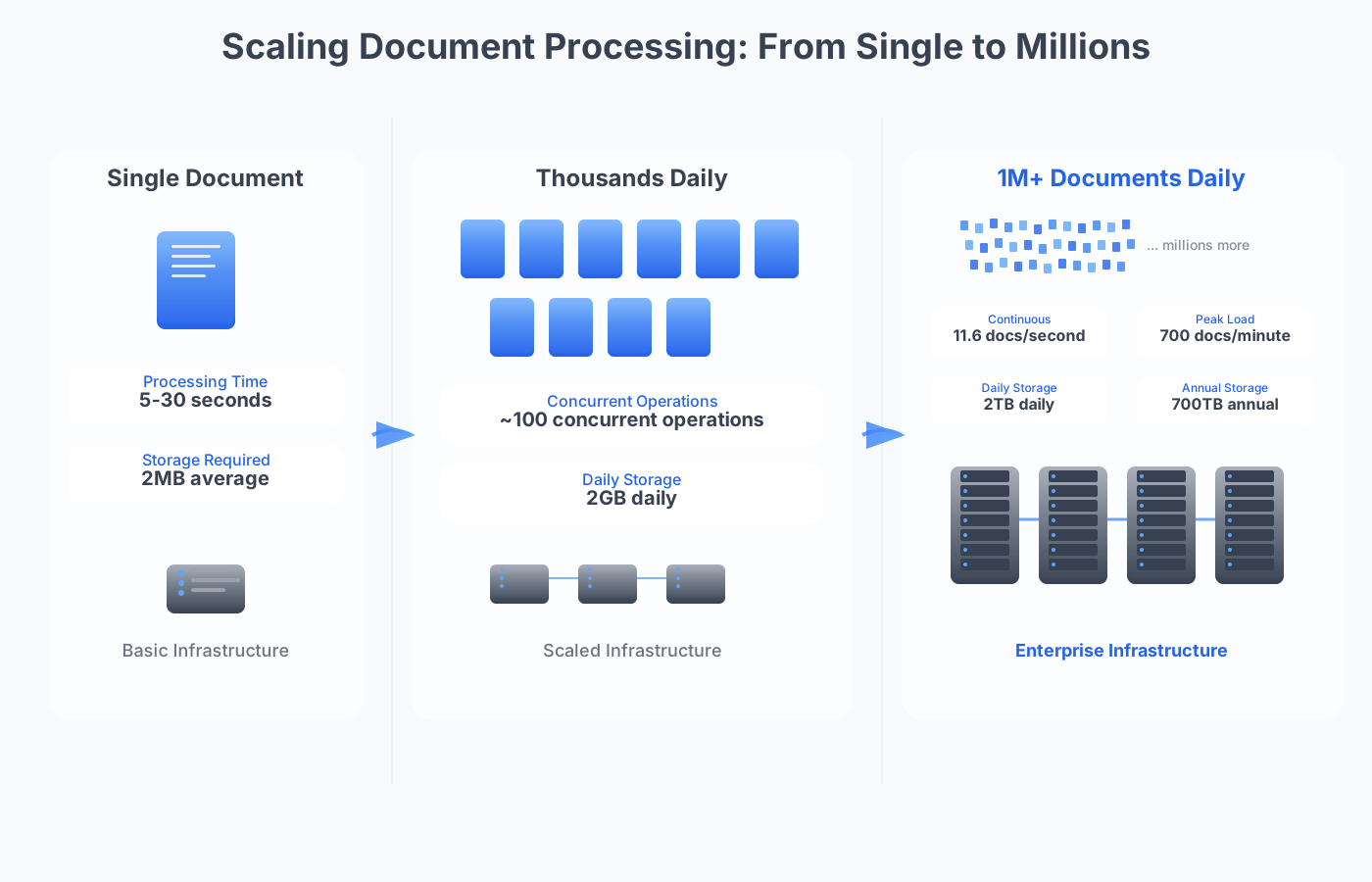
Memory and compute requirements scale even more dramatically. Modern AI document processing often requires loading large language models that can consume 10-50GB of RAM per instance. Processing complex documents with multiple AI models for extraction, classification, and analysis can require substantial GPU resources. When multiplied across the concurrent processing needs for millions of documents, the infrastructure requirements quickly exceed what traditional server architectures can provide cost-effectively.
The challenge extends beyond raw computational resources to include consistency and quality assurance. Processing a single document allows for human review and correction of any errors. Processing millions of documents requires automated quality assurance systems that can detect and handle edge cases, processing failures, and accuracy degradation across the entire pipeline. The complexity of maintaining consistent quality at scale while processing diverse document types, formats, and quality levels requires sophisticated monitoring and validation systems.
Successful large-scale document processing systems rely on several fundamental architectural patterns that enable horizontal scaling while maintaining performance and cost effectiveness. These patterns represent proven approaches that have been tested across numerous high-volume implementations and provide the foundation for systems capable of processing millions of documents daily.
The microservices architecture pattern forms the backbone of scalable document processing systems. Rather than building a monolithic application that handles all aspects of document processing, successful systems decompose the workflow into discrete, independently scalable services. A typical microservices architecture for document processing includes separate services for document ingestion, format conversion, content extraction, data validation, storage management, and output generation. Each service can be scaled independently based on processing demands and resource requirements.
This decomposition provides several critical advantages for large-scale processing. Different stages of document processing have different resource requirements and processing characteristics. Document ingestion services are typically I/O intensive and benefit from high network bandwidth and fast storage. Content extraction services require substantial CPU and memory resources, particularly when running complex AI models. Storage services need high-capacity, reliable storage with appropriate backup and redundancy configurations. By separating these concerns into independent services, each component can be optimized and scaled according to its specific requirements.
The event-driven architecture pattern enables loose coupling between services while providing the reliability and scalability needed for high-volume processing. Rather than direct service-to-service communication, each processing stage publishes events to a message queue system when work is completed. Downstream services consume these events and begin their processing tasks independently. This approach provides natural buffering during processing spikes, allows for service failures without losing work, and enables easy addition of new processing stages without modifying existing services.
Message queues serve as the nervous system for large-scale document processing architectures. Systems like Apache Kafka, Amazon SQS, or Azure Service Bus provide the reliable message delivery, ordering guarantees, and throughput needed to coordinate processing across millions of documents. The queue system handles the complexity of managing work distribution, ensuring that failed processing attempts are retried, and providing visibility into processing status across the entire pipeline.
The distributed processing pattern leverages container orchestration systems like Kubernetes to manage the deployment and scaling of processing services across multiple servers or cloud instances. Container orchestration provides automatic scaling based on queue depth or processing metrics, ensuring that sufficient processing capacity is available during peak loads while scaling down during quieter periods to optimize costs. The orchestration system also handles service discovery, load balancing, and health monitoring across the distributed processing cluster.
Data partitioning strategies become critical when processing volumes reach millions of documents daily. Effective partitioning spreads the processing load evenly across available resources while maintaining the ability to track and manage individual documents through the processing pipeline. Common partitioning approaches include time-based partitioning where documents are processed in chronological batches, hash-based partitioning where documents are distributed based on content characteristics, and priority-based partitioning where urgent documents receive expedited processing.
The infrastructure requirements for processing millions of documents daily extend far beyond simply provisioning more servers. Successful large-scale implementations require careful consideration of storage architectures, network topology, compute resource allocation, and cost optimization strategies that work together to provide the performance and reliability needed for enterprise-grade document processing.
Storage architecture represents one of the most critical infrastructure decisions for large-scale document processing systems. The storage system must handle the initial ingestion of millions of documents, provide fast access during processing, maintain processed results for immediate retrieval, and support long-term archival with appropriate compliance and governance controls. A typical architecture employs a tiered storage approach where hot storage provides fast access to documents actively being processed, warm storage maintains recently processed documents for quick retrieval, and cold storage archives older documents cost-effectively while maintaining compliance requirements.
The choice between block storage, object storage, and file systems significantly impacts both performance and cost at scale. Object storage systems like Amazon S3, Azure Blob Storage, or Google Cloud Storage provide the scalability and cost effectiveness needed for storing millions of documents, but they require careful consideration of access patterns and retrieval costs. Block storage provides better performance for database workloads and temporary processing storage but becomes expensive at scale. File systems offer familiar interfaces and good performance but require more complex management and scaling strategies.
Network architecture becomes a significant bottleneck when moving millions of documents through processing pipelines. The network design must accommodate the initial upload of documents, movement between processing stages, access to external services and APIs, and delivery of processed results to downstream systems. High-bandwidth, low-latency network connections between processing components are essential for maintaining throughput, while network segmentation and security controls ensure that sensitive document data remains protected throughout the processing pipeline.
Compute resource management requires sophisticated orchestration to handle the varying resource requirements of different document types and processing stages. Simple documents might require minimal CPU and memory resources, while complex multi-page documents with embedded images, tables, and forms might require substantial GPU resources for optical character recognition and advanced AI analysis. The compute orchestration system must dynamically allocate resources based on processing requirements while maintaining cost effectiveness and preventing resource starvation across the processing pipeline.
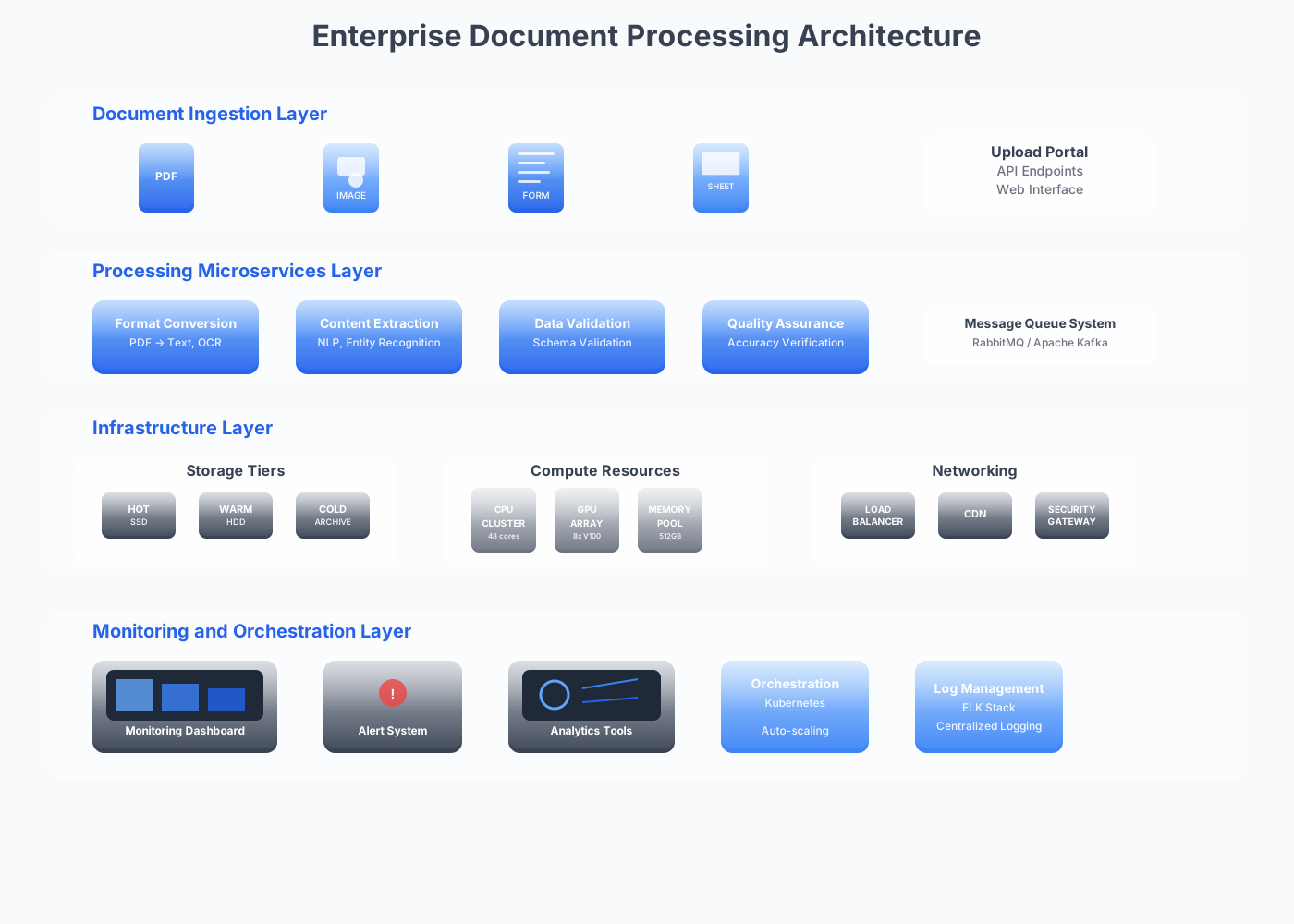
Memory management becomes particularly complex when running multiple AI models concurrently for document processing. Large language models for content extraction and analysis can consume 10-50GB of RAM per instance, while computer vision models for image and form processing require substantial GPU memory. Effective memory management strategies include model sharing across processing instances, dynamic model loading based on document requirements, and memory pooling to prevent resource fragmentation during high-volume processing periods.
Cost optimization at scale requires continuous monitoring and adjustment of resource allocation based on processing patterns and business requirements. Cloud-based implementations can leverage auto-scaling capabilities to match resource consumption with processing demands, but they require careful configuration to prevent cost overruns during processing spikes. Reserved instance pricing, spot instance utilization, and resource scheduling can provide significant cost savings for predictable processing workloads while maintaining the flexibility needed for varying document volumes.
The design of the document processing pipeline determines both the quality of results and the efficiency of resource utilization when processing millions of documents daily. Successful pipeline architectures balance processing thoroughness with performance requirements while providing the flexibility needed to handle diverse document types and processing requirements.
Pipeline stage design begins with document ingestion and validation, which serves as the foundation for all subsequent processing. The ingestion stage must handle multiple input formats including PDFs, images, Office documents, and various proprietary formats while performing initial validation to ensure document quality and completeness. This stage often includes format standardization, where documents are converted to common formats for consistent processing downstream. The validation component checks for corrupt files, unsupported formats, and documents that exceed size or complexity limits that might cause processing failures.
Content extraction represents the most resource-intensive stage of the processing pipeline and requires careful optimization to maintain throughput at scale. Modern AI-powered extraction systems combine optical character recognition for scanned documents, natural language processing for text analysis, computer vision for form and table extraction, and machine learning models for content classification and entity recognition. Each of these technologies has different resource requirements and processing characteristics that must be balanced for optimal performance.
The extraction stage benefits significantly from parallel processing architectures where different AI models can process different aspects of the same document simultaneously. Text extraction can proceed in parallel with image analysis, while form field recognition can operate independently of content classification. This parallel approach reduces overall processing time while maximizing resource utilization across the available compute infrastructure.
Quality assurance and validation systems become essential when processing millions of documents where manual review is impractical. Automated quality assurance systems monitor extraction accuracy, flag potential errors or inconsistencies, and route problematic documents for human review or alternative processing approaches. These systems typically use statistical analysis to identify outliers, confidence scoring to assess extraction quality, and business rule validation to ensure extracted data meets expected formats and constraints.
Pipeline orchestration systems manage the flow of documents through multiple processing stages while maintaining visibility into processing status and handling failures gracefully. Modern orchestration platforms like Apache Airflow, Kubernetes workflows, or cloud-specific orchestration services provide the reliability and scalability needed to coordinate processing across millions of documents. These systems handle task scheduling, dependency management, error recovery, and resource allocation while providing monitoring and alerting capabilities for operational oversight.
Error handling and recovery mechanisms are critical for maintaining processing reliability when dealing with millions of documents daily. The pipeline must gracefully handle various failure scenarios including corrupted documents, processing timeouts, resource exhaustion, and external service failures. Effective error handling includes automatic retry mechanisms with exponential backoff, dead letter queues for documents that consistently fail processing, and alerting systems that notify operators of systemic issues requiring intervention.
Data flow optimization focuses on minimizing the movement and transformation of document data throughout the processing pipeline. Large documents require significant network bandwidth and storage I/O when moved between processing stages, so optimization strategies include processing documents in place when possible, using streaming processing for large files, and implementing intelligent caching to avoid redundant operations. Compression and deduplication techniques can significantly reduce storage and network requirements while maintaining processing accuracy.
Maintaining consistent quality and performance when processing millions of documents daily requires sophisticated monitoring and quality assurance systems that can operate automatically while providing operators with the visibility needed to maintain system health and processing accuracy.
Quality assurance systems for large-scale document processing must operate at multiple levels to ensure both individual document accuracy and system-wide performance. Document-level quality assurance includes confidence scoring for extracted content, validation against business rules and expected formats, and comparison with reference standards when available. System-level quality assurance monitors overall processing accuracy trends, identifies degradation in model performance, and detects systemic issues that might affect large numbers of documents.
Automated quality scoring systems use machine learning techniques to assess the accuracy and completeness of document processing results without requiring human review. These systems analyze extraction confidence scores, cross-validate results across multiple processing models, and apply statistical techniques to identify potential errors or inconsistencies. Quality scores enable automatic routing of low-confidence results for human review while allowing high-confidence results to proceed through automated workflows.
Performance monitoring systems track processing metrics across the entire pipeline to identify bottlenecks, resource constraints, and optimization opportunities. Key metrics include processing throughput measured in documents per hour, average processing time per document, resource utilization across compute and storage systems, and error rates for different document types and processing stages. These metrics provide the foundation for capacity planning, performance optimization, and cost management decisions.
Real-time alerting systems notify operators of processing issues, quality degradation, and system failures that require immediate attention. Effective alerting systems balance comprehensive coverage with alert fatigue by using intelligent thresholds, escalation procedures, and correlation analysis to identify significant issues while filtering out routine operational noise. Integration with incident management systems ensures that alerts result in appropriate response procedures and resolution tracking.
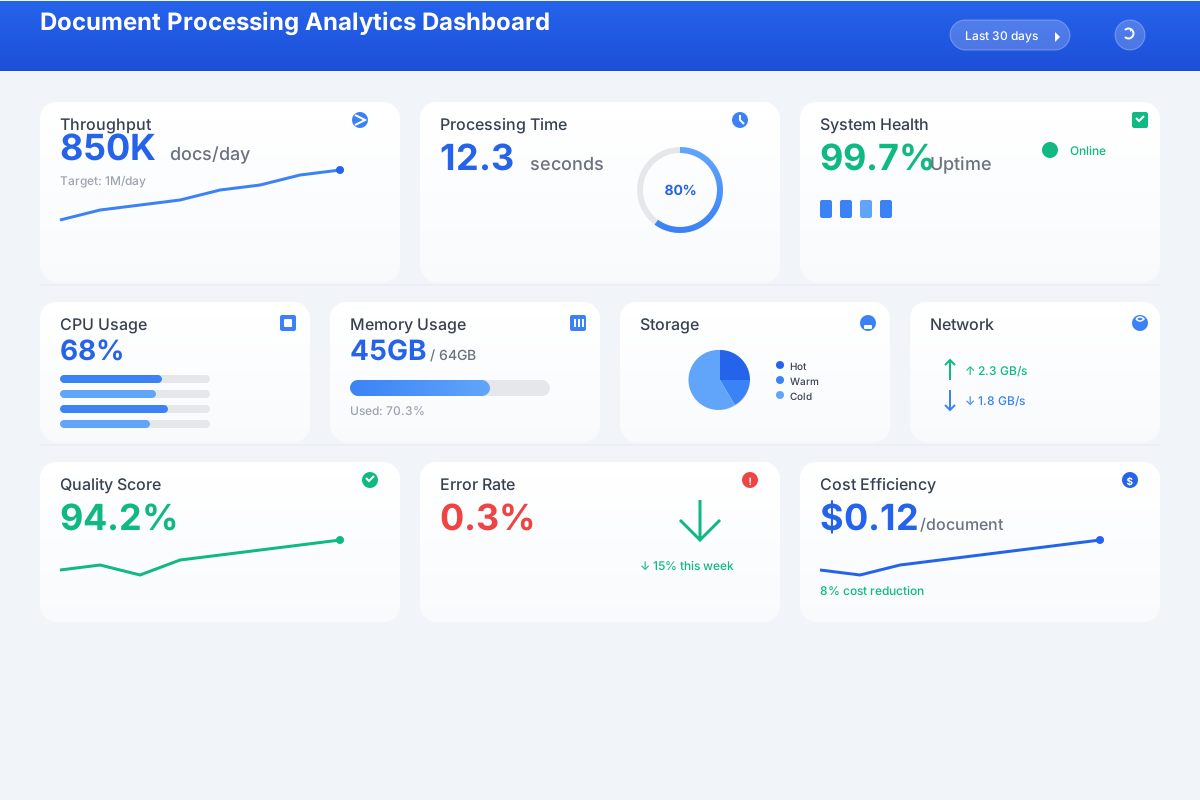
Audit and compliance monitoring becomes increasingly important as document processing volumes scale into millions of documents daily. Audit systems track document processing history, maintain chain of custody records, and provide the detailed logging needed for regulatory compliance and security analysis. These systems must handle the volume and velocity of audit data generated by large-scale processing while providing efficient search and reporting capabilities for compliance teams.
Quality trend analysis uses historical processing data to identify patterns in processing accuracy, performance degradation, and resource utilization that might indicate needed optimizations or system maintenance. Trend analysis can reveal seasonal patterns in document volumes, gradual degradation in model accuracy that indicates need for retraining, and infrastructure changes that improve or harm processing performance. This analysis provides the foundation for proactive system management and continuous improvement initiatives.
Capacity planning and forecasting systems use historical processing data and business projections to predict future resource requirements and identify potential scaling bottlenecks before they impact processing performance. These systems consider factors including document volume growth, processing complexity trends, and infrastructure cost optimization to recommend scaling strategies that maintain performance while optimizing costs.
Operating document processing systems at the scale of millions of documents daily requires sophisticated cost optimization strategies that balance processing quality, performance requirements, and operational expenses. Successful cost optimization addresses both direct processing costs and indirect expenses including storage, networking, and operational overhead.
Processing cost optimization begins with efficient resource utilization strategies that match compute capacity with processing demands while minimizing idle resources. Auto-scaling systems can automatically adjust processing capacity based on queue depth, processing metrics, or scheduled patterns, ensuring sufficient resources during peak periods while scaling down during quieter times. However, effective auto-scaling requires careful configuration to avoid thrashing between scaling states and account for the startup time required for new processing instances.
Storage cost optimization becomes critical when managing the massive data volumes generated by processing millions of documents daily. Intelligent data lifecycle management automatically transitions documents through storage tiers based on access patterns and business requirements. Recently processed documents remain in high-performance storage for immediate access, while older documents migrate to lower-cost storage tiers with appropriate retrieval capabilities. Automated deletion policies remove outdated documents while maintaining compliance with retention requirements.
Processing efficiency optimization focuses on reducing the computational resources required for each document while maintaining processing quality. Techniques include model optimization to reduce memory and compute requirements, batch processing to amortize overhead costs across multiple documents, and intelligent processing routing that matches document characteristics with appropriate processing approaches. Simple documents can be processed with lightweight models while complex documents receive more intensive analysis only when needed.
Infrastructure cost optimization leverages cloud pricing models and resource scheduling to minimize operational expenses. Reserved instance pricing provides significant discounts for predictable processing workloads, while spot instance utilization can reduce costs for batch processing jobs that can tolerate interruption. Container orchestration systems can efficiently pack processing workloads onto available infrastructure while maintaining performance isolation and resource guarantees.
Network cost optimization addresses the significant bandwidth requirements for moving millions of documents through processing pipelines. Strategies include data compression to reduce transfer volumes, intelligent caching to avoid redundant data movement, and processing optimization that minimizes the number of times documents must be transferred between processing stages. Cloud-based implementations benefit from co-locating processing and storage resources to minimize data transfer costs between availability zones or regions.
Operational cost optimization reduces the human effort required to maintain and operate large-scale document processing systems. Automation of routine operational tasks including system monitoring, performance optimization, and capacity planning reduces the staffing requirements for system operation. Self-healing systems that automatically detect and resolve common issues minimize the need for manual intervention while maintaining system reliability.
Successfully implementing large-scale document processing systems requires a phased approach that builds capability incrementally while proving system design and optimization strategies at each stage. This roadmap approach reduces implementation risk while providing opportunities to optimize system performance and costs before reaching full-scale production volumes.
The initial phase focuses on establishing core processing capabilities with a subset of document types and volumes that represent the full-scale requirements. This phase implements the fundamental microservices architecture, establishes basic processing pipelines, and validates the technology choices for content extraction and analysis. Processing volumes during this phase typically range from thousands to tens of thousands of documents daily, providing sufficient scale to test system design while maintaining manageable complexity.
The scaling phase expands processing capabilities to handle increased document volumes and additional document types while optimizing system performance and cost effectiveness. This phase implements advanced orchestration systems, establishes comprehensive monitoring and quality assurance capabilities, and proves auto-scaling and resource optimization strategies. Processing volumes during this phase typically range from hundreds of thousands to low millions of documents daily, representing the transition to true large-scale processing.
The optimization phase fine-tunes system performance, cost effectiveness, and operational efficiency while adding advanced capabilities including machine learning model optimization, advanced analytics, and integration with downstream business systems. This phase achieves full-scale processing capabilities handling millions of documents daily while maintaining target quality, performance, and cost metrics.
Best practices for large-scale implementation include maintaining comprehensive documentation of system architecture, processing workflows, and operational procedures that enable effective knowledge transfer and system maintenance. Documentation should include architecture diagrams, API specifications, deployment procedures, troubleshooting guides, and performance optimization recommendations that enable teams to effectively operate and enhance the system over time.
Testing and validation strategies must address both functional correctness and performance characteristics at scale. Functional testing validates that document processing produces accurate results across different document types and processing scenarios. Performance testing validates that system architecture can handle target processing volumes while maintaining response time and throughput requirements. Load testing with realistic document volumes and processing patterns identifies potential bottlenecks and scaling limitations before they impact production operations.
Security and compliance considerations become increasingly complex as processing volumes scale to millions of documents daily. Security strategies must address data protection throughout the processing pipeline, access controls for processing systems and stored documents, audit logging for compliance requirements, and incident response procedures for security events. Compliance frameworks must accommodate the automated processing of sensitive documents while maintaining regulatory requirements for data handling, retention, and disposal.
Change management and system evolution practices ensure that large-scale processing systems can adapt to changing business requirements while maintaining operational stability. Version control systems track changes to processing models, configuration settings, and system architecture. Deployment strategies including blue-green deployments and canary releases enable safe rollout of system changes while minimizing disruption to processing operations. Rollback procedures provide rapid recovery from problematic changes that impact processing quality or performance.
The architectural patterns and strategies outlined in this analysis provide the foundation for successfully implementing document processing systems capable of handling millions of documents daily while maintaining quality, performance, and cost effectiveness. However, the rapid evolution of AI technologies, cloud computing capabilities, and business requirements demands continuous attention to emerging trends and optimization opportunities.
The transformation from traditional document processing approaches to large-scale AI-powered systems represents a fundamental shift in how organizations handle information processing workflows. Success requires not only technical expertise in distributed systems, AI model deployment, and cloud architecture, but also deep understanding of business requirements, quality standards, and operational constraints that influence system design decisions.
Organizations planning large-scale document processing implementations should focus on building systems that can evolve with changing requirements while maintaining operational stability and cost effectiveness. This requires architectural approaches that separate concerns effectively, provide clear interfaces between system components, and enable incremental enhancement without disrupting production operations.
The investment in properly architected large-scale document processing systems provides significant returns through improved processing efficiency, reduced operational costs, and enhanced business capabilities. Organizations that successfully implement these systems gain competitive advantages through faster processing of business-critical documents, improved data quality and consistency, and reduced reliance on manual processing workflows.
Future developments in AI model efficiency, edge computing capabilities, and specialized processing hardware will continue to influence optimal architectural approaches for large-scale document processing. Organizations should maintain flexibility in their system architectures to accommodate these technological advances while focusing on proven patterns and practices that provide immediate business value.
The complexity of processing millions of documents daily requires sustained attention to system optimization, quality assurance, and operational excellence. Success depends on building teams with appropriate technical expertise, establishing effective operational procedures, and maintaining commitment to continuous improvement as processing volumes and business requirements evolve over time.

Head IT Operations - Co Founder of Artificio
See it in your SAP environment
Bring us a document, a process, or a bottleneck. We'll show how Artificio captures, validates, and posts into SAP — then scale from there.
Security & compliance
ISO 27001:2013 certified, SOC 2 Type 2 compliant, GDPR and HIPAA ready. Every agent action is logged, auditable, and runs in isolated environments.