

Blog
Intelligent Document Processing with LLMs: Transforming Data into Decisions
Automated document analysis with LLMs transforms workflows. Extract insights, summarize, and query financial, legal, and regulatory documents efficiently.

Blog
Automated document analysis with LLMs transforms workflows. Extract insights, summarize, and query financial, legal, and regulatory documents efficiently.
Organizations across sectors are drowning in documents. Financial statements, contracts, compliance reports, investment memoranda these text-heavy artifacts contain critical information that drives business decisions. Yet the traditional approach to extracting this information remains largely manual, time-consuming, and prone to human error. Financial analysts, legal teams, and compliance officers spend countless hours reading, analyzing, and summarizing documents that often span hundreds of pages. This process creates bottlenecks, delays decision-making, and diverts skilled professionals from higher-value analytical work.
Intelligent Document Processing (IDP) has emerged as a response to this challenge, offering automated approaches to document analysis. However, the recent integration of Large Language Models (LLMs) into IDP workflows represents not merely an incremental improvement but a fundamental transformation in how organizations interact with their document collections. This technological advancement enables professionals to extract precise information, generate comprehensive summaries, and derive actionable insights with unprecedented efficiency and accuracy.
This article explores the intersection of Intelligent Document Processing and Large Language Models, examining both theoretical frameworks and practical applications across financial services and regulatory domains. By analyzing real-world implementations, we will demonstrate how this technology is reshaping document-intensive workflows and enabling more informed, timely decisions.
Intelligent Document Processing represents the evolution of document management from simple storage and retrieval systems to sophisticated platforms capable of understanding document content and context. Before exploring how LLMs have transformed this field, we should establish a clear understanding of IDP's fundamental components and traditional approaches.
At its essence, IDP encompasses technologies and methodologies designed to extract, classify, and process information from various document types. Traditional IDP systems typically incorporate several key technologies:
Optical Character Recognition (OCR) transforms images of text into machine-readable character data, converting scanned documents or photographs into editable and searchable content. Modern OCR systems achieve high accuracy rates for clearly printed text but may struggle with handwritten notes, unusual fonts, or poor-quality scans.
Document classification systems identify document types based on layout patterns, keywords, or other distinctive features. This classification enables appropriate routing and processing based on document category for instance, distinguishing between invoices, contracts, and compliance reports.
Information extraction capabilities identify and capture specific data elements within documents, such as dates, monetary amounts, entity names, or defined fields within forms. Traditional approaches relied heavily on templates and rule-based systems tailored to specific document formats.
Natural Language Processing (NLP) capabilities enable basic understanding of text meaning beyond simple keyword matching. Earlier NLP implementations could identify entities, relationships, and sentiment but lacked deeper contextual understanding of complex documents.
These components formed the foundation of IDP implementations for the past decade, offering substantial improvements over fully manual processing. However, traditional IDP faced significant limitations when confronted with unstructured documents, varying formats, or content requiring nuanced interpretation.
The development of IDP systems has followed a trajectory from rigid, rules-based approaches toward increasingly flexible, AI-driven methodologies:
First-generation IDP systems relied on explicit rules and templates defined by domain experts. These systems performed well for standardized documents with consistent formats but required extensive configuration for each document type and failed when encountering variations or exceptions.
Second-generation approaches incorporated machine learning algorithms to improve adaptability. These systems could learn from examples rather than requiring explicit rules, gradually improving classification accuracy and extraction precision as they processed more documents. However, they still required substantial training data and often struggled with previously unseen document formats.
Third-generation IDP solutions began leveraging deep learning models specifically designed for document understanding tasks. These models demonstrated improved capabilities for handling visual and textual elements in documents but still required specialized training for specific document types and extraction tasks.
The integration of Large Language Models represents the fourth and most recent evolutionary stage, introducing capabilities that fundamentally change how organizations can interact with their document collections. Rather than being limited to predefined extraction tasks, these systems can respond to natural language queries, understand document context, and generate insights that connect information across multiple sources.
Large Language Models have introduced capabilities that transcend traditional IDP approaches, creating new paradigms for document analysis and information extraction. Understanding these fundamental capabilities provides context for the practical applications we will explore later.
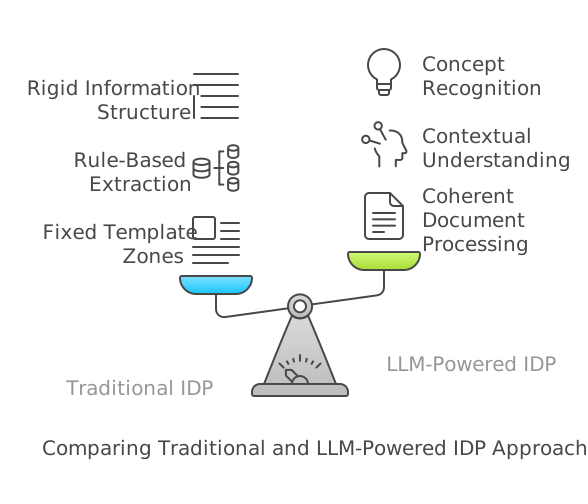
Traditional IDP systems primarily relied on pattern matching identifying text that conformed to expected formats or appeared in anticipated locations within documents. While effective for standardized forms, this approach failed when information appeared in unexpected contexts or used varying terminology.
LLMs bring a fundamentally different capability: contextual understanding. These models process text in ways that approximate human reading comprehension, grasping not just the presence of key terms but their meaning within the broader narrative. This comprehension enables several critical advantages:
Recognition of conceptual equivalence allows LLMs to identify relevant information even when expressed in different terms. For instance, an LLM can recognize that "potential future obligations not currently on the balance sheet" refers to the same concept as "contingent liabilities" without requiring explicit rules connecting these phrases.
Implied information inference enables extraction of facts that exist between the lines rather than in explicit statements. When a financial report mentions "significant one-time charges related to restructuring" without specifying an amount, an LLM can connect this statement to a numerical figure appearing elsewhere in the document, even if not explicitly labeled as restructuring costs.
Document-level context maintenance ensures that information is interpreted within its proper framework. An LLM can distinguish, for instance, between identical numerical values representing current-year versus previous-year metrics, or between baseline projections and sensitivity analysis scenarios.
These capabilities dramatically reduce the need for document-specific templates or extraction rules, allowing systems to handle diverse document types without extensive reconfiguration.
While traditional IDP systems processed documents individually, LLMs excel at maintaining context across multiple documents, enabling more comprehensive analysis:
Information synthesis across related documents allows connections between facts appearing in separate sources. For example, when analyzing a potential investment, an LLM can connect revenue projections from a financial model with contract terms from legal documentation and market assumptions from industry reports.
Consistency verification identifies contradictions or discrepancies between related documents. If a company's regulatory filing mentions certain contingent liabilities while its investor presentations omit this information, an LLM-powered system can flag this inconsistency for further investigation.
Temporal analysis tracks changes in information over time by comparing document sequences. This capability proves particularly valuable for monitoring evolving situations, such as changes in financial projections or contractual terms across multiple document versions.
This cross-document analysis capability transforms how organizations approach complex document collections, enabling insights that would be extraordinarily difficult to achieve through manual review alone.
Perhaps the most transformative capability LLMs bring to document processing is the ability to interact with document collections through natural language:
Query-based information retrieval allows domain experts to ask specific questions about document content using ordinary language rather than specialized search syntax. This approach dramatically increases the accessibility of document analysis capabilities for professionals without technical expertise.
Targeted insight extraction focuses analysis on specific business questions rather than general information categories. Rather than extracting all dates or monetary values, an LLM can identify precisely which figures represent forward-looking projections versus historical performance, even when these distinctions require contextual understanding.
Adaptive summarization generates document overviews at varying levels of detail based on specific information needs. These summaries can range from high-level executive summaries to detailed technical analyses, each tailored to particular audiences or decision requirements.
These capabilities transform how professionals interact with document collections, enabling focused, question-driven analysis that aligns directly with business decision needs.
One of the most powerful applications of LLMs in document processing involves using structured sets of queries to extract comprehensive insights from complex document collections. This approach combines the flexibility of natural language interaction with the thoroughness and consistency of structured analysis frameworks.
Query sets represent collections of carefully formulated questions designed to extract specific types of information from documents. Unlike ad hoc queries, these question collections are systematically developed to cover particular analytical domains comprehensively. Financial due diligence query sets, for instance, might include dozens of questions examining revenue quality, expense structure, balance sheet strength, and cash flow sustainability.
The development of effective query sets typically involves collaboration between domain experts who understand what information matters for specific decisions and LLM specialists who understand how to formulate questions that yield reliable results. This collaborative process ensures that queries are both business-relevant and technically optimized.
Once developed, query sets can be reused across similar document collections, ensuring consistent analytical coverage and enabling comparison across cases. For instance, a commercial lender might apply the same underwriting query set to loan applications from multiple borrowers, facilitating standardized analysis and risk assessment.
The query set approach transforms document processing from simple extraction to sophisticated synthesis through a multi-stage workflow:
Initial information extraction applies individual queries to relevant documents, identifying specific facts, figures, and statements that address each question. The LLM maintains source attribution throughout this process, linking each extracted element to its location in the original documents.
Consolidation and reconciliation identifies relationships between extracted information elements, resolving apparent contradictions and establishing connections between related facts. This stage often reveals insights that would remain hidden when examining individual query responses in isolation.
Narrative construction transforms the consolidated information into coherent, structured narratives that address the underlying analytical needs. Rather than simply listing extracted facts, this step produces readable summaries that explain implications and highlight key findings.
Format adaptation presents the synthesized information in appropriate formats for different consumption contexts detailed memoranda for thorough review, executive summaries for high-level decision-making, or standardized templates for compliance reporting.
This progression from extraction to synthesis enables the generation of comprehensive analytical reports that would traditionally require days or weeks of expert review to produce.
Effective implementation of query-based report generation requires balancing standardization for consistency with customization for specific analytical needs:
Core query frameworks establish standard question sets addressing fundamental information categories relevant to particular domains. For financial analysis, these might include profitability assessment, liquidity evaluation, and solvency verification questions common to most financial reviews.
Industry-specific extensions augment these core frameworks with questions addressing unique considerations in particular sectors. Healthcare lending analysis, for instance, might include specialized queries about reimbursement patterns and regulatory compliance that would be irrelevant for manufacturing companies.
Transaction-specific additions incorporate questions addressing unique aspects of individual cases. When analyzing an acquisition target with significant international operations, analysts might add specific queries about currency exposure or country-specific regulatory requirements.
This layered approach ensures both analytical consistency and situational relevance, allowing organizations to maintain standardized processes while accommodating case-specific information needs.
The theoretical capabilities of LLM-powered document processing translate into tangible business value across multiple sectors and use cases. Examining specific implementations provides insight into practical applications and realized benefits.
Insurance companies face rigorous regulatory oversight, including requirements to submit detailed annual financial reports to government agencies. These reports, often hundreds of pages long, must be carefully audited to verify the companies' ability to meet future obligations to policyholders.
Traditionally, government auditors manually reviewed these extensive financial reports a process characterized by several inherent limitations:
Time intensity required auditors to spend days reading through lengthy documents to locate relevant information about financial position and liquidity measures. This manual process limited how many insurance companies each auditor could effectively oversee.
Consistency challenges arose as different auditors might focus on different aspects of the reports or interpret similar information differently, potentially leading to uneven regulatory oversight across companies.
Depth constraints meant that time pressure often forced auditors to focus on a limited set of standard metrics rather than conducting more comprehensive analysis that might reveal emerging risks or unusual patterns.
These limitations affected not only regulatory efficiency but potentially financial system stability by restricting the thoroughness of insurance company oversight.
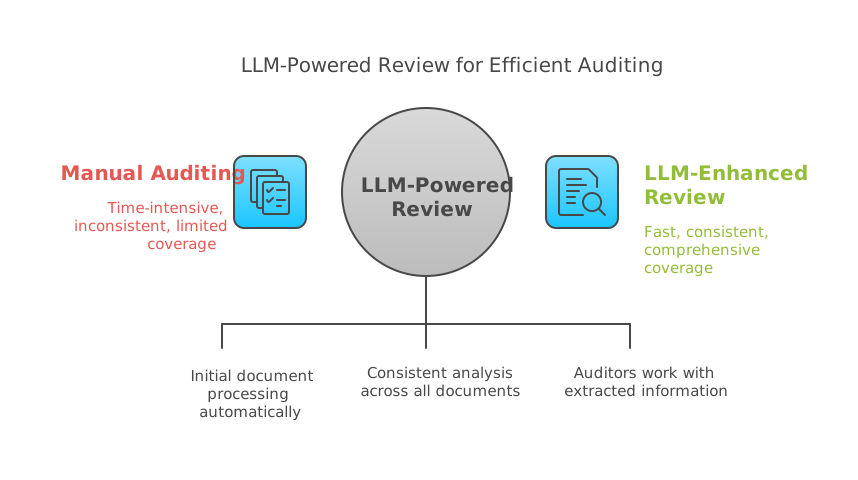
Regulatory agencies implementing LLM-powered document processing have transformed this workflow through several key innovations:
Standardized query frameworks establish consistent analytical approaches across all insurance company reviews. Financial experts and regulatory specialists collaborate to develop comprehensive question sets covering capital adequacy, asset quality, reinsurance arrangements, and other critical factors affecting insurer stability.
Automated initial analysis applies these query frameworks to each submitted report, extracting relevant information and generating preliminary assessments of regulatory compliance and financial stability. This automation ensures that every report receives thorough coverage of all standard analytical dimensions.
Auditor augmentation positions human regulators to review the extracted information and automated assessments rather than performing initial information gathering. This approach allows regulators to focus their expertise on evaluating implications and identifying concerning patterns rather than locating relevant data points.
Organizations implementing this approach report several significant improvements:
Analytical throughput has increased dramatically, with auditors able to complete initial assessments in hours rather than days. One regulatory agency reported increasing the number of insurance companies each auditor could effectively oversee by approximately 300%.
Analytical consistency has improved through standardized query frameworks applied uniformly across all companies. This consistency enables more reliable comparison across insurers and more systematic identification of outliers or concerning patterns.
Review depth has expanded as the time saved on basic information gathering allows regulators to ask more questions and explore potential concerns more thoroughly. Several agencies report identifying subtle risk indicators that likely would have been overlooked in traditional manual reviews.
These benefits translate directly to improved regulatory effectiveness and potentially enhanced financial system stability through more thorough oversight of insurance company financial conditions.
Private equity firms conduct intensive due diligence before investing in target companies, examining financial performance, market position, operational efficiency, and potential risks. This process traditionally required large teams of analysts and lawyers reviewing hundreds of documents provided in data rooms.
The conventional due diligence process faced several significant constraints:
Extreme time pressure characterized most private equity transactions, with firms typically having six to eight weeks to complete thorough analyses of complex businesses. This time constraint often forced difficult tradeoffs between analytical thoroughness and transaction timelines.
Document volume challenges arose as investment banks commonly provided hundreds or thousands of documents spanning financial statements, contracts, compliance records, and operational reports. Manually reviewing all these materials exceeded practical time constraints, forcing analysts to prioritize certain documents while potentially missing important information in others.
Coordination complexity emerged when multiple specialists financial analysts, legal experts, operations consultants, and industry advisors needed to extract and share relevant information from overlapping document sets. This complexity created risks of information silos or duplicated effort.
These limitations affected not only process efficiency but potentially investment outcomes by constraining the thoroughness of pre-transaction risk assessment and opportunity identification.
Private equity firms implementing LLM-powered document processing have transformed their due diligence workflows:
Comprehensive document ingestion processes all available materials in the data room, making the entire document collection available for analysis rather than forcing upfront prioritization decisions. This approach ensures that potentially important information isn't overlooked simply because it appears in seemingly less critical documents.
Specialized query frameworks address different analytical dimensions financial performance, legal risks, operational efficiency, market position allowing subject matter experts to define the questions most relevant to their domains. These frameworks typically include both standard questions applicable to all transactions and industry-specific questions relevant to particular target types.
Collaborative analysis platforms enable multiple specialists to simultaneously examine different aspects of the target company while maintaining awareness of findings across domains. When legal experts identify contingent liabilities, for instance, financial analysts can immediately incorporate these findings into valuation models.
Private equity firms report several significant advantages from this transformed approach:
Diligence acceleration reduces the typical timeline from six-eight weeks to three-four weeks while maintaining or increasing analytical thoroughness. This acceleration creates competitive advantage in auction processes where speed often determines which bidders receive serious consideration from sellers.
Resource optimization allows firms to conduct more thorough diligence without proportionately increasing team size. Several firms report completing comprehensive analysis with approximately 40% fewer analyst hours than comparable transactions using traditional methods.
Risk identification improves through more exhaustive document coverage and cross-domain information synthesis. Multiple firms report identifying material risks such as customer concentration issues, contract renewal uncertainties, or undisclosed liabilities that likely would have been missed in traditional processes due to time constraints or document prioritization decisions.
These benefits translate directly to improved investment selection, more accurate valuation, and potentially enhanced returns through better risk-adjusted decision-making.
Commercial real estate transactions require thorough underwriting before banks commit to financing. This process involves analyzing property fundamentals, tenant quality, market conditions, and potential risks to ensure loan repayment capacity.
Conventional real estate underwriting faced several efficiency challenges:
Manual extraction requirements forced analysts to review numerous documents property condition reports, environmental assessments, lease agreements, market studies to gather relevant information. This process typically consumed days of analyst time for each prospective loan.
Standardization difficulties arose as information appeared in inconsistent formats across different property types, markets, and documentation standards. This inconsistency required analysts to adapt their approach for each transaction rather than following uniform procedures.
Proposal delays resulted from the time-intensive nature of gathering and synthesizing information before investment committees could evaluate potential loans. In competitive lending markets, these delays potentially cost banks valuable lending opportunities.
These limitations affected not only operational efficiency but potentially lending outcomes by constraining the number of opportunities banks could effectively evaluate and slowing response times to borrowers.
Commercial real estate lenders implementing LLM-powered document processing have transformed their underwriting workflows:
Standardized underwriting criteria define specific questions addressing property quality, tenant strength, market conditions, and risk factors. These criteria ensure consistent evaluation across properties while accommodating differences between property types (office, retail, industrial, multifamily) through specialized query subsets.
Automated document analysis extracts relevant information from property reports, environmental assessments, lease agreements, and market studies. This automation enables comprehensive coverage of all documentation rather than selective review based on perceived importance.
Expedited term sheet generation utilizes extracted information to quickly populate standardized lending proposals for investment committee review. This acceleration enables more responsive communication with potential borrowers and faster transaction processing.
Commercial real estate lenders report several significant advantages:
Processing efficiency improvements reduce typical underwriting timelines from weeks to days. One regional bank reported decreasing average underwriting time from approximately 15 business days to 3 business days while maintaining thorough risk assessment.
Proposal quality enhancements result from more comprehensive information extraction and standardized analysis frameworks. Several lenders report that more thorough documentation review has improved their ability to identify appropriate loan terms and structures based on property-specific risk factors.
Competitive advantage emerges from faster response times to borrowers, particularly in active markets where multiple lenders compete for attractive lending opportunities. The ability to present term sheets to borrowers days or weeks before competitors translates directly to increased lending volume and market share.
These benefits translate to both operational efficiency and potentially improved loan portfolio performance through more thorough risk assessment and appropriate structuring.
The real-world examples described above illustrate how LLM-powered document processing transforms specific business processes. Looking across these implementations reveals broader patterns in how this technology changes document-centric workflows across domains.
Perhaps the most fundamental transformation involves redefining how work is divided between human experts and automated systems:
Information gathering transitions from human to machine responsibility. Rather than having skilled professionals spend hours locating relevant information within documents, LLM-based systems perform this initial extraction, allowing humans to begin their work with organized, relevant information already assembled.
Pattern recognition becomes a collaborative activity where machines identify standard patterns while humans focus on exceptions, anomalies, and contextual factors requiring domain expertise. This collaboration maximizes the comparative advantages of both human and machine intelligence.
Judgment application remains primarily human-centered but becomes more informed through more comprehensive information access and preliminary analysis. Human experts can focus their cognitive capacity on evaluating implications and making decisions rather than gathering inputs for those decisions.
This redefined division of labor allows organizations to leverage both technological capabilities and human expertise more effectively, focusing each on the aspects of work where they add greatest value.
Successful implementations balance process standardization for consistency with flexibility for case-specific needs:
Structured frameworks establish consistent analytical approaches across similar cases, ensuring thorough coverage of standard considerations and enabling meaningful comparison across transactions or entities. These frameworks typically incorporate industry best practices and organizational experience from previous similar analyses.
Customization mechanisms allow adaptation to unique case characteristics without sacrificing structural consistency. Query frameworks might include standard sections applicable to all cases alongside optional modules activated for particular scenarios or industry-specific considerations.
Iterative refinement processes capture insights from each implementation to continuously improve analytical frameworks. When analysts identify new questions that proved valuable in specific cases, these questions can be incorporated into standard frameworks for future use.
This balance ensures that organizations maintain analytical consistency while adapting to diverse scenarios and continuously improving their analytical approaches based on accumulated experience.
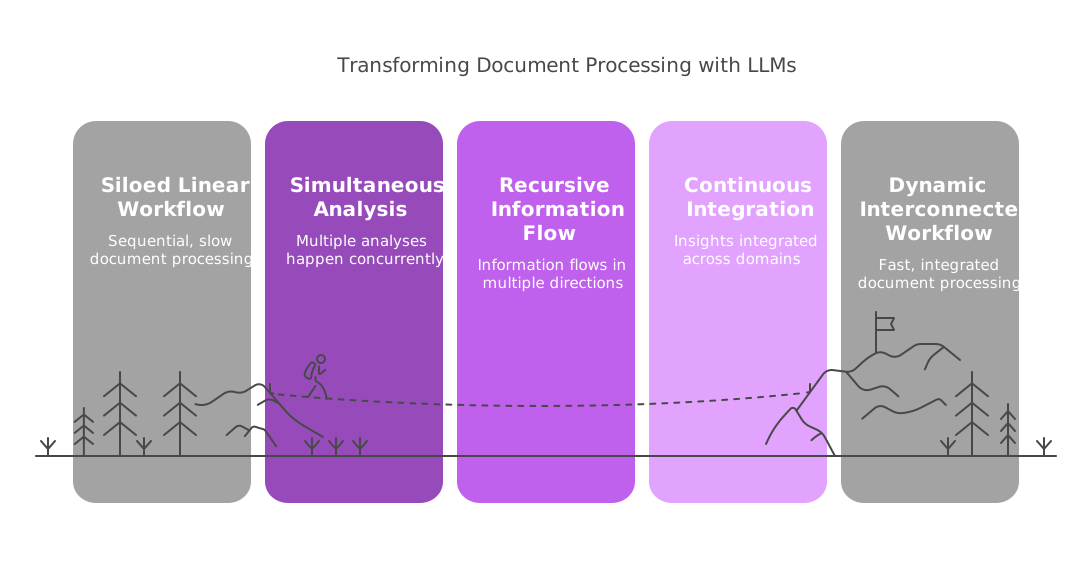
Traditional document review followed predominantly linear workflows, with information moving sequentially through defined stages. LLM-powered approaches enable more dynamic, recursive analytical processes:
Simultaneous multi-perspective analysis allows different analytical dimensions to be explored concurrently rather than sequentially. Financial, legal, operational, and market analyses can proceed in parallel, with insights from each domain immediately available to inform the others.
Iterative refinement enables analysts to progressively deepen their investigation based on initial findings. When preliminary analysis reveals potential concerns or opportunities, analysts can rapidly formulate more specific follow-up queries to explore these areas more thoroughly.
Continuous integration of new information accommodates documents added throughout the analytical process. As additional materials become available, they can be immediately incorporated into the analysis without requiring process restart or extensive manual review.
This transition from linear to recursive workflows enables more dynamic, responsive analytical processes that adapt to emerging insights and evolving information availability.
Organizations seeking to implement LLM-powered document processing must develop appropriate technical infrastructure and organizational capabilities. Understanding the essential components of effective implementations can guide successful development efforts.
Effective LLM-powered document processing platforms incorporate several critical technical elements:
Document processing pipelines transform documents from their native formats (PDF, Word, Excel, images) into representations suitable for LLM analysis. These pipelines typically include OCR capabilities for scanned documents, table extraction for structured data, and layout analysis to preserve document structure.
Knowledge retrieval systems organize processed documents to enable efficient identification of relevant content based on queries. These systems often employ vector databases or other semantic retrieval approaches to identify conceptually relevant content rather than relying solely on keyword matching.
Query processing components translate user questions or predefined query sets into effective prompts for the underlying LLMs. These components often include techniques for breaking complex questions into subqueries, handling context limitations, and ensuring appropriate source attribution.
LLM integration layers connect the platform to appropriate language models through APIs or local deployment. These layers handle context management, response processing, and often include specialized prompting strategies optimized for document analysis tasks.
Output generation modules transform LLM responses into appropriate formats for different consumption contexts—detailed reports, executive summaries, structured data for downstream systems, or interactive dashboards for exploratory analysis.
The specific implementation of these components varies based on organizational needs, document characteristics, and available technology resources, but all effective platforms address these fundamental requirements.
Beyond technical infrastructure, successful implementation requires developing appropriate organizational capabilities:
Domain expertise translation involves capturing the knowledge of subject matter experts in query frameworks, evaluation criteria, and output requirements. This translation ensures that automated systems address the actual information needs of business processes rather than technical capabilities in search of applications.
Implementation methodology development establishes systematic approaches for tackling new document processing challenges. Rather than treating each implementation as a unique project, effective organizations develop repeatable methodologies for analyzing requirements, configuring systems, and measuring outcomes.
Cross-functional collaboration mechanisms enable ongoing cooperation between domain experts who understand business requirements and technical specialists who implement LLM-powered solutions. This collaboration often involves designated "translators" who can bridge business and technical domains.
These organizational capabilities prove as important as technical infrastructure in achieving successful implementations and sustainable value generation.
Given the critical nature of many document processing applications, establishing appropriate accuracy verification and building user trust require specific attention:
Source attribution mechanisms ensure that all extracted information maintains clear links to source documents. These connections allow users to verify any specific information point against original documentation, building confidence in system outputs.
Confidence indication approaches communicate the system's certainty about different information elements. Rather than presenting all extracted information with uniform confidence, effective implementations distinguish between directly stated facts, reasonably inferred information, and more speculative conclusions.
Verification workflows establish appropriate human review based on information materiality and confidence levels. Critical information with lower confidence scores might require mandatory human verification, while routine information with high confidence might proceed with spot-checking or statistical quality control.
User education programs help professionals understand both the capabilities and limitations of LLM-powered systems. This understanding enables appropriate reliance on automated outputs while maintaining necessary critical evaluation of results.
These considerations ensure that LLM-powered document processing serves as a reliable foundation for consequential business decisions.
The integration of Large Language Models into Intelligent Document Processing represents more than incremental improvement to existing workflows—it fundamentally transforms how organizations extract value from their document collections and make document-informed decisions.
The implementations examined in this article demonstrate several dimensions of impact already being realized:
Efficiency transformation shifts document processing from days or weeks to hours or minutes while simultaneously increasing analytical thoroughness. This acceleration enables more responsive decision-making without sacrificing quality.
Analytical depth enhancement allows more comprehensive examination of document collections than practical time constraints would permit with manual approaches. Organizations report identifying significant insights that likely would have been missed under traditional constraints.
Role evolution for knowledge workers transitions professionals from information gatherers to insight generators and decision makers. This evolution both improves organizational effectiveness and increases professional satisfaction by focusing human effort on higher-value activities.
These impacts extend across industries and document-intensive functions, from financial services and legal analysis to regulatory compliance and business intelligence.
Several emerging trends suggest how this technology will continue evolving:
Multimodal document understanding capabilities are rapidly advancing, improving the ability to integrate textual information with visual elements like charts, diagrams, and images. These capabilities will further enhance the comprehensiveness of document analysis, particularly for materials that communicate key information visually.
Domain-specific optimization continues as organizations develop specialized frameworks for particular industries or functions. These specialized implementations incorporate domain-specific terminology, analytical frameworks, and decision criteria to enhance relevance and accuracy.
Integration with structured data systems will increasingly connect document-derived insights with information from databases, creating more comprehensive analytical environments. This integration will enable analyses that combine the structured precision of databases with the rich context of documents.
These trends suggest that LLM-powered document processing will continue expanding both its capabilities and its applications across organizational functions.
For organizations confronting document-intensive processes, several strategic implications emerge:
Competitive necessity is developing in document-intensive fields as early adopters realize significant efficiency and effectiveness advantages. Organizations that delay implementation may find themselves at competitive disadvantage in terms of both operational efficiency and decision quality.
Implementation approach matters significantly for realizing potential value. Organizations achieving greatest success typically begin with focused applications addressing specific document challenges rather than attempting enterprise-wide implementation immediately.
Capability building requires balanced investment in both technical infrastructure and organizational adaptation. Successful organizations develop not only appropriate technology but also the human capabilities to effectively leverage these tools within business processes.
As with previous transformative technologies, the greatest advantages will likely accrue to organizations that view LLM-powered document processing not merely as efficiency enhancement but as opportunity to fundamentally reimagine how they extract insights from information and make document-informed decisions.
The examples and analysis presented here offer both practical guidance for implementation and strategic perspective on the transformative potential of this rapidly evolving technological approach. As organizations across sectors confront ever-increasing document volumes and complexity, LLM-powered document processing will likely become an essential capability for maintaining operational effectiveness and decision quality.

Head IT Operations - Co Founder of Artificio
See it in your SAP environment
Bring us a document, a process, or a bottleneck. We'll show how Artificio captures, validates, and posts into SAP — then scale from there.
Security & compliance
ISO 27001:2013 certified, SOC 2 Type 2 compliant, GDPR and HIPAA ready. Every agent action is logged, auditable, and runs in isolated environments.