

Blog
Leveraging LLM for Intelligent PDF Document Analysis
Explore a novel framework leveraging Large Language Models for advanced PDF document intelligence, including information extraction and question answering.

Blog
Explore a novel framework leveraging Large Language Models for advanced PDF document intelligence, including information extraction and question answering.
The Portable Document Format (PDF) has established itself as the de facto standard for document exchange and preservation across diverse domains including legal, medical, financial, and academic sectors. Its capacity to maintain formatting consistency across different platforms and operating systems has contributed to its widespread adoption since its introduction by Adobe in the early 1990s. However, the very features that make PDF a robust format for human consumption complex layout structures, embedded graphics, and formatted text simultaneously present significant challenges for automated information extraction and analysis systems.
The ability to efficiently extract, process, and analyze information from PDF documents is increasingly crucial in the contemporary information landscape. Organizations across sectors accumulate vast repositories of PDF documents containing critical information, from financial statements and legal contracts to research papers and technical documentation. The manual extraction of this information is time-consuming, error-prone, and increasingly impractical given the scale of modern document repositories. Consequently, there is a pressing need for sophisticated document intelligence systems capable of automatically extracting and interpreting information from PDF files with high accuracy and contextual understanding.
Traditional approaches to PDF information extraction have relied primarily on rule-based systems, optical character recognition (OCR), and machine learning techniques designed specifically for document understanding. While these approaches have yielded some success, they often struggle with document variability, complex layouts, and the contextual interpretation of extracted information. Furthermore, these methods typically require extensive domain-specific customization, limiting their generalizability across different document types and use cases.
The advent of Large Language Models (LLMs) represents a paradigm shift in natural language processing and understanding. These models, trained on vast corpora of text data, demonstrate remarkable capabilities in comprehending and generating human language across diverse contexts. Their potential application to document intelligence tasks, particularly for PDF information extraction and analysis, offers promising avenues for overcoming the limitations of traditional approaches. LLMs bring to bear sophisticated language understanding capabilities that can potentially transcend the structural complexities of PDF documents, enabling more accurate and contextually aware information extraction.
This paper presents a methodological framework for leveraging LLMs to enhance PDF document intelligence. We begin by examining the structure of PDF documents and the challenges they present for automated information extraction. We then review traditional extraction methods and their limitations, setting the stage for our proposed LLM-powered approach. The core of our framework integrates document vectorization, semantic retrieval, and LLM-based information synthesis to create robust question-answering capabilities for PDF documents. We provide implementation details, evaluation metrics, and a discussion of the framework's limitations and potential future developments.
The technical architecture of PDF files is fundamentally distinct from other document formats, presenting unique challenges for information extraction systems. At its core, a PDF file comprises a collection of objects organized into a hierarchical structure. These objects include content streams containing text and graphics, font specifications, metadata, and a document structure tree. The PDF format employs a page description language derived from PostScript, focusing primarily on the visual representation of content rather than its semantic organization.
PDF documents encode text as sequences of character codes positioned at specific coordinates on a page. This coordinate-based text positioning allows for complex layouts but divorces text from its logical structure. Unlike formats such as HTML or XML, which explicitly encode document structure, PDF primarily encodes visual appearance. Text that visually appears as a paragraph to a human reader may be represented internally as disconnected text elements without explicit indication of their logical relationship. The absence of inherent structural markup in PDFs necessitates the reconstruction of logical document structure during the extraction process.
Font handling in PDF documents introduces additional complexities. PDFs can embed custom fonts or reference standard fonts, and the encoding of characters within these fonts may not follow standard Unicode conventions. Font substitution and the mapping of character codes to Unicode can introduce discrepancies between the visual appearance of text and its extracted representation. Furthermore, PDFs can employ various compression and encoding schemes for content streams, requiring specialized decompression algorithms during the extraction process.
The extraction of structured information from PDF documents presents numerous challenges stemming from their technical composition and the diversity of document types. These challenges can be categorized into several key areas:
Layout Complexity: PDF documents often employ sophisticated layouts including multi-column text, sidebars, headers, footers, and floating elements. The spatial arrangement of content on a page conveys structural information that is immediately apparent to human readers but challenging for automated systems to interpret. Determining the correct reading order of text elements requires sophisticated layout analysis algorithms that can infer logical structure from spatial positioning.
Content Heterogeneity: PDFs frequently contain heterogeneous content types including formatted text, tables, images, charts, forms, and annotations. Each content type requires specialized extraction techniques, and the boundaries between different content elements may not be explicitly defined. Tables, in particular, pose significant challenges as they combine spatial positioning with logical relationships between data cells.
Document Variability: The format and structure of PDF documents vary significantly across different domains and sources. Financial statements, legal contracts, academic papers, and technical manuals each employ distinct conventions for organizing information. This variability necessitates adaptive extraction approaches capable of accommodating diverse document structures without extensive customization.
Image-Based Content: A substantial portion of PDF documents, particularly those created through scanning physical documents, store information as images rather than text. These documents require optical character recognition (OCR) preprocessing, which introduces additional sources of error and uncertainty in the extraction process. Even with advanced OCR technologies, the accurate recognition of text in low-quality scans, documents with unusual fonts, or those containing handwritten elements remains challenging.
Text Flow Ambiguity: Unlike formats that explicitly encode reading order, the sequence in which text elements should be read in a PDF must be inferred from their spatial positioning. This inference is particularly challenging in documents with complex layouts where the logical reading order may diverge from a simple left-to-right, top-to-bottom progression. Column boundaries, page transitions, and the integration of non-text elements all contribute to this ambiguity.
Semantic Understanding: Beyond the basic extraction of text, deriving meaningful information from PDF documents requires semantic understanding of the content. Identifying entity relationships, contextual interpretations, and the significance of textual elements within the broader document context demands sophisticated natural language understanding capabilities that transcend mere text extraction.
These challenges have historically necessitated specialized extraction approaches that combine multiple techniques, including rule-based systems, computer vision algorithms, and machine learning models. However, traditional approaches often struggle to generalize across diverse document types and frequently require extensive customization for specific document formats. The integration of LLMs into PDF extraction pipelines offers the potential to address these challenges through more sophisticated language understanding and contextual interpretation capabilities.
Rule-based extraction approaches employ predefined patterns, heuristics, and templates to identify and extract specific information from PDF documents. These systems typically rely on regular expressions, coordinate-based extraction, and pattern matching to locate and extract targeted data elements. The fundamental premise of rule-based extraction is that documents within a specific domain often follow consistent formatting conventions that can be codified into extraction rules.
These approaches have demonstrated efficacy in scenarios involving highly structured documents with consistent formatting, such as standardized forms and templated reports. When document formats are stable and well-defined, rule-based systems can achieve high accuracy with relatively straightforward implementation. They also offer the advantage of explainability, as the extraction rules are explicitly defined and can be traced back to specific patterns in the document.
However, rule-based extraction systems exhibit significant limitations. Their performance degrades substantially when confronted with document variability, as even minor formatting changes can disrupt established extraction patterns. The development of extraction rules requires substantial domain expertise and manual effort, necessitating extensive rule refinement and maintenance as document formats evolve. Furthermore, rule-based approaches struggle with unstructured or semi-structured document components, where information is presented in natural language without consistent formatting cues.
The scalability of rule-based systems is inherently limited by the need to develop and maintain separate rule sets for different document types. This characteristic renders them impractical for organizations dealing with diverse document collections. Additionally, rule-based approaches typically focus on extracting specific data elements rather than comprehensively understanding document content, limiting their applicability for complex information retrieval tasks.
Optical Character Recognition (OCR) technology serves as a foundational component in PDF extraction pipelines, particularly for documents containing image-based text. OCR systems employ computer vision and pattern recognition techniques to convert images of text into machine-encoded text, enabling further processing and analysis. Modern OCR systems leverage deep learning approaches, including convolutional neural networks (CNNs) and recurrent neural networks (RNNs), to achieve higher accuracy across diverse fonts, languages, and document qualities.
OCR has evolved substantially in recent decades, with contemporary systems achieving high accuracy rates under optimal conditions. Advanced OCR engines can process multiple languages, recognize a wide range of fonts, and adapt to various text orientations. When integrated with pre-processing techniques such as image enhancement, deskewing, and noise reduction, OCR systems can effectively handle even challenging document images with acceptable accuracy.
Nevertheless, OCR technology continues to face significant limitations. Recognition accuracy decreases markedly when processing low-quality images, unusual fonts, handwritten text, or documents with complex backgrounds. OCR errors propagate through subsequent processing stages, potentially compromising the integrity of extracted information. Additionally, OCR processes typically discard layout information, converting document images into plain text without preserving structural relationships between textual elements.
The post-processing of OCR output presents additional challenges. OCR systems may introduce artifacts such as erroneous characters, word splitting, and improper line breaks that require correction through sophisticated post-processing algorithms. Furthermore, OCR primarily addresses the recognition of text within images but does not inherently solve the challenges of understanding document structure, semantic relationships, or contextual interpretation.
Recent years have witnessed the emergence of specialized machine learning models designed specifically for document understanding tasks. These approaches employ various neural network architectures to address challenges in document layout analysis, entity recognition, and information extraction. Notable examples include LayoutLM and its variants, which integrate text content with spatial layout information through transformer-based architectures. These models leverage pre-training on large document corpora to develop representations that capture both textual and structural aspects of documents.
Machine learning approaches offer several advantages over traditional rule-based and OCR-centric methods. They can adapt to document variability through exposure to diverse training examples, reducing the need for manual rule definition. When trained on sufficiently representative datasets, these models can generalize across different document types within a domain. Furthermore, they can capture complex relationships between document elements, enabling more sophisticated extraction tasks such as form field detection, table structure recognition, and entity relationship extraction.
Despite these advancements, machine learning-based document understanding systems face their own set of limitations. They typically require substantial labeled training data specific to particular document types or domains, limiting their out-of-the-box applicability to novel document formats. The creation of training datasets for document understanding tasks is labor-intensive, requiring manual annotation of document structures, entity types, and relationships. Transfer learning approaches partially mitigate this challenge but may still require domain-specific fine-tuning.
Additionally, many document understanding models focus on specific tasks such as layout analysis or entity recognition rather than providing comprehensive document intelligence capabilities. The integration of these task-specific models into end-to-end extraction pipelines introduces complexity and potential error propagation between components. Furthermore, while these models demonstrate improved adaptability compared to rule-based approaches, they may still struggle with extremely varied document formats or those significantly diverging from their training distribution.
In practical applications, PDF extraction systems often employ hybrid approaches that combine elements of rule-based extraction, OCR technology, and machine learning models. These hybrid systems leverage the strengths of different methodologies while attempting to mitigate their individual limitations. A typical hybrid pipeline might employ OCR for image-based text, machine learning models for layout analysis and entity recognition, and rule-based components for specific extraction tasks with well-defined patterns.
Hybrid approaches have demonstrated enhanced performance compared to single-method implementations, particularly for complex document processing scenarios. They can adapt to different document characteristics, applying appropriate techniques based on document type, quality, and extraction requirements. Furthermore, hybrid systems can incorporate validation and correction mechanisms that improve overall extraction accuracy through cross-verification between different extraction methods.
However, hybrid approaches also introduce increased system complexity, requiring sophisticated orchestration between components and careful handling of interactions between different extraction methodologies. The performance of these systems remains constrained by the limitations of their constituent components, and they still typically require substantial domain-specific customization for optimal performance. Moreover, traditional hybrid approaches generally lack the contextual understanding and reasoning capabilities necessary for advanced document intelligence tasks such as question answering and implicit information inference.
Large Language Models represent the culmination of decades of research in natural language processing and deep learning. These models employ transformer-based architectures with billions of parameters, trained on vast corpora of text data through self-supervised learning objectives. The scale of these models, both in terms of parameter count and training data volume, enables them to capture nuanced patterns in language use across diverse contexts. Through extensive pre-training, LLMs develop sophisticated representations of language that encode semantic, syntactic, and pragmatic aspects of text.
The capabilities of contemporary LLMs extend far beyond simple text generation. These models demonstrate remarkable proficiency in understanding context, recognizing entities and relationships, inferring implicit information, and reasoning about textual content. They can maintain coherence over long contexts, enabling the processing of extended document passages. Furthermore, LLMs exhibit emergent abilities not explicitly trained for, including zero-shot and few-shot learning capabilities that allow them to perform tasks with minimal task-specific examples.
Of particular relevance to document intelligence is the contextual understanding capability of LLMs. Unlike traditional extraction approaches that process textual elements in isolation, LLMs can interpret information within its broader document context. This contextual awareness enables more accurate entity resolution, reference disambiguation, and inference of relationships between document elements. Additionally, the language generation capabilities of LLMs facilitate the reformulation of extracted information into coherent responses tailored to specific queries.
Recent advancements in multi-modal LLMs have further expanded their potential applications for document intelligence. Models capable of processing both text and images can potentially integrate visual and textual information from documents, addressing challenges related to layout understanding and the interpretation of graphical elements. While these capabilities are still evolving, they represent a promising direction for comprehensive document understanding.
LLMs offer several distinct advantages for PDF document processing compared to traditional extraction approaches. Their foundation in natural language understanding enables them to transcend many of the structural challenges inherent in PDF documents. Rather than relying solely on layout analysis or pattern matching, LLMs can interpret textual content semantically, extracting meaning even when the document structure is complex or inconsistent.
The adaptability of LLMs across different document types and domains represents another significant advantage. Through exposure to diverse text during pre-training, these models develop representations that generalize across various document formats, reducing the need for domain-specific customization. This adaptability is particularly valuable for organizations dealing with heterogeneous document collections spanning multiple domains and formats.
The contextual processing capabilities of LLMs address the challenge of maintaining coherence across document sections. Traditional extraction approaches often struggle to preserve contextual relationships between different parts of a document, particularly when information must be integrated across pages or sections. LLMs can maintain context over extended passages, enabling more coherent interpretation of document content and more accurate responses to complex queries spanning multiple document sections.
Furthermore, LLMs enable natural language interfaces for document interaction through question-answering capabilities. Users can query documents using natural language questions rather than constructing structured queries or navigating complex search interfaces. This accessibility democratizes access to document information, allowing non-technical users to retrieve specific information without specialized query formulation skills.
Despite their transformative potential, LLMs present several limitations and challenges for PDF document processing. Context window constraints represent a significant limitation, as even the most advanced LLMs have finite context capacities. While these capacities continue to expand with model evolution, they remain insufficient for processing lengthy documents in their entirety, necessitating document segmentation and context management strategies in practical implementations.
The computational requirements of LLMs pose challenges for deployment, particularly in resource-constrained environments. Inference with large models demands substantial computational resources, potentially limiting their applicability in settings without access to adequate hardware. Although model compression and optimization techniques partially address this challenge, they often involve trade-offs between computational efficiency and model performance.
The "hallucination" phenomenon, wherein LLMs generate plausible but factually incorrect information, represents a critical concern for document intelligence applications. When processing documents, LLMs may inadvertently introduce inaccuracies by generating content not supported by the source material. This tendency necessitates careful system design with verification mechanisms to ensure the factual accuracy of extracted information.
Additionally, while LLMs possess sophisticated language understanding capabilities, their grasp of visual and structural document elements remains limited. Even multi-modal models currently demonstrate incomplete understanding of complex document layouts, table structures, and the semantic significance of visual formatting. Consequently, LLM-based approaches may require integration with specialized document structure analysis components to fully capture the information encoded in document formatting.
Privacy and security considerations also present challenges for LLM deployment in document processing contexts. Many documents contain sensitive information, and the transmission of such content to external LLM services raises potential privacy concerns. Organizations handling confidential documents may require on-premises deployment options or secure processing pipelines with robust data protection measures.
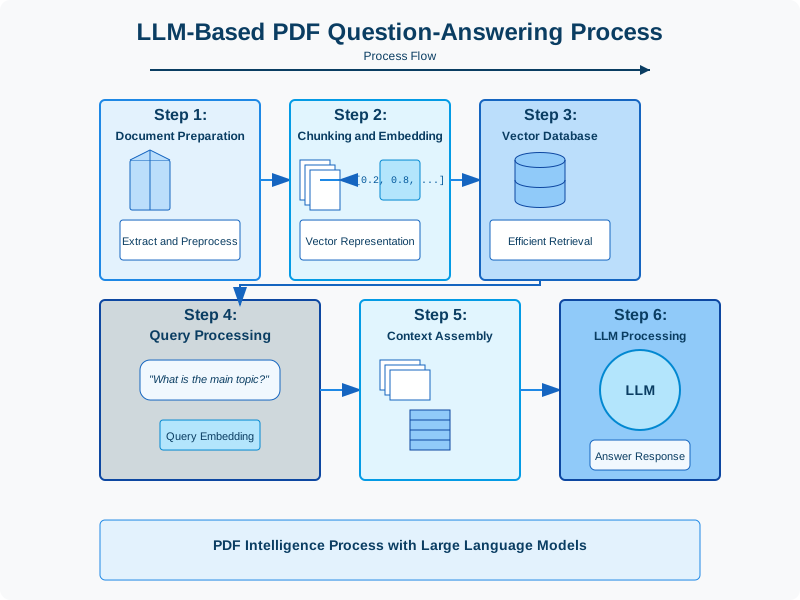
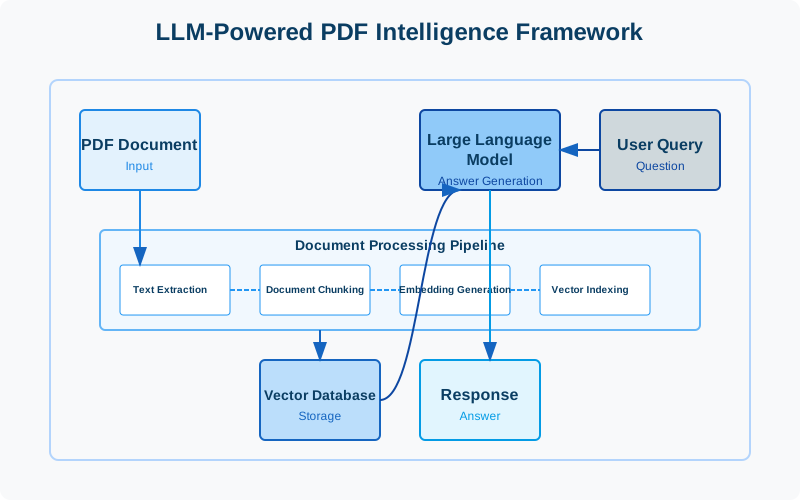
The proposed framework for LLM-powered PDF intelligence integrates document processing, vector representation, retrieval mechanisms, and language model inference into a cohesive system for document understanding and question answering. This architecture addresses the limitations of both traditional extraction methods and pure LLM approaches through strategic component integration and processing pipeline design.
At the framework's foundation lies a document processing pipeline responsible for transforming raw PDF documents into structured representations amenable to further analysis. This pipeline incorporates text extraction, document segmentation, and preprocessing components tailored to the specific characteristics of PDF documents. The extracted content undergoes chunking into semantically coherent segments that balance contextual completeness with the context limitations of downstream LLMs.
The vector representation subsystem transforms document chunks into numerical embeddings that capture their semantic content. These embeddings are generated through specialized embedding models that project textual content into high-dimensional vector spaces where semantic similarity corresponds to vector proximity. The resulting embeddings are indexed in a vector database optimized for efficient similarity search, enabling retrieval of relevant document content in response to user queries.
The query processing component transforms natural language questions into the same vector space as document chunks, facilitating the identification of relevant document sections through similarity computation. Retrieved chunks undergo context assembly to create a coherent prompt that incorporates both the user query and relevant document content. This assembled context serves as input to the LLM inference component, which generates responses that synthesize information from the provided document context.
The framework incorporates feedback mechanisms that capture user interactions and response evaluations to continuously refine retrieval and response generation processes. These mechanisms enable adaptive improvement through both explicit user feedback and implicit signals derived from interaction patterns. Additionally, the architecture includes evaluation components that monitor system performance across various dimensions, facilitating continuous quality assessment and model refinement.
The document processing stage represents a critical foundation for the framework, directly influencing the quality and accuracy of downstream processes. For text-based PDFs, the framework employs specialized PDF parsing libraries that maintain awareness of document structure while extracting textual content. For image-based documents, the pipeline integrates advanced OCR processing with post-correction algorithms to achieve high-quality text extraction despite the challenges of image-based content.
Document segmentation strategies within the framework extend beyond naive chunking approaches that divide text based solely on length. Instead, the system employs semantic chunking algorithms that identify natural boundaries within documents, respecting paragraph structures, section divisions, and thematic transitions. This semantic awareness prevents the fragmentation of coherent information units, ensuring that related content remains grouped within the same chunks. For documents with explicit structural elements such as headers and sections, the chunking algorithm leverages these markers to enhance segmentation quality.
The framework addresses the challenge of maintaining cross-reference integrity through intelligent chunk overlapping strategies. By incorporating controlled redundancy between adjacent chunks, the system reduces the risk of losing contextual connections that span chunk boundaries. The degree of overlap is adaptively determined based on document characteristics, with greater overlap applied to densely interconnected content and reduced overlap for documents with more discrete sections.
Preprocessing pipelines within the framework standardize textual content to enhance downstream processing. These pipelines apply normalization techniques including whitespace standardization, character encoding harmonization, and the correction of common OCR artifacts. For specialized document types, domain-specific preprocessing modules handle particular formatting conventions, abbreviations, and terminology, improving the system's adaptability across diverse document domains.
The chunking process preserves metadata about each chunk's original location and context within the source document. This provenance information enables the system to accurately attribute information to its source and facilitates the reconstruction of broader context when necessary. The metadata includes hierarchical document position, proximity to structural elements such as headings, and relationships to other chunks, enriching the semantic representation of document segments.
The effectiveness of the framework relies substantially on the quality of the vector representations generated for document chunks and user queries. The system employs specialized embedding models designed specifically for document representation rather than generic text embeddings. These models capture the semantic essence of document segments while maintaining sensitivity to domain-specific terminology and concepts relevant to the document corpus.
The embedding generation process incorporates document structural information alongside textual content, enhancing the vector representations with awareness of each chunk's position and function within the broader document context. This structural awareness enables more nuanced similarity computation that considers not only thematic relevance but also structural appropriateness when retrieving document content in response to queries.
The framework implements hierarchical embedding strategies for documents with explicit structural organization. In these cases, the system generates embeddings at multiple granularity levels, including section-level and paragraph-level representations. This hierarchical approach enables more efficient retrieval through progressive refinement, first identifying relevant document sections before pinpointing specific content chunks within those sections.
Vector storage and indexing within the framework leverage specialized vector databases optimized for similarity search in high-dimensional spaces. These databases employ techniques such as approximate nearest neighbor search to achieve efficient retrieval even with large document collections. The indexing structure incorporates metadata filtering capabilities that allow retrieval refinement based on document properties, enhancing precision for queries targeting specific document types or sections.
The retrieval mechanism employs sophisticated relevance scoring that extends beyond simple cosine similarity. The scoring function incorporates multiple factors including semantic similarity, chunk position within the document, proximity to structural elements, and potential answer containment likelihood. This multifaceted scoring approach produces more contextually appropriate retrieval results compared to methods based solely on semantic similarity.
The framework's query processing component transforms natural language questions into effective retrieval queries through several sophisticated processing steps. Initial query analysis identifies question intent, expected answer type, and key entities mentioned in the query. This analysis informs subsequent query expansion and transformation processes that enhance retrieval effectiveness. For ambiguous queries, the system may generate multiple query variants to increase the likelihood of retrieving relevant content.
Query embedding generation employs the same embedding models used for document chunks, ensuring compatibility between query and document representations in the vector space. However, the embedding process incorporates query-specific optimizations that account for the structural differences between questions and document content. These optimizations enhance retrieval performance by addressing the inherent asymmetry between query formulation and document content expression.
The context assembly process represents a critical component that significantly influences the quality of LLM-generated responses. Rather than simply concatenating retrieved chunks, the system employs intelligent context arrangement strategies that establish a coherent narrative flow within the assembled context. The assembly process considers the logical relationships between chunks, arranging them to maximize coherence and minimize redundancy in the final context.
For queries requiring information synthesis across multiple document sections, the assembly process incorporates specialized handling to establish connections between disparate chunks. This may include the insertion of transitional text that clarifies relationships between sections or the reorganization of chunks to establish a more logical progression of information. The resulting assembled context presents information in a manner conducive to accurate interpretation by the LLM.
The framework implements dynamic context optimization to address LLM context window limitations. When the volume of relevant content exceeds context capacity constraints, the system employs adaptive summarization and prioritization techniques to ensure that the most pertinent information receives adequate representation within the context. This optimization process considers both content relevance to the query and information density when allocating context space.
The effective integration of LLMs into the document intelligence framework requires careful consideration of prompt engineering, model selection, and inference configuration. The system employs structured prompts that clearly delineate document content from query information, establishing explicit instructions for the LLM regarding the scope and nature of its response. These prompts include specific directives to cite document evidence, maintain factual accuracy, and acknowledge information gaps when appropriate.
Model selection within the framework considers the specific requirements of document intelligence tasks, prioritizing models with strengths in factual accuracy, context utilization, and structured information extraction. The system accommodates different LLM variants depending on the specific requirements of the deployment scenario, with configuration options ranging from highly optimized models for resource-constrained environments to high-capacity models for complex document understanding tasks.
Inference configuration represents another critical aspect of LLM integration. The framework employs carefully calibrated temperature and sampling parameters that balance response creativity with factual precision. Lower temperature settings are typically employed for factual extraction tasks, while slightly higher settings may be used for tasks requiring information synthesis or summarization across document sections.
The response generation process incorporates post-processing components that enhance the quality and utility of LLM outputs. These components verify factual consistency between the generated response and the provided document context, flagging potential hallucinations for correction. Furthermore, the post-processing pipeline formats responses according to user preferences, potentially incorporating structural elements such as section headings, bullet points, or emphasized text for improved readability.
For scenarios requiring structured information extraction rather than natural language responses, the framework implements specialized prompting strategies that guide the LLM to produce outputs in specific formats such as JSON or tabular structures. These strategies enable the integration of LLM-powered extraction with downstream systems that require structured data inputs rather than natural language text.
The evaluation of LLM-powered PDF intelligence systems demands comprehensive assessment across multiple dimensions of performance. While traditional information retrieval metrics provide valuable insights into retrieval effectiveness, they must be complemented by specialized metrics that address the unique aspects of LLM-based question answering. This section presents an integrated evaluation framework that encompasses retrieval accuracy, response quality, and system efficiency.
Retrieval precision and recall represent fundamental metrics for assessing the system's ability to identify relevant document content. Precision quantifies the proportion of retrieved chunks that contain information pertinent to the query, while recall measures the proportion of relevant information in the document that was successfully retrieved. These metrics provide complementary perspectives on retrieval performance, with precision focusing on retrieval specificity and recall addressing comprehensiveness. The F1 score, computed as the harmonic mean of precision and recall, offers a balanced assessment that accounts for both dimensions.
For question-answering tasks, answer accuracy transcends simple retrieval evaluation. This metric assesses whether the generated response correctly addresses the query based on document content. Accuracy evaluation requires the establishment of ground truth answers through expert annotation, enabling comparison between system-generated responses and reference answers. This comparison may employ exact match criteria for factual questions with unambiguous answers or allow for semantic equivalence in cases requiring interpretative responses.
Factual consistency represents another critical dimension of evaluation, measuring the alignment between the generated response and the source document content. This metric assesses whether the system's responses contain information contradicting the source material or fabricated details not present in the document. Factual consistency evaluation requires careful comparison between the generated response and the retrieved document chunks, potentially complemented by human review for ambiguous cases.
Contextual relevance evaluates the system's ability to provide responses appropriate to the specific context established by the query and document content. This metric considers whether the response addresses the query's intended meaning within the document's subject domain rather than providing generic or tangential information. Contextual relevance assessment typically requires human evaluation using standardized rubrics that define relevance criteria specific to the document domain.
Response comprehensiveness measures the completeness of the system's answer relative to the information available in the document. This metric evaluates whether the response incorporates all relevant information from the document rather than providing partial or fragmented answers. Comprehensiveness assessment considers both the breadth of information covered and the depth of detail provided, with evaluation criteria calibrated to the complexity of the query and the richness of the document content.
Beyond accuracy and relevance, practical deployment considerations necessitate the evaluation of efficiency and scalability dimensions. Processing latency measures the time required for the system to generate responses, encompassing document processing, retrieval, and LLM inference stages. This metric directly influences user experience and operational feasibility, particularly for interactive applications with real-time requirements. Latency evaluation should consider both average and percentile measurements to assess both typical performance and worst-case scenarios.
Computational resource utilization quantifies the system's demands in terms of processor, memory, and storage resources across different operational scales. This metric provides insights into deployment requirements and operational costs, guiding infrastructure planning and optimization efforts. Resource utilization assessment should consider both peak and sustained resource demands under realistic usage patterns.
Throughput capacity evaluates the system's ability to handle concurrent queries, measuring the maximum query volume that can be processed while maintaining acceptable performance characteristics. This metric is particularly relevant for multi-user deployments and high-volume applications where system responsiveness under load represents a critical requirement. Throughput evaluation should assess performance degradation patterns as query volume increases, identifying potential bottlenecks and capacity limitations.
Indexing efficiency measures the time and resources required to process and index new documents, influencing the system's adaptability to evolving document collections. This metric considers both the computational demands of the indexing process and the time delay between document addition and availability for querying. Efficient indexing processes enable more responsive adaptation to document collection changes, enhancing the system's practical utility in dynamic information environments.
The ultimate effectiveness of document intelligence systems depends on their practical utility for end users. User satisfaction metrics capture subjective assessments of system performance through structured feedback mechanisms or satisfaction surveys. These assessments provide holistic insights into the system's perceived value, complementing objective performance metrics with user-centered evaluation. Satisfaction measurement frameworks should address multiple dimensions including response quality, system responsiveness, and overall usability.
Task completion efficiency evaluates the system's impact on user workflow, measuring improvements in time or effort required to complete document-related tasks. This metric quantifies the practical benefits of the system in real-world usage scenarios, providing concrete evidence of operational value. Task efficiency evaluation typically involves comparative studies contrasting system-assisted performance with traditional manual processes.
Learning curve assessment measures the time and effort required for users to effectively utilize the system, influencing adoption rates and sustained usage patterns. This metric considers both initial training requirements and the progression of user proficiency over time, providing insights into the system's accessibility to users with varying technical backgrounds. Learning assessment may employ structured user studies with defined task sequences and performance tracking over multiple sessions.
Information discovery effectiveness evaluates the system's ability to surface relevant information that users might not have explicitly requested or known to exist. This metric addresses the system's value as an exploratory tool that enhances document utilization beyond simple fact retrieval. Discovery effectiveness assessment typically requires specialized evaluation protocols that introduce users to documents containing unexplored information relevant to their general interests or objectives.
The proposed framework addresses fundamental limitations of both traditional extraction methods and pure LLM approaches through strategic integration of document processing, vector representation, and language model inference. By structuring these components into a cohesive architecture, the framework enables sophisticated document intelligence applications that transcend simple text extraction to provide contextually aware information retrieval and synthesis.
The implementation considerations presented in this paper provide practical guidance for system development, outlining specific techniques for document processing, embedding generation, and LLM integration. These implementation details address the technical challenges inherent in PDF processing while leveraging the emerging capabilities of large language models. The evaluation framework establishes comprehensive metrics for assessing system performance across accuracy, efficiency, and user experience dimensions, providing a foundation for rigorous system validation and continuous improvement.
While the approach presented here represents a significant advancement in document intelligence capabilities, it also acknowledges important limitations and ethical considerations. The discussion of privacy, security, and ethical implementation provides a foundation for responsible deployment that respects information sensitivity, user privacy, and appropriate information attribution. Furthermore, the exploration of future research directions highlights promising avenues for addressing current limitations and extending capabilities into new domains.
As organizations increasingly seek to extract value from vast document repositories, the integration of LLM capabilities with document processing represents a transformative opportunity. By enabling more natural and contextually aware document interaction, these systems have the potential to significantly enhance information accessibility and utilization across diverse domains. The methodological framework presented in this paper provides a foundation for realizing this potential through principled implementation approaches that balance technical innovation with responsible deployment considerations.

Head IT Operations - Co Founder of Artificio
See it in your SAP environment
Bring us a document, a process, or a bottleneck. We'll show how Artificio captures, validates, and posts into SAP — then scale from there.
Security & compliance
ISO 27001:2013 certified, SOC 2 Type 2 compliant, GDPR and HIPAA ready. Every agent action is logged, auditable, and runs in isolated environments.