

Blog
What are AI Agents in Document Processing?
Explore how AI agents revolutionize document processing with advanced extraction, classification, and automation.

Blog
Explore how AI agents revolutionize document processing with advanced extraction, classification, and automation.
In today's data-driven business environment, organizations are constantly seeking ways to optimize their document processing workflows. The sheer volume of documents that enterprises manage from invoices and contracts to medical records and customer correspondence presents significant challenges in terms of efficiency, accuracy, and resource allocation. Traditional manual processing methods are not only time-consuming but also prone to human error and inconsistency. This is where AI agents have emerged as transformative solutions in document processing, revolutionizing how organizations handle their document-intensive operations.
AI agents in document processing represent a sophisticated evolution in intelligent automation technology. Unlike conventional document management systems that rely heavily on human intervention, these AI-powered entities can autonomously understand, interpret, and process documents with minimal human oversight. By leveraging advanced technologies such as natural language processing (NLP), machine learning (ML), and computer vision, AI agents can extract meaningful insights from unstructured documents, classify them according to content, validate the accuracy of extracted information, and seamlessly integrate this data into business workflows.
The significance of AI agents extends beyond mere automation. They embody a paradigm shift in how organizations approach document management transforming it from a reactive, labor-intensive process to a proactive, intelligence-driven function. As organizations increasingly recognize the strategic importance of efficient document processing in enhancing operational efficiency and competitive advantage, the adoption of AI agents has gained substantial momentum across various industries.
This article explores the nature, capabilities, and applications of AI agents in document processing, examining how they function, the benefits they offer, and the ways in which they are reshaping business operations in the digital age. By understanding the transformative potential of AI agents, organizations can make informed decisions about implementing these technologies to streamline their document workflows and unlock the full value of their documentary information.
AI agents represent a significant advancement over traditional automation technologies in document processing. To fully appreciate their capabilities, it is essential to understand how they differ from conventional approaches such as Robotic Process Automation (RPA) and rule-based systems.
The evolution of document processing technologies has witnessed a progression from simple rule-based systems to sophisticated AI agents. Early document management solutions relied primarily on predefined rules and templates to extract information from structured documents. While effective for standardized documents with consistent formats, these systems struggled with variations in layout, content, or document quality. Their rigid architecture required extensive customization for each document type, making them labor-intensive to implement and maintain.
RPA emerged as an advancement over rule-based systems, enabling the automation of repetitive tasks through software robots that mimic human actions. RPA solutions can follow prescribed workflows to process documents, interact with multiple applications, and execute predefined steps. However, traditional RPA exhibits limited adaptability to changing document formats or unexpected variations, as it fundamentally operates based on programmed instructions rather than understanding the semantic content of documents.
AI agents, by contrast, represent a quantum leap in document processing capabilities. They are characterized by their ability to perceive, reason, learn, and adapt qualities that distinguish them from their predecessors. Unlike rule-based systems or conventional RPA, AI agents can understand the context and meaning of document content, recognize patterns and relationships within data, learn from experience, and make intelligent decisions based on this understanding. This cognitive dimension allows them to handle unstructured documents, adapt to format variations, and improve their performance over time.
The sophisticated capabilities of AI agents stem from their multi-layered cognitive architecture, which typically encompasses several key components (refer to Figure 1: Cognitive Architecture of AI Agents in Document Processing). At the foundation lies the perception layer, where computer vision and optical character recognition (OCR) technologies enable the agent to "see" and digitize document content. Enhanced OCR capabilities allow modern AI agents to accurately process diverse document formats, including handwritten text, low-quality scans, and documents with complex layouts.
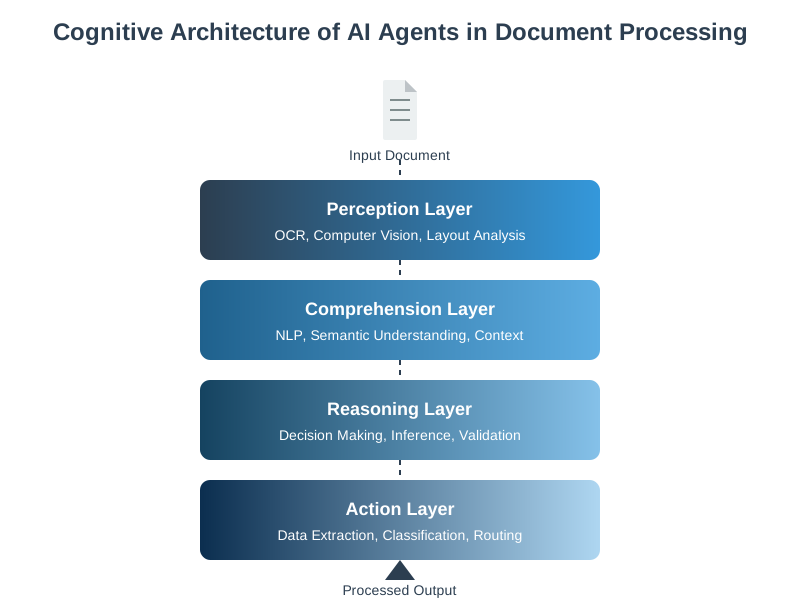
Above the perception layer resides the comprehension layer, where NLP and text analytics empower the agent to understand the semantic meaning of extracted text. This involves techniques such as named entity recognition, sentiment analysis, and contextual understanding, which collectively enable the agent to interpret document content in a manner similar to human comprehension. The comprehension layer also incorporates domain-specific knowledge that helps the agent understand industry-specific terminology and document conventions.
The reasoning layer constitutes the "brain" of the AI agent, where machine learning algorithms and inference engines process the comprehended information to make decisions. This may involve identifying relevant data points, validating information against business rules or external databases, and determining appropriate actions based on document content. Advanced AI agents employ sophisticated reasoning mechanisms, including probabilistic reasoning and knowledge graphs, to handle complex scenarios and uncertainty.
Finally, the action layer executes the decisions made by the reasoning layer, which may include extracting and structuring data, classifying documents, routing them to appropriate workflows, or triggering subsequent business processes. This layer also manages the integration with existing business systems, ensuring that processed information flows seamlessly into enterprise applications.
The interconnected nature of these cognitive layers enables AI agents to process documents holistically, considering not just individual data points but also the relationships between them and their broader business context. This comprehensive approach results in more accurate, contextually aware document processing that transcends the capabilities of traditional automation technologies.
Perhaps the most distinctive characteristic of AI agents is their capacity for learning and adaptation. Unlike static rule-based systems, AI agents employ machine learning techniques to improve their performance through experience. This learning occurs through various mechanisms:
This adaptability enables AI agents to handle document variations, accommodate changing business requirements, and progressively enhance their performance without constant reprogramming. As a result, they can maintain high accuracy levels even as document formats evolve or new document types are introduced.
The distinction between traditional automation and AI agents is not merely technical but fundamentally philosophical. While conventional automation tools aim to replicate human actions, AI agents aspire to emulate human cognitive processes perceiving, understanding, reasoning, and learning. This cognitive approach to document processing delivers a level of flexibility, accuracy, and intelligence that conventional automation cannot achieve, making AI agents particularly valuable for organizations dealing with diverse, complex document processing requirements.
The transformative impact of AI agents in document processing stems from their diverse and sophisticated capabilities. These capabilities enable them to handle complex document processing tasks with a level of intelligence and efficiency that surpasses traditional automated solutions. This section explores the core functionalities that define AI agents in the document processing domain.
Data extraction represents one of the most fundamental capabilities of AI agents in document processing. Unlike conventional OCR solutions that merely digitize text, AI agents employ sophisticated techniques to identify, extract, and structure relevant information from documents with varying formats and layouts.
Modern AI-powered extraction utilizes deep learning models trained on vast document corpora to recognize patterns and contextual relationships within documents. These models can identify data fields without relying on rigid templates, enabling them to adapt to format variations and handle previously unseen document types. For instance, an AI agent processing invoices can identify total amounts, tax information, and line items even when the invoice layout differs from those in its training data.
The extraction capabilities of AI agents extend beyond text to encompass multimodal information, including tables, charts, signatures, and even handwritten annotations. Advanced computer vision algorithms enable these agents to understand the visual structure of documents, recognizing how information is organized spatially and contextually (see Figure 2: Multimodal Information Extraction by AI Agents). This spatial awareness is particularly valuable when processing complex documents like financial statements or technical reports, where information hierarchy and relationships are expressed through layout.
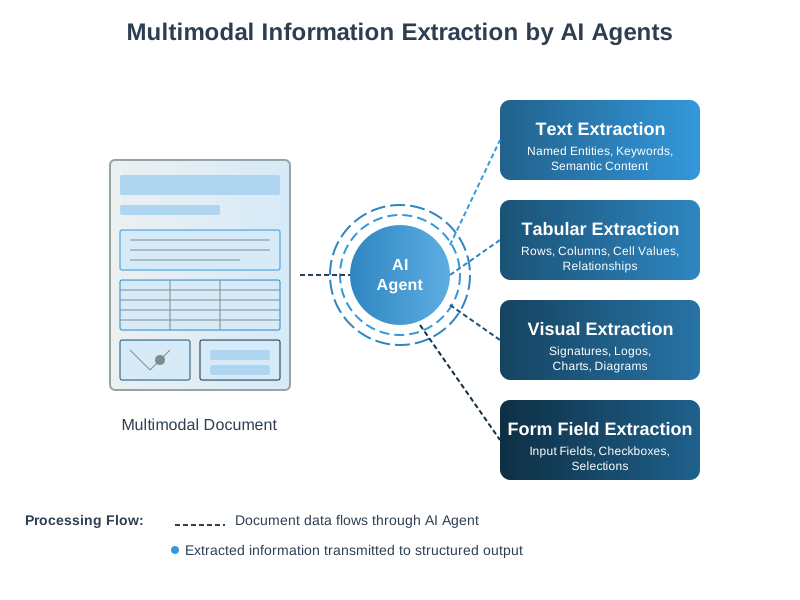
Furthermore, AI agents can perform contextual extraction, where the meaning and relevance of extracted data are determined based on surrounding information. For example, when processing a contract, an AI agent can identify key clauses and their implications by understanding the context in which specific terms appear. This contextual intelligence enables more nuanced data extraction that captures not just explicit information but also implicit relationships and dependencies within documents.
Document classification represents another critical capability of AI agents, enabling them to automatically categorize incoming documents based on their content, structure, and purpose. This classification goes beyond simple rule-based sorting to encompass sophisticated content analysis that considers both explicit and implicit document characteristics.
AI agents approach classification through multiple analytical dimensions. Content-based classification uses NLP to analyze the semantic content of documents, identifying key topics, entities, and terminology that indicate document type. For instance, the presence of specific legal clauses might identify a document as a particular type of contract, while certain medical terminology might classify a document as a specific type of clinical report.
Structure-based classification examines the document's layout, formatting, and organizational patterns to determine its category. Many document types follow consistent structural conventions that AI agents can learn to recognize. Visual classification leverages computer vision to identify distinctive visual elements, such as logos, signatures, or specific form layouts, that signal particular document types.
The classification capabilities of AI agents are particularly valuable in organizations that process diverse document types, as they enable automatic sorting and routing without manual intervention. For example, in a financial institution, incoming documents can be automatically classified as loan applications, account statements, or compliance reports, and directed to appropriate processing workflows accordingly.
Moreover, AI agents can perform hierarchical classification, assigning documents to broad categories and then to more specific subcategories based on increasingly granular criteria. This enables precise document routing and processing tailored to specific document types. The classification process can also adapt over time, learning from user feedback to refine categorization criteria and improve accuracy.
Data validation constitutes a critical capability that distinguishes advanced AI agents from basic extraction tools. By incorporating sophisticated validation mechanisms, AI agents can verify the accuracy, completeness, and consistency of extracted information, significantly reducing errors and improving data quality.
AI agents employ multiple validation strategies to ensure data integrity. Internal consistency checks examine relationships between different data elements within the same document to identify inconsistencies or logical contradictions. For example, when processing an invoice, an AI agent might verify that the sum of line item amounts matches the subtotal, or that the tax calculation is accurate based on the applicable rate.
External validation involves cross-referencing extracted information against trusted external sources or databases. An AI agent processing vendor invoices might validate vendor information against a master vendor database, or verify that pricing aligns with established contract terms. This cross-validation helps identify discrepancies that might indicate errors or potential fraud.
Contextual validation assesses whether extracted information makes sense within the specific business context. For instance, an unusually large invoice amount for a routine purchase might trigger a validation flag for review. Similarly, missing critical information that would be expected in a particular document type can be identified and flagged.
Advanced AI agents can also perform probabilistic validation, assigning confidence scores to extracted data based on the quality of the source document, the clarity of the information, and the agent's previous accuracy in similar contexts. These confidence scores help prioritize human review for instances where the AI agent has lower certainty, optimizing the allocation of human attention to cases where it adds the most value.
The routing capabilities of AI agents extend beyond simple rule-based distribution to encompass intelligent, context-aware document handling. By understanding document content, importance, and business context, AI agents can direct documents to the appropriate recipients, workflows, or systems based on sophisticated decision criteria.
Content-based routing analyzes document content to determine the most appropriate processing path. For example, a customer complaint might be routed to different departments based on the specific products or services mentioned, the nature of the issue, or the sentiment expressed. This intelligent routing ensures that documents reach the individuals or teams best equipped to handle them.
Priority-based routing incorporates urgency assessment, where AI agents evaluate time-sensitivity based on document content, sender information, or explicit deadlines. Critical documents can be flagged for immediate attention, while routine matters follow standard processing timelines. This prioritization helps organizations allocate resources efficiently and respond appropriately to time-sensitive matters.
Workload-balanced routing considers not just document characteristics but also recipient availability and current workload. AI agents can distribute documents to ensure equitable workload distribution among team members, preventing bottlenecks and optimizing overall processing efficiency. This dynamic routing adjustment represents a significant advancement over static rule-based routing that does not consider operational context.
Exception-based routing identifies documents that require special handling or human intervention. AI agents can recognize unusual cases, incomplete information, or high-risk scenarios that necessitate expert review, automatically directing these documents to specialized workflows while allowing straightforward cases to proceed through automated channels.
Perhaps the most transformative aspect of AI agents in document processing is their ability to integrate seamlessly with existing business systems and automate end-to-end workflows. Rather than functioning as isolated tools, sophisticated AI agents serve as intelligent intermediaries that connect document processing with broader business operations.
System integration enables AI agents to extract information from documents and automatically populate relevant fields in enterprise applications such as ERP systems, CRM platforms, or financial management software. This bidirectional integration eliminates manual data entry, reduces transcription errors, and ensures consistent information across systems.
Workflow automation extends this integration by orchestrating complex, multi-step processes based on document content and business rules. An AI agent processing a loan application, for instance, might extract relevant financial information, validate it against credit databases, calculate risk metrics, and route the application to the appropriate underwriting queue all without human intervention for straightforward cases.
API connectivity allows AI agents to interact with a wide range of internal and external systems, accessing reference data for validation, retrieving contextual information to enhance processing accuracy, and transmitting processed data to downstream systems. This connectivity enables AI agents to function within the organization's broader technology ecosystem, rather than as standalone applications.
Event-driven processing enables AI agents to respond dynamically to business events, such as triggering follow-up actions when specific conditions are met in processed documents. For example, an AI agent might automatically generate a renewal reminder when processing a contract with an approaching expiration date, or flag a compliance issue when specific regulatory language is absent from a required document.
Through these integration capabilities, AI agents transform document processing from an isolated administrative function to an integral component of intelligent business operations. They enable a seamless flow of documentary information throughout the organization, ensuring that critical data is captured, validated, and utilized effectively across business processes.
The theoretical capabilities of AI agents translate into transformative applications across diverse industries. This section explores how different sectors leverage AI agents to address specific document processing challenges, highlighting the versatility and practical impact of these intelligent systems.
Financial institutions manage an extraordinary volume of document-intensive processes, from loan origination and account opening to regulatory compliance and fraud detection. In this context, AI agents serve as powerful allies in streamlining operations, enhancing accuracy, and improving customer experience.
In loan processing, AI agents can transform traditionally lengthy approval cycles. By automatically extracting relevant information from application forms, financial statements, and supporting documentation, these agents enable faster assessment of creditworthiness. For instance, mortgage lenders employing AI-powered document processing have reported reduction in application processing times from weeks to days, significantly enhancing customer satisfaction and competitive advantage.
Invoice processing represents another domain where financial institutions deploy AI agents to great effect. These intelligent systems can extract line items, verify them against purchase orders, validate mathematical accuracy, and flag discrepancies for review. The automation of these previously manual processes not only accelerates payment cycles but also improves vendor relationships through timely, accurate processing.
Regulatory compliance documentation presents particularly complex challenges due to stringent requirements and potentially severe consequences for errors. AI agents can systematically review compliance documents, identify missing information or non-compliant language, and ensure adherence to evolving regulatory standards. Beyond mere identification, advanced agents can suggest remediation steps to address compliance gaps, providing actionable guidance to compliance teams.
Fraud detection represents a high-value application where the pattern recognition capabilities of AI agents yield significant benefits. By analyzing transaction documents, account statements, and authorization forms, these agents can identify suspicious patterns or anomalies that might indicate fraudulent activity. The ability to process large volumes of documentary evidence quickly enables financial institutions to detect potential fraud earlier, minimizing financial losses and reputational damage.
The healthcare industry faces unique document processing challenges due to the critical nature of medical information, stringent privacy requirements, and the complexity of healthcare documentation. AI agents are increasingly deployed to address these challenges, contributing to improved patient care, operational efficiency, and regulatory compliance.
Medical records management represents a primary application area, where AI agents can extract and organize critical patient information from diverse sources, including admission forms, clinical notes, diagnostic reports, and treatment plans. By structuring this information and making it readily accessible to healthcare providers, AI agents support more informed clinical decision-making and coordinated care delivery.
Insurance claims processing traditionally involves substantial manual review of medical documentation to determine coverage eligibility and appropriate reimbursement. AI agents can accelerate this process by extracting relevant diagnosis codes, treatment details, and provider information, validating them against policy terms, and flagging potential issues for human review. This automation not only speeds reimbursement but also reduces the administrative burden on healthcare providers.
Clinical trial documentation management presents complex challenges due to the volume and precision requirements of research data. AI agents can process case report forms, adverse event reports, and research protocols, ensuring data completeness and consistency while flagging potential protocol deviations. This application supports research integrity and regulatory compliance while accelerating the research timeline.
Revenue cycle management benefits from AI agents that can process explanation of benefits documents, remittance advice, and payment adjustments, automatically reconciling them with billing records and identifying discrepancies. This automation helps healthcare organizations optimize revenue capture and reduce administrative costs, contributing to financial sustainability in an increasingly challenging healthcare environment.
The legal profession has historically been document-intensive, with attorneys spending countless hours reviewing contracts, case files, discovery materials, and regulatory documents. AI agents have emerged as valuable tools that augment legal expertise, enabling more efficient and thorough document analysis.
Contract analysis represents a primary application area, where AI agents can extract key provisions, identify non-standard clauses, and flag potential risks or inconsistencies. During due diligence processes, these agents can rapidly review volumes of contracts to identify change-of-control provisions, assignment restrictions, or other clauses relevant to the transaction. This acceleration of contract review not only reduces costs but also enables more comprehensive analysis than would be feasible through purely manual review.
In litigation support, AI agents assist with e-discovery by analyzing vast collections of documents to identify those relevant to specific legal issues or responsive to particular discovery requests. Beyond simple keyword matching, advanced agents can understand conceptual relationships, recognize potentially privileged communications, and prioritize documents based on likely relevance to the case. This intelligent filtering dramatically reduces the volume of documents requiring attorney review, focusing valuable legal expertise on the most significant materials.
Regulatory compliance monitoring represents another valuable application, where AI agents can continuously scan regulatory publications, identify changes relevant to specific industries or jurisdictions, and flag necessary updates to compliance programs. This proactive approach helps organizations maintain compliance with evolving regulatory landscapes without dedicating extensive human resources to regulatory monitoring.
Legal research benefits from AI agents that can analyze case law, statutes, and scholarly articles to identify precedents and authorities relevant to specific legal questions. By understanding the conceptual relationships between legal documents, these agents can suggest connections or parallels that might not be immediately apparent through traditional research methods, enhancing the quality of legal analysis.
Manufacturing and supply chain operations involve complex documentation flows that coordinate production, procurement, shipping, and regulatory compliance. AI agents help optimize these document-intensive processes, contributing to operational efficiency and supply chain resilience.
Material receipt and quality control processes traditionally require manual verification of delivery documentation against purchase orders and quality specifications. AI agents can automate this verification by extracting information from delivery notes, certificates of analysis, and inspection reports, comparing it against expected parameters, and flagging discrepancies for investigation. This automation ensures consistent application of quality standards while accelerating material receipt processes.
Supply chain documentation management encompasses purchase orders, shipping manifests, customs declarations, and international trade documentation. AI agents can process these diverse documents, extract relevant information, and ensure consistency across the documentation chain. For international shipments, these agents can verify compliance with country-specific requirements, reducing delays and penalties associated with incomplete or inaccurate documentation.
Regulatory compliance in manufacturing involves maintaining detailed documentation of production processes, quality control measures, and safety protocols. AI agents can monitor this documentation for completeness and consistency with regulatory requirements, identifying potential compliance gaps before they result in regulatory issues. This proactive approach helps maintain continuous compliance while reducing the administrative burden on production teams.
Engineering change management involves coordinating documentation updates when product designs or manufacturing processes change. AI agents can analyze change request documentation, identify affected documentation that requires updating, and verify that all necessary changes have been implemented consistently. This coordination ensures that documentation remains accurate and aligned with current practices, supporting quality control and regulatory compliance (see Figure 3: AI Agent Workflow in Engineering Change Management).

The sophisticated capabilities of AI agents in document processing rest upon a foundation of advanced technologies that enable them to perceive, understand, and interact with documentary information. Understanding this technological underpinning provides insight into how AI agents function and the factors that influence their performance.
Natural Language Processing (NLP) enables AI agents to comprehend the semantic content of documents, going beyond simple keyword recognition to understand meaning, context, and implications. This technology has advanced dramatically in recent years, with the emergence of transformer-based models that capture nuanced linguistic relationships and contextual meanings.
Named Entity Recognition (NER) identifies specific entities mentioned in documents, such as people, organizations, locations, dates, and monetary amounts. In document processing, NER helps extract structured information from unstructured text, enabling the population of database fields with relevant data points. Advanced NER models can identify domain-specific entities, such as legal clauses in contracts or medical conditions in healthcare documentation.
Sentiment analysis determines the emotional tone and subjective information expressed in text, which can be particularly valuable when processing customer communications, feedback forms, or complaint letters. By understanding sentiment, AI agents can prioritize urgent or negative communications for immediate attention, contributing to more responsive customer service.
Relationship extraction identifies connections between entities mentioned in documents, recognizing how different elements relate to each other. For example, in a contract, relationship extraction might identify which parties are responsible for specific obligations, or in a medical report, which symptoms are associated with particular diagnoses. This capability enables more sophisticated understanding of documentary content and supports more accurate data extraction.
Language models, particularly large language models (LLMs), have revolutionized NLP capabilities by capturing deep contextual understanding of language. These models enable AI agents to comprehend complex linguistic constructions, domain-specific terminology, and implicit information that might not be explicitly stated. When properly fine-tuned for document processing applications, language models enable unprecedented accuracy in understanding documentary content across diverse domains and document types.
Computer vision technologies enable AI agents to perceive and interpret the visual aspects of documents, including layout, formatting, graphics, and non-textual elements. This visual understanding complements text analysis to provide comprehensive document comprehension.
Optical Character Recognition (OCR) converts images of text into machine-readable text, serving as the foundation for document digitization. Modern deep learning-based OCR systems achieve high accuracy even with challenging inputs such as handwritten text, unusual fonts, or degraded image quality. Advanced OCR can adapt to different languages, special characters, and domain-specific notations, enabling global applicability of document processing solutions.
Layout analysis identifies the structural organization of documents, recognizing elements such as headers, footers, columns, tables, and graphics. This spatial understanding helps AI agents interpret how information is organized and related within documents. For complex documents like financial statements or technical specifications, layout analysis is crucial for correctly interpreting the relationship between different information elements.
Form recognition identifies form fields, checkboxes, signature lines, and other structured elements commonly found in forms and standardized documents. This capability enables AI agents to locate and extract information from specific fields, even when the overall form layout varies. Advanced form recognition can adapt to previously unseen form types by recognizing common patterns in how information is structured and presented.
Image analysis enables the interpretation of non-textual visual elements such as logos, signatures, stamps, diagrams, and photographs. In document processing, image analysis might verify the presence of required stamps or signatures, interpret diagrams or charts, or extract information from embedded graphics. This multimodal perception enhances the comprehensiveness of document understanding, capturing information that might be missed by text-only analysis.
Machine learning technologies enable AI agents to learn from experience, adapt to new document types, and continuously improve their performance without explicit reprogramming. This adaptive capacity distinguishes AI agents from rule-based document processing systems and underpins their ability to handle diverse, evolving document ecosystems.
Supervised learning trains document processing models using labeled examples, where the correct outputs for specific inputs have been identified by human experts. This approach is particularly valuable for training extraction models to recognize specific data fields or classification models to identify document types. While effective, supervised learning requires substantial labeled training data, which can be resource-intensive to create.
Transfer learning addresses this limitation by leveraging knowledge gained from one document type to improve processing of related document types. For example, an AI agent trained to process invoices from one vendor can apply that knowledge to handle invoices from a different vendor with minimal additional training. This capability dramatically reduces the amount of training data required for new document types, accelerating implementation and adaptation.
Unsupervised learning identifies patterns and structures in documents without labeled examples, enabling the discovery of intrinsic document characteristics. In document processing, unsupervised learning might identify common layouts across a document corpus, cluster similar documents together, or detect anomalies that deviate from typical patterns. These insights can guide subsequent supervised learning efforts or directly inform document processing workflows.
Active learning optimizes the training process by identifying the most informative examples for human annotation. Rather than randomly selecting documents for labeling, active learning algorithms identify cases where the model has low confidence or where annotation would provide the most significant learning value. This approach maximizes the impact of human expertise, focusing annotation efforts where they will most improve model performance.
Reinforcement learning enables AI agents to learn optimal document processing strategies through trial and error, receiving feedback on their performance and adjusting accordingly. While less commonly used in document processing than other machine learning approaches, reinforcement learning shows promise for optimizing complex, multi-step document workflows where the best processing path may not be obvious in advance.
While the capabilities and applications of AI agents in document processing offer compelling benefits, successful implementation requires careful consideration of several key factors. Organizations seeking to deploy these intelligent systems should address these considerations to maximize value realization and mitigate potential challenges.
Effective implementation begins with strategic alignment, ensuring that AI agent deployment supports core business objectives and addresses high-value document processing challenges. Rather than pursuing technology implementation for its own sake, organizations should identify specific use cases where AI agents can deliver measurable business impact.
Process assessment represents an essential first step, involving systematic evaluation of existing document workflows to identify pain points, inefficiencies, and error-prone activities that might benefit from AI agent intervention. This assessment should consider both quantitative metrics, such as processing time and error rates, and qualitative factors, such as employee satisfaction and customer experience.
Value quantification helps prioritize implementation efforts by estimating the potential return on investment for different use cases. This analysis typically considers factors such as labor cost reduction, error reduction, processing time improvements, and enhanced customer satisfaction. By quantifying these benefits, organizations can identify the highest-value opportunities and sequence implementation accordingly.
Complexity evaluation assesses the technical and operational challenges associated with specific use cases. Factors such as document complexity, format variability, and integration requirements influence implementation difficulty and time to value. Organizations often benefit from beginning with moderately complex use cases that offer meaningful benefits while avoiding excessive implementation challenges.
Stakeholder alignment ensures that all relevant parties—including business users, IT teams, compliance functions, and executive sponsors—understand and support the AI agent implementation. Engaging stakeholders early in the planning process helps identify potential concerns, incorporate diverse perspectives, and build the organizational consensus necessary for successful deployment.
The effectiveness of AI agents in document processing depends significantly on proper training and configuration. Unlike traditional software that follows explicit programming instructions, AI agents learn from examples and improve through experience, making their training and configuration process fundamentally different.
Data requirements vary based on the specific document processing task and the learning approach employed. Supervised learning typically requires substantial labeled examples, where human experts have identified the correct outputs for representative inputs. Organizations should assess their access to relevant training data and may need to allocate resources for data collection and annotation if existing datasets are insufficient.
Domain adaptation enables AI agents to handle organization-specific terminology, document formats, and processing requirements. Even when using pre-trained models, some degree of customization is typically necessary to adapt the agent to the specific documentary environment of the implementing organization. This adaptation process may involve fine-tuning existing models with organization-specific examples or developing custom components for particular processing tasks.
Quality assurance mechanisms ensure that AI agents perform reliably in production environments. These mechanisms typically include thorough testing with diverse document samples, validation against human-processed results, and ongoing monitoring of performance metrics. Organizations should establish clear performance thresholds that AI agents must meet before deployment and maintain throughout operation.
Continuous improvement processes enable AI agents to evolve as document types, business requirements, and processing standards change. These processes typically involve monitoring agent performance, collecting examples of processing errors or edge cases, and periodically retraining or refining the agent to address identified limitations. By establishing systematic feedback loops, organizations can ensure that AI agents continue to deliver value over time.
AI agents in document processing rarely operate in isolation; their value is maximized when they integrate seamlessly with existing systems and workflows. Thoughtful integration planning ensures that document processing intelligence enhances rather than disrupts established business operations.
System connectivity requirements vary based on the specific document processing use case and the organization's existing technology ecosystem. Common integration points include document management systems, content repositories, enterprise resource planning (ERP) platforms, customer relationship management (CRM) systems, and line-of-business applications. Organizations should identify all systems that will exchange information with the AI agent and establish appropriate connectivity mechanisms.
Workflow integration considerations address how the AI agent will fit within existing business processes. Key decisions include determining at which points in the process the agent will intervene, how exceptions or low-confidence cases will be handled, and how human review will be incorporated when necessary. Effective workflow integration often involves reconfiguring existing processes to leverage AI capabilities rather than simply automating current workflows.
User interface design significantly influences adoption and effectiveness. Even the most powerful AI agent will deliver limited value if users struggle to interact with it. Organizations should carefully design user interfaces that enable easy document submission, clear presentation of extracted information, intuitive correction mechanisms for errors, and transparent insights into agent confidence levels and decision factors.
Authentication and security requirements ensure that document processing remains compliant with organizational security policies and regulatory requirements. These requirements typically address document access controls, encryption of sensitive information, audit trails of processing activities, and secure transmission of documentary information between systems. Given the often sensitive nature of processed documents, robust security measures are essential for responsible AI agent deployment.
The human dimension of AI agent implementation is often as critical as the technological components. Effective change management and skill development initiatives help ensure that the organization can fully leverage AI capabilities while addressing employee concerns and developing necessary competencies.
Workforce impact assessment identifies how AI agent deployment will affect existing roles and responsibilities. While document processing automation may reduce the need for certain manual tasks, it typically creates new requirements for exception handling, quality oversight, and process optimization. Understanding these shifts helps organizations proactively address workforce concerns and develop appropriate transition strategies.
Communication strategies ensure that all stakeholders understand the purpose, capabilities, and limitations of AI agents in document processing. Clear, consistent communication helps manage expectations, address misconceptions, and build organizational support for implementation. These strategies should emphasize how AI agents augment human capabilities rather than replace human workers, highlighting opportunities for employees to focus on higher-value activities.
Training programs develop the skills necessary to work effectively with AI agents. These programs typically address both technical competencies, such as configuring and monitoring AI systems, and operational skills, such as interpreting agent outputs and handling exceptions. By investing in skill development, organizations empower employees to serve as effective partners to AI agents, maximizing the value of both human and artificial intelligence.
Role evolution planning helps employees transition from manual document processing to more strategic roles that leverage AI capabilities. These new roles might include exception handling for complex cases, quality oversight of AI-processed documents, continuous improvement of AI systems, or customer interaction for high-value document processes. By articulating clear career paths that incorporate AI, organizations can transform potential workforce resistance into enthusiasm for enhanced capabilities.
The field of AI agents in document processing continues to evolve rapidly, with emerging technologies and approaches promising even greater capabilities in the future. Understanding these trends helps organizations anticipate future developments and position their document processing strategies accordingly.
Future AI agents will increasingly exhibit multimodal intelligence, integrating text, visual, and even audio understanding to comprehend documents holistically. This evolution builds on current capabilities but extends them to encompass more sophisticated integration of different information modalities.
Visual-linguistic models that simultaneously process text and images will enable more sophisticated understanding of document content and context. These models can interpret the relationship between textual content and visual elements such as charts, diagrams, or photographs, extracting meaning from their combined presentation. In financial documents, for instance, such models could interpret both tabular financial data and accompanying explanatory graphs, understanding how they complement each other.
Document structure understanding will advance beyond current layout analysis to comprehend the logical organization and rhetorical structure of documents. Future AI agents will recognize not just where information appears but how it functions within the document's overall argumentative or narrative structure. This deeper structural understanding will enable more sophisticated summarization, analysis, and information extraction that captures the document's communicative intent.
Cross-document intelligence will enable AI agents to process related documents collectively rather than individually, recognizing relationships, inconsistencies, or complementary information across document sets. For example, when processing a contract amendment, future agents might automatically identify and incorporate relevant information from the original contract and previous amendments, presenting a comprehensive understanding of the contractual relationship.
Temporal document understanding will recognize how document content evolves over time, tracking changes between versions and understanding their significance. This capability will be particularly valuable for documents that undergo revisions, such as contracts, policies, or technical specifications, enabling automatic identification of substantive changes and their implications.
As AI agents assume greater responsibility for document processing, the importance of explainability and transparency increases. Future developments will emphasize making AI decision-making processes more understandable to human users, building trust and enabling effective oversight.
Decision explanation capabilities will enable AI agents to articulate the reasoning behind their document processing decisions in human-understandable terms. Rather than functioning as black boxes, these agents will provide clear explanations of why specific information was extracted, how documents were classified, or why particular routing decisions were made. These explanations build user trust and facilitate effective collaboration between human and artificial intelligence.
Confidence indication mechanisms will communicate the AI agent's certainty about its processing decisions, helping users understand when to trust automated outcomes and when additional verification might be warranted. Advanced confidence indicators may provide granular assessments for different aspects of document processing, distinguishing between high-confidence extractions and more uncertain interpretations within the same document.
Processing visualizations will illustrate how the AI agent perceives and interprets documents, highlighting recognized entities, relationships, and structural elements. These visualizations make the agent's understanding transparent to users, enabling them to identify potential misinterpretations or oversights. For complex documents, such visualizations can be particularly valuable in verifying that the agent has correctly captured all relevant information.
Audit trails will document the AI agent's processing steps, decisions, and confidence levels, providing accountability and traceability for automated document processing. These trails will be particularly important in regulated industries where document processing must meet specific compliance requirements and may be subject to regulatory review.
The learning capabilities of AI agents will continue to advance, moving toward systems that can autonomously adapt to new document types and processing requirements with minimal human intervention. This evolution will reduce implementation effort and enable more responsive adaptation to changing document ecosystems.
Few-shot learning will enable AI agents to learn from very limited examples, recognizing patterns and applying them to new document types after seeing just a handful of representative samples. This capability will dramatically reduce the training data requirements that currently present a significant implementation barrier, making AI document processing more accessible to organizations with limited historical data or those processing rare document types.
Unsupervised adaptation will allow AI agents to identify patterns in document streams and adjust their processing approaches accordingly, without explicit retraining. For example, an agent might autonomously recognize that a vendor has changed their invoice format and adapt its extraction approach to accommodate the new layout, maintaining processing accuracy without manual intervention.
Continuous learning architectures will enable AI agents to refine their capabilities through ongoing operation, incorporating feedback from human reviewers and learning from corrections to improve future processing. These architectures will transform production operation from a static execution phase to a dynamic learning opportunity, with each processed document potentially contributing to improved performance.
Collaborative learning across organizations, with appropriate privacy safeguards, may enable AI agents to benefit from diverse document processing experiences without sharing sensitive documentary content. Federated learning approaches, where models learn from distributed data without centralizing it, could allow multiple organizations to collectively improve document processing capabilities while maintaining data confidentiality.
Perhaps the most significant trend in AI agent development is the evolution toward more sophisticated collaboration between human and artificial intelligence, creating systems where each amplifies the other's strengths. This collaborative approach recognizes that optimal document processing often involves both human judgment and AI capabilities.
Adaptive workflow distribution will dynamically allocate document processing tasks between AI agents and human workers based on the specific characteristics of each document and the comparative advantages of each processor. Simple, standardized documents might be processed entirely by AI, while complex or unusual documents might involve greater human participation. This intelligent distribution optimizes both efficiency and accuracy across the document spectrum.
Interactive learning mechanisms will enable AI agents to learn from human processing decisions in real-time, incorporating immediate feedback to improve future processing. When a human corrects an AI extraction or classification, the agent will not only apply that correction to the current document but understand the underlying pattern to improve processing of similar documents in the future.
Augmented intelligence interfaces will present AI-derived insights to human processors in ways that enhance their decision-making without replacing their judgment. These interfaces might highlight potentially relevant information, suggest possible interpretations, or flag potential issues, while leaving final decisions to human discretion. This approach leverages both AI pattern recognition and human contextual understanding.
Human expertise amplification will enable subject matter experts to extend their influence through AI agents that learn from their decision patterns and apply similar judgment to routine cases. This approach allows experts to focus on truly complex or novel documents while their expertise implicitly guides AI processing of more standard documents, effectively multiplying their impact across the organization.
AI agents represent a fundamental shift in how organizations approach document processing, transforming it from a primarily administrative function to a strategic capability that enhances operational efficiency, decision quality, and customer experience. As these intelligent systems continue to evolve, their impact on document-intensive industries will only increase, offering both opportunities and challenges for forward-thinking organizations.
The journey toward intelligent document processing is not merely technological but organizational and cultural. Successfully implementing AI agents requires not just sophisticated algorithms and computing infrastructure but also thoughtful change management, skill development, and process redesign. Organizations that approach this transformation holistically, considering both technological and human dimensions, position themselves to realize the greatest value from AI-powered document processing.
Looking ahead, the continued advancement of AI agents promises ever more sophisticated document understanding, increasingly autonomous operation, and more seamless human-AI collaboration. Organizations that establish strong foundations for AI-powered document processing today will be well-positioned to leverage these future capabilities, maintaining competitive advantage in an increasingly digital business landscape.
The future of document processing lies not in choosing between human and artificial intelligence but in intelligently combining them, creating systems where each enhances the other's strengths. By embracing this collaborative approach, organizations can transform document processing from a necessary cost center to a source of strategic value, unlocking the full potential of their documentary information and the insights it contains.
As the capabilities of AI agents continue to advance, they will increasingly serve not just as tools for processing documents but as intelligent partners in extracting meaning, identifying insights, and informing decisions based on documentary information. This evolution will fundamentally transform how organizations relate to documents, shifting focus from managing documents as administrative artifacts to leveraging them as strategic information assets.

Head IT Operations - Co Founder of Artificio
See it in your SAP environment
Bring us a document, a process, or a bottleneck. We'll show how Artificio captures, validates, and posts into SAP — then scale from there.
Security & compliance
ISO 27001:2013 certified, SOC 2 Type 2 compliant, GDPR and HIPAA ready. Every agent action is logged, auditable, and runs in isolated environments.