

Blog
Harnessing AI-Powered OCR: A Deep Dive into IDP
Artificio's AI OCR revolutionizes doc processing with advanced ML & deep learning, offering high accuracy & efficiency.

Blog
Artificio's AI OCR revolutionizes doc processing with advanced ML & deep learning, offering high accuracy & efficiency.
The intersection of Artificial Intelligence (AI) and Optical Character Recognition (OCR) represents a transformative advancement in document processing technology, fundamentally altering how organizations handle information extraction and management. In this rapidly evolving technological landscape, Artificio has emerged as a pioneer, successfully integrating sophisticated machine learning algorithms with traditional OCR methodologies to create an intelligent, adaptive system capable of unprecedented accuracy in document processing. This comprehensive analysis explores the technological foundations, implementation methodologies, and practical applications of AI-powered OCR in contemporary enterprise environments, with particular emphasis on Artificio's innovative approach to solving complex document processing challenges.
The integration of artificial intelligence into OCR technology marks a paradigm shift in document processing capabilities, transcending the limitations of traditional approaches. Where conventional OCR systems relied heavily on rule-based methodologies and static pattern matching algorithms, they frequently encountered significant challenges when confronted with variations in document format, quality, or content structure. The incorporation of artificial intelligence, particularly deep learning models, has revolutionized this landscape by introducing adaptive recognition capabilities that continuously evolve through machine learning processes. This evolutionary leap has transformed OCR from a simple character recognition tool into an intelligent document understanding system capable of contextual interpretation and adaptive learning.
Artificio's AI-powered OCR system exemplifies this evolutionary progression, representing the convergence of multiple technological advances in machine learning and computer vision. The system architecture incorporates a sophisticated neural network framework that seamlessly integrates convolutional neural networks (CNNs) for advanced image processing, recurrent neural networks (RNNs) for sequence analysis, and transformer models for contextual understanding. This multi-layered approach enables the system to not only recognize characters with exceptional accuracy but also comprehend document context, interpret complex layouts, and understand semantic relationships within the processed content. The synergy between these various AI components creates a robust system capable of handling diverse document types while maintaining high accuracy levels across different scenarios.
The technological foundation of Artificio's intelligent document processing system represents a sophisticated synthesis of advanced AI methodologies and practical implementation strategies. At its core, the system employs a suite of specialized neural networks, each optimized for specific aspects of document processing. The deep learning models implement state-of-the-art architectures that work in concert to achieve optimal results. The feature extraction networks, built on advanced CNN architectures, demonstrate remarkable adaptability in identifying and extracting relevant features from document images, regardless of quality variations or format complexities. These networks work in conjunction with sequence processing components that analyze temporal and spatial relationships between extracted features, enabling accurate text line detection and word grouping even in complex document layouts.
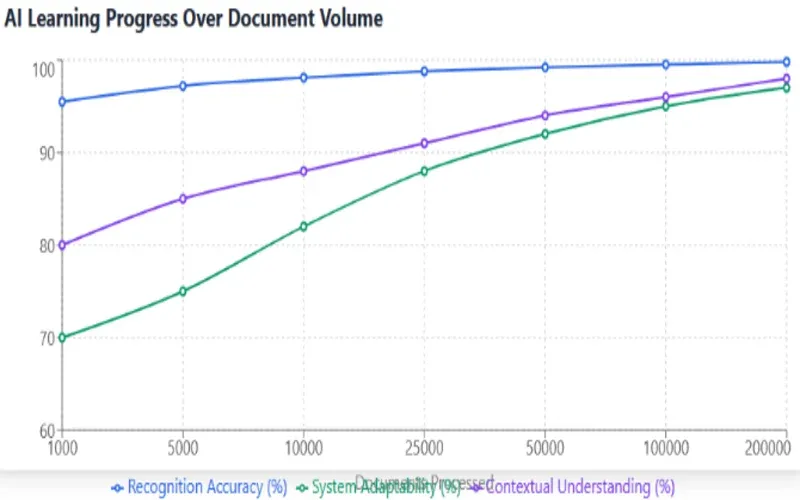
The system's adaptive learning capabilities represent a particularly significant advancement in the field of document processing. Through the implementation of transfer learning methodologies, the system efficiently leverages pre-trained models while maintaining the flexibility to adapt to domain-specific requirements through fine-tuning processes. This approach significantly reduces the training time and data requirements for new document types while maintaining high accuracy levels. The active learning component continuously incorporates user feedback and corrections, creating a dynamic system that evolves and improves with usage. This continuous learning process enables the system to adapt to new document formats and styles without requiring complete system retraining, representing a significant advantage in real-world applications where document formats frequently evolve.
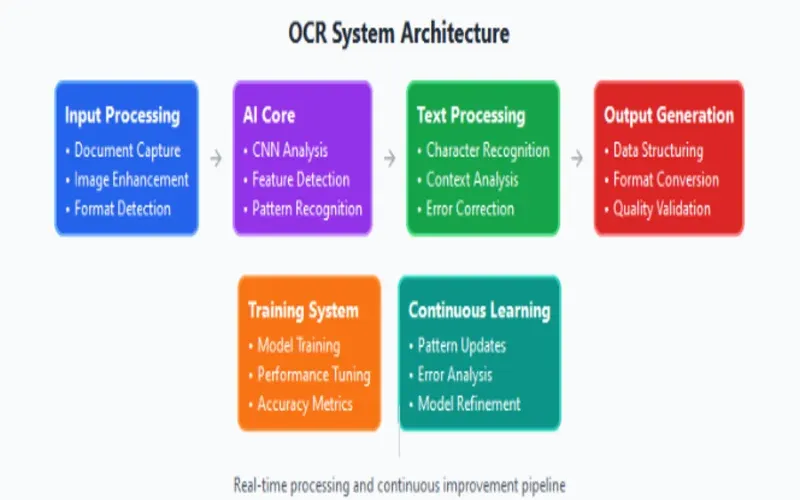
The integration of artificial intelligence has enabled sophisticated document processing capabilities that fundamentally transform how organizations handle document management. The system's intelligent layout analysis capabilities exemplify this advancement, employing advanced computer vision algorithms to comprehend document structure and organization. This sophisticated understanding enables automatic template detection and classification, dynamic field identification and extraction, and adaptive table structure recognition, all while maintaining high accuracy levels across diverse document formats. The system's ability to process multi-column text and complex layouts demonstrates the significant advantages of AI-powered OCR over traditional approaches.
Context-aware recognition represents another crucial advancement in the system's capabilities. Through sophisticated language modeling and semantic analysis, the system performs continuous validation of extracted text, ensuring accuracy through contextual verification. This process includes the recognition of industry-specific terminology and automatic error correction based on contextual clues, significantly reducing error rates in specialized documents. The system's multilingual processing capabilities further extend its utility, enabling simultaneous recognition of multiple languages and scripts while maintaining high accuracy levels. This advanced language handling includes cultural format adaptation and context-aware language detection, making the system particularly valuable in global business environments where multilingual document processing is increasingly common.
The successful deployment of AI-powered OCR systems demands a sophisticated implementation methodology that addresses both technical complexities and operational nuances. The implementation process begins with a comprehensive discovery and assessment phase that extends beyond basic requirements gathering. This initial phase involves detailed document flow analysis, utilizing advanced analytics to map existing document processes and identify optimization opportunities. Organizations must conduct thorough audits of their document ecosystems, including volume analysis, format distribution studies, and critical path identification. This foundational analysis enables the development of precise implementation strategies that align with organizational objectives while minimizing operational disruption.
The technical implementation phase follows a structured approach that emphasizes system optimization and integration stability. This phase begins with the establishment of a robust development environment that mirrors production conditions, enabling accurate testing and validation. The system architecture must be carefully designed to accommodate both current requirements and future scalability needs. This includes the implementation of load-balancing mechanisms, failover systems, and distributed processing capabilities to ensure optimal performance under varying workload conditions. The deployment strategy typically follows a phased approach, beginning with pilot programs in controlled environments before expanding to full-scale implementation.
Training and optimization represent critical components of the implementation process, requiring sophisticated approaches to system configuration and performance tuning. The training phase incorporates advanced techniques such as synthetic data generation for rare document types, adversarial training to improve system robustness, and progressive learning approaches that optimize model performance over time. Organizations must establish comprehensive training protocols that address various document scenarios, including edge cases and exceptional conditions. The optimization process utilizes sophisticated performance metrics and analytics tools to fine-tune system parameters, ensuring optimal recognition accuracy across diverse document types.
Data security and compliance considerations form an integral part of the implementation strategy, particularly in regulated industries. Organizations must implement robust security frameworks that address data encryption, access control, and audit trail requirements. This includes the implementation of sophisticated authentication mechanisms, role-based access controls, and comprehensive logging systems that track document processing activities. Compliance requirements must be carefully mapped and integrated into the system configuration, ensuring adherence to industry-specific regulations and data protection standards.
Operational integration represents a complex challenge that requires careful attention to existing workflow processes and system interactions. The integration strategy must address various operational considerations, including the establishment of sophisticated quality control mechanisms that utilize statistical process control methods to monitor system performance. Exception handling procedures must be developed with consideration for both automated and manual intervention scenarios, ensuring efficient resolution of processing anomalies. Performance monitoring systems must be implemented with comprehensive dashboards and reporting capabilities that provide real-time visibility into system operations and performance metrics.
Change management and user adoption strategies play crucial roles in successful implementation. Organizations must develop comprehensive training programs that address the needs of various user groups, from system administrators to end users. These programs should incorporate hands-on training sessions, detailed documentation, and ongoing support mechanisms to ensure effective system utilization. The change management strategy must address cultural and organizational factors that might impact adoption, including resistance to automation and concerns about job displacement.
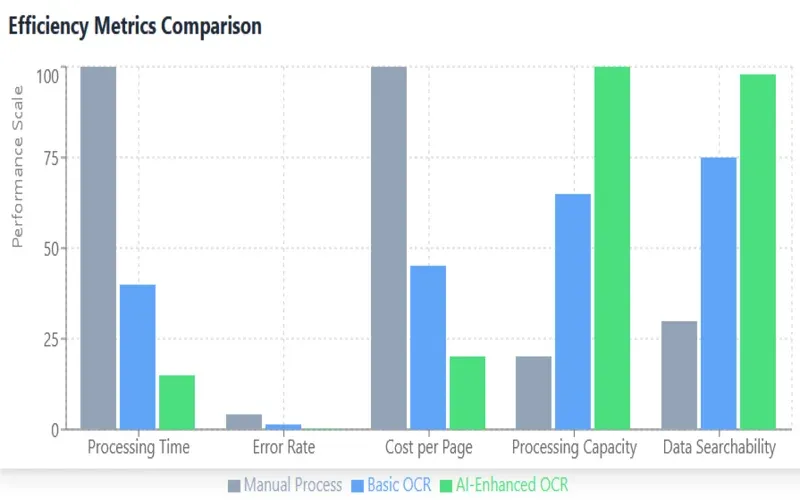
The implementation of AI-powered OCR has demonstrated significant impact across various industrial sectors, with particularly notable results in financial services, healthcare, and legal services. In the financial sector, the technology has revolutionized invoice processing and financial document management, achieving accuracy rates of 99.9% while significantly reducing processing times. The system's ability to perform real-time fraud detection through pattern analysis and automated compliance checking has proven invaluable in maintaining regulatory compliance while improving operational efficiency. The healthcare sector has similarly benefited from the technology's capabilities in medical record digitization and insurance claim processing, where the system's context awareness and accuracy have significantly improved document processing efficiency while reducing errors.
The future trajectory of AI-powered OCR technology presents extraordinary possibilities for innovation and advancement, driven by emerging technologies and evolving business requirements. Quantum computing integration represents a particularly promising frontier, with the potential to revolutionize document processing capabilities. The application of quantum algorithms to pattern recognition and feature extraction could exponentially improve processing speeds while enabling the analysis of significantly larger document datasets. Quantum-enhanced machine learning algorithms may enable real-time processing of complex documents with unprecedented accuracy, fundamentally transforming the capabilities of OCR systems.
Advanced natural language understanding represents another crucial area of future development, with significant implications for document processing accuracy and comprehension. The integration of sophisticated language models based on transformer architectures promises to enhance contextual understanding and semantic analysis capabilities. These advancements will enable OCR systems to better understand document context, improve error correction through semantic validation, and enhance the accuracy of extracted information. The development of multilingual and cross-cultural language models will further expand the system's capabilities in global business environments.
Emerging developments in neural network architectures and deep learning methodologies suggest significant potential for improvement in document processing capabilities. The evolution of attention mechanisms and self-supervised learning approaches may enable OCR systems to better understand document structure and content relationships. Advanced neural architectures could improve the system's ability to handle complex layouts, degraded documents, and challenging content types. The integration of few-shot and zero-shot learning capabilities could enable rapid adaptation to new document types with minimal training data requirements.
The convergence of OCR technology with other emerging technologies presents exciting possibilities for expanded functionality. The integration of augmented reality (AR) and mixed reality (MR) technologies could enable real-time document processing and overlay capabilities, providing immediate access to digitized content in physical environments. Blockchain integration could enhance document verification and authenticity tracking, ensuring the integrity of processed documents through immutable record-keeping. The development of edge computing capabilities could enable distributed processing architectures that optimize performance while maintaining data security.
Artificial General Intelligence (AGI) research may contribute to the development of more sophisticated document understanding capabilities. The potential integration of cognitive computing approaches could enable OCR systems to better understand document context, intent, and relationships. These advances could lead to systems capable of handling increasingly complex document types while requiring minimal human intervention. The development of explainable AI capabilities will become increasingly important, enabling systems to provide clear justification for their processing decisions and improving user trust.
Advancements in hardware acceleration and processing optimization suggest significant improvements in system performance and efficiency. The development of specialized processing units optimized for OCR workloads could improve processing speeds while reducing energy consumption. Edge computing architectures could enable distributed processing capabilities that optimize performance while maintaining data security. The integration of sophisticated caching and optimization algorithms could further improve system responsiveness and efficiency.
The evolution of user interface technologies and human-computer interaction paradigms will likely influence the future development of OCR systems. The integration of natural language interfaces and conversational AI capabilities could enable more intuitive system interaction and configuration. Advanced visualization technologies could improve the presentation of processed documents and extraction results, enabling better user understanding and validation of system outputs. The development of adaptive interfaces that respond to user behavior and preferences could enhance system usability and adoption.
Privacy-preserving computation techniques represent another critical area for future development, particularly in regulated industries and sensitive applications. The integration of homomorphic encryption and secure multi-party computation could enable document processing while maintaining data privacy. Zero-knowledge proof systems could provide verification capabilities without exposing sensitive document content. These advancements will be crucial for expanding the application of OCR technology in highly regulated industries and sensitive use cases.
The potential impact of these future developments extends beyond technical capabilities to include broader implications for business processes and organizational efficiency. The continued evolution of AI-powered OCR technology suggests a future where document processing becomes increasingly automated and intelligent while maintaining high levels of accuracy and security. Organizations that effectively leverage these advancing capabilities will gain significant advantages in operational efficiency and data management capabilities.
Artificio's implementation of AI-powered OCR technology represents a significant advancement in document processing capabilities, demonstrating the practical benefits of integrating sophisticated artificial intelligence with real-world business applications. The system's ability to combine high accuracy levels with practical usability makes it an increasingly valuable tool for organizations across various sectors. As the technology continues to evolve and improve, its role in organizational document processing will likely expand, offering new possibilities for efficiency and automation in document management processes.

Head IT Operations - Co Founder of Artificio
See it in your SAP environment
Bring us a document, a process, or a bottleneck. We'll show how Artificio captures, validates, and posts into SAP — then scale from there.
Security & compliance
ISO 27001:2013 certified, SOC 2 Type 2 compliant, GDPR and HIPAA ready. Every agent action is logged, auditable, and runs in isolated environments.