

Blog
AI Transforms Mortgage Application Processing
Explore the AI revolution in mortgage document processing. Learn how automation boosts efficiency, accuracy, and transforms lending for lenders and borrowers.

Blog
Explore the AI revolution in mortgage document processing. Learn how automation boosts efficiency, accuracy, and transforms lending for lenders and borrowers.
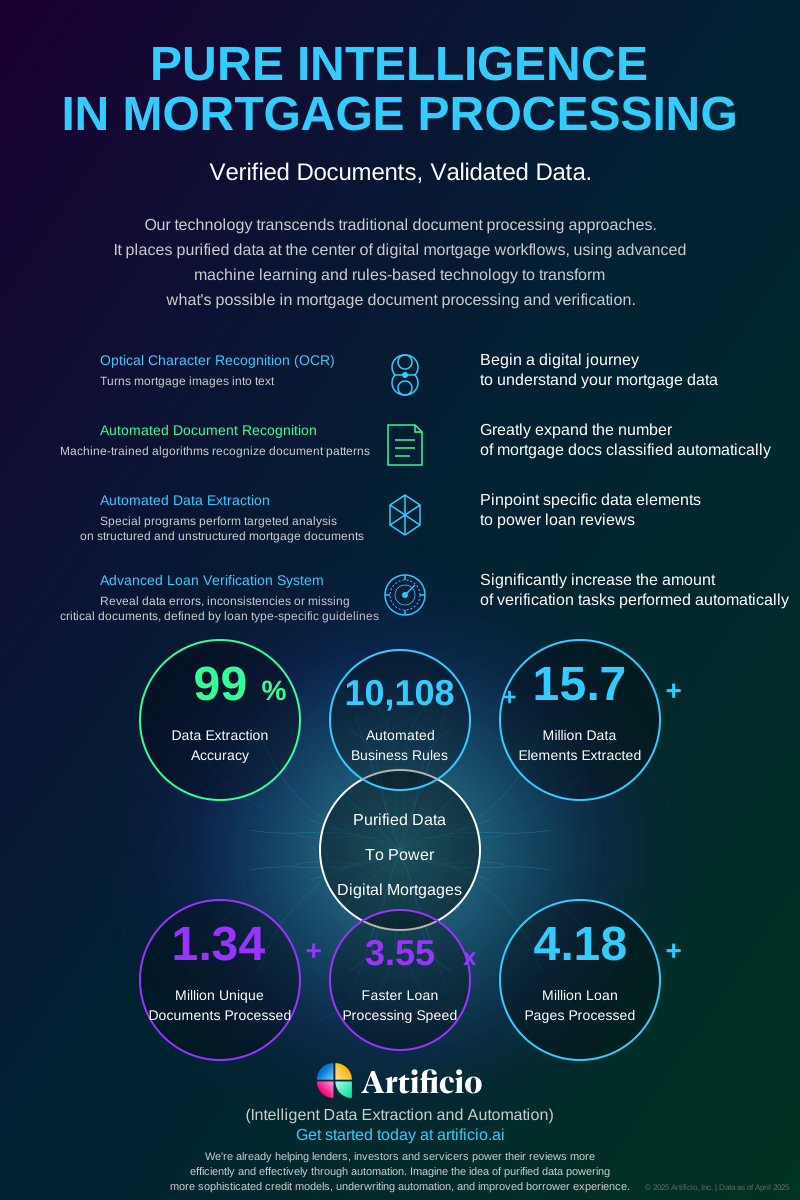
In the rapidly evolving landscape of financial technology, few sectors have witnessed as profound a transformation as mortgage document processing. What was once a labor-intensive, error-prone, and time-consuming process has been revolutionized through the integration of artificial intelligence, machine learning, and advanced data extraction technologies. This transformation isn't merely incremental it represents a fundamental reimagining of how mortgage documents are processed, analyzed, and verified. In this comprehensive exploration, we'll delve into the technological innovations driving this change, the tangible benefits for lenders and borrowers alike, and the future trajectory of mortgage document processing.
To appreciate the magnitude of the current revolution, we must first understand the historical context of mortgage document processing. For decades, the mortgage industry operated under the weight of paper documentation reams of it. A typical mortgage application could generate hundreds of pages of documentation, from loan applications and income verification to property appraisals and title documents.
This paper-based approach created numerous inefficiencies:
The first wave of digital transformation in the mortgage industry began with the simple digitization of documents converting paper to PDF files. While this addressed some challenges related to storage and accessibility, it failed to tackle the fundamental inefficiencies in data extraction and verification. Essentially, the industry had digitized the paper, but not the process.
Enter the current revolution, powered by intelligent document processing technology. This isn't merely about converting documents to digital format but about transforming them into structured, verified data that can power automated decision-making processes.
The technological revolution in mortgage document processing rests on four foundational pillars, each representing a critical advancement in how the industry handles documentation:
OCR technology represents the essential first step in the journey from document to data. It transforms static document images into machine-readable text, effectively teaching computers to "read" mortgage documents the way humans do, but at vastly greater speeds and scales.
Modern OCR systems specifically designed for mortgage processing have evolved far beyond simple text recognition. They can now:
The accuracy of mortgage-focused OCR systems has improved dramatically, with some solutions achieving over 99% accuracy for text extraction from standard mortgage documents. This improvement comes from specialized training on mortgage-specific documentation and the integration of machine learning algorithms that continuously improve through exposure to more documents.
The impact of advanced OCR on mortgage processing cannot be overstated. By converting images to machine-readable text, OCR initiates the entire data extraction workflow and enables all subsequent automation processes. Without this critical first step, even the most sophisticated AI systems would be blind to the information contained in mortgage documents.
While OCR tells us what text is present in a document, Automated Document Recognition answers the question of what type of document we're looking at. This represents a crucial evolution in mortgage processing technology.
Traditional document management systems required manual tagging or specific naming conventions to identify document types. Modern ADR systems, by contrast, can automatically determine whether they're looking at a loan application, a W-2 form, a bank statement, or a property appraisal even without consistent formatting or file naming.
These systems work by:
The practical implications are significant. In a typical mortgage application with 50+ distinct document types, ADR technology can automatically sort and route documents to appropriate processing workflows without human intervention. Documents requiring income verification are directed to income verification specialists or algorithms, while property documentation follows a different path.
This automated classification dramatically increases processing efficiency and enables true straight-through processing for standard documents while flagging unusual or problematic documents for human review.
With documents properly identified, the next pillar focuses on extracting specific data points from each document. Automated Data Extraction represents perhaps the most transformative element of modern mortgage processing technology.
Traditional mortgage processing required human reviewers to locate key information across dozens of documents a time-consuming and error-prone process. ADE systems, by contrast, can automatically locate, extract, and validate hundreds of specific data points across a mortgage application package in seconds.
Advanced ADE systems employ sophisticated techniques:
The impact on processing efficiency is remarkable. Modern systems can extract thousands of data points from a typical mortgage application in minutes rather than hours, with accuracy rates exceeding 99% for standard fields. The technology effectively eliminates the data entry bottleneck that has historically constrained mortgage processing.
Beyond efficiency, ADE significantly improves data quality. By applying consistent extraction rules and validation checks, these systems eliminate many common human errors like transposed numbers, misread fields, or overlooked information.
The final pillar addresses perhaps the most complex aspect of mortgage processing: comprehensive verification and compliance checking. Advanced Loan Verificiation Systems represent the integration of business rules, regulatory requirements, and risk assessment into automated verification workflows.
These systems:
What makes modern audit systems truly revolutionary is their ability to apply contextual intelligence to verification processes. Unlike simple rule-based checkers, advanced systems understand that verification requirements differ based on loan type, property characteristics, borrower profiles, and regulatory jurisdictions.
For example, an effective ALAS would apply different verification standards to:
This contextual intelligence allows the system to apply the right verification rules to the right situations, avoiding both overly stringent and overly lenient verification standards.
While each technological pillar offers significant advancements, the true revolution comes from their integration into a cohesive ecosystem. This integration creates what some industry leaders call "purified data" highly accurate, verified information extracted from raw documentation that can power automated decision processes with confidence.
Creating this ecosystem involves several key integration challenges:
For the four pillars to work together seamlessly, data must flow smoothly between systems with consistent formats and structures. This requires:
Mortgage industry leaders have addressed these challenges through specialized middleware and data transformation layers that ensure consistency across diverse systems and standardized APIs that enable smooth information exchange between components.
Even the most advanced automation systems encounter exceptions unusual documents, ambiguous information, or verification conflicts that require human judgment. Effective integration requires sophisticated exception handling processes:
The most effective mortgage processing systems maintain what industry experts call "appropriate automation" automating routine processes while seamlessly incorporating human expertise for complex judgments. This balanced approach maintains processing efficiency while ensuring careful review where needed.
Mortgage documentation contains highly sensitive personal and financial information, making security and compliance critical considerations. Integrated processing systems must incorporate:
Financial institutions have addressed these challenges through specialized compliance middleware, encryption standards, and third-party security certifications that ensure processing systems meet or exceed regulatory requirements.
The revolution in mortgage document processing isn't merely technological it delivers measurable, significant benefits to lenders, borrowers, and the broader financial ecosystem. Industry research and implementation data reveal several quantifiable improvements:
The most immediate impact appears in basic processing metrics:
A major national lender reported reducing their average document processing time from 45-60 minutes per loan package to under 15 minutes, while simultaneously improving accuracy and reducing exceptions.
Beyond efficiency, automation significantly improves data quality metrics:
These improvements directly impact loan quality and reduce repurchase risk. One regional lender reported a 85% reduction in repurchase demands after implementing comprehensive document automation with advanced verification.
Improved data extraction and verification capabilities significantly enhance risk management:
The impact extends beyond lenders to significantly improve the borrower experience:
Together, these benefits create a compelling case for automation adoption. The most advanced implementations deliver a rare combination of reduced costs, improved quality, enhanced risk management, and better customer experience a true win-win situation for all stakeholders.
To illustrate the real-world impact of these technologies, consider the experience of a mid-sized mortgage lender that fully implemented an integrated document automation system in 2023:
Before implementation, their processing metrics showed:
After implementing comprehensive automation with all four technological pillars:
Most impressively, these improvements came with a 35% reduction in per-loan processing costs and a two-point increase in their Net Promoter Score from borrowers. This case study demonstrates how technological advancement creates benefits across multiple dimensions simultaneously.
While technology drives this revolution, the human element remains crucial, though significantly transformed. The role of mortgage processing professionals has evolved from data entry and routine verification to exception handling, oversight, and process improvement.
Traditional mortgage processors spent most of their time on routine tasks:
In automated environments, these professionals now focus on higher-value activities:
This shift requires new skills and expertise. The most successful organizations invest heavily in retraining their workforce, focusing on analytical thinking, pattern recognition, and process expertise rather than data entry speed or basic document familiarity.
The automation revolution has also created entirely new roles that bridge mortgage domain expertise and technology skills:
These hybrid roles command premium compensation and represent a significant career advancement opportunity for mortgage professionals willing to develop technical expertise alongside their industry knowledge.
Despite remarkable progress, significant challenges remain in the journey toward fully automated mortgage document processing:
Some document types continue to resist reliable automation:
Industry leaders are addressing these challenges through specialized extraction techniques, but full automation remains elusive for the most complex document types.
The regulatory landscape for mortgage lending continuously evolves, requiring processing systems to adapt:
Successful implementations build adaptability into their systems, with configurable rules engines and regular updates to verification standards.
Many financial institutions struggle with integration between cutting-edge document processing and decades-old loan origination systems:
These challenges often require custom integration layers or middleware solutions to enable smooth data flow between modern processing components and established loan systems.
As current challenges are addressed, several emerging trends point to the future direction of mortgage document processing:
Advanced systems are beginning to predict documentation needs based on application characteristics:
This predictive approach further streamlines the process by reducing documentation iterations and focusing requirements on truly necessary verification.
The most advanced implementations are moving beyond document extraction to real-time verification:
These ecosystems can potentially eliminate entire categories of documentation requirements, moving from "document verification" to "information verification" regardless of source.
Machine learning is enabling self-improving systems that continuously enhance their capabilities:
These self-improving systems represent a fundamental shift from static automation to dynamic systems that continuously enhance their capabilities through operational experience.
The revolution in mortgage document processing represents more than technological advancement it fundamentally transforms one of the most significant financial transactions in most people's lives. By converting the mortgage application from a documentation-heavy ordeal to a streamlined, data-driven process, these technologies address longstanding inefficiencies that have burdened lenders and frustrated borrowers for decades.
For financial institutions, the competitive implications are clear. Early adopters of comprehensive document automation gain significant advantages in cost structure, processing capacity, risk management, and customer experience. Those slow to adapt risk being left behind as industry standards evolve around these new capabilities.
For borrowers, the benefits materialize as faster approvals, more transparent processes, and ultimately, a better path to homeownership. The reduced friction in mortgage processing removes a significant stress point in what remains one of life's most important financial decisions.
Perhaps most significantly, this technological revolution democratizes access to mortgage processing excellence. While document processing expertise was once concentrated in the largest financial institutions with the resources for large processing teams, automation makes sophisticated processing capabilities accessible to lenders of all sizes.
The future of mortgage document processing will continue to evolve, but the fundamental transformation is already here. The shift from document-centric to data-centric processing, enabled by artificial intelligence and machine learning, has permanently changed how the mortgage industry operates. The winners in this new landscape will be those who fully embrace this change, continuously adapt to emerging capabilities, and focus their human expertise on the complex judgments where it adds the greatest value.
In the final analysis, the revolution in mortgage document processing isn't just about technology it's about transforming a critical financial service to better serve both the institutions that provide it and the consumers who depend on it. Few technological advances can claim such far-reaching impact on both business operations and consumer experience.

Head IT Operations - Co Founder of Artificio
See it in your SAP environment
Bring us a document, a process, or a bottleneck. We'll show how Artificio captures, validates, and posts into SAP — then scale from there.
Security & compliance
ISO 27001:2013 certified, SOC 2 Type 2 compliant, GDPR and HIPAA ready. Every agent action is logged, auditable, and runs in isolated environments.