

Blog
The Digital Transformation of Document Workflows
Streamline document workflows for efficiency. Overcome bottlenecks, improve security, and boost growth. Learn how to transform your processes.

Blog
Streamline document workflows for efficiency. Overcome bottlenecks, improve security, and boost growth. Learn how to transform your processes.
In today's rapidly evolving digital landscape, document workflows represent the unspoken backbone of organizational efficiency. Despite the accelerating push toward digital transformation, many businesses continue to struggle with fragmented document processes that create operational bottlenecks, compromise data security, and ultimately hinder growth potential. Document management inefficiencies silently drain productivity across departments, from legal teams wrestling with contract approval cycles to finance departments manually processing invoices, and HR teams navigating complex employee documentation requirements. According to recent industry analyses, knowledge workers spend approximately 50% of their time searching for information, and 60% of organizations report significant delays in business processes due to document workflow challenges.
The transition from traditional paper-based systems to modern digital workflows represents more than a mere technological upgrade it constitutes a fundamental reimagining of how information flows through an organization. Effective document workflow optimization transcends basic digitization efforts, encompassing sophisticated process automation, intelligent data extraction, streamlined approvals, seamless system integration, and robust security protocols. Organizations that successfully transform their document ecosystems gain significant competitive advantages through faster processing times, reduced operational costs, improved compliance posture, and enhanced customer and employee experiences.
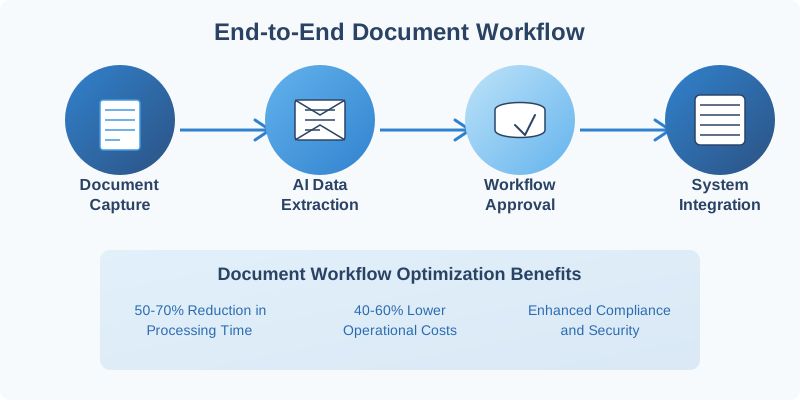
The modern enterprise faces unprecedented document management challenges that extend far beyond simple file storage issues. The average organization deals with thousands of documents daily contracts, invoices, forms, applications, reports each requiring specific handling procedures and governance protocols. Without structured workflows, these documents become trapped in various states of incompletion, creating visibility gaps that frustrate stakeholders and delay critical business functions. Executives report that document-related inefficiencies rank among their top operational concerns, with particular emphasis on approval bottlenecks, version control complications, and security vulnerabilities.
Document workflow deficiencies manifest in numerous ways across the enterprise. Financial operations suffer from payment delays when invoice approvals languish in email inboxes or physical routing systems. Sales cycles extend unnecessarily when contracts require multiple manual handoffs between departments. Customer onboarding experiences deteriorate when application processing stretches from days to weeks due to disjointed verification procedures. Perhaps most concerning, compliance risks escalate dramatically when document handling lacks consistent methodology and transparent audit trails. These challenges compound in global organizations where regulatory requirements vary by jurisdiction and documents flow across international boundaries.
Transforming document workflows requires a comprehensive strategic approach rather than isolated technology implementations. Successful organizations begin by mapping their document ecosystem identifying all document types, their origins, the transformations they undergo, the approvals they require, and their ultimate destinations. This holistic visualization exposes redundancies, bottlenecks, and compliance vulnerabilities that might otherwise remain hidden within departmental silos. Executive sponsorship proves essential during this discovery phase, as cross-functional visibility often reveals organizational inefficiencies that transcend departmental boundaries and require leadership intervention.
Once the document landscape has been thoroughly mapped, organizations can prioritize workflow improvements based on business impact, implementation complexity, and return on investment potential. High-volume processes with significant manual components, such as accounts payable operations or customer onboarding procedures, typically yield the greatest transformation benefits. Effective prioritization considers both quantitative metrics (processing time, error rates, labor costs) and qualitative factors (customer satisfaction, compliance risk, strategic alignment). This balanced approach ensures that workflow optimization efforts address the organization's most pressing document management challenges while advancing broader digital transformation objectives.
The document workflow journey begins with capture the critical first step that transforms physical documents or unstructured digital files into actionable information assets. Modern capture technologies have evolved far beyond basic scanning capabilities, now incorporating sophisticated optical character recognition (OCR), natural language processing (NLP), and machine learning algorithms that extract meaningful data from documents regardless of format or structure. These intelligent capture systems automatically classify incoming documents, extract relevant data fields, and validate information against established business rules, dramatically reducing manual handling requirements while improving data accuracy.
Advanced organizations implement omnichannel capture strategies that process documents consistently regardless of source whether received via email, uploaded through web portals, submitted through mobile applications, or scanned from physical originals. This unified approach eliminates process variations that often lead to inconsistent handling and data quality issues. Cloud-based capture platforms offer particular advantages by enabling distributed processing capabilities accessible from any location, critical functionality in today's hybrid work environments. When properly implemented, intelligent capture transforms the front end of document workflows from a manual bottleneck into a streamlined digital on-ramp that accelerates all subsequent processing steps.
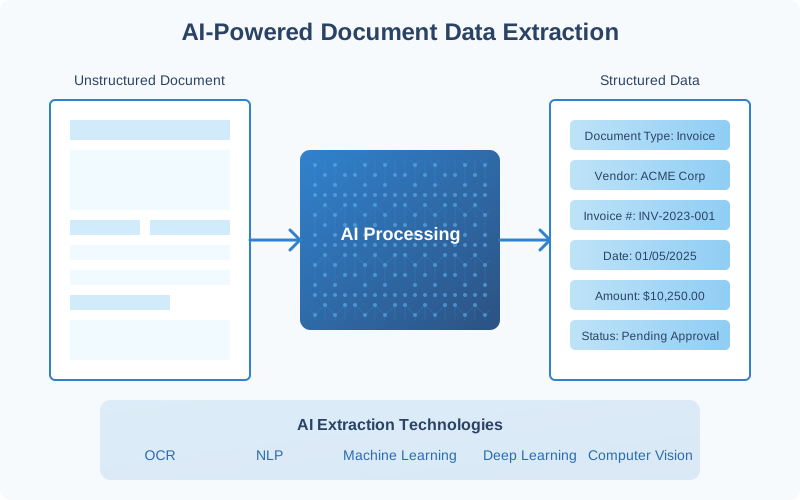
Once captured, documents enter the classification phase where intelligent systems determine document types and route them to appropriate workflows based on content analysis rather than manual sorting. Modern classification technologies combine template matching, keyword identification, pattern recognition, and machine learning to accurately categorize documents even when formats vary or key information appears in unexpected locations. This automated classification eliminates the delays and errors associated with manual sorting while ensuring that each document enters the correct processing pathway from the outset.
Sophisticated routing capabilities direct documents to appropriate stakeholders based on content, urgency, dollar value, or other business rules. Dynamic routing adapts to organizational changes, automatically redirecting workflows when approvers are unavailable or when escalation thresholds are reached. These intelligent routing systems dramatically reduce the "idle time" documents spend waiting for attention, addressing one of the most significant inefficiencies in traditional document workflows. Organizations that implement automated classification and routing typically report 70-80% reductions in document processing delays, translating directly into accelerated business operations and improved stakeholder experiences.
Extracting accurate data from documents represents one of the most labor-intensive aspects of traditional document processing. Modern workflow solutions employ artificial intelligence and machine learning technologies to automatically identify and extract critical information fields from diverse document types. These systems progressively improve their extraction accuracy through ongoing training, developing the ability to reliably capture data from semi-structured and unstructured documents that previously required manual keying. Advanced solutions can extract complex information elements including tables, line items, and contextual data that conventional OCR technology cannot reliably process.
Data validation represents the essential companion to extraction, applying business rules and verification checks to ensure information accuracy before documents advance through subsequent workflow stages. Effective validation combines automated integrity checks with selective manual verification of exception cases, striking an optimal balance between processing speed and data quality. Integration with authoritative data sources such as vendor databases, customer information systems, or product catalogs enables real-time cross-referencing that catches discrepancies early in the processing cycle. This front-loaded validation approach prevents errors from propagating through workflows, dramatically reducing exception handling requirements and rework cycles in downstream processes.
Approval bottlenecks represent the most commonly cited pain point in document workflows, creating frustrating delays that impact business operations and stakeholder satisfaction. Digital workflow solutions transform approvals through configurable routing rules, parallel processing capabilities, and mobile-enabled interfaces that allow stakeholders to review and approve documents from any location. Rule-based approval matrices automatically determine required signatories based on document content, monetary thresholds, or organizational policies, ensuring appropriate oversight without unnecessary review layers. Parallel approval workflows enable multiple stakeholders to review documents simultaneously rather than sequentially, collapsing approval timelines from weeks to days or even hours.
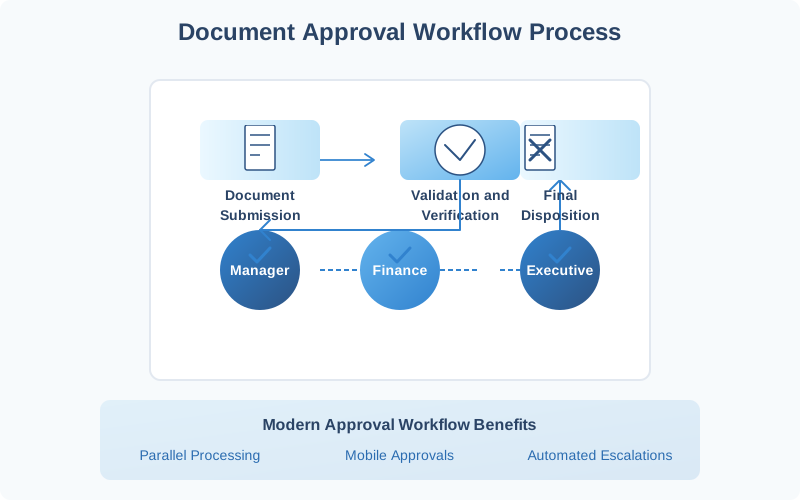
Electronic signature integration represents a critical component of approval workflow transformation, eliminating the printing, signing, scanning, and mailing cycles that plague traditional signature processes. Modern e-signature solutions provide legally-binding approval mechanisms with comprehensive audit trails that document exactly when and by whom approvals were granted. Mobile approval capabilities have proven particularly transformative, enabling executives and managers to maintain workflow momentum even when traveling or working remotely. Organizations that implement comprehensive approval workflow transformation typically reduce approval cycle times by 70-90%, directly accelerating the business processes dependent on those approvals.
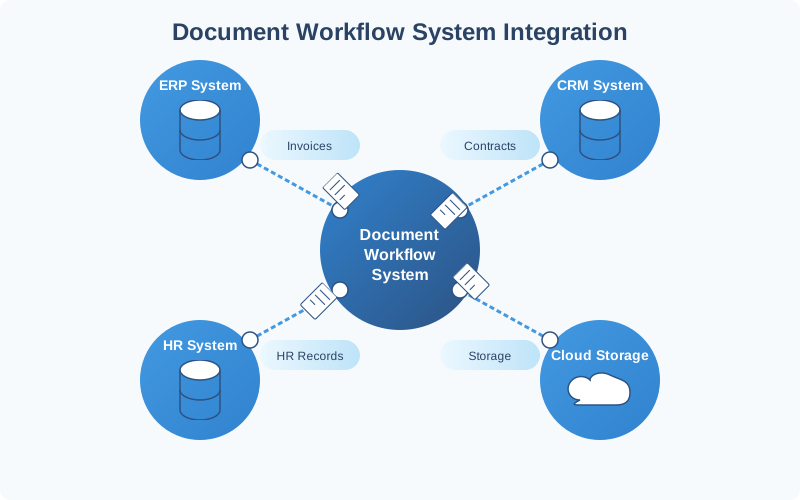
Document workflows rarely exist in isolation they connect with and support core business processes managed in enterprise systems such as ERP, CRM, HRIS, and financial platforms. Effective workflow transformation requires seamless integration between document management capabilities and these operational systems. Modern integration approaches utilize API connections, microservices architectures, and robotic process automation (RPA) to create bidirectional data flows between document workflows and enterprise applications without expensive custom development work. These integration capabilities ensure that document-centric information automatically propagates to relevant business systems while contextual data from those systems enriches document workflows.
The benefits of system integration extend far beyond simple data synchronization. Integrated workflows eliminate the "swivel chair" processing where staff manually transfer information between systems, reducing labor requirements while improving data consistency. Process visibility improves dramatically when document status information appears within the business applications that stakeholders use daily. Exception handling becomes more efficient when workflow systems automatically reference contextual information from enterprise applications. Perhaps most importantly, end-to-end integration enables true straight-through processing for routine transactions, allowing organizations to handle growing document volumes without proportional staff increases.
Regulatory compliance and information security concerns have intensified as organizations process increasingly sensitive documents through digital workflows. Effective workflow transformation addresses these requirements through comprehensive governance capabilities that manage document access, maintain detailed audit trails, enforce retention policies, and protect confidential information throughout the document lifecycle. Role-based access controls ensure that employees can access only the document types and data fields required for their specific job functions. Version control mechanisms maintain document integrity while preserving the ability to review historical changes when necessary for audit or investigation purposes.
Advanced workflow solutions implement security by design, incorporating encryption for documents both in transit and at rest, multi-factor authentication for sensitive operations, and automated compliance checks that flag potential policy violations before they result in regulatory exposure. Geographically-aware processing routes documents through appropriate regional workflows to maintain compliance with data sovereignty requirements. Comprehensive audit trails document every interaction with regulated documents, providing the evidence necessary to demonstrate compliance during regulatory examinations or legal proceedings. Organizations that implement these governance capabilities transform their document workflows from compliance liabilities into powerful tools for managing regulatory obligations more efficiently.
The most sophisticated document workflow implementations incorporate robust analytics capabilities that provide visibility into process performance and identify opportunities for continuous improvement. Operational dashboards display key metrics such as processing volumes, cycle times, exception rates, and approval velocities, allowing managers to identify bottlenecks and resource constraints in real time. Historical trend analysis reveals seasonal patterns and long-term performance trajectories that inform capacity planning and process enhancement initiatives. Predictive analytics capabilities forecast workflow volumes and completion timelines, enabling proactive resource allocation to maintain service levels during peak periods.
Process mining technologies offer particularly powerful insights by analyzing workflow data to uncover inefficiencies and variation that might not be apparent through conventional reporting. These tools can identify unauthorized process shortcuts, unnecessary approval loops, and correlation patterns between specific document attributes and processing exceptions. The organizations that achieve the greatest workflow transformation benefits establish formal improvement programs that regularly analyze these analytics insights and implement targeted process enhancements. This data-driven approach transforms document workflows from static procedures into continuously evolving assets that become increasingly efficient over time.
Document workflow transformation represents one of the most significant yet frequently overlooked opportunities for organizational efficiency improvement and digital transformation advancement. The technologies and methodologies detailed throughout this article provide a comprehensive framework for transforming document-centric operations across the enterprise. Organizations that successfully implement these capabilities typically report 40-60% reductions in processing costs, 50-80% improvements in processing times, substantial compliance risk reduction, and significantly enhanced stakeholder experiences. These benefits directly contribute to competitive advantage through improved operational agility, enhanced cash flow management, and superior customer and employee experiences.
Looking ahead, emerging technologies promise to further revolutionize document workflows through increasingly sophisticated artificial intelligence capabilities. Natural language processing advancements will enable systems to comprehend document context and intent rather than simply extracting data fields. Conversational interfaces will transform how users interact with document workflows, making complex processes accessible through simple voice commands or text conversations. Blockchain implementations will provide immutable audit trails for sensitive document transactions. Organizations that establish strong document workflow foundations today position themselves to readily adopt these emerging capabilities as they mature, maintaining their efficiency advantages in an increasingly digital business environment.

Head IT Operations - Co Founder of Artificio
See it in your SAP environment
Bring us a document, a process, or a bottleneck. We'll show how Artificio captures, validates, and posts into SAP — then scale from there.
Security & compliance
ISO 27001:2013 certified, SOC 2 Type 2 compliant, GDPR and HIPAA ready. Every agent action is logged, auditable, and runs in isolated environments.