

Blog
API-Driven Document Automation: A Paradigm Shift in Organizational Workflow
Uncover hidden costs of manual document processing. Learn how intelligent automation can reduce errors and save resources.

Blog
Uncover hidden costs of manual document processing. Learn how intelligent automation can reduce errors and save resources.
An examination of how modern document parsing APIs are revolutionizing data extraction while preserving existing enterprise infrastructure
In the modern business landscape, the persistent reliance on manual document processing represents one of the most significant yet underrecognized operational inefficiencies. Organizations across the spectrum of industries collectively dedicate millions of labor hours to the monotonous task of extracting data from invoices, purchase orders, receipts, contracts, and myriad other document types. This process transcends mere tedium it constitutes a multifaceted drain on organizational resources, introducing error susceptibility, escalating operational costs, and diverting valuable human capital from activities that could generate substantially higher value.
Consider the empirical reality: a typical medium-sized enterprise processes approximately 10,000 invoices annually. When each invoice demands 15 minutes for manual processing, this accumulates to 2,500 hours per year effectively consuming the entire productive capacity of a full-time employee solely for data transposition. Furthermore, this calculation addresses merely one document type within one departmental function, leaving the total organizational burden significantly underestimated.
The comprehensive cost structure extends far beyond direct labor expenditure. Data entry errors frequently precipitate payment discrepancies, which subsequently necessitate resource-intensive reconciliation processes. Processing delays routinely result in payment delinquency, potentially damaging supplier relationships and forfeiting early payment incentives that could otherwise yield substantial savings. Document mishandling introduces compliance vulnerabilities, potentially exposing organizations to regulatory penalties and litigation. Perhaps most insidiously, the assignment of knowledge workers to repetitive, low-cognitive-demand tasks contributes to diminished job satisfaction, reduced engagement, and ultimately elevated turnover rates each carrying its own considerable replacement and onboarding costs.
Despite these manifest inefficiencies, numerous organizations maintain these suboptimal processes, primarily due to the perceived complexity and disruption associated with system transformation. The institutional inertia derives from legitimate concerns: existing systems represent significant capital investments, employees have developed proficiency with current workflows, and the risk of operational disruption during transition appears prohibitively high. However, recent technological developments have fundamentally altered this calculus, offering a pathway to process optimization that does not necessitate wholesale system replacement.
Intelligent Document Processing (IDP) represents the convergence of multiple technological disciplines optical character recognition (OCR), machine learning algorithms, computer vision, and natural language processing into a unified system capable of automatically transforming unstructured document content into structured, machine-readable data. This technological confluence has produced systems that transcend traditional document digitization, which merely converted images to text, to achieve genuine document understanding.
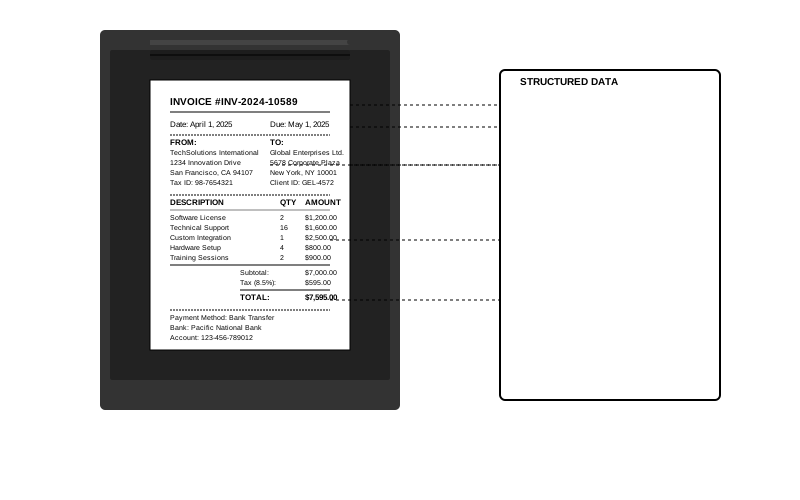
The animation depicted above illustrates the fundamental mechanism: a document undergoes multi-stage processing wherein an intelligent system identifies salient information fields, extracts the pertinent data elements, and converts them into a structured format typically JSON or XML that facilitates seamless integration with existing enterprise systems. This transformation from unstructured to structured information constitutes the essential value proposition of IDP technology.
Contemporary IDP solutions incorporate sophisticated capabilities that distinguish them from their technological predecessors. These systems demonstrate contextual awareness, enabling them to differentiate between document types and apply appropriate extraction rules based on content rather than rigid templates. They employ semantic understanding to identify relevant information fields regardless of their spatial positioning within documents, adapting to the wide variability in formatting encountered across vendors and document types. The extraction process incorporates validation mechanisms that verify data consistency, flagging anomalies for human review. Perhaps most significantly, modern IDP systems implement machine learning algorithms that continuously refine their accuracy through exposure to corrections and additional document examples, creating a virtuous cycle of improving performance over time.
The architectural innovation that fundamentally alters the implementation calculus is the availability of these capabilities as application programming interfaces (APIs). This delivery mechanism enables organizations to access sophisticated document processing functionality without installing complex on-premises software or migrating data to new systems. The API approach essentially decouples the document processing function from the underlying business systems, allowing organizations to enhance existing workflows rather than replace them a critical distinction that substantially reduces implementation barriers.
The transformative aspect of API-based document processing solutions lies in their ability to augment existing systems rather than necessitate their replacement. This integration-focused approach recognizes the substantial organizational investment in established business applications and the operational disruption inherent in system migration. By exposing document processing capabilities through standardized interfaces, these solutions can interoperate with virtually any existing enterprise application.
The integration architecture typically follows a middleware pattern, wherein the document processing API serves as an intermediary layer between document sources and destination systems. Documents enter this middleware layer through various ingestion mechanisms email servers, network folders, direct uploads, or scanning devices. The IDP system processes these documents, extracting structured data according to predefined rules and models. The resulting structured data is then transmitted to destination systems through their native APIs or other integration mechanisms such as database connections, file transfers, or message queues.
This architectural approach accommodates integration with enterprise resource planning (ERP) systems including SAP, Oracle, and Microsoft Dynamics; accounting platforms such as QuickBooks, Xero, and Sage; customer relationship management (CRM) systems including Salesforce, HubSpot, and Microsoft Dynamics; document management repositories like SharePoint, Documentum, and Box; cloud storage services including Dropbox, Google Drive, and OneDrive; and custom-developed proprietary applications that often form the backbone of organizational processes.
The integration methodology preserves existing approval workflows, security models, and business logic while eliminating the manual data entry component. Documents continue to flow through established channels they are simply liberated from the friction of human transcription. This preservation of existing processes significantly reduces change management challenges and user resistance, as end users often experience the integration as an enhancement to their current workflow rather than a disruptive replacement.
To illustrate the practical implementation of intelligent document processing, we can examine a detailed process transformation for accounts payable invoice processing one of the most common initial applications for this technology due to its high transaction volume and standardized document structure.
In a typical pre-automation environment, the invoice processing workflow encompasses multiple manual touchpoints. The process initiates when a vendor transmits an invoice via email or physical mail to the accounts payable department. Upon receipt, an accounts payable clerk manually reviews the document, identifying key information fields such as vendor details, invoice number, date, line items, tax amounts, and total due. The clerk then manually transcribes this information into the organization's financial system, a process that typically requires 5-15 minutes per invoice depending on complexity. Once entered, the invoice progresses through an approval workflow based on organizational hierarchy and authorization limits. Following approval, the invoice is scheduled for payment according to terms. Finally, the physical or digital document is archived in a recordkeeping system for future reference and audit purposes. This end-to-end process typically consumes 8-10 days from receipt to payment, with manual data entry accounting for 1-2 days of this timeline.
The post-automation workflow fundamentally transforms this process while maintaining its essential structure. In the enhanced workflow, vendors submit invoices to a dedicated email address or supplier portal that serves as the ingestion point for the IDP system. Upon receipt, the system automatically classifies the document as an invoice and extracts all relevant data fields, including line-item details, using advanced recognition algorithms. The extracted data undergoes validation against existing records, including purchase orders and vendor master data, to identify discrepancies. The structured data is then transmitted directly to the financial system through its API, creating an invoice record without human intervention. The system flags exceptions such as missing information or validation failures for human review through an exception handling interface. The invoice then enters the same approval workflow as in the manual process, maintaining organizational control structures. Following approval, payment is scheduled according to the same business rules as before. The digital invoice and its extracted metadata are automatically archived in the document management system. This enhanced process typically reduces end-to-end processing time to 3-4 days, with the data extraction and entry phase compressed from hours to seconds.
The transformation preserves the essential control structures and approval mechanisms while eliminating the manual data entry component. Approvers continue to review invoices through familiar interfaces, and payment scheduling follows established protocols. The critical difference lies in the elimination of manual transcription and the resulting acceleration of the process, reduction in errors, and liberation of human resources for higher-value activities.
A holistic Intelligent Document Processing solution comprises several interconnected components that collectively transform unstructured documents into structured business data. Understanding these architectural elements provides insight into the comprehensive nature of modern document processing systems.
The document ingestion subsystem serves as the entry point, providing multiple channels through which documents enter the processing pipeline. This component typically supports email integration, enabling direct receipt of documents sent to dedicated addresses; scanner integration for processing physical documents; upload interfaces for manual submission; and folder monitoring for processing documents placed in designated network locations. The ingestion component may also incorporate preprocessing functions such as image enhancement, page separation, and initial quality validation.
The document classification engine determines the nature of each document, identifying whether it represents an invoice, purchase order, receipt, contract, or other document type. This classification may employ visual characteristics, textual content analysis, or a combination of approaches. Advanced systems can identify multiple document types within a single file, handling complex scenarios such as invoices with attached packing slips or contracts with embedded amendments.
The data extraction engine constitutes the core processing component, employing a combination of technologies to identify and extract relevant information. This component typically utilizes zonal OCR for documents with consistent layouts, pattern recognition for identifying common data formats such as dates and invoice numbers, key-value pair extraction for associated field labels and data, table extraction algorithms for handling line items, and contextual analysis for understanding data relationships. The extraction engine may incorporate multiple processing approaches, selecting optimal methods based on document characteristics.
The validation subsystem verifies extracted data against business rules and existing information sources. This component typically performs format validation to ensure data conforms to expected patterns, cross-field validation to verify internal consistency within documents, and external validation against master data and other systems. The validation subsystem generates confidence scores for extracted data, enabling automated decision-making regarding which fields require human verification.
The exception handling framework provides interfaces and workflows for managing documents that cannot be fully automated. This component typically includes visual validation interfaces displaying the original document alongside extracted data, correction mechanisms for modifying extraction results, and routing capabilities for directing exceptions to appropriate personnel based on document type or issue category. Advanced exception handling systems incorporate learning mechanisms that use corrections to improve future processing.
The system integration layer connects the IDP solution with existing business applications. This component typically includes pre-built connectors for common enterprise systems, API endpoints for custom integration, workflow triggers for initiating downstream processes, and data transformation capabilities for mapping extracted information to destination system requirements. The integration layer may also incorporate transaction management features ensuring reliable data transmission.
The analytics and reporting framework provides visibility into document processing operations. This component typically includes operational dashboards displaying processing volumes and exception rates, performance metrics tracking accuracy and throughput, audit trails recording document handling history, and trend analysis identifying processing patterns and anomalies. The analytics component often serves as the primary management interface for the overall solution.
Collectively, these architectural components create a comprehensive system that transforms document processing from a manual, labor-intensive activity to an automated, exception-based workflow. The modular nature of this architecture enables organizations to implement capabilities incrementally, beginning with core functionality and expanding as processes mature.
While accounts payable automation represents the most common initial application for intelligent document processing, the technology's fundamental capabilities extracting structured data from unstructured documents have relevant applications across virtually every organizational function. This cross-functional applicability significantly enhances the return on investment for IDP implementations.
Human resources departments routinely process document-intensive workflows throughout the employee lifecycle. Recruitment generates substantial document volume through resumes, cover letters, and application forms, each containing structured information in unstandardized formats. Intelligent document processing can extract candidate information, match qualifications against job requirements, and populate applicant tracking systems without manual intervention. The onboarding process generates numerous forms including tax documents, benefits enrollments, and policy acknowledgments, each requiring data extraction and system entry. Employee lifecycle events such as promotions, transfers, and separations similarly generate documentation requiring processing. By automating these document workflows, human resources departments can accelerate processing, improve data accuracy, and redirect staff toward higher-value activities such as candidate engagement and employee development.
Legal departments manage complex document ecosystems with substantial extraction requirements. Contract analysis represents a particularly suitable application, as agreements contain numerous structured data elements parties, effective dates, renewal terms, liability limits, governing law embedded within highly unstructured text. Intelligent document processing can extract these key elements, populate contract management systems, and flag critical provisions for review. Similar applications exist for regulatory filings, compliance documentation, and litigation records. The technology enables legal departments to process higher document volumes without corresponding staffing increases, while improving contract visibility and reducing risk through more consistent information extraction.
Sales operations involve numerous document-based processes amenable to intelligent automation. Order processing typically requires extraction of customer information, product details, quantities, and pricing from purchase orders received in diverse formats. Quotation generation often necessitates extracting specifications from customer requirement documents. Proposal responses, particularly for complex RFP processes, involve significant information extraction and consolidation. By automating these document-intensive processes, sales departments can accelerate order processing, improve accuracy, and redirect sales personnel from administrative tasks to customer engagement activities.
Customer service functions increasingly employ document processing automation to enhance responsiveness. Support tickets, warranty claims, and service requests often arrive as unstructured communications containing key information requiring extraction and routing. Return authorization processes involve extracting product information, purchase details, and return reasons from customer-submitted documents. Warranty validation requires extracting product and purchase information from registration cards and proof-of-purchase documentation. Automation of these processes enables customer service departments to process higher volumes while maintaining or improving response times.
Supply chain management encompasses numerous document-intensive processes well-suited to intelligent automation. Shipping documentation including bills of lading, packing lists, and customs forms contains structured information critical to logistics processes. Quality certifications and compliance documents require information extraction to verify regulatory adherence. Supplier onboarding generates substantial documentation requiring processing before vendors can be integrated into procurement systems. Automation of these document workflows enhances supply chain visibility, accelerates supplier integration, and improves compliance management.
Healthcare providers and payers confront particularly document-intensive environments with stringent accuracy requirements. Patient intake forms, insurance cards, and medical history documentation require accurate data extraction for electronic health record systems. Insurance claims processing involves extracting procedure codes, diagnosis information, and patient details from clinical documentation. Explanation of benefits documents require extraction of payment information, covered services, and patient responsibility amounts. The structured extraction of this information enhances patient care through improved information accessibility while reducing administrative burden on clinical staff.
These cross-functional applications demonstrate the versatility of intelligent document processing technology and its potential to transform information flow throughout the organization. The common thread across these applications is the conversion of unstructured document content into structured data that can populate business systems without manual intervention. This capability addresses a fundamental challenge present in virtually every business function, creating opportunities for process enhancement throughout the enterprise.
The remarkable advancement in document processing capabilities over the past decade derives primarily from fundamental breakthroughs in artificial intelligence, particularly in the domains of computer vision, machine learning, and natural language processing. These technological developments have collectively transformed document automation from template-based approaches requiring substantial configuration to intelligent systems capable of understanding document context and adapting to variability.
Deep learning-based optical character recognition represents a fundamental technological shift from traditional OCR approaches. Earlier generations of OCR technology relied primarily on pattern matching against predefined character sets, requiring high-quality images with consistent formatting to achieve acceptable accuracy. Contemporary deep learning OCR utilizes neural networks trained on millions of text samples, enabling significantly higher recognition accuracy, particularly for challenging scenarios including poor image quality, unusual fonts, skewed text, and handwritten content. This enhanced recognition capability fundamentally expands the range of documents suitable for automated processing, accommodating the quality variability inherent in real-world document collections.
Transfer learning methodologies have dramatically accelerated the development of document processing models for specific document types. Traditional machine learning approaches required extensive training data for each new document category often hundreds or thousands of example rendering the development of specialized models prohibitively resource-intensive for many organizations. Transfer learning enables the adaptation of pre-trained models to new document types with substantially smaller training sets, typically requiring dozens rather than hundreds of examples. This approach significantly reduces the implementation timeline for new document types while improving initial accuracy, enabling organizations to expand automation scope more rapidly.
Few-shot learning represents a further evolution in model adaptation, enabling systems to recognize new document formats or extract new field types with minimal examples sometimes as few as 3-5 samples. This capability derives from sophisticated meta-learning techniques wherein the system learns general principles of document structure and field identification rather than specific patterns for each document type. Few-shot learning substantially reduces the configuration effort for handling document variations, enabling systems to adapt to new vendor formats or document layouts with minimal human intervention.
Natural language processing advances have transformed the extraction of information from textual content. Earlier document processing approaches relied primarily on pattern matching and regular expressions to identify specific data formats such as dates, currency amounts, or invoice numbers. Contemporary NLP-based approaches understand semantic relationships within text, enabling the extraction of information based on context rather than format. This contextual understanding allows systems to identify relevant information despite variations in terminology, phrasing, and structure across documents. Particularly significant is the development of named entity recognition capabilities that can identify and categorize entities such as organizations, locations, people, monetary values, and dates within unstructured text.
Computer vision advancements have similarly transformed the processing of visual document elements. Modern document processing systems employ advanced computer vision techniques to understand document layout, identifying structural elements such as tables, headers, footers, and logical sections without relying on fixed templates. These capabilities enable the intelligent processing of complex document formats including multi-column layouts, nested tables, and documents combining textual and graphical elements. Particularly significant are advances in table structure recognition, which enable accurate extraction of tabular data regardless of formatting variations.
The integration of these technological capabilities has produced document processing systems with unprecedented adaptability. Modern IDP solutions can process documents with variable layouts, inconsistent formatting, poor image quality, multiple languages, handwritten annotations, and industry-specific terminology all with minimal configuration. This adaptability fundamentally alters the implementation equation, reducing the specialized configuration previously required for each document type and enabling broader automation scope with lower implementation effort.
The implementation of intelligent document processing solutions benefits from a structured, phased approach that manages organizational change while delivering incremental value. This measured methodology contrasts with traditional system implementations that often require substantial upfront investment before realizing benefits. The API-based nature of modern IDP solutions enables an incremental approach wherein organizations can validate value through limited deployments before expanding scope.
The initial discovery and assessment phase establishes foundational understanding of current document workflows and quantifies improvement opportunities. This phase typically begins with process mapping exercises documenting current document flows, handling procedures, volumes, and processing times. Document analysis examines samples across document types to assess formatting consistency, information density, and extraction complexity. Systems inventory identifies destination systems for extracted data, integration mechanisms, and data format requirements. Stakeholder interviews gather perspectives from document handlers, process owners, and system administrators. This discovery process culminates in opportunity assessment that quantifies potential benefits, prioritizes document types based on value and complexity, and establishes success metrics for the implementation.
The proof of concept phase validates technology effectiveness with actual organizational documents. This limited-scope implementation typically selects a single, high-volume document type most commonly vendor invoices for initial automation. The proof of concept involves configuring the IDP solution for the selected document type, processing a representative sample of historical documents, measuring extraction accuracy against manual processing, and refining the configuration to address identified gaps. This controlled evaluation enables organizations to validate the technology's effectiveness with their specific document types before committing to broader implementation. Successful proof of concept implementations typically demonstrate recognition accuracy exceeding 80% for key fields, providing confidence for expanded deployment.
The initial implementation phase establishes core infrastructure and processes for the first production document type. This phase includes establishing document ingestion channels, configuring extraction rules for production deployment, developing integration with destination systems, establishing exception handling workflows, and training key users on the new process. Organizations typically implement a phased cutover, processing documents through both manual and automated channels initially to validate results before transitioning fully to the automated workflow. This phase establishes not only the technical infrastructure but also the governance processes, support mechanisms, and performance monitoring essential for sustained operation.
The expansion phase extends automation to additional document types and processes. With core infrastructure established, organizations can incrementally add document types to the automation scope, leveraging the experience gained during initial implementation. Each expansion iteration follows a streamlined implementation process: document analysis, extraction configuration, integration development, testing, and deployment. Organizations typically prioritize expansion based on document volume, process pain points, and implementation complexity, addressing simpler, higher-volume document types before progressing to more complex formats. This phased expansion delivers continuous improvement over time while managing change at a sustainable pace.
The optimization phase focuses on enhancing automated processes through continuous improvement mechanisms. With core automation established, organizations can focus on refining extraction accuracy, expanding straight-through processing rates, streamlining exception handling, and enhancing reporting capabilities. This phase typically involves regular review of extraction exceptions to identify patterns and improvement opportunities, refinement of extraction models based on accumulated corrections, and process adjustments based on operational metrics. The continuous improvement focus ensures that the solution evolves with changing document formats and business requirements.
This measured implementation approach delivers several advantages over traditional system implementations. The incremental delivery model produces measurable benefits early in the implementation cycle, generating organizational momentum and stakeholder support. The phased expansion manages change at a sustainable pace, allowing users to adapt to new processes without overwhelming disruption. The proof-of-concept validation reduces implementation risk by confirming technology effectiveness before significant investment. Perhaps most significantly, the approach accommodates resource constraints by dividing implementation into manageable components that can be executed without large, dedicated project teams.
The economic case for intelligent document processing rests on a comprehensive assessment of both tangible and intangible benefits across multiple dimensions. While cost reduction often serves as the initial justification, a thorough analysis reveals broader value creation extending to process acceleration, error reduction, and strategic resource reallocation.
Direct labor cost reduction represents the most immediately quantifiable benefit. Organizations typically realize 60-80% reduction in manual processing time for automated document types, with higher automation rates for standardized documents such as invoices and lower rates for more variable documents such as contracts. This efficiency translates directly to labor cost savings or capacity creation, enabling processing of higher document volumes without corresponding staff increases. For a mid-sized organization processing 10,000 invoices annually, this typically represents 1,500-2,000 hours of annual capacity creation approximately one full-time equivalent that can be redirected to higher-value activities.
Process acceleration generates multiple derivative benefits beyond direct labor savings. Reduced processing time enables organizations to capture more early payment discounts from vendors, typically yielding 1-2% savings on eligible invoice amounts. For organizations with substantial purchasing volumes, these discounts can exceed the direct labor savings from automation. Faster processing also improves vendor relationships by ensuring timely payment, potentially yielding preferential treatment during supply constraints or more favorable terms during contract negotiations. Customer-facing document processes similarly benefit from acceleration, with faster order processing, claims handling, and service requests enhancing customer satisfaction and potentially reducing churn.
Error reduction generates substantial but often underquantified benefits. Manual data entry typically produces error rates of 2-4%, each requiring costly correction processes. Document automation reduces these errors by 80-95%, yielding not only direct savings in correction costs but also avoiding the consequential costs of payment errors, order fulfillment mistakes, and compliance issues. These consequential costs often substantially exceed the direct correction costs, particularly for errors affecting customer experience or regulatory compliance. The error reduction benefit increases proportionally with document complexity and data field count, as human error rates rise with cognitive load while automated extraction maintains consistent accuracy.
Audit efficiency improvements generate particular value for regulated industries and public companies. Manual document processing typically requires substantial time during audits to locate documents, validate data transcription, and explain discrepancies. Automated processing with comprehensive audit trails can reduce this audit support time by 40-50%, generating both direct labor savings and accelerating audit completion. This acceleration carries particular value for time-sensitive reporting cycles such as quarterly financial closings, where audit delays can impact reporting timelines and potentially affect market perception.
Compliance risk reduction, while challenging to quantify precisely, carries substantial value particularly in regulated industries. Manual document processing introduces numerous compliance vulnerabilities through misclassification, incomplete data capture, and inconsistent handling procedures. Automated processing enforces consistent handling rules, captures comprehensive metadata, and maintains complete audit trails all reducing compliance risk exposure. For organizations in highly regulated industries such as healthcare, financial services, or pharmaceuticals, this risk reduction may constitute the primary value driver, as compliance failures can trigger substantial penalties and reputational damage.
Scalability without proportional cost increase represents a strategic benefit extending beyond immediate efficiency gains. Manual document processing typically requires proportional staffing increases to handle growing document volumes, creating a direct correlation between business growth and processing costs. Automated processing breaks this correlation, enabling substantial volume increases with minimal incremental cost. This scalability enhances organizational agility by removing document processing as a constraint on growth initiatives, acquisition integration, or new market entry. The strategic value of this scalability grows with organizational growth rate and market volatility.
Employee experience enhancement generates both retention benefits and productivity improvements. Reallocating staff from repetitive data entry to higher-value activities typically increases job satisfaction, potentially reducing turnover in administrative functions that often experience high attrition rates. Beyond retention, this reallocation often unlocks productivity improvements as experienced staff apply their institutional knowledge and subject matter expertise to value-creation activities rather than transcription tasks. Organizations frequently discover that the productivity gained through strategic reallocation exceeds the direct efficiency benefits of automation itself.
Comprehensive economic analysis typically reveals return on investment within 6-12 months for initial implementation, with subsequent document type additions yielding accelerated returns as they leverage existing infrastructure. This rapid payback period, combined with the API-based implementation approach requiring minimal capital investment, positions intelligent document processing as one of the highest-yield digital transformation initiatives available to contemporary organizations.
Intelligent document processing technology has reached a critical inflection point wherein technical capability, implementation methodology, and economic value have converged to create compelling transformation opportunities for organizations across industries. The historical constraints that preserved manual document handling implementation complexity, system disruption concerns, and accuracy limitations have been largely eliminated through architectural innovation, particularly the API-based delivery model that enables enhancement rather than replacement of existing systems.
The technology has evolved beyond simple character recognition to achieve genuine document understanding, enabling the processing of complex, variable documents with minimal configuration. The implementation methodology has matured from high-risk "big bang" approaches to measured, incremental deployments that deliver value while managing organizational change. The economic model has shifted from capital-intensive software implementations to subscription-based services that align costs with value creation. This convergence has transformed document automation from a specialized technology with limited applicability to a mainstream solution relevant to virtually every organization that processes business documents.
Organizations that embrace this technology now position themselves to realize multiple strategic advantages. The immediate efficiency gains from eliminated manual processing create capacity that can be redirected toward value-creation activities. The accelerated processing timelines enhance both supplier and customer relationships through more responsive interactions. The improved data accuracy and accessibility enhance decision-making through more timely and reliable information. Perhaps most significantly, the scalability provided by automated processing removes document handling as a constraint on organizational growth and transformation.
The question confronting organizational leaders is no longer whether document processing should be automated, but rather how quickly the transformation can be implemented within existing operational constraints. Those who move decisively to implement intelligent document processing position themselves to realize both immediate efficiency gains and long-term strategic advantages as they liberate their organizations from the persistent burden of manual document handling.

Head IT Operations - Co Founder of Artificio
See it in your SAP environment
Bring us a document, a process, or a bottleneck. We'll show how Artificio captures, validates, and posts into SAP — then scale from there.
Security & compliance
ISO 27001:2013 certified, SOC 2 Type 2 compliant, GDPR and HIPAA ready. Every agent action is logged, auditable, and runs in isolated environments.