

Blog
The Evolution of Automation - Understanding RPA vs APA vs AI Agents
Explore the shift from RPA to AI agents. Learn differences, benefits, and implementation.

Blog
Explore the shift from RPA to AI agents. Learn differences, benefits, and implementation.
In today's rapidly evolving technological landscape, businesses are confronted with an expanding array of automation solutions promising to revolutionize operations, streamline workflows, and reduce costs. Terms like Robotic Process Automation (RPA), Agentic Process Automation (APA), and AI agents have become commonplace in business technology discussions. However, the distinctions between these technologies and their respective capabilities and limitations often remain unclear to decision-makers tasked with implementing digital transformation initiatives.
The automation landscape has evolved significantly over the past decade. What began with simple script-based automation has transformed into sophisticated AI-powered systems capable of handling complex, unstructured data and making autonomous decisions. This evolution reflects the growing need for businesses to process increasingly diverse information formats while maintaining operational efficiency and accuracy.
As illustrated in Figure 1, the progression from RPA to APA to AI agents represents a fundamental shift in how machines interact with business processes from rigid rule-following to adaptive learning and autonomous decision-making. This shift has profound implications for how organizations approach document processing, workflow management, and knowledge work automation.
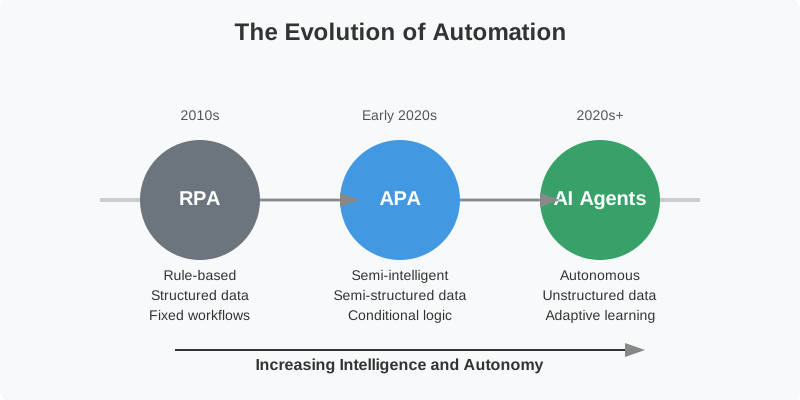
Robotic Process Automation, or RPA, emerged as a transformative technology in the early 2010s, offering businesses a way to automate repetitive, rule-based tasks without extensive programming knowledge. At its core, RPA functions as a digital worker that mimics human interactions with digital systems, following predefined rules to execute tasks with precision and consistency.
RPA excels in structured environments where processes follow clear, unchanging patterns. These digital robots operate by interpreting the user interface of digital systems clicking buttons, entering data, copying and pasting information just as a human would, but with greater speed and accuracy. This makes RPA particularly valuable for high-volume, repetitive tasks that follow consistent rules.
The strength of RPA lies in its ability to handle structured data with remarkable efficiency. When processing invoices with standardized formats, for example, an RPA bot can be programmed with instructions like: "If field X is in position Y, copy it to system Z." This explicit programming allows RPA to achieve near-perfect accuracy when working with standardized documents and well-defined processes.
However, this rigid adherence to rules also reveals RPA's fundamental limitation: its inability to adapt to variations or handle unstructured data. Even minor changes to document formats or process steps can cause RPA bots to fail, requiring human intervention and reprogramming. This brittleness makes RPA solutions less effective for organizations dealing with variable document formats or processes that require judgment and decision-making.
Despite these limitations, RPA has delivered significant value to organizations worldwide. According to recent industry reports, RPA implementations have achieved return on investment figures ranging from 30% to 200% within the first year of deployment. These impressive returns typically come from reduced processing times, improved accuracy, and the reallocation of human workers to higher-value activities.
The business case for RPA remains strong in specific contexts, particularly for organizations with:
For these organizations, RPA continues to serve as an effective entry point into automation, offering tangible benefits without requiring extensive system changes or advanced AI capabilities. However, as businesses encounter more complex automation challenges—particularly those involving unstructured data and variable processes—many find themselves reaching the limits of what traditional RPA can accomplish.
As organizations began encountering the limitations of traditional RPA, technology providers responded by developing more flexible automation solutions. This gave rise to Agentic Process Automation (APA), a significant evolutionary step that bridges the gap between rigid RPA and fully autonomous AI agents.
APA represents an enhanced approach to automation that combines the rule-based functionality of RPA with more advanced capabilities for handling semi-structured data and executing conditional logic. Unlike pure RPA, which requires explicit programming for every possible scenario, APA systems can navigate decision points within defined parameters, making them substantially more adaptable to real-world business processes.
The key distinction between RPA and APA lies in their different approaches to process variability. While RPA follows fixed paths through digital workflows, APA can evaluate conditions and select appropriate actions from a predefined set of options. This conditional execution allows APA to handle processes with moderate complexity, such as routing approval requests based on document contents or extracting information from semi-structured documents with varying layouts.
APA systems typically incorporate technologies such as:
These capabilities make APA particularly valuable for processes that contain some variability but still follow recognizable patterns. Consider, for example, an accounts payable process that handles invoices from different vendors with varying formats. While an RPA bot might struggle with these variations, an APA system can identify key information regardless of its precise location on the document, classify the invoice type, and determine the appropriate approval workflow based on company policies.
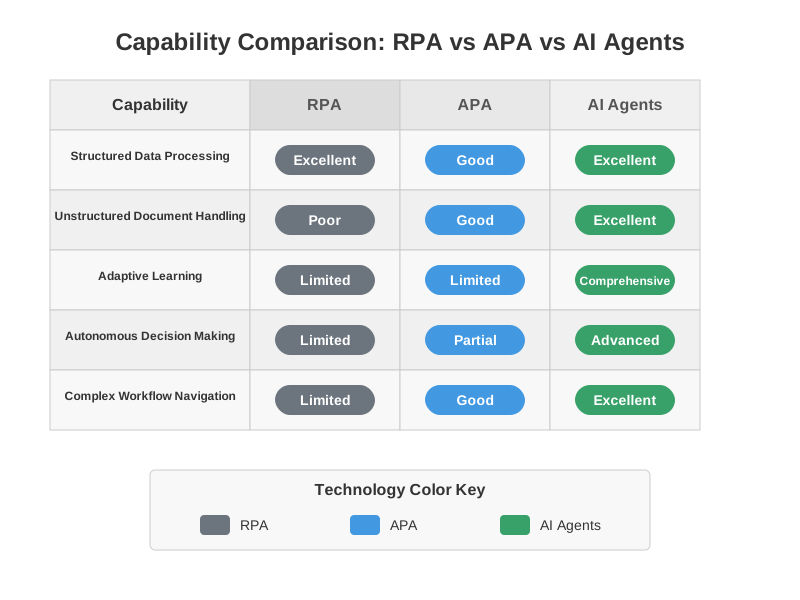
Figure 2 provides a detailed comparison of the capabilities of RPA, APA, and AI agents across key dimensions such as structured data processing, unstructured document handling, adaptive learning, autonomous decision-making, and complex workflow navigation. As the visualization demonstrates, APA occupies a middle ground between the rigid efficiency of RPA and the advanced capabilities of AI agents.
Organizations typically adopt APA when they need more flexibility than RPA can provide but aren't ready for the complexity and organizational changes required for fully autonomous AI agents. This intermediate approach allows businesses to extend automation to processes with moderate complexity while building the skills and infrastructure needed for more advanced AI implementations.
The business value of APA stems from its ability to handle a wider range of processes than RPA, particularly those involving semi-structured data and conditional logic. By automating these more complex workflows, organizations can achieve higher automation rates and greater process resilience, reducing the frequency of exceptions that require human intervention.
While RPA and APA have delivered significant value in automating structured and semi-structured processes, they represent only intermediate steps in the broader evolution of business automation. The emergence of AI agents marks a fundamental shift in this trajectory moving from programmatic automation to truly intelligent systems capable of learning, adapting, and making complex decisions with minimal human oversight.
AI agents leverage advanced artificial intelligence technologies, including deep learning, natural language processing, computer vision, and reinforcement learning, to develop a comprehensive understanding of business documents, processes, and contexts. Unlike their more limited predecessors, AI agents can interpret unstructured data, adapt to new situations, and continuously improve their performance through experience.
The capabilities of AI agents extend far beyond simple task execution. These sophisticated systems can:
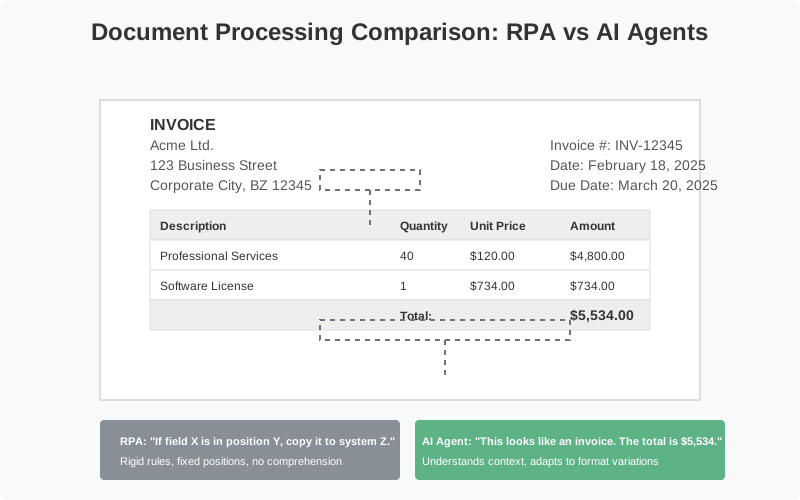
To appreciate the transformative potential of AI agents, consider how differently they approach document processing compared to RPA systems. When confronted with an invoice, an RPA bot follows rigid instructions: "If field X is in position Y, copy it to system Z." In contrast, an AI agent demonstrates a fundamentally different level of comprehension: "This looks like an invoice. The total is $5,534. The date is February 18th. It's from Acme Ltd. Should I process it?"
This distinction, illustrated in Figure 3, highlights the shift from programmatic execution to intelligent comprehension. The AI agent doesn't just follow predefined steps; it understands the document's nature, extracts relevant information regardless of format, and can engage in a decision-making process that incorporates business context and organizational priorities.
The technological foundation for AI agents represents a convergence of several advanced fields:
Modern NLP models based on transformer architectures enable AI agents to understand the semantic meaning of text in documents, going far beyond simple keyword matching. These models can interpret context, identify entities, and extract relationships between concepts even when information is presented in novel ways or with unfamiliar terminology.
Advanced computer vision algorithms allow AI agents to "see" documents much as humans do, recognizing visual patterns, layout structures, and graphical elements. This capability is particularly valuable for processing documents with complex visual hierarchies, such as medical records, technical drawings, or financial statements with embedded charts.
Through reinforcement learning techniques, AI agents can optimize their performance over time by learning from the outcomes of their actions. This creates systems that improve continuously through experience, becoming more accurate and efficient without requiring explicit reprogramming.
Many sophisticated AI agents incorporate knowledge graphs that represent the relationships between entities, concepts, and processes within a specific domain. These structured repositories of knowledge enable AI agents to reason about complex scenarios by drawing on both general principles and specific facts relevant to their area of operation.
The integration of these technologies creates systems capable of handling document-centric workflows with unprecedented flexibility and intelligence. AI agents excel in environments characterized by:
Within the broader category of AI agents, an important distinction has emerged between specialist and generalist approaches. While both leverage advanced AI technologies, they differ significantly in their design philosophy, capabilities, and optimal use cases.
Generalist AI agents are designed to handle a wide range of tasks across multiple domains. These systems draw on large language models and broad training data to develop flexible capabilities that can be applied to diverse scenarios. The appeal of generalist agents lies in their versatility a single system that can potentially address numerous automation needs across an organization.
In contrast, specialist AI agents are purpose-built for specific domains or functions, such as document processing, financial analysis, or regulatory compliance. These focused systems incorporate deep domain knowledge, specialized algorithms, and training data specific to their area of expertise. Rather than attempting to be all things to all users, specialist agents excel at performing a narrower range of tasks with exceptional proficiency.
The distinction between specialist and generalist AI agents parallels a classic trade-off in human expertise: breadth versus depth. Just as a general practitioner physician offers valuable versatility while a specialist provides deeper expertise in a specific area, AI agents face similar capability trade-offs based on their design and training.
For document processing and automation, specialist AI agents offer several distinct advantages:
Specialist document processing agents incorporate detailed knowledge of industry-specific terminology, document types, and regulatory requirements. An AI agent specialized in processing medical claims, for instance, would understand healthcare coding systems, insurance policies, and compliance requirements in ways that a generalist agent might not.
By focusing on a specific domain, specialist agents can achieve higher accuracy rates for critical tasks. This precision is particularly valuable in contexts where errors carry significant costs, such as financial transactions, legal document analysis, or healthcare documentation.
Specialist agents are typically designed to integrate directly with industry-specific systems and workflows. For example, a specialist accounts payable agent would include built-in connections to major ERP systems and understand the specific requirements for posting transactions correctly.
In highly regulated industries, specialist agents can incorporate detailed knowledge of relevant laws and standards, ensuring that automated processes remain compliant with evolving regulatory requirements.
The debate between specialist and generalist approaches extends beyond theoretical concerns into practical business considerations. As noted by industry experts, including Artificio's CTO in his publication "The Unreasonable Hype of Generalist AI Agents," expectations for generalist AI agents often outpace their actual capabilities, particularly in specialized business contexts.
The potential pitfalls of over-relying on generalist approaches were summarized in a prescient prediction: "In 2025, we will hear two new kinds of cautionary stories about AI agents. First, an enterprise will deploy generalist agents, expecting them to outperform their best long-tenured employees at their main specialty. But the generalist agents will be found to be missing three things: niche expertise, necessary meticulousness, and domain experience."
This caution echoes historical patterns in technology adoption, where initial enthusiasm for "one-size-fits-all" solutions eventually gives way to more nuanced approaches that recognize the value of specialization for complex tasks. While generalist AI agents will continue to evolve and improve, specialist agents are likely to maintain significant advantages in domains where deep expertise and accuracy are paramount.
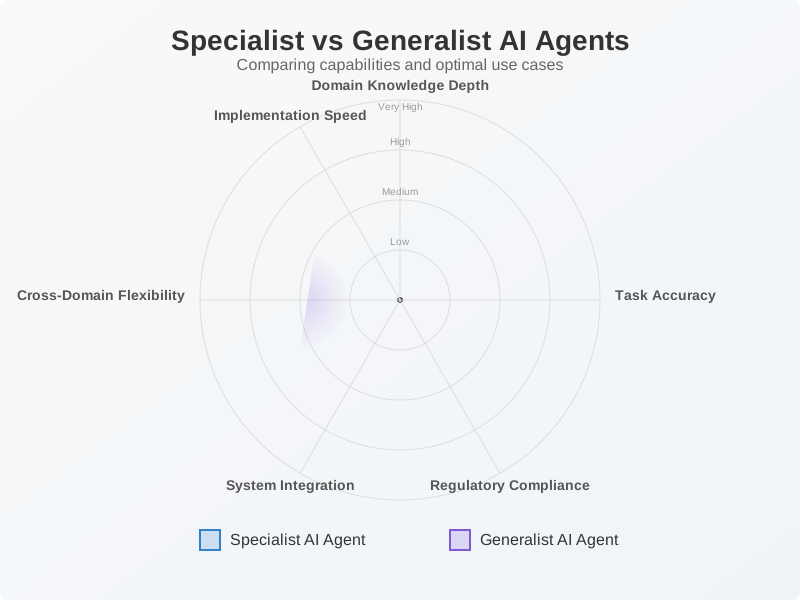
Figure 4 illustrates the key differences between specialist and generalist AI agents across dimensions such as domain knowledge depth, accuracy in specific tasks, flexibility across domains, and implementation complexity. This visualization helps organizations understand the trade-offs involved and select the approach that best aligns with their specific automation objectives.
Despite the advanced capabilities of AI agents, concerns about workforce displacement remain prevalent among organizations considering automation initiatives. The question "Will AI agents replace my accounts payable team?" represents a common anxiety about the potential impact of intelligent automation on knowledge work positions.
However, the reality of AI agent implementation reveals a more nuanced picture than simple worker replacement. Rather than eliminating human roles, effective AI agent deployments typically transform them shifting human workers from routine processing tasks to higher-value activities that leverage uniquely human capabilities such as relationship management, strategic thinking, and complex problem-solving.
This collaborative model creates a partnership between human workers and AI agents, with each contributing their distinct strengths to business processes. AI agents excel at handling routine document processing, ensuring consistency, and operating continuously without fatigue. Human workers, meanwhile, provide critical oversight, handle complex exceptions, build relationships with stakeholders, and make strategic decisions that require contextual understanding or ethical judgment.
In accounts payable operations, for example, this partnership might distribute responsibilities as follows:
This collaborative approach delivers several benefits beyond mere cost reduction:
Importantly, human workers also play a crucial role in the initial deployment and ongoing improvement of AI agents. Subject matter experts provide the training data, business rules, and feedback necessary for AI agents to develop their capabilities. This creates a virtuous cycle in which human expertise enhances AI performance, which in turn expands the capacity of human workers to apply their expertise more broadly.
Organizations that approach AI agent implementation as an opportunity for human-AI collaboration rather than simple labor replacement typically achieve more successful outcomes and encounter less resistance from employees. By emphasizing how automation will transform jobs rather than eliminate them, leaders can build support for digital transformation initiatives and ensure that their workforce develops the skills needed to thrive in an increasingly automated environment.
As organizations evaluate the potential of RPA, APA, and AI agents, they face critical decisions about where and how to implement these technologies. An effective automation strategy requires thoughtful consideration of business needs, process characteristics, and organizational readiness rather than simply pursuing the most advanced technology available.
Not all business processes benefit equally from automation, and different processes may require different automation approaches. A comprehensive automation strategy begins with a systematic assessment of business processes to identify the most promising candidates for each type of automation technology.
For RPA implementation, organizations typically prioritize processes with the following characteristics:
Examples include data migration between systems, standard report generation, and simple validation checks that follow explicit rules.
APA becomes more appropriate when processes involve:
Typical APA applications include invoice processing with multiple vendor formats, customer onboarding workflows, and approval processes with conditional routing.
AI agents represent the most advanced automation option, best suited for processes characterized by:
These characteristics make AI agents particularly valuable for contract analysis, regulatory compliance monitoring, complex customer support interactions, and data extraction from highly variable document formats.
By matching automation technologies to process characteristics, organizations can maximize the return on their automation investments while minimizing implementation challenges. This process-centric approach often results in a hybrid automation strategy that deploys different technologies for different workflow components based on their specific requirements.
For organizations ready to implement AI agents, a structured approach helps maximize success probability while managing risks. A comprehensive implementation roadmap typically includes the following phases:
The journey begins with a thorough assessment of current processes, pain points, and automation opportunities. This phase involves:
During this phase, cross-functional teams including operations staff, IT specialists, and business leaders work together to build a shared understanding of challenges and opportunities. This collaborative approach helps ensure that automation initiatives address genuine business needs rather than technology-driven assumptions.
Rather than attempting enterprise-wide deployment immediately, successful organizations typically begin with carefully selected pilot projects that demonstrate value while containing risk. Effective pilot initiatives:
The pilot design should incorporate not only the technical implementation details but also considerations for process changes, exception handling procedures, and transition plans for affected employees.
The technical implementation phase involves configuring the AI agent system, connecting it to relevant data sources and target systems, and training it on organization-specific requirements. This phase typically includes:
The training component extends beyond the AI system itself to include the human workers who will collaborate with it. Employees need to understand both how the AI agent functions and how their own roles will evolve as automation is implemented.
Following successful pilot completion, organizations can expand their AI agent implementation to additional processes or business units. This scaling phase requires:
Throughout deployment, the focus should remain on business outcomes rather than technical capabilities. Regular reviews should assess whether the implementation is delivering the expected benefits and identify opportunities for further optimization.
Unlike traditional software implementations, AI agent deployments benefit from ongoing refinement as the system gains experience and business requirements evolve. A robust continuous improvement program includes:
This continuous improvement cycle represents a key advantage of AI agent implementations over more static automation approaches. Rather than requiring complete reprogramming to address new requirements, AI agents can adapt incrementally through additional training and refinement of their underlying models.
The technical aspects of implementing AI agents, while critical, represent only part of the challenge. Equally important and often more challenging is managing the organizational change that accompanies automation initiatives. Effective change management addresses the human concerns, workflow adjustments, and cultural shifts that determine whether technology adoption succeeds or falters.
Key elements of successful change management for AI agent implementations include:
Transparent Communication
Organizations should communicate openly about automation plans, addressing concerns about job impacts directly while highlighting opportunities for role enhancement. Effective communication:
This transparency helps build trust and reduce the anxiety that often accompanies technological change.
Skills Development
As automation shifts routine tasks to AI agents, human workers need to develop new skills that complement automated capabilities. Forward-thinking organizations implement training programs that prepare employees for evolving roles by developing:
These development opportunities help employees see automation as a catalyst for career growth rather than a threat to job security.
Involvement and Empowerment
Engaging employees in the automation journey increases both the quality of implementation and the level of acceptance. Organizations can foster involvement by:
This participatory approach transforms employees from passive recipients of change to active contributors to the organization's digital transformation.
While current AI agent implementations already deliver significant value, the field continues to evolve rapidly. Organizations planning their automation strategy should consider not only present capabilities but also emerging trends that will shape the future of intelligent automation.
Next-generation AI agents will incorporate increasingly sophisticated cognitive abilities, including:
Predictive Analytics
Future AI agents will move beyond processing current documents to anticipating future patterns and needs. In accounts payable, for example, an advanced AI agent might analyze historical spending patterns to predict cash flow requirements, identify potential supply chain disruptions, or recommend optimal payment timing based on discount opportunities and cash position.
Contextual Understanding
AI agents will develop deeper contextual awareness, allowing them to interpret documents and situations within broader business contexts. This enhanced understanding will enable more nuanced decision-making that considers factors beyond the immediate document content, such as market conditions, organizational priorities, or strategic initiatives.
Autonomous Learning
While current AI agents typically require supervised learning with human feedback, future systems will increasingly develop autonomous learning capabilities. These advanced agents will identify patterns, develop hypotheses, and test approaches independently, accelerating their improvement cycles and reducing the need for explicit training.
Cross-Domain Integration
As AI agents mature, they will increasingly integrate knowledge and insights across traditionally separate domains. For example, an advanced financial document processing agent might incorporate understanding from legal, regulatory, and market analysis domains to provide more comprehensive insights and recommendations.
Expanded Application Areas
The application of AI agents will expand beyond current document-centric use cases to address broader business challenges:
End-to-End Process Orchestration
Rather than focusing on discrete document processing tasks, future AI agents will orchestrate entire business processes from initiation to completion. These comprehensive agents will manage workflows across multiple systems, coordinate human and automated activities, and adapt processes dynamically based on changing conditions.
Regulatory Compliance Monitoring
As regulatory environments grow increasingly complex, AI agents specialized in compliance monitoring will become essential business tools. These agents will continuously analyze changing regulations, assess organizational activities against compliance requirements, and proactively identify potential issues before they result in violations or penalties.
Advanced Risk Management
Future AI agents will contribute to enterprise risk management by identifying emerging risks, analyzing complex risk scenarios, and recommending mitigation strategies. By processing vast amounts of internal and external data, these agents will detect patterns and anomalies that might escape human analysts, enabling more proactive risk management.
Strategic Decision Support
Beyond operational efficiency, advanced AI agents will increasingly support strategic decision-making by synthesizing insights from diverse data sources, modeling potential scenarios, and recommending courses of action. These agents will function as trusted advisors, augmenting human decision-making with data-driven insights and rigorous analysis.
Integration and Ecosystem Development
The future effectiveness of AI agents will depend not only on their individual capabilities but also on how they integrate with broader technology ecosystems:
Interoperable Agent Networks
Rather than functioning as isolated systems, future AI agents will operate within interconnected networks, sharing information and coordinating activities across organizational boundaries. These agent ecosystems will enable more comprehensive process automation that spans departments, systems, and even organizational boundaries.
Standardized Knowledge Representation
The development of standardized knowledge representation frameworks will facilitate knowledge sharing between AI agents and across organizations. These shared knowledge structures will accelerate learning and reduce implementation costs by enabling the transfer of domain expertise between compatible systems.
Human-AI Collaboration Platforms
Specialized platforms designed specifically for human-AI collaboration will emerge, providing intuitive interfaces, transparent explanation mechanisms, and seamless handoffs between automated and human activities. These platforms will maximize the effectiveness of human-AI partnerships by optimizing how each contributes to shared objectives.
As we navigate the evolving landscape of business automation from RPA to APA to increasingly sophisticated AI agents several strategic imperatives emerge for organizations seeking to maximize the benefits of these technologies:
1. Adopt a Process-Centric Approach
Successful automation strategies begin with business processes and outcomes rather than technologies. By understanding the characteristics, requirements, and objectives of each process, organizations can select the most appropriate automation approach whether RPA, APA, or AI agents to deliver optimal results.
2. Embrace Hybrid Automation Models
Rather than viewing RPA, APA, and AI agents as mutually exclusive options, forward-thinking organizations adopt hybrid approaches that leverage each technology's strengths for different process components. This pragmatic strategy delivers immediate benefits from simpler automation while building capabilities for more advanced implementations.
3. Invest in Human-AI Collaboration
The most successful automation initiatives focus not on replacing humans but on creating effective partnerships between human workers and intelligent systems. By reimagining roles, developing complementary skills, and designing collaborative workflows, organizations can create teams that leverage both human insight and AI efficiency.
4. Build Governance for Intelligent Systems
As automation systems become more autonomous and integral to business operations, organizations need robust governance frameworks to ensure these systems operate reliably, ethically, and in alignment with business objectives. Effective governance addresses issues of transparency, accountability, bias prevention, and continuous oversight.
5. Cultivate Organizational Adaptability
In a landscape of rapid technological evolution, adaptability becomes a critical organizational capability. Leaders should foster cultures that embrace continuous learning, experimentation, and incremental improvement essential qualities for thriving in an environment of ongoing technological change.
The progression from RPA to APA to AI agents represents not merely a technical evolution but a fundamental transformation in how organizations approach work, decision-making, and value creation. By understanding the distinct capabilities, appropriate applications, and implementation considerations for each of these automation approaches, business leaders can navigate this transformation strategically leveraging technology to enhance human capabilities rather than simply replace them.
Organizations that approach automation thoughtfully, with clear objectives and a commitment to continuous learning, will find themselves well-positioned to thrive in an increasingly digital future. As intelligent automation becomes a standard feature of the business landscape, the question is no longer whether to implement these technologies but how to implement them in ways that create sustainable competitive advantage and enduring value.
The journey from rigid RPA systems to flexible, intelligent AI agents mirrors the broader evolution of business technology from automating routine tasks to augmenting human intelligence and creativity. By embracing this evolution with strategic clarity and organizational wisdom, forward-thinking companies will transform not only their operations but also their capacity for innovation, adaptation, and growth in an increasingly complex and dynamic business environment.

Head IT Operations - Co Founder of Artificio
See it in your SAP environment
Bring us a document, a process, or a bottleneck. We'll show how Artificio captures, validates, and posts into SAP — then scale from there.
Security & compliance
ISO 27001:2013 certified, SOC 2 Type 2 compliant, GDPR and HIPAA ready. Every agent action is logged, auditable, and runs in isolated environments.