

Blog
Document Automation: Changing Business Operations Through Intelligent Workflows
Explore document automation's benefits, from efficiency to compliance. Learn Artificio's 4-step methodology for successful implementation.

Blog
Explore document automation's benefits, from efficiency to compliance. Learn Artificio's 4-step methodology for successful implementation.
In today's rapidly evolving business landscape, organizations across industries are constantly seeking ways to streamline operations, reduce costs, and enhance productivity. One of the most promising technological advancements in this realm has been the development and implementation of document automation systems. These sophisticated platforms are revolutionizing how businesses handle their documentation processes, transforming what were once tedious, error-prone manual tasks into streamlined, efficient workflows. This comprehensive analysis explores the multifaceted world of document automation, with a particular focus on the four-step methodology pioneered by industry leaders like Artificio.
Document automation represents far more than merely converting paper documents to digital formats. It encompasses an entire ecosystem of technologies and methodologies designed to minimize human intervention in document-centric business processes. At its core, document automation involves the application of software to generate, manipulate, store, manage, and distribute documents in a systematic manner. This technology has evolved significantly from its humble beginnings as basic template systems to today's sophisticated platforms incorporating artificial intelligence, machine learning, and advanced analytics.
The business value proposition of document automation is compelling and multidimensional. Organizations implementing comprehensive document automation solutions frequently report substantial improvements across various performance metrics, including:
These benefits explain why the global document automation market is projected to grow at a compound annual growth rate of approximately 12.6% between 2023 and 2028, according to recent industry analyses. Organizations are increasingly recognizing that document automation represents not merely an operational improvement but a strategic competitive advantage in information-intensive industries.
The most sophisticated document automation platforms implement a comprehensive methodology encompassing four distinct yet interconnected phases. This holistic approach ensures that documents are not only created efficiently but also managed effectively throughout their entire lifecycle. Let's explore each of these critical phases in detail.
[See Figure 1: Template Design Process, showing the WYSIWYG interface and approval workflow]
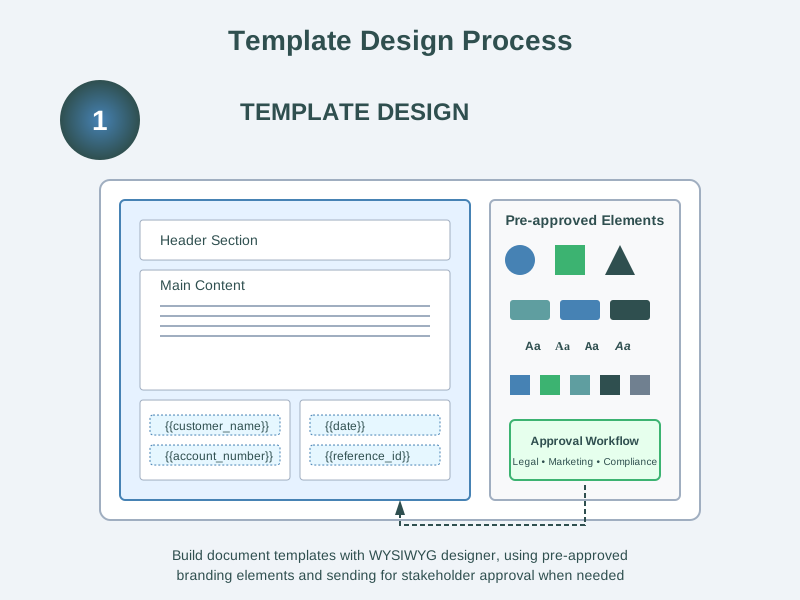
The first and perhaps most fundamental step in the document automation process involves creating intelligent, flexible document templates that serve as the foundation for all subsequent automation activities. These templates are significantly more sophisticated than typical word processing templates, incorporating conditional logic, dynamic content blocks, and data mapping capabilities.
Modern document automation platforms provide intuitive What-You-See-Is-What-You-Get (WYSIWYG) design interfaces that enable business users to create complex templates without requiring extensive technical expertise. These interfaces typically offer robust formatting controls, pre-approved design elements (such as logos, headers, and footers), and the ability to incorporate dynamic content placeholders that will later be populated with actual data.
The template design process typically begins with a thorough analysis of existing documents to identify common elements, variable components, and conditional sections. Document automation specialists then construct master templates that codify these elements into a structured format that balances standardization with flexibility. Critical considerations during this phase include:
The quality of template design fundamentally determines the effectiveness of subsequent automation stages. Organizations that invest sufficient resources in creating comprehensive, flexible templates realize significantly greater benefits from their document automation initiatives. The template design phase establishes the framework within which all document generation occurs, making it perhaps the most critical element of the overall automation strategy.
[See Figure 2: Document Rendering System, illustrating data flows and transformation processes]
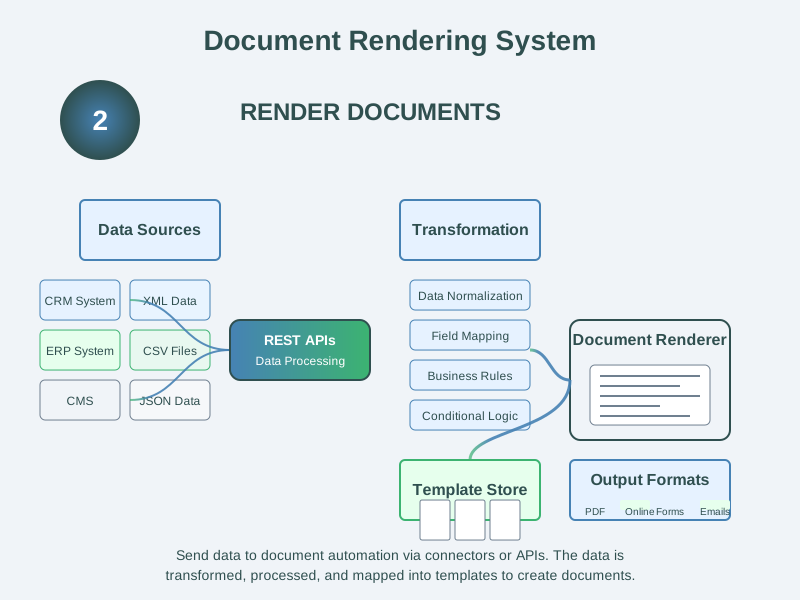
Once robust templates have been established, the next phase in the document automation journey focuses on rendering the process of combining templates with actual data to produce finalized documents. This phase represents the dynamic heart of document automation, where static templates come alive with specific information relevant to particular business transactions, customers, or situations.
The rendering process begins with data acquisition, where information is gathered from various business systems through either batch processing or real-time integration. Modern document automation platforms offer multiple connectivity options, including:
Once acquired, this raw data undergoes transformation processes to ensure compatibility with template structures. These transformations may include:
The Artificio document automation system exemplifies this sophisticated approach, utilizing REST APIs to facilitate seamless data exchange with external systems. Their platform incorporates advanced data transformation capabilities that can handle complex business rules, ensuring that information is not merely transferred but intelligently processed before document generation.
The rendering engine then merges the prepared data with the appropriate templates, applying all conditional logic, formatting rules, and dynamic content controls. This process occurs at remarkable speed, with enterprise-grade platforms capable of generating thousands of complex documents per hour. The output can be produced in multiple formats simultaneously, including PDF, HTML, Word, XML, and digitally signed versions, depending on distribution requirements.
Modern rendering engines also incorporate proofing mechanisms that verify document accuracy before finalization. These may include automated validation checks, sample document review processes, and exception handling for data anomalies. By implementing comprehensive validation protocols, organizations can prevent erroneous documents from reaching customers or business partners.
[See Figure 3: Document Assembly Workflow, showcasing how multiple components are combined]
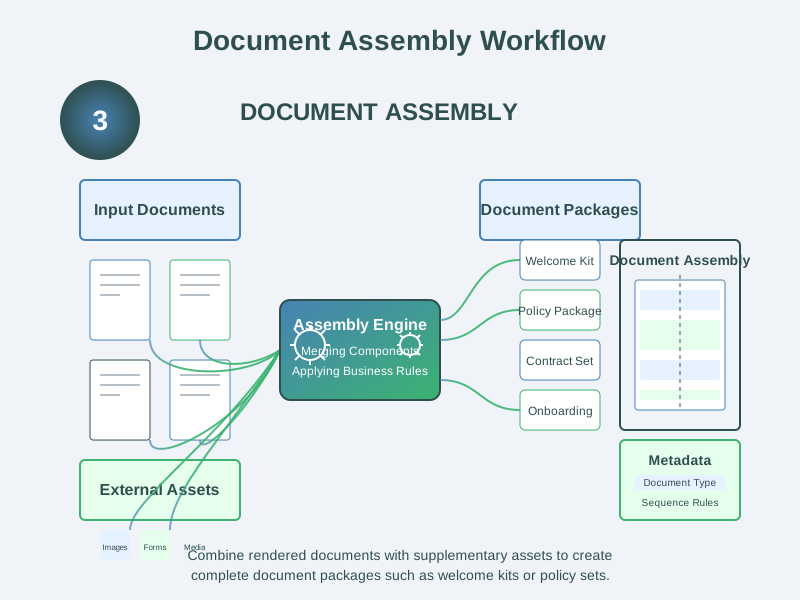
While the rendering phase creates individual documents, many business scenarios require more complex information packages consisting of multiple related documents assembled in a specific sequence. The document assembly phase addresses this need by intelligently combining rendered documents with other content assets to create comprehensive information packages.
Document assembly extends beyond simple file combination, incorporating sophisticated logic to determine which components should be included based on specific business contexts. For example, an insurance policy package might include:
The assembly process typically utilizes metadata associated with each document component to determine inclusion criteria, sequencing rules, and presentation formats. This metadata-driven approach enables organizations to maintain component libraries containing hundreds or thousands of potential document elements that can be dynamically assembled based on specific business needs.
Modern document assembly systems also address complex formatting challenges that arise when combining components created for different purposes. These include intelligent pagination, consistent header/footer treatment, automatic table of contents generation, and standardized numbering across the assembled package. The result is a seamless document experience that appears purposefully designed rather than mechanically assembled.
The Artificio document assembly system exemplifies this approach by providing sophisticated capabilities for combining rendered documents with ancillary content to create cohesive information packages. Their platform supports conditional assembly rules, enabling the creation of highly personalized document collections that contain only relevant information for specific recipients.
Organizations leveraging advanced document assembly capabilities gain significant advantages in customer communication effectiveness. By providing comprehensive yet precisely targeted information packages, they can enhance customer understanding, reduce support inquiries, and improve overall satisfaction with the documentation experience.
[See Figure 4: Multi-Channel Distribution System, illustrating various delivery methods]
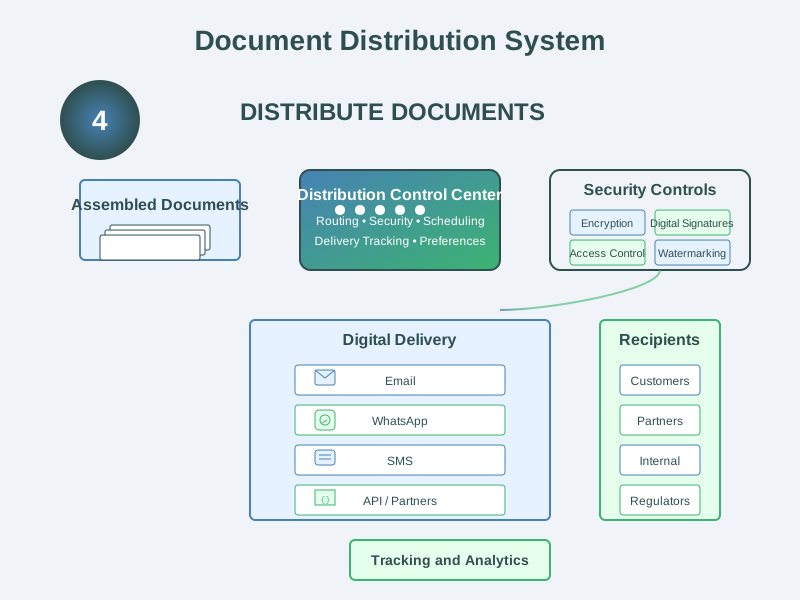
The final phase in the document automation methodology focuses on distribution delivering completed documents to their intended recipients through appropriate channels. While seemingly straightforward, effective document distribution involves significant complexity, especially in organizations serving diverse customer segments with varying communication preferences.
Modern document distribution systems support omnichannel delivery strategies, enabling organizations to reach recipients through their preferred communication methods. These delivery options typically include:
The distribution process incorporates intelligent routing logic that determines the optimal delivery channel based on recipient preferences, document characteristics, regulatory requirements, and business rules. This logic ensures that each document reaches its intended audience through the most appropriate method, balancing efficiency with effectiveness.
Security considerations play a critical role in the distribution phase, particularly for sensitive information. Advanced distribution systems incorporate multiple security mechanisms, including:
The Artificio distribution system exemplifies this comprehensive approach, offering a robust multi-channel delivery platform that handles everything from digital distribution to integration with print service providers. Their system maintains detailed delivery tracking, providing organizations with complete visibility into document status throughout the distribution process.
Effective distribution represents the culmination of the document automation journey, ensuring that carefully created content actually reaches its intended audience in a timely, secure manner. Organizations implementing sophisticated distribution capabilities can significantly enhance customer satisfaction while reducing delivery costs and improving compliance with communication regulations.
While the four-step methodology provides the structural framework for document automation, several emerging technologies are dramatically enhancing capabilities at each phase. These technologies are transforming document automation from a primarily efficiency-focused tool to a strategic business enabler capable of delivering unprecedented insights and experiences.
Artificial intelligence (AI) and machine learning (ML) are perhaps the most transformative technologies impacting document automation. These technologies contribute across the automation lifecycle in multiple ways:
Organizations implementing AI-enhanced document automation systems report significant improvements in both operational efficiency and customer experience quality. As these technologies continue to mature, we can expect even greater capabilities in content personalization, document intelligence, and predictive document generation.
Modern document automation platforms are increasingly leveraging cloud-native architectures to provide unprecedented scalability, accessibility, and integration capabilities. These architectures offer several advantages over traditional on-premises document systems:
Organizations migrating from legacy document systems to cloud-native platforms typically experience significant improvements in agility, resilience, and innovation capacity. The subscription-based economic model of cloud services also shifts document automation from capital-intensive infrastructure investments to more flexible operational expenses.
While document automation delivers value across virtually all sectors, several industries have emerged as particularly aggressive adopters due to their document-intensive operations and regulatory environments. Exploring these industry-specific applications provides valuable insights into the practical implementation of document automation technologies.
The financial services industry faces dual pressures of stringent regulatory requirements and escalating customer expectations for seamless experiences. Document automation addresses both challenges simultaneously, enabling institutions to produce compliant documentation with unprecedented efficiency.
Specific applications include:
Leading financial institutions implementing end-to-end document automation report regulatory compliance improvements exceeding 35% while simultaneously reducing document processing costs by 40-60%. These dual benefits explain the industry's rapid adoption of sophisticated automation platforms.
Healthcare organizations face enormous documentation burdens arising from clinical requirements, administrative processes, and regulatory mandates. Document automation helps address these challenges while maintaining strict patient privacy protections.
Key healthcare applications include:
Healthcare providers implementing document automation typically report significant improvements in documentation accuracy (over 45% error reduction) and substantial time savings for clinical staff (averaging 30+ minutes per day). These efficiencies translate directly into improved patient care and resource utilization.
Manufacturing operations require coordinated document flows spanning design specifications, production instructions, quality control procedures, and customer deliverables. Document automation streamlines these complex requirements while ensuring consistency across related documentation.
Manufacturing-specific applications include:
Manufacturers leveraging document automation report typical process efficiency improvements of 50-70% for documentation tasks, with corresponding reductions in errors and delays. These improvements directly enhance operational agility and customer satisfaction.
While the benefits of document automation are compelling, successful implementation requires thoughtful planning and execution. Organizations that achieve the greatest returns typically follow structured implementation approaches addressing both technical and organizational considerations.
Before embarking on document automation initiatives, organizations should conduct thorough readiness assessments examining several critical dimensions:
Organizations that conduct thorough readiness assessments before implementation typically experience faster deployment cycles and higher satisfaction with automation outcomes. These assessments also help identify quick-win opportunities that can demonstrate value and build momentum for broader automation initiatives.
Successful document automation implementations typically follow phased approaches rather than attempting comprehensive transformation in a single project. Effective phasing strategies include:
A well-structured phased approach enables organizations to realize incremental benefits while building internal expertise and refining implementation methods. This approach also facilitates more accurate ROI measurement by establishing clear baselines and improvement metrics for each implementation phase.
Document automation fundamentally transforms how organizations create and manage critical business communications. Sustainable success requires establishing governance frameworks addressing several key aspects:
Organizations that establish robust governance frameworks experience significantly greater long-term satisfaction with their document automation investments. These frameworks prevent the proliferation of inconsistent templates, protect content quality, and ensure that automation benefits increase rather than degrade over time.
As we look toward the future, several emerging trends promise to further transform document automation capabilities and applications. Organizations planning long-term automation strategies should monitor these developments and consider their potential implications.
Traditional document automation relies on structured data sources feeding predefined templates. Emerging conversational interfaces are changing this paradigm by enabling natural language interactions that dynamically generate appropriate documentation. These systems can:
This approach shows particular promise for advisory scenarios in professional services, financial consulting, and healthcare, where documentation needs emerge organically through client interactions rather than structured transactions.
While current document automation systems can produce personalized communications, next-generation platforms will enable unprecedented levels of individualization through:
These capabilities will transform documents from static deliverables to adaptive communication tools that evolve based on recipient engagement and needs. Organizations leveraging these technologies will likely achieve significantly higher response rates and customer satisfaction levels.
The most advanced vision for document automation envisions interconnected document ecosystems that autonomously generate, distribute, and act upon information without human intervention. These systems will:
While fully autonomous document ecosystems remain aspirational, components of this vision are already emerging in specific applications such as automated regulatory reporting, algorithmic contract management, and intelligent customer communication systems.
As we've explored throughout this analysis, document automation has evolved from a tactical efficiency tool to a strategic business capability fundamentally transforming how organizations create, manage, and leverage their critical information assets. The four-step methodology encompassing template design, document rendering, assembly, and distribution provides a comprehensive framework for implementing automation that delivers substantial benefits across operational efficiency, customer experience, and regulatory compliance dimensions.
Organizations seeking to maximize returns from document automation investments should approach implementation with strategic vision while maintaining practical execution discipline. This balanced approach includes:
As document automation capabilities continue advancing through AI enhancement, blockchain integration, and cloud-native architectures, the gap between leaders and laggards in this domain will likely widen. Organizations that establish strong foundations now will be well-positioned to incorporate emerging capabilities as they mature, maintaining competitive advantage in increasingly digital markets.
Beyond technological considerations, the most successful document automation implementations recognize that effective documentation ultimately serves human needs whether helping customers understand complex products, enabling employees to perform their roles effectively, or providing regulators with evidence of appropriate business practices. By maintaining this human-centered perspective while leveraging increasingly powerful automation technologies, organizations can transform documentation from a necessary burden into a powerful tool for business success.

Head IT Operations - Co Founder of Artificio
See it in your SAP environment
Bring us a document, a process, or a bottleneck. We'll show how Artificio captures, validates, and posts into SAP — then scale from there.
Security & compliance
ISO 27001:2013 certified, SOC 2 Type 2 compliant, GDPR and HIPAA ready. Every agent action is logged, auditable, and runs in isolated environments.