

Blog
Orchestrated Intelligence - The Future of Workflow
Explore the evolution of workflow automation, from early ERP to AI-powered systems. Learn about data integration and future trends.

Blog
Explore the evolution of workflow automation, from early ERP to AI-powered systems. Learn about data integration and future trends.
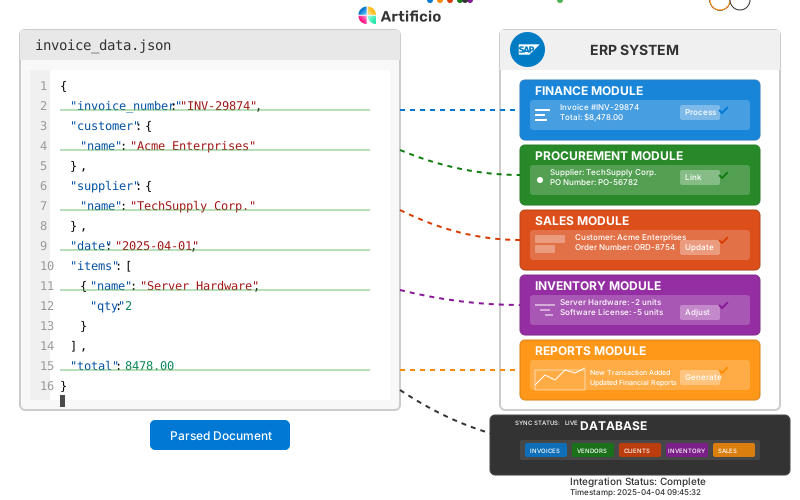
In the rapidly evolving landscape of business technology, the integration of automated workflows has emerged as a transformative force reshaping organizational efficiency. The journey from manual, paper-based processes to sophisticated digital systems represents one of the most significant paradigm shifts in modern business operations. This transformation, however, has not occurred overnight but has evolved through distinct phases, each building upon the technological capabilities and organizational needs of its time. The contemporary business environment demands not only speed and accuracy but also adaptability and intelligence in process management qualities that have become increasingly attainable through advances in workflow automation.
The concept of workflow automation, though seemingly modern, has deep historical roots that trace back to the early principles of scientific management introduced by Frederick Taylor in the early 20th century. Taylor's emphasis on optimizing work processes for efficiency laid the groundwork for the systematic approach to business operations that would eventually evolve into the digital workflows we recognize today. The progression from these mechanical efficiency principles to today's sophisticated digital integration systems reflects not merely technological advancement but a fundamental reimagining of how organizations structure their internal processes.
This article explores the remarkable evolution of automated workflows, with particular emphasis on two revolutionary developments: the integration of data extraction systems with Enterprise Resource Planning (ERP) platforms, and the emergence of email-based approval mechanisms that have dramatically streamlined decision-making processes. These innovations represent not just incremental improvements but paradigmatic shifts in how businesses conceptualize and implement process management. Through examining these developments, we gain insight into both the technical underpinnings and the broader organizational implications of modern workflow automation.
The journey toward automated workflows began long before the digital age, with early attempts at standardization in business operations dating back to the industrial revolution. However, the first meaningful steps toward true automation emerged in the mid-20th century with the introduction of primitive computational systems for business applications. The 1960s and 1970s saw the development of Material Requirements Planning (MRP) systems, which represented early attempts to digitize inventory management and production planning. These systems, though rudimentary by today's standards, introduced the concept of computational assistance in business operations that would eventually evolve into comprehensive ERP systems.
The 1980s marked a significant inflection point with the widespread adoption of personal computers in business environments. This period saw the emergence of the first true workflow tools, primarily centered around document management and basic process tracking. Software like Lotus Notes introduced rudimentary workflow capabilities, allowing for sequential document routing and basic approval mechanisms. However, these early systems typically operated in isolation, creating digital silos that mirrored the departmental divisions of traditional organizational structures.
The 1990s brought about a fundamental shift with the rise of enterprise-wide systems that sought to break down these silos. Early ERP platforms from companies like SAP and Oracle introduced the concept of integrated business processes spanning multiple departments. These systems represented the first genuine attempt to create end-to-end digital workflows that could traverse organizational boundaries. Despite their revolutionary potential, these early ERP implementations were often characterized by rigid processes and significant implementation challenges, leading to mixed results in practice.
The early 2000s saw the next major evolution with the rise of web-based applications and service-oriented architectures. This period witnessed the emergence of more flexible workflow systems that could be customized to fit specific organizational needs rather than forcing businesses to conform to predefined process templates. The introduction of Business Process Management (BPM) as a discipline during this era reflected a growing recognition of process design and optimization as strategic organizational priorities rather than mere technical considerations.
The past decade has seen perhaps the most dramatic transformation, with the convergence of multiple technological trends including cloud computing, artificial intelligence, mobile connectivity, and advanced data analytics. These developments have collectively enabled a new generation of intelligent workflow systems capable of adapting to changing conditions, learning from historical patterns, and operating seamlessly across multiple platforms and devices. This evolution has fundamentally changed not only the technical capabilities of workflow systems but also their strategic role within organizations.
At the heart of contemporary workflow automation lies the challenge of data integration the ability to extract, transform, and utilize information from various sources in a coherent and meaningful way. The evolution of data integration capabilities has been a defining feature in the development of workflow automation, with each advancement opening new possibilities for process efficiency and organizational intelligence.
Early data integration efforts were largely manual, requiring significant human intervention to transfer information between systems. The introduction of Electronic Data Interchange (EDI) standards in the 1970s represented the first significant step toward automated data exchange between organizations, though these systems were typically limited to structured transactions and required substantial technical infrastructure. The 1990s saw the emergence of Extract, Transform, Load (ETL) processes that enabled more sophisticated data manipulation, though these still operated primarily in batch modes rather than real-time.
The rise of XML and web services in the early 2000s marked another crucial development, enabling more flexible data interchange formats and mechanisms. These technologies laid the groundwork for the API economy that would emerge in subsequent years, allowing for real-time data integration between previously disparate systems. The development of enterprise service buses (ESBs) and integration platforms during this period reflected a growing recognition of data integration as a core organizational capability rather than a periodic technical task.
Recent years have seen perhaps the most significant advancements in this domain, with the emergence of intelligent document processing systems capable of extracting structured data from unstructured documents using machine learning algorithms. These systems can now recognize patterns in documents like invoices, resumes, or purchase orders, and extract relevant information with minimal human intervention. This capability has dramatically expanded the scope of workflow automation by allowing digital systems to incorporate data from traditionally analog sources.
The data extraction processes that power modern ERP integrations represent a fascinating convergence of multiple technologies. At their foundation are advanced optical character recognition (OCR) systems that have evolved far beyond basic text recognition to understand document structure and context. These are complemented by natural language processing capabilities that can interpret the meaning and relevance of extracted text, and machine learning algorithms that continuously improve accuracy through exposure to additional examples. The combination of these technologies enables systems to transform raw documents into structured data that can flow seamlessly into workflow processes.
The business impact of these capabilities cannot be overstated. Organizations can now automate the processing of incoming documents like vendor invoices, customer orders, or employment applications tasks that previously required substantial manual effort. This automation not only reduces processing costs but also dramatically improves accuracy and enables real-time visibility into operational processes. For example, financial systems can now update automatically as invoices are received rather than waiting for periodic manual data entry, giving organizations unprecedented insight into their current financial position.
The evolution of document processing capabilities represents one of the most significant developments in workflow automation. Traditional approaches to document management were focused primarily on storage and retrieval, with minimal capability to interpret document contents without human intervention. The transition from these passive document repositories to active systems capable of extracting and acting upon document content marks a fundamental shift in workflow capabilities.
Intelligent Document Processing (IDP) systems combine multiple technologies to transform unstructured document content into structured data that can be integrated into business processes. The foundation of these systems typically involves advanced OCR capable of high accuracy across diverse document types, layouts, and quality levels. Modern OCR systems have evolved beyond simple character recognition to understand document structure, including the ability to identify tables, form fields, and relevant sections based on visual layout cues.
Building upon this foundation, contemporary IDP systems incorporate natural language understanding capabilities that extend processing beyond mere text recognition to comprehending the meaning and context of extracted information. These systems can identify entities (like companies, people, or locations), understand relationships between concepts, and extract key information even when it appears in variable formats or positions within documents. This semantic understanding enables much more robust processing than was possible with template-based approaches that relied on fixed document layouts.
Machine learning has dramatically enhanced these capabilities by enabling systems to improve through experience. Rather than requiring exhaustive pre-programming of every possible document variation, modern systems can learn from examples and human corrections, continuously refining their extraction accuracy over time. This learning capability is particularly valuable for organizations dealing with diverse document sources or formats that evolve over time.
The practical applications of IDP extend across virtually every business function. In finance departments, these systems can process invoices from multiple vendors with varying formats, automatically extracting key fields like invoice numbers, line items, and amounts for validation and payment processing. Human resources teams can use similar capabilities to process job applications and resumes, extracting candidate qualifications and experience for comparison against job requirements. Supply chain operations benefit from automated processing of shipping documents, purchase orders, and quality certifications.
Perhaps most importantly, IDP systems have dramatically expanded the scope of workflow automation by bridging the gap between unstructured information and structured business processes. Where previous workflow automation required structured data inputs, modern systems can begin their processes with raw documents, automatically extracting the necessary information to initiate and drive workflows. This capability has enabled organizations to automate processes that were previously considered too document-intensive or variable for systematic approaches.
Enterprise Resource Planning systems have long served as the operational backbone for medium and large organizations, consolidating core business functions into a unified platform. However, the integration between these systems and external data sources has historically represented a significant challenge. Early ERP systems were essentially closed environments, requiring manual data entry or complex custom interfaces to incorporate information from external sources. This limitation created substantial friction in business processes that spanned the boundaries between ERP systems and other operational tools.
The modern approach to ERP integration represents a dramatic departure from these historical constraints. Contemporary integration architectures leverage multiple mechanisms to create seamless data flows between systems. API-based integrations enable real-time data exchange between ERP platforms and external systems, allowing for immediate updates across the business technology ecosystem. Event-driven architectures provide mechanisms for systems to react automatically to changes or triggers, initiating appropriate processes without manual intervention. Low-code integration platforms have democratized the development of these connections, reducing dependency on specialized technical resources for basic integration needs.
The integration between document processing systems and ERP platforms exemplifies the potential of this approach. Consider the traditional process for processing supplier invoices: documents would arrive via mail or email, requiring manual data entry into the ERP system before approval workflows could begin. This process was time-consuming, error-prone, and created significant delays in financial processes. Modern integrated systems transform this workflow by automatically extracting invoice data and populating ERP records, triggering appropriate approval workflows, and even validating the information against purchase orders or contracts.
This integration delivers multiple layers of business value. Process efficiency improves dramatically, with studies suggesting that automated invoice processing can reduce processing costs by 60-80% compared to manual methods. Accuracy increases significantly, eliminating the errors associated with manual data entry that can lead to incorrect payments or accounting entries. Perhaps most importantly, cycle times shrink from days or weeks to hours or minutes, enabling organizations to capture early payment discounts, improve vendor relationships, and maintain more accurate financial records.
The evolution of these integration capabilities has fundamentally changed the role of ERP systems within organizations. Rather than serving as isolated transaction processing systems, modern ERP platforms function as hubs within broader digital ecosystems, exchanging information with specialized applications, data repositories, and external partners. This connectivity has expanded the strategic value of ERP investments by enabling them to support more comprehensive and adaptive business processes that span traditional system boundaries.
While data integration has dramatically improved the efficiency of transaction processing, many business processes ultimately require human judgment and approval. The evolution of approval workflows represents another critical dimension in the advancement of process automation, particularly in how technology has simplified and streamlined decision-making processes without sacrificing appropriate governance and control.
Traditional approval processes typically required physical documents and signatures, creating substantial delays and coordination challenges, particularly in geographically distributed organizations. Early digital alternatives often replicated these limitations, requiring approvers to log into specialized systems to review and approve transactions. This approach improved upon paper processes but still created friction by requiring users to interrupt their normal work patterns to access separate approval systems.
The innovation of email-based approval workflows addressed this fundamental limitation by bringing approval decisions directly into the communication channels that knowledge workers already used throughout their day. By embedding approval capabilities within email messages, these systems eliminated the need for users to access separate applications, dramatically reducing the friction associated with approval processes. This approach recognized that while transactions might live in ERP or other operational systems, decisions were made by humans who primarily operated in communication-focused environments.
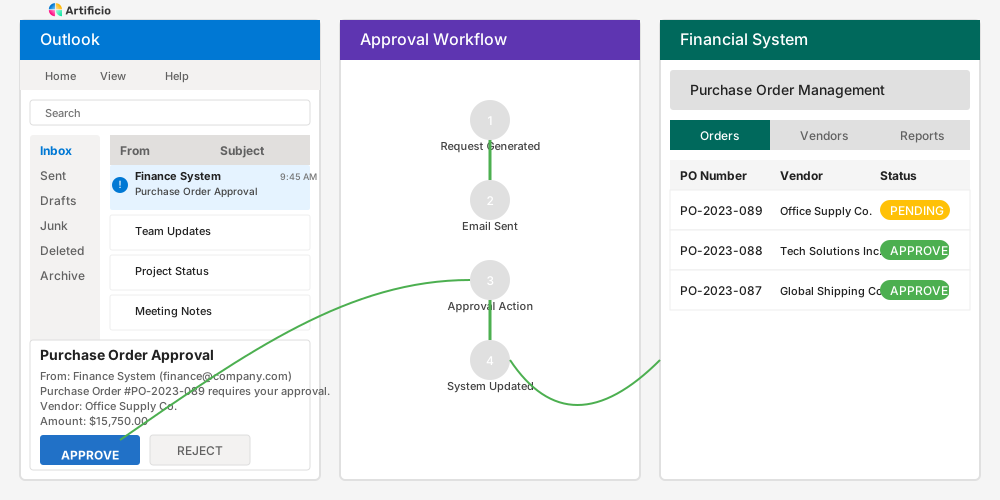
Modern email approval systems demonstrate sophisticated capabilities far beyond simple "approve/reject" functionality. They can present approvers with relevant transaction details, supporting documents, historical information, and analytics that inform decision-making. Some systems incorporate contextual intelligence, routing approvals based on factors like amount thresholds, departmental responsibilities, or risk factors rather than static organizational hierarchies. Advanced implementations even support mobile approvals, enabling decisions from smartphones or tablets when approvers are away from their desks.
The business impact of these capabilities extends far beyond simple convenience. Studies have shown that email-based approval workflows can reduce decision latency by 70-90% compared to traditional approaches. This acceleration delivers tangible benefits in operational processes like purchase order approvals, where faster decisions translate directly to reduced lead times for critical supplies or equipment. In financial operations, streamlined approvals can enable organizations to capture early payment discounts or avoid late payment penalties. For customer-facing processes like contract approvals or credit decisions, faster response times can directly impact revenue and customer satisfaction.
These systems also enhance governance and compliance by creating comprehensive audit trails of approval decisions. Unlike manual processes where approvals might be documented inconsistently, digital approval workflows automatically record who approved each transaction, when the approval occurred, and what information was available at the time of the decision. This documentation provides valuable protection in regulatory audits or disputes and enables organizations to analyze and optimize their approval processes over time.
The next frontier in workflow automation involves the integration of artificial intelligence capabilities that extend systems beyond simple rule-based processing to incorporate learning, adaptation, and decision support. This evolution represents a fundamental shift from workflows as pre-defined process templates to dynamic systems that can evolve based on operational patterns and outcomes.
Early applications of AI in workflow contexts focused primarily on narrow process optimizations, such as using machine learning to improve document classification accuracy or predict processing exceptions. While valuable, these applications essentially enhanced existing process steps rather than fundamentally reimagining workflow capabilities. Recent developments have enabled more transformative applications that leverage AI throughout the workflow lifecycle.
Intelligent workflow systems now incorporate multiple AI capabilities that collectively enable more adaptive and supportive processes. Process mining techniques analyze historical workflow execution data to identify bottlenecks, variations, and optimization opportunities, enabling continuous process improvement based on actual operational patterns rather than theoretical models. Predictive analytics anticipate process exceptions or delays, allowing organizations to intervene proactively rather than reacting to problems after they occur. Natural language processing enables more intuitive user interactions, including the ability to initiate or interact with workflows through conversational interfaces rather than structured forms.
Perhaps most significantly, decision intelligence capabilities are now being embedded within workflows to support human judgment rather than simply routing approval requests. These systems can analyze historical decisions, organizational policies, and relevant contextual factors to provide recommendations or insights that inform human judgment. For example, an invoice approval workflow might flag unusual pricing compared to historical patterns, highlight terms that deviate from standard agreements, or identify opportunities to consolidate purchases across departments.
The practical applications of these intelligent workflows span virtually every business function. In financial operations, intelligent accounts payable workflows can identify duplicate invoices, validate pricing against contracts, and optimize payment timing to balance cash flow considerations against available early payment discounts. Supply chain workflows can adapt dynamically to changing conditions, automatically adjusting order quantities or timing based on demand patterns, inventory levels, and supplier performance. Customer service processes can route inquiries based on complexity, sentiment, and agent expertise rather than simple queue-based assignments.
The organizational implications of these developments extend far beyond operational efficiency. Intelligent workflows enable higher degrees of organizational adaptability by allowing processes to evolve continuously based on changing conditions rather than requiring periodic redesign efforts. They extend the accessible scope of automation by handling greater complexity and variability than was possible with traditional rule-based approaches. Perhaps most importantly, they change the relationship between human workers and automated systems from one of replacement to augmentation, focusing automation on routine aspects while enhancing human capabilities for judgment and exception handling.
Despite the technological advances in workflow automation, the role of humans remains central to effective process execution and evolution. Rather than eliminating human involvement, modern workflow systems are increasingly designed to optimize the collaboration between human judgment and automated processing, leveraging the unique strengths of each.
The historical narrative around automation has often focused on efficiency gained through reducing human involvement in processes. While this perspective captures important benefits, it fails to recognize how automation can actually enhance human contributions by shifting focus from routine processing to higher-value activities. Modern workflow systems exemplify this shift by automating transactional elements while creating new opportunities for humans to apply judgment, creativity, and interpersonal skills.
In approval workflows, for example, the automation of document processing and routing doesn't eliminate human decision-making but rather enhances it by providing relevant information, historical context, and analytical insights that inform better judgments. The time saved from manual document handling and system navigation can be redirected to more thoughtful evaluation of complex or unusual cases that require genuine human discernment. This redirection of human attention from process mechanics to decision quality represents a fundamental shift in how organizations leverage their human capital.
The design of human touchpoints within automated workflows has become an increasingly sophisticated discipline. Contemporary approaches recognize that effective human-system collaboration requires more than simple task assignment it demands thoughtful consideration of how information is presented, how options and implications are communicated, and how feedback is incorporated. Systems that present approvers with clear summaries of key information, visual indicators of unusual patterns, and relevant historical context enable better decisions in less time than those that simply present raw transaction details.
Organizational change management has emerged as a critical success factor in workflow implementation, reflecting the recognition that technical capabilities alone are insufficient to deliver business value. Successful implementations typically involve substantial attention to user experience design, training programs that emphasize both technical operations and decision principles, and governance structures that balance standardization with appropriate flexibility. Organizations that invest in these human elements typically realize significantly greater returns from their workflow automation investments than those focused exclusively on technical implementation.
The evolution of workflow systems has also changed the skills required for process management roles. Where process managers previously focused primarily on documentation and compliance monitoring, contemporary roles demand capabilities in data analysis, exception management, and continuous improvement facilitation. This shift requires organizations to invest in developing new capabilities among their process professionals and to create career paths that recognize the increasing strategic importance of these functions.
The global economic and social impact of workflow automation extends far beyond individual organizational boundaries. These technologies have collectively reshaped industry structures, labor markets, and competitive dynamics across multiple sectors, creating both opportunities and challenges that demand thoughtful consideration.
From a macroeconomic perspective, workflow automation has contributed significantly to productivity growth over recent decades. Studies suggest that organizations implementing comprehensive workflow automation typically realize productivity improvements of 15-25% in affected processes, with some achieving substantially higher gains. These improvements have enabled organizations to deliver more value with fewer resources, potentially creating economic surplus that can benefit customers, employees, and shareholders.
The distribution of these benefits, however, has varied considerably across different contexts. In some cases, automation gains have translated primarily into cost reductions and margin improvements, while in others they have enabled service enhancements, quality improvements, or business model innovations that deliver broader value. The most successful organizations typically achieve balanced outcomes that create sustainable advantages rather than temporary cost efficiencies that competitors can readily replicate.
The labor market impacts of workflow automation have been complex and multifaceted. Contrary to simplistic narratives about technological unemployment, the evidence suggests that workflow automation has typically led to job transformation rather than wholesale elimination. Tasks within roles have been redistributed, with automated systems handling routine elements while humans focus on exceptions, judgment, and interpersonal aspects. This redistribution has generally elevated skill requirements, creating challenges for workers without access to appropriate education or training opportunities but also opening new career paths for those able to develop relevant capabilities.
Industry structures have also evolved in response to workflow automation capabilities. In many sectors, these technologies have reduced barriers to entry by enabling smaller organizations to implement sophisticated processes that previously required substantial scale. Cloud-based workflow platforms have been particularly significant in this regard, allowing smaller entities to access enterprise-grade capabilities without corresponding infrastructure investments. This democratization of process capabilities has intensified competitive dynamics in many industries and accelerated the pace of innovation.
Environmental impacts represent another important dimension of workflow automation effects. Digital workflows have substantially reduced paper consumption in many organizations, with corresponding benefits in resource conservation and waste reduction. More efficient processes have also reduced energy consumption in some contexts, particularly where automation eliminates redundant steps or unnecessary transportation requirements. However, the energy requirements of digital infrastructure remain significant, highlighting the importance of sustainable technology strategies as automation adoption continues to expand.
Looking forward, workflow automation is likely to play an increasingly important role in addressing global challenges ranging from healthcare access to climate response. The efficiency gains and coordination capabilities these systems enable can help organizations deliver essential services more effectively and respond more rapidly to changing conditions. Realizing this potential, however, will require thoughtful approaches that balance automation opportunities against human needs and values.
The evolution of workflow automation continues to accelerate, with emerging technologies and changing organizational requirements driving new capabilities and approaches. Several key trends are likely to shape the next phase of development in this domain, creating both opportunities and challenges for organizations seeking to optimize their operational processes.
The convergence of workflow systems with emerging AI capabilities represents perhaps the most significant near-term development. The integration of large language models, for example, is already enabling new natural language interfaces that allow users to describe desired processes in conversational terms rather than through technical specifications. These capabilities dramatically reduce the technical barriers to workflow creation and modification, potentially democratizing process design across organizations. Similarly, computer vision advances are expanding the types of documents and visual information that can be incorporated into automated workflows, extending automation potential into previously challenging domains.
Blockchain and distributed ledger technologies are creating new possibilities for multi-party workflows that extend beyond organizational boundaries. These technologies enable secure, transparent process execution across multiple entities without requiring centralized control or trusted intermediaries. Supply chain workflows represent early applications of this approach, with blockchain-based systems enabling end-to-end visibility and verification across complex networks of suppliers, manufacturers, logistics providers, and retailers. Similar capabilities are emerging in financial services, healthcare, and public sector contexts where process integrity across multiple participants is essential.
Edge computing architectures are enabling new workflow patterns that distribute processing closer to data sources rather than centralizing all operations. This approach reduces latency, improves reliability in limited-connectivity environments, and enables new applications in contexts ranging from manufacturing operations to field service scenarios. Workflows that incorporate Internet of Things (IoT) devices particularly benefit from these architectures, allowing for real-time process adaptation based on sensor data without constant cloud connectivity.
The concept of "hyperautomation" has emerged to describe comprehensive approaches that combine multiple automation technologies within integrated strategies. These approaches recognize that different automation mechanisms including RPA, BPM, iPaaS, AI, and others have complementary strengths and limitations. By orchestrating these capabilities within coherent architectures, organizations can address more complex process challenges than would be possible with any single technology. This integrated perspective shifts focus from individual automation tools to comprehensive capabilities that can be applied across diverse process challenges.
Ethical and governance considerations are gaining prominence as workflow automation expands into increasingly consequential domains. Questions around algorithmic bias, decision transparency, human oversight, and appropriate automation boundaries require thoughtful approaches that balance efficiency gains against other important values. Organizations are increasingly developing formal governance structures that address these considerations, recognizing that sustainable automation requires attention to both technical capabilities and their broader implications.
User experience design continues to evolve as workflow systems extend beyond specialized technical users to encompass broader organizational populations. Contemporary approaches emphasize intuitive interfaces, contextual guidance, and adaptive supports that accommodate diverse user needs and capabilities. This evolution reflects recognition that workflow effectiveness ultimately depends on human-system interaction quality, not just technical process design.
The evolution of workflow automation represents one of the most significant transformations in how organizations structure and execute their operations. From the early days of basic document routing to today's intelligent, adaptive systems, each advancement has expanded both the scope of what can be automated and the value that automation delivers. This progression shows no signs of slowing, with emerging technologies continuing to reshape possibilities and expectations around organizational processes.
The most successful implementations of these technologies share common characteristics that transcend specific technical approaches. They maintain clear focus on business outcomes rather than technical capabilities, recognizing automation as a means to strategic ends rather than an objective in itself. They balance standardization with appropriate flexibility, creating consistent processes while accommodating legitimate variations in business requirements. Perhaps most importantly, they optimize the collaboration between human judgment and automated processing, leveraging the unique strengths of each rather than simply seeking to minimize human involvement.
Looking forward, workflow automation will likely become an increasingly central element of organizational capability rather than a separate technical domain. The boundaries between workflow tools and other business systems will continue to blur as process automation capabilities become embedded within core operational platforms. Similarly, the distinction between process designers and operational users will diminish as more intuitive tools enable broader participation in process creation and evolution.
For individual organizations, the challenge lies in developing coherent automation strategies that align with broader business objectives rather than pursuing isolated point solutions. This requires not only technical expertise but also process design capabilities, change management skills, and governance frameworks that ensure automation efforts deliver sustainable value. Organizations that develop these capabilities will be well-positioned to thrive in an environment where process excellence increasingly differentiates market leaders from followers.
For society more broadly, the challenge involves ensuring that the benefits of workflow automation are widely shared rather than narrowly concentrated. This requires attention to workforce development, ensuring that individuals have opportunities to develop the skills needed in increasingly automated environments. It also demands thoughtful approaches to automation governance that balance efficiency objectives against broader human values and needs.
The journey of workflow automation from basic document routing to intelligent, adaptive systems represents one of the most significant transformations in organizational operations over recent decades. As this evolution continues, it will reshape not only how work is performed but also the fundamental relationship between human judgment and technological capabilities in creating organizational value. Navigating this transformation successfully requires both technical excellence and human wisdom a combination that will distinguish the most effective organizations in the years ahead.

Head IT Operations - Co Founder of Artificio
See it in your SAP environment
Bring us a document, a process, or a bottleneck. We'll show how Artificio captures, validates, and posts into SAP — then scale from there.
Security & compliance
ISO 27001:2013 certified, SOC 2 Type 2 compliant, GDPR and HIPAA ready. Every agent action is logged, auditable, and runs in isolated environments.