

Blog
Multi-Modal AI for Enterprise Automation
Explore how multi-modal AI is changing enterprise automation. It's the next frontier in document processing.

Blog
Explore how multi-modal AI is changing enterprise automation. It's the next frontier in document processing.
The world of document automation is experiencing a seismic shift. While traditional optical character recognition (OCR) and text-based AI have served businesses well for basic document processing, they're hitting a wall when it comes to understanding the complex, multi-layered documents that drive modern enterprises. Think about the last time you tried to extract meaningful data from an architectural blueprint, a medical chart with embedded images, or a financial report filled with graphs and tables. These documents don't just contain text - they're rich tapestries of visual information, contextual relationships, and layered meaning that single-modal AI systems simply can't grasp.
Enter multi-modal AI document processing, a revolutionary approach that's transforming how businesses handle their most challenging document automation tasks. Unlike traditional systems that process text, images, and data separately, multi-modal AI understands documents the way humans do - as integrated experiences where text, visuals, layouts, and context work together to convey meaning. This isn't just an incremental improvement; it's a fundamental reimagining of what's possible in document automation.
The timing couldn't be more critical. As businesses digitize at unprecedented rates and regulatory requirements become more complex, the limitations of legacy document processing systems are becoming painfully apparent. Organizations are drowning in documents that contain critical business intelligence locked away in formats that traditional automation tools can't touch. The companies that master multi-modal AI document processing won't just gain efficiency - they'll unlock competitive advantages that were previously impossible.
Traditional document processing systems operate like skilled but narrow specialists. OCR excels at reading text, computer vision can identify images, and data extraction tools work well with structured formats. But put them together in a real-world document, and the magic disappears. These systems process each element in isolation, missing the crucial connections that give documents their true meaning.
Consider a typical insurance claim form that includes handwritten notes, photographs of damage, and structured data fields. A traditional system might successfully extract the policyholder's name and date of loss, but it completely misses the relationship between the damage description and the accompanying photos. It can't understand that the circled area in the photograph corresponds to the written note about structural damage, or that the severity assessment requires interpreting both visual and textual cues together.
This fragmented approach creates numerous problems for businesses. First, there's the accuracy issue. When systems can't understand context and relationships between different types of content, they make errors that require human intervention. A manufacturing company processing quality control reports might find that their traditional system can extract test results from tables but completely misses the visual indicators in accompanying charts that show trends over time. The result is incomplete analysis and missed opportunities for process improvement.
The efficiency problem is equally significant. When automated systems can only handle parts of documents, humans must step in to fill the gaps. This creates bottlenecks in workflows and defeats the purpose of automation. Legal firms processing contracts might have systems that can extract standard clauses but need lawyers to manually review and interpret diagrams, flowcharts, or complex formatting that contains crucial deal terms.
Perhaps most frustrating is the missed intelligence problem. Documents contain layers of meaning that emerge from the interplay between different content types. A research report's true insights might come from understanding how the narrative text relates to the data visualizations, or how the methodology described in one section connects to the results shown in graphs and tables. Single-modal systems treat these as separate elements, missing the rich insights that could drive strategic decisions.
The scalability challenge compounds these issues. As document volumes grow and become more complex, the limitations of traditional processing become exponentially more problematic. Organizations find themselves in a paradox where their most valuable documents - the complex, multi-faceted ones that drive key decisions - are the least amenable to automation using conventional approaches.
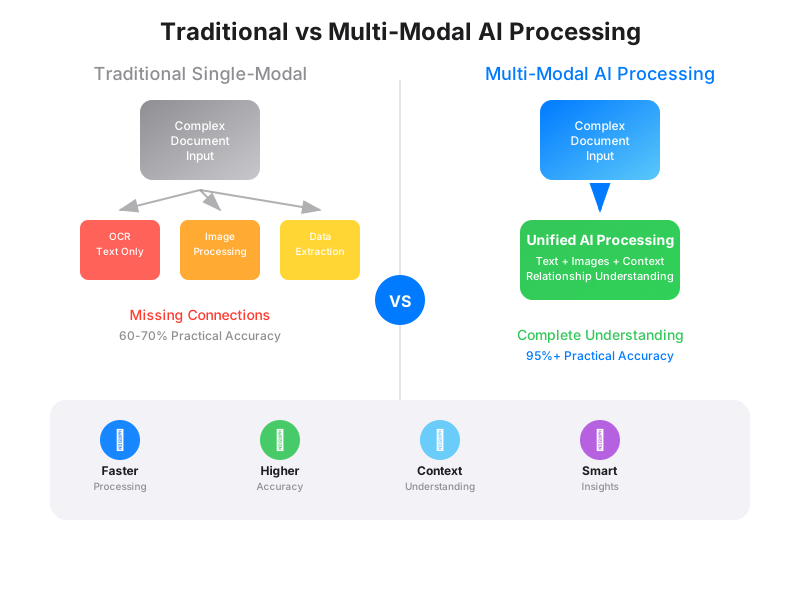
Multi-modal AI represents a fundamental shift in how machines understand documents. Instead of processing text, images, and layout elements separately, these systems use vision-language models that mirror human cognitive processes. Just as you instinctively connect a chart's title with its data points, or understand that an arrow in a diagram points to specific text, multi-modal AI creates these same connections automatically.
The breakthrough lies in how these systems are trained. Rather than learning text and visual processing as separate skills, vision-language models learn to understand the relationships between different types of content from the ground up. They're trained on millions of documents where text and visuals work together, teaching them to recognize patterns like how captions relate to images, how tables connect to surrounding paragraphs, or how diagrams illustrate textual concepts.
This integrated understanding enables capabilities that seem almost magical compared to traditional systems. When processing a technical manual, multi-modal AI doesn't just extract the text and identify the images separately. It understands that Figure 3.2 referenced in paragraph two shows the component being described, that the warning symbol next to specific text indicates safety concerns, and that the numbered steps in the procedure correspond to the numbered elements in the accompanying diagram.
The technology achieves this through sophisticated neural architectures that process multiple input streams simultaneously. The visual processing component analyzes layouts, identifies objects and shapes, and understands spatial relationships. The language processing component handles text extraction, semantic understanding, and contextual interpretation. But the real innovation is in the fusion layer where these different streams of understanding combine to create a unified comprehension of the document's meaning.
This unified understanding enables the system to answer questions and extract information that would be impossible with traditional approaches. Ask a multi-modal system about quarterly revenue trends, and it can correlate text discussing market conditions with visual data in charts and graphs to provide comprehensive insights. Request information about safety protocols, and it can connect written procedures with warning symbols, diagrams, and photographic examples to ensure complete understanding.
The contextual awareness of multi-modal AI extends beyond individual documents to understand document types and industry conventions. A system processing medical records learns that certain visual indicators have specific meanings in healthcare contexts, while the same visual elements might mean something entirely different in engineering documents. This domain-specific understanding allows for more accurate and relevant information extraction.
The impact of multi-modal AI document processing becomes clear when you examine how it's solving real problems across different industries. These aren't theoretical benefits - they're practical improvements that are already changing how businesses operate.
In healthcare, medical records present some of the most complex document processing challenges. A typical patient file might include handwritten physician notes, diagnostic images, lab results in tabular format, medication charts, and treatment timelines. Traditional systems struggle with this complexity, often requiring medical professionals to manually piece together information from different sources. Multi-modal AI changes this completely by understanding how all these elements relate to create a comprehensive patient picture.
Consider how a multi-modal system processes an emergency room visit record. It doesn't just extract the patient's vital signs from structured fields and note the physician's written assessment separately. Instead, it understands that the spike in heart rate shown in the monitoring chart correlates with the timing of the medication administration noted in the treatment log, and that both relate to the physician's written observation about the patient's response to treatment. This holistic understanding enables more accurate patient summaries, better care coordination, and improved clinical decision-making.
The financial services industry presents another compelling use case. Investment reports, loan applications, and regulatory filings often combine numerical data, charts, graphs, written analysis, and supporting documentation. A loan officer reviewing a commercial real estate application needs to understand not just the financial statements, but how the property photos relate to the appraisal values, how the location maps connect to the market analysis, and how the business plan narrative aligns with the projected cash flows.
Multi-modal AI excels in these scenarios by creating connections that human reviewers might miss due to time constraints or the sheer volume of information. It can identify when property photos show conditions that contradict written descriptions, when financial projections don't align with market data shown in accompanying charts, or when risk factors mentioned in text are supported or contradicted by visual evidence in the documentation.
Manufacturing and engineering documentation presents unique challenges that showcase multi-modal AI's capabilities. Technical specifications, assembly instructions, and quality control procedures often rely heavily on the relationship between written instructions and visual elements. A system processing manufacturing quality reports needs to understand not just the numerical test results, but how those numbers relate to the visual inspections, how the defect categories mentioned in text correspond to the images of actual defects, and how the overall quality trends shown in charts connect to specific process changes noted in written reports.
Legal document processing represents another frontier where multi-modal AI is making significant inroads. Contract analysis traditionally focuses on text-based clause extraction, but many agreements include diagrams, exhibits, schedules, and visual elements that are crucial to understanding terms and obligations. A commercial lease might include floor plans that define the exact space being rented, parking diagrams that specify allocated spots, or architectural drawings that outline tenant improvement allowances. Multi-modal AI can process these visual elements alongside the text to provide complete contract analysis.
The insurance industry benefits tremendously from multi-modal processing capabilities. Claims processing involves photographs of damage, written descriptions of incidents, policy documents with coverage details, and often technical reports with charts and diagrams. Traditional systems might extract basic information from each element, but they can't make the crucial connections that determine claim validity and appropriate settlement amounts.
A property damage claim, for example, might include photos of the damaged area, a written description of how the damage occurred, weather reports showing conditions at the time of loss, and repair estimates with detailed breakdowns. Multi-modal AI can analyze how the damage patterns in the photos align with the described cause of loss, whether the weather conditions support the claimed timeline, and if the repair estimates are reasonable given the extent of damage shown in the visual evidence. 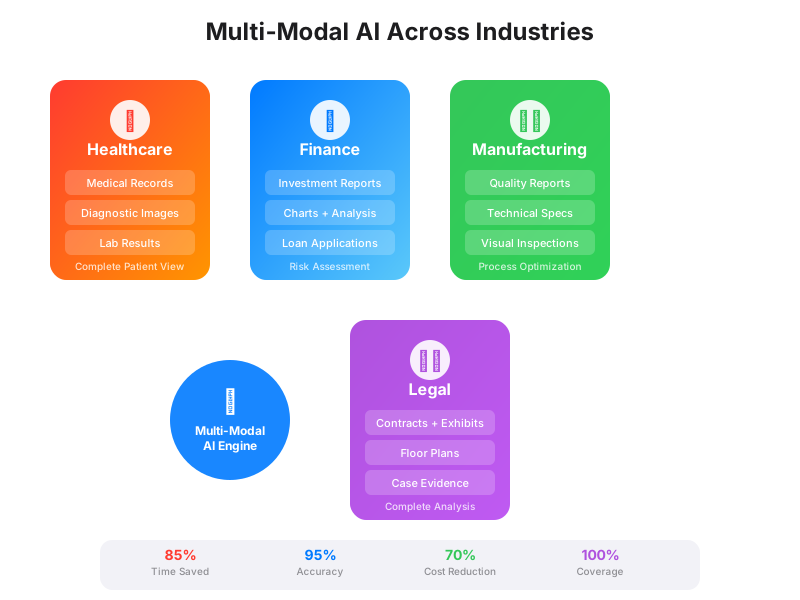
The technical superiority of multi-modal AI over traditional OCR-based systems becomes apparent when you examine how each approach handles complex document understanding tasks. Traditional OCR systems excel at their core function - converting images of text into machine-readable characters. But their limitations become severe when documents require more than simple text extraction.
OCR systems typically follow a linear processing model: scan the document, identify text regions, extract characters, and output raw text. This approach works well for straightforward documents like typed letters or simple forms, but breaks down when faced with documents where meaning emerges from the relationship between different elements. The extracted text lacks context about its position relative to images, charts, or other visual elements, making it impossible to understand the document's full meaning.
Multi-modal AI takes a fundamentally different approach by processing all document elements simultaneously and understanding their relationships. Instead of treating a chart and its caption as separate entities, the system recognizes them as related components of a unified message. This relationship awareness enables much more accurate information extraction and analysis.
The accuracy improvements are substantial and measurable. Traditional OCR might achieve 95% character recognition accuracy on clean text, but when you factor in context understanding and relationship identification, the practical accuracy for meaningful information extraction often drops to 60-70%. Multi-modal AI systems maintain higher practical accuracy because they use contextual understanding to verify and correct extraction results.
For example, if a traditional OCR system encounters a partially obscured number in a financial table, it might guess incorrectly or flag it for manual review. A multi-modal system can use the surrounding context - the table structure, related numbers, and descriptive text - to make more informed decisions about ambiguous characters. It might recognize that based on the table's purpose and the pattern of other numbers, a partially obscured "8" is more likely than a "3" or "6".
The robustness of multi-modal systems extends to handling various document qualities and formats. Traditional OCR performs poorly on documents with complex layouts, mixed fonts, or image backgrounds. Multi-modal AI adapts to these challenges by using visual understanding to navigate complex layouts and contextual understanding to maintain accuracy even when text quality is suboptimal.
Processing speed represents another significant advantage. While it might seem counterintuitive that a more complex system would be faster, multi-modal AI eliminates many of the iterative steps required by traditional approaches. Instead of separately processing text, then images, then attempting to correlate results, multi-modal systems handle everything in a single integrated pass. This eliminates the bottlenecks created by sequential processing and reduces the need for human intervention to resolve conflicts between different processing stages.
The ability to handle unstructured and semi-structured documents sets multi-modal AI apart from traditional systems. OCR works best with clearly structured documents where text appears in predictable patterns. But many business documents don't follow rigid structures. Reports might include narrative sections, bullet points, embedded charts, sidebar comments, and footnotes, all arranged in complex layouts that vary from document to document.
Multi-modal AI thrives in these environments because it understands layout patterns and can adapt to different document structures. It recognizes that information in a sidebar relates to the main text, that footnotes provide additional context for specific points, and that charts and graphs support or illustrate written content. This flexibility makes it suitable for processing the diverse document types that businesses encounter in real-world scenarios.
The error reduction capabilities of multi-modal AI are particularly impressive. Traditional systems often produce errors when text is ambiguous or when context is needed to resolve uncertainty. A date like "3/4/23" might be interpreted as March 4th or April 3rd depending on regional conventions, but a traditional OCR system has no way to determine the correct interpretation. Multi-modal AI can use contextual clues from the document - other date formats used, geographical indicators, or document purpose - to make more accurate determinations.
Implementing multi-modal AI document processing isn't without challenges, but understanding these obstacles and their solutions is crucial for successful deployment. The most common hurdles involve data preparation, system integration, performance optimization, and change management. Each presents unique considerations that require careful planning and strategic thinking.
Data preparation represents the first major challenge. Multi-modal AI systems require high-quality training data that represents the types of documents and use cases they'll encounter in production. Unlike traditional OCR systems that mainly need text samples, multi-modal systems need documents that showcase the full range of text-visual relationships they'll need to understand. This means collecting representative samples of actual business documents, properly annotating them to highlight important relationships, and ensuring the training data covers edge cases and unusual scenarios.
The annotation process itself can be complex and time-consuming. Training data needs to identify not just what text appears where, but how different elements relate to each other. A financial report used for training might need annotations showing how specific paragraphs relate to particular charts, how footnotes connect to table entries, and how visual elements support or contradict textual claims. This level of detailed annotation requires domain expertise and significant manual effort.
Organizations often underestimate the data volume requirements for effective multi-modal AI training. While a traditional OCR system might achieve good results with thousands of training examples, multi-modal systems often need tens of thousands or hundreds of thousands of annotated examples to achieve optimal performance. This scale requirement can create resource and timeline challenges for implementation projects.
System integration presents another layer of complexity. Multi-modal AI systems need to fit into existing document processing workflows, integrate with current business systems, and maintain compatibility with downstream applications that expect processed document data. This often means building custom APIs, developing data transformation layers, and ensuring that the rich, contextual output from multi-modal systems can be effectively used by systems designed for simpler input formats.
The processing requirements of multi-modal AI systems are significantly higher than traditional OCR solutions. These systems require substantial computational resources, including GPU acceleration for optimal performance. Organizations need to plan for infrastructure upgrades, evaluate cloud versus on-premises deployment options, and consider how processing costs will scale with document volumes.
Performance optimization becomes crucial when deploying multi-modal AI at enterprise scale. While these systems provide superior accuracy and understanding, they also require more processing time per document than traditional approaches. Organizations need to balance processing quality with throughput requirements, potentially implementing hybrid approaches where simple documents continue to use traditional processing while complex documents leverage multi-modal capabilities.
Quality assurance and validation present unique challenges for multi-modal AI implementations. Traditional OCR systems can be validated primarily through character accuracy metrics, but multi-modal systems require evaluation of relationship understanding, context interpretation, and semantic accuracy. Developing appropriate testing frameworks and validation metrics requires careful consideration of business objectives and use case requirements.
Change management often becomes the most significant obstacle to successful multi-modal AI adoption. Organizations accustomed to simple text extraction workflows need to adapt to systems that provide richer, more complex outputs. Users need training to understand and leverage the enhanced capabilities, while business processes may need modification to take advantage of improved document understanding.
The solution to these challenges lies in phased implementation approaches that gradually introduce multi-modal capabilities while maintaining existing workflows. Starting with pilot projects that focus on specific document types or use cases allows organizations to build expertise and demonstrate value before scaling to broader implementations. This approach also provides opportunities to refine data preparation processes, optimize system performance, and develop change management strategies based on real-world experience.
Successful organizations often establish centers of excellence or dedicated teams focused on multi-modal AI implementation. These teams develop expertise in data preparation, system integration, and performance optimization while serving as internal consultants for different business units considering multi-modal AI adoption. This centralized expertise approach helps avoid duplicated effort and ensures consistent implementation quality across the organization. 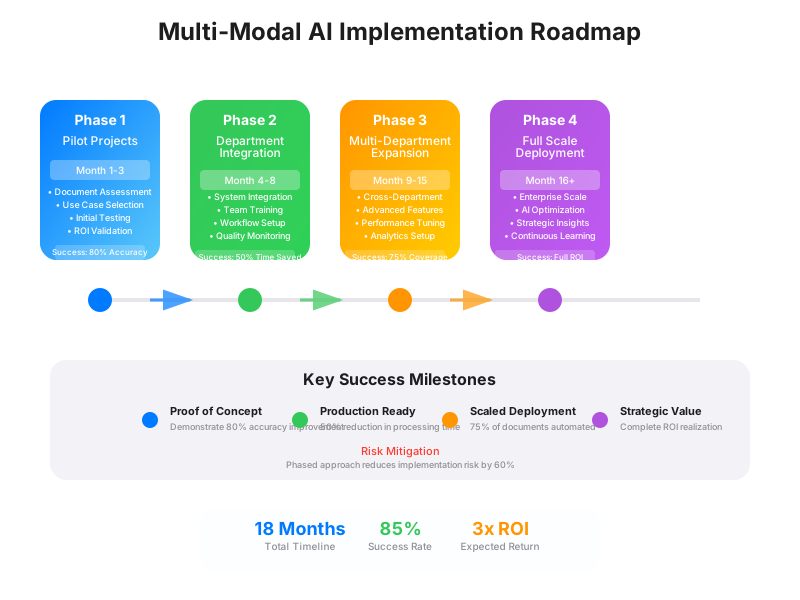
Artificio.ai's approach to multi-modal AI document processing addresses the implementation challenges while maximizing the technology's transformative potential. The platform's architecture is designed from the ground up to handle the complexity of real-world business documents while providing the simplicity and reliability that enterprises demand.
The platform's strength lies in its ability to democratize advanced AI capabilities through intuitive interfaces and pre-configured industry solutions. Rather than requiring organizations to build multi-modal AI expertise from scratch, Artificio.ai provides ready-to-deploy solutions that can be customized for specific use cases and integrated into existing workflows with minimal disruption.
One of the key differentiators is the platform's approach to training data and model optimization. Artificio.ai has invested heavily in developing comprehensive training datasets that cover a wide range of document types, industries, and use cases. This means organizations can achieve high accuracy results without needing to create extensive training datasets from their own documents, significantly reducing implementation time and cost.
The platform's handling of document variability sets it apart from competitors. Real business documents don't follow textbook examples - they include handwritten annotations, mixed formats, varying quality levels, and unique layout conventions. Artificio.ai's multi-modal AI systems are trained to handle this variability, adapting to different document characteristics while maintaining accuracy and reliability.
Integration capabilities represent another significant advantage. The platform provides robust APIs and pre-built connectors that simplify integration with existing business systems. Whether organizations use enterprise resource planning systems, customer relationship management platforms, or custom business applications, Artificio.ai can deliver processed document data in formats that seamlessly integrate with downstream systems.
The platform's approach to scalability addresses one of the major concerns with multi-modal AI implementation. Organizations worry about processing costs and performance as document volumes grow, but Artificio.ai's cloud-native architecture automatically scales resources based on demand while optimizing costs through intelligent processing allocation. Simple documents still use efficient processing methods, while complex documents leverage full multi-modal capabilities only when needed.
Quality assurance and accuracy monitoring are built into the platform rather than being afterthoughts. Organizations can establish accuracy thresholds, monitor processing quality in real-time, and receive alerts when documents require human review. This proactive approach to quality management ensures that automation improvements don't come at the expense of accuracy or reliability.
The platform's industry-specific optimizations provide immediate value for organizations in healthcare, financial services, manufacturing, legal, and other document-intensive sectors. Rather than requiring extensive customization, these pre-configured solutions understand industry-specific document types, regulatory requirements, and processing conventions. A healthcare organization can deploy multi-modal AI for medical record processing with confidence that the system understands medical terminology, regulatory compliance requirements, and clinical documentation standards.
Security and compliance considerations are integrated throughout the platform architecture. Multi-modal AI processing often involves sensitive business documents, and Artificio.ai provides enterprise-grade security controls, audit trails, and compliance reporting capabilities. Organizations can maintain strict data governance while leveraging advanced AI capabilities.
The platform's commitment to continuous improvement means that multi-modal AI capabilities evolve and improve over time. New document types, enhanced accuracy, and expanded functionality are delivered through regular platform updates without requiring organizations to manage complex upgrade processes or retrain internal teams.
The adoption of multi-modal AI document processing represents more than a technology upgrade - it's a strategic transformation that will reshape how organizations handle information and make decisions. Companies that embrace these capabilities early will gain sustainable competitive advantages that extend far beyond improved document processing efficiency.
The most immediate strategic advantage lies in operational excellence. Organizations implementing multi-modal AI can process complex documents with unprecedented accuracy and speed, reducing manual effort while improving decision-making quality. This operational improvement translates directly into cost savings, but more importantly, it frees human resources to focus on higher-value activities that drive business growth.
The intelligence advantage may prove even more significant in the long term. Multi-modal AI doesn't just process documents more efficiently - it extracts insights and identifies patterns that human reviewers might miss. Organizations can discover trends in customer feedback, identify risk patterns in regulatory filings, or uncover market opportunities hidden in complex research reports. This enhanced business intelligence capability can inform strategic decisions and identify competitive opportunities.
Regulatory compliance and risk management represent another area where multi-modal AI provides strategic advantages. As regulatory requirements become more complex and penalties for non-compliance increase, organizations need more sophisticated approaches to document analysis and compliance monitoring. Multi-modal AI can identify compliance issues, flag potential risks, and ensure that regulatory reporting includes all relevant information from complex document sets.
The customer experience implications are profound. Organizations can respond more quickly to customer inquiries, process applications more efficiently, and provide more accurate information by leveraging multi-modal AI's superior document understanding capabilities. A financial services company might approve loan applications faster by automatically analyzing complex financial documentation, while a healthcare provider might improve patient care by quickly accessing and interpreting comprehensive medical records.
Innovation acceleration represents a less obvious but potentially transformative advantage. When organizations can quickly extract insights from technical documents, research reports, and complex analysis, they can accelerate product development, identify market opportunities, and respond more rapidly to competitive threats. The time saved on document processing can be redirected toward innovation activities that drive business growth.
The network effects of multi-modal AI adoption create additional strategic advantages. As more organizations in an industry adopt these capabilities, the competitive pressure increases for others to follow suit. Early adopters establish advantages in processing speed, accuracy, and insight generation that become difficult for competitors to match without similar technology investments.
Data asset value appreciation represents a long-term strategic benefit that many organizations overlook. Multi-modal AI helps organizations extract more value from their existing document repositories, effectively appreciating the value of historical data assets. A manufacturing company might discover quality improvement insights in historical inspection reports, while a law firm might identify precedent patterns in case files that improve legal strategy development.
The scalability advantages of multi-modal AI become more significant as organizations grow and document volumes increase. Traditional approaches to document processing become bottlenecks as businesses expand, but multi-modal AI systems can scale efficiently while maintaining quality and accuracy. This scalability enables business growth without proportional increases in administrative overhead.
The transition to multi-modal AI document processing isn't just about keeping up with technology trends - it's about positioning your organization for success in an increasingly complex and competitive business environment. The organizations that recognize and act on this opportunity will establish lasting advantages in efficiency, insight generation, and strategic decision-making capability.
The evidence is clear that traditional document processing approaches are reaching their limits. As business documents become more complex and the volume of information continues to grow, single-modal systems simply can't provide the accuracy, understanding, and insights that modern organizations need. Multi-modal AI represents the natural evolution of document processing technology, and early adoption provides significant competitive advantages.
The implementation challenges, while real, are manageable with proper planning and the right technology platform. Organizations don't need to build multi-modal AI expertise from scratch or navigate complex technical implementations alone. Platforms like Artificio.ai provide the infrastructure, expertise, and support needed for successful adoption while minimizing risk and accelerating time to value.
The strategic implications extend far beyond document processing efficiency. Multi-modal AI enables new approaches to business intelligence, risk management, compliance monitoring, and customer service that can transform organizational capabilities and competitive positioning. The question isn't whether multi-modal AI will become standard in document processing - it's whether your organization will be among the leaders or followers in this transformation.
The future belongs to organizations that can extract maximum value from their information assets while operating with unprecedented efficiency and insight. Multi-modal AI document processing provides the foundation for this future, and the time to begin this transformation is now. The competitive advantages available to early adopters won't remain available indefinitely, and the organizations that act decisively will establish positions that become increasingly difficult for competitors to challenge.
Your documents contain more intelligence and value than traditional processing systems can unlock. Multi-modal AI is the key to accessing that hidden value while building the operational excellence and strategic insight capabilities that will define successful organizations in the years ahead. The question isn't whether to embrace multi-modal AI document processing - it's how quickly you can begin realizing its transformative potential.

Head IT Operations - Co Founder of Artificio
See it in your SAP environment
Bring us a document, a process, or a bottleneck. We'll show how Artificio captures, validates, and posts into SAP — then scale from there.
Security & compliance
ISO 27001:2013 certified, SOC 2 Type 2 compliant, GDPR and HIPAA ready. Every agent action is logged, auditable, and runs in isolated environments.