

Blog
Human-AI: Solving Document Processing Errors
Discover how cognitive biases like confirmation bias and attention fatigue lead to document processing errors and how human-AI partnerships offer a solution.

Blog
Discover how cognitive biases like confirmation bias and attention fatigue lead to document processing errors and how human-AI partnerships offer a solution.
Every CFO has been there. A seemingly competent accounts payable team processes hundreds of invoices weekly without issue, then suddenly a $50,000 duplicate payment slips through. The vendor was different, the invoice number was off by one digit, and the amount was identical to a legitimate payment from the previous month. How did three people miss something so obvious? The answer isn't incompetence or carelessness. It's psychology.
Human brains are remarkable pattern-recognition machines, but they're also riddled with predictable blind spots that make certain types of document processing errors almost inevitable. While most companies focus on training and process improvements to reduce these errors, they're fighting against millions of years of cognitive evolution. The real solution lies in understanding these psychological limitations and designing human-AI partnerships that compensate for them.
Confirmation bias represents one of the most dangerous psychological pitfalls in document processing. This cognitive shortcut causes our brains to unconsciously filter information to match our existing expectations, making us literally blind to contradictory evidence. In document processing, this translates to a phenomenon where experienced processors develop mental templates for common document types and unconsciously force new documents to fit these patterns.
Consider a typical invoice processing scenario. An experienced AP clerk has processed thousands of invoices from the same vendor over the past two years. The vendor always submits invoices with the same format, similar amounts (usually between $2,000-$5,000), and consistent payment terms. When a fraudulent invoice arrives that mimics this vendor's format but contains a $15,000 charge for services never rendered, the processor's brain performs a dangerous trick. Instead of flagging the unusual amount, confirmation bias kicks in, and the brain focuses on the familiar elements that match the expected pattern while downplaying the anomalous details.
Research from the Harvard Business School found that document processors working with familiar vendor formats miss critical discrepancies 34% more often than when processing documents from new vendors. This isn't because they're less careful with known vendors, but because their brains have learned to process these documents more automatically, reducing the conscious attention paid to each individual field. The very expertise that makes them efficient also makes them vulnerable to sophisticated errors.
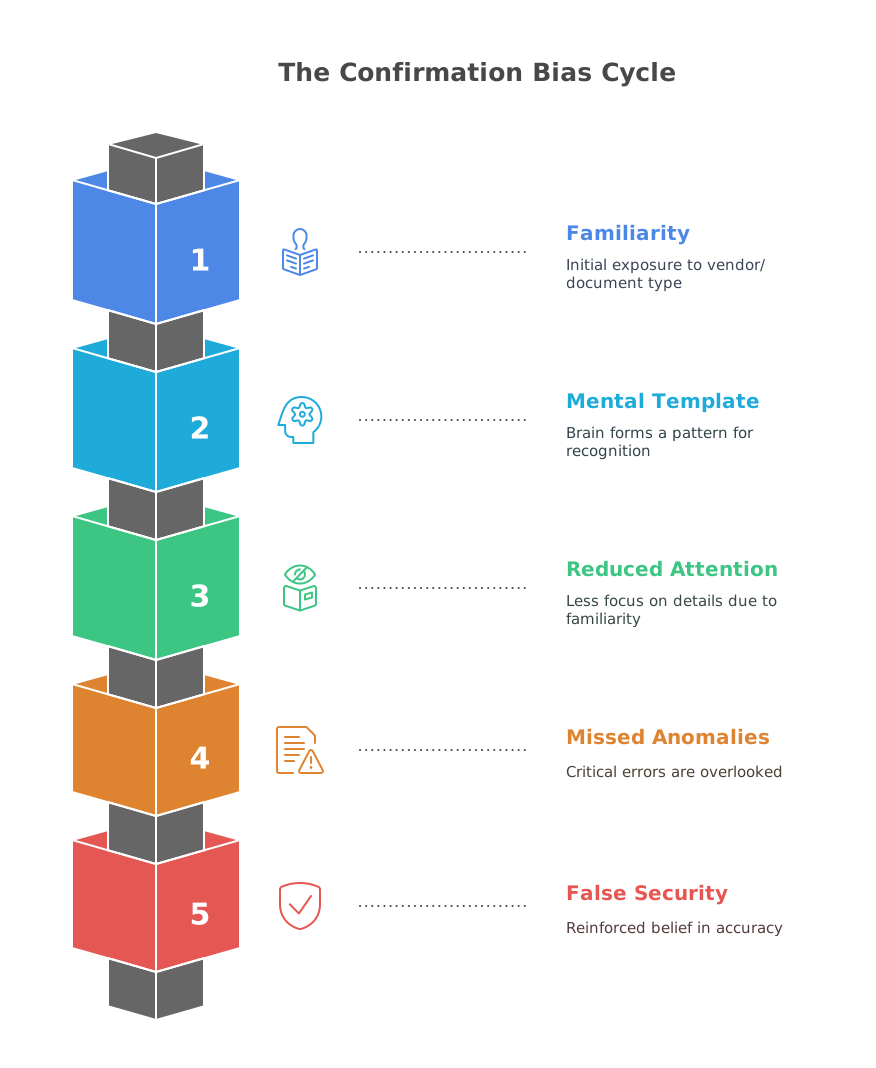
This psychological trap becomes even more pronounced in high-volume environments where time pressure amplifies the brain's tendency to rely on shortcuts. Processors under deadline pressure are 67% more likely to apply confirmation bias, according to studies conducted by cognitive psychology researchers at Stanford University. The irony is that the busier the processing environment, the more likely these costly oversights become.
AI agents specifically designed for document processing don't suffer from confirmation bias because they don't form expectations based on historical patterns in the same way humans do. Every document is processed with the same level of scrutiny, whether it's the first invoice from a vendor or the thousandth. This consistent vigilance makes AI agents particularly valuable as a complementary verification layer, catching the precise types of errors that human expertise makes more likely to miss.
The human brain's capacity for sustained attention operates much like a muscle that grows progressively weaker with extended use. Attention fatigue, also known as directed attention fatigue, represents a well-documented psychological phenomenon where cognitive performance degrades predictably over time when performing tasks that require focused concentration. In document processing environments, this degradation follows a remarkably consistent pattern that most organizations completely underestimate.
Neuroscience research conducted at the University of Michigan tracked the error rates of financial document processors throughout standard eight-hour workdays. The results revealed a disturbing trend that challenges conventional wisdom about human reliability. Processors maintained relatively high accuracy rates (typically above 96%) for approximately the first 90 minutes of concentrated work. However, after processing roughly 75-100 documents, accuracy began declining at an accelerating rate. By the fourth hour of continuous processing, error rates had doubled. Most significantly, processors were largely unaware of their declining performance, rating their attention and accuracy as consistent throughout the day.
The mechanism behind attention fatigue involves the prefrontal cortex, the brain region responsible for executive control and error detection. As this area becomes depleted through sustained use, several critical functions diminish simultaneously. Working memory capacity decreases, making it harder to hold multiple pieces of information in mind while cross-referencing documents. Pattern recognition becomes less precise, leading to increased false positives where dissimilar items appear more alike than they actually are. Most critically, the brain's error-detection systems become less sensitive, meaning mistakes that would normally trigger conscious awareness slip through unnoticed.
What makes attention fatigue particularly dangerous in document processing is its interaction with routine tasks. The more familiar and repetitive a task becomes, the more it relies on automatic processing rather than conscious attention. While this automation normally increases efficiency, it also means that when attention fatigue sets in, there's less conscious oversight available to catch errors. Processors experiencing attention fatigue don't simply work more slowly, they maintain their processing speed while their error-detection capabilities diminish, creating a perfect storm for systematic mistakes.
Organizations that recognize attention fatigue have experimented with various countermeasures, including mandatory breaks, job rotation, and reduced daily quotas. While these approaches can help, they also introduce new complications around workflow continuity and staffing requirements. AI agents offer a more elegant solution by providing consistent performance that doesn't degrade over time. An AI agent processing its 500th document of the day maintains exactly the same error-detection capabilities as when processing the first document, effectively serving as a tireless backup system for human processors whose natural cognitive limitations make extended accuracy impossible.
One of the most counterintuitive discoveries in cognitive psychology is the expertise paradox, the finding that deep knowledge in a specific domain can actually increase certain types of errors. This phenomenon challenges the intuitive belief that more experience always leads to better performance, revealing instead that expertise creates its own unique vulnerabilities that can be particularly costly in document processing environments.
Expert document processors develop sophisticated mental models that allow them to process familiar document types with remarkable speed and efficiency. These mental models function like cognitive shortcuts, enabling experts to quickly identify key information, spot common errors, and maintain high throughput. However, these same mental models can become cognitive traps when documents deviate from expected patterns in subtle ways. The expert's brain, confident in its pattern recognition abilities, may unconsciously "correct" perceived errors in documents that are actually accurate but unusual.
A striking example of the expertise paradox emerged from a study of insurance claims processors at a major financial services company. Senior processors with over five years of experience were compared with newer employees who had less than six months on the job. When processing standard claims that fit typical patterns, the experts significantly outperformed the novices in both speed and accuracy. However, when presented with legitimate but unusual claims that contained uncommon but valid combinations of coverage types, claim amounts, and circumstances, the experts actually performed worse than the novices.
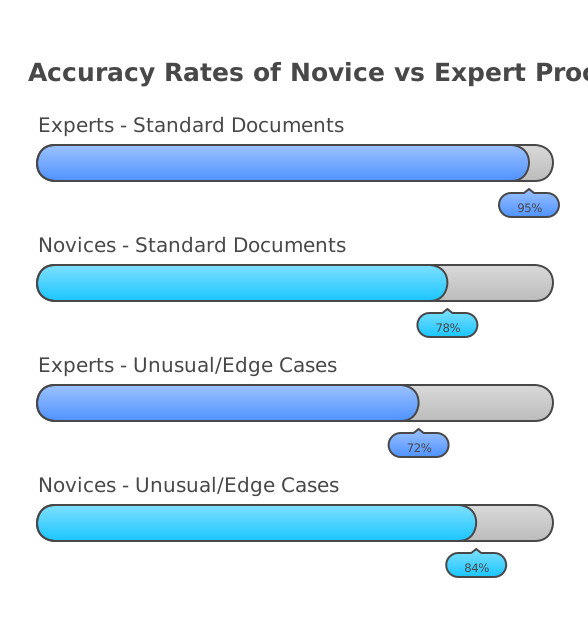
The psychological mechanism behind this paradox involves what researchers call "expert blind spots." As processors develop expertise, their brains become increasingly efficient at recognizing patterns and filling in missing information based on context. This pattern completion ability is usually helpful, but it becomes problematic when the brain fills in information that contradicts what's actually on the document. Expert processors are more likely to see what should be there rather than what is actually there, particularly when processing documents that contain valid but uncommon combinations of fields.
This expertise bias is compounded by what psychologists call the "confidence trap." Expert processors, accustomed to high accuracy rates, develop strong confidence in their judgment. This confidence can lead to reduced double-checking behaviors and increased reliance on first impressions. When an expert processor's initial assessment of a document is incorrect, their confidence in that assessment makes them less likely to reconsider or seek verification, whereas a less confident novice processor might naturally engage in more careful verification behaviors.
The implications for document processing operations are profound. Organizations cannot simply assume that their most experienced staff will catch the most complex errors. In fact, the most experienced processors may be precisely the ones most likely to miss errors in documents that deviate from established patterns. AI agents offer a valuable counterbalance to expert bias because they don't develop the same kind of pattern-based expectations that can blind human experts to valid variations. An AI agent processes each document according to its actual content rather than according to what similar documents typically contain, making it an ideal complement to human expertise rather than a replacement for it.
Human visual processing, despite its remarkable sophistication, operates according to specific limitations that make certain types of document analysis systematically unreliable. The brain's pattern recognition system evolved to identify threats, food sources, and social cues in natural environments, not to detect subtle variations in formatted text and numerical data. When we force this ancient system to process modern documents, predictable failure modes emerge that even the most careful human processors cannot fully overcome.
The brain processes visual information through a series of shortcuts designed for speed rather than precision. One of the most problematic shortcuts for document processing is called "gist processing," where the brain forms an overall impression of a document's content and structure within the first few hundred milliseconds of viewing. This gist processing is remarkably accurate for natural scenes but can be dangerously misleading for documents that contain critical differences in seemingly similar layouts. Two invoices with identical formats but different vendor names, amounts, or dates can generate nearly identical gist impressions, causing the brain to treat them as more similar than they actually are.
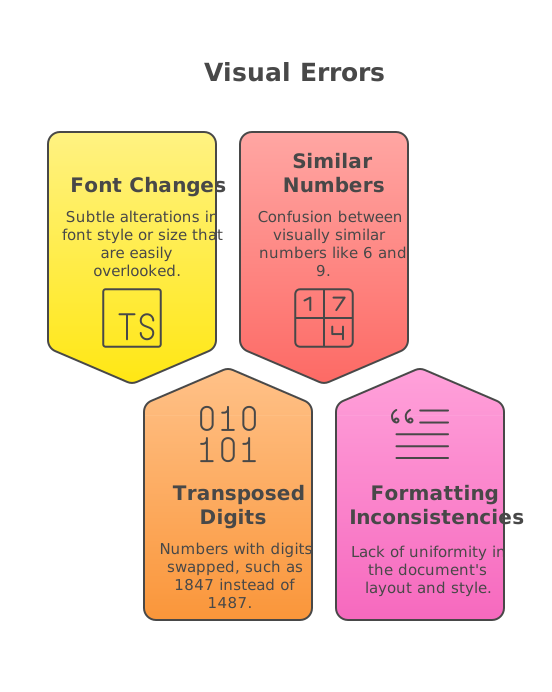
Typography and formatting present another category of systematic challenges for human visual processing. Research conducted by cognitive scientists at MIT found that human accuracy in detecting font variations, spacing irregularities, and formatting inconsistencies drops dramatically when these variations are subtle. In controlled experiments, document processors missed 43% of formatting-based fraud indicators when the fraudulent elements were designed to blend naturally with legitimate formatting. This isn't a training issue, it's a fundamental limitation of how human visual attention operates.
The problem becomes more severe when dealing with numerical data, where the brain's pattern recognition system is particularly vulnerable to errors. Humans have specific blind spots when processing sequences of digits, especially when those sequences contain transpositions (digits in wrong order), omissions, or additions. The classic example involves similar-looking numbers like 6 and 9, or 1 and 7, but the issue extends to more complex patterns. Document processors regularly miss errors where account numbers, invoice numbers, or amounts contain single-digit changes that dramatically alter the meaning while maintaining visual similarity.
Color perception adds another layer of complexity to pattern recognition challenges. A significant percentage of the population has some form of color vision deficiency, making them unable to distinguish between certain color-coded elements in documents. Even processors with normal color vision can struggle with color-based information when documents are photocopied, scanned at low resolution, or displayed on monitors with different calibration settings. Organizations that rely on color coding for critical document processing steps may be systematically excluding certain types of information from effective human review.
AI agents excel precisely in the areas where human pattern recognition fails. Computer vision systems can detect pixel-level differences in formatting, identify numerical transpositions with perfect consistency, and maintain the same level of scrutiny regardless of how many similar documents they've processed. Rather than replacing human pattern recognition entirely, AI agents can serve as specialized tools that compensate for specific human limitations while allowing human processors to focus on higher-level judgment tasks that require contextual understanding and business logic that AI systems still handle less effectively.
Cognitive load theory reveals that the human brain operates with a limited pool of mental resources that must be shared across all concurrent tasks and decisions. While most organizations view document processing as an isolated activity, cognitive psychology research demonstrates that intensive document work consumes mental resources that affect decision-making quality across all other business activities. The hidden cost of cognitive overload extends far beyond processing errors to impact strategic thinking, customer service quality, and overall organizational performance.
The brain manages cognitive load through three primary systems: sensory processing (taking in information), working memory (manipulating information), and long-term memory retrieval (accessing stored knowledge). Document processing simultaneously taxes all three systems. Processors must visually scan documents (sensory processing), compare multiple fields and cross-reference information (working memory), and apply business rules and regulations (long-term memory retrieval). When these systems become overloaded, they don't simply shut down, they begin making systematic trade-offs that prioritize speed over accuracy and routine responses over thoughtful analysis.
Studies conducted at business schools have tracked the decision-making quality of managers and staff members before and after periods of intensive document processing. The results consistently show that cognitive load from document work creates a measurable decline in performance on subsequent tasks that require judgment, creativity, or complex reasoning. Managers who spend significant portions of their day reviewing documents and reports show reduced performance on strategic planning activities, decreased empathy in employee interactions, and increased reliance on decision-making shortcuts that can lead to poor business outcomes.
The phenomenon becomes particularly pronounced in environments where document processing is combined with customer interaction. Customer service representatives who handle both document verification and customer support calls show declining satisfaction scores as their document processing load increases. The mental resources required for careful document review leave less cognitive capacity available for the active listening, problem-solving, and emotional regulation that high-quality customer service requires. Organizations unknowingly create situations where improving document processing accuracy comes at the cost of customer relationship quality.
Cognitive load also affects learning and adaptation within organizations. Staff members operating at high cognitive load are less likely to notice opportunities for process improvement, less receptive to training on new procedures, and more resistant to changes in workflow. The mental resources required for careful document processing leave little capacity for the kind of reflective thinking that drives continuous improvement. Organizations may find themselves stuck in suboptimal processes not because staff members lack the ability to identify improvements, but because the cognitive demands of their current work prevent them from engaging in the kind of analytical thinking that improvement requires.
AI agents can dramatically reduce cognitive load by handling the routine aspects of document processing that consume mental resources without requiring complex judgment. When AI agents handle data extraction, format validation, and routine error checking, human processors can focus their cognitive resources on exception handling, relationship management, and strategic decision-making. This isn't simply about making document processing more efficient, it's about freeing up mental capacity for the kinds of high-value activities that drive business growth and competitive advantage.
Understanding the psychological limitations that affect document processing accuracy doesn't mean accepting defeat in the battle against errors. Instead, it provides a roadmap for designing human-AI partnerships that leverage the unique strengths of both artificial and human intelligence while compensating for their respective weaknesses. The goal isn't to eliminate human involvement in document processing, but to create systems where psychological biases become irrelevant to overall accuracy and efficiency.
Effective human-AI partnerships in document processing recognize that humans and AI agents have complementary cognitive profiles. Humans excel at contextual understanding, relationship management, exception handling, and creative problem-solving. They can recognize when a document doesn't make business sense even if it's technically correct, identify fraud patterns that haven't been seen before, and communicate with vendors and customers to resolve discrepancies. AI agents excel at consistent attention to detail, pattern matching across large datasets, numerical accuracy, and processing speed that doesn't degrade over time.
The most successful implementations create workflows where AI agents handle the cognitive tasks that humans find psychologically challenging, while humans focus on the judgment-based activities where their psychological capabilities provide genuine advantages. For example, AI agents can perform initial document classification, data extraction, and rule-based validation while flagging unusual patterns or potential discrepancies for human review. This approach eliminates the attention fatigue and confirmation bias problems that plague human-only processing while ensuring that complex business logic and relationship considerations receive appropriate human oversight.
Training programs for human-AI partnership require a fundamental shift in how organizations think about document processing skills. Rather than focusing primarily on accuracy and speed in routine processing tasks, training should emphasize exception handling, vendor relationship management, and the kind of analytical thinking that helps humans make good decisions about the issues that AI agents flag for review. This approach recognizes that the most valuable human processors in an AI-augmented environment are those who can provide contextual judgment rather than those who can process routine documents most quickly.
The psychological benefits of well-designed human-AI partnerships extend beyond improved accuracy to include job satisfaction and professional development. Document processors who work with AI agents report lower stress levels, greater confidence in their work output, and increased opportunity to engage in more interesting problem-solving activities. Rather than feeling replaced by technology, they feel empowered by tools that eliminate the tedious aspects of their work while highlighting opportunities for them to add distinctive human value.
Organizations implementing human-AI partnerships in document processing should expect a transition period where staff members adapt to new workflows and develop confidence in AI agent capabilities. Success requires clear communication about how AI agents complement rather than replace human judgment, training programs that help staff members develop skills in AI-human collaboration, and performance metrics that recognize the value of good exception handling and relationship management rather than focusing exclusively on processing volume.
The psychology of document processing reveals that human error isn't a training problem to be solved, but a cognitive reality to be designed around. Confirmation bias, attention fatigue, expertise paradox, pattern recognition failures, and cognitive load represent systematic limitations that affect even the most skilled and dedicated document processors. Organizations that continue to rely solely on human processes, no matter how well-designed, will continue to experience predictable error patterns that AI agents can prevent.
The path forward requires embracing a partnership model that leverages human strengths in judgment, creativity, and relationship management while utilizing AI agents to handle the routine cognitive tasks where human psychology creates systematic vulnerabilities. This approach doesn't diminish the importance of human expertise, it redirects that expertise toward higher-value activities where psychological capabilities provide genuine competitive advantages.
Document processing accuracy isn't ultimately about choosing between humans and AI, it's about understanding the psychological realities that affect human performance and designing systems that work with human nature rather than against it. Organizations that recognize these psychological factors and implement appropriate human-AI partnerships will not only achieve better accuracy and efficiency in their document processing, they'll also create more satisfying work environments where human processors can focus on the kinds of complex, judgment-based activities that represent the best use of human cognitive capabilities.
The question isn't whether AI agents will transform document processing, but whether organizations will proactively design these transformations to amplify human strengths while compensating for human limitations. The companies that get this balance right will gain sustainable competitive advantages through both superior operational efficiency and more engaged, higher-performing human teams.

Head IT Operations - Co Founder of Artificio
See it in your SAP environment
Bring us a document, a process, or a bottleneck. We'll show how Artificio captures, validates, and posts into SAP — then scale from there.
Security & compliance
ISO 27001:2013 certified, SOC 2 Type 2 compliant, GDPR and HIPAA ready. Every agent action is logged, auditable, and runs in isolated environments.