

Blog
How AI Agents Automate Document Filing Processes
Discover how AI agents revolutionize document filing, boosting efficiency and accuracy. Learn key components and benefits.

Blog
Discover how AI agents revolutionize document filing, boosting efficiency and accuracy. Learn key components and benefits.
In today's fast-paced business environment, organizations are continually seeking innovative solutions to streamline operations, reduce costs, and enhance productivity. Document management a critical yet often overlooked aspect of business operations represents a significant opportunity for transformation through artificial intelligence. Traditional document filing processes are labor-intensive, error-prone, and time-consuming, creating bottlenecks that impede organizational efficiency and scalability.
AI agent development has emerged as a revolutionary approach to addressing these challenges. By combining advanced technologies such as agentic frameworks, large language models (LLMs), and human-in-the-loop (HITL) systems, businesses can now automate complex document workflows while maintaining necessary oversight and quality control. These intelligent systems can independently process documents, extract relevant information, categorize content, and execute filing tasks with unprecedented speed and accuracy.
The implementation of AI-driven document filing solutions has far-reaching implications for businesses across industries. From healthcare providers managing patient records to legal firms organizing case files, from financial institutions processing transaction documents to government agencies handling citizen applications. AI agents are transforming how organizations interact with, manage, and leverage their document repositories.
This article explores the transformative potential of AI agent development in document filing processes. We will examine the key components of effective AI agent systems, the implementation strategies that maximize their value, and the tangible benefits they deliver to organizations. Additionally, we will address the challenges and considerations organizations must navigate when adopting these technologies, providing a comprehensive roadmap for businesses looking to embark on this digital transformation journey.
AI agent development represents the evolution of artificial intelligence from passive tools to active participants in business processes. Unlike traditional automation systems that follow rigid, predefined rules, AI agents possess the capability to learn, adapt, and make decisions based on complex inputs. This fundamental shift in functionality enables these systems to handle the inherent variability and complexity of document management tasks that previously required human intervention.
The journey toward intelligent document processing has been marked by several key technological milestones, as illustrated in Figure 1 below.
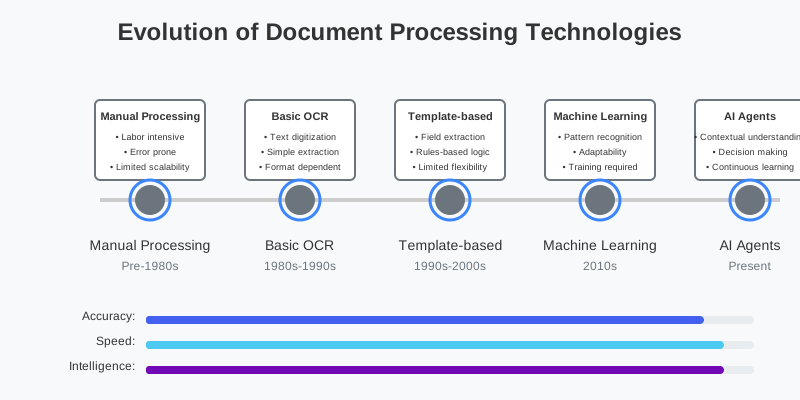
Traditional document management systems relied heavily on manual data entry and basic optical character recognition (OCR) technology, which could digitize text but struggled with understanding document context or handling variations in format. The introduction of template-based extraction systems improved efficiency for standardized documents but still required extensive configuration for each document type and failed when presented with unfamiliar formats.
The emergence of machine learning algorithms marked a significant advancement, enabling systems to recognize patterns and extract information from semi-structured documents with greater flexibility. However, these systems still required substantial training data and struggled with completely unstructured content or complex decision-making tasks.
Modern AI agent development represents the culmination of these technological advancements, combining the pattern recognition capabilities of machine learning with the contextual understanding of large language models and the decision-making frameworks of agentic systems. This powerful combination enables AI agents to approach document filing tasks with a level of comprehension and adaptability previously thought impossible for automated systems.
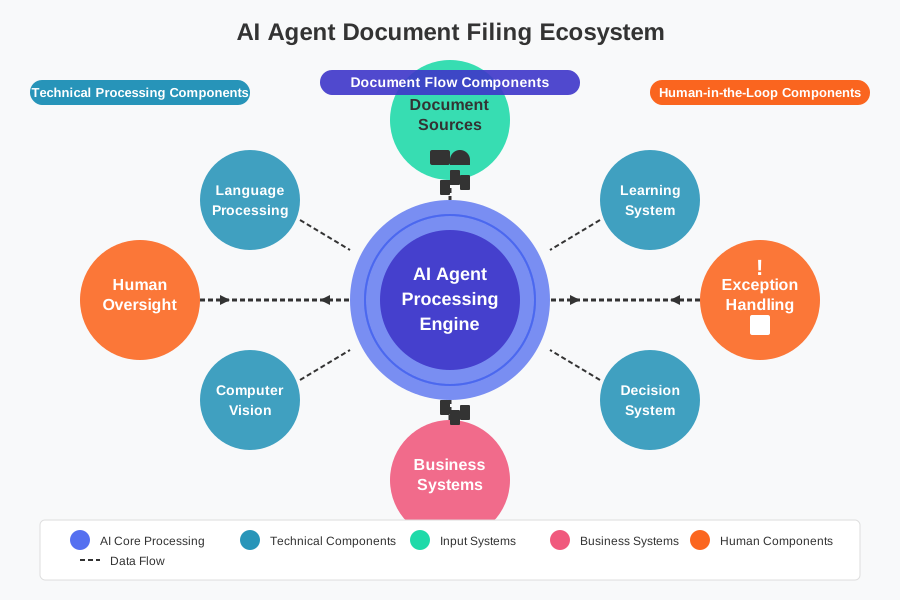
Effective AI agent development for document filing processes integrates several key components:
The integration of these components creates AI agent systems capable of addressing the multifaceted challenges of document filing processes. By combining linguistic understanding, visual analysis, decision-making frameworks, and human oversight, these systems can handle the diversity and complexity of organizational documents while maintaining the reliability and accuracy required for business-critical processes.
The theoretical understanding of AI agent components provides the foundation for their application in real-world document filing scenarios. In practice, these technologies are orchestrated into sophisticated workflows that transform how organizations manage their document repositories. This section examines the practical implementation of AI agents in document filing processes, highlighting the workflow stages where they deliver the most significant impact.
Document filing represents more than simple storage; it encompasses a comprehensive intelligence cycle that transforms raw documents into accessible, actionable organizational knowledge. AI agents navigate this cycle through a series of interconnected processes, as illustrated in Figure 2. 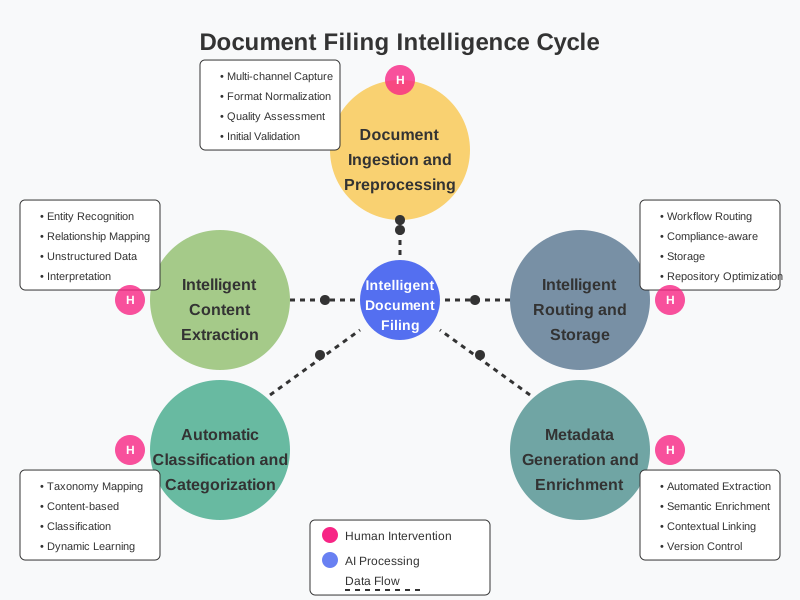
The document filing process begins with ingestion the point at which documents enter the organizational system. AI agents streamline this initial phase through several capabilities:
Multi-channel Capture: Modern organizations receive documents through diverse channels email attachments, web forms, mobile uploads, scanned paper documents, and digital native files. AI agents integrate with these various input sources, creating a unified ingestion layer that standardizes the initial processing regardless of origin. This multi-channel approach eliminates silos in document collection and ensures comprehensive processing across all organizational touchpoints.
Format Normalization: Business documents exist in numerous formats, from structured templates to completely unstructured narratives. AI agents employ sophisticated conversion algorithms to normalize these varied formats into consistent, machine-processable representations. This normalization may involve transforming scanned images into searchable text through OCR, converting proprietary formats to standard ones, or extracting embedded content from complex document structures.
Quality Assessment and Enhancement: Document quality significantly impacts downstream processing success. AI agents automatically evaluate incoming documents for quality issues such as poor scan resolution, incomplete pages, or corrupted digital files. When deficiencies are detected, the system can apply enhancement techniques like image sharpening, noise reduction, or format repair. Documents falling below defined quality thresholds can be flagged for manual review or returned to the source with specific improvement requests.
Once documents are ingested and normalized, AI agents perform the critical task of content extraction identifying and capturing the meaningful information contained within documents.
Contextual Entity Recognition: Beyond basic text extraction, AI agents employ named entity recognition capabilities specifically tuned to organizational contexts. These systems identify business-specific entities such as customer identifiers, project codes, transaction amounts, or product references. The contextual nature of this recognition allows the system to distinguish between similar entities based on surrounding content (e.g., differentiating between billing addresses and shipping addresses in an invoice).
Relationship Mapping: Advanced AI agents not only extract discrete data points but also identify the relationships between them. These relationships provide crucial context for document interpretation connecting parties in a contract, linking line items to invoice totals, or associating medical conditions with specific treatments in healthcare documentation. By capturing these relationships, AI agents preserve the semantic structure of documents during the extraction process.
Unstructured Data Interpretation: Perhaps the most significant advantage of modern AI agents is their ability to extract meaningful information from unstructured text. Through natural language understanding capabilities, these systems can identify key insights, agreements, or implications in narrative content such as legal opinions, meeting minutes, or customer correspondence. This capability extends document processing beyond simple data extraction to knowledge capture, allowing organizations to leverage insights previously locked in unstructured content.
Effective document filing depends on accurate categorization, which enables efficient retrieval and appropriate processing. AI agents revolutionize this classification process through:
Multi-level Taxonomy Mapping: Organizations typically maintain complex document classification schemes with multiple hierarchical levels. AI agents can simultaneously evaluate documents against these multi-level taxonomies, determining not just the primary document type but also appropriate sub-categories, subject domains, and specialized classifications. This comprehensive categorization supports both broad document management functions and specialized departmental needs.
Content-based Classification: Rather than relying solely on explicit metadata or rules, AI agents analyze document content to determine appropriate classifications. This content-based approach allows the system to accurately categorize documents even when explicit classification markers are missing or when documents contain mixed content types. The system evaluates textual content, formatting patterns, entity presence, and other content features to make classification decisions that reflect actual document purpose and content.
Dynamic Classification Learning: Leading AI agent implementations continuously improve their classification accuracy through both supervised and unsupervised learning mechanisms. These systems analyze user interactions, processing exceptions, and reclassification patterns to identify classification errors or gaps in the existing taxonomy. This ongoing learning allows the classification system to adapt to evolving document types and organizational needs without requiring constant manual reconfiguration.
Metadata information about documents rather than their content is essential for effective document management. AI agents enhance metadata capabilities through:
Automated Metadata Extraction: Basic document properties such as creation date, author, document type, and length are automatically extracted and standardized. For specialized document types, domain-specific metadata fields are populated based on content analysis (e.g., extracting case numbers for legal documents or policy numbers for insurance documentation).
Semantic Enrichment: Beyond explicit metadata, AI agents generate implicit metadata through semantic analysis. This includes identifying document themes, sentiment, key topics, and content summaries. Semantic enrichment provides additional retrieval pathways and enables more sophisticated document analytics without requiring manual tagging.
Contextual Linking: Advanced AI agents establish connections between related documents, creating an interconnected document network. These connections might link different versions of the same document, connect supporting materials to primary documents, or identify precedent relationships between similar documents. Contextual linking transforms isolated document stores into knowledge graphs that reflect the actual relationships between organizational documents.
The final stage of the document filing process involves directing documents to appropriate destinations and storage locations. AI agents enhance this process through:
Workflow-driven Routing: Based on document classification and content analysis, AI agents determine appropriate processing workflows and automatically route documents to relevant systems or individuals. This intelligent routing ensures that documents receive proper attention without manual distribution efforts. For example, a customer complaint might be automatically routed to the appropriate department based on product mentions and complaint type, while financial documentation might be directed to accounting workflows with appropriate approval paths.
Compliance-aware Storage: AI agents incorporate regulatory requirements and organizational policies into storage decisions. Documents containing sensitive information are automatically directed to secure storage with appropriate access controls and retention schedules. This compliance-aware approach minimizes risk by ensuring that document handling aligns with relevant regulations from initial filing onwards.
Optimized Repository Organization: Beyond simple filing, AI agents continuously analyze document repository structures to identify optimization opportunities. This might include suggesting taxonomy refinements, identifying redundant storage areas, or recommending reorganization to improve retrieval efficiency. This ongoing optimization ensures that document repositories evolve to meet changing organizational needs without requiring periodic manual reorganization efforts.
While AI agents significantly automate document filing processes, the most effective implementations strategically incorporate human expertise through a structured collaboration model. This approach recognizes that different document processing scenarios require varying levels of automation and human involvement, as illustrated in Figure 3.
The collaboration model establishes specific interaction patterns between human operators and AI agents:
Exception Handling: Documents that fall outside expected patterns or contain ambiguous information are flagged for human review. The AI agent provides context for the exception, highlighting the specific elements requiring attention and suggesting potential resolutions. This targeted escalation ensures that human expertise is applied where it delivers the most value.
Confidence-based Escalation: Rather than applying binary automation rules, sophisticated AI agents assess their confidence in processing decisions and escalate cases falling below defined thresholds. This nuanced approach allows organizations to establish different confidence requirements for different document types or processing scenarios, reflecting their risk tolerance and regulatory environment.
Contextual Learning: Human decisions in escalated cases provide valuable learning opportunities for AI agents. By analyzing these interventions, the system continuously refines its understanding of document patterns, exception conditions, and appropriate handling procedures. This iterative learning process steadily reduces the need for human involvement while maintaining processing quality.
Process Governance: Beyond case-by-case intervention, human experts maintain oversight of the entire document filing system through process governance. This includes monitoring system performance, reviewing automation patterns, and adjusting processing rules based on changing organizational requirements. This governance layer ensures that the document filing system remains aligned with business objectives and compliance requirements.
The human-AI collaboration model transforms document filing from a binary choice between manual processing and full automation to a spectrum of interaction patterns. This nuanced approach allows organizations to optimize the balance between processing efficiency and quality control, applying human expertise strategically while maximizing automation benefits.
The implementation of AI agents in document filing processes delivers multifaceted benefits that extend far beyond simple cost reduction. These benefits transform how organizations interact with their document repositories, unlocking new capabilities and enhancing operational performance across multiple dimensions.
The most immediate and quantifiable benefits of AI agent implementation appear in operational metrics:
Processing Volume and Velocity: Organizations implementing AI-driven document filing solutions routinely report 60-80% reductions in document processing times compared to manual approaches. This acceleration enables businesses to handle growing document volumes without proportional increases in processing resources. A financial services organization that previously required 45 minutes to process a complete loan application can reduce this to 10 minutes or less through AI agent implementation, dramatically improving both customer experience and operational throughput.
Resource Allocation Transformation: AI agent implementation fundamentally changes how human resources are allocated in document-intensive operations. Rather than deploying skilled personnel for routine document handling, organizations can redirect these resources toward higher-value activities requiring human judgment and expertise. This transformation is particularly significant in professional services firms, where document processing traditionally consumes substantial portions of professional time that could otherwise be devoted to client service and relationship development.
Error Reduction and Quality Improvement: Manual document filing processes are inherently prone to errors—misclassification, inconsistent metadata application, and filing omissions. AI agents apply consistent processing rules across all documents, dramatically reducing error rates. Organizations typically experience 30-50% reductions in document-related errors after implementing AI filing systems, with corresponding decreases in error remediation costs and compliance risks.
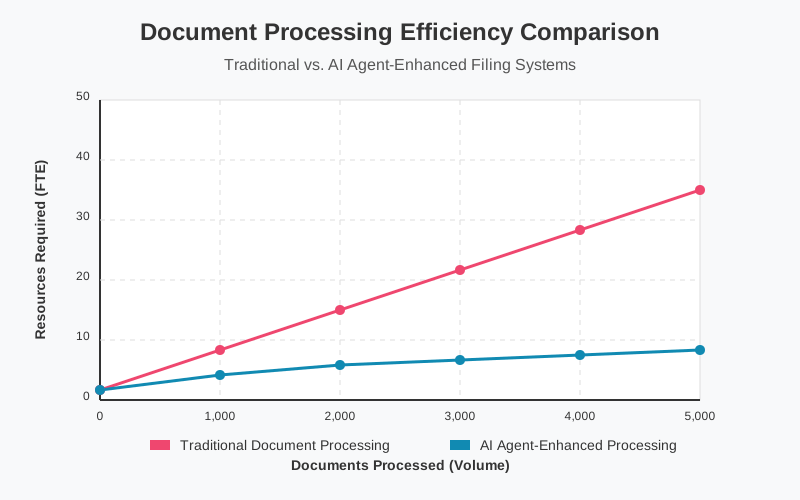
Scalability Without Proportional Cost Increases: Traditional document filing approaches require near-linear resource increases to accommodate growing document volumes. AI agent systems fundamentally break this relationship, enabling organizations to handle substantial volume increases with minimal additional resources. This scalability advantage is particularly valuable for organizations experiencing rapid growth or those with cyclical document processing demands.
Figure 3 illustrates the relationship between document processing volume and resource requirements in traditional versus AI agent-enhanced filing systems:
. 
Beyond operational efficiencies, AI agent implementation transforms how organizations access and leverage their document repositories:
Comprehensive Searchability: AI agents dramatically enhance document searchability through consistent metadata application, content extraction, and semantic indexing. This comprehensive approach enables employees to locate relevant documents through diverse search parameters—from explicit metadata fields to conceptual queries based on document content. This enhanced searchability reduces information retrieval time by 40-60% compared to traditional filing systems, enabling faster decision-making and response to both internal and external requests.
Cross-document Knowledge Discovery: Traditional document filing systems treat documents as isolated entities, limiting organizations' ability to identify patterns and relationships across their document repositories. AI agent systems overcome this limitation through relationship mapping and contextual linking, enabling organizations to discover insights that span multiple documents. This capability is particularly valuable in research-intensive environments, legal case management, and complex project documentation, where critical insights often emerge from connections across document boundaries.
Proactive Information Delivery: Advanced AI agent implementations move beyond reactive document retrieval to proactive information delivery. These systems analyze user activities, project contexts, and organizational patterns to identify and suggest relevant documents before users actively search for them. This anticipatory approach ensures that critical information reaches appropriate personnel at the point of need, enhancing decision quality and reducing the risk of information gaps.
Analytics-enabled Document Intelligence: AI agent systems transform static document repositories into dynamic intelligence sources through advanced analytics capabilities. These systems can analyze filing patterns, content trends, and usage metrics to generate organizational insights identifying emerging topics in customer communications, tracking compliance trends in contractual documents, or highlighting shifts in operational documentation. This analytics layer converts document repositories from administrative necessities to strategic assets that inform organizational decision-making.
Document management represents a significant compliance and risk area for many organizations. AI agent implementation strengthens compliance capabilities through several mechanisms:
Consistent Policy Application: Regulatory compliance often depends on consistent application of document handling policies across the organization. AI agents ensure that these policies are applied uniformly to all documents regardless of volume, timing, or processing location. This consistency is particularly valuable for organizations operating across multiple jurisdictions with varying regulatory requirements, as the system can apply appropriate jurisdiction-specific rules based on document characteristics.
Comprehensive Audit Trails: AI agent systems maintain detailed processing records for each document, capturing all actions, decisions, and modifications throughout the document lifecycle. These comprehensive audit trails provide defensible evidence of compliance with regulatory requirements and organizational policies. In regulated industries like healthcare, financial services, or government contracting, these audit capabilities significantly reduce compliance risk and simplify regulatory inspections.
Sensitive Information Management: Documents frequently contain sensitive information requiring specialized handling under regulations like GDPR, HIPAA, or industry-specific requirements. AI agents automatically identify sensitive content through pattern recognition and contextual analysis, ensuring appropriate security measures and access controls. This capability reduces the risk of inappropriate information disclosure while enabling appropriate information sharing for legitimate business purposes.
Retention Management Automation: Document retention requirements vary widely based on document type, content, regulatory jurisdiction, and organizational policies. AI agents apply these complex retention rules automatically based on document classification and content analysis. This automation ensures that documents are retained for required periods and appropriately disposed of when retention requirements expire, minimizing both retention-related risks and unnecessary storage costs.
The impact of AI agent implementation extends to the human experience within the organization:
Reduced Administrative Burden: Document filing represents a significant administrative burden for many professionals, diverting time and attention from higher-value activities. AI agents alleviate this burden by handling routine filing tasks, allowing employees to focus on activities that leverage their expertise and judgment. This reduction in administrative load is particularly significant for knowledge workers and professionals whose primary contributions depend on applying specialized expertise rather than document management skills.
Enhanced Service Capabilities: Employees in customer-facing roles often depend on rapid document access to resolve inquiries or provide services. AI agent implementation dramatically improves document accessibility, enabling these employees to respond to customer needs more quickly and comprehensively. This capability enhancement improves both customer satisfaction and employee confidence in service interactions, creating a virtuous cycle of improved experiences for both parties.
Knowledge Continuity Preservation: Traditional document filing approaches often rely heavily on individual knowledge and practices, creating significant risks during employee transitions. AI agent systems externalize and standardize this knowledge within the filing system itself, ensuring continuity regardless of personnel changes. This knowledge preservation is particularly valuable in specialized departments with complex document requirements, where new employees would otherwise face steep learning curves for document management practices.
Implementation Strategies for Successful AI Agent Deployment
While the benefits of AI agent implementation are compelling, realizing these advantages requires thoughtful deployment strategies that address both technological and organizational dimensions. Successful implementations typically follow structured approaches that balance immediate operational improvements with long-term transformation goals.
Organizations achieve the highest success rates with phased implementation strategies that manage complexity and provide incremental value:
Document Type Prioritization: Rather than attempting comprehensive implementation across all document types simultaneously, successful organizations begin with document categories offering the highest value-to-complexity ratio. High-volume standardized documents with clear processing requirements such as invoices, standard contracts, or application forms typically provide excellent starting points. These initial implementations deliver measurable benefits while building organizational experience with AI agent systems.
Capability Progressive Expansion: Implementation complexity increases with the sophistication of processing requirements. Successful organizations typically begin with basic capabilities like document classification and metadata extraction before progressing to more complex functions such as semantic analysis or contextual linking. This progressive approach allows both the technology and the organization to mature together, reducing implementation risks while steadily expanding capabilities.
Workflow Integration Sequence: Document filing systems interact with numerous organizational workflows and systems. Rather than attempting simultaneous integration across all touchpoints, effective implementations follow a prioritized integration sequence based on business impact and technical complexity. Initial integrations typically focus on core document repositories and primary workflow systems, with specialized integrations following as the implementation matures.
Technology implementation represents only one dimension of successful AI agent deployment. Equally critical is the organizational change management that enables personnel to adapt to and leverage new capabilities:
Stakeholder Engagement and Education: Document filing processes typically span multiple organizational functions with diverse priorities and concerns. Successful implementations engage these stakeholders early in the process, addressing specific concerns and highlighting function-specific benefits. This engagement transforms potential resistance into active support by aligning implementation priorities with stakeholder objectives.
Role Evolution Support: AI agent implementation fundamentally changes roles involved in document processing, shifting emphasis from routine tasks to exception handling and process governance. Organizations must support this evolution through skill development programs, role redefinition, and performance metric adjustments that recognize the changing nature of document-related work. This support ensures that personnel can successfully transition to higher-value activities as routine processing is automated.
Success Demonstration and Communication: Visible success builds implementation momentum and organizational support. Effective implementations include deliberate success demonstration strategies showcasing measurable improvements, highlighting specific process transformations, and communicating benefits across the organization. These communications transform the implementation from a departmental initiative to an organizational asset with broad support.
Beyond phasing and change management, several technical considerations significantly impact implementation success:
Data Quality and Preparation: AI agent performance depends heavily on the quality of training and configuration data. Successful implementations include structured data preparation phases that cleanse historical documents, standardize classification approaches, and establish quality baselines. This preparation investment substantially improves initial system performance and accelerates time-to-value.
Integration Architecture Design: Document filing systems interact with numerous organizational systems from document creation tools to business process systems to analytics platforms. Effective implementations define clear integration architectures that standardize interaction patterns, establish data exchange protocols, and manage system dependencies. This architectural approach reduces integration complexity and creates a foundation for ongoing system evolution.
Performance Monitoring Framework: AI agent systems require ongoing monitoring to ensure continued performance as document patterns, business requirements, and organizational structures evolve. Successful implementations establish comprehensive monitoring frameworks that track both technical metrics (processing accuracy, system responsiveness) and business outcomes (cycle time reduction, error rate decreases). These frameworks support continuous improvement and enable rapid response to emerging issues or opportunities.
While AI agent implementation offers tremendous benefits, organizations must navigate several challenges to achieve successful outcomes. Understanding and addressing these challenges proactively significantly improves implementation success rates and long-term value realization.
Several technical challenges commonly emerge during AI agent implementations:
Document Variability Management: Organizations typically manage diverse document types with varying structures, formats, and quality levels. This variability challenges AI systems trained on specific patterns or templates. Successful implementations address this challenge through multi-model approaches that apply different processing techniques based on document characteristics, progressive training strategies that continuously expand the system's recognition capabilities, and fallback mechanisms that maintain processing continuity when confronted with novel document formats.
Integration Complexity: Document filing systems typically interact with numerous existing systems—from document creation tools to business process applications to storage repositories. These integration points can introduce significant complexity, particularly in organizations with legacy systems or heterogeneous technology environments. Effective implementations manage this complexity through standardized integration patterns, phased integration approaches, and middleware solutions that abstract underlying system variations.
Performance Scaling: As implementation scope expands to include more document types and processing volume increases, system performance can become challenging. Successful organizations address this challenge through architectural approaches that separate processing components, allow independent scaling of system elements, and optimize resource allocation based on processing demands. Cloud-based implementations offer particular advantages in this area, enabling dynamic resource allocation that aligns with processing requirements.
Ongoing Learning Requirements: Document patterns, organizational terminology, and processing requirements evolve continuously. AI systems must adapt to these changes to maintain performance over time. Leading implementations establish structured learning cycles that periodically retrain models with current document examples, incorporate user feedback into learning processes, and monitor performance metrics to identify adaptation needs. This ongoing learning transforms the system from a static implementation to a dynamic capability that evolves with the organization.
Beyond technical considerations, several organizational challenges influence implementation success:
Skill Transformation Requirements: AI agent implementation shifts document processing roles from routine handling to exception management, process governance, and system oversight. This shift requires different skill sets than traditional document processing, creating potential gaps between existing capabilities and new requirements. Successful organizations address this challenge through structured training programs, role transition planning, and recruitment strategies that align personnel capabilities with emerging needs.
Process Ownership Transitions: Document filing processes often span multiple organizational functions with shared or ambiguous ownership. AI agent implementation typically requires clearer ownership structures to manage system configuration, establish processing rules, and govern overall operation. Organizations must navigate these ownership transitions thoughtfully, establishing appropriate governance mechanisms that balance functional needs with system consistency requirements.
Resistance to Automation: Document filing processes often represent long-established organizational practices with significant personal investment from involved personnel. Automation of these processes can trigger resistance based on both job security concerns and attachment to established methods. Effective implementations address this resistance through transparent communication about role evolution (rather than elimination), involvement of current process experts in system design, and clear demonstration of benefits that extend beyond simple cost reduction.
Governance Model Establishment: AI agent systems require different governance approaches than traditional document processes, with increased emphasis on exception handling protocols, system configuration management, and performance monitoring. Organizations must establish these governance models concurrently with technological implementation, ensuring that appropriate oversight mechanisms exist to manage the system effectively over time.
AI agent implementation also raises several ethical and compliance considerations that require thoughtful attention:
Data Privacy and Sensitivity: Document repositories often contain sensitive information subject to regulatory protection and ethical handling requirements. AI processing of these documents must maintain appropriate privacy safeguards, including access controls, data minimization practices, and processing transparency. Organizations must carefully evaluate privacy implications during system design and establish appropriate safeguards based on document content and regulatory requirements.
Decision Transparency and Accountability: AI agents make numerous processing decisions that affect document handling, access, and lifecycle management. Organizations must ensure appropriate transparency and accountability for these decisions, particularly when they affect regulatory compliance or contractual obligations. This transparency requires both technical capabilities (decision logging, explanation mechanisms) and organizational processes (review protocols, escalation paths) that maintain appropriate oversight of system operations.
Bias Identification and Mitigation: AI systems can inadvertently perpetuate or amplify biases present in training data or configuration parameters. In document filing contexts, these biases might affect classification decisions, priority assignments, or exception handling patterns. Organizations must establish protocols to identify potential biases, implement mitigation strategies, and monitor system behavior for bias indicators. This attention to bias management ensures that the system operates fairly and equitably across all document types and organizational functions.
The domain of AI agent development for document filing continues to evolve rapidly, with several emerging trends that promise to further transform organizational capabilities. Understanding these trends enables forward-thinking organizations to anticipate future developments and position their document management strategies accordingly.
Current document processing systems primarily focus on textual content, with limited capabilities for interpreting visual elements, spatial relationships, and structural information. Emerging AI agent technologies are expanding these capabilities through multimodal understanding approaches that integrate text, vision, and spatial models into unified processing frameworks.
Visual-Textual Integration: Advanced systems now combine computer vision and natural language processing to interpret documents holistically, understanding both textual content and visual elements such as charts, diagrams, logos, and layout structures. This integration enables more comprehensive document understanding, particularly for complex documents where meaning emerges from the interaction between textual and visual elements.
Document Structure Interpretation: Beyond simple text extraction, emerging systems analyze document structures to understand hierarchical relationships, section dependencies, and information flow patterns. This structural understanding provides additional context for content interpretation, enabling more accurate classification and more nuanced information extraction from complex documents.
Multimedia Document Processing: Document concepts increasingly extend beyond traditional paper-based formats to include multimedia content such as audio recordings, video presentations, and interactive digital formats. Leading-edge AI agent systems are expanding to process these multimedia documents, extracting and indexing information across modalities to create unified document representations that preserve all relevant content regardless of original format.
The evolution toward multimodal document understanding represents a fundamental shift in document processing capabilities, moving from text-centric approaches to comprehensive content interpretation that more closely approximates human document understanding. Organizations investing in these capabilities gain significant advantages in processing complex documents and extracting maximum value from multimedia content.
While current AI agent systems require significant configuration and supervised learning, emerging approaches emphasize autonomous learning capabilities that reduce implementation effort and accelerate adaptation to changing document patterns.
Unsupervised Pattern Discovery: Advanced systems employ unsupervised learning techniques to identify document patterns, classification criteria, and extraction rules without explicit training examples. These capabilities enable AI agents to recognize emerging document categories, detect pattern shifts, and adjust processing approaches automatically based on observed document characteristics rather than predefined rules.
Transfer Learning Across Document Types: Rather than requiring separate training for each document type, emerging systems leverage transfer learning techniques to apply knowledge gained from one document category to others with similar characteristics. This cross-category learning dramatically reduces the training data requirements for new document types and accelerates system expansion to cover comprehensive document portfolios.
Continuous Learning Loops: Leading-edge implementations establish continuous learning loops that automatically incorporate processing outcomes, user interactions, and exception handling decisions into ongoing system training. These self-improving systems steadily enhance their capabilities through normal operations, becoming more accurate and comprehensive over time without requiring explicit retraining initiatives.
Zero-shot and Few-shot Learning: The most advanced systems employ zero-shot and few-shot learning approaches that can process entirely new document types with minimal or no specific training examples. These capabilities enable organizations to rapidly expand system coverage to emerging document categories without extensive preparation periods, significantly enhancing operational agility in dynamic business environments.
The evolution toward autonomous learning represents a transformative shift in AI agent implementation, reducing the expertise barriers and resource requirements that currently limit adoption. As these capabilities mature, document processing systems will transition from specialized implementations requiring significant expertise to adaptable capabilities that organizations can deploy with minimal specialized knowledge.
Current document filing systems primarily focus on specific processing tasks rather than end-to-end workflow automation. Emerging cognitive workflow capabilities expand system scope to encompass comprehensive process automation that integrates document filing with broader business processes.
Context-aware Processing: Advanced systems incorporate contextual factors beyond the document itself, including business conditions, user roles, organizational priorities, and related processes. This contextual awareness enables more intelligent processing decisions, such as adjusting routing based on current workloads, modifying extraction priorities based on business conditions, or adapting classification approaches based on organizational changes.
Predictive Processing: Rather than simply reacting to incoming documents, emerging systems employ predictive capabilities to anticipate processing requirements and prepare appropriate resources. These capabilities enable proactive scaling during anticipated volume spikes, preliminary rule preparation for expected document types, and resource allocation optimization based on predicted processing patterns.
Decision Automation: Beyond basic filing operations, advanced systems automate increasingly complex decisions based on document content and organizational context. These might include approval determinations for standard requests, compliance verification for regulatory documents, or preliminary risk assessments for financial documentation. This decision automation dramatically accelerates end-to-end processing for routine cases while escalating complex situations for human judgment.
Cross-system Orchestration: Document filing frequently initiates broader business processes spanning multiple systems and organizational functions. Emerging AI agents serve as orchestration engines that coordinate these cross-system processes, ensuring appropriate handoffs between functions, monitoring process progression, and intervening when exceptions or delays occur. This orchestration capability transforms document filing from an isolated function to an integrated component of comprehensive business process automation.
The evolution toward cognitive workflow automation represents a significant expansion of AI agent scope, transforming these systems from specialized document processors to comprehensive business process enablers. Organizations implementing these capabilities gain the ability to automate end-to-end workflows that begin with document filing but extend across diverse business functions and systems.
Traditional document filing approaches centralize processing within specific systems or departments, limiting cross-organizational knowledge sharing and process integration. Emerging federated intelligence approaches overcome these limitations through distributed processing architectures that maintain appropriate boundaries while enabling coordinated document understanding.
Cross-repository Knowledge Sharing: Advanced systems establish knowledge-sharing mechanisms across separate document repositories, enabling document insights from one area to inform processing in others while maintaining appropriate access controls and ownership boundaries. These capabilities enable organizations to maintain specialized repositories for different functions or entities while benefiting from enterprise-wide document intelligence.
Edge Processing Integration: As organizations increasingly generate and capture documents at operational edges rather than central locations, emerging systems distribute processing capabilities to these edge environments. This distributed approach enables immediate document processing at the point of capture, reducing transmission requirements while maintaining consistent processing standards across the organization.
Collaborative Intelligence Networks: Leading-edge implementations establish collaborative networks that connect document processing systems across organizational boundaries—between business units, between companies and suppliers, or between partner organizations. These networks enable secure document exchange with consistent processing standards, facilitating smoother interactions while maintaining appropriate information boundaries and ownership control.
Privacy-preserving Processing: Emerging systems employ privacy-preserving techniques such as federated learning, differential privacy, and secure multi-party computation to enable document intelligence sharing without exposing sensitive content. These approaches allow organizations to benefit from cross-boundary learning and processing coordination while maintaining strict control over actual document content and sensitive information.
The evolution toward federated document intelligence enables organizations to overcome the traditional tradeoff between centralized efficiency and distributed control. These capabilities are particularly valuable for complex organizations with diverse document requirements, extensive partner networks, or significant privacy constraints that complicate centralized approaches.
Theoretical benefits and emerging trends provide important context for AI agent implementation, but real-world experiences offer particularly valuable insights. This section examines several implementation cases across industries, highlighting specific approaches, challenges, and outcomes.
A leading mortgage provider faced increasing competitive pressure to accelerate loan processing while maintaining strict compliance requirements and managing growing document volumes. The organization implemented an AI agent system focused on mortgage application processing, with the following key elements:
Implementation Approach: The organization employed a phased approach, beginning with standard documents (identification, income verification, property documentation) before expanding to more complex components (legal agreements, exception documentation). This phased approach allowed the team to demonstrate value quickly while building expertise for more challenging document types.
Technical Architecture: The implementation combined specialized models for standard financial documents with general-purpose language models for narrative content. This hybrid approach optimized processing efficiency for common documents while maintaining flexibility for less structured content. The system integrated with existing loan origination systems through standardized APIs, minimizing disruption to established workflows.
Human-AI Collaboration Model: The implementation established a tiered exception handling approach, with routine variations addressed by specialized teams and complex exceptions escalated to underwriting experts. This tiered model efficiently allocated human expertise while maintaining processing continuity. The system incorporated exception decisions into ongoing learning processes, steadily reducing escalation rates as implementation matured.
Results and Impact: The implementation reduced average document processing time from 45 minutes to 8 minutes per application, enabling same-day qualification decisions that significantly improved customer experience. Processing capacity increased by 240% without additional staffing, allowing the organization to accommodate business growth while controlling operational costs. Exception rates declined from 28% initially to 12% after six months as the system incorporated learning from human interventions.
A regional healthcare network struggled with fragmented patient documentation across facilities, inconsistent classification approaches, and compliance risks related to protected health information. The organization implemented an AI agent system for comprehensive medical records management:
Implementation Approach: Given the sensitive nature of healthcare documentation, the organization employed a shadow implementation approach that ran the AI system in parallel with existing processes for an extended period. This approach allowed extensive validation before full cutover, ensuring system accuracy and reliability without risking patient care or compliance issues.
Technical Architecture: The implementation emphasized security and compliance features, including comprehensive audit trails, role-based access controls, and specialized entity recognition for protected health information. These features ensured appropriate information handling while enabling efficient processing. The system integrated with existing electronic health record systems, creating a unified view of patient documentation regardless of originating facility.
Human-AI Collaboration Model: The implementation established specialized review teams for different document categories, with clinical documentation reviewed by nursing staff and administrative documentation handled by records specialists. This specialized approach ensured that review activities leveraged appropriate expertise while maintaining processing efficiency. The system incorporated clinician feedback into learning processes, continuously improving accuracy for complex medical terminology and relationships.
Results and Impact: The implementation reduced documentation retrieval time from an average of 12 minutes to less than 30 seconds, significantly improving care delivery efficiency during patient encounters. Classification consistency across facilities increased from 62% to 94%, enhancing information sharing and coordination. Compliance-related documentation incidents decreased by 78%, substantially reducing regulatory risks and associated mitigation costs.
A corporate legal department faced rapidly growing document volumes, complex classification requirements, and critical retrieval needs for litigation support. The organization implemented an AI agent system focused on comprehensive case documentation management:
Implementation Approach: The organization prioritized historical document conversion alongside new document processing, recognizing that maximum value required comprehensive repository coverage. This parallel approach balanced immediate operational improvements with long-term strategic benefits. The implementation team collaborated closely with legal subject matter experts to develop specialized classification taxonomies and extraction patterns aligned with legal practice requirements.
Technical Architecture: The implementation emphasized relationship identification capabilities that connected related documents, detected precedent relationships, and mapped citation networks. These relationship features transformed document filing from simple storage to knowledge management, significantly enhancing the document repository's value for legal practitioners. The system integrated with legal research platforms, enabling unified search across internal documentation and external legal sources.
Human-AI Collaboration Model: The implementation established document review workflows that aligned with attorney seniority and expertise, routing complex or precedent-setting documents to senior attorneys while assigning routine documentation to paralegals or junior staff. This expertise-aligned routing optimized reviewer time while ensuring appropriate oversight for critical documents. The system incorporated attorney classification decisions into its learning processes, steadily aligning its understanding with legal practice patterns.
Results and Impact: The implementation reduced document retrieval time for case preparation by 67%, enabling more thorough preparation within compressed timeframes. Relationship mapping features identified relevant precedents that attorneys had overlooked in 23% of cases, improving argument quality and outcome consistency. Document processing costs decreased by 44% while processing volume increased by 150%, creating capacity for the department to support business growth without proportional resource increases.
A global manufacturing organization struggled with fragmented technical documentation across product lines, inconsistent formatting approaches, and knowledge loss during employee transitions. The company implemented an AI agent system focused on comprehensive technical documentation management:
Implementation Approach: The organization emphasized taxonomy development and standardization as foundational elements, recognizing that consistent classification was essential for effective technical documentation management. This foundation-first approach required additional upfront investment but significantly improved long-term outcomes. The implementation team conducted extensive knowledge capture with experienced engineers, incorporating their implicit classification approaches into system configuration.
Technical Architecture: The implementation emphasized multimodal processing capabilities that handled technical diagrams, specification sheets, and procedural documentation with equal effectiveness. These capabilities ensured comprehensive processing regardless of documentation format or content type. The system integrated with product lifecycle management systems, creating connections between technical documentation and related product data.
Human-AI Collaboration Model: The implementation established community validation approaches that engaged technical experts in periodic system reviews rather than transaction-by-transaction validation. This community approach distributed validation effort across the organization while leveraging specialized expertise for different documentation types. The system incorporated community feedback into scheduled retraining cycles, balancing continuous improvement with validation efficiency.
Results and Impact: The implementation reduced new product documentation development time by 34% through improved reference document identification and knowledge reuse. Engineering time devoted to documentation retrieval decreased by 58%, allowing engineers to focus on technical activities rather than information gathering. Knowledge retention during employee transitions improved significantly, with new team members reaching productivity benchmarks 40% faster through enhanced documentation access.
The evolution of AI agent technologies for document filing represents a fundamental transformation in how organizations interact with their document repositories. This transformation extends far beyond simple automation, reshaping document repositories from administrative necessities to strategic knowledge assets that enhance organizational capability and competitive advantage.
Traditional document filing focused primarily on storage and retrieval ensuring that documents could be found when needed while minimizing the resources required for management. AI agent implementation fundamentally expands this focus to knowledge enablement—extracting, connecting, and activating the information and insights contained within document repositories to drive organizational performance.
This shift from processing to enablement transforms document repositories from passive storage systems to active knowledge resources that support decision-making, identify emerging patterns, and preserve organizational expertise. The document filing function evolves from an administrative cost center to a strategic capability that enhances organizational agility, institutional memory, and operational intelligence.
As AI agents assume responsibility for routine document processing, the human role in document management evolves toward higher-value activities that leverage uniquely human capabilities. Document specialists transition from procedural execution to system governance, exception handling, and process optimization applying judgment and context understanding where they deliver maximum value.
This role evolution creates new career paths and professional development opportunities within document management functions, attracting talent with different skill profiles and creating advancement pathways that weren't possible in traditional document processing environments. Organizations that manage this transition effectively transform document management from routine administration to knowledge stewardship, elevating both the function's impact and its appeal as a career focus.
As AI agent capabilities for document filing become more widely available, implementation excellence emerges as the primary differentiator between organizations that extract maximum value from these technologies and those that achieve only incremental improvements. This excellence encompasses both technical dimensions (architecture design, integration approaches, performance optimization) and organizational elements (change management, skill development, governance structures).
Organizations that develop implementation excellence gain compound advantages over time their systems learn more effectively from operational feedback, their personnel develop deeper expertise in system optimization, and their processes evolve more rapidly to leverage emerging capabilities. These compound advantages create sustainable performance gaps that competitors struggle to close, even when implementing similar technologies.
The continued evolution of AI agent technologies for document filing promises even greater transformation in coming years, with advances in multimodal understanding, autonomous learning, cognitive workflow automation, and federated intelligence expanding what's possible in document management. Organizations that establish strong foundations now position themselves to leverage these emerging capabilities as they mature, maintaining competitive advantage through continuous capability enhancement.
The most successful organizations approach this evolution strategically viewing document filing not as an isolated function but as an integral component of comprehensive knowledge management and process automation. This strategic perspective guides investment decisions, shapes implementation priorities, and drives ongoing optimization efforts, ensuring that document filing capabilities align with and support broader organizational objectives.
In this evolving landscape, document filing transforms from mundane necessity to strategic enabler converting document repositories from administrative burdens to knowledge assets that enhance organizational performance across multiple dimensions. Organizations that recognize and embrace this transformation position themselves for sustained advantage in increasingly knowledge-driven competitive environments.
The integration of AI agent development in document filing processes represents one of the most impactful applications of artificial intelligence in organizational operations. By transforming how organizations capture, process, and leverage document content, these technologies enhance not just operational efficiency but fundamental organizational capabilities from knowledge preservation to process agility to decision quality. As these technologies continue to evolve, they promise even greater transformation, establishing document intelligence as a core component of organizational capability in the digital age.

Head IT Operations - Co Founder of Artificio
See it in your SAP environment
Bring us a document, a process, or a bottleneck. We'll show how Artificio captures, validates, and posts into SAP — then scale from there.
Security & compliance
ISO 27001:2013 certified, SOC 2 Type 2 compliant, GDPR and HIPAA ready. Every agent action is logged, auditable, and runs in isolated environments.