

Blog
Multimodal AI: Document Intelligence Revolution
Discover how multimodal AI is revolutionizing document processing, moving beyond text to unlock true document intelligence with vision-language models.

Blog
Discover how multimodal AI is revolutionizing document processing, moving beyond text to unlock true document intelligence with vision-language models.
Picture this: You're processing an insurance claim that includes a damage assessment report. The document contains written descriptions, photographs of the damage, technical diagrams, data tables with repair estimates, and handwritten notes from the adjuster. Traditional document processing systems would struggle with this complexity, often requiring multiple specialized tools and manual intervention to extract meaningful information from each element. But what if a single AI system could understand all these components simultaneously, cross-reference the written assessment with the visual damage evidence, validate the repair estimates against the diagrams, and produce a comprehensive analysis in minutes rather than hours?
This isn't science fiction anymore. Welcome to the era of multimodal AI in document processing, where artificial intelligence finally matches human-like comprehension of complex documents. We're witnessing a fundamental shift from text-centric processing to true document intelligence that understands the full spectrum of information within any document format.
For decades, document processing has been trapped in a text-first mindset. Even the most advanced Optical Character Recognition (OCR) systems and early AI implementations treated documents as collections of words to be extracted and categorized. This approach worked reasonably well for simple, text-heavy documents like contracts or invoices, but it created significant blind spots when dealing with the visual and structural elements that make documents truly informative.
Consider a typical financial report. Traditional text-only processing might successfully extract the written analysis and numerical data from tables, but it would completely miss the trends shown in graphs, the relationships depicted in organizational charts, or the contextual information conveyed through document layout and formatting. The system would essentially be reading with one eye closed, missing crucial visual cues that human analysts instinctively use to understand the complete picture.
This limitation becomes even more pronounced in today's business environment, where documents are increasingly multimedia-rich. Medical records include diagnostic images alongside patient histories. Engineering specifications combine technical drawings with written instructions. Marketing materials blend text, images, and infographics to convey complex messages. Legal documents often incorporate charts, exhibits, and visual evidence that are just as important as the written content.
The problem isn't just about missing information. Text-only processing often leads to context gaps that can result in serious misinterpretations. When an AI system processes a contract but can't see the attached technical diagrams, it might extract the specifications correctly but miss critical details about implementation requirements shown visually. When processing a medical report, it might capture the written diagnosis but overlook abnormalities clearly visible in accompanying scans or charts.
These limitations have forced businesses to create complex, multi-step workflows involving different specialized tools for different document elements. OCR for text, separate image recognition systems for visual elements, manual review processes to connect the dots between different types of information. The result is slower processing, higher costs, increased error rates, and frustrated users who know there has to be a better way.
The business impact of these limitations is substantial. Companies often have to choose between speed and accuracy when processing complex documents. They might implement fast text-extraction systems that miss important visual information, or they might rely on slow, manual processes that ensure nothing is overlooked but create bottlenecks in critical business workflows. Neither approach is sustainable in today's competitive environment where document processing speed and accuracy can make the difference between winning and losing business opportunities.
The emergence of multimodal AI represents the most significant advancement in document processing since the invention of OCR. Unlike traditional systems that process text, images, and tables separately, multimodal AI uses Vision-Language Models (VLMs) that can understand and interpret all these elements simultaneously within their proper context.
The technology behind this revolution is genuinely fascinating. Modern VLMs like PaLI (Pathways Language and Image model) and similar architectures don't just see text and images as separate data streams. Instead, they create unified representations where visual and textual information exist in the same computational space. Think of it as teaching a computer to read documents the way humans do - by taking in all the visual information at once and understanding how different elements relate to each other.
When a multimodal AI system processes a document, it starts by ingesting the entire document as a unified entity. The system doesn't separate text from images or tables from charts. Instead, it uses computer vision techniques to segment the document into different regions while maintaining awareness of how these regions relate to each other spatially and contextually. This spatial understanding is crucial because the physical layout of information in a document often conveys meaning that text-only systems miss entirely.
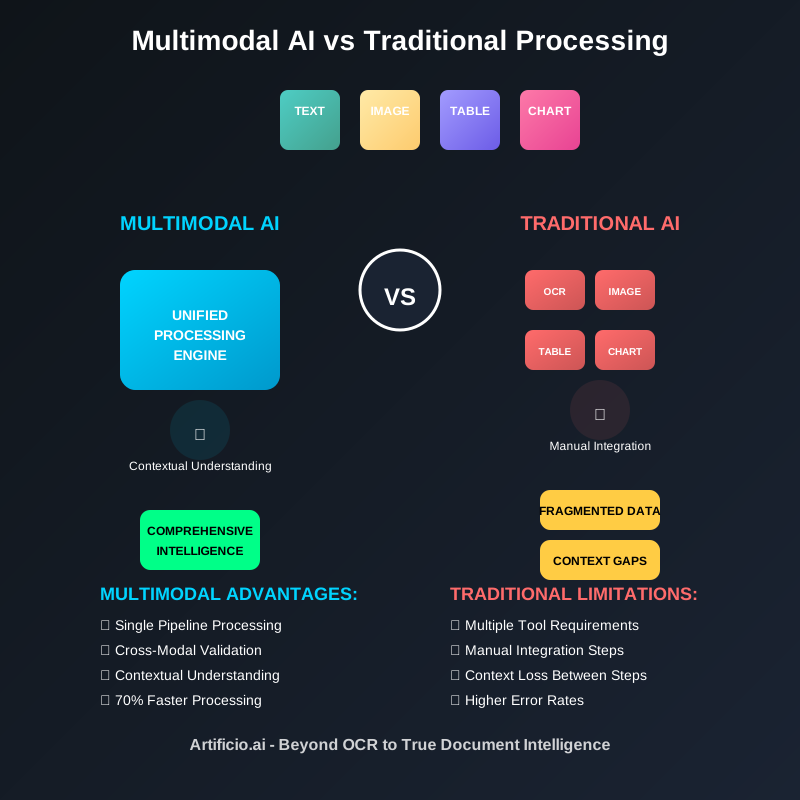
The processing happens through sophisticated attention mechanisms that allow the AI to focus on relevant parts of the document while maintaining global context. When analyzing a lab report, for example, the system doesn't just read the written conclusions separately from the diagnostic images. It actively connects references in the text to specific areas in the images, understands how data tables relate to the visual findings, and can even identify discrepancies between different information sources within the same document.
This contextual understanding extends to implicit relationships that would challenge even human reviewers. The AI can recognize when a chart contradicts written conclusions, when an image shows details not mentioned in the text, or when tables contain data that suggests different interpretations than the narrative sections. This level of cross-referencing and validation happens automatically and instantaneously, providing a depth of analysis that traditional systems simply cannot achieve.
The technical implementation involves several breakthrough technologies working together. Vision transformers project image patches into shared semantic spaces with language models, enabling true integration rather than simple concatenation of different data types. Advanced attention mechanisms allow the system to dynamically focus on relevant document elements based on the specific task or query being processed. Late interaction techniques, similar to those used in ColBERT, enable flexible matching between query requirements and document content across all modalities.
Perhaps most importantly, these systems can generate comprehensive insights that go beyond simple data extraction. They can create summaries that incorporate information from all document elements, identify patterns and anomalies across different data types, and even generate new content like reports or recommendations based on their holistic understanding of the source documents.
The speed improvements are remarkable too. What once required multiple processing steps, different software tools, and manual integration now happens in a single, streamlined workflow. A complex document that might have taken hours to fully process and analyze can now be understood comprehensively in minutes, with accuracy levels that often exceed what human reviewers achieve when working under time pressure.
The transformative power of multimodal AI becomes most apparent when we examine its applications across different industries. Each sector presents unique challenges that highlight why traditional text-only processing falls short and how multimodal approaches deliver superior results.
The insurance industry processes millions of claims annually, each potentially involving complex documentation that combines written reports, photographic evidence, technical assessments, and financial calculations. Traditional claims processing requires adjusters to manually correlate information from multiple sources, often leading to delays, inconsistencies, and disputed settlements.
Multimodal AI transforms this process by enabling simultaneous analysis of all claim components. When processing an auto accident claim, the system can examine the written police report while simultaneously analyzing photos of vehicle damage, cross-referencing repair estimates with visual evidence, and validating witness statements against photographic proof. The AI doesn't just extract information from each source independently. It actively looks for correlations, inconsistencies, and supporting evidence across all document elements.
For property damage claims, this capability proves especially valuable. The AI can analyze photos of damaged structures, compare them with written damage assessments, validate repair estimates against visual evidence, and even identify potential fraud indicators by spotting inconsistencies between reported damage and photographic evidence. A recent implementation at a major insurance company showed 40% faster claim processing times with 25% fewer disputed settlements, largely due to the AI's ability to identify discrepancies that human reviewers might miss.
The technology also excels at processing complex commercial insurance claims that involve technical documentation. When reviewing a manufacturing equipment claim, the system can analyze technical specifications, correlate them with damage photos, validate repair procedures against manufacturer documentation, and assess whether proposed solutions align with industry standards. This comprehensive analysis happens automatically, freeing up experienced adjusters to focus on complex cases that truly require human judgment.
Healthcare presents perhaps the most compelling use case for multimodal AI in document processing. Medical records combine narrative reports, diagnostic images, lab results in tabular form, hand-drawn diagrams, and various visual documentation types. Traditional systems struggle to provide comprehensive patient assessments because they can't correlate information across these different formats effectively.
Multimodal AI changes this dynamic completely. When processing a patient's diagnostic workup, the system can simultaneously analyze written physician notes, examine diagnostic images like X-rays or MRIs, correlate findings with lab result tables, and cross-reference everything with the patient's historical medical records. This comprehensive analysis often reveals patterns and connections that might be overlooked when reviewing each element separately.
The system's ability to understand medical imaging in context with written reports provides particular value. It can identify when radiological findings mentioned in text reports are clearly visible in accompanying images, spot discrepancies between written interpretations and actual image content, and even flag potential diagnostic oversights by recognizing abnormalities that weren't mentioned in the written analysis.
Clinical trial documentation represents another area where multimodal processing delivers significant advantages. These documents often combine patient outcome data, visual documentation of treatments, complex statistical analyses, and regulatory compliance information. Multimodal AI can process all these elements simultaneously, ensuring that data extraction is complete and that relationships between different information types are preserved and analyzed.
The accuracy improvements in healthcare document processing are substantial. One major hospital system reported 60% faster medical record analysis with 35% fewer transcription errors after implementing multimodal AI. More importantly, the system's ability to cross-reference information across document elements helped identify potential drug interactions and treatment conflicts that had been missed in previous manual reviews.
The legal industry generates and processes enormous volumes of complex documents that combine text, exhibits, charts, diagrams, and various forms of evidence. Traditional legal document processing has been labor-intensive, requiring teams of attorneys and paralegals to manually review and cross-reference information across multiple document types and formats.
Multimodal AI revolutionizes legal document analysis by enabling comprehensive understanding of complete legal packages. When processing contract disputes, the system can simultaneously analyze the written contract terms, examine attached technical specifications or drawings, correlate referenced exhibits with main document provisions, and identify inconsistencies between different document elements that might indicate areas of legal vulnerability or opportunity.
Document discovery, one of the most time-consuming aspects of legal work, becomes dramatically more efficient with multimodal processing. The AI can review thousands of documents simultaneously, identifying relevant information regardless of whether it appears in text form, as visual evidence, or within complex tables and charts. The system's ability to understand context across different information types means it can identify relevant documents that traditional keyword-based searches might miss.
Contract analysis particularly benefits from multimodal capabilities. Many contracts include technical drawings, financial projections, organizational charts, and other visual elements that are just as legally significant as the written terms. Multimodal AI can analyze all these elements together, identifying potential conflicts between written terms and visual specifications, flagging unusual patterns in financial data, and ensuring that all contract components align with stated objectives and requirements.
Manufacturing companies deal with some of the most complex documents in any industry. Technical specifications often combine detailed written instructions, CAD drawings, parts diagrams, assembly charts, quality control data, and safety documentation. Traditional document processing systems struggle with this complexity, often requiring multiple specialized tools and significant manual intervention.
Multimodal AI transforms technical documentation processing by understanding the relationships between different information types. When processing a product specification document, the system can correlate written technical requirements with CAD drawings, validate assembly instructions against parts diagrams, and ensure that quality control procedures align with safety specifications. This comprehensive analysis helps identify potential manufacturing issues before production begins.
The system excels at processing change orders and engineering modifications, which often involve updates to multiple document types simultaneously. Traditional systems might update written specifications without properly correlating changes to related drawings or diagrams. Multimodal AI ensures that modifications are consistently applied across all document elements, reducing the risk of manufacturing errors due to inconsistent documentation.
Quality control documentation presents another area where multimodal processing delivers significant value. The AI can analyze inspection reports, correlate findings with photographic evidence, validate measurements against technical drawings, and identify patterns in quality data that might indicate systematic issues. This comprehensive analysis often reveals quality trends that would be difficult to detect when analyzing each information type separately.
Artificio's approach to multimodal AI represents a significant advancement over traditional document processing solutions. While many companies are still struggling to integrate basic OCR with simple AI models, Artificio has built its entire platform around the principle that true document intelligence requires understanding all elements of a document within their proper context.
The foundation of Artificio's multimodal advantage lies in its AI agent architecture. Unlike traditional systems that process documents through linear pipelines, Artificio's AI agents work collaboratively to understand different aspects of documents simultaneously. The Document Classification Agent doesn't just categorize based on text content. It considers visual layout, image content, table structures, and other multimodal signals to make more accurate classification decisions.
This agent-based approach enables sophisticated processing workflows that adapt dynamically to different document types and requirements. When processing a complex financial report, different agents might specialize in text analysis, chart interpretation, table extraction, and cross-validation, but they work together through shared understanding to ensure coherent, comprehensive results. The system doesn't just extract information from each element independently. It actively seeks connections and validates consistency across all document components.
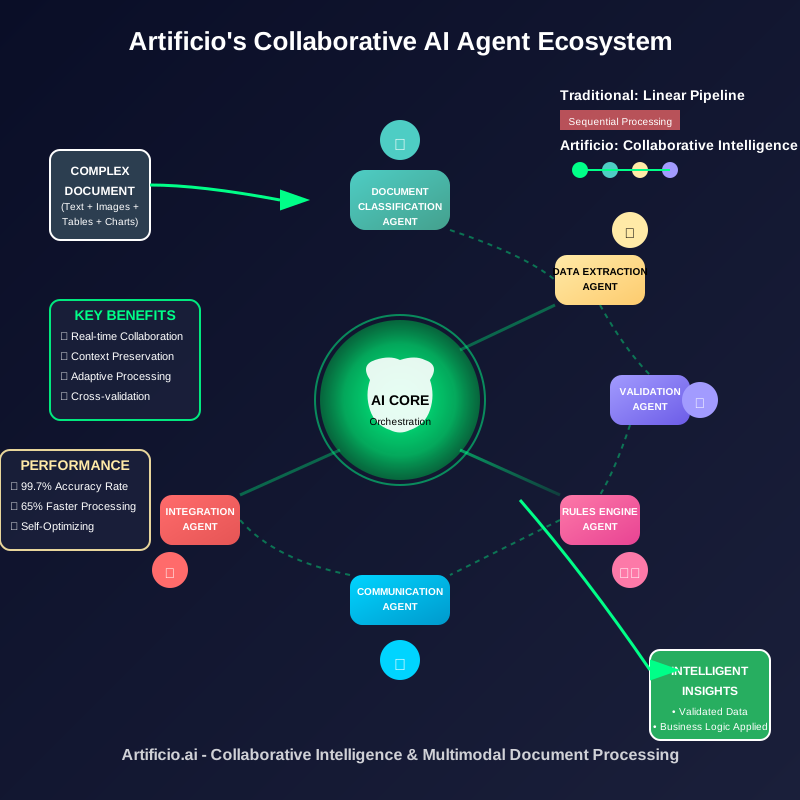
Artificio's pre-trained NLP models have been specifically designed to work with multimodal inputs. These models understand not just what text says, but how it relates to visual and structural elements within documents. When processing an invoice, for example, the system doesn't just extract line items from text. It correlates text descriptions with any product images, validates quantities against visual inspection photos, and ensures that calculated totals match extracted numerical data across different document sections.
The Data Validation and Verification capabilities become particularly powerful in multimodal contexts. The system can cross-validate information extracted from different document elements, identifying discrepancies that might indicate errors or potential fraud. When processing insurance claims, the validation system might flag cases where written damage descriptions don't align with photographic evidence, or where repair estimates seem inconsistent with the extent of damage shown in images.
Artificio's LLM-Based Rules Engine adds another layer of sophistication to multimodal processing. The system can apply complex business logic that considers information from all document elements, making decisions that would typically require human judgment. In loan processing applications, the rules engine might consider not just written financial information, but also validate it against supporting documentation like bank statements, tax forms, and employment verification letters, ensuring that all elements tell a consistent story.
The Intelligent Communication Suite benefits significantly from multimodal understanding. When the system needs to communicate with stakeholders about processed documents, it can provide comprehensive summaries that incorporate insights from all document elements. Rather than sending separate notifications about text content and visual elements, the system can provide unified communications that reflect complete understanding of the processed information.
Real-world implementations of Artificio's multimodal capabilities demonstrate impressive results. A major logistics company processing bills of lading saw 55% faster processing times and 40% fewer errors after implementing Artificio's multimodal solution. The system's ability to correlate shipping manifest text with container photos and cross-reference everything with customs documentation eliminated many of the manual verification steps that had previously slowed operations.
A financial services firm processing loan applications experienced even more dramatic improvements. By analyzing application documents, supporting financial statements, property appraisals with photos, and employment verification letters simultaneously, the system reduced loan processing time by 65% while improving approval accuracy by 30%. The multimodal analysis helped identify applications where different document elements told inconsistent stories, flagging them for additional human review before potential problems could impact the business.
Understanding how multimodal AI actually works provides insight into why it represents such a significant advancement over traditional document processing approaches. The technical architecture combines several cutting-edge technologies in ways that create capabilities greater than the sum of their parts.
At the foundation level, multimodal document processing begins with unified document ingestion that treats the entire document as a single, complex entity rather than a collection of separate elements. The system uses advanced computer vision techniques to segment documents into different regions while maintaining spatial relationships between elements. This segmentation process doesn't just identify text blocks, images, and tables. It understands how these elements relate to each other positionally and contextually within the overall document structure.
The vision component utilizes transformer-based architectures that can process images at multiple resolution levels simultaneously. This multi-scale processing allows the system to understand both fine details within document elements and global document structure. When analyzing a technical manual, for example, the system can simultaneously process detailed component diagrams and understand how these diagrams relate to the overall document flow and organization.
Language processing in multimodal systems goes far beyond traditional natural language processing. The text analysis components are specifically designed to understand references to visual elements, spatial relationships described in text, and implicit connections between written content and other document elements. When the text mentions "as shown in Figure 3" or "see attached photograph," the system actively locates and analyzes the referenced visual content, creating explicit connections between textual and visual information.
The integration layer represents perhaps the most sophisticated aspect of multimodal processing architecture. This component uses attention mechanisms that can dynamically focus on relevant document elements based on the specific processing task or user query. The attention system doesn't just look at individual elements in isolation. It understands how information flows between different document components and can identify cases where elements complement, contradict, or provide additional context for each other.
Cross-modal reasoning capabilities enable the system to draw conclusions that require understanding multiple information types simultaneously. When processing a medical report, the system might notice that written conclusions about patient improvement contradict trends visible in attached charts or graphs. This type of reasoning requires sophisticated understanding of how different information modalities relate to each other and what types of relationships are significant in specific contexts.
The output generation phase leverages advanced language models that can synthesize information from all document elements into coherent, comprehensive results. These models don't just concatenate extracted information from different sources. They create unified narratives that reflect genuine understanding of how different document elements contribute to the overall meaning and significance of the processed information.
Performance optimization in multimodal systems involves several technical challenges. Processing multiple information types simultaneously requires careful resource management to ensure acceptable response times. Artificio's implementation uses adaptive processing strategies that adjust computational resource allocation based on document complexity and user requirements. Simple documents might receive streamlined processing, while complex technical documents get full multimodal analysis.
The scalability architecture supports processing large volumes of diverse documents without performance degradation. This involves sophisticated caching strategies that can reuse processing results across similar document types, parallel processing capabilities that can handle multiple document elements simultaneously, and efficient data structures that minimize memory usage while maintaining processing speed.
The current generation of multimodal AI represents just the beginning of what's possible in document intelligence. Looking ahead, several emerging trends and technologies promise to make document processing even more sophisticated, accurate, and valuable for business applications.
Self-learning capabilities represent one of the most exciting frontiers in multimodal AI development. Future systems will continuously improve their understanding of document types, processing requirements, and user preferences based on ongoing interaction and feedback. Rather than requiring periodic retraining on new datasets, these systems will adapt organically to new document formats, industry-specific requirements, and changing business needs.
The self-learning process will operate across all modalities simultaneously. As the system encounters new types of visual elements, document layouts, or information relationships, it will automatically update its understanding without losing previously acquired knowledge. This continuous learning approach will be particularly valuable for businesses that deal with evolving document formats or that expand into new markets with different documentation standards.
Real-time processing capabilities are advancing rapidly, moving multimodal AI from batch processing toward instant analysis. Future implementations will be able to process complex multimodal documents in real-time as they're being created or modified. This capability will enable new applications like live document collaboration with AI assistance, instant validation of information as it's entered, and immediate flagging of potential issues or inconsistencies during document creation.
The integration with augmented and virtual reality technologies promises to revolutionize how humans interact with processed document information. Rather than reviewing AI-generated summaries and reports on traditional screens, users will be able to explore document information in immersive three-dimensional environments. Complex technical documentation could be visualized as interactive 3D models that users can manipulate to understand different aspects of the information.
Edge processing capabilities will bring multimodal AI directly to mobile devices and embedded systems. This development will enable instant document processing in field environments without requiring cloud connectivity. Insurance adjusters will be able to process claims on-site, field service technicians will have immediate access to technical documentation analysis, and remote workers will be able to handle complex document workflows regardless of connectivity limitations.
Advanced reasoning capabilities will enable multimodal AI systems to understand not just what documents contain, but what they mean in broader business contexts. Future systems will understand industry-specific implications of document information, identify potential risks or opportunities that aren't explicitly stated, and provide strategic recommendations based on comprehensive document analysis.
The integration with other AI technologies like speech recognition and natural language generation will create more comprehensive document intelligence ecosystems. Users will be able to interact with document processing systems through natural conversation, asking complex questions about document content and receiving detailed, contextually appropriate responses that draw on information from all document elements.
Ethical AI and explainability features will become increasingly important as multimodal systems make more complex decisions based on document analysis. Future systems will provide detailed explanations of how they reached specific conclusions, what information from which document elements influenced their analysis, and why certain recommendations or flags were generated. This transparency will be crucial for regulated industries and high-stakes applications where decision-making processes must be auditable and understandable.
The adoption of multimodal AI in document processing represents more than just a technological upgrade. It fundamentally changes how businesses can leverage their document-based information assets and creates new opportunities for competitive advantage, operational efficiency, and strategic insight generation.
Organizations implementing multimodal document processing typically see immediate improvements in operational efficiency. Processing times for complex documents often decrease by 50-70%, while accuracy rates improve by 25-40%. These improvements compound over time as the systems learn from additional document examples and user feedback. The efficiency gains free up human resources for higher-value activities while reducing the operational costs associated with document processing workflows.
The strategic value of multimodal processing extends beyond operational improvements. By extracting more complete and accurate information from documents, organizations gain better insights into their operations, customers, and market conditions. Financial services companies can make more informed lending decisions by considering all aspects of application packages. Healthcare organizations can provide better patient care by having more complete understanding of medical records and diagnostic information.
Risk management benefits significantly from multimodal document analysis. The technology's ability to cross-validate information across different document elements and identify inconsistencies helps organizations identify potential fraud, compliance issues, and operational risks that might be missed by traditional processing methods. Insurance companies report significant reductions in fraudulent claims after implementing multimodal analysis systems that can identify discrepancies between different types of evidence.
Customer experience improvements often follow multimodal AI implementations. Faster, more accurate document processing translates into shorter wait times for loan approvals, insurance claims, permit applications, and other document-intensive customer interactions. The improved accuracy reduces the need for customers to resubmit information or provide additional clarification, creating smoother, more satisfying service experiences.
Competitive positioning becomes a crucial consideration as multimodal AI adoption spreads across industries. Early adopters gain significant advantages in processing speed, accuracy, and the ability to handle complex document types that challenge competitors still using traditional systems. These advantages can translate into market share gains, particularly in industries where document processing speed directly impacts customer acquisition and retention.
The implementation considerations for multimodal AI involve both technical and organizational factors. Technical infrastructure must be capable of supporting the computational requirements of multimodal processing, which are significantly higher than traditional text-only systems. Organizations need to plan for adequate computing resources, storage capacity, and network bandwidth to support effective multimodal processing.
Organizational change management becomes critical when implementing multimodal systems. Employees accustomed to traditional document processing workflows need training on new capabilities and revised procedures. The increased automation may require job role modifications and skill development to ensure that human workers can effectively collaborate with AI systems.
Data governance and security considerations become more complex with multimodal systems. Organizations must ensure that visual and multimedia document elements receive appropriate security protections and that privacy requirements are met across all information types. The cross-referencing capabilities of multimodal systems can potentially reveal sensitive information patterns that weren't apparent in traditional text-only processing.
Return on investment calculations for multimodal AI implementations typically show positive results within 12-18 months for most organizations. The combination of operational efficiency gains, accuracy improvements, and new capability enablement usually provides compelling financial justification. Organizations should consider both direct cost savings and strategic value creation when evaluating multimodal AI investments.
The evolution from text-only document processing to comprehensive multimodal intelligence represents one of the most significant technological advances in modern business operations. Organizations that embrace this transformation position themselves for sustained competitive advantage, while those that delay adoption risk falling behind as multimodal capabilities become standard expectations rather than innovative differentiators.
Artificio's leadership in multimodal AI reflects our commitment to delivering document processing solutions that match the complexity and sophistication of modern business information needs. Our AI agent architecture, combined with advanced multimodal processing capabilities, provides the foundation for document intelligence that truly understands and analyzes information the way humans do, but with the speed, consistency, and scalability that only AI can provide.
The future belongs to organizations that can extract maximum value from their document-based information assets. Multimodal AI makes that future possible today, transforming documents from static repositories of information into dynamic sources of actionable intelligence. The question isn't whether multimodal document processing will become standard across industries. The question is whether your organization will lead this transformation or follow it.

Head IT Operations - Co Founder of Artificio
See it in your SAP environment
Bring us a document, a process, or a bottleneck. We'll show how Artificio captures, validates, and posts into SAP — then scale from there.
Security & compliance
ISO 27001:2013 certified, SOC 2 Type 2 compliant, GDPR and HIPAA ready. Every agent action is logged, auditable, and runs in isolated environments.