

Blog
Bias in Document Automation: Building Fair AI for Enterprise
Learn how bias affects AI in document automation, its risks, and best practices for building fair and trustworthy enterprise systems.

Blog
Learn how bias affects AI in document automation, its risks, and best practices for building fair and trustworthy enterprise systems.
Picture this: A qualified small business owner applies for a loan, submitting all the required documentation through an automated processing system. The AI reviews the application and flags it for rejection, not because of creditworthiness or financial metrics, but because the system struggles to accurately read documents written in a particular handwriting style or formatted differently than its training examples. Meanwhile, a similar application with identical financial credentials but presented in a format the AI recognizes better gets approved without question.
This scenario isn't hypothetical. It's happening right now in businesses around the world where AI-powered document automation systems make thousands of decisions daily, processing everything from loan applications and insurance claims to HR onboarding forms and healthcare documents. While these systems promise efficiency and consistency, they often carry hidden biases that can perpetuate discrimination, create unfair outcomes, and expose organizations to significant legal and reputational risks.
The rapid adoption of AI in document processing workflows has created a perfect storm where bias can flourish unchecked. Organizations are eager to automate manual processes and improve efficiency, but many don't fully understand how their AI systems make decisions or whether those decisions are fair across different populations. A biased document automation system can reject the wrong loan application, misclassify critical medical forms, or skew compliance checks in ways that disproportionately affect certain groups. The consequences extend far beyond individual cases, potentially affecting thousands of customers and exposing businesses to regulatory violations, lawsuits, and lasting damage to their reputation.
The stakes couldn't be higher. As AI becomes the backbone of enterprise document workflows, ensuring fairness and eliminating bias isn't just an ethical imperative—it's a business necessity. Companies that fail to address bias in their document automation systems risk not only harming the people they serve but also undermining the very efficiency gains they sought to achieve.
When we talk about bias in document automation, we're referring to systematic unfairness in how AI systems process, interpret, and make decisions about documents. This bias manifests when automated systems consistently produce different outcomes for similar inputs based on irrelevant characteristics like the document's format, language, or the demographic characteristics of the person who created it.
In the context of machine learning and AI, bias occurs when algorithms make decisions that systematically favor or disadvantage certain groups. Unlike human bias, which might be conscious or unconscious, AI bias is often embedded in the data used to train models or in the algorithms themselves. The challenge is that this bias can be invisible to the people deploying and using these systems, making it particularly dangerous in high-stakes document processing scenarios.
Document automation bias takes many forms, each with serious implications for fairness and accuracy. OCR (Optical Character Recognition) models, for instance, often struggle with certain handwriting styles, particularly those from non-Western cultures or individuals with different writing patterns due to educational backgrounds or physical limitations. When an OCR system can't accurately read a handwritten form, it might incorrectly extract key information or flag the document for manual review, creating delays and potential discrimination against people whose writing doesn't match the system's training data.
Large Language Models (LLMs) used in document processing present another layer of complexity. These models might misinterpret gendered language, make assumptions about names that sound foreign, or struggle with cultural context that affects how information is presented in documents. A resume processing system might inadvertently downgrade applications that mention certain cultural organizations or use language patterns that differ from the predominant style in the training data.
Classification systems present perhaps the most insidious form of bias in document automation. When these systems are trained on historical data that reflects past discrimination, they learn to perpetuate those same biases. A document classifier trained primarily on successful loan applications from a particular demographic might learn subtle patterns that disadvantage other groups, even when the actual financial qualifications are identical.
The impact extends beyond individual documents to entire categories of information. If a document automation system consistently misclassifies certain types of forms or struggles with documents from specific regions or languages, it creates systematic disadvantages that compound over time. A healthcare claims processing system that has trouble with forms from community health centers serving diverse populations could delay or deny legitimate claims, affecting access to care for vulnerable communities.
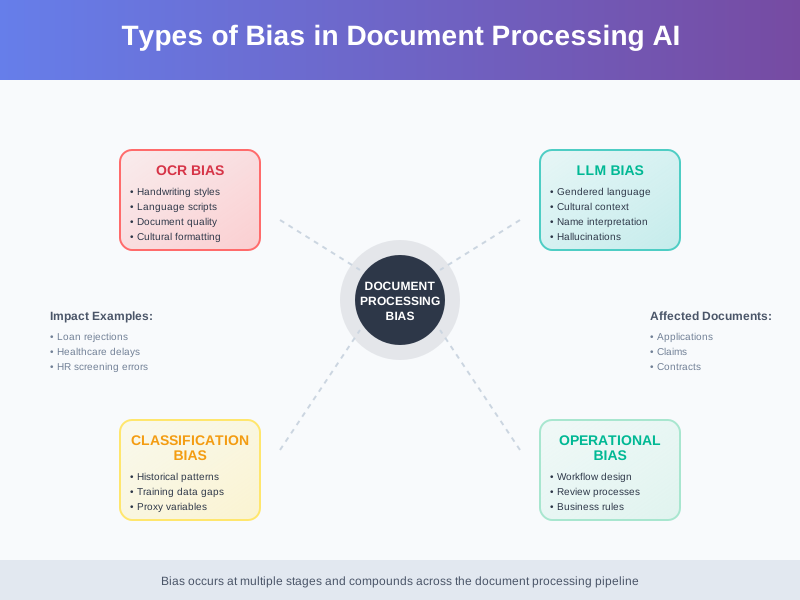
Understanding bias in document automation requires recognizing that it can enter the system at multiple points, each presenting unique challenges and requiring different mitigation strategies. The four primary types of bias in intelligent document processing create a complex web that can trap even well-intentioned organizations.
Data bias represents the foundation upon which all other biases build. When training datasets don't accurately represent the full spectrum of documents an AI system will encounter in production, the resulting models inherit these limitations. Consider a document classification system trained primarily on forms from North American companies. When deployed globally, it might struggle with European privacy notices formatted differently, Asian business documents with different information hierarchies, or Latin American forms that include cultural context unfamiliar to the model. The training data's geographic, linguistic, and cultural limitations become the system's blind spots.
This data bias isn't always obvious. A dataset might include documents from multiple countries but still be biased if certain regions are overrepresented or if the documents from underrepresented areas were processed differently during data collection. Financial institutions, for example, might have extensive training data from urban branches but limited data from rural or community-focused locations, creating models that work well for some customers but struggle with others.
Model bias operates at the algorithmic level, where the mathematical structures used to process information can inadvertently favor certain patterns over others. Even with perfectly representative training data, algorithms can develop preferences that reinforce existing stereotypes or create new forms of discrimination. This happens because machine learning models excel at finding patterns, including subtle correlations that humans might not notice or consider relevant.
A document processing model might learn that certain formatting styles, fonts, or layout patterns correlate with successful outcomes in the training data, not because these elements are actually predictive of success, but because they reflect historical biases in the source material. The model then applies these learned preferences to new documents, potentially discriminating against submissions that don't match the favored patterns.
Human bias in labeling introduces subjective interpretation into what should be objective data processing. When human annotators label training data, they bring their own perspectives, experiences, and unconscious biases to the task. This is particularly problematic in document processing where the meaning and importance of information can vary across cultural contexts. An annotator might consistently mark certain types of business names as less professional, rate documents with particular linguistic patterns as lower quality, or apply stricter standards to forms that don't match their expectations.
The challenge is compounded when labeling guidelines aren't specific enough to account for cultural and contextual variations. What constitutes a complete address, a valid business description, or appropriate supporting documentation can vary significantly across different communities and cultures. Without explicit guidance on these variations, human labelers might inadvertently introduce bias by applying their own cultural norms as universal standards.
Operational bias emerges when business workflows and decision-making processes unintentionally amplify existing systemic inequities. This type of bias isn't necessarily built into the AI model itself but rather in how the organization uses and acts on the model's outputs. A document processing system might accurately identify differences between applications, but if the business rules for handling those differences create disparate impacts, the overall system becomes biased.
For instance, a system might flag documents for manual review based on complexity or unusual formatting. If documents from certain communities consistently trigger these flags due to different business practices, cultural norms, or resource constraints, those communities face longer processing times and additional scrutiny. Even if the AI is technically working as designed, the operational impact creates systemic disadvantage.
These biases don't operate in isolation. They interact and compound each other, creating complex challenges that require comprehensive solutions. A system suffering from data bias might develop model biases that are then amplified by human labeling bias and operationalized through biased business processes. Breaking this cycle requires intervention at every level, from data collection through deployment and monitoring.
The importance of fairness in enterprise document automation extends far beyond moral imperatives, though these certainly matter. In today's regulatory environment, business climate, and interconnected global economy, biased document processing systems pose existential risks to organizations that deploy them.
Regulatory compliance represents the most immediate and measurable impact of bias in document automation. The General Data Protection Regulation (GDPR) in Europe explicitly addresses automated decision-making, requiring organizations to provide meaningful explanations for algorithmic decisions that significantly affect individuals. When document processing systems make biased decisions, they violate these transparency requirements and expose organizations to substantial fines. In the United States, the Equal Employment Opportunity Commission (EEOC) has made clear that AI systems used in hiring and employment decisions must comply with civil rights laws, regardless of whether discrimination was intentional.
Financial services face particularly stringent requirements around fair lending practices. The Fair Credit Reporting Act, Equal Credit Opportunity Act, and Community Reinvestment Act all apply to automated systems used in lending decisions. A document processing system that systematically disadvantages certain communities in loan application processing doesn't just create individual harm—it violates federal law and can result in enforcement actions, fines, and mandatory remediation programs that cost millions of dollars.
Healthcare organizations using AI for claims processing, prior authorization, or treatment recommendations must navigate an even more complex regulatory landscape. The Affordable Care Act prohibits discrimination in healthcare coverage, while HIPAA requires that automated systems maintain the same privacy protections as manual processes. When document automation systems in healthcare exhibit bias, they can deny or delay care for vulnerable populations, creating both legal liability and patient safety risks.
Customer trust forms the foundation of long-term business success, and nothing erodes trust faster than the perception of unfair treatment. When customers discover that an organization's automated systems treat them differently based on irrelevant characteristics, the damage extends far beyond the immediate transaction. Social media and online reviews amplify these experiences, turning individual cases of bias into public relations crises that can affect customer acquisition and retention for years.
The challenge is particularly acute for organizations serving diverse customer bases. A financial institution that primarily serves immigrant communities, for example, cannot afford to deploy document processing systems that struggle with non-English names, international address formats, or documentation from foreign institutions. The bias doesn't just affect individual customers—it can exclude entire market segments and limit business growth opportunities.
Business risk from biased automation compounds over time, creating cascading effects that are difficult to contain once they begin. Biased document processing systems make more errors, require more manual intervention, and create more customer complaints. These inefficiencies erode the cost savings that justified the automation investment in the first place. Meanwhile, the organization faces increased legal exposure, regulatory scrutiny, and reputational damage that can persist long after the technical issues are resolved.
The scalability of bias presents perhaps the most dangerous aspect of automated document processing. While a human processing documents might exhibit bias in individual cases, an AI system can apply that same bias to thousands of documents simultaneously. A single biased model can affect every loan application, insurance claim, or employment verification processed through the system. The impact multiplies with each transaction, creating systematic disadvantage that affects entire communities.
Consider a healthcare claims processing system that has learned to flag certain types of community health center documentation for additional review. If this bias affects even a small percentage of claims, it could delay payment for thousands of providers serving vulnerable populations, potentially affecting their ability to continue operations and serve their communities. The individual bias becomes a systemic problem with far-reaching consequences.
Organizations must also consider the opportunity cost of biased systems. When document automation fails to serve diverse populations effectively, businesses miss opportunities to expand into new markets, serve underrepresented communities, and build inclusive products and services. In an increasingly diverse and globalized economy, this limitation becomes a competitive disadvantage that affects long-term growth and sustainability.
The financial impact of addressing bias after deployment far exceeds the cost of building fair systems from the beginning. Retrofitting biased systems requires retraining models, updating data pipelines, revising business processes, and often rebuilding customer relationships damaged by unfair treatment. Legal settlements, regulatory fines, and remediation programs can cost millions of dollars, while the opportunity cost of lost business and damaged reputation continues indefinitely.
Identifying bias in document automation systems requires a systematic approach that combines technical analysis, business intelligence, and continuous monitoring. Unlike software bugs that cause obvious failures, bias often manifests as subtle patterns that only become apparent through careful analysis of system behavior across different populations and use cases.
Benchmarking against diverse datasets provides the foundation for bias detection. Organizations must test their document processing systems against representative samples that reflect the full diversity of documents they'll encounter in production. This means going beyond the typical test sets used during development to include documents from different languages, cultures, regions, and demographic groups. A comprehensive benchmark should include variations in handwriting styles, document formats, business practices, and cultural contexts that the system will encounter in real-world deployment.
The challenge lies in creating these diverse benchmark datasets when the organization's historical data might already be biased. Financial institutions, for example, might have extensive data from certain geographic regions or customer segments but limited representation from others. Building fair benchmarks requires deliberate effort to collect documents from underrepresented groups and create synthetic examples that fill gaps in the data.
Effective benchmarking also requires understanding the specific ways bias might manifest in the organization's use case. A healthcare claims processor needs benchmarks that include documents from different types of providers, patient populations, and geographic regions. An HR system should be tested with resumes and applications that represent the full diversity of potential candidates, including different educational backgrounds, career paths, and cultural contexts.
Auditing system outputs for fairness metrics requires sophisticated analysis that goes beyond simple accuracy measurements. Organizations must track performance across different demographic groups, document types, and processing scenarios to identify patterns that might indicate bias. This analysis should include both quantitative metrics like error rates and processing times, and qualitative assessments of the types of errors occurring in different populations.
Statistical parity represents one approach to measuring fairness, examining whether the system produces similar outcomes across different groups. However, this metric alone can be misleading if the underlying populations have genuinely different characteristics. More sophisticated approaches like equalized odds or demographic parity provide better insights into whether differences in outcomes reflect legitimate distinctions or systematic bias.
The analysis must also consider intersectionality, recognizing that bias often affects people who belong to multiple underrepresented groups differently than those who belong to just one. A document processing system might perform adequately for women and adequately for non-English speakers separately, but struggle significantly with documents from women who are also non-English speakers.
Monitoring error rates across document types, languages, and formats provides ongoing insight into system performance and potential bias. This monitoring should track not just whether the system makes errors, but what types of errors occur and which populations are affected. A pattern of increased false positives for certain types of documents might indicate bias even if overall accuracy remains acceptable.
Language-specific monitoring is particularly important for organizations serving multilingual populations. Systems might perform well with English documents but struggle with other languages, or they might handle formal business languages adequately while having trouble with cultural variations and colloquialisms. Regular monitoring helps identify these patterns before they affect large numbers of customers.
Format-related bias can be subtle but significant. Documents from different regions, industries, or time periods might use different formatting conventions, layouts, or information hierarchies. A system trained primarily on recent documents might struggle with older formats, while one developed in one geographic region might have trouble with documents from other areas.
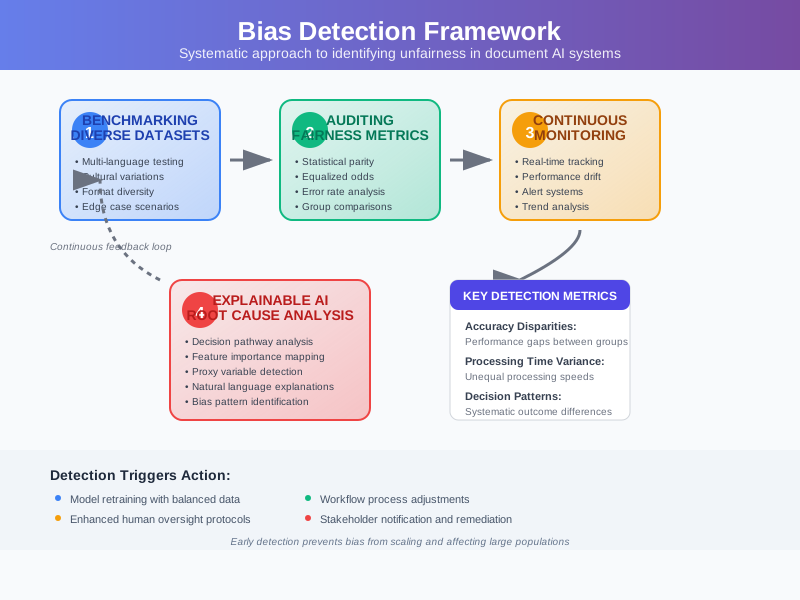
Leveraging Explainable AI (XAI) tools provides crucial insight into why models make specific decisions and helps identify the factors contributing to biased outcomes. These tools can reveal when a system is relying on irrelevant characteristics like document formatting, name patterns, or linguistic styles to make decisions. Understanding these decision patterns helps organizations identify bias that might not be apparent from outcome analysis alone.
XAI tools can highlight when models are using proxy variables that correlate with protected characteristics to make decisions. For example, a system might learn to associate certain address patterns with risk levels, effectively using geography as a proxy for demographic characteristics. Even if the system never explicitly considers race or ethnicity, it might still produce discriminatory outcomes based on these learned associations.
The explainability analysis should examine both individual decisions and aggregate patterns. Understanding why a specific document was flagged or rejected helps identify immediate bias issues, while analyzing decision patterns across large numbers of documents reveals systematic biases that affect entire populations.
Building fair document automation systems requires proactive strategies that address bias at every stage of the development and deployment process. These practices must be embedded into organizational culture and technical workflows, not treated as an afterthought or compliance checkbox.
Diverse data collection represents the cornerstone of bias mitigation in document processing systems. Organizations must deliberately seek out documents that represent the full spectrum of their intended user base, including variations in languages, cultures, business practices, and individual circumstances. This often means going beyond traditional data sources to partner with community organizations, international offices, and specialized service providers who work with underrepresented populations.
The collection process should account for both obvious and subtle forms of diversity. Language diversity includes not just different languages but also variations in dialect, formality, and cultural context within the same language. Geographic diversity encompasses different legal systems, business practices, and documentation standards. Demographic diversity includes differences in education levels, technological access, and cultural backgrounds that affect how people create and submit documents.
Effective diverse data collection also requires understanding the barriers that might prevent certain groups from being represented in datasets. If data collection processes require specific technical skills, access to particular software, or familiarity with certain business practices, they might inadvertently exclude important populations. Organizations must design collection processes that are accessible to all potential users and actively reach out to underrepresented communities.
Human-in-the-loop review provides a critical safety net for catching unfair outcomes before they affect customers. However, implementing effective human oversight requires more than simply having people check AI decisions. The humans in the loop must be trained to recognize bias, equipped with appropriate tools and information, and empowered to override system decisions when necessary.
The design of human review processes significantly affects their ability to catch bias. If reviewers only see cases flagged by the AI system, they might miss systematic biases that affect how documents are initially processed or categorized. Effective human oversight includes random sampling of all decisions, not just those the system considers uncertain.
Training for human reviewers must address both explicit and implicit bias. Reviewers need to understand how their own perspectives might influence their decisions and learn to recognize when system outputs might reflect bias rather than legitimate distinctions. This training should include specific examples of bias in document processing and guidance on how to evaluate fairness across different populations.
The timing and context of human review also matter significantly. Reviewers need access to relevant information about the populations and communities affected by their decisions, but they must also be protected from information that might introduce bias. Striking this balance requires careful design of review interfaces and decision-support tools.
Continuous feedback loops ensure that bias mitigation efforts adapt to changing conditions and emerging challenges. Document processing systems operate in dynamic environments where new types of documents, populations, and use cases constantly emerge. Static bias mitigation strategies quickly become obsolete without mechanisms for learning from real-world performance and adjusting accordingly.
Effective feedback loops require systematic collection of information about system performance across different populations. This includes not just technical metrics but also customer feedback, community input, and insights from frontline staff who interact with affected populations. The feedback mechanism should make it easy for people to report potential bias and ensure that these reports are investigated and addressed promptly.
The feedback process must also account for the fact that bias often affects the people least likely to have their voices heard in traditional feedback channels. Organizations need proactive outreach to communities that might be disproportionately affected by biased systems and alternative channels for collecting feedback from people who might not use traditional customer service or feedback mechanisms.
Transparency in workflows builds trust and enables external accountability for fair document processing. Organizations should clearly communicate how their automated systems work, what factors influence decisions, and how people can seek review or appeal automated decisions. This transparency extends beyond legal requirements to include proactive communication about bias mitigation efforts and ongoing monitoring activities.
Transparency also means acknowledging limitations and uncertainties in automated systems. When document processing systems struggle with certain types of documents or populations, organizations should communicate these limitations clearly and provide alternative processing options. Hiding these limitations creates false confidence and prevents people from seeking appropriate alternatives.
The communication strategy should be tailored to different audiences and contexts. Technical stakeholders need detailed information about model architecture and bias mitigation techniques, while customers need clear explanations of how decisions affect them and what options they have for review or appeal.
Governed AI pipelines embed fairness checks and compliance monitoring directly into the technical infrastructure used to build and deploy document processing systems. These governance mechanisms ensure that bias considerations are evaluated at every stage of the development process, from data collection through model training to deployment and monitoring.
Technical governance includes automated testing for bias, version control that tracks fairness metrics alongside performance metrics, and deployment gates that require bias analysis before systems can be released to production. The governance framework should also include regular audits by independent teams and external validators who can provide objective assessments of system fairness.
Organizational governance ensures that bias mitigation has appropriate leadership support, resource allocation, and accountability mechanisms. This includes clear roles and responsibilities for bias monitoring, escalation procedures for addressing bias incidents, and regular reporting on fairness metrics to senior leadership and board oversight committees.
The integration of Large Language Models and generative AI into document processing workflows has fundamentally changed both the opportunities and risks associated with bias in automated systems. These powerful models bring unprecedented capabilities for understanding and generating human-like text, but they also introduce new forms of bias that can be more subtle and difficult to detect than traditional machine learning approaches.
LLMs amplify both the potential benefits and dangers of AI in document processing. Their ability to understand context, handle multiple languages, and work with unstructured information makes them powerful tools for processing diverse documents. At the same time, their training on vast amounts of internet text means they've absorbed many of the biases present in human-generated content. When these models process documents, they might apply cultural assumptions, stereotypes, and linguistic biases that weren't explicitly programmed but were learned from their training data.
The risks associated with LLMs in document processing are multifaceted and often unexpected. Hallucinations represent one of the most significant concerns, where models generate plausible-sounding but factually incorrect information. In document processing contexts, this might mean the model infers missing information based on biased assumptions rather than acknowledging uncertainty. A model processing a loan application with incomplete information might "fill in the blanks" based on stereotypes about the applicant's name, address, or other characteristics.
Cultural bias in summarization presents another critical risk. When LLMs summarize documents or extract key information, they might emphasize certain types of information while downplaying others based on cultural patterns in their training data. A model trained primarily on Western business documents might not properly recognize or prioritize information that's considered important in other cultural contexts, leading to summaries that miss crucial details for certain populations.
The language capabilities of LLMs can also introduce bias in unexpected ways. While these models often perform better than traditional systems on multiple languages, they typically show significant performance variations across different languages and dialects. Models might understand formal business English perfectly while struggling with colloquial expressions, regional dialects, or languages that were underrepresented in their training data.
LLMs can also perpetuate gender, racial, and cultural stereotypes in their interpretation of document content. When processing resumes, for example, a model might unconsciously associate certain skills or experiences with particular demographic groups based on patterns in its training data. These associations can influence how the model prioritizes or categorizes information, even when the original document doesn't contain explicit demographic information.
Despite these risks, LLMs also present unprecedented opportunities for improving fairness in document processing. Their ability to generate synthetic data offers powerful tools for balancing training datasets and filling gaps in representation. Organizations can use LLMs to create diverse examples of documents that might be underrepresented in their historical data, helping to train more robust and fair processing systems.
Synthetic data generation must be approached carefully to avoid simply amplifying existing biases in new forms. The process requires explicit guidance about diversity and fairness objectives, careful validation of generated content, and ongoing monitoring to ensure that synthetic data actually improves rather than degrades system fairness. When done well, synthetic data can help organizations create more comprehensive training sets without waiting to collect additional real-world examples from underrepresented populations.
The explainability capabilities of LLMs represent another significant opportunity for bias mitigation. Unlike traditional machine learning models that provide numerical outputs with limited explanation, LLMs can generate natural language explanations of their decisions that humans can understand and evaluate. This explainability can help organizations identify when models are making decisions based on irrelevant or biased factors.
Natural language explanations also make it easier for affected individuals to understand why particular decisions were made and to identify potential bias in the process. A loan applicant who receives an explanation that their application was flagged because of "unusual formatting" or "incomplete documentation" can more easily determine whether this represents a legitimate concern or potential bias than if they simply received a rejection code.
LLMs can also be used to automatically audit other AI systems for bias, analyzing decision patterns and identifying potential fairness issues at scale. These models can process large volumes of decisions and flag cases that might indicate systematic bias, helping organizations identify problems before they affect large numbers of people.
The integration of LLMs into document processing workflows requires new approaches to bias mitigation that account for their unique characteristics. Traditional statistical approaches to measuring bias might not capture the subtle ways that LLMs introduce unfairness, requiring more sophisticated evaluation methods that can assess cultural sensitivity, linguistic fairness, and contextual appropriateness.
Organizations deploying LLMs in document processing must also consider the dynamic nature of these systems. Unlike traditional machine learning models that remain stable once deployed, LLMs might be updated regularly with new training data or fine-tuning that could introduce new biases or change existing ones. This requires ongoing monitoring and evaluation that adapts to evolving model capabilities and characteristics.
At Artificio, we recognize that fairness and trustworthiness aren't optional features in enterprise document processing—they're fundamental requirements that must be built into every aspect of our platform. Our approach to bias mitigation and responsible AI deployment reflects years of experience working with enterprises that serve diverse populations and operate in heavily regulated industries.
Our platform embeds fairness checks throughout the entire document processing pipeline, from initial data ingestion through final decision output. These checks operate at multiple levels, including automated statistical analysis of outcomes across different populations, semantic analysis of document content for potential bias indicators, and workflow monitoring that tracks processing patterns across different document types and sources.
The fairness monitoring system continuously analyzes processing outcomes to identify potential disparities in how different types of documents or populations are treated. This analysis goes beyond simple accuracy metrics to examine processing times, error types, and decision patterns that might indicate systematic bias. When the system detects potential fairness issues, it automatically flags them for human review and provides detailed analysis to help investigators understand the source and scope of the problem.
Human oversight plays a central role in our approach to trustworthy document processing. Our platform is designed to make human review efficient and effective, providing reviewers with the context and tools they need to make fair decisions. The human-in-the-loop interface presents relevant information about document processing while protecting reviewers from information that might introduce bias.
Our review workflow includes multiple checkpoints where humans can intervene to correct biased outcomes or provide feedback that improves system performance. These interventions are captured and analyzed to identify patterns that can inform model improvements and training updates. The system learns not just from successful automated processing but also from cases where human intervention was necessary to ensure fair outcomes.
Explainability is fundamental to building trust in automated document processing. Our platform provides clear, understandable explanations for every decision, using natural language to describe why documents were processed in particular ways. These explanations are tailored to different audiences, providing technical details for system administrators while offering accessible summaries for affected individuals.
The explainability system goes beyond simple decision explanations to provide insights into the factors that influenced processing outcomes. Users can understand not just what decision was made but also what information was considered, how different factors were weighted, and what alternative outcomes might have been possible with different inputs.
Enterprise readiness requires robust governance and compliance capabilities that help organizations meet their regulatory obligations while maintaining operational efficiency. Our platform includes comprehensive audit trails that track every decision and intervention, enabling organizations to demonstrate compliance with fairness requirements and respond quickly to regulatory inquiries.
The governance framework includes role-based access controls that ensure appropriate people have visibility into bias monitoring and mitigation activities. Senior leadership can access high-level dashboards showing fairness metrics and trends, while technical teams have detailed access to system performance data and diagnostic tools.
Our approach to ethical automation recognizes that technology alone cannot solve bias problems—it requires a combination of technical capabilities, human oversight, and organizational commitment to fairness. We work closely with our enterprise customers to develop governance frameworks that align with their values and regulatory requirements while enabling them to achieve their operational objectives.
The platform's design reflects our understanding that bias mitigation is an ongoing process rather than a one-time implementation. We provide tools and frameworks that enable continuous improvement, allowing organizations to refine their fairness practices as they learn from real-world deployment and changing business needs.
Data privacy and security considerations are integrated into every aspect of our bias mitigation approach. We recognize that efforts to improve fairness cannot come at the expense of individual privacy or data security. Our platform includes privacy-preserving techniques for bias analysis that enable organizations to identify and address fairness issues without exposing sensitive personal information.
The future of document automation lies not in choosing between efficiency and fairness, but in building systems that deliver both. As AI technology continues to evolve and enterprise adoption accelerates, organizations that prioritize trustworthy, unbiased document processing will gain sustainable competitive advantages while those that ignore these considerations face mounting risks and limitations.
The regulatory landscape will continue to evolve toward greater accountability and transparency in AI systems. Organizations that build fairness into their document processing workflows today will be better positioned to adapt to new requirements and avoid the costly remediation efforts that await those who treat bias as an afterthought. The European Union's AI Act, growing AI governance requirements in the United States, and similar initiatives worldwide signal a clear trend toward mandatory bias testing and mitigation in high-impact AI applications.
Technological advances in areas like federated learning, privacy-preserving machine learning, and advanced explainability will create new opportunities for building fair document processing systems. These technologies will enable organizations to collaborate on bias mitigation efforts while protecting sensitive data, learn from diverse populations without compromising privacy, and provide even more detailed and accessible explanations of automated decisions.
The business case for fair document automation will only strengthen as markets become more diverse, global, and interconnected. Organizations that can effectively serve diverse populations while maintaining compliance and trust will capture growth opportunities that remain inaccessible to those with biased systems. The cost of bias—in terms of legal exposure, customer churn, and operational inefficiency—will become increasingly apparent as awareness and accountability mechanisms improve.
Customer expectations around fairness and transparency in automated systems will continue to rise. People will increasingly demand to understand how AI systems make decisions that affect them and will choose to work with organizations that demonstrate commitment to fair treatment. Transparency will become a competitive differentiator rather than just a compliance requirement.
The technical sophistication of bias detection and mitigation tools will advance rapidly, making it easier for organizations to build and maintain fair systems. Automated bias testing, real-time fairness monitoring, and intelligent bias mitigation will become standard features of enterprise AI platforms. Organizations that adopt these tools early will develop expertise and capabilities that provide lasting advantages.
However, technology alone will never be sufficient to ensure fairness in document automation. Human judgment, ethical leadership, and organizational commitment to equity remain essential components of trustworthy AI systems. The future belongs to organizations that combine advanced technology with strong governance, diverse perspectives, and genuine commitment to serving all their customers fairly.
The imperative for action is clear and urgent. Every day that organizations delay addressing bias in their document processing systems, they risk harming individuals, communities, and their own long-term success. The tools, knowledge, and frameworks for building fair systems exist today—what's needed is the commitment to use them.
Enterprises must demand accountability and transparency from their AI vendors, insist on fairness testing and bias mitigation as standard features, and invest in the governance capabilities needed to deploy AI responsibly. They must also recognize that building trustworthy AI is not a one-time project but an ongoing commitment that requires sustained attention and resources.
The choice facing organizations today is not whether to use AI in document processing—the efficiency and scalability benefits are too compelling to ignore. The choice is whether to deploy AI systems that perpetuate and amplify existing inequities or to build systems that advance fairness while delivering operational benefits. Organizations that choose the path of responsible AI will not only serve their customers better but will also position themselves for success in an increasingly complex and regulated environment.
The future of document AI is bright, but only if we build it with fairness, transparency, and human dignity at its core. The time for action is now, and the responsibility lies with every organization that deploys these powerful technologies. By demanding better from our AI systems and committing to continuous improvement in fairness and accountability, we can create a future where document automation serves everyone equitably and advances human flourishing rather than perpetuating discrimination.
The path forward requires courage, commitment, and collaboration across the entire ecosystem of AI developers, enterprise customers, regulators, and affected communities. But the rewards in terms of business success, regulatory compliance, customer trust, and social impact justify the effort required. The question is not whether we can build fair and trustworthy document AI systems, but whether we will choose to do so.

Head IT Operations - Co Founder of Artificio
See it in your SAP environment
Bring us a document, a process, or a bottleneck. We'll show how Artificio captures, validates, and posts into SAP — then scale from there.
Security & compliance
ISO 27001:2013 certified, SOC 2 Type 2 compliant, GDPR and HIPAA ready. Every agent action is logged, auditable, and runs in isolated environments.