

Blog
Real-Time Human-in-the-Loop (HITL) Workflows
Explore how real-time Human-in-the-Loop (HITL) workflows integrate AI & human expertise for efficient, reliable document processing.

Blog
Explore how real-time Human-in-the-Loop (HITL) workflows integrate AI & human expertise for efficient, reliable document processing.
In the rapidly evolving landscape of document processing technologies, organizations face an increasingly complex challenge: how to harness the efficiency and scalability of artificial intelligence while maintaining the nuanced judgment and contextual understanding that only human experts can provide. This challenge becomes particularly acute when processing critical documents where errors could lead to significant financial, legal, or operational consequences. The solution lies not in choosing between automation and human oversight, but in their thoughtful integration through real-time Human-in-the-Loop (HITL) workflows. These sophisticated systems represent the culmination of years of research and practical implementation at the intersection of machine learning, human-computer interaction, and organizational process design. At Artificio, we have developed and refined HITL methodologies that seamlessly blend the computational power of advanced algorithms with the irreplaceable expertise of human specialists, creating document processing systems that are simultaneously more efficient and more reliable than either approach in isolation.
The concept of Human-in-the-Loop is not merely a technical implementation but a philosophical approach to artificial intelligence that acknowledges both the remarkable capabilities and inherent limitations of automated systems. By recognizing that machine learning models despite their increasingly sophisticated design cannot fully replicate the contextual awareness, ethical judgment, and creative problem-solving abilities of experienced professionals, HITL workflows establish a complementary relationship between human and machine intelligence. This relationship allows each participant to contribute their strengths: algorithms handle routine processing at scale, while human experts focus their attention on edge cases, ambiguous data, or scenarios requiring nuanced interpretation of complex documents. The result is a symbiotic system that continuously improves through structured feedback loops, gradually expanding the range of tasks that can be reliably automated while maintaining human oversight for critical decisions.
In this comprehensive exploration of real-time HITL workflows for document processing, we will examine the architectural principles, implementation strategies, and operational considerations that underpin successful deployments of these systems. Drawing on Artificio's extensive experience implementing HITL solutions across diverse industries from financial services and healthcare to legal services and government operations we will provide a detailed framework for organizations seeking to enhance their document processing capabilities. We will discuss how to design intelligent routing mechanisms that efficiently allocate human attention, how to establish clear escalation triggers that identify cases requiring expert review, and how to structure feedback mechanisms that enable continuous system improvement. Throughout, we will emphasize the importance of thoughtful system design that balances technical sophistication with human-centered principles, ensuring that HITL workflows not only improve operational efficiency but also enhance the quality and meaningfulness of human work in the age of automation.
The history of document processing reflects a continuous progression toward increased efficiency and accuracy, with each technological advancement building upon previous innovations while introducing new capabilities and challenges. In the pre-digital era, document processing was entirely manual, with human workers handling every aspect from initial receipt to data extraction, verification, and filing. This approach, while benefiting from human contextual understanding and adaptability, was inherently limited in its scalability and consistency. The introduction of digitization and basic automation in the late 20th century represented the first significant shift away from purely manual processing, enabling organizations to handle higher document volumes and implement rudimentary quality controls. However, these early automated systems typically followed rigid rules that failed to accommodate document variability or handle exceptions gracefully, requiring extensive human intervention for anything beyond the most standardized formats.
The emergence of machine learning and specifically natural language processing in the early 21st century marked another transformation in document processing capabilities. Instead of relying solely on predefined rules, these systems could identify patterns across large datasets, gradually improving their ability to extract information from semi-structured and unstructured documents. This development enabled a new wave of automation that extended beyond simple template matching to incorporate contextual understanding of document content. Nevertheless, these systems still faced significant limitations in handling complex documents, adapting to new formats, or making nuanced judgments about ambiguous information. Even the most sophisticated deep learning models, trained on vast document corpora, occasionally produce confident but incorrect interpretations that can lead to serious downstream errors if left unchecked.
The recognition of these persistent limitations has led to the current paradigm of hybrid intelligence, embodied in HITL workflows that strategically combine algorithmic processing with targeted human involvement. This approach acknowledges that neither fully manual nor fully automated systems represent optimal solutions for many document processing challenges, particularly those involving high-stakes decisions or complex interpretations. Instead, HITL workflows distribute tasks according to the comparative advantages of humans and machines: algorithms handle high-volume, routine processing where patterns are clear and stakes are moderate, while human experts focus on edge cases, novel situations, and critical decisions that benefit from contextual knowledge and ethical judgment. This division of labor not only improves overall system performance but establishes a framework for continuous improvement, as human decisions provide valuable feedback that enhances algorithm training.
The evolution toward hybrid intelligence has been accelerated by advances in several key technologies. Real-time communication protocols enable immediate routing of documents requiring human attention, minimizing processing delays. Sophisticated user interfaces present relevant document information and model confidence scores to human reviewers, facilitating rapid yet informed decisions. Secure cloud infrastructure supports distributed teams of reviewers who can collaborate on complex cases. Perhaps most importantly, reinforcement learning techniques allow systems to adapt based on human feedback, gradually expanding the range of documents that can be processed with minimal human intervention. Together, these technologies have transformed document processing from a binary choice between manual and automated approaches into a continuum where organizations can tailor the level of human involvement to the specific requirements and risk profiles of different document types and processing scenarios.
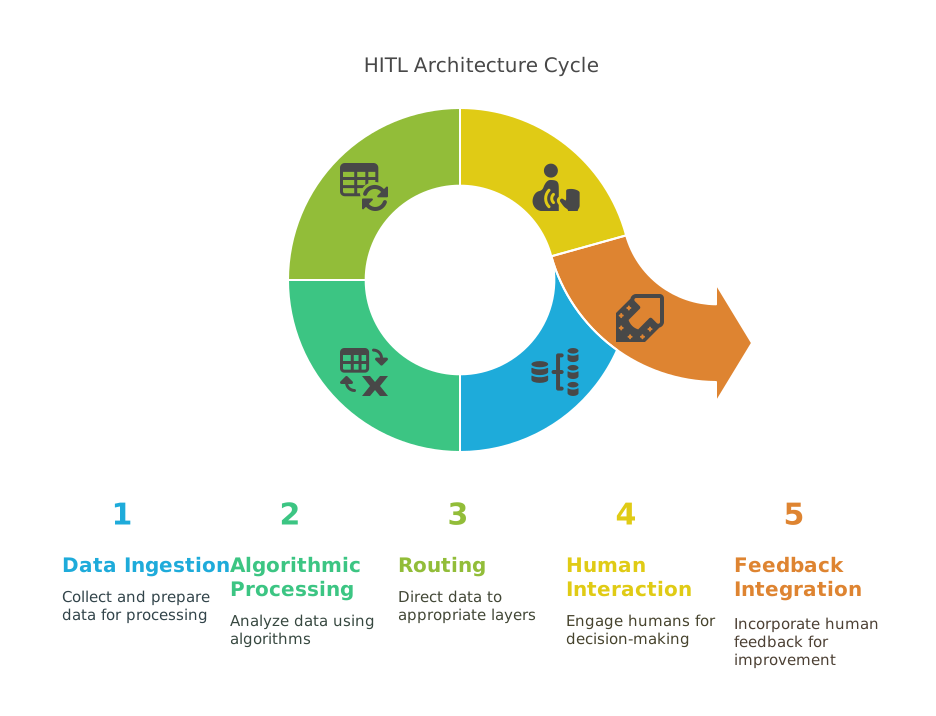
The development of robust HITL workflows requires careful attention to system architecture, establishing technical foundations that support seamless interaction between automated components and human participants. At its core, an effective HITL architecture consists of several interconnected layers, each fulfilling specific functions while maintaining cohesion with the overall system. The data ingestion layer serves as the entry point, standardizing documents from diverse sources and formats into consistent representations suitable for both algorithmic processing and human review. This layer typically incorporates preprocessing capabilities such as OCR (Optical Character Recognition) for digitizing physical documents, format conversion for handling various file types, and initial quality assessment to identify obvious defects or corruptions that might impede downstream processing. By establishing a uniform data foundation, this layer simplifies subsequent processing while preserving the original document characteristics that might be relevant for human reviewers.
Above the ingestion layer sits the algorithmic processing layer, which applies machine learning models to perform tasks such as document classification, information extraction, and anomaly detection. This layer represents the first attempt at automated understanding, applying trained models to recognize patterns, extract structured data, and generate initial interpretations of document content. A critical feature of this layer in HITL systems is the calculation of confidence scores that quantify the model's certainty about its predictions across different document elements. These scores serve as essential signals for the routing layer, which determines whether a document or specific components within it can proceed through automated channels or require human attention. The sophistication of this confidence assessment directly influences the efficiency of the overall system, as overly conservative thresholds waste human attention on routine cases, while excessively permissive thresholds allow errors to propagate through the system.
The routing layer implements the decision logic that directs documents between automated and human processing paths based on predefined criteria and real-time system status. This layer must balance multiple considerations: the confidence scores provided by the algorithmic layer, the criticality and risk profile of the specific document type, available human capacity, and processing time constraints. Effective routing mechanisms typically employ tiered approaches that distinguish between different levels of human intervention, from quick validation of specific data points to comprehensive review of entire documents. The routing layer also incorporates load balancing capabilities to distribute work evenly among available human reviewers while matching specific documents to reviewers with appropriate expertise and authorization levels. Through these mechanisms, the routing layer serves as the central coordination point that orchestrates the dynamic allocation of human attention across the document processing workflow.
The human interaction layer provides the interfaces and tools through which experts review and process documents flagged for their attention. This layer demands particular attention to user experience design, as its effectiveness directly influences both the quality and efficiency of human contributions to the workflow. Well-designed interfaces highlight the specific elements requiring review, provide relevant context from the original document, display the system's confidence assessments and reasoning, and offer streamlined mechanisms for humans to input their decisions or corrections. Advanced implementations incorporate progressive disclosure principles that allow reviewers to access additional document context as needed without creating cognitive overload. The human interaction layer must also support collaboration tools for cases requiring input from multiple experts, audit trails that document the review process, and performance analytics that help identify opportunities for interface improvement or reviewer training.
Finally, the feedback integration layer closes the loop between human decisions and system improvement by systematically capturing review outcomes and incorporating them into model refinement. This layer implements mechanisms for both immediate correction updating the current document's processing results based on human input and long-term learning that enhances model performance for future documents. Effective feedback integration requires careful data structures that preserve the relationship between original model predictions, human corrections, and the contextual factors that influenced the discrepancy. It also necessitates thoughtful aggregation of feedback across multiple reviewers and documents to identify systematic patterns rather than responding to isolated anomalies. Through this continuous learning process, the feedback integration layer enables HITL systems to gradually reduce their reliance on human intervention over time while maintaining or improving overall processing quality.
The strategic determination of when and how to incorporate human judgment represents one of the most consequential design decisions in HITL workflows. Excessive human involvement undermines the efficiency gains of automation, while insufficient oversight can lead to costly errors propagating through critical processes. Developing a systematic framework for identifying intervention points requires deep understanding of both the technical capabilities of automated systems and the business context in which document processing occurs. This framework must consider multiple dimensions: the inherent limitations of current machine learning approaches, the specific characteristics of different document types, the organizational risk tolerance for various processing scenarios, and the relative costs of different error types. By analyzing these factors in combination, organizations can establish nuanced intervention strategies that optimize the allocation of human attention across their document processing operations.
The technical limitations of automated document processing systems provide the first set of indicators for potential human intervention. Current machine learning models, despite their impressive capabilities, exhibit several persistent weaknesses that can necessitate human oversight. Novel document formats or layouts that deviate significantly from training data often challenge automated systems, as they struggle to transfer learning across substantial formatting changes. Documents containing handwritten elements, non-standard terminology, or domain-specific jargon may exceed the recognition capabilities of general-purpose models. Complex logical relationships between document elements such as conditional clauses in contracts or nuanced medical findings can confuse systems trained primarily on statistical patterns rather than causal understanding. Visual elements like charts, diagrams, or embedded images frequently require human interpretation, particularly when their content influences the meaning of surrounding text. By identifying these technical boundaries, organizations can anticipate scenarios where human review is likely necessary regardless of model confidence scores.
Beyond technical limitations, document characteristics provide additional signals for determining appropriate intervention points. Document criticality the potential impact of processing errors serves as a primary consideration, with high-stakes documents such as legal contracts, medical diagnoses, or financial transactions warranting greater human oversight regardless of model performance. Document complexity, measured by factors such as length, structural intricacy, and interdependence between sections, correlates with increased opportunities for algorithmic misinterpretation and thus higher intervention requirements. Temporal sensitivity also influences intervention decisions, as documents with urgent processing requirements may benefit from parallel human review rather than sequential escalation processes that could introduce delays. Finally, regulatory context plays a crucial role, as certain industries and document types operate under compliance regimes that explicitly require human verification regardless of automation capabilities. By systematically assessing these document characteristics, organizations can develop granular intervention policies tailored to their specific document ecosystem.
The implementation of human intervention in HITL workflows extends beyond binary decisions about whether human review is necessary to encompass sophisticated determinations about intervention timing, scope, and format. Real-time intervention brings humans into the process immediately upon identification of potential issues, maximizing the opportunity for timely correction but potentially creating workflow interruptions. Batch-based intervention aggregates cases requiring human attention for periodic review, improving efficiency at the cost of some processing delay. The scope of intervention can range from targeted verification of specific data points to comprehensive review of entire documents, with targeted approaches conserving human attention but risking missed context. Similarly, intervention formats span a spectrum from simple binary validations (approve/reject) to detailed corrections and annotations, with more complex formats providing richer feedback for system improvement but demanding greater human effort. The optimal combination of these intervention parameters varies across document types and processing contexts, requiring thoughtful configuration based on empirical performance data.
To operationalize these conceptual frameworks, effective HITL systems implement specific technical mechanisms that trigger human intervention when warranted. Confidence thresholds represent the most common approach, routing documents for human review when model certainty falls below predefined levels for critical fields or overall document interpretation. Anomaly detection algorithms identify documents whose characteristics deviate significantly from expected patterns, flagging them for human verification even when model confidence appears high. Random sampling mechanisms select a percentage of documents for human review regardless of model predictions, providing ongoing quality assurance and helping to detect "unknown unknowns" that might otherwise escape attention. Business rule triggers initiate human review when specific conditions are met, such as transaction amounts exceeding certain thresholds or the presence of particular contractual clauses. Together, these technical mechanisms translate abstract intervention principles into concrete workflow decisions, ensuring that human attention is directed toward cases where it adds the greatest value.
The interface through which human experts interact with the document processing system critically influences both the quality and efficiency of their contributions. Well-designed human interfaces in HITL workflows transcend traditional document viewing tools to create purposeful environments that highlight relevant information, streamline decision processes, and capture valuable feedback. These interfaces must simultaneously serve multiple functions: presenting document content clearly, communicating model interpretations and confidence levels, facilitating human input, and gathering data for system improvement. The design challenges inherent in balancing these functions are substantial, requiring thoughtful application of principles from human-computer interaction, cognitive psychology, and domain-specific expertise. At Artificio, our experience implementing HITL interfaces across diverse industries has revealed several fundamental design principles that significantly enhance human reviewer effectiveness regardless of the specific document types being processed.
Context-aware presentation forms the foundation of effective review interfaces, ensuring that human experts can quickly understand both the document itself and the system's interpretation of it. This approach begins with intelligent document visualization that preserves original formatting while enabling interaction with specific elements. Rather than presenting documents as undifferentiated text, effective interfaces maintain spatial relationships, typographic distinctions, and structural hierarchies that provide important contextual cues. Alongside this visualization, interfaces should display the system's extracted data and interpretations, clearly indicating which elements were automatically processed and which require human attention. This parallel presentation allows reviewers to efficiently compare original content with extracted information, identifying discrepancies without switching between different views. The most sophisticated implementations employ visual highlighting techniques that direct attention to specific document regions requiring review, using color coding to indicate confidence levels or potential issues. By thoughtfully integrating document visualization with interpretation display, these interfaces minimize the cognitive load associated with context switching and information synthesis.
Efficient input mechanisms represent another critical aspect of HITL interface design, directly influencing review throughput and accuracy. These mechanisms must accommodate various input types from simple validations to complex annotations while minimizing physical and cognitive effort. Selection-based inputs such as radio buttons, checkboxes, and dropdown menus provide efficient validation options for predefined categories, reducing error risk compared to free-text entry. For more complex corrections, structured input fields with appropriate validation constraints help ensure data consistency. Advanced interfaces implement keyboard shortcuts for common actions, allowing experienced reviewers to operate without switching between keyboard and mouse. Contextual suggestion systems that propose likely corrections based on document content and historical patterns can further accelerate the review process. By carefully designing these input mechanisms based on task analysis and user research, organizations can significantly reduce the time required for human review while maintaining or improving accuracy.
Progressive disclosure principles provide a powerful framework for managing interface complexity in document review systems. Rather than presenting all possible information and options simultaneously an approach that can overwhelm reviewers and impede decision-making progressive interfaces reveal details on demand through structured layers of information. Initial views focus on essential elements requiring immediate attention, with additional context, historical data, or analysis tools available through explicit interaction. This approach allows novice reviewers to work with simplified interfaces while enabling experts to access more sophisticated capabilities as needed. Implementation typically involves expandable panels, tabbed interfaces, or hover-activated information displays that maintain spatial context. Critical to successful progressive disclosure is thoughtful information architecture that anticipates reviewer needs at different stages of the document review process, ensuring that relevant details are accessible with minimal navigation overhead.
Performance feedback mechanisms represent the final essential component of effective review interfaces, providing reviewers with insights about their speed, accuracy, and impact on overall workflow performance. Real-time metrics such as documents processed, average review time, and agreement with other reviewers help individuals pace their work appropriately. Historical comparisons across similar document types can highlight areas for potential improvement. When implemented sensitively focusing on learning rather than surveillance these feedback mechanisms can enhance reviewer engagement and development. Equally important is system status feedback that communicates how human decisions influence model learning, helping reviewers understand the broader significance of their work beyond immediate document processing. By implementing these various feedback mechanisms, organizations foster continuous improvement in human performance while strengthening the connection between individual reviews and system-wide enhancement.
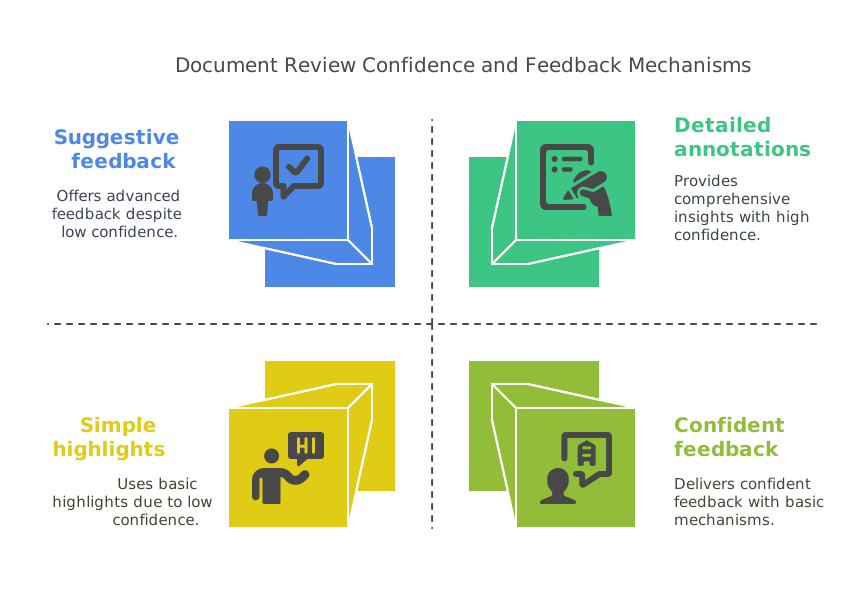
The design of escalation protocols within HITL workflows provides structure for managing cases that exceed the capabilities of initial processing approaches, whether automated or human. These protocols establish formal pathways for routing complex or ambiguous documents to increasingly specialized resources, ensuring that challenging cases receive appropriate attention without unnecessary delays or excessive resource allocation. Effective escalation frameworks extend beyond simple binary distinctions between automated and human processing to create nuanced hierarchies that match specific document characteristics with appropriate levels of expertise and authority. By implementing these structured approaches to exception handling, organizations can maintain processing efficiency while providing appropriate safeguards for complex or high-risk documents that might otherwise become bottlenecks or sources of error in the document processing workflow.
The foundation of effective escalation protocols lies in clear taxonomies of exception types that categorize the various challenges documents might present. Technical exceptions arise from issues with document quality, format, or structure that impede standard processing, such as poor image resolution, unusual layouts, or corrupted files. Content exceptions relate to the substance of documents, including ambiguous language, contradictory statements, or information that conflicts with established records. Compliance exceptions involve potential regulatory issues, such as missing required disclosures or suspicious activity indicators. Business exceptions encompass cases that meet technical requirements but may require special handling based on business context, such as high-value transactions or requests from priority customers. Through explicit definition of these exception categories, organizations can develop targeted escalation pathways that direct documents to reviewers with the specific expertise needed to address particular challenges, rather than treating all exceptions as undifferentiated problems requiring generic human attention.
Beyond categorization, effective escalation protocols incorporate tiered review structures that align review resources with case complexity and risk profiles. First-tier review typically involves generalist staff who handle common exceptions according to established guidelines, enabling rapid resolution of straightforward issues. Second-tier review engages subject matter experts with deeper domain knowledge who can address more complex cases requiring interpretation of ambiguous content or application of specialized regulations. Third-tier review involves senior decision-makers with authority to approve exceptions to standard policies or make judgments in novel situations lacking clear precedent. By implementing these tiered structures, organizations create efficient filtering mechanisms that conserve scarce expert attention while ensuring appropriate oversight for cases requiring specialized knowledge. The specific configuration of these tiers including the number of levels, expertise requirements, and decision authority varies based on industry context, document criticality, and organizational structure.
Temporal considerations play a crucial role in escalation protocol design, with timing mechanisms balancing the need for thorough review against processing efficiency requirements. Time-based auto-escalation ensures that documents do not remain in queues indefinitely, automatically elevating cases that exceed standard processing timeframes to higher review levels. Conversely, cool-down periods prevent premature escalation of complex cases, providing initial reviewers with sufficient time to research and resolve issues before engaging more senior resources. Priority frameworks assign different processing timeframes to documents based on business urgency, customer commitments, or regulatory requirements, ensuring that critical documents receive expedited handling throughout the escalation process. The calibration of these temporal mechanisms requires careful analysis of historical processing patterns, business requirements, and resource constraints to establish realistic timeframes that support both quality outcomes and operational efficiency.
The practical implementation of escalation protocols within HITL workflows requires robust supporting infrastructure that facilitates smooth transitions between processing stages while preserving contextual information. Case management systems maintain comprehensive records of document characteristics, processing history, and current status, ensuring that each reviewer has access to relevant background information without duplicating previous work. Annotation tools allow reviewers to highlight specific issues requiring attention and document their reasoning, providing important context for subsequent review levels. Knowledge bases containing precedent cases, policy interpretations, and regulatory guidance help standardize decision-making across reviewers while reducing the need for repeated escalation of similar issues. Workflow analytics track escalation patterns over time, identifying opportunities to refine automated processing, enhance reviewer training, or adjust escalation thresholds based on empirical performance data. Together, these infrastructure components transform escalation protocols from abstract workflows into operational systems that effectively manage exceptions while continuously improving overall processing capabilities.
The distinctive power of HITL workflows emerges not merely from their ability to incorporate human judgment into immediate document processing decisions, but from their capacity to systematically learn from these human interventions to improve future performance. This learning process transforms what might otherwise be isolated human corrections into a structured knowledge base that enhances the underlying automated systems. Effective feedback loops between human decisions and model improvement represent both a significant technical challenge and a crucial opportunity for organizations implementing HITL document processing. These feedback mechanisms must capture not only the corrective actions taken by human reviewers but also the contextual factors that necessitated human intervention, creating rich training signals that support meaningful model enhancement. By designing comprehensive feedback architectures that span from individual corrections to systematic model updates, organizations can establish HITL workflows that continuously evolve toward greater automation without sacrificing accuracy or compliance.
The foundation of effective feedback loops lies in granular data capture that records specific human decisions alongside relevant context. Rather than simply logging that human intervention occurred, sophisticated systems record precisely which document elements required correction, what changes were made, and which document characteristics may have contributed to the initial processing error. This detailed recording encompasses multiple dimensions: the nature of the correction (e.g., data extraction adjustment, classification change, validation override), the confidence levels assigned by the automated system, the document features present in the problematic section, and any explicit rationale provided by the human reviewer. The structure of this feedback data critically influences its utility for model improvement, with optimal implementations preserving relationships between original automated predictions, human corrections, and the document context in which discrepancies occurred. Organizations that invest in developing these comprehensive feedback structures establish the essential raw material for meaningful system learning, enabling targeted improvements rather than generalized retraining.
Beyond individual correction capture, effective learning systems implement aggregation mechanisms that identify patterns across multiple human interventions. These mechanisms analyze feedback data to distinguish between isolated anomalies and systematic processing weaknesses that warrant model adjustment. Statistical analysis identifies document types, fields, or characteristics associated with higher intervention rates, highlighting specific model limitations. Clustering techniques group similar corrections to reveal common error patterns that might indicate particular training deficiencies. Trend analysis tracks changes in intervention rates over time, helping distinguish between transient issues and persistent challenges. Through these aggregation approaches, organizations transform discrete human decisions into actionable insights about model performance, establishing priorities for improvement efforts and identifying specific processing components requiring enhancement. The sophistication of these analytical methods directly influences the efficiency of the learning process, determining how effectively human expertise translates into systematic improvement.
The integration of human feedback into model refinement spans a spectrum of approaches, from manual rule adjustments to sophisticated machine learning techniques. Rule-based systems may incorporate explicit exceptions or additional processing conditions based on patterns identified in human corrections, providing transparent improvements for well-defined error types. Traditional machine learning models can undergo supervised fine-tuning with datasets enriched by human corrections, gradually adapting their parameters to reduce similar errors in future processing. Advanced reinforcement learning approaches can incorporate human feedback as reward signals, optimizing model behavior to align with expert preferences without requiring explicit correction of every error. Hybrid approaches often prove most effective, combining rule-based adjustments for clear-cut issues with machine learning refinements for more nuanced challenges. Regardless of the specific technical approach, effective feedback integration requires careful validation processes that confirm improvements in targeted areas without introducing regressions in previously well-functioning components.
The organizational implementation of these feedback loops requires both technical infrastructure and procedural frameworks that support continuous improvement. Feedback management systems centralize correction data from multiple reviewers and documents, providing the consolidated datasets required for meaningful pattern analysis. Version control mechanisms track model changes over time, enabling performance comparison across iterations and rollback capabilities when necessary. Explicit review cycles establish regular intervals for evaluating aggregated feedback and implementing model adjustments, ensuring that learning occurs systematically rather than haphazardly. Performance monitoring frameworks compare automated processing results before and after model updates, validating that changes produce the intended improvements in production environments. Through these organizational structures, feedback loops transcend technical implementations to become integral components of operational excellence, transforming HITL workflows from static processes into dynamic systems that continuously evolve based on accumulated expertise.
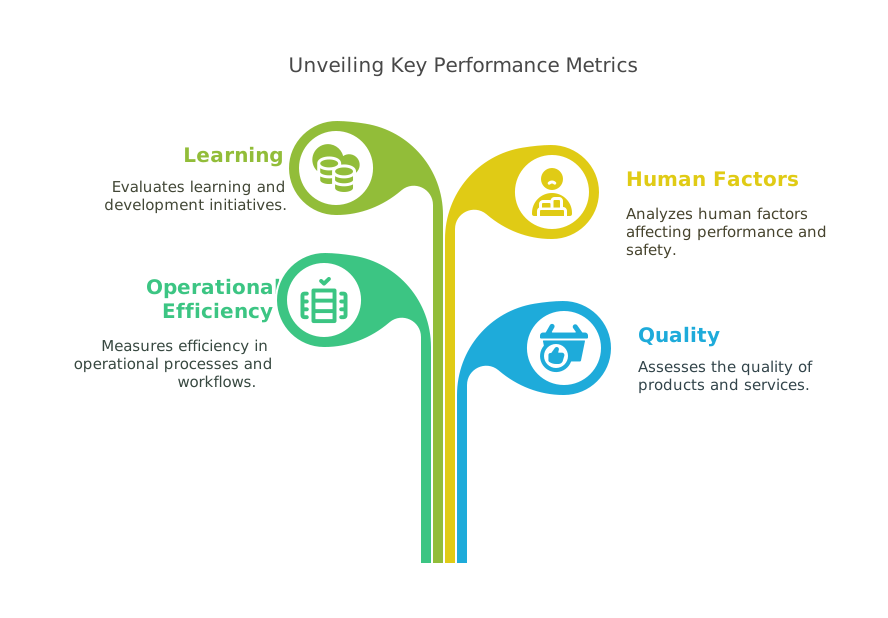
The evaluation of HITL document processing systems presents unique measurement challenges that transcend traditional automation metrics. Unlike fully automated systems that can be assessed solely on technical performance dimensions, HITL workflows require holistic evaluation frameworks that consider both automated and human components, their interactions, and their combined impact on business outcomes. Developing appropriate performance metrics for these hybrid systems necessitates careful consideration of multiple perspectives: operational efficiency that captures resource utilization and throughput, processing quality that reflects accuracy and compliance, system learning that measures improvement over time, and human factors that address reviewer experience and development. By implementing balanced measurement approaches that span these diverse dimensions, organizations can effectively monitor HITL performance, identify opportunities for enhancement, and demonstrate the business value of these sophisticated processing systems.
Operational efficiency metrics provide essential visibility into the resource dynamics and processing capabilities of HITL workflows. End-to-end processing time tracks the total duration from document receipt to completion, including both automated and human processing phases. Human intervention rate measures the percentage of documents requiring expert review, with declining rates over time potentially indicating improving automation capabilities. Queue depth and aging metrics monitor backlog accumulation and processing delays, highlighting potential capacity constraints or routing inefficiencies. Cost per document calculations incorporate both computational expenses and human time, providing a comprehensive view of resource requirements across the hybrid workflow. Time allocation analysis examines how human reviewers distribute their effort across different documents and exception types, identifying opportunities for interface improvements or training interventions. Together, these operational metrics reveal the fundamental economics of HITL processing, enabling organizations to optimize resource allocation while maintaining appropriate service levels for different document types and business contexts.
While efficiency measures capture how resources are utilized, quality metrics assess the accuracy, consistency, and compliance of processing outcomes dimensions that ultimately determine the business value of HITL workflows. Error detection rate tracks the percentage of documents where human review identifies and corrects automated processing mistakes, providing direct feedback on model performance. False escalation rate measures cases unnecessarily routed for human review despite correct automated processing, highlighting opportunities to refine routing thresholds. Inter-reviewer agreement quantifies consistency across different human experts reviewing similar documents, with low agreement potentially indicating unclear guidelines or subjective judgment areas requiring standardization. External validation checks compare processing results against independent verification sources, providing objective accuracy assessment beyond internal consistency measures. Compliance violation tracking monitors regulatory or policy infringements that escape both automated and human detection, offering critical insights for high-risk processing domains. These quality metrics complement efficiency measures to provide a comprehensive performance view, ensuring that optimization efforts enhance processing economics without compromising output integrity.
System learning metrics specifically focus on how effectively HITL workflows improve over time through the integration of human feedback. Automation expansion rate tracks the increasing percentage of document types or processing scenarios handled without human intervention, demonstrating growing system capabilities. Error reduction velocity measures how quickly specific error types diminish following feedback incorporation, indicating learning effectiveness for particular challenges. Feedback utilization rate assesses what proportion of human corrections generate systematic improvements versus remaining as isolated adjustments, highlighting potential gaps in the learning infrastructure. Model confidence calibration compares predicted confidence levels against actual error rates, with improving alignment suggesting enhanced self-assessment capabilities. Novelty detection performance evaluates how effectively the system identifies previously unseen document variations requiring human attention, reflecting adaptability to changing document ecosystems. By monitoring these learning dimensions, organizations can validate that their HITL implementations deliver the progressive improvement that distinguishes dynamic learning systems from static automation.
Human factor metrics complete the evaluation framework by addressing the experience and performance of the people participating in HITL workflows. Reviewer productivity tracks document processing rates across different reviewers and document types, identifying potential training needs or interface improvements. Cognitive load assessment measures perceived effort and concentration requirements, highlighting opportunities to simplify complex review tasks. Job satisfaction surveys evaluate how reviewers perceive their role within the hybrid workflow, with positive sentiment typically correlating with higher quality contributions. Skill development metrics track growing reviewer capabilities over time, including handling more complex exceptions or processing documents more efficiently. Expert utilization analysis examines whether specialist knowledge is appropriately leveraged for complex cases while conserving expert time for routine processing. These human-centered metrics recognize that reviewer experience directly influences processing quality and system learning, making human factors an integral component of overall HITL performance rather than a separate consideration.
The practical implementation of HITL workflows involves navigating numerous challenges that span technical infrastructure, organizational dynamics, and operational procedures. Beyond the conceptual design of these systems lies the complex reality of integrating them into existing business environments, each with unique constraints and requirements. Organizations embarking on HITL implementations must address several critical areas that influence deployment success and long-term sustainability. These include technology infrastructure considerations that provide the foundation for reliable system operation, organizational alignment efforts that ensure stakeholder support and resource availability, process integration approaches that embed HITL workflows within broader operational contexts, and change management strategies that facilitate adoption across technical and human components. By proactively addressing these implementation challenges through structured approaches and proven methodologies, organizations can significantly improve their likelihood of realizing the full potential of HITL document processing.
Technical infrastructure requirements for effective HITL systems extend well beyond the core processing algorithms to encompass the complete environment supporting hybrid workflows. Scalable computing architecture provides the foundation, with flexible resource allocation that accommodates variable document volumes and processing complexity without sacrificing responsiveness. Real-time communication mechanisms enable immediate routing of documents between automated and human processing stages, maintaining workflow continuity across hybrid paths. Robust data persistence ensures that document status, processing history, and human decisions are reliably maintained throughout the processing lifecycle, preserving context across multiple interventions when required. Integration interfaces connect HITL components with existing enterprise systems such as document management platforms, customer relationship databases, and compliance monitoring tools, enabling seamless information flow across the broader technology ecosystem. Security frameworks protect sensitive document content throughout processing, with particular attention to documents in transit between automated systems and human reviewers who may access content through various devices and locations. Organizations must carefully assess their existing infrastructure against these requirements, identifying gaps that require investment before HITL implementation and developing appropriate technology roadmaps to support both initial deployment and future scaling.
Beyond technology considerations, successful HITL implementation requires thoughtful organizational alignment that establishes appropriate governance structures and resource allocations. Executive sponsorship provides essential visibility and funding support, particularly during initial implementation phases when return on investment may not yet be fully realized. Cross-functional steering committees ensure that diverse stakeholder perspectives including operations, compliance, technology, and human resources inform system design and deployment decisions. Clear ownership delineation establishes responsibility for different system components, from model development and maintenance to reviewer management and performance monitoring. Resource allocation frameworks determine how human expertise is distributed across processing tiers, balancing efficiency requirements against quality and compliance considerations. While these organizational elements may appear less tangible than technical components, they frequently determine implementation success or failure, as misaligned incentives or unclear responsibilities can undermine even technically sophisticated systems. Organizations that invest in establishing these governance foundations before technical implementation significantly improve their likelihood of successful deployment and sustainable operation.
The integration of HITL workflows with existing business processes presents another critical implementation consideration, requiring careful attention to touchpoints and dependencies across the operational landscape. Process mapping exercises identify how documents enter and exit the HITL workflow, including origination channels, verification requirements, and downstream consumption patterns. Exception handling protocols establish how the HITL system interacts with existing escalation pathways and decision authorities, ensuring seamless management of cases requiring specialized attention. Service level alignment ensures that HITL processing timeframes support broader business commitments to customers, partners, and regulatory authorities. Transitional procedures define how documents in process during system implementation or modification will be handled, preventing disruption during deployment phases. Through comprehensive process integration planning, organizations ensure that HITL implementations enhance rather than complicate their operational environment, delivering improved document processing capabilities without creating new procedural challenges or organizational friction.
Perhaps the most consequential yet frequently underestimated aspect of HITL implementation involves the human transition required for successful adoption. Reviewer selection processes identify individuals with appropriate subject matter expertise, technological aptitude, and adaptability to work effectively within hybrid workflows. Training programs develop both technical proficiency with review interfaces and conceptual understanding of how automated and human components interact within the broader system. Performance management frameworks establish appropriate metrics and incentives that recognize the unique contributions of human reviewers within partially automated environments. Career development pathways clarify how reviewer roles evolve as automation capabilities advance, addressing potential concerns about job security while highlighting opportunities for professional growth toward more complex analytical and oversight responsibilities. Communication strategies explain the purpose and benefits of HITL implementation for all stakeholders, addressing potential resistance by emphasizing how the system enhances rather than replaces human expertise. Organizations that devote sufficient attention to these human aspects of implementation foster the engaged reviewer communities essential for HITL success, transforming potential resistance into collaborative participation in system improvement.
The implementation of HITL workflows for document processing spans diverse industries, each presenting unique document ecosystems, regulatory requirements, and risk profiles that influence system design and deployment. While the fundamental architectural principles of HITL remain consistent across sectors, their specific application varies significantly based on industry context, with particular differences in automation boundaries, escalation triggers, and human review protocols. By examining these industry-specific adaptations, organizations can identify relevant patterns and precedents for their own implementations, learning from sector peers rather than attempting to develop entirely novel approaches. These explorations also reveal how HITL workflows address particular industry challenges, from complex regulatory compliance requirements to high-volume processing demands, demonstrating the versatility of the hybrid intelligence approach across different business environments.
In financial services, HITL workflows have transformed document-intensive processes such as loan underwriting, account opening, and regulatory filings—domains where accuracy requirements are stringent but processing volumes necessitate automation. Loan document processing represents a particularly illustrative case, with lenders implementing tiered review structures that route standard applications through highly automated channels while escalating exceptions based on risk-weighted criteria. These systems typically establish multiple automation boundaries, with straightforward income verification and property valuation handled algorithmically, while complex employment situations or unusual collateral arrangements trigger human review. The regulatory consequences of processing errors in this domain have led to conservative escalation triggers, with documents containing potential fraud indicators, compliance issues, or high loan values automatically routed for human attention regardless of model confidence. For participating human experts, financial services HITL implementations emphasize decision consistency and regulatory compliance, with interfaces that highlight potential policy violations and embedded reference materials that support consistent interpretation of ambiguous guidelines. The feedback loops in these systems focus particularly on improving fraud detection and regulatory compliance capabilities, with human decisions about suspicious documents receiving especially high weighting in model refinement processes.
In healthcare settings, HITL workflows have been deployed for medical document processing including clinical notes, diagnostic reports, insurance claims, and patient consent forms contexts where misinterpretation can have serious consequences for patient care and organizational liability. Medical coding represents a particularly sophisticated application, with systems that extract billable procedures and diagnoses from clinical documentation while routing complex cases for human review. The automation boundaries in these implementations typically allow straightforward code assignment for common conditions and procedures while escalating cases involving comorbidities, unusual treatment combinations, or emerging conditions lacking established coding precedents. Escalation triggers in healthcare HITL systems often incorporate both confidence thresholds and specific medical indicators, with particular sensitivity to contradictory information that might suggest documentation errors with potential clinical implications. The human interfaces in these systems emphasize contextual understanding, providing reviewers with access to patient history, related documents, and applicable coding guidelines to support informed decisions. Feedback mechanisms in healthcare HITL implementations face unique challenges related to medical terminology evolution and regulatory updates, requiring sophisticated version control that distinguishes between model improvements and necessary adaptations to changing external standards. Despite these complexities, healthcare organizations implementing HITL workflows have reported significant improvements in coding accuracy and reduced claim rejection rates while maintaining appropriate clinical oversight for complex cases.
Legal document processing presents another domain where HITL workflows have demonstrated significant value, particularly for contract review, discovery processes, and regulatory compliance verification. Contract analysis systems employ sophisticated entity extraction and clause identification models that process standard agreement language while escalating novel provisions or ambiguous terms for attorney review. The automation boundaries in these systems have expanded steadily as models incorporate feedback from legal experts, with increasingly complex clause variations handled algorithmically while preserving human review for truly novel language or high-risk contract provisions. Escalation triggers in legal HITL implementations typically incorporate both semantic uncertainty measures and business rule filters, with automatic human routing for contractual commitments exceeding specified value thresholds or deviating from approved templates. Human interfaces for legal review emphasize comparative analysis, enabling side-by-side evaluation of similar provisions across document sets and highlighting specific language requiring attention. The feedback loops in these systems often implement sophisticated differentiation between generalizable patterns and client-specific requirements, allowing models to learn common legal constructions while preserving explicit handling for organization-specific terms and conditions. Law firms and corporate legal departments have leveraged these capabilities to dramatically increase contract review throughput while maintaining necessary quality controls, enabling more comprehensive risk assessment across larger document volumes than possible with traditional manual review.
Public sector applications of HITL workflows have addressed the massive document processing requirements of government agencies responsible for benefits administration, regulatory compliance, and citizen services. Tax processing systems represent an early but continuously evolving implementation, with algorithms handling standard returns while routing complex filings or potential compliance issues for examiner review. The automation boundaries in these systems vary based on tax type and complexity, with straightforward wage and withholding verification largely automated while business expenses, investment income, and international transactions more frequently trigger human attention. Escalation in public sector implementations often incorporates sophisticated risk scoring that combines multiple factors—including historical compliance patterns, statistical outlier detection, and specific documented risk indicators—to prioritize cases requiring human expertise. Human interfaces in these systems emphasize processing consistency and defensible decision-making, with structured documentation of review rationale that supports potential appeals or subsequent audits. Feedback mechanisms in public sector HITL workflows frequently operate under constraints related to model transparency and explainability, with particular emphasis on demonstrating that automated processing applies regulations consistently across taxpayer categories. Despite implementation challenges related to legacy systems and complex regulatory requirements, government agencies have achieved significant efficiency improvements through HITL deployment while maintaining appropriate oversight for complex or high-risk cases.
The manufacturing and supply chain sector has implemented HITL workflows for processing documents essential to global commerce, including bills of lading, customs declarations, quality certifications, and compliance attestations. Import/export documentation processing illustrates the complexity of these implementations, with systems that extract product information, verify regulatory compliance, and validate commercial terms while routing exceptions for specialist review. The automation boundaries in these systems typically enable algorithmic processing of standard shipments with established product codes and trading partners, while escalating cases involving restricted products, sanctioned entities, or unusual shipping arrangements. Escalation triggers incorporate both technical confidence measures and specific compliance flags, with automatic human routing for documentation containing potential regulatory issues regardless of model certainty. Human interfaces in these systems emphasize quick resolution of time-sensitive exceptions, providing reviewers with access to regulatory databases, historical transaction records, and communication tools for coordinating with relevant stakeholders. Feedback loops face particular challenges related to regional variations in document formats and regulatory requirements, requiring models that can distinguish between generalizable patterns and jurisdiction-specific processing rules. Organizations implementing these systems have reported significant reductions in documentation processing delays and compliance violations, enabling smoother supply chain operations while maintaining necessary regulatory controls.
The development and deployment of HITL workflows raise important ethical considerations that extend beyond technical performance and operational efficiency. These hybrid systems, which distribute decision-making authority between algorithms and human experts, create novel questions about responsibility, transparency, fairness, and workforce impact that organizations must thoughtfully address. Rather than treating these ethical dimensions as secondary concerns to be considered after technical implementation, responsible organizations integrate ethical reflection throughout the design and deployment process, recognizing that ethical choices are embedded in seemingly technical decisions about confidence thresholds, escalation criteria, and interface design. By proactively addressing these considerations, organizations can develop HITL implementations that not only deliver operational benefits but also uphold organizational values, respect human dignity, and contribute to positive societal outcomes.
Accountability and responsibility structures represent a fundamental ethical consideration in HITL workflows, requiring clear delineation of decision authority across hybrid systems. These structures must establish who bears ultimate responsibility for processing outcomes particularly in cases involving adverse decisions or processing errors and how that responsibility is distributed across system designers, model developers, human reviewers, and organizational leadership. Effective accountability frameworks distinguish between different error types, from technical malfunctions to judgment mistakes, with appropriate attribution that neither scapegoats individual reviewers for systematic problems nor absolves human decision-makers through algorithmic deflection. Practical implementation typically involves documented escalation paths for questionable cases, explicit policies regarding reviewer authority to override model recommendations, and regular audit processes that examine both automated and human decisions against established standards. Organizations that develop these clear accountability structures not only address ethical requirements but typically improve operational performance by reducing ambiguity about decision authority and review responsibilities.
Transparency and explainability considerations address how HITL workflows communicate their functioning to various stakeholders, from the human reviewers participating in the system to external parties affected by processing decisions. For internal transparency, effective implementations provide reviewers with visibility into model reasoning, helping them understand why particular documents were escalated and what specific elements require attention. This transparency enables more informed human judgments while facilitating constructive feedback that improves model performance. For external transparency, organizations must determine appropriate disclosure levels regarding automation use, human oversight mechanisms, and decision criteria—particularly for processes with significant consequences for individuals or organizations. The appropriate degree of external transparency varies based on context, with greater disclosure typically warranted for governmental functions, consumer-facing decisions, or processes with substantial rights implications. By thoughtfully addressing these transparency dimensions, organizations can foster trust with both internal participants and external stakeholders while avoiding the pitfalls of either algorithmic opacity or overwhelming information disclosure.
Fairness and bias mitigation represent increasingly prominent ethical considerations as organizations recognize that HITL workflows can either perpetuate or help address systematic disparities in document processing outcomes. Initial implementation requires careful analysis of training data to identify potential bias patterns, from obvious protected category discrimination to subtle disparities in processing quality across document types or origination channels. Ongoing monitoring examines escalation patterns and correction rates across different document categories, identifying potential areas where the system may apply inconsistent standards. Advanced implementations incorporate explicit fairness metrics alongside traditional performance measures, evaluating whether processing outcomes vary inappropriately across demographic groups or document characteristics unrelated to legitimate processing criteria. Human review processes play an essential role in bias mitigation, with diverse reviewer teams, structured evaluation guidelines, and regular calibration sessions helping to identify and address potential disparities. By integrating these fairness considerations throughout the HITL lifecycle, organizations can develop systems that apply consistent standards across document types and sources while maintaining appropriate differentiation based on relevant risk factors and processing requirements.
Workforce impact considerations acknowledge that HITL implementations fundamentally change the nature of document processing work, creating both challenges and opportunities for affected employees. Responsible deployment includes thoughtful transition planning that provides clear communication about changing role expectations, comprehensive training on new interfaces and workflows, and appropriate support for employees who may struggle with technological adaptation. Job design receives particular attention, with carefully considered decisions about task allocation between automated and human components that create meaningful work rather than relegating humans to monotonous exception handling. Career development pathways establish how employees can progress as automation capabilities expand, typically emphasizing transitions toward higher-value activities involving complex judgment, process improvement, and exception management. Organizations that thoughtfully address these workforce considerations not only fulfill ethical obligations to employees but typically achieve better operational outcomes through higher employee engagement, reduced resistance to technological change, and preservation of valuable institutional knowledge that can inform system improvement.
Privacy and data governance frameworks complete the ethical consideration set, establishing how document information flows through hybrid processing systems and what protections apply at different stages. These frameworks address questions including what document elements are extracted and stored during processing, how long original documents and processing records are retained, what access controls apply for different user categories, and how processing data may be used for system improvement versus other organizational purposes. Particular attention focuses on sensitive document categories containing personal information, confidential business data, or legally privileged content, with appropriate restrictions on extraction, storage, and utilization of this information. Implementation typically involves both technical safeguards such as encryption and access limitations and procedural controls including regular compliance audits and documentation of processing purpose. Organizations operating in regulated industries or across international jurisdictions face additional complexity, requiring privacy frameworks that accommodate varying requirements while maintaining operational consistency. By developing comprehensive privacy and data governance approaches, organizations protect both document subjects and their own legal interests while establishing the trust foundation necessary for HITL adoption.
The field of HITL document processing continues to evolve rapidly, with emerging technologies, methodological innovations, and expanding application domains creating new possibilities for hybrid intelligence systems. Understanding these developmental trajectories provides organizations with valuable insights for strategic planning, helping them anticipate how current implementations might evolve and what new capabilities might become available. While specific predictions in this dynamic landscape necessarily involve uncertainty, several clear trends have emerged that will likely shape the future of HITL workflows. These include advancements in foundational AI technologies that expand automation boundaries, methodological refinements that enhance human-machine collaboration effectiveness, and novel application domains that leverage hybrid approaches for previously intractable document processing challenges. By monitoring these developments and incorporating promising innovations into their implementation roadmaps, organizations can ensure that their HITL workflows remain at the forefront of capabilities while delivering increasing value over time.
Advancements in foundational AI technologies represent perhaps the most visible driver of HITL evolution, with several emerging approaches showing particular promise for document processing applications. Multimodal models that simultaneously process text, layout, and visual elements enable more comprehensive document understanding, reducing the need for human intervention in cases involving complex formatting or embedded graphics. Self-supervised learning techniques that leverage vast unlabeled document corpora produce more robust initial models, establishing stronger automation foundations before human feedback incorporation. Few-shot learning capabilities enable rapid adaptation to new document types with minimal examples, reducing the traditionally lengthy training periods required for processing novel formats. Foundation models pre-trained on diverse document sets provide sophisticated transfer learning capabilities, allowing organizations to fine-tune highly capable systems for specific document ecosystems rather than building domain-specific models from scratch. Neural-symbolic approaches that combine statistical pattern recognition with explicit reasoning show particular promise for complex document types requiring logical inference across different elements. While the specific timeline for these technologies' maturation remains uncertain, their combined impact will likely significantly expand automation boundaries while enabling more targeted and effective human intervention for truly complex cases.
Beyond technological advancements, methodological innovations in human-machine collaboration continue to refine how automated and human components interact within HITL workflows. Active learning frameworks increasingly incorporate uncertainty estimation techniques that more precisely identify which document elements would benefit most from human attention, optimizing intervention targeting. Collaborative interface designs shift from simple validation paradigms toward more sophisticated co-creation approaches where humans and algorithms jointly develop document interpretations through iterative refinement. Mixed-initiative interaction models dynamically adjust automation levels based on document complexity and human workload, creating more flexible processing pathways than traditional static routing. Explanation generation capabilities provide human reviewers with increasingly sophisticated insights into model reasoning, facilitating more informed intervention decisions and more targeted feedback. Collective intelligence approaches that aggregate insights across multiple reviewers enable more nuanced consensus formation for ambiguous documents, transcending the limitations of individual judgment. These methodological refinements collectively enhance the quality of human-machine collaboration, enabling more effective distribution of processing responsibilities across hybrid systems while increasing the learning value derived from each human interaction.
The application landscape for HITL workflows continues to expand beyond traditional document-centric domains to encompass new content types and processing scenarios that benefit from hybrid intelligence approaches. Multimodal content analysis extends HITL principles to materials combining textual, visual, and sometimes audio elements, including technical documentation, educational materials, and marketing collateral. Conversational content processing applies hybrid approaches to customer interactions, support transcripts, and meeting records that require both technical language processing and nuanced interpersonal understanding. Creative content workflows incorporate HITL methodologies into development processes for materials such as technical publications, training materials, and regulatory submissions, where both technical accuracy and communication effectiveness matter. Cross-lingual document processing leverages hybrid approaches to manage translation challenges that exceed purely automated capabilities, particularly for specialized terminology, culturally nuanced content, or legally significant phrasing. Each of these application expansions adapts core HITL principles to new contexts, demonstrating the versatility of the hybrid intelligence paradigm while creating novel implementation considerations specific to each domain.
Organizational and ecosystem developments further shape the future HITL landscape, with several trends influencing how these workflows are developed, deployed, and governed. Specialized service providers are emerging that offer HITL capabilities through various delivery models, from fully managed services to customizable platforms that organizations can adapt to their specific document ecosystems. Industry-specific frameworks are evolving that establish standard approaches for common document types within particular sectors, reducing implementation complexity while promoting consistency across organizations. Regulatory perspectives on automated processing continue to develop, with emerging standards addressing required human oversight levels for different document categories and processing contexts. Workforce specialization increasingly creates distinct professional roles focusing on HITL system development, reviewer management, and performance optimization, reflecting the maturing nature of this field. Interorganizational collaboration models enable shared development and utilization of HITL capabilities across supply chains, industry consortia, or regulatory ecosystems, creating economies of scale previously unavailable to individual organizations. These developments collectively indicate a maturing field moving beyond early adoption toward standardized approaches, specialized expertise, and ecosystem-level coordination that will likely accelerate both implementation quality and adoption rates across diverse industries.
The implementation of real-time Human-in-the-Loop workflows for document processing represents not merely a technical solution to operational challenges but a fundamental reimagining of how organizations approach knowledge work in the age of artificial intelligence. By transcending the false dichotomy between full automation and completely manual processing, HITL workflows create sustainable models that harness the complementary strengths of algorithms and human experts. These hybrid approaches enable organizations to process documents at scales previously unattainable while maintaining the quality standards, compliance requirements, and contextual understanding that business operations demand. Perhaps most importantly, well-designed HITL systems establish frameworks for continuous improvement that gradually expand automation capabilities through structured learning from human expertise, creating upward spirals of enhancement rather than static processing models. As artificial intelligence capabilities continue their rapid advancement, the principles of thoughtful human-machine collaboration embodied in HITL workflows will likely remain essential for organizations seeking to balance efficiency with quality in their document processing operations.
The sustainable success of HITL implementations depends on their ability to effectively address several interrelated requirements that span technical performance, business alignment, and ethical responsibility. Technical robustness provides the foundation, with reliable infrastructure, appropriate model architectures, and effective interface design creating the mechanisms through which hybrid processing occurs. Operational integration ensures that HITL workflows connect seamlessly with broader business processes, supporting rather than disrupting established workflows while delivering tangible efficiency and quality improvements. Economic viability depends on thoughtful resource allocation that directs human attention toward cases where it adds the greatest value while expanding automation boundaries through continuous learning. Ethical alignment ensures that these systems operate in ways that respect human dignity, maintain appropriate accountability, and distribute the benefits of technological advancement equitably across organizational stakeholders. Organizations that address these requirements comprehensively develop HITL implementations that deliver sustainable value while adapting gracefully to evolving business needs and technological capabilities.
For organizations embarking on HITL implementation journeys, several guiding principles can help navigate the complexities of this emerging field. Start with clear business objectives rather than technology-driven motivations, ensuring that HITL capabilities address specific document processing challenges with measurable value. Adopt incremental implementation approaches that begin with limited document types and controlled processing volumes, allowing operational learning before expanding to more complex scenarios. Invest in foundational components including robust document ingestion, appropriate model architectures, effective human interfaces, and comprehensive feedback mechanisms that will support long-term system evolution. Actively engage human experts throughout the design and deployment process, recognizing that their domain knowledge and practical experience provide essential insights for effective system design. Implement comprehensive measurement frameworks that track not only efficiency metrics but also quality outcomes, learning effectiveness, and human experience dimensions that collectively determine long-term success. Through these approaches, organizations can develop HITL capabilities that deliver immediate operational benefits while establishing platforms for continuous improvement and expansion.
The future of document processing clearly lies neither in complete automation that eliminates human judgment nor in traditional manual approaches that cannot scale to contemporary information volumes. Instead, it resides in thoughtfully designed hybrid systems that allocate processing responsibilities across human and automated components based on their respective strengths, establish effective collaboration mechanisms that enhance combined performance, and implement structured learning processes that continuously refine these allocations. By embracing this hybrid intelligence paradigm through well-designed HITL workflows, organizations can develop document processing capabilities that simultaneously deliver greater efficiency, higher quality, and more meaningful human work experiences than either automated or manual approaches in isolation. As the document ecosystem continues its expansion in volume, complexity, and business significance, these balanced approaches will likely become increasingly essential components of organizational knowledge management, enabling effective operation in information environments that would overwhelm either humans or algorithms operating independently.
Artificio specializes in developing sophisticated artificial intelligence solutions that enhance human capabilities rather than replacing them. Our approach emphasizes thoughtful integration of advanced technologies with human expertise, creating systems that deliver both efficiency and quality. With extensive experience implementing HITL workflows across diverse industries, we help organizations navigate the technical, operational, and ethical complexities of hybrid intelligence implementation. From initial concept development through full-scale deployment and ongoing optimization, Artificio partners with clients to create document processing solutions that address their specific business challenges while establishing foundations for continuous improvement. To learn more about how Artificio's HITL approaches can enhance your document processing capabilities, visit our website or contact our solutions team for a consultation.

Head IT Operations - Co Founder of Artificio
See it in your SAP environment
Bring us a document, a process, or a bottleneck. We'll show how Artificio captures, validates, and posts into SAP — then scale from there.
Security & compliance
ISO 27001:2013 certified, SOC 2 Type 2 compliant, GDPR and HIPAA ready. Every agent action is logged, auditable, and runs in isolated environments.