

Blog
Multi-Tenant Document Workflow: AI Agents for Collaboration
Automate complex multi-departmental workflows & boost productivity with AI-powered document processing.

Blog
Automate complex multi-departmental workflows & boost productivity with AI-powered document processing.
Picture this: You're the operations manager at a mid-size tech company, and a simple vendor contract just landed on your desk. Seems straightforward, right? Wrong. Over the next three weeks, you'll watch this single document ping-pong between Legal (who needs to review terms), Finance (who wants to analyze costs), IT (who must assess security requirements), and Procurement (who handles vendor relationships). Each department will ask for changes. Some will conflict with others. People will go on vacation. Emails will get buried. And what should have taken five days will stretch into a month-long odyssey that frustrates everyone involved.
Sound familiar? You're not alone. This scenario plays out thousands of times daily across enterprises worldwide, and it's costing businesses far more than they realize. The problem isn't that individual departments are inefficient. Most teams have actually gotten pretty good at handling their internal processes. The real issue is what happens in the spaces between departments, where documents get lost in translation and workflows break down.
This is the multi-tenant workflow challenge, and it's one of the biggest productivity killers in modern business. Unlike basic document processing or simple workflow automation, intelligent document processing with multi-tenant orchestration means coordinating complex processes across multiple departments, systems, and people who often have competing priorities and incompatible tools. It's like trying to conduct a symphony where half the musicians are reading different sheet music.
But here's the good news: AI agents for document processing and workflows are changing the game. Instead of relying on humans to manually track dozens of parallel processes, AI-powered document processing agents can orchestrate these complex workflows with the precision of a digital conductor. They understand departmental relationships, spot bottlenecks before they happen, and automatically route documents along the most efficient paths while keeping everything compliant and auditable through automated document processing workflows.
The companies that master intelligent document processing don't just get more efficient. They gain a competitive edge that compounds over time, executing complex automated document processing tasks faster and more reliably than their competitors. Let's dive into why this matters and how to make it work.
Walk into any enterprise today, and you'll see something interesting: individual departments that run like well-oiled machines, but an organization that somehow moves at the speed of molasses. This isn't anyone's fault. It's the natural result of how businesses grow and organize themselves.
Here's what happens. Companies start small, with everyone wearing multiple hats and working closely together. Communication is easy because everyone sits in the same room. But as organizations grow, they naturally specialize. HR focuses on people stuff. IT handles technology. Legal deals with contracts and compliance. Finance manages money. Each department develops its own expertise, tools, and ways of working.
This specialization is necessary and valuable. You want your legal team to be experts in contract law, not generalists trying to juggle legal work with IT tickets and payroll processing. But there's a downside: these departments can become islands, each optimized for their own work but not necessarily for collaboration with others.
The problem becomes obvious when you look at how work actually flows through an organization. Business processes don't respect departmental boundaries. Take something as basic as hiring a new employee. HR starts the process with job postings and interviews. But then IT needs to set up accounts and equipment. Facilities has to arrange a workspace. Legal might need to review employment agreements. Finance sets up payroll. The employee's manager needs to plan onboarding and training.
Each department has different timelines, priorities, and systems. HR might use Workday for their processes, IT uses ServiceNow for ticketing, Facilities manages requests through a completely different system, and Legal tracks everything in SharePoint. Getting all these departments to work together smoothly requires constant coordination, and that's where things start to break down.
The coordination burden falls heavily on individuals who become unofficial project managers for cross-departmental processes. They spend their days sending status emails, chasing approvals, attending alignment meetings, and manually moving information between systems that don't talk to each other. It's exhausting and inefficient, but someone has to do it. 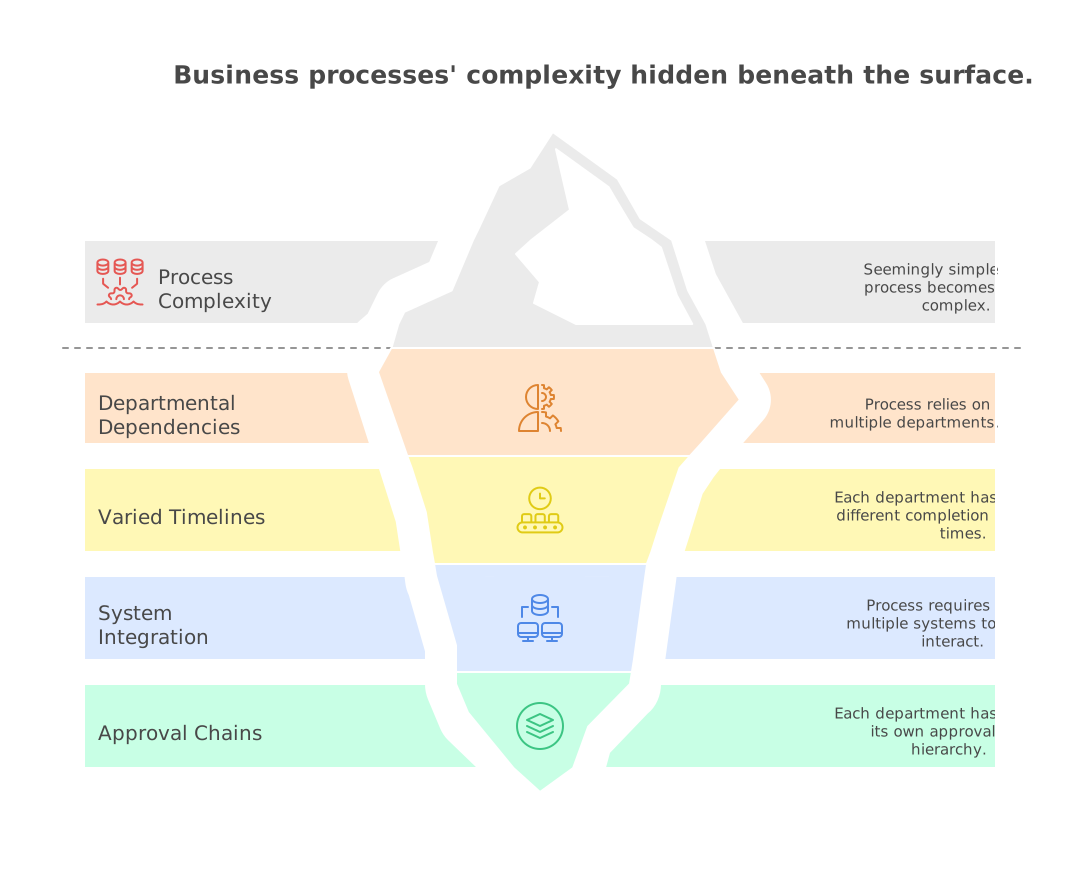
Version control becomes a nightmare in this environment. Imagine Legal is reviewing contract terms while Finance simultaneously analyzes pricing and Operations assesses delivery requirements. Without proper orchestration, these parallel activities can create conflicting changes, outdated information, and the need to restart processes when people realize they've been working with different versions of the same document.
Compliance adds another layer of complexity. Different departments operate under different regulatory frameworks, and documents often need to meet multiple standards simultaneously. A healthcare company's clinical trial documentation, for example, must satisfy FDA requirements for data integrity, legal requirements for patient consent, HR requirements for investigator credentials, and finance requirements for cost tracking. Each department applies their own compliance lens to the same documents, and missing any requirement can invalidate the entire process.
The technology landscape makes everything worse. The average large organization uses over 1,200 different applications, most of which weren't designed to work together. Documents frequently require manual handoffs between systems, creating opportunities for errors, delays, and lost information. What should be seamless digital workflows often involve printing documents, walking them to another department, and re-entering information into different systems.
This creates what efficiency experts call the "coordination paradox." The more sophisticated individual departments become, the harder it gets to coordinate their activities. Organizations find themselves trapped: they need specialization to compete, but specialization creates coordination challenges that slow everything down.
Most executives know their organizations have coordination problems, but they dramatically underestimate the true cost. The obvious expenses are easy to see: software licenses, employee salaries, meeting time. But the hidden costs of fragmented workflows often dwarf these visible expenses.
Research shows that knowledge workers spend only about 40% of their time on work that actually requires their expertise and training. The other 60% gets consumed by "work about work," the administrative overhead of coordinating activities, searching for information, and managing process complexity. For a company with 500 knowledge workers earning $80,000 annually, this represents $24 million in productivity costs directly tied to coordination overhead.
But that's just the beginning. The real damage comes from the cascading effects of delays and errors. When a contract approval that should take a week stretches to a month because of coordination failures, the cost isn't just the additional administrative time. There's the opportunity cost of delayed revenue, the risk of losing deals to faster competitors, the cost of sales people explaining delays to frustrated customers, and potential legal exposure from missed deadlines.
A technology services company tracked their vendor onboarding process and found some eye-opening numbers. The direct labor costs were about $2,800 per vendor, involving time from procurement, legal, finance, IT, and compliance teams. But when they included hidden costs like project delays while waiting for approvals, duplicated effort from poor information sharing, and expensive compliance remediation, the true cost was closer to $9,200 per vendor. The extra $6,400 came from inefficiencies that were invisible in their standard cost accounting.
Error amplification is another hidden cost multiplier. In well-orchestrated processes, mistakes get caught and fixed early with minimal impact. But in fragmented workflows, errors often aren't discovered until much later, after multiple departments have built work on incorrect information. IBM research shows that fixing errors costs exponentially more based on when they're discovered. An error caught during initial document creation might cost $150 to fix, but the same error found after multiple departments have processed the document could cost $15,000 or more to remediate.
Customer impact represents perhaps the most damaging consequence. Modern customers expect fast, seamless experiences, but fragmented internal processes create customer-facing delays and inconsistencies that directly hurt satisfaction and retention. A telecommunications company discovered that onboarding process failures, caused mainly by poor coordination between sales, technical operations, and customer service, drove 28% of customer churn in the first 90 days. With average customer lifetime value of $4,800, this translated to over $18 million in annual revenue loss tied directly to internal coordination problems.
The innovation opportunity cost might be the most strategic impact. When organizations burn resources managing process coordination, they have fewer resources for innovation and growth. A pharmaceutical company found that their research teams spent 35% of their time on administrative coordination rather than actual research. In an industry where time-to-market can mean hundreds of millions in revenue, this coordination tax was literally costing them breakthrough opportunities.
Compliance violations represent the highest-stakes cost category. Healthcare organizations face average HIPAA violation penalties of $2.2 million per incident. Financial services companies can get hit with regulatory fines in the tens of millions. When workflows are fragmented across departments without proper oversight, compliance failure risk increases dramatically because no single team has visibility into the complete compliance picture.
These costs compound over time. Organizations with fragmented workflows don't just move slower, they get slower. As processes accumulate more steps, exceptions, and workarounds, the coordination burden grows. What starts as a minor inefficiency becomes a major competitive disadvantage as nimbler competitors pull ahead.
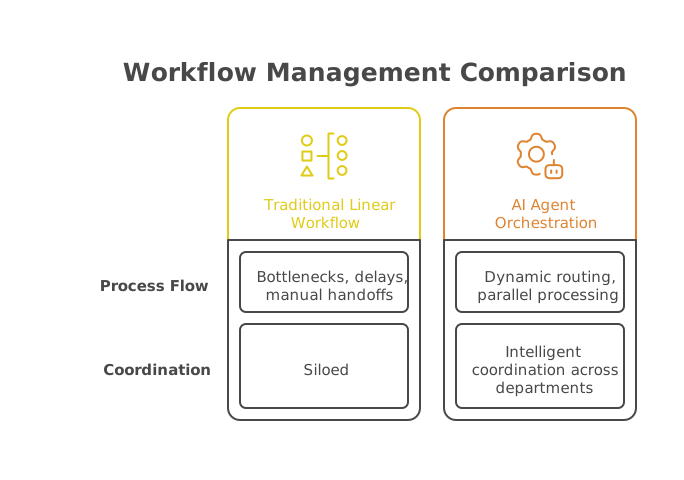
Traditional workflow automation tackles individual processes within departments. AI document processing with intelligent orchestration solves the much harder problem of coordinating processes across departments, systems, and stakeholder groups. Think of it as the difference between teaching individual musicians to play their parts perfectly versus conducting an entire orchestra to create beautiful music together.
AI agents designed for intelligent document processing and multi-tenant orchestration operate on several levels simultaneously. At the document level, they track versions, changes, and approval states across all stakeholders through automated data extraction and analysis. At the process level, they understand dependencies, bottlenecks, and critical paths. At the organizational level, they know departmental priorities, resource constraints, and communication preferences. This multi-layered intelligence lets them make smart routing decisions that human coordinators would struggle to manage manually.
The key innovation is contextual awareness. Traditional workflow tools follow rigid rules: "If document type A, route to department B, wait for approval, then send to department C." AI agents understand context: "Legal is backed up this week because of the acquisition, but Sarah in Legal can handle routine contracts quickly. Finance is waiting for budget approval on similar contracts, so let's route this one to the alternative approver who can make decisions independently. Operations prefers email notifications in the morning but Slack messages for urgent items."
This contextual intelligence transforms how cross-departmental document workflow automation operates. Instead of documents sitting in queues waiting for the "right" person who happens to be on vacation, AI-powered document processing agents dynamically route work to available qualified alternatives. Instead of processes stalling because one department missed a notification, intelligent automation proactively escalates and suggests alternatives. Instead of stakeholders working with outdated information, automated document processing ensures everyone has the latest versions and understands what changed.
Real-time adaptation is another crucial capability. When priorities shift, deadlines move, or unexpected issues arise, AI agents can instantly recalculate optimal routing and notify affected stakeholders. A contract that was following the standard 10-day approval process can be automatically expedited when the sales team flags it as critical for quarter-end, with the agent coordinating accelerated reviews across all departments while maintaining compliance requirements.
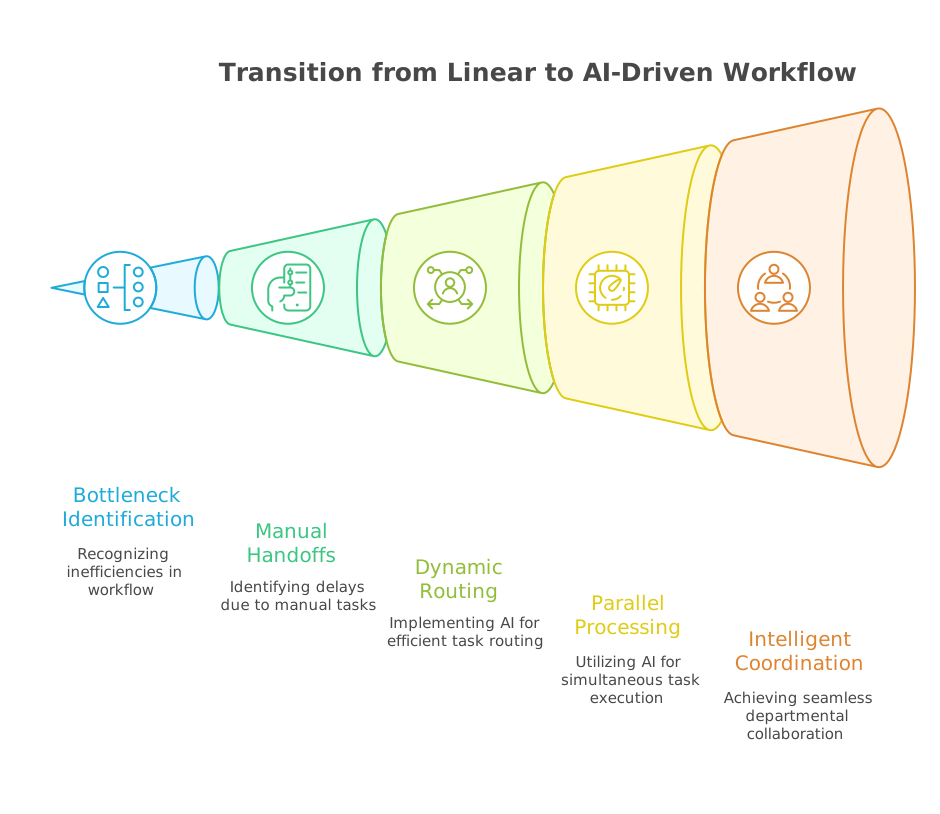
The intelligence extends to learning from patterns and outcomes. AI agents track which routing decisions work best for different types of documents, which approvers make faster decisions, which departments tend to create bottlenecks, and which process variations lead to better outcomes. This learning feeds back into future orchestration decisions, creating workflows that get smarter and more efficient over time.
Communication orchestration represents another major advancement. Instead of flooding people with status emails and meeting requests, AI agents provide personalized, contextual updates. Legal gets concise summaries of contract changes that require their attention. Finance receives cost impact analyses when budget implications change. Operations gets timeline updates that affect project delivery. Each stakeholder gets exactly the information they need, when they need it, in their preferred format.
Integration capabilities allow AI agents to work across the entire technology stack without requiring expensive system replacements. Agents can pull information from HR systems, push updates to project management tools, trigger notifications in collaboration platforms, and maintain audit trails in compliance systems. This universal integration means organizations can improve coordination without ripping out existing investments.
The predictive capabilities of AI orchestration create entirely new possibilities for process optimization. Agents can forecast when bottlenecks are likely to occur based on current workloads and historical patterns, automatically suggesting process adjustments to prevent delays. They can identify when document requirements are likely to conflict across departments and proactively facilitate resolution discussions. They can even predict which processes are at risk for compliance failures and recommend corrective actions.
To understand how AI agent orchestration works in practice, let's examine some common cross-departmental scenarios that plague most organizations and see how intelligent coordination transforms these processes.
Traditional contract approvals are coordination nightmares. A typical B2B services contract might require input from Sales (who negotiated the terms), Legal (who reviews compliance and risk), Finance (who analyzes pricing and payment terms), Operations (who assesses delivery capability), and Security (who evaluates data protection requirements). Each department has different priorities, timelines, and approval criteria.
In a fragmented workflow, the sales rep emails the contract to Legal, who reviews it over three days and sends back redlines. Sales incorporates changes and forwards to Finance, who finds pricing issues and sends it back to Sales. Meanwhile, Operations never sees the contract until after it's signed and discovers they can't meet the delivery requirements, forcing expensive renegotiation.
AI-powered document processing with intelligent orchestration transforms this process completely. When Sales uploads the contract, the AI document processing system immediately analyzes the document content through automated data extraction and identifies all required reviewers based on contract type, value, terms, and risk factors. Instead of sequential reviews, the agent coordinates parallel reviews where possible, sending relevant sections to appropriate departments simultaneously.
The intelligent document processing system provides each reviewer with contextual information: Legal sees similar contract precedents and regulatory considerations specific to this client's industry. Finance gets cost analysis and budget impact projections. Operations receives delivery requirement summaries and resource availability data. Security gets data flow diagrams and compliance requirement checklists.
As reviews progress, the AI document processing agent tracks changes and identifies conflicts before they become problems. When Legal's liability limitations conflict with Finance's payment terms, the automated document processing system flags this immediately and facilitates a resolution discussion with relevant context about similar conflicts and their resolutions. When Operations identifies capacity constraints, the agent automatically calculates alternative delivery options and their cost implications for Finance review.
The agent also manages the coordination overhead. Instead of dozens of status emails, stakeholders get personalized dashboards showing exactly what requires their attention. Automated reminders adapt to individual preferences and workload patterns. When delays threaten deal closure, the agent escalates appropriately and suggests expedited review processes.
Employee onboarding involves more departments than most people realize. HR drives the overall process, but IT must provision accounts and equipment, Facilities arranges workspace and access, Legal processes employment agreements and compliance documentation, Finance sets up payroll and benefits, and the hiring manager coordinates role-specific training and integration.
Traditional onboarding often fails because these activities happen in isolation. IT might provision basic accounts but miss specialized software requirements. Facilities might assign a desk but forget parking access. Legal might process standard agreements but overlook role-specific compliance requirements. The result is new employees who can't fully function for weeks while coordination issues get resolved.
Intelligent document processing with AI workflow orchestration creates a truly integrated onboarding experience. When HR initiates the process, the AI document processing system analyzes the role requirements, department needs, and individual circumstances to create a personalized coordination plan through automated data extraction from job descriptions, departmental requirements, and compliance frameworks. Instead of generic checklists, each department gets specific, contextualized tasks with clear dependencies and timelines.
The agent coordinates equipment procurement with workspace assignment, ensuring laptops arrive when office space is ready. It synchronizes account provisioning with training schedules, so specialized software access is available exactly when onboarding requires it. It aligns legal documentation with finance setup, ensuring compliance requirements don't delay payroll processing.
Real-time coordination handles the inevitable changes and exceptions. When the new employee's start date shifts, the agent automatically adjusts all dependent activities across departments and notifies affected stakeholders with context about what changed and why. When security clearance takes longer than expected, the agent identifies alternative activities that can proceed and reschedules dependent tasks.
Enterprise software implementations involve coordinated activities across Sales (who manages customer relationships), Technical Services (who handles configuration and deployment), Customer Success (who drives adoption and satisfaction), Support (who resolves issues), and often Legal and Finance for contract amendments and billing changes.
These implementations frequently fail because departments work from different assumptions about scope, timeline, and success criteria. Sales might have promised features that Technical Services can't deliver on the agreed timeline. Customer Success might be planning adoption activities that require technical capabilities not yet configured. Support might be unprepared for issues specific to the customer's unique environment.
AI-powered document processing with intelligent orchestration aligns all stakeholders around a single, dynamic view of the implementation. The automated document processing system maintains a comprehensive understanding of customer requirements, technical constraints, resource availability, and success metrics through continuous document extraction and analysis. As the implementation progresses, it coordinates activities to maximize success probability while minimizing coordination overhead.
When technical discoveries change the implementation approach, the agent immediately assesses impact on customer expectations, timeline, and resource requirements. It facilitates cross-departmental discussions with full context about trade-offs and alternatives. When customer priorities shift, the agent recalculates optimal resource allocation and coordinates changes across all affected teams. 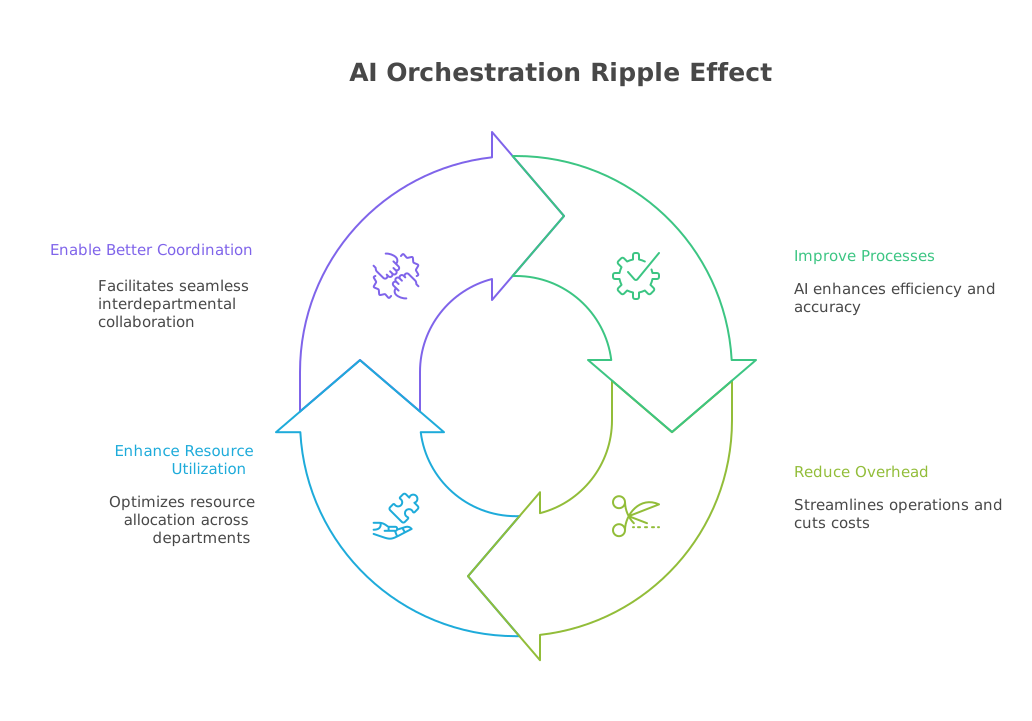
Implementing multi-tenant document workflow orchestration isn't just a technology deployment. It requires a systematic approach that addresses process design, organizational alignment, and change management alongside the technical implementation. Organizations that approach this strategically achieve much better results than those that treat it as purely a technology project.
The foundation of successful orchestration is understanding your current workflows in detail. This goes beyond documenting the official process steps to understanding how work actually flows through your organization, including the informal coordination mechanisms that people have developed to work around system limitations.
Start by identifying your highest-impact cross-departmental processes. These are typically processes that involve multiple departments, handle high-value or high-risk items, occur frequently enough to matter, and currently experience significant coordination challenges. Common candidates include contract approvals, employee onboarding, vendor management, customer implementations, compliance audits, and budget approvals.
For each target process, map the complete stakeholder ecosystem. This includes primary stakeholders who make decisions or perform work, secondary stakeholders who provide input or oversight, and tertiary stakeholders who are affected by outcomes. Understanding stakeholder relationships, dependencies, and communication patterns is crucial for designing effective orchestration.
Document the current coordination mechanisms in detail. How do stakeholders currently communicate about process status? What information do they need to do their work effectively? What triggers escalations or expedited handling? What are the common failure modes and their root causes? This analysis reveals orchestration requirements that aren't obvious from formal process documentation.
Quantify the coordination burden for each stakeholder group. How much time do people spend on coordination activities versus value-added work? What are the common sources of delays and rework? What information gaps cause the most problems? This analysis helps prioritize orchestration features and build the business case for investment.
Effective orchestration design balances automation with human judgment. The goal isn't to eliminate human decision-making but to eliminate coordination overhead while enhancing human capability with better information and smarter routing.
Design orchestration rules that reflect how your organization actually works, not how the org chart suggests it should work. If certain approvers consistently make decisions faster, build that into routing logic. If some departments prefer different communication channels for different types of requests, accommodate those preferences. If certain document types consistently require expedited handling during specific business cycles, build that contextual awareness into the system.
Create escalation paths that adapt to context and circumstances. Simple time-based escalations often create more problems than they solve by escalating routine delays the same way as critical issues. Design escalation logic that considers business context, stakeholder availability, and impact of delays on downstream processes.
Plan for exception handling from the beginning. Every process has exceptions, and orchestration systems must handle them gracefully. Design mechanisms for stakeholders to provide context about unusual circumstances, request alternative routing, or escalate issues that don't fit standard patterns.
Build in learning and optimization capabilities. The orchestration system should track outcomes and continuously improve routing decisions based on what works best in your specific environment. Plan for regular analysis of orchestration performance and systematic process improvements based on data insights.
Most organizations already have significant investments in workflow and collaboration tools. Effective orchestration builds on these investments rather than replacing them. Design integration architecture that leverages existing systems while adding the coordination intelligence they lack.
Start with pilot implementations on carefully selected processes. Choose processes that are important enough to matter but not so critical that failures would be catastrophic. Ideal pilot processes have willing stakeholders, clear success metrics, and relatively straightforward coordination requirements.
Implement comprehensive monitoring and analytics from day one. Track not just process completion times but coordination overhead, stakeholder satisfaction, error rates, and exception handling effectiveness. This data is essential for demonstrating value and guiding continuous improvement.
Plan rollout in phases that build confidence and capability progressively. Start with basic coordination features like intelligent routing and automated notifications. Add more sophisticated capabilities like predictive bottleneck identification and dynamic process optimization as stakeholders become comfortable with the system and trust builds.
Technology deployments fail when they don't account for human factors and organizational dynamics. Successful orchestration requires stakeholders to change how they work, communicate, and coordinate with other departments. This change must be carefully managed and supported.
Invest heavily in stakeholder education about not just how to use the new tools but why orchestration matters and how it benefits them personally. People need to understand that orchestration isn't about controlling their work but about eliminating the coordination overhead that prevents them from focusing on value-added activities.
Create feedback mechanisms that let stakeholders influence orchestration design and continuous improvement. The people doing the work often have the best insights into what would make coordination more effective. Make it easy for them to suggest improvements and implement valuable suggestions quickly.
Establish clear governance for orchestration policies and exceptions. While AI agents can handle routine coordination decisions, stakeholders need to know how to escalate unusual situations and request changes to orchestration rules. Clear governance prevents orchestration from becoming a bureaucratic obstacle.
Measure and communicate orchestration benefits in terms that matter to each stakeholder group. Legal teams care about compliance risk reduction and faster turnaround times. Finance teams want to see cost savings and better resource utilization. Operations teams value predictability and reduced firefighting. Tailor communication to highlight benefits that resonate with each audience.
As organizations grow and evolve, their coordination challenges become more complex. Effective orchestration solutions must scale not just with volume but with organizational complexity, regulatory requirements, and business model changes. Future-proofing your orchestration capability requires thinking beyond current needs to anticipate how coordination requirements will evolve.
Global organizations face coordination challenges that go far beyond time zones and language differences. Different regions have different regulatory requirements, business practices, cultural norms, and operational constraints. Orchestration systems must understand and accommodate these differences while maintaining global consistency where required.
AI agents can learn to adapt communication styles and timing to cultural preferences. They can understand that certain types of decisions require face-to-face discussion in some cultures while others prefer written documentation. They can adjust routing logic to account for regional holidays, business practices, and regulatory requirements.
The key is building cultural intelligence into orchestration logic while maintaining the ability to coordinate across regions when business processes require global alignment. A contract that requires both US legal review and European data privacy assessment needs orchestration that understands both regulatory frameworks and coordinates compliance across jurisdictions.
Organizations constantly evolve through growth, restructuring, acquisitions, and strategic pivots. Orchestration systems must adapt to these changes without requiring complete reimplementation. This requires architecture that separates orchestration logic from organizational structure, allowing routing rules and coordination patterns to evolve as the organization changes.
When organizations acquire new companies, orchestration systems must quickly integrate new stakeholders, processes, and systems into existing coordination patterns. When organizations restructure, orchestration logic must adapt to new departmental boundaries and approval hierarchies. When organizations expand into new business lines, orchestration systems must accommodate new process types and coordination requirements.
Building this adaptability requires orchestration platforms that can learn from organizational changes and suggest process updates rather than requiring manual reconfiguration of every affected workflow.
Regulatory environments continue to evolve, with new privacy laws, industry regulations, and compliance requirements emerging regularly. Orchestration systems must be able to incorporate new compliance requirements into existing processes without disrupting operations.
This requires orchestration platforms that understand regulatory concepts and can automatically adapt processes when new requirements emerge. When GDPR introduced new data privacy requirements, orchestration systems needed to automatically add privacy impact assessments to processes involving personal data. When new financial regulations emerge, orchestration systems must incorporate new approval requirements and audit trails into relevant processes.
The most sophisticated orchestration systems can predict regulatory impact based on process characteristics and proactively suggest compliance enhancements before violations occur.
The technology landscape continues to evolve rapidly, with new collaboration tools, AI capabilities, and integration platforms emerging constantly. Orchestration systems must be able to incorporate new technologies as they become available while maintaining backward compatibility with existing investments.
This includes integration with emerging AI capabilities like advanced natural language processing for document analysis, predictive analytics for bottleneck prevention, and intelligent assistants for personalized stakeholder support. It also includes integration with new collaboration platforms, mobile applications, and IoT devices that can provide additional context for orchestration decisions.
The most future-proof orchestration platforms are built on open architectures that can easily incorporate new technologies and data sources as they become available.
Multi-tenant document workflow automation with intelligent document processing represents a fundamental shift from managing individual processes to optimizing organizational coordination. Companies that master AI-powered document processing don't just become more efficient, they become more agile, responsive, and competitive. They can execute complex initiatives faster, adapt to market changes more quickly, and deliver better customer experiences because their automated document processing capabilities support rather than hinder their strategic objectives.
The competitive advantage of superior document workflow automation compounds over time. Organizations with excellent AI document processing and coordination capabilities can take on more complex projects, serve more demanding customers, and pursue opportunities that would be impossible with fragmented workflows. They attract better talent because people prefer working in environments where intelligent automation handles coordination overhead, allowing them to focus on meaningful work.
The technology to enable sophisticated intelligent document processing is available today, but implementing it successfully requires more than just deploying new software. It requires a holistic approach that addresses process design, organizational alignment, and change management alongside technical implementation. Organizations that approach AI-powered document processing strategically, with clear vision and systematic execution, will build automated document processing capabilities that provide lasting competitive advantage in an increasingly complex business environment.
The question isn't whether your organization will eventually need sophisticated document workflow automation with intelligent document processing. The question is whether you'll build this AI document processing capability proactively to drive competitive advantage, or reactively to keep up with competitors who moved first. In a world where coordination complexity continues to increase, intelligent document processing isn't just an operational improvement, it's a strategic imperative.

Head IT Operations - Co Founder of Artificio
See it in your SAP environment
Bring us a document, a process, or a bottleneck. We'll show how Artificio captures, validates, and posts into SAP — then scale from there.
Security & compliance
ISO 27001:2013 certified, SOC 2 Type 2 compliant, GDPR and HIPAA ready. Every agent action is logged, auditable, and runs in isolated environments.