

Blog
Why Single-Model Document AI Hits a Ceiling, and How Multi-Model Architecture Breaks Through
Artificio's Multi-Model AI Extraction Core boosts document processing accuracy by orchestrating specialized AI tools, reducing errors by 59%.

Blog
Artificio's Multi-Model AI Extraction Core boosts document processing accuracy by orchestrating specialized AI tools, reducing errors by 59%.
Most enterprise teams have been down this road before. You invest in document processing software, run some tests, and watch it perform reasonably well on clean, straightforward files. Then reality kicks in. Scanned invoices with coffee stains. Handwritten notes in the margins. Tables that span multiple pages. Suddenly that 90% accuracy rate drops to something that creates more work than it saves.
This isn't a vendor problem. It's an architectural one. And it's exactly why Artificio built something different.
Traditional document processing tools rely on a single approach. OCR engines read text character by character. Standalone AI models try to make sense of what they see. Pattern-matching algorithms hunt for keywords and formats they've been programmed to recognize.
Each method works well for specific scenarios. OCR handles typed text on clean pages. Language models understand context and meaning. Pattern matching catches predictable formats reliably.
The trouble is that real business documents don't fit neatly into one category. A single invoice might include typed text, a stamped approval, a handwritten date correction, and a table with merged cells. Asking any single model to handle all of that is like asking a specialist surgeon to also manage anesthesia, nursing care, and post-op recovery. Technically possible, but you're not going to get the best results.
Artificio's Multi-Model AI Extraction Core takes a fundamentally different approach. Instead of forcing one tool to do everything, it orchestrates multiple specialized models that each handle what they do best. Think of it as a document processing team rather than a document processing tool. 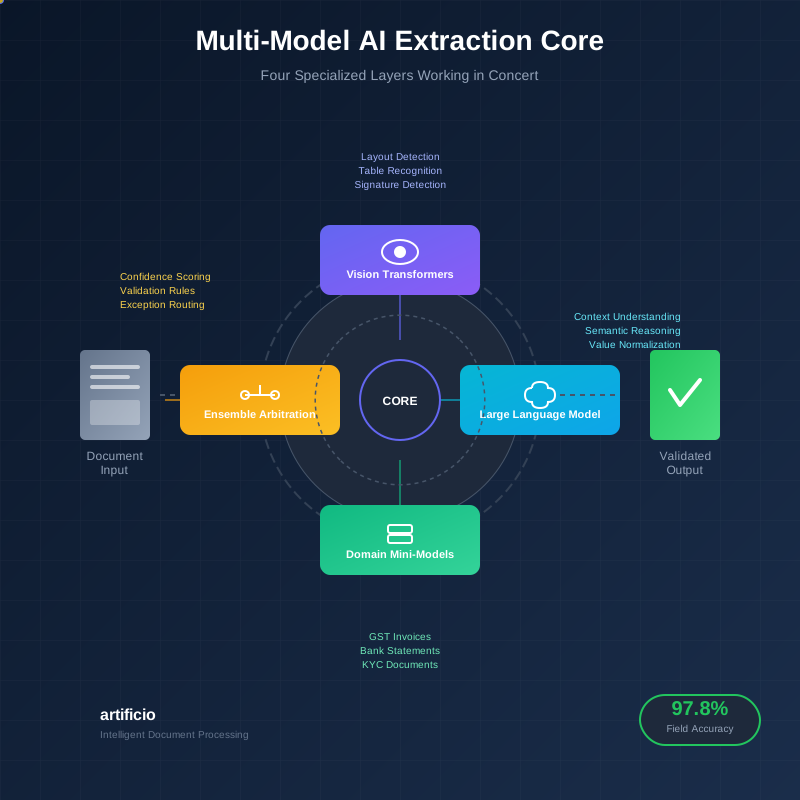
The first layer uses Vision Transformer technology to understand document structure spatially. This isn't about reading words. It's about seeing the page the way a human does, recognizing that this block is a table, that smudge is a signature, and those numbers in the corner are page counts rather than invoice totals. Traditional OCR reads left to right, top to bottom. Vision Transformers understand that a three-column layout means the middle column isn't just a continuation of the left one.
Once the system knows where things are, the LLM layer figures out what they mean. This is where contextual intelligence comes in. When the system sees "PAN" on an Indian financial document, it knows that refers to Permanent Account Number. When it encounters an ambiguous date like "01/02/23," it can look at surrounding context to determine whether that's January 2nd or February 1st.
More importantly, the LLM can handle the messy reality of business documents. Abbreviations, industry jargon, inconsistent formatting, and even typos don't derail extraction when there's genuine language understanding behind it.
Here's where things get interesting. Artificio has trained compact, focused models for specific document categories like GST invoices, bank statements, KYC documents, and insurance policies. These aren't general-purpose models trying to understand everything. They're specialists that know exactly what a valid GSTIN looks like, what fields should appear on a particular form type, and what patterns indicate potential errors.
A mini-model trained on thousands of bank statements doesn't need to figure out what "closing balance" means from first principles. It already knows, and it knows where to find it even when different banks format their statements differently.
Multiple models mean multiple opinions. The Ensemble Confidence Arbitration Layer serves as the decision-maker, weighing outputs from each model and applying validation rules to produce final results. This isn't simple majority voting. The system uses weighted algorithms based on each model's confidence level, cross-references results against business rules like GSTIN checksums and IFSC patterns, and flags anything that doesn't pass muster for human review.
When the Vision Transformer says a field contains "12,500" and the LLM says context suggests it should be "125,000," the arbitration layer examines both interpretations against document type expectations and validation rules before making a call. If confidence stays low, it routes to exception handling rather than guessing.
Numbers tell part of the story. Field-level accuracy jumped from 92.3% to 97.8% in internal benchmarks. That might sound like incremental improvement until you realize it represents a 59% reduction in extraction errors. On a thousand documents, that's the difference between 77 errors requiring manual correction and 22.
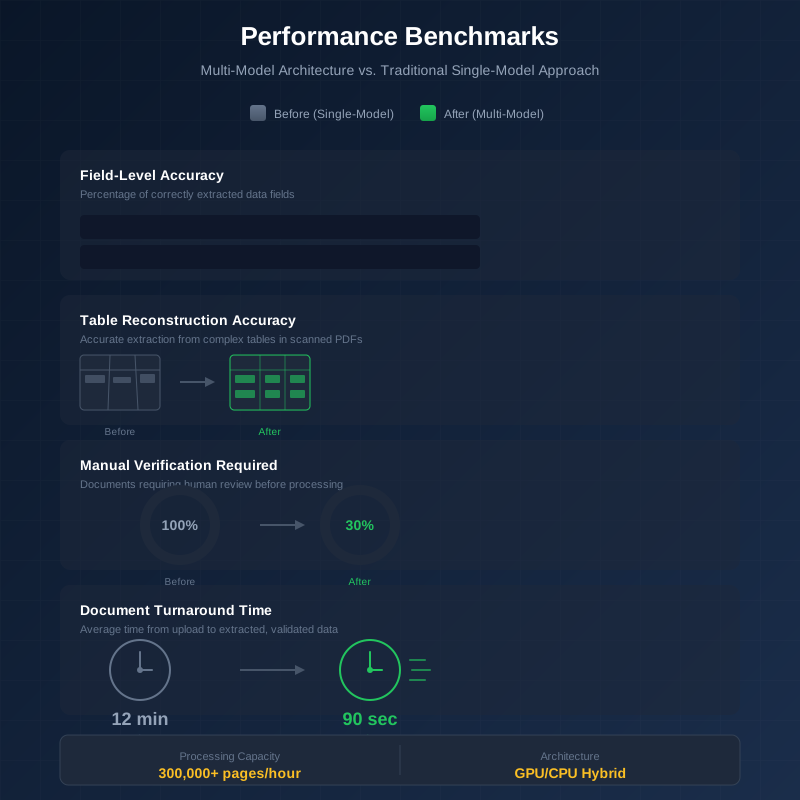
Table reconstruction on scanned PDFs improved by 41%. If you've ever watched an OCR tool turn a neat expense table into a jumbled mess of misaligned columns, you know why this matters.
Manual verification requirements dropped by 70%. Document turnaround fell from 12 minutes to 90 seconds. At scale, that's the difference between document processing being a cost center that slows everything down and document processing being infrastructure that enables speed.
Generic OCR tools treat every document the same way. They read text, apply pattern matching, and hope for the best. That works fine when documents are consistent and clean. It falls apart when they're not.
"Generic OCR treats every document the same way, but real business documents demand contextual understanding," says Lal Singh, Artificio's Founder and CEO. "Our Multi-Model Core combines computer vision, language understanding, and deep domain expertise to deliver accuracy that exceeds what manual operators achieve."
That last point deserves emphasis. The benchmark isn't just "better than other software." It's "better than humans doing the same task manually." That's the threshold where automation stops being a tradeoff between speed and accuracy and starts being simply better.
Accuracy matters, but it's not the whole picture for enterprise deployment. Regulated industries need audit trails documenting every extraction decision. Confidence scores need to accompany each value so organizations can route high-certainty extractions to straight-through processing while flagging uncertain ones for review.
The Multi-Model Extraction Core includes all of this. Every extraction decision is logged with the models involved. Confidence thresholds are configurable. Exception handling protocols ensure nothing slips through the cracks. GDPR, HIPAA, and industry-specific compliance requirements are baked into the architecture rather than bolted on afterward.
Document extraction rarely exists in isolation. Extracted data needs to flow somewhere, trigger something, connect to existing systems. The Multi-Model Extraction Core integrates with Artificio's AI Agents platform, which handles the workflow side of things.
The Document Intelligence Agent learns from user corrections over time, getting smarter about edge cases specific to your documents. The Workflow Optimization Agent routes documents based on confidence levels and document types. The ERP Integration Agent connects directly to SAP, Oracle NetSuite, Microsoft Dynamics 365, and other enterprise systems through pre-built connectors.
This means going from uploaded document to updated ERP record without manual data entry in between, at least for the 97%+ of extractions that hit confidence thresholds.
Financial services organizations use the system for loan document processing. Accurate extraction of income verification documents, bank statements, and identity proofs speeds up underwriting while reducing fraud risk from manual transcription errors.
Healthcare providers deploy it for patient documentation, capturing clinical information accurately while maintaining HIPAA compliance throughout the document lifecycle.
Logistics companies process bills of lading, freight invoices, and customs documentation at scale, eliminating the data entry bottlenecks that slow supply chains.
Manufacturing enterprises handle vendor invoices, purchase orders, and compliance certificates through automated workflows that connect directly with production and financial systems.
Document processing has been stuck at accuracy levels that make full automation impractical. The 92% accuracy that sounds impressive in a demo means 8 errors per 100 documents in production. Scale that to thousands or millions of documents and you're looking at a verification workload that defeats the purpose of automation.
The Multi-Model approach changes that math. At 97.8% accuracy with intelligent confidence scoring and exception routing, full automation becomes viable for the bulk of document processing work. Humans focus on genuine exceptions rather than cleaning up after software that couldn't quite get it right.
"We built the Multi-Model Core because single-model approaches hit accuracy ceilings that enterprises cannot accept," Singh explains. "By combining specialized AI capabilities with intelligent arbitration, we deliver results that justify full automation of document-intensive processes."
Artificio continues expanding its library of domain-specific models while enhancing the core architecture's learning capabilities. The roadmap includes additional document categories, enhanced multilingual support, and advanced anomaly detection for fraud prevention.
For organizations drowning in document processing backlogs or stuck with accuracy levels that require constant human oversight, the Multi-Model AI Extraction Core represents a genuine architectural leap. Not incremental improvement, but a fundamentally different approach to solving a problem that has frustrated enterprises for decades.

Head IT Operations - Co Founder of Artificio
See it in your SAP environment
Bring us a document, a process, or a bottleneck. We'll show how Artificio captures, validates, and posts into SAP — then scale from there.
Security & compliance
ISO 27001:2013 certified, SOC 2 Type 2 compliant, GDPR and HIPAA ready. Every agent action is logged, auditable, and runs in isolated environments.