

Blog
Automated Income Verification Data Flow: Revolution in Mortgage Processing
This article analyzes an automated data flow for income verification, improving mortgage processing speed and accuracy.

Blog
This article analyzes an automated data flow for income verification, improving mortgage processing speed and accuracy.
The mortgage industry has long been characterized by labor-intensive processes, particularly in the realm of income verification. The traditional manual assessment of income documentation represents a significant bottleneck in mortgage processing, contributing to extended closing times, increased operational costs, and elevated risk of human error. This article presents a comprehensive analysis of an automated income verification data flow system that transforms disparate income documentation into standardized, structured data suitable for integration with Loan Origination Systems (LOS). The proposed framework leverages advanced document processing technologies, intelligent data extraction algorithms, rule-based income calculation engines, and seamless system integration capabilities to entirely eliminate manual verification steps. By examining each component of this automated pipeline from initial document ingestion through to final LOS integration this article illuminates the technological underpinnings, implementation considerations, and potential industry impact of this transformative approach to income verification. The article concludes with an evaluation of the system's benefits, limitations, and future directions, positioning automated income verification as a cornerstone of next-generation mortgage processing infrastructure.
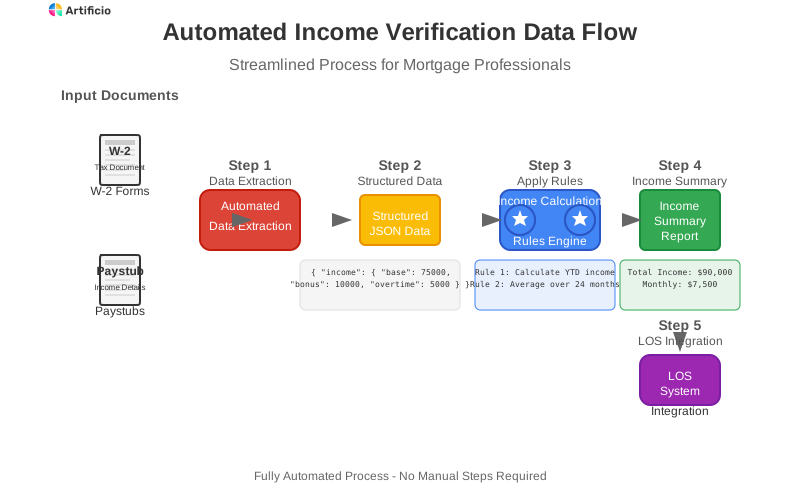
The mortgage origination process represents one of the most document-intensive workflows in the financial services industry. At the heart of this process lies income verification a critical procedure that establishes a borrower's capacity to service their debt obligations. Traditional approaches to income verification have relied heavily on manual document review, wherein mortgage professionals meticulously examine W-2 forms, pay stubs, tax returns, and other income-related documentation to assess and calculate a borrower's income. This manual approach, while thorough, introduces several inefficiencies into the mortgage origination pipeline, including prolonged processing times, inconsistent application of calculation methodologies, and susceptibility to human error.
Recent advancements in document processing technologies, data extraction capabilities, and rules-based systems have created the opportunity to fundamentally reimagine the income verification workflow. By automating the extraction, structuring, analysis, and integration of income data, financial institutions can dramatically improve the efficiency, accuracy, and consistency of their mortgage origination processes. The automated income verification data flow represents a paradigm shift in mortgage processing transforming what was once a labor-intensive manual process into a streamlined, technology-driven workflow that maintains or exceeds the analytical rigor of traditional approaches while eliminating their inherent inefficiencies.
This article provides a comprehensive examination of an end-to-end automated income verification system designed to process income documentation without manual intervention. Beginning with the ingestion of common income documents such as W-2 forms and pay stubs, the system progresses through several sophisticated processing stages, including automated data extraction, JSON data structuring, rules-based income calculation, income summarization, and ultimately, integration with downstream Loan Origination Systems. Each stage of this technological pipeline employs advanced methodologies to ensure accurate and consistent processing of income information, thereby enabling mortgage professionals to focus their expertise on higher-value activities such as borrower consultation and complex underwriting decisions rather than routine data entry and calculation tasks.
The significance of this technological approach extends beyond mere operational efficiency. In an increasingly competitive mortgage marketplace characterized by growing consumer expectations for rapid decision-making and digital-first experiences, automated income verification represents a critical competitive differentiator. Moreover, in a regulatory environment that continues to emphasize the importance of consistent, well-documented underwriting practices, automated income verification offers financial institutions a mechanism to ensure standardized application of income calculation methodologies while maintaining comprehensive audit trails of their decision-making processes.
Through detailed analysis of each component in the automated income verification data flow, this article aims to provide mortgage industry stakeholders with the technical knowledge and implementation insights necessary to evaluate and potentially adopt similar technological approaches within their own organizations. As the mortgage industry continues its digital transformation journey, understanding and embracing technologies such as automated income verification will increasingly become a prerequisite for remaining competitive in a rapidly evolving financial services landscape.
The evolution of mortgage processing technology has historically lagged behind advancements in other financial services domains, with income verification remaining particularly resistant to automation due to the complexity and variability of income documentation. Within the traditional mortgage origination workflow, income verification stands as one of the most time-consuming and error-prone stages, frequently requiring multiple iterations as underwriters request additional documentation or clarification from borrowers. A 2023 industry survey conducted by the Mortgage Bankers Association indicated that income verification accounts for approximately 28% of the total time required for mortgage processing and represents a primary source of friction in the customer experience. This prolonged processing time not only diminishes customer satisfaction but also increases the risk of application abandonment, particularly among digitally native consumers accustomed to streamlined financial services experiences.
The significance of automated income verification must be understood within the broader context of mortgage industry challenges. Rising operational costs, intensifying competition from fintech disruptors, and fluctuating interest rate environments have collectively compressed profit margins and heightened the importance of operational efficiency. Concurrently, regulatory requirements established in the wake of the 2008 financial crisis particularly the Ability-to-Repay and Qualified Mortgage standards have placed additional emphasis on thorough, consistent income verification practices. These converging pressures have created a compelling business case for technology-enabled process improvements that can simultaneously enhance efficiency, ensure compliance, and improve the customer experience.
Previous attempts to automate aspects of income verification have often resulted in partial solutions that still required significant manual intervention. Early document digitization efforts focused primarily on basic optical character recognition (OCR) to transform physical documents into digital formats but lacked the sophisticated extraction capabilities necessary to identify and categorize complex income data. Similarly, initial attempts at automated calculation often employed overly simplistic rule sets that could not accommodate the diverse income patterns and employment scenarios encountered in real-world mortgage applications. These partial automation approaches frequently introduced new inefficiencies as mortgage professionals found themselves needing to verify and correct the output of imperfect automated systems.
The automated income verification data flow described in this article represents a significant advancement beyond these earlier approaches. By integrating state-of-the-art document processing technologies, context-aware data extraction algorithms, comprehensive rules engines, and seamless system integration capabilities, this approach achieves end-to-end automation of the income verification process without sacrificing analytical rigor or compliance requirements. The system's ability to transform unstructured document data into standardized, structured formats enables consistent application of income calculation methodologies across all applications while maintaining traceability between calculated income figures and their documentary sources.
Furthermore, the significance of automated income verification extends to its potential impact on mortgage accessibility and financial inclusion. Traditional manual verification processes have often disadvantaged borrowers with non-traditional income patterns or complex employment histories, as these scenarios typically require additional documentation and specialized calculation methodologies that may be inconsistently applied across different mortgage professionals. By encoding comprehensive calculation methodologies and supporting diverse income scenarios, automated verification systems can potentially expand access to mortgage financing for qualified borrowers whose income patterns may have presented verification challenges under manual systems.
As the mortgage industry continues to embrace digital transformation initiatives, automated income verification represents a critical cornerstone of the future mortgage origination infrastructure. By eliminating manual steps in this central underwriting process, financial institutions can develop more responsive, efficient, and customer-centric mortgage origination experiences while maintaining the analytical rigor necessary for sound underwriting decisions.
The architecture of the automated income verification system comprises a series of interconnected technological components, each responsible for discrete aspects of the verification process. This section provides an in-depth examination of each component within the automated data flow, detailing the underlying technologies, methodologies, and implementation considerations.
The automated verification process begins with the ingestion of income documentation, primarily W-2 forms and pay stubs, although the system architecture supports expansion to additional document types such as tax returns, profit and loss statements, and bank statements. Document ingestion may occur through multiple channels, including direct uploads to web portals, mobile document capture applications, secure email submission, or integration with document management systems. Upon receipt, documents undergo preprocessing to optimize them for subsequent extraction processes. This preprocessing stage includes several critical operations that significantly impact downstream extraction accuracy.
Document classification represents the first preprocessing step, wherein machine learning algorithms identify the document type, issuer, and relevant tax year or pay period. This classification step enables the system to apply document-specific extraction rules and validation criteria in later processing stages. Classification algorithms typically employ a combination of visual layout analysis, text pattern recognition, and form identifier detection to categorize incoming documents with high accuracy. Studies have demonstrated that hybrid approaches combining convolutional neural networks for visual analysis with transformer-based models for textual analysis achieve classification accuracy exceeding 98% across common income document types.
Following classification, documents undergo enhancement procedures designed to optimize image quality for text extraction. These procedures include deskewing to correct angular distortion, noise reduction to eliminate artifacts that might interfere with character recognition, contrast normalization to improve text-background separation, and resolution standardization to ensure consistent processing. For documents submitted in physical format and subsequently scanned, additional preprocessing steps may include border detection and removal, page segmentation, and blank page elimination. The collective impact of these enhancement procedures can improve downstream extraction accuracy by 15-20% compared to unenhanced documents, particularly for documents captured via mobile devices or lower-quality scanning equipment.
The final preprocessing step involves layout analysis, wherein the document's structure is mapped to identify regions containing relevant income information. This analysis employs computer vision techniques to detect tables, headers, forms fields, and textual blocks, creating a spatial understanding of the document that guides subsequent targeted extraction efforts. Advanced layout analysis systems incorporate domain-specific knowledge about the structure of common income documents, recognizing, for instance, the characteristic layout of a W-2 form or the typical tabular structure of a pay stub. By establishing this structural understanding, the system can more efficiently direct its extraction resources toward high-value regions of the document while minimizing computational effort on irrelevant sections.
The preprocessing system collectively transforms raw document inputs into optimized, classified, and structurally analyzed assets ready for detailed information extraction. The quality and thoroughness of this preprocessing stage directly influences the accuracy and completeness of all subsequent extraction and calculation processes.
Following preprocessing, documents progress to the automated data extraction stage perhaps the most technically sophisticated component of the verification pipeline. This stage employs a multi-layered approach to information extraction, combining optical character recognition, natural language processing, and domain-specific extraction models to transform unstructured document content into structured, machine-interpretable data points.
The foundation of the extraction process is advanced optical character recognition (OCR) technology capable of accurately identifying textual content across various fonts, formats, and qualities. Modern OCR systems utilized in financial document processing typically achieve character-level accuracy exceeding 99% on standard forms, though this accuracy may decrease for handwritten annotations or degraded documents. These systems employ deep learning architectures, particularly variants of recurrent neural networks and transformer models, that have been trained on extensive financial document corpora to recognize industry-specific terminology, numerical formats, and common abbreviations.
Beyond basic character recognition, the extraction system incorporates contextual understanding to correctly interpret extracted text. This contextual layer is particularly important for financial documents where the meaning of numerical values depends heavily on their labeled context or spatial position within the document. For example, on a W-2 form, the system must differentiate between numerically similar fields such as "Wages, tips, other compensation" (Box 1), "Social security wages" (Box 3), and "Medicare wages and tips" (Box 5) distinctions that require understanding both the textual labels and the form's structure. This contextual interpretation layer combines rules-based approaches for standardized forms with machine learning models for more variable document types, enabling accurate field identification across diverse document layouts and formats.
The extraction system employs specialized algorithms for detecting and processing tabular data, a common format for presenting payment history on pay stubs. These algorithms identify table structures, recognize header rows, and correctly associate values with their corresponding categories and time periods. For recurring income documents like pay stubs, the system identifies and extracts temporal patterns distinguishing between current period earnings and year-to-date totals while tracking payment frequency and consistency. These temporal insights become critical inputs for the subsequent income calculation stage, particularly for variable income types that require averaging across multiple pay periods.
To enhance extraction accuracy for domain-specific information, the system incorporates specialized extraction models trained on particular document types and income scenarios. These specialized models recognize industry-specific compensation structures (such as commission-based earnings in real estate or shift differentials in healthcare) and extract relevant details accordingly. Similarly, occupation-specific models may be employed to accurately process documents from industries with unique compensation structures, such as military Leave and Earnings Statements or union-based compensation with complex deduction and contribution patterns.
The extraction process concludes with a validation layer that applies financial logic and consistency checks to the extracted data. This validation includes mathematical verification (ensuring that component values sum to stated totals), cross-document consistency checking (comparing information across multiple documents from the same employer), and anomaly detection (identifying values that deviate significantly from expected ranges or patterns). When potential inconsistencies are detected, the system flags these areas for either automated secondary processing using alternative extraction techniques or, in rare cases, limited human review.
Through this sophisticated multi-layered approach, the automated extraction system transforms raw document content into structured data elements ready for standardization and further processing. The accuracy and completeness of this extraction stage directly impacts the quality of income calculations and ultimately, the reliability of lending decisions based on these calculations.
The intermediate phase between extraction and calculation involves transforming the diverse extracted data elements into a standardized, structured format that enables consistent processing regardless of the original document source. JSON (JavaScript Object Notation) serves as the ideal data format for this purpose due to its flexibility, hierarchical structure capability, and widespread adoption in modern software systems. The JSON structuring process involves three key operations: normalization, enrichment, and standardization.
Normalization converts extracted data from various formats and units into consistent representations suitable for comparative analysis and calculation. This process addresses common variations in how income information is presented across different document types and employers. For example, pay frequencies may be normalized from diverse terms like "bi-weekly," "semi-monthly," or "24 pay periods annually" into standardized calculation factors. Similarly, income amounts expressed in different time units (hourly rates, weekly totals, monthly salaries) are normalized to comparable time periods to facilitate consistent processing. The normalization layer also handles format standardization, ensuring consistent treatment of numerical separators, date formats, and currency notations regardless of their original presentation in source documents.
Data enrichment augments the extracted information with additional context and metadata necessary for accurate income analysis. This enrichment process adds several categories of supplementary information: temporal context (pay period dates, document effective dates), classification tags (income categorization such as base, overtime, bonus, or commission), confidence metrics (indicating the system's certainty about extracted values), and source reference data (creating traceable links between structured data elements and their origins within source documents). This enrichment enables downstream processes to apply appropriate calculation methodologies based on income types and provides traceability for audit and quality control purposes.
The standardization operation organizes the normalized and enriched data into a consistent JSON schema designed specifically for income analysis. This schema employs a hierarchical structure that represents the natural relationships between income components. At the highest level, the schema typically organizes data by income source (employer), followed by income categories (base salary, overtime, bonuses, etc.), with temporal sequences of individual payments at the most granular level. This hierarchical approach enables both detailed analysis of specific income components and aggregated views across categories or sources. The schema incorporates extensibility features to accommodate future document types and income scenarios while maintaining backward compatibility with existing processing systems.
The resulting structured JSON representation serves as a unified data model that decouples downstream processing from the vagaries of source documents. This separation of concerns enables continuous improvement of extraction technologies without requiring corresponding changes to calculation logic, as long as the JSON interface contract remains stable. The structured format also facilitates data persistence, allowing the income information to be stored, queried, and analyzed independently of the original documents while maintaining bidirectional traceability between calculated values and source materials.
From an implementation perspective, the JSON structuring component typically employs a combination of rules-based mapping for well-defined transformations and machine learning models for more complex normalization scenarios. The component operates within a robust error handling framework that manages exceptions such as missing data elements, inconsistent hierarchical relationships, or confidence values below established thresholds. When exceptional conditions are encountered, the system applies fallback strategies that preserve as much valid data as possible while clearly marking uncertain elements for special handling during the calculation phase.
The JSON data structuring stage creates a critical abstraction layer within the overall verification workflow transforming diverse, unstructured document data into a standardized, machine-readable format optimized for algorithmic income analysis and calculation. This intermediary representation enables the subsequent rules engine to operate on a consistent data model regardless of the variety and complexity of the original income documentation.
At the core of the automated income verification system lies the rules-based calculation engine a sophisticated computational component that applies industry-standard methodologies, regulatory requirements, and institutional policies to the structured income data. This engine transforms raw income information into qualified income determinations suitable for mortgage underwriting decisions. The calculation engine represents an encoding of expert knowledge, capturing the complex rules and heuristics that experienced mortgage professionals apply when manually assessing income documentation.
The architecture of the rules engine employs a modular, extensible framework designed to accommodate diverse income scenarios and calculation methodologies. At its foundation, the engine utilizes a rule execution framework that separates rule definitions from execution logic, enabling business users and compliance specialists to maintain calculation rules without requiring software development intervention. Rules are typically defined using a domain-specific language designed for financial calculations, providing both the expressiveness needed for complex scenarios and the clarity required for audit and governance purposes. The rule definitions undergo rigorous validation before deployment to ensure mathematical accuracy, logical consistency, and alignment with regulatory requirements.
The calculation process begins with income categorization, wherein the engine analyzes the structured JSON data to identify distinct income streams and classify them according to type (e.g., base salary, hourly, overtime, bonus, commission). This classification determines which calculation methodologies apply to each income component. For consistently recurring income such as base salary, the engine may apply straightforward projection methods. For variable income such as overtime or commission, the engine employs historical averaging techniques, typically calculating averages over 12-24 month lookback periods in accordance with agency guidelines. For seasonal or irregular income, the engine applies more sophisticated analysis including seasonality adjustments and trend analysis to derive representative income figures.
The engine incorporates multiple layers of calculation logic to address the complexity of real-world income scenarios. Foundational calculations establish baseline income values using standard methodologies for each income type. These baseline calculations are then refined through adjustment layers that account for factors such as income stability, employment tenure, and historical consistency. The engine applies qualification rules that implement regulatory requirements and institutional policies regarding income eligibility for mortgage purposes. Finally, documentation adequacy rules assess whether sufficient evidence exists to support each income determination, ensuring that calculations are based on complete and appropriate documentation.
A particularly powerful aspect of the rules engine is its ability to handle complex employment scenarios that would challenge manual processing approaches. The engine incorporates specialized calculation modules for scenarios such as multiple concurrent employers, self-employment income, retirement distributions, investment income, rental property income, and part-time or secondary employment. Each specialized module implements the specific calculation methodologies and documentation requirements appropriate for that income type, enabling consistent treatment of complex scenarios across all applications.
The calculation engine maintains comprehensive traceability between its inputs, intermediate calculations, and final determinations. Each income figure produced by the engine is accompanied by a detailed calculation audit trail that documents the specific rules applied, the source data utilized, and any special conditions or exceptions encountered during processing. This traceability serves multiple purposes: it supports quality control processes, enables clear explanation of income determinations to borrowers, satisfies regulatory documentation requirements, and provides valuable training data for continuous improvement of the system.
From a technical implementation perspective, the rules engine typically employs a combination of deterministic rule processing for well-defined calculations and statistical models for more complex scenarios requiring pattern recognition or trend analysis. The engine operates within an extensive validation framework that applies both mathematics-based consistency checks and domain-specific reasonableness tests to identify potential calculation anomalies. When anomalies are detected, the system employs progressively more sophisticated analysis techniques to resolve discrepancies or, in rare cases, flags the calculation for limited human review while clearly identifying the specific aspects requiring attention.
The rules-based calculation engine represents the analytical heart of the automated income verification system, transforming structured data into meaningful income determinations through the application of encoded expert knowledge. By consistently applying industry-standard methodologies across all applications, the engine ensures that income calculations are accurate, defensible, and compliant with relevant regulatory guidelines.
Following calculation, the system generates comprehensive income summaries that distill complex calculations into clear, actionable representations suitable for underwriting decisions. These summaries transform detailed calculation outputs into standardized formats that communicate essential income characteristics while providing access to supporting details when needed. The summarization process balances the competing demands of conciseness for rapid decision-making and completeness for thorough underwriting review.
The summary generation process begins with the aggregation of calculated income components into meaningful totals and subtotals organized by income category, source, and stability classification. For each aggregated figure, the system calculates key derivatives such as monthly equivalents, annual projections, and historical averages. The system applies industry-standard rounding rules and truncation practices to ensure that all presented figures conform to mortgage industry conventions. Beyond simple numerical aggregation, the summarization process includes trending analysis to identify patterns of income growth or decline that may influence underwriting decisions, stability assessments that evaluate the consistency and predictability of each income stream, and confidence metrics that communicate the system's certainty about each calculated value based on the completeness and quality of supporting documentation.
The reporting component transforms these aggregated calculations into multiple output formats tailored to different consumption scenarios. For underwriter review, the system generates detailed income worksheets that present calculated values alongside supporting information and calculation methodologies. These worksheets typically include interactive elements that enable underwriters to explore the underlying data and calculation logic, verifying specific components without requiring manual recalculation. For automated underwriting system (AUS) submission, the reporting component generates standardized data payloads that conform to the specifications of systems such as Fannie Mae's Desktop Underwriter or Freddie Mac's Loan Product Advisor. For borrower communication, simplified income summaries explain how income was calculated in clear, non-technical language, supporting transparency in the mortgage process.
A critical aspect of the summarization stage is the generation of supporting evidence packages that document the basis for all income determinations. These packages establish clear lineage between source documents, extracted data elements, calculation methodologies, and final income figures. The evidence packages typically include annotated versions of source documents with extracted data highlighted, calculation worksheets showing step-by-step derivation of income figures, and exception reports documenting any special conditions or policy adaptations applied during the calculation process. These comprehensive documentation packages satisfy regulatory requirements for underwriting transparency while streamlining quality control and audit processes.
From an implementation perspective, the summarization and reporting component employs a template-based architecture that separates content generation from presentation formatting. This separation enables consistent calculation reporting across multiple output formats and delivery channels. The component incorporates advanced data visualization capabilities that transform complex income patterns into intuitive graphical representations, enabling quick recognition of trends, seasonality, and anomalies that might be less apparent in tabular data formats. The reporting system operates within a comprehensive permissioning framework that controls access to different levels of income detail based on user roles and information requirements.
The income summarization and reporting stage represents the translation layer between complex calculations and human or automated decision-making processes. By generating clear, comprehensive income representations with appropriate supporting evidence, this component enables confident underwriting decisions while maintaining the transparency and traceability required in modern mortgage operations.
The final stage in the automated income verification data flow involves seamless integration with Loan Origination Systems (LOS) and surrounding workflow systems. This integration transforms the technological capabilities of the verification system into operational reality within mortgage processing workflows. The integration approach employs modern API-based architectures to enable flexible, secure data exchange between systems while supporting diverse implementation scenarios across various technology environments.
The integration framework implements bidirectional data exchange capabilities, enabling both push delivery of income calculations to the LOS and pull requests initiated from LOS workflow events. This bidirectional approach supports various implementation scenarios, from fully automated processing to hybrid workflows where verification occurs at specific user-initiated points in the origination process. The integration layer employs standardized data contracts that normalize income information into formats compatible with leading LOS platforms, commercial point-of-sale systems, and agency submission interfaces. These standardized contracts decouple the verification system's internal representations from external system requirements, enabling the verification system to evolve independently while maintaining stable integration points.
Beyond simple data exchange, the integration framework implements sophisticated workflow automation capabilities that coordinate activities across systems. Event-based triggers initiate income verification based on document availability, application milestones, or explicit user requests. Status synchronization ensures that all systems maintain consistent understanding of verification progress and outcomes. Task generation automatically creates appropriate work items when verification exceptions require human attention. Notification services alert relevant parties about verification completions, issues requiring attention, or documentation gaps that need resolution.
The integration architecture incorporates comprehensive security and compliance features designed specifically for handling sensitive financial information. All data exchanges employ end-to-end encryption using industry-standard protocols, with additional field-level encryption for particularly sensitive elements. Authentication mechanisms ensure that only authorized systems and users can initiate verification processes or access results. Detailed activity logging creates immutable records of all system interactions, supporting both operational troubleshooting and compliance requirements. Data retention policies automatically enforce appropriate lifecycle management of sensitive information in accordance with regulatory requirements and organizational policies.
From an implementation perspective, the integration framework employs a layered architecture that separates core integration capabilities from platform-specific adapters. This separation enables the verification system to connect with diverse LOS platforms through configuration rather than custom development. The framework includes robust error handling mechanisms that manage common integration challenges such as network interruptions, version mismatches, and synchronization issues. Recovery procedures enable transactions to resume from points of failure without data loss or duplication. Performance optimization techniques including asynchronous processing, batch operations, and intelligent caching ensure that integration activities maintain appropriate throughput even during peak processing periods.
The LOS integration stage completes the automated verification pipeline, transforming advanced technological capabilities into operational value within production mortgage workflows. By seamlessly connecting the verification system with existing mortgage technology ecosystems, this stage enables financial institutions to realize the efficiency and accuracy benefits of automated income verification without disruptive changes to their core origination platforms or processes.
Successful implementation of automated income verification systems requires careful consideration of various operational, technical, and organizational factors. This section outlines key implementation considerations and best practices derived from industry experience with similar automation initiatives.
From an architectural perspective, successful implementations typically adopt a modular, microservices-based approach that decomposes the verification pipeline into independently deployable components. This architectural pattern enables gradual implementation, with organizations often beginning with document preprocessing and extraction capabilities before progressing to more complex calculation and integration components. The modular approach also facilitates the incorporation of commercial components alongside custom-developed elements, enabling organizations to leverage specialized vendor capabilities for specific functions while maintaining a cohesive overall solution. Implementation teams should establish clear interface contracts between components, enabling individual modules to evolve independently while preserving system-wide interoperability.
Data quality management represents a critical success factor in automated verification implementations. Organizations should establish comprehensive data governance practices that monitor extraction accuracy, calculation consistency, and integration fidelity across the entire verification pipeline. Automated quality control checkpoints should be implemented at key transition points within the workflow, applying both deterministic validation rules and statistical anomaly detection to identify potential issues before they impact downstream processes. When quality exceptions occur, clear remediation workflows should guide appropriate corrective actions while maintaining overall processing efficiency. Over time, implementation teams should develop feedback loops that continuously improve system accuracy by incorporating insights from exception patterns and edge cases.
Change management considerations are particularly important given the significant operational transformation represented by automated verification. Implementation teams should develop comprehensive training programs that help mortgage professionals understand both the capabilities and limitations of the automated system. Role transition planning should address how existing verification specialists will evolve toward higher-value activities such as complex case analysis and exception handling. Processing policies and procedures will require updating to incorporate automated verification into standard workflows, with clear guidelines for scenarios requiring manual intervention or supplementary analysis. Communication strategies should emphasize both efficiency benefits and quality improvements to build organizational support for the automation initiative.
Implementation timelines for comprehensive verification systems typically span 6-18 months depending on organizational complexity, existing technology infrastructure, and implementation approach. Successful projects generally adopt phased implementation strategies that deliver incremental value while managing change impact. Initial phases often focus on document classification and data extraction for standard document types, progressing to basic calculation capabilities for straightforward income scenarios. Subsequent phases introduce more sophisticated capabilities such as complex income calculations, integration with automated underwriting systems, and handling of specialized document types. This incremental approach enables organizations to realize partial benefits early in the implementation journey while building experience and refining their approach for more complex capabilities.
From a resource perspective, successful implementations require cross-functional teams that combine mortgage domain expertise, document processing experience, data science capabilities, and integration specialization. The mortgage domain experts provide critical insights into income calculation methodologies, document interpretation, and exception handling approaches. Document processing specialists contribute expertise in classification, extraction, and validation techniques for financial documents. Data scientists develop and refine the machine learning models that enhance extraction accuracy and support complex pattern recognition. Integration specialists ensure seamless connectivity with existing mortgage technology ecosystems. This multidisciplinary approach ensures that the resulting system balances technological sophistication with practical operational relevance.
Performance considerations should address both throughput capacity and response time requirements across various usage scenarios. For batch processing of existing document collections, the system should demonstrate sufficient throughput to process typical document volumes within operational windows. For interactive scenarios where users await verification results, the system should deliver appropriate response times to maintain workflow momentum. Implementation teams should establish comprehensive performance testing regimes that evaluate system behavior under various load conditions and document complexity scenarios. Scaling strategies should address how the system will accommodate both growth in overall document volumes and spikes during peak processing periods such as month-end or seasonal applications surges.
The most successful implementations establish clear, quantifiable success metrics aligned with organizational objectives. Process efficiency metrics typically include verification turnaround time, manual intervention rates, and processing capacity per underwriter. Quality metrics measure extraction accuracy, calculation consistency, and exception rates across different document and income types. Compliance metrics assess adherence to regulatory requirements, policy guidelines, and documentation standards. Customer experience metrics evaluate impacts on overall application processing time, consistency of income assessments, and transparency of calculation methodologies. By establishing baseline measurements and tracking improvement across these dimensions, organizations can demonstrate concrete value from their verification automation investments.
The automated income verification data flow delivers numerous benefits across operational, financial, and customer experience dimensions. Operationally, the system dramatically reduces the time required for income verification, with industry implementations reporting 60-80% reductions in processing time compared to manual approaches. This efficiency improvement directly contributes to reduced time-to-close metrics, enabling financial institutions to process higher application volumes without corresponding staffing increases. The consistency of automated calculation methodologies eliminates processor-to-processor variations in income determinations, ensuring that similar scenarios receive similar treatment regardless of which team members process the application. The standardized approach also improves fraud detection capabilities by applying consistent scrutiny to all applications and flagging anomalous patterns that might escape notice in manual reviews.
From a financial perspective, the automation of verification activities generates significant cost savings through reduced labor requirements, with large implementations reporting 30-50% reductions in per-loan processing costs. Beyond direct cost savings, the improved processing velocity enables higher origination volumes without proportional cost increases, creating economies of scale that enhance overall profitability. The system's ability to detect potential income calculation errors before they impact underwriting decisions reduces costly repurchase risk and improves loan quality metrics. For financial institutions participating in correspondent or wholesale lending models, the automated verification capabilities can support "delegated income" models that reduce correspondent processing burdens while maintaining appropriate quality control.
The customer experience benefits of automated verification extend beyond simple processing speed improvements. The reduction in documentation requests and follow-up questions creates a smoother application experience with fewer customer touchpoints. The consistency of income calculations improves the predictability of lending decisions, reducing instances where borrowers receive unexpected loan amount adjustments late in the process. The system's ability to handle complex income scenarios expands access to mortgage financing for qualified borrowers with non-traditional income patterns, contributing to broader financial inclusion objectives. For borrowers utilizing digital application channels, the automated verification capabilities enable real-time income assessments that support immediate pre-approval decisions, meeting growing consumer expectations for instant feedback.
Despite these substantial benefits, automated verification systems do face certain limitations and challenges. The extraction technology, while highly accurate for standard document formats, may encounter difficulties with unusual document layouts, poor image quality, or handwritten annotations. The rules-based calculation approaches, though comprehensive, cannot fully replicate the judgment and contextual interpretation that experienced underwriters apply in particularly complex or unusual income scenarios. Integration capabilities may be constrained by limitations in existing LOS platforms or surrounding systems that were not designed with API-based interactions in mind. Privacy and security considerations introduce implementation complexities, particularly in multi-entity environments where document sharing and access controls must be carefully managed.
Future directions for automated income verification systems will likely address these limitations while expanding capabilities in several dimensions. Extraction technologies will continue to advance through application of emerging machine learning approaches, particularly few-shot learning techniques that reduce training data requirements for new document types and self-supervised models that continuously improve through operational feedback. Calculation methodologies will evolve toward hybrid approaches that combine rules-based processing with machine learning models, enabling the system to identify and learn from complex patterns in income data while maintaining the explainability required for mortgage underwriting. Integration capabilities will expand beyond traditional LOS platforms to embrace open banking ecosystems, alternative data sources, and decentralized finance applications, creating more comprehensive financial profiles for borrower evaluation.
Perhaps the most significant future direction involves the expansion from income verification to comprehensive automated underwriting that incorporates additional factors such as assets, liabilities, property valuation, and credit characteristics. This evolution toward comprehensive digital underwriting will require similar automation approaches across all verification domains, with sophisticated orchestration capabilities to coordinate activities and resolve discrepancies across domains. As these comprehensive automation capabilities mature, they will enable truly transformative mortgage experiences that combine the efficiency of fully digital processing with the personalized guidance that borrowers value during complex financial transactions.
The automated income verification data flow represents a technological breakthrough that transforms one of the most labor-intensive aspects of mortgage processing into a streamlined, consistent, and highly efficient workflow. By eliminating manual steps throughout the verification process, this system enables mortgage professionals to focus their expertise on complex underwriting decisions and borrower guidance rather than routine document processing and calculation tasks. The modular architecture of the system progressing from document ingestion through extraction, structuring, calculation, summarization, and integration provides a comprehensive framework that financial institutions can adapt to their specific operational contexts and technology ecosystems.
The broad adoption of automated verification approaches will likely accelerate in coming years as mortgage industry participants respond to competitive pressures, margin constraints, and evolving consumer expectations. Organizations that successfully implement these technologies will position themselves advantageously in a mortgage marketplace increasingly defined by processing efficiency, consistent underwriting quality, and seamless customer experiences. As verification automation becomes the industry standard rather than a competitive differentiator, the focus will shift toward how these foundational capabilities can enable more comprehensive transformation of the mortgage origination process.
Beyond its immediate operational impact, automated income verification represents an important milestone in the broader digital transformation of mortgage lending. By demonstrating that even complex, judgment-intensive processes can be effectively automated through sophisticated technological approaches, these systems establish a template for similar transformation in other aspects of mortgage origination and servicing. The verification automation journey provides valuable implementation experiences, organizational learning, and technological foundations that will accelerate subsequent automation initiatives across the mortgage lifecycle.
As the mortgage industry continues to evolve, automated income verification will increasingly become not merely a process improvement initiative but an essential component of competitive lending operations. Financial institutions that embrace these technologies and successfully integrate them into their operational workflows will be well-positioned to thrive in a mortgage marketplace defined by digital capabilities, processing efficiency, and customer-centricity. The future of mortgage lending belongs to organizations that can effectively blend technological sophistication with human expertise, and automated verification systems represent an important step along this evolutionary path.

Head IT Operations - Co Founder of Artificio
See it in your SAP environment
Bring us a document, a process, or a bottleneck. We'll show how Artificio captures, validates, and posts into SAP — then scale from there.
Security & compliance
ISO 27001:2013 certified, SOC 2 Type 2 compliant, GDPR and HIPAA ready. Every agent action is logged, auditable, and runs in isolated environments.