

Blog
Revolutionizing Mortgage Processing: Artificio's Intelligent Document API
Learn how Artificio's AI/ML solutions automate mortgage document extraction, analysis, and income verification.

Blog
Learn how Artificio's AI/ML solutions automate mortgage document extraction, analysis, and income verification.
In the constantly evolving landscape of financial technology, mortgage processing remains one of the most document-intensive and time-consuming operations in the banking sector. The traditional mortgage approval process has long been characterized by manual document reviews, tedious data extraction, and fragmented verification procedures creating inefficiencies that frustrate both lenders and borrowers alike. Today, we're witnessing a profound transformation in this space through advanced artificial intelligence and machine learning technologies. At the forefront of this revolution is Artificio's Document Intelligence API and Income Summary Generator, a specialized solution designed to seamlessly integrate with existing mortgage systems and streamline the most challenging aspects of mortgage document processing.
Before diving into the specifics of Artificio's solution, it's essential to understand the scope of the challenge that mortgage processing presents. The average mortgage application involves between 100 to 500 pages of documentation, spanning diverse formats including paystubs, W-2s, bank statements, tax returns, credit reports, property appraisals, and numerous legal disclosures. Traditionally, processing these documents requires mortgage professionals to:
This manual approach introduces several critical pain points:
The financial stakes are equally significant. Industry research indicates that the cost to process a single mortgage application ranges from $7,000 to $8,000, with document handling and data extraction representing approximately 20% of this cost. In an industry with thin margins, any technology that can reduce these expenses while improving accuracy and speed creates a substantial competitive advantage.
Artificio has taken a targeted approach to solving the mortgage document processing challenge. Rather than attempting to replace existing mortgage systems, Artificio has developed two specialized components that integrate seamlessly with lenders' current infrastructure:
These components are designed to work in harmony with existing:
This integration-focused approach allows lenders to enhance their current technology investments rather than replace them, significantly reducing implementation barriers and accelerating time to value.
Let's examine Artificio's specialized components in detail to understand how they transform document processing within the mortgage ecosystem.
The heart of Artificio's offering is its Document Intelligence API, a sophisticated artificial intelligence and machine learning platform specifically designed for mortgage document processing. This component represents the most technically advanced aspect of the solution, employing multiple AI disciplines to transform static documents into structured, machine-readable data.
Artificio's Document Intelligence API employs multiple recognition technologies working in concert:
Beyond simple text recognition, the API employs sophisticated named entity recognition (NER) models to identify and extract specific data points relevant to mortgage underwriting. These include:
What makes Artificio's extraction particularly powerful is its contextual awareness. Rather than simply identifying text that looks like a dollar amount, the system understands what that amount represents within the specific document. For example, on a paystub, it can distinguish between gross pay, net pay, various deductions, and year-to-date totals even when these numbers appear in similar formats.
One of the most sophisticated aspects of the Document Intelligence API is its ability to cross-validate information across multiple document types. For instance:
This cross-validation capability significantly reduces fraud risk and catches discrepancies that might otherwise require manual review.
Artificio's Document Intelligence API employs a continuous learning architecture that allows it to improve over time. When the system encounters an unfamiliar document format or struggles with particular extraction tasks, these cases are flagged for review. Machine learning engineers can then provide additional training examples, allowing the system to handle similar documents more effectively in the future.
This learning isn't just theoretical it's practical and measurable. Since its initial deployment, Artificio's system has improved its extraction accuracy from 85% to over 97% across all document types, with especially significant gains in handling less standardized documents like self-employment profit and loss statements.
The Document Intelligence API is designed to integrate directly with existing Mortgage CRM systems through a well-documented set of APIs. This integration enables:
The API accepts documents in multiple formats (PDF, TIFF, JPEG, PNG) and from various sources, making it compatible with virtually any document collection system used by mortgage lenders today.
While accurate data extraction is essential, mortgage underwriters don't make decisions based on isolated data points. They need comprehensively organized financial profiles that present a complete picture of a borrower's financial situation. This is where Artificio's Income Summary Generator comes into play.
Different loan products and mortgage programs have specific requirements for how income must be calculated. The Income Summary Generator applies these rules automatically, performing calculations such as:
These calculations would typically require significant manual effort from underwriters, but Artificio's system performs them automatically and consistently, ensuring compliance with mortgage program guidelines.
Beyond income calculations, the system generates a complete financial profile that includes:
A crucial feature of the Income Summary Generator is its ability to maintain clear links between final calculated figures and the source documents that support them. For each income or asset calculation, the system creates a detailed evidence map showing:
This evidence mapping creates a clear audit trail that makes it easy for underwriters to verify calculations and for quality control teams to validate decisions during post-closing reviews.
Based on the comprehensive financial profile it creates, the Income Summary Generator can automatically assess eligibility for various mortgage programs, including:
By automating these preliminary eligibility determinations, the system helps direct applications to the most appropriate loan products earlier in the process, reducing time-consuming rework when applications are initially submitted for incompatible programs.
The Income Summary Generator is designed to interface directly with existing Loan Origination Systems through standard APIs and data formats. This integration allows:
This seamless integration means that underwriters can work entirely within their familiar LOS environment while benefiting from the advanced processing performed by Artificio's system.
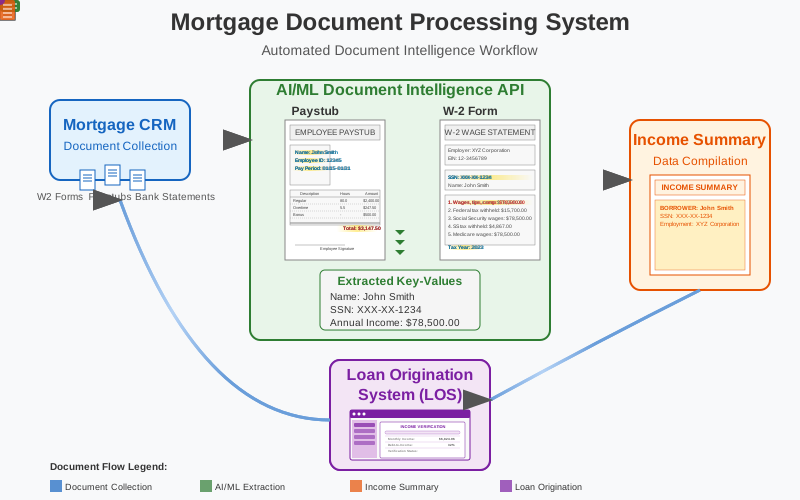
Understanding how Artificio's components fit into the broader mortgage ecosystem is essential for appreciating their transformative impact. Let's walk through the end-to-end workflow to see how the Document Intelligence API and Income Summary Generator interact with existing systems:
The process begins in the lender's existing Mortgage CRM, where documents are collected through various channels:
As documents enter the CRM, they are tagged with basic metadata (borrower ID, document type if known, submission date) and made available to Artificio's Document Intelligence API through pre-built connectors.
Once documents are available in the CRM, Artificio's Document Intelligence API goes to work:
The API then returns both the structured extracted data and status information back to the CRM, where it can trigger appropriate workflows based on the results such as requesting replacement documents if quality issues are detected or alerting loan officers to potential discrepancies.
As sufficient documentation accumulates, Artificio's Income Summary Generator begins its work:
The resulting financial profile provides a comprehensive, verified view of the borrower's financial situation, ready for underwriting evaluation.
Finally, the structured data and financial summaries flow into the lender's existing Loan Origination System:
Underwriters can now focus their expertise on evaluating the application rather than on manual data entry and calculation, significantly accelerating the decision process while improving accuracy.
As the underwriting process proceeds, status updates flow back through the system:
This creates a continuous, efficient cycle that minimizes delays and ensures that all stakeholders have current, accurate information throughout the process.
The technical sophistication of Artificio's Document Intelligence API and Income Summary Generator yields concrete, measurable benefits for mortgage lenders, their staff, and ultimately for borrowers. Let's examine the specific impacts across several key dimensions:
Lenders implementing Artificio's components have reported dramatic improvements in operational metrics:
These efficiency gains translate directly to cost savings. Lenders report an average cost reduction of $1,200 to $1,800 per loan file, primarily from reduced labor costs and faster closing times.
Beyond operational efficiency, Artificio's components significantly improve risk management capabilities:
These risk management improvements have tangible financial benefits beyond direct cost savings. Lenders using Artificio's components report reduced repurchase requests from investors and lower costs for quality control staff.
Perhaps most importantly, Artificio's intelligent document processing capabilities dramatically improve the experience for mortgage applicants:
Customer satisfaction metrics tell the story clearly. Lenders using Artificio's components report Net Promoter Scores (NPS) 15-20 points higher than industry averages, with particular improvements in ratings for "ease of process" and "clear communication."
Financial institutions that have implemented Artificio's Document Intelligence API and Income Summary Generator gain significant competitive advantages:
These advantages are particularly valuable in a mortgage market characterized by thin margins and intense competition. The institutions that can process loans more efficiently while providing a superior customer experience establish meaningful differentiation in an otherwise homogenized market.
Understanding the technical architecture behind Artificio's Document Intelligence API and Income Summary Generator provides insight into why they achieve such significant performance improvements over traditional approaches and even over earlier generation document automation tools.
At the core of the system's document understanding capabilities is a hybrid deep learning architecture that combines multiple neural network types:
This hybrid approach allows the system to simultaneously understand both the visual structure of documents and the semantic meaning of their contents a significant advance over traditional OCR systems that treat documents merely as collections of text without understanding context.
Rather than using general-purpose document understanding models, Artificio pre-trained its models on millions of mortgage-specific documents, including:
This domain-specific training creates models that understand the unique characteristics of mortgage documents, including specialized terminology, typical data patterns, and common variations in formatting. The result is extraction accuracy rates 15-25% higher than could be achieved with general-purpose document AI systems.
Artificio built its components using a modern microservices architecture where each function exists as an independent, containerized service. This approach delivers several advantages:
This architecture also enables the system to process documents in parallel streams rather than sequentially, contributing significantly to the speed improvements over traditional document processing.
Beyond its technical architecture, Artificio's components benefit from proprietary datasets developed over years of working with mortgage documents:
These proprietary data assets enhance the system's ability to accurately interpret documents from diverse sources, providing an advantage that would be difficult for competitors to replicate quickly.
Financial institutions considering Artificio's Document Intelligence API and Income Summary Generator often want to understand not just what the technology does, but how it can be successfully integrated with their existing CRM and LOS environments. Artificio has developed a proven implementation methodology based on successful deployments across dozens of lenders ranging from community banks to nationwide mortgage operations.
The journey begins with a thorough discovery phase, typically lasting 3-4 weeks, where Artificio's implementation team:
This phase concludes with a detailed implementation plan that includes integration specifications, customization requirements, and projected performance improvements based on the lender's specific situation.
The technical integration work focuses on establishing reliable connections between Artificio's components and the lender's existing systems:
This phase typically takes 4-8 weeks depending on the complexity of the lender's existing systems and any customization requirements.
Rather than attempting a full-scale deployment immediately, Artificio recommends a controlled pilot approach:
This controlled approach allows for fine-tuning of the integration before broader deployment while building confidence among stakeholders through demonstrated results.
Successful implementation requires more than just technical integration it requires effective change management. Artificio's implementation methodology includes:
This phased approach typically extends over 3-6 months, ensuring that staff become comfortable with the new capabilities and integrated workflows before full reliance on the automated components.
Implementation isn't the end of the journey but the beginning of a continuous improvement cycle:
This ongoing optimization ensures that the initial efficiency gains are not only maintained but enhanced over time, with most lenders reporting continued performance improvements for at least 24 months after initial implementation.
While Artificio's current Document Intelligence API and Income Summary Generator represent significant advances over traditional approaches, the company continues to invest in research and development to extend their capabilities further. Several emerging technologies and approaches are currently in various stages of development:
Artificio is expanding its cross-validation capabilities to include external data sources:
These expanded validation networks will further reduce fraud risk while simultaneously decreasing the documentation burden on borrowers for information that can be verified through trusted third-party sources.
An exciting development in progress is the application of natural language generation (NLG) to produce underwriter-ready narrative summaries:
These NLG capabilities will further enhance underwriter productivity by reducing the time spent documenting file notes and creating consistency in how similar scenarios are described and analyzed.
Recognizing the diverse technology ecosystem within mortgage lending, Artificio is developing enhanced integration capabilities:
These integration enhancements will make Artificio's components even more accessible and valuable across the full spectrum of mortgage lenders, regardless of their existing technology choices.
Looking further ahead, Artificio is exploring blockchain technology for establishing immutable document provenance:
This blockchain integration promises to further enhance security while potentially enabling new models where verified documents can be securely reused across multiple financial institutions with the borrower's consent.
Artificio's Document Intelligence API and Income Summary Generator represent more than just incremental improvements in document handling they constitute a transformative intelligence layer that integrates with and enhances existing mortgage systems. By focusing specifically on the most challenging aspects of document processing accurate extraction, contextual understanding, and financial analysis Artificio delivers maximum value while minimizing implementation barriers.
The results speak for themselves: faster processing, lower costs, reduced risks, and happier customers. But perhaps more importantly, Artificio's components enable mortgage professionals to elevate their focus from tedious document handling to the aspects of lending that truly require human judgment: understanding unique borrower situations, structuring appropriate loans, and building lasting customer relationships.
For financial institutions looking to remain competitive in an increasingly digital mortgage landscape, Artificio's specialized components offer a clear path forward one where artificial intelligence doesn't replace existing systems or human expertise but rather amplifies both by removing the administrative burden that has traditionally consumed so much of the mortgage professional's time and attention.
As these components continue to evolve with new capabilities and integration options, the gap between early adopters and traditional mortgage operations will likely widen, creating increased pressure for digital transformation across the industry. The question for mortgage lenders is no longer whether to enhance their document processing, but how quickly they can implement specialized intelligence layers like Artificio's to remain competitive in an industry where efficiency, accuracy, and customer experience have become the defining competitive differentiators.
For borrowers, the ultimate beneficiaries of this technology, the future of mortgage processing looks brighter than ever with less paperwork, faster approvals, and a much-improved experience during what remains one of the most significant financial transactions in most people's lives. And that, perhaps, is the greatest promise of Artificio's technology: making homeownership more accessible by removing the friction that has traditionally made mortgage processes so challenging for so many people.
This article has showcased Artificio's Document Intelligence API and Income Summary Generator, highlighting how these specialized components integrate with existing Mortgage CRM and Loan Origination Systems to create a revolutionary approach to mortgage processing that delivers substantial benefits in efficiency, risk management, and customer experience.

Head IT Operations - Co Founder of Artificio
See it in your SAP environment
Bring us a document, a process, or a bottleneck. We'll show how Artificio captures, validates, and posts into SAP — then scale from there.
Security & compliance
ISO 27001:2013 certified, SOC 2 Type 2 compliant, GDPR and HIPAA ready. Every agent action is logged, auditable, and runs in isolated environments.