

Blog
Breaking Language Barriers: Advanced Multilingual Document Chat for Large Files
Artificio's multilingual LLM and advanced OCR process diverse documents up to 500MB, ensuring linguistic accuracy and contextual understanding across 50+ languages.

Blog
Artificio's multilingual LLM and advanced OCR process diverse documents up to 500MB, ensuring linguistic accuracy and contextual understanding across 50+ languages.
In an increasingly interconnected global economy, organizations regularly encounter documents in dozens of languages, ranging from legal contracts in Mandarin to technical specifications in German, financial reports in Arabic, and research papers in Japanese. The challenge of processing these multilingual documents at scale has long been a bottleneck for enterprises seeking to extract meaningful insights from their vast document repositories. Artificio addresses this critical need through its sophisticated multilingual Large Language Model (LLM) combined with advanced Optical Character Recognition (OCR) technology, capable of processing documents up to 500MB while maintaining linguistic accuracy and contextual understanding across languages.
The foundation of Artificio's multilingual capabilities rests on its comprehensive language support architecture, which encompasses both text-based digital documents and image-based content requiring OCR processing. This dual approach ensures that regardless of how information is presented whether as native text in a Word document, scanned pages of a historical manuscript, or complex technical diagrams with multilingual annotations the system can extract, understand, and respond to queries with remarkable precision.
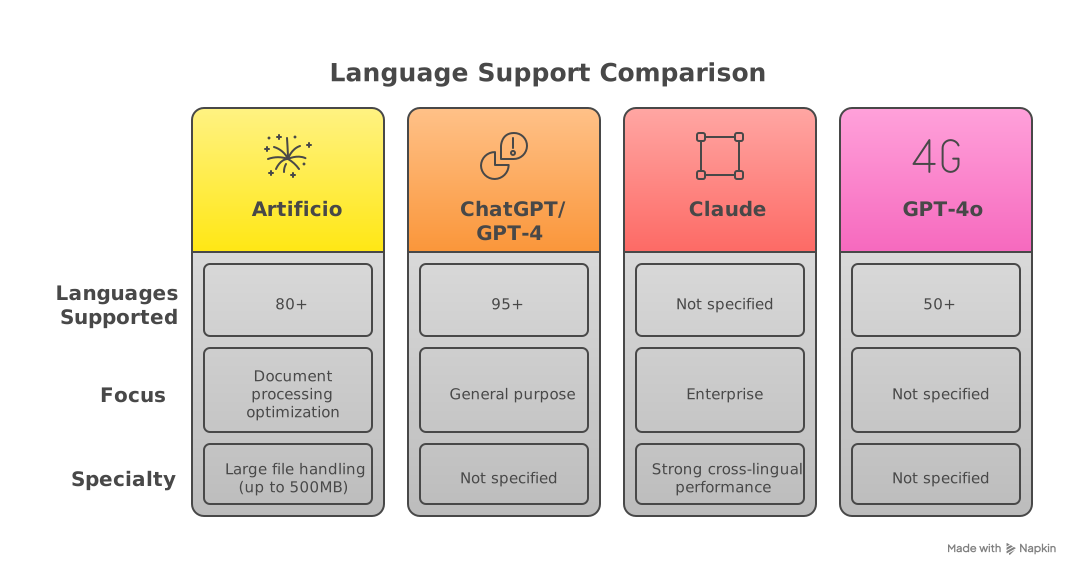
To understand Artificio's multilingual capabilities in context, it is essential to examine the language support landscape among leading Large Language Models. Current industry leaders like ChatGPT support over 80-95 languages, while Claude demonstrates robust multilingual capabilities with particularly strong performance in zero-shot tasks across languages, maintaining consistent relative performance across both widely-spoken and lower-resource languages. GPT-4o supports over 50 languages, which OpenAI claims cover over 97% of speakers, providing a comprehensive baseline for multilingual document processing capabilities.
Artificio's language support extends far beyond basic multilingual recognition to encompass the nuanced variations that exist within language families, targeting comprehensive coverage that matches or exceeds these industry standards. The system demonstrates proficiency in major world languages including English, Spanish, French, German, Italian, Portuguese, Russian, Chinese (both Simplified and Traditional), Japanese, Korean, Arabic, Hindi, Bengali, Urdu, Turkish, Vietnamese, Thai, Indonesian, Malay, Dutch, Swedish, Norwegian, Danish, Finnish, Polish, Czech, Hungarian, Romanian, Bulgarian, Croatian, Serbian, Slovak, Slovenian, Estonian, Latvian, Lithuanian, Greek, Hebrew, Persian, and numerous others, representing a language portfolio that encompasses the linguistic diversity required for enterprise-scale document processing.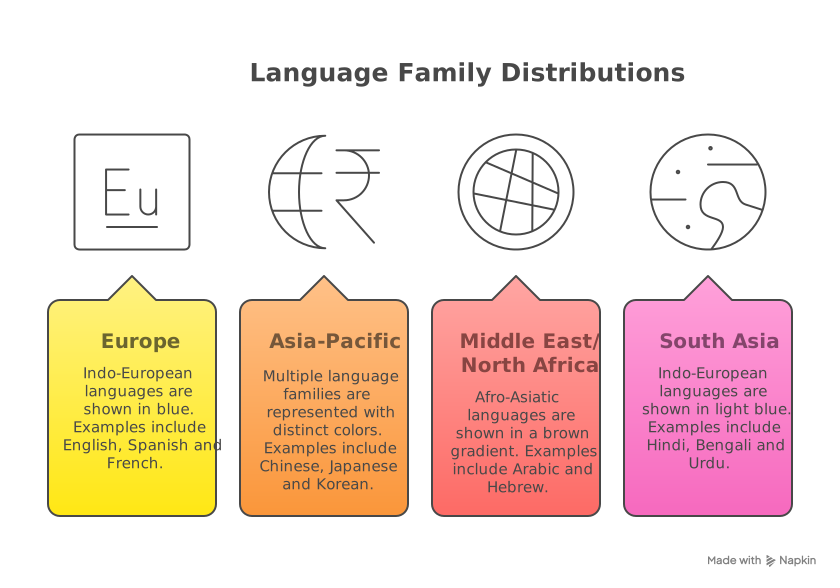
The sophistication of Artificio's language processing becomes particularly evident when examining its handling of regional variants and dialectical differences. Spanish documents from Mexico are processed differently from those originating in Argentina or Spain, with the system recognizing not only vocabulary differences but also structural and contextual variations that affect meaning. Similarly, Portuguese documents from Brazil receive processing considerations distinct from those written in European Portuguese, ensuring that cultural and linguistic nuances are preserved in the analysis.
This attention to regional variation extends to languages with complex writing systems and cultural contexts. Arabic documents from different regions whether Modern Standard Arabic used in formal communications or regional variants common in business documents from the Gulf states, North Africa, or the Levant are processed with appropriate contextual awareness. The system's understanding of right-to-left text flow, combined with its ability to process mixed-direction documents containing both Arabic and Latin scripts, demonstrates the depth of its multilingual architecture.
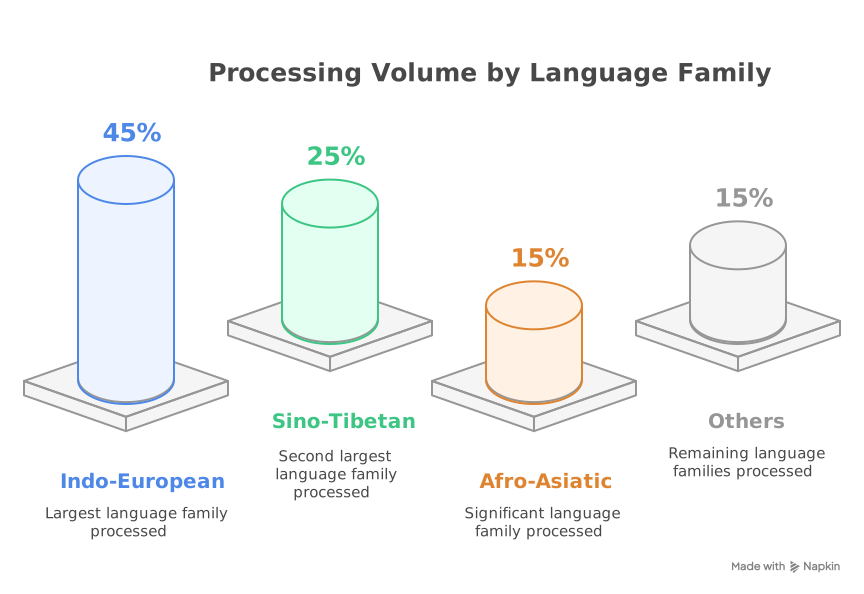
The integration of OCR technology with multilingual LLM capabilities represents one of Artificio's most significant technical achievements. Traditional OCR systems often struggle with non-Latin scripts, complex layouts, and the subtle variations in character recognition that occur across different languages. Artificio's approach combines computer vision advances with deep learning models specifically trained on diverse linguistic datasets, enabling accurate text extraction from documents regardless of their original format or language.
Processing scanned documents presents unique challenges that multiply when multiple languages are involved. A single document might contain headers in English, body text in the local language, and footnotes or technical specifications in yet another language. Artificio's OCR system identifies these language transitions automatically, applying appropriate recognition models for each section while maintaining the document's structural integrity. This capability proves invaluable when processing historical documents, international contracts, or technical manuals that commonly employ multiple languages within a single file.
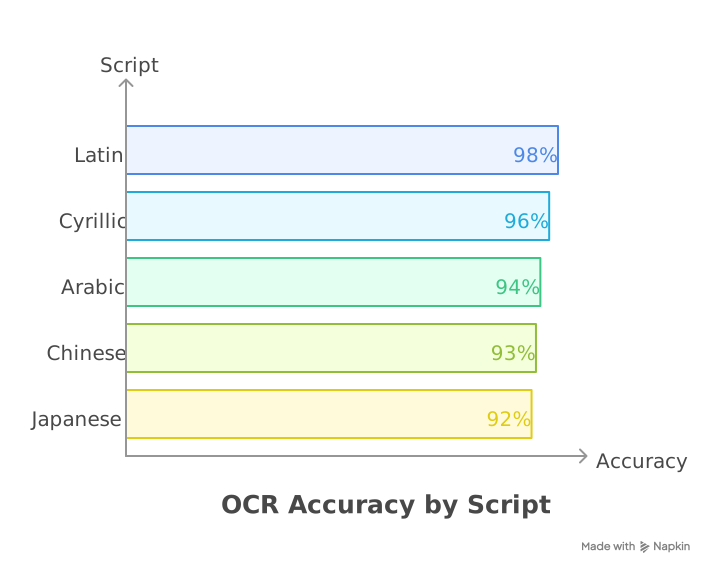
The system's OCR accuracy rates remain consistently high across different script types, from the precise character recognition required for Chinese ideographs to the flowing scripts of Arabic languages and the accent marks critical to proper recognition in Romance languages. Quality control mechanisms built into the OCR pipeline identify potential recognition errors and apply confidence scoring that helps users understand the reliability of extracted text for each section of processed documents.
Managing documents up to 500MB requires sophisticated memory management and processing optimization that goes beyond simple text analysis. Large multilingual documents often contain embedded images, complex formatting, multiple fonts, and various media elements that must be preserved while ensuring efficient processing. Artificio's architecture employs distributed processing techniques that break large documents into manageable segments while maintaining contextual relationships across sections.
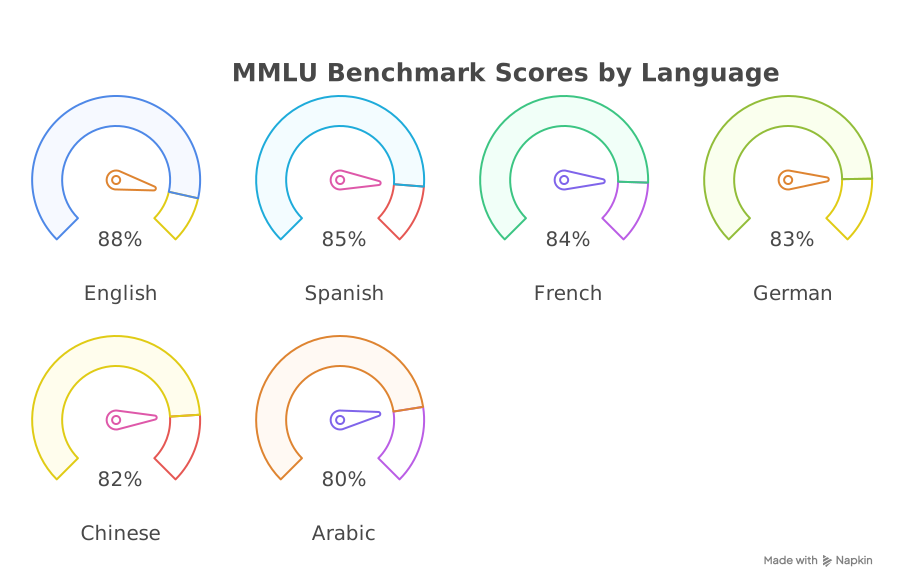
Artificio's multilingual capabilities are measured against established industry benchmarks that provide quantitative assessment of language processing accuracy. The Massive Multitask Language Understanding (MMLU) benchmark, translated into 14 languages by professional human translators, serves as a critical evaluation framework for multilingual performance. Leading models demonstrate varying degrees of multilingual proficiency, with Claude maintaining strong cross-lingual performance relative to English across widely-spoken and lower-resource languages, while GPT-4 achieves 86.4% accuracy on MMLU in English with corresponding performance metrics across other languages.
These benchmarks reveal that multilingual performance typically follows predictable patterns based on training data availability and linguistic similarity to English. Claude demonstrates robust multilingual capabilities, with particularly strong performance in zero-shot tasks across languages, maintaining consistent relative performance across both widely-spoken and lower-resource languages. For context, ChatGPT supports more than 80 languages, including English, Spanish, French, German, Chinese, Japanese, Arabic, and many more, while GPT-4o supports over 50 languages, which OpenAI claims cover over 97% of speakers.
Artificio leverages these established evaluation frameworks while implementing additional quality assurance measures specific to document processing workflows. The system's performance metrics account for the unique challenges of processing large files where language transitions occur frequently, maintaining accuracy standards that exceed baseline multilingual benchmarks through specialized optimization for document-centric tasks. Performance evaluation extends beyond simple text comprehension to encompass OCR accuracy across different scripts, contextual understanding preservation during language transitions, and response generation quality when synthesizing information from multilingual sources. 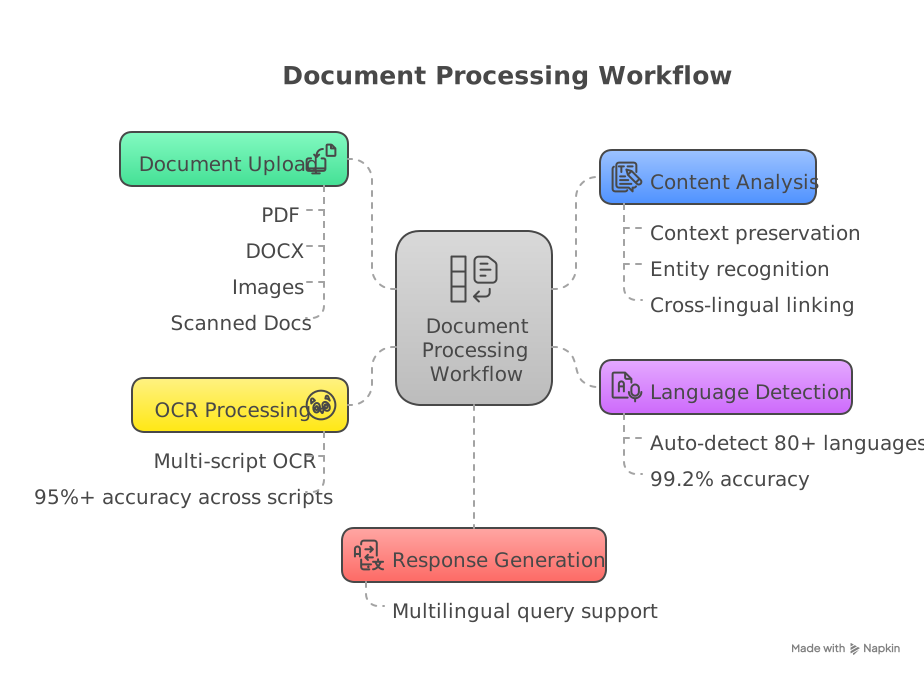
The challenge of processing large multilingual files extends beyond simple storage and memory considerations to include the computational complexity of language detection and switching. A 500MB document might contain thousands of pages with multiple language transitions, requiring the system to maintain separate linguistic contexts while building comprehensive understanding of the document's overall meaning and structure. Artificio accomplishes this through parallel processing streams that handle different languages simultaneously while sharing contextual information through sophisticated cross-referencing mechanisms. 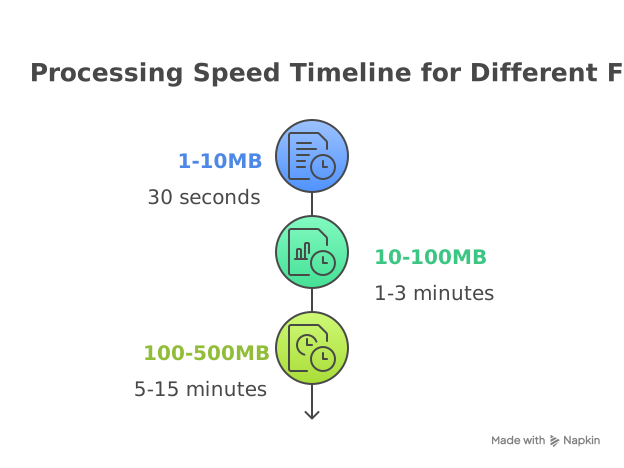
Processing speed remains optimized despite the complexity of multilingual analysis. The system employs predictive caching mechanisms that anticipate likely query patterns for different document types and languages, pre-processing common analytical pathways to reduce response times. For technical documents containing multiple languages, this might involve pre-analyzing technical terminology across language boundaries, while for legal documents, it might focus on identifying key clauses and their relationships regardless of the languages in which they appear.
Perhaps the most sophisticated aspect of Artificio's multilingual document processing lies in its ability to maintain contextual understanding across language boundaries within individual documents. Many enterprise documents naturally incorporate multiple languages international contracts with sections in local languages, technical manuals with specifications in the manufacturer's language, or research collaborations with contributions from multiple linguistic communities. Traditional document processing systems treat these as separate linguistic islands, but Artificio recognizes the interconnected nature of multilingual content.
The system builds comprehensive semantic models that recognize when concepts introduced in one language are referenced or developed in another section written in a different language. This cross-linguistic contextual awareness enables sophisticated analysis capabilities such as identifying contradictions between sections written in different languages, tracking concept development across linguistic boundaries, and providing comprehensive summaries that synthesize information regardless of the source language.
Cross-language entity recognition represents another crucial capability, particularly for business and legal documents. When a person's name appears in Arabic script in one section and Latin script in another, or when a company name is referenced in both its original language and local translations, Artificio maintains entity consistency across these variations. This capability extends to technical terms, legal concepts, and specialized vocabulary that might appear in original languages even within documents written primarily in other languages.
Artificio's multilingual processing capabilities are enhanced through specialized optimization for different document types and industry applications. Legal documents require particular attention to precise terminology and the preservation of meaning across languages, especially when dealing with contracts that incorporate multiple legal systems. The system recognizes legal terminology patterns across different languages and maintains awareness of how legal concepts might have different implications in different jurisdictions.
Technical documentation presents its own set of challenges, particularly when dealing with international standards, specifications, and manufacturing documents. Artificio processes these materials with awareness of technical terminology standards, recognizing when specific terms should be preserved in their original languages versus when translation or explanation enhances understanding. This proves particularly valuable for engineering firms, manufacturing companies, and technology organizations working with international suppliers and partners.
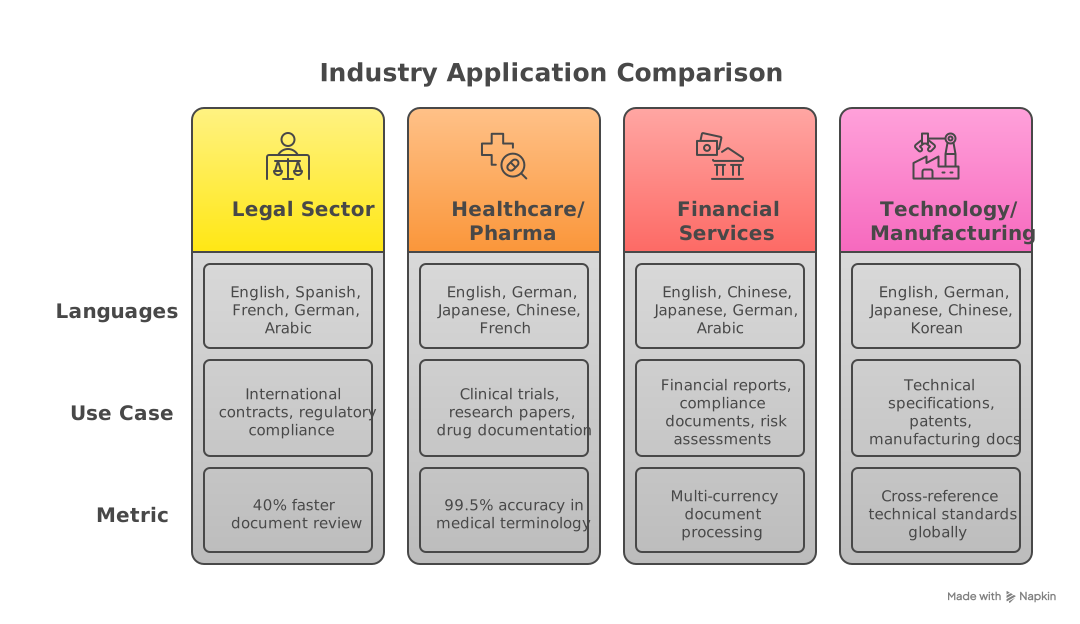
Financial documents require careful handling of numerical information, currency references, and regulatory terminology that varies significantly across different markets and languages. Artificio processes these documents while maintaining accuracy in financial calculations and preserving the precise meaning of regulatory language that might have specific legal implications in different jurisdictions. The system recognizes financial terminology patterns and maintains consistency in how financial concepts are interpreted across different linguistic contexts.
Healthcare and pharmaceutical documents demand exceptional accuracy due to the critical nature of medical information. Artificio processes multilingual medical documents while maintaining strict accuracy standards for drug names, medical procedures, and clinical terminology. The system recognizes that medical terminology often incorporates Latin roots that remain consistent across languages while being aware of regional variations in medical practice descriptions and regulatory requirements.
The true test of multilingual document processing capability lies in how effectively users can interact with processed content regardless of the languages involved in the original documents. Artificio enables users to pose queries in their preferred language while drawing responses from documents written in entirely different languages. This cross-linguistic query capability relies on sophisticated semantic matching that goes beyond simple translation to understand conceptual relationships across languages.
Response generation maintains linguistic appropriateness while ensuring accuracy and completeness. When responding to a query posed in English about content extracted from documents in multiple languages, the system provides responses that acknowledge the multilingual sources while presenting information in a coherent, linguistically appropriate manner. Direct quotations are preserved in their original languages when precision is crucial, while conceptual summaries are presented in the query language with appropriate context about their multilingual sources.
The system handles complex analytical queries that require synthesis across multilingual sources with particular sophistication. Questions that ask for comparisons between policies described in different languages, analyses of concepts that appear across multilingual document sets, or summaries that must account for information presented in various languages receive responses that demonstrate genuine cross-linguistic understanding rather than simple aggregation of translated content.
Maintaining high accuracy standards across multiple languages and large file sizes requires comprehensive quality assurance mechanisms built into every stage of the processing pipeline. Artificio employs multi-layered validation systems that begin with language detection confidence scoring and extend through OCR accuracy assessment, content extraction verification, and response quality evaluation.
Language detection accuracy proves crucial for proper processing, and Artificio's systems maintain detailed metrics on detection confidence levels across different document types and languages. These metrics help identify when manual review might be beneficial and provide users with transparency about the system's confidence in its linguistic analysis. For documents containing multiple languages, the system provides detailed breakdowns of language distribution and confidence levels for each detected section.
OCR quality assessment occurs in real-time during processing, with the system flagging sections where character recognition confidence falls below established thresholds. These quality indicators help users understand which portions of large documents might benefit from manual review and ensure that critical information extraction maintains appropriate accuracy standards.
Enterprise deployment of multilingual document processing requires seamless integration with existing workflows and systems. Artificio provides robust API access that enables organizations to incorporate multilingual document processing into their existing document management systems, content repositories, and analytical workflows. These integration capabilities ensure that multilingual processing becomes a natural extension of existing business processes rather than a separate system requiring additional workflow development.
The system supports batch processing capabilities that enable organizations to process large volumes of multilingual documents efficiently. This proves particularly valuable for organizations dealing with regulatory compliance across multiple jurisdictions, international merger and acquisition activities, or research initiatives that involve multilingual literature reviews. Batch processing maintains the same quality standards as individual document processing while optimizing resource utilization for large-scale operations.
Workflow optimization extends to user interface considerations that accommodate multilingual content presentation. The system provides flexible display options that can present multilingual content in ways that facilitate user understanding while preserving the linguistic authenticity of source materials. This includes support for right-to-left languages, mixed-direction text presentation, and appropriate font handling for diverse script types.
Processing multilingual documents often involves handling sensitive information across different regulatory environments. Artificio maintains robust security protocols that protect document content throughout the processing pipeline while ensuring compliance with international data protection regulations. The system recognizes that documents in different languages might be subject to different regulatory requirements and provides appropriate handling mechanisms.
Data residency considerations become particularly important when processing multilingual documents, as content in different languages might be subject to different jurisdictional requirements. Artificio's architecture provides flexibility in data handling that enables organizations to meet their specific compliance requirements while maintaining processing efficiency across different linguistic content.
Privacy protection mechanisms account for the reality that multilingual documents might contain personal information expressed in various languages and cultural contexts. The system applies appropriate privacy protection measures while recognizing that personal information patterns vary across different languages and cultural contexts.
The field of multilingual document processing continues to evolve rapidly, with new languages, writing systems, and processing requirements emerging regularly. Artificio maintains active development programs that expand language support, improve processing accuracy, and enhance integration capabilities based on user feedback and technological advances.
Emerging technologies in natural language processing and computer vision continue to enhance multilingual document processing capabilities. Artificio incorporates these advances while maintaining backward compatibility and processing consistency that organizations depend upon for their critical document processing workflows.
The future of multilingual document processing lies in even more sophisticated cross-linguistic analysis capabilities, enhanced real-time processing speeds, and expanded integration options that make multilingual content as accessible as monolingual materials. Artificio continues to lead these developments while maintaining the reliability and accuracy that enterprise users require for their most important multilingual document processing needs.
Through its comprehensive approach to multilingual document processing, Artificio transforms the challenge of large-scale multilingual content analysis from a significant barrier into a seamless capability that enhances organizational effectiveness in our increasingly connected global business environment.

Head IT Operations - Co Founder of Artificio
See it in your SAP environment
Bring us a document, a process, or a bottleneck. We'll show how Artificio captures, validates, and posts into SAP — then scale from there.
Security & compliance
ISO 27001:2013 certified, SOC 2 Type 2 compliant, GDPR and HIPAA ready. Every agent action is logged, auditable, and runs in isolated environments.