

Blog
How Artificio's Large-File Processing Transforms Enterprise Data Analysis
AI-driven Artificio analyzes large business data (up to 500MB) for strategic decisions, democratizing advanced analytics.

Blog
AI-driven Artificio analyzes large business data (up to 500MB) for strategic decisions, democratizing advanced analytics.
In the contemporary business landscape, the exponential growth of data has become both an unprecedented opportunity and a formidable challenge for organizations across industries. The digital transformation has resulted in the proliferation of extensive datasets that contain valuable insights capable of informing strategic decision-making, optimizing operational efficiency, and driving innovation. However, the sheer volume and complexity of these datasets have traditionally posed significant barriers to extraction and analysis, particularly for non-technical stakeholders who may lack specialized data science expertise. This disconnect between data availability and accessibility represents a critical gap in the modern business intelligence ecosystem a gap that emerging AI-driven solutions like Artificio are specifically designed to address.
The evolution of business intelligence has been marked by several distinct phases, beginning with rudimentary reporting tools and gradually progressing toward more sophisticated analytics platforms. The earliest iterations of business intelligence software primarily focused on historical data analysis and basic reporting functionalities, offering limited capabilities for predictive analytics or real-time decision support. As computational capabilities expanded, so too did the scope and utility of business intelligence solutions, incorporating advanced statistical models and visualization tools to enhance data interpretation. The most recent paradigm shift in this evolutionary trajectory has been precipitated by the integration of artificial intelligence and machine learning technologies, which have fundamentally transformed the way organizations interact with their data assets.
Artificio represents the vanguard of this new generation of AI-enhanced business intelligence platforms, distinguishing itself through a unique confluence of accessibility, computational power, and analytical sophistication. At the core of Artificio's value proposition is its remarkable capacity for processing extraordinarily large files up to 500 megabytes a capability that substantially exceeds the limitations of conventional web-based language model interfaces. This expanded processing capacity enables organizations to analyze comprehensive documents, extensive datasets, and complex information repositories that would otherwise require fragmentation or specialized preprocessing to accommodate the constraints of standard analytical tools.
This article explores the transformative potential of Artificio's large-file processing capabilities within the broader context of business intelligence and data analytics. Through an examination of technical architecture, practical applications, and comparative advantages, we will elucidate how Artificio is reconfiguring the relationship between businesses and their data resources, democratizing access to sophisticated analytical tools, and ultimately catalyzing more informed decision-making across organizational hierarchies. By bridging the traditionally siloed domains of data science and business operations, Artificio exemplifies the next evolutionary stage in business intelligence one characterized by intuitive interfaces, robust processing capabilities, and the seamless integration of artificial intelligence into everyday business processes.
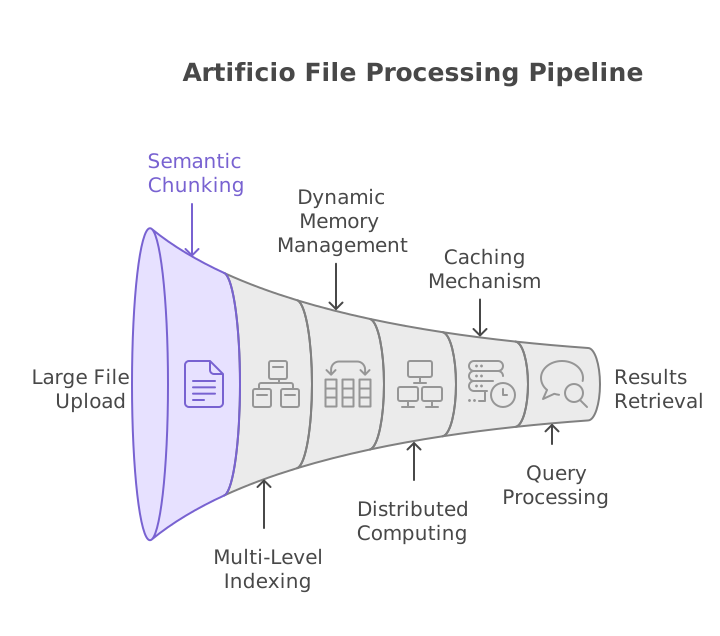
The exceptional file-processing capabilities that distinguish Artificio from conventional language model interfaces are underpinned by a sophisticated technical architecture specifically engineered to accommodate and efficiently analyze extensive datasets. Understanding the fundamental components of this architecture provides valuable insight into how Artificio transcends the limitations that have traditionally constrained web-based analytical platforms. The system's ability to process files up to 500 megabytes represents a significant technical achievement one that requires innovative approaches to data chunking, memory management, and computational resource allocation.
At the foundation of Artificio's architecture is an advanced document processing pipeline that begins with the initial file upload. When a user submits a large document or dataset, the system employs adaptive chunking algorithms that partition the file into manageable segments while preserving the semantic relationships and contextual continuity between different sections. Unlike conventional chunking methods that might arbitrarily divide text based solely on character or token counts, Artificio's approach is designed to recognize natural document structures, such as chapters, sections, paragraphs, and thematic units. This semantically-aware segmentation ensures that the integrity of information is maintained throughout the analytical process, preventing the fragmentation of critical concepts or the disruption of important contextual elements.
The chunked documents then undergo a sophisticated indexing process that creates navigable data structures optimized for efficient retrieval and analysis. This indexing phase incorporates multiple layers of metadata tagging, including semantic classification, entity recognition, and relationship mapping. By generating comprehensive indices at various levels of granularity, Artificio establishes a multidimensional representation of the document that facilitates rapid and precise information retrieval. When a user submits a query through the chat interface, the system can quickly identify and access relevant sections without needing to reprocess the entire document, substantially reducing computational overhead and enhancing response time despite the substantial file size.
A critical component in Artificio's ability to handle large files is its implementation of sophisticated memory management techniques that optimize resource utilization throughout the analytical workflow. Traditional language model interfaces often load entire documents into memory, creating substantial computational bottlenecks when processing extensive files. In contrast, Artificio employs a dynamic memory allocation approach that selectively loads and unloads document segments based on their relevance to ongoing analytical tasks. This adaptive resource management enables the system to maintain responsive performance even when dealing with exceptionally large files, effectively circumventing the memory constraints that typically limit web-based analytical platforms.
The integration of distributed computing frameworks further enhances Artificio's processing capabilities, allowing the system to parallelize computational tasks across multiple nodes when analyzing particularly complex or extensive documents. By distributing the analytical workload, Artificio can simultaneously process different sections of a large document, substantially reducing the time required to extract meaningful insights from comprehensive datasets. This parallelization is implemented through a carefully orchestrated architecture that coordinates analytical processes across distributed resources while maintaining data coherence and consistency throughout the analytical pipeline.
Artificio's technical architecture also incorporates advanced caching mechanisms that further optimize performance when handling large files. The system maintains intelligent caches of frequently accessed document segments, previously computed analyses, and common query patterns, reducing redundant processing and enhancing responsiveness during interactive analytical sessions. These caching strategies are particularly valuable in enterprise contexts where multiple stakeholders may need to analyze the same document from different perspectives, as they eliminate the need to repeatedly process identical content across different analytical sessions.
The culmination of these architectural components is a system capable of transcending the file size limitations that have traditionally constrained web-based language model interfaces. By implementing innovative approaches to document segmentation, indexing, memory management, distributed computing, and caching, Artificio establishes a foundation for analyzing extensive documents that would otherwise exceed the processing capabilities of conventional analytical platforms. This expanded processing capacity represents a significant advancement in business intelligence technology, enabling organizations to extract meaningful insights from comprehensive information resources without requiring specialized technical expertise or dedicated computational infrastructure.
The landscape of language model interfaces has expanded considerably in recent years, with numerous platforms offering various capabilities for natural language processing and document analysis. However, a critical examination of these platforms reveals substantial limitations in their capacity to process large files limitations that Artificio has specifically designed its architecture to overcome. Understanding these comparative differences illuminates the distinct advantages that Artificio offers for organizations dealing with extensive documents and comprehensive datasets.
Conventional language model interfaces typically impose stringent constraints on file sizes, with most platforms limiting uploads to between 10 and 25 megabytes. For instance, ChatGPT generally restricts file sizes to approximately 20-25 megabytes, while Google's Gemini maintains similar limitations of around 20 megabytes per file. Other prominent platforms such as Claude and Perplexity demonstrate even more restrictive parameters, permitting files of only 10-15 megabytes. These constraints reflect the computational challenges associated with processing extensive documents within web-based environments, particularly when maintaining the responsive performance that users expect from interactive analytical platforms.
The implications of these file size limitations extend far beyond mere technical considerations, fundamentally constraining the types of documents and datasets that organizations can analyze through conventional language model interfaces. Comprehensive business reports, extensive legal documentation, complete financial datasets, and detailed technical specifications frequently exceed these size limitations, necessitating artificial fragmentation that disrupts the contextual continuity of the information. This fragmentation can significantly impede analytical quality, as it requires analysts to manually partition documents in ways that may not align with their natural semantic structure, potentially obscuring important relationships between different sections of the content.
Artificio's capacity to process files up to 500 megabytes represents a transformative advancement in this context, expanding the range of analyzable documents by orders of magnitude compared to conventional platforms. This expanded processing capacity eliminates the need for artificial document fragmentation, preserving the semantic integrity of extensive information resources and enabling more comprehensive analytical perspectives. The ability to analyze complete documents within their full context enhances the quality and reliability of extracted insights, providing organizations with a more accurate understanding of complex information landscapes than would be possible through fragmented analysis.
Beyond raw file size capabilities, Artificio also distinguishes itself through its implementation of sophisticated analytical tools specifically designed for large document processing. While conventional language model interfaces often employ generalized analytical approaches that may not adequately address the unique challenges of extensive documents, Artificio incorporates specialized techniques optimized for navigating and extracting insights from comprehensive information resources. These include advanced document mapping functionalities that help users visualize the structure and relationships within large documents, alongside targeted extraction capabilities that can identify and retrieve specific information elements without requiring users to manually search through extensive content.
The distinction between Artificio and conventional language model interfaces extends to their integration capabilities as well. Traditional platforms often operate as standalone tools with limited connectivity to enterprise systems, requiring users to manually transfer information between different applications. In contrast, Artificio offers seamless integration with both ERP and non-ERP systems, facilitating the bidirectional flow of information between analytical processes and operational workflows. This integration enables organizations to directly incorporate insights from large document analysis into their business processes, enhancing the practical utility and organizational impact of the analytical capabilities.
Another significant differentiator lies in Artificio's approach to user engagement and analytical interaction. Conventional language model interfaces typically employ standardized query-response paradigms that may not adequately support the nuanced exploration of extensive documents. Artificio, however, implements a more sophisticated conversational interface specifically designed for navigating complex information landscapes. This interface enables users to progressively refine their analytical focus through natural language interactions, exploring different dimensions of large documents without requiring specialized query syntax or technical expertise. This conversational approach to document analysis substantially enhances accessibility for non-technical stakeholders, democratizing access to insights that might otherwise remain confined within specialized analytical domains.
The pricing and accessibility models also differ substantially between Artificio and conventional language model interfaces. While the expanded processing capabilities of enterprise-grade alternatives to standard platforms typically come with prohibitive cost structures and complex implementation requirements, Artificio offers its 500-megabyte processing capability through an accessible web interface with a pragmatic pricing model aligned with organizational value. This combination of advanced technical capabilities and practical accessibility enables a broader range of organizations to benefit from large document analysis without requiring substantial infrastructure investments or specialized technical resources.
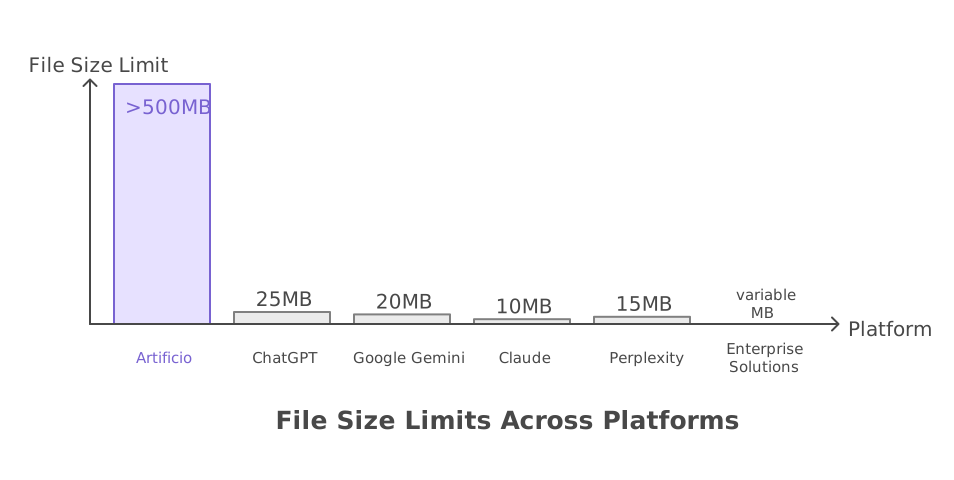
In aggregate, these comparative distinctions highlight the fundamental advantages that Artificio offers over conventional language model interfaces, particularly for organizations dealing with extensive documents and comprehensive datasets. By transcending the file size limitations of traditional platforms while simultaneously enhancing analytical capabilities, integration options, and accessibility, Artificio establishes a new paradigm for large document analysis one that aligns sophisticated technical capabilities with practical business requirements.
The theoretical advantages of enhanced file-processing capabilities acquire practical significance when examined within specific business contexts where large documents and extensive datasets are commonplace. Across diverse industries, organizations routinely generate and analyze comprehensive information resources that exceed the processing limitations of conventional language model interfaces. Artificio's capacity to accommodate files up to 500 megabytes opens new analytical possibilities in these contexts, enabling more comprehensive understanding and more informed decision-making than would otherwise be possible.
In the legal sector, comprehensive case files, extensive contract collections, and complete regulatory documentation frequently exceed the processing limitations of traditional language model interfaces. Legal professionals often need to analyze thousands of pages of documentation to identify relevant precedents, extract pertinent clauses, or understand complex regulatory frameworks. Artificio's large-file processing capabilities enable attorneys to upload complete legal resources without artificial fragmentation, preserving the contextual relationships that are often critical for accurate legal interpretation. The ability to analyze extensive legal documentation within its full context enhances the quality of legal research, reduces the risk of overlooking relevant information, and ultimately contributes to more thorough and well-informed legal strategies.
Financial analysis similarly benefits from enhanced file-processing capabilities, particularly when dealing with comprehensive financial reports, complete transaction records, and extensive market data. Financial professionals routinely work with datasets that contain thousands or even millions of entries, representing transaction histories, investment performances, or market movements across extended time periods. These datasets often exceed the processing limitations of conventional analytical platforms, necessitating artificial segmentation that can obscure important patterns and relationships. Artificio's ability to process large financial datasets in their entirety enables more comprehensive analysis, facilitating the identification of subtle patterns, long-term trends, and complex relationships that might remain hidden when examining fragmented information.
The healthcare industry generates some of the most extensive and complex documentation across any sector, including comprehensive medical records, complete clinical trial data, and extensive research literature. Healthcare professionals need to navigate these extensive information resources to understand patient histories, identify treatment patterns, and stay informed about the latest research developments. Traditional language model interfaces often cannot accommodate complete medical documentation, requiring artificial partitioning that disrupts the continuity of patient information or research narratives. Artificio's expanded processing capacity enables healthcare professionals to analyze comprehensive medical documentation within its full context, enhancing diagnostic accuracy, treatment planning, and research understanding.
In manufacturing and engineering contexts, technical documentation frequently spans thousands of pages, incorporating detailed specifications, comprehensive testing data, and extensive operational guidelines. Engineers and technical professionals need to navigate these resources to understand complex systems, troubleshoot operational issues, and ensure compliance with detailed specifications. The size of complete technical documentation often exceeds the processing capabilities of standard analytical platforms, necessitating fragmentation that can obscure important technical relationships. Artificio's large-file processing capabilities enable engineers to analyze comprehensive technical documentation in its entirety, enhancing system understanding, troubleshooting effectiveness, and specification compliance.
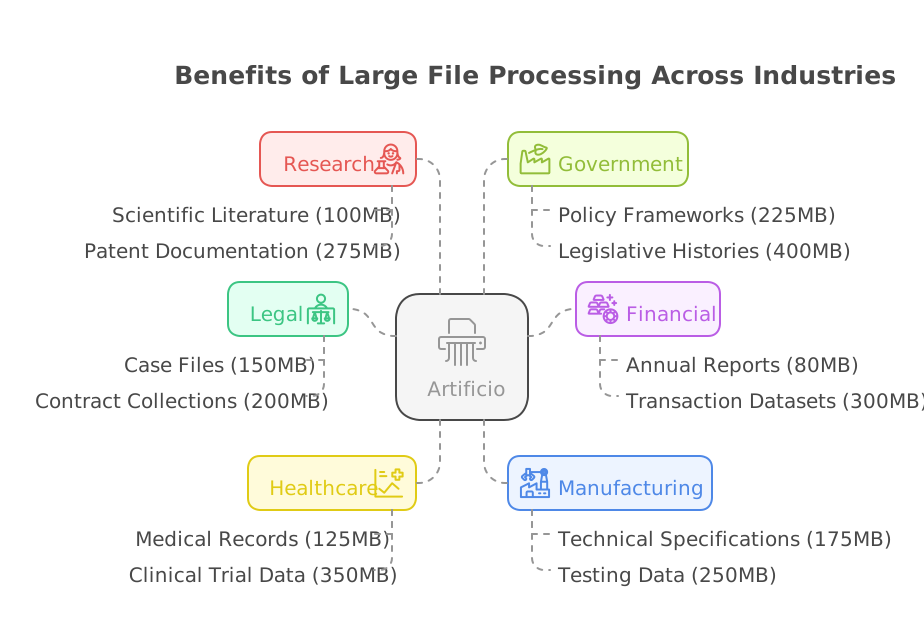
Research and development activities across industries similarly benefit from enhanced file-processing capabilities, particularly when analyzing comprehensive scientific literature, complete experimental datasets, and extensive patent documentation. Researchers routinely work with information resources that exceed the processing limitations of conventional language model interfaces, requiring artificial segmentation that can disrupt the continuity of scientific narratives or experimental analyses. Artificio's ability to process large research documents in their entirety facilitates more comprehensive understanding of scientific literature, more thorough analysis of experimental data, and more effective navigation of patent landscapes.
Government and public sector organizations handle some of the most extensive documentation across any domain, including comprehensive policy frameworks, complete legislative histories, and extensive public records. Government officials and policy analysts need to navigate these resources to understand regulatory environments, analyze policy impacts, and ensure compliance with legislative requirements. The size of complete government documentation frequently exceeds the processing capabilities of standard analytical platforms, necessitating fragmentation that can obscure important policy relationships. Artificio's expanded processing capacity enables government professionals to analyze comprehensive policy documentation within its full context, enhancing regulatory understanding, policy analysis, and compliance monitoring.
Beyond these industry-specific applications, large-file processing capabilities offer substantial benefits for cross-functional activities that span organizational boundaries. Strategic planning processes often incorporate extensive market analyses, comprehensive competitive intelligence, and complete operational assessments documents that frequently exceed the processing limitations of conventional analytical platforms. Artificio's ability to analyze these comprehensive resources in their entirety enables more informed strategic decision-making, facilitating the integration of diverse information perspectives into cohesive strategic frameworks. Similarly, due diligence processes during mergers and acquisitions involve analyzing extensive financial records, comprehensive legal documentation, and complete operational assessments information resources that benefit substantially from Artificio's enhanced processing capabilities.
The practical value of large-file processing extends to educational and training contexts as well, where comprehensive textbooks, complete course materials, and extensive academic resources frequently exceed the processing limitations of standard analytical platforms. Educators and students benefit from the ability to analyze complete educational resources within their full context, enhancing learning comprehension, research effectiveness, and academic understanding. Artificio's conversational interface makes these comprehensive educational resources more accessible to learners at various levels, democratizing access to sophisticated analytical capabilities within educational environments.
The common thread connecting these diverse practical applications is the enhanced analytical quality and decision-making confidence that results from analyzing comprehensive information resources within their full context. By eliminating the need for artificial document fragmentation, Artificio enables organizations to maintain the semantic integrity of their information assets throughout the analytical process, preserving important relationships and contextual elements that might otherwise be disrupted when processing large files through conventional platforms. This enhanced contextual understanding translates into more accurate insights, more informed decisions, and ultimately more effective organizational outcomes across industries and functional domains.
A particularly transformative aspect of Artificio's approach to large-file processing lies in its democratization of advanced analytics making sophisticated data analysis accessible to stakeholders without specialized technical expertise. Traditional approaches to analyzing extensive documents and complex datasets have typically required specialized skills in data science, programming, or statistical analysis. This technical barrier has often confined the benefits of sophisticated data analysis to specialized departments or external consultants, creating analytical bottlenecks and impeding the integration of data-driven insights into everyday business processes. Artificio's user-centric design philosophy directly addresses this limitation, establishing an interface that combines powerful analytical capabilities with intuitive interaction paradigms.
The democratization of advanced analytics begins with Artificio's user interface, which employs a conversational interaction model familiar to users across technical backgrounds. Rather than requiring specialized query languages or technical parameters, Artificio enables users to formulate analytical questions using natural language expressions the same linguistic constructs they would use when discussing the document with human colleagues. This conversational approach substantially reduces the learning curve associated with sophisticated analytical tools, enabling stakeholders from diverse functional backgrounds to engage directly with complex information resources without requiring technical intermediaries. The ability to interact with extensive documents through natural conversation eliminates a fundamental barrier that has traditionally restricted access to advanced analytical capabilities.
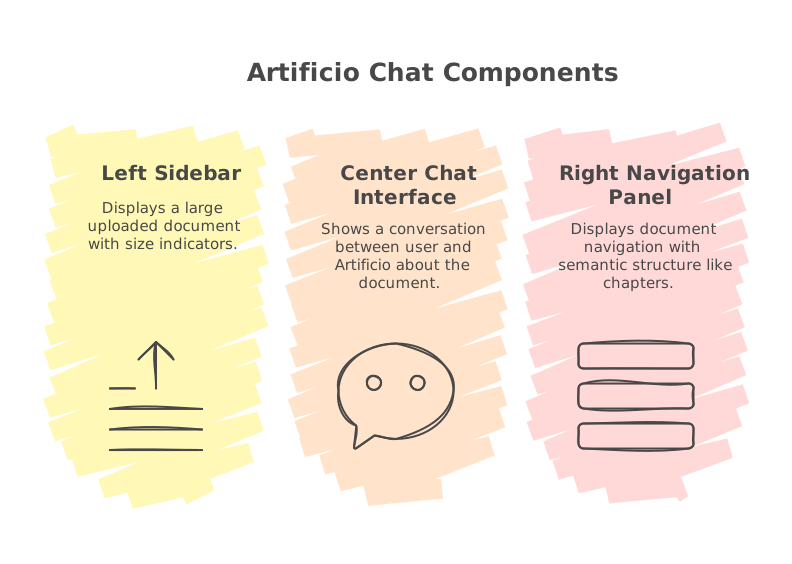
Beyond its conversational interface, Artificio incorporates drag-and-drop components that further enhance accessibility for non-technical users. These visual interaction elements enable users to manipulate and analyze data through intuitive gestures rather than technical commands, making sophisticated analytical operations accessible to stakeholders without programming expertise. The drag-and-drop functionality extends to various analytical processes, including data extraction, visualization configuration, and workflow automation. By translating complex technical operations into visual interactions, Artificio enables users to perform sophisticated analytical tasks without needing to understand the underlying technical mechanisms, substantially expanding the population of stakeholders who can directly engage with organizational data assets.
The democratization of analytics is further enhanced through Artificio's contextual guidance capabilities, which provide users with adaptive suggestions and explanations throughout the analytical process. As users interact with extensive documents, the system offers contextually relevant recommendations for potential analytical pathways, highlighting important elements within the document and suggesting productive avenues for further exploration. These guidance features function as an embedded analytical mentor, helping users navigate complex information landscapes and progressively develop their analytical skills through practical application. The combination of powerful analytical capabilities with contextual guidance creates an environment where users can gradually expand their analytical sophistication within the flow of their everyday work.
Artificio's approach to data visualization similarly contributes to analytical democratization by automatically generating intuitive visual representations of complex information. When analyzing extensive datasets or documents, the system can identify appropriate visualization formats based on the data characteristics and analytical context, presenting complex information in easily interpretable visual formats without requiring users to manually configure visualization parameters. These automated visualization capabilities help non-technical users identify patterns, trends, and relationships within complex datasets that might otherwise remain obscured within textual or tabular representations, enhancing analytical comprehension across technical backgrounds.
The system's form-generation capabilities represent another dimension of analytical democratization, enabling users to create structured data collection instruments without requiring technical expertise in form design or database architecture. Non-technical users can define the information they need to collect and Artificio automatically generates appropriate form structures, establishing the underlying data schemas and validation rules without requiring manual technical configuration. This capability enables functional specialists to design data collection processes aligned with their domain expertise, reducing dependence on technical resources and accelerating the implementation of data-driven workflows across organizational functions.
The workflow automation features further extend analytical democratization by enabling non-technical users to establish sophisticated process sequences without requiring programming expertise. Through intuitive visual interfaces, users can define conditional logic, processing rules, and decision pathways that automatically execute in response to predefined triggers or conditions. This automation capability enables functional specialists to embed their domain expertise within automated processes, translating their operational knowledge into executable workflows without requiring technical intermediaries. The ability to automate complex processes through intuitive interfaces substantially expands the scope of operational optimization that non-technical stakeholders can directly influence.
Artificio's integration with both ERP and non-ERP systems further enhances analytical democratization by connecting sophisticated analytical capabilities with everyday operational processes. Through pre-configured connectors and intuitive integration interfaces, non-technical users can establish bidirectional data flows between Artificio's analytical environment and various operational systems, ensuring that insights derived from large document analysis can directly inform operational decisions. This seamless integration eliminates the technical barriers that have traditionally separated analytical processes from operational workflows, enabling a more fluid incorporation of data-driven insights into everyday business activities.
The enhanced accessibility enabled by these features transforms the organizational dynamics surrounding data analysis, shifting analytical capabilities from specialized technical domains into everyday business processes. When non-technical stakeholders can directly analyze extensive documents and complex datasets without requiring technical intermediaries, several important organizational benefits emerge. Analytical bottlenecks are reduced as insights can be generated by the stakeholders who need them rather than requiring specialized analytical resources. The contextual quality of analysis improves as domain experts can directly explore data relevant to their functional expertise rather than translating their requirements through technical intermediaries. The organizational velocity of analytical processes accelerates as insights can be generated and applied without the delays associated with specialized resource allocation. Perhaps most importantly, the analytical culture of the organization evolves as more stakeholders develop data-driven perspectives through direct engagement with organizational information assets.
The democratization of advanced analytics represents one of the most significant impacts of Artificio's large-file processing capabilities, transforming not only the technical parameters of data analysis but also the organizational dynamics surrounding analytical processes. By making sophisticated analytical capabilities accessible to stakeholders across technical backgrounds, Artificio enables a more pervasive integration of data-driven insights into organizational decision-making an integration that ultimately enhances the quality, velocity, and impact of business intelligence across functional domains.
As we consider the trajectory of business intelligence technologies exemplified by platforms like Artificio, several emerging trends and implications warrant examination. The evolution of large-file processing capabilities represents just one dimension of a broader technological transformation reshaping the relationship between organizations and their data assets. Understanding these evolving patterns provides valuable context for anticipating how business intelligence platforms will continue to develop and the implications these developments hold for organizational data strategies.
One of the most significant trends emerging in the business intelligence landscape is the progressive convergence of analytical and operational systems. Historically, business intelligence tools have primarily functioned as separate analytical layers that extract insights from operational data but remain functionally distinct from the systems that manage everyday business processes. The integration capabilities demonstrated by platforms like Artificio suggest a future where this separation diminishes, with analytical intelligence becoming seamlessly embedded within operational workflows. This convergence enables more responsive decision-making as insights can immediately inform operational actions without requiring manual transfers between separate analytical and operational environments. As this trend continues, we can anticipate further dissolution of the traditional boundaries between business intelligence platforms and operational systems, with analytical capabilities becoming intrinsic components of everyday business processes rather than separate analytical layers.
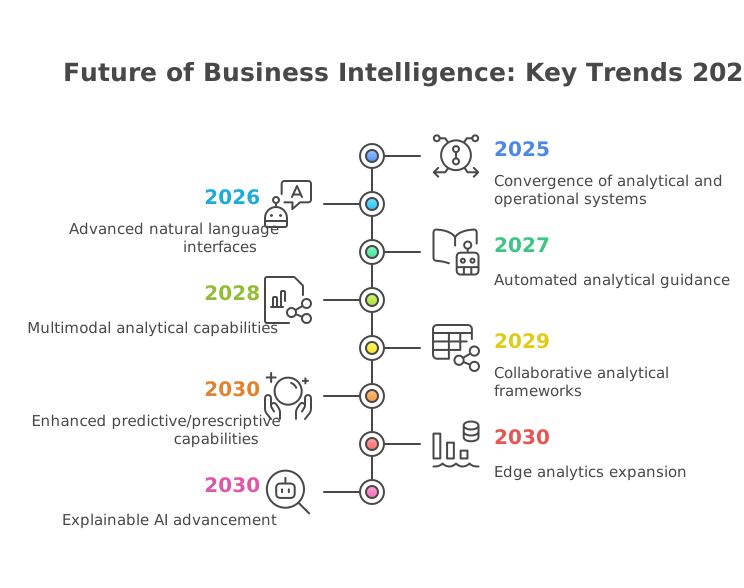
The evolution of natural language interfaces represents another significant trajectory in the business intelligence landscape. While conversational interaction models have already substantially enhanced accessibility for non-technical users, ongoing advancements in natural language processing suggest even more intuitive and sophisticated interaction paradigms in future iterations. These advancements will likely include enhanced capability for understanding complex analytical intentions expressed through casual language, more nuanced interpretation of domain-specific terminology, and more sophisticated guidance through analytical processes. As natural language interfaces continue to evolve, business intelligence platforms will become increasingly accessible to stakeholders across technical backgrounds, further democratizing advanced analytical capabilities across organizational hierarchies.
The increasing sophistication of automated analytical guidance represents a related trend with substantial implications for organizational data utilization. Current business intelligence platforms like Artificio already incorporate contextual recommendations that help users navigate complex information landscapes. Future iterations will likely expand these capabilities to include more proactive analytical suggestions based on organizational patterns, personalized guidance aligned with individual analytical behaviors, and increasingly sophisticated explanations of complex analytical concepts. These advancements will further reduce the learning curve associated with sophisticated data analysis, enabling organizations to develop more pervasive analytical competencies across functional domains without requiring extensive technical training.
The evolution of multimodal analytical capabilities represents another important trajectory in the business intelligence landscape. While current platforms primarily focus on textual and structured data analysis, future iterations will likely incorporate more sophisticated capabilities for analyzing diverse data types, including images, audio recordings, video content, and interactive simulations. These multimodal analytical capabilities will enable organizations to extract insights from increasingly diverse information sources, establishing more comprehensive analytical perspectives that incorporate multiple dimensions of organizational knowledge. As these capabilities evolve, business intelligence platforms will become increasingly versatile analytical environments capable of synthesizing insights across information modalities.
The advancement of collaborative analytical frameworks represents a particularly significant trend in the evolution of business intelligence technologies. While current platforms primarily support individual analytical processes, future iterations will likely incorporate more sophisticated capabilities for collaborative analysis, enabling multiple stakeholders to simultaneously explore extensive documents and datasets from different perspectives. These collaborative capabilities will facilitate the integration of diverse domain expertise into analytical processes, enabling more comprehensive interpretation of complex information landscapes. As collaborative frameworks evolve, business intelligence platforms will increasingly function as shared analytical environments that facilitate the convergence of diverse organizational perspectives around common information resources.
The progressive enhancement of predictive and prescriptive capabilities represents another important trajectory in the business intelligence landscape. While current platforms like Artificio already incorporate certain predictive elements, future iterations will likely feature more sophisticated capabilities for anticipating future scenarios based on historical patterns and suggesting optimal actions based on predicted outcomes. These advanced capabilities will enable organizations to transition from primarily retrospective analysis toward more forward-looking analytical perspectives, enhancing strategic planning processes and operational optimization efforts. As predictive and prescriptive capabilities continue to evolve, business intelligence platforms will increasingly function as strategic advisors that help organizations anticipate future developments and optimize responses to emerging opportunities and challenges.
The expansion of edge analytics represents a related trend with important implications for organizational data utilization. While current business intelligence platforms primarily process data within centralized environments, future iterations will likely incorporate more sophisticated capabilities for analyzing data at its source whether in operational systems, IoT devices, or distributed organizational nodes. These edge analytics capabilities will enable more responsive analytical processes by reducing the latency associated with data transfer and centralized processing. As edge analytics continues to evolve, business intelligence platforms will increasingly function as distributed analytical networks that process information across organizational ecosystems rather than exclusively within centralized environments.
The advancement of explainable AI represents a particularly critical trend in the evolution of business intelligence technologies. As analytical capabilities become increasingly sophisticated, the ability to understand and trust automated analytical processes becomes increasingly important for organizational adoption. Future iterations of business intelligence platforms will likely incorporate more transparent explanation mechanisms that help users understand the reasoning behind analytical conclusions, the factors influencing predictions, and the confidence levels associated with various analytical outputs. These explanation capabilities are essential for building trust in automated analytical processes, particularly in contexts where analytical outputs inform significant organizational decisions. As explainable AI continues to evolve, business intelligence platforms will increasingly function not only as analytical processors but also as analytical educators that help organizations understand the mechanisms underlying data-driven insights.
The implications of these evolving trends extend beyond technological considerations to encompass broader organizational dynamics. As business intelligence platforms become more accessible, integrated, and sophisticated, organizations will need to develop new competencies for leveraging these expanded capabilities effectively. Data literacy will become increasingly important across organizational roles as more stakeholders engage directly with analytical processes. Information governance frameworks will need to evolve to accommodate more pervasive analytical access while maintaining appropriate security and compliance parameters. Organizational structures may need to adapt as analytical capabilities become more distributed across functional domains rather than concentrated within specialized analytical departments.
Perhaps most significantly, the evolution of business intelligence technologies will likely necessitate new perspectives on the strategic value of organizational data assets. As platforms like Artificio continue to enhance the accessibility and utility of extensive information resources, organizations will increasingly recognize data not merely as an operational byproduct but as a strategic resource capable of generating substantial competitive advantage. This recognition will likely influence investment priorities, talent development strategies, and organizational decision-making frameworks, elevating data strategy to a central consideration in broader business strategy rather than a subsidiary technical concern.
In aggregate, these trends suggest a future business intelligence landscape characterized by more accessible, integrated, and sophisticated analytical capabilities—a landscape where platforms like Artificio continue to expand the boundaries of what organizations can extract from their information resources and how widely these analytical capabilities can be distributed across organizational stakeholders.
The emergence of AI-driven business intelligence platforms capable of processing extraordinarily large files represents a pivotal advancement in the ongoing evolution of organizational data utilization. As exemplified by Artificio's capacity to analyze documents up to 500 megabytes far exceeding the limitations of conventional web-based language model interfaces these enhanced processing capabilities are redefining the relationship between organizations and their information assets, enabling more comprehensive analytical perspectives and more informed decision-making across functional domains.
The transformative impact of these advanced platforms extends well beyond mere technical parameters to encompass fundamental changes in how organizations extract value from their data resources. By eliminating the need for artificial document fragmentation, platforms like Artificio preserve the semantic integrity of extensive information resources throughout the analytical process, ensuring that insights are derived from complete contextual understanding rather than fragmented perspectives. The enhanced accessibility of these platforms democratizes sophisticated analytical capabilities across organizational hierarchies, enabling stakeholders without specialized technical expertise to directly engage with complex information landscapes and extract actionable insights aligned with their functional domains.
As organizations navigate increasingly complex operational environments and information ecosystems, the ability to efficiently analyze comprehensive documents and datasets becomes not merely a technical convenience but a strategic imperative. Platforms like Artificio that combine powerful processing capabilities with intuitive interaction paradigms are establishing new paradigms for organizational intelligence paradigms characterized by more pervasive analytical competencies, more integrated operational and analytical processes, and more responsive decision-making frameworks. The continued evolution of these platforms suggests a future where data-driven insights become increasingly embedded within everyday business processes, informing decisions at all organizational levels without requiring specialized analytical intermediaries.
The journey toward this more analytically empowered future requires thoughtful consideration of both technological capabilities and organizational readiness. As business intelligence platforms continue to expand the boundaries of what organizations can extract from their information resources, complementary investments in data literacy, information governance, and organizational adaptation become increasingly important for realizing the full potential of these enhanced analytical capabilities. The organizations that most effectively leverage platforms like Artificio will be those that recognize business intelligence not merely as a technical function but as a strategic capability embedded within broader organizational systems and cultures.
In this context, Artificio's ability to process files up to 500 megabytes represents more than a technical specification it symbolizes a fundamental shift in the accessibility and utility of organizational information assets. By transcending the processing limitations that have traditionally constrained business intelligence platforms, Artificio and similar advanced systems are opening new analytical possibilities across industries and functional domains, enabling organizations to extract more comprehensive insights from their data resources and translate these insights into more informed decisions and more effective actions. This enhanced analytical capability ultimately contributes to more resilient organizations better equipped to navigate complex operational environments and respond effectively to emerging opportunities and challenges.
As we look toward the future of business intelligence, the trajectory exemplified by Artificio suggests continued expansion of both processing capabilities and accessibility features, further democratizing sophisticated analytical tools and embedding data-driven insights more deeply within organizational processes. This evolution represents a profound opportunity for organizations willing to embrace these enhanced capabilities and adapt their operational frameworks to leverage the expanded analytical possibilities they enable. In this increasingly data-rich business landscape, platforms like Artificio are not merely analytical tools but catalysts for organizational transformation transformation toward more informed, responsive, and intelligent business paradigms aligned with the complex demands of contemporary markets and operational environments.

Head IT Operations - Co Founder of Artificio
See it in your SAP environment
Bring us a document, a process, or a bottleneck. We'll show how Artificio captures, validates, and posts into SAP — then scale from there.
Security & compliance
ISO 27001:2013 certified, SOC 2 Type 2 compliant, GDPR and HIPAA ready. Every agent action is logged, auditable, and runs in isolated environments.