

Blog
Large Document Processing Transforms Technical Compliance
Discover how AI-powered document chat simplifies complex technical documentation management for compliance, efficiency, and quality.

Blog
Discover how AI-powered document chat simplifies complex technical documentation management for compliance, efficiency, and quality.
The modern enterprise faces an unprecedented challenge in managing the vast expanse of technical documentation required for regulatory compliance, operational excellence, and quality assurance. Organizations across industries from pharmaceuticals and aerospace to manufacturing and software development must navigate increasingly complex webs of technical specifications, testing protocols, and operational guidelines that can span thousands of pages and encompass intricate interdependencies. The traditional approach of manual document review and fragmented analysis has proven inadequate for ensuring comprehensive compliance across these complex documentation ecosystems, creating significant operational risks and compliance vulnerabilities that can have far-reaching consequences for organizational success.
The emergence of advanced document processing technologies, particularly Artificio's groundbreaking Document Chat platform, represents a transformative solution to the challenges of large-scale technical document management. This innovative approach to document processing enables organizations to maintain complete oversight of their most complex technical documentation while ensuring seamless compliance verification across interconnected systems of specifications, testing data, and operational procedures. By leveraging artificial intelligence to process documents up to 500MB in size through intuitive conversational interfaces, organizations can now access the full depth of their technical documentation with unprecedented accuracy and contextual understanding.
The significance of this technological advancement cannot be overstated in industries where compliance failures can result in regulatory sanctions, product recalls, safety incidents, or significant financial penalties. Technical specifications serve as the foundation for product quality, operational safety, and regulatory compliance, yet their complexity often makes comprehensive understanding and verification challenging even for subject matter experts. The ability to process and analyze these documents in their entirety, maintaining all contextual relationships and cross-references, provides organizations with a powerful tool for ensuring compliance excellence while streamlining operational efficiency. 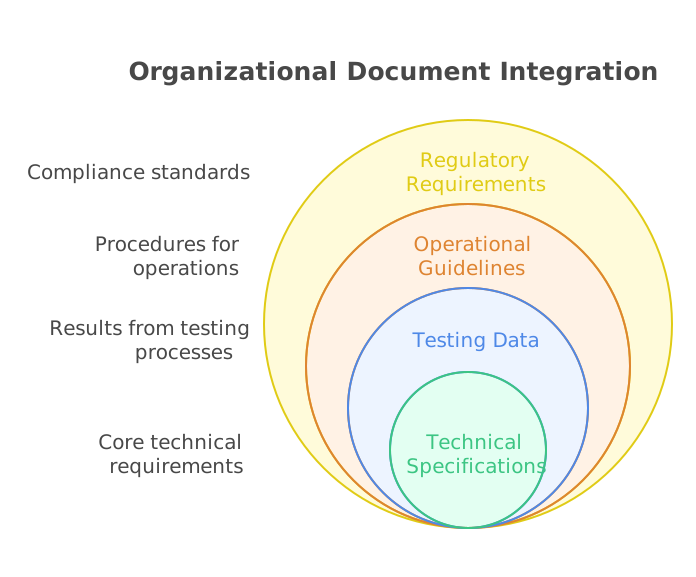
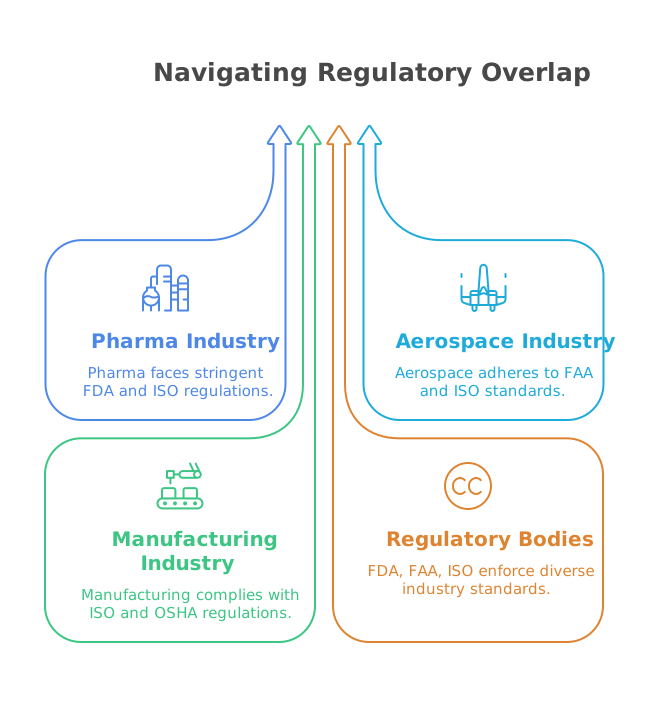
Contemporary regulatory environments demand unprecedented levels of documentation accuracy and traceability, particularly in highly regulated industries where technical specifications must demonstrate compliance with multiple overlapping standards and requirements. The pharmaceutical industry, for example, must navigate FDA regulations, Good Manufacturing Practice guidelines, International Council for Harmonisation standards, and various regional regulatory requirements, all while maintaining detailed documentation of testing protocols, manufacturing procedures, and quality control measures. Each of these regulatory frameworks introduces specific documentation requirements that must be consistently applied across all related technical specifications and operational procedures.
The aerospace and defense industries face similarly complex compliance landscapes, where technical specifications must demonstrate adherence to stringent safety standards, performance requirements, and regulatory protocols established by agencies such as the Federal Aviation Administration, Department of Defense, and various international aviation authorities. These specifications often incorporate extensive testing data that must be cross-referenced with applicable standards, maintenance procedures that must align with operational guidelines, and design requirements that must demonstrate compliance with safety regulations. The interconnected nature of these requirements means that changes to one specification can have cascading effects across multiple related documents, making comprehensive compliance verification an extremely complex undertaking.
Manufacturing industries encounter their own unique set of compliance challenges, particularly in sectors such as automotive, where technical specifications must demonstrate compliance with safety standards, environmental regulations, quality requirements, and performance benchmarks established by regulatory bodies in multiple jurisdictions. The globalization of manufacturing operations has further complicated this landscape, as organizations must ensure that their technical documentation demonstrates compliance with regulatory requirements in all markets where their products are sold or manufactured. This multi-jurisdictional compliance requirement often results in technical specifications that must simultaneously address varying regulatory frameworks while maintaining consistency in underlying technical requirements.
The complexity of modern compliance requirements is further amplified by the dynamic nature of regulatory environments, where standards and requirements are continuously evolving in response to technological advances, safety considerations, and market developments. Organizations must maintain current awareness of regulatory changes while ensuring that their technical documentation is updated to reflect new requirements and that compliance verification processes account for evolving standards. This dynamic environment creates additional challenges for traditional document management approaches, which often struggle to maintain comprehensive oversight of regulatory changes and their implications for existing technical documentation.
The conventional approach to managing technical specifications, testing data, and operational guidelines has historically relied on manual review processes, spreadsheet-based tracking systems, and document management platforms that treat each document as an isolated entity. These traditional methods, while adequate for simpler documentation requirements, have proven increasingly inadequate for the scale and complexity demands of modern technical compliance management. The fundamental limitation of these approaches lies in their inability to maintain comprehensive understanding of document relationships and their failure to preserve contextual integrity across large, interconnected documentation systems.
Manual review processes, while thorough when properly executed, are inherently limited by human capacity constraints and the potential for oversight in complex document analysis. Subject matter experts tasked with reviewing comprehensive technical specifications must maintain awareness of hundreds or thousands of interconnected requirements while ensuring that all applicable standards and regulations are properly addressed. The cognitive load associated with this type of comprehensive review often exceeds human capacity, particularly when dealing with documents that span multiple technical domains or regulatory frameworks. Additionally, manual review processes are time-intensive and resource-demanding, creating bottlenecks in compliance verification workflows that can delay product development, regulatory submissions, and operational implementations.
Spreadsheet-based tracking systems, commonly employed to manage compliance requirements across multiple documents, suffer from fundamental scalability limitations that become apparent when dealing with complex technical documentation. While spreadsheets can effectively track simple compliance requirements, they struggle to represent the complex relationships and interdependencies that characterize modern technical specifications. The linear nature of spreadsheet organization makes it difficult to capture hierarchical relationships, cross-references between different document sections, and the cascading effects of requirement changes across multiple related specifications. Furthermore, spreadsheet-based systems are prone to data integrity issues, version control problems, and synchronization challenges when multiple team members are involved in compliance management activities.
Traditional document management platforms, while offering improved storage and retrieval capabilities compared to manual systems, typically treat documents as discrete entities without maintaining awareness of the relationships and dependencies that exist between different technical specifications. This isolation approach makes it difficult to assess the compliance implications of changes to one document across related specifications, creates challenges in identifying potential conflicts between different requirements, and limits the ability to perform comprehensive compliance verification across interconnected documentation systems. The search and analysis capabilities of traditional platforms are often limited to keyword-based approaches that fail to capture the semantic relationships and contextual nuances that are critical for effective compliance management.
The fragmentation problem inherent in traditional approaches becomes particularly acute when dealing with large technical documents that exceed the processing capabilities of conventional systems. Many traditional platforms require large documents to be broken into smaller segments for processing, a practice that inevitably results in the loss of contextual relationships and cross-references that are essential for comprehensive compliance verification. This fragmentation makes it difficult to understand the full implications of specific requirements, assess the completeness of compliance documentation, and identify potential gaps or conflicts in technical specifications.
Modern technical specifications have evolved into highly sophisticated documents that serve multiple critical functions within organizational operations, regulatory compliance frameworks, and quality assurance systems. These documents typically integrate detailed performance requirements, testing protocols, operational procedures, safety specifications, and compliance verification methods into comprehensive resources that guide product development, manufacturing operations, and quality control activities. The complexity of contemporary technical specifications reflects the increasing sophistication of modern products and services, the evolving regulatory landscape, and the growing emphasis on quality assurance and risk management across industries.
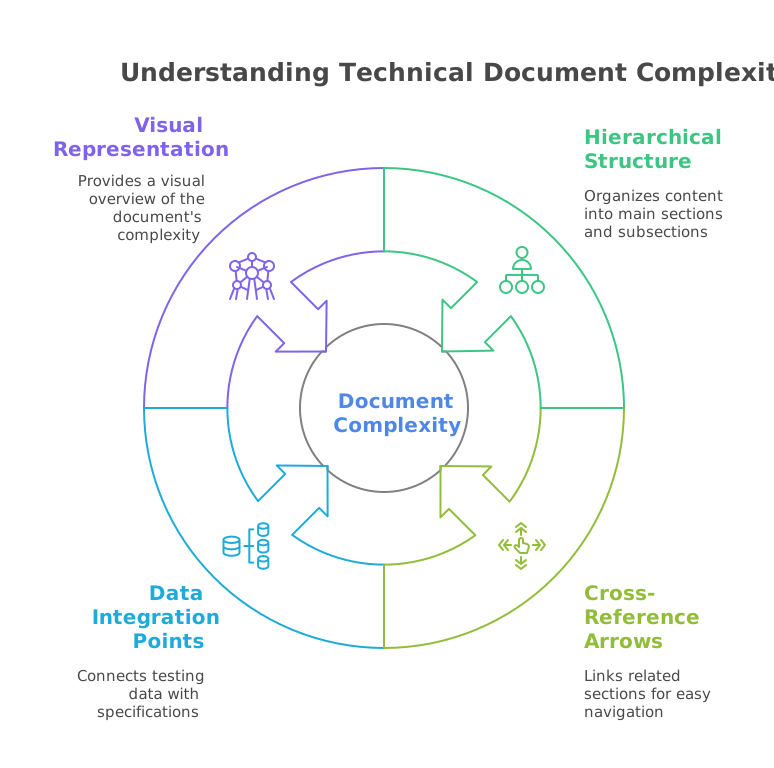
The structure of modern technical specifications often follows hierarchical frameworks that organize requirements according to functional areas, regulatory domains, or operational phases, with each level of the hierarchy containing detailed sub-requirements, testing procedures, and compliance verification methods. This hierarchical organization enables systematic approaches to requirement management while accommodating the complex interdependencies that characterize modern technical systems. However, the hierarchical structure also creates challenges for traditional document processing approaches, which often struggle to maintain awareness of the relationships between different levels of the hierarchy and the implications of changes at one level for related requirements throughout the specification.
Testing data integration represents a critical component of modern technical specifications, with documents typically incorporating extensive datasets that demonstrate compliance with performance requirements, safety standards, and regulatory specifications. These datasets often include statistical analyses, trend assessments, comparative evaluations, and validation studies that provide empirical support for specification requirements and compliance claims. The integration of testing data within technical specifications creates additional complexity for document processing systems, which must be capable of understanding numerical relationships, statistical significance, and the implications of testing results for overall specification compliance.
Cross-referencing systems within technical specifications have become increasingly sophisticated, with modern documents incorporating extensive networks of internal references, external standard citations, and regulatory requirement mappings that create complex webs of interconnected information. These cross-referencing systems enable comprehensive traceability of requirements while facilitating impact analysis for potential changes or updates. However, the complexity of modern cross-referencing systems also creates significant challenges for document processing technologies, which must maintain awareness of all reference relationships while providing accurate navigation and analysis capabilities.
Artificio's Document Chat platform represents a fundamental paradigm shift in how organizations approach large-scale technical document processing and compliance management. Unlike traditional systems that struggle with file size limitations and context preservation challenges, Document Chat leverages advanced artificial intelligence capabilities to process documents up to 500MB in size while maintaining complete contextual understanding across thousands of pages of technical content. This breakthrough capability enables organizations to work with their most comprehensive technical specifications, testing databases, and operational guidelines as unified, coherent documents rather than fragmented collections of isolated sections.
The conversational interface that defines Document Chat's user experience represents a revolutionary departure from traditional search-based document interaction models. Rather than requiring users to formulate specific queries using predetermined syntax or navigate complex menu structures, the platform enables natural language interaction that allows users to explore document content through intuitive conversation. This conversational approach is particularly valuable for technical compliance applications, where users often need to explore complex relationships between different requirements, understand the implications of specific testing data, or verify compliance across multiple interconnected specifications.
The platform's ability to maintain semantic relationships throughout entire documents addresses one of the most critical limitations of traditional document processing approaches. Technical specifications rely heavily on contextual relationships between different sections, with requirements in one area often dependent on specifications outlined in other parts of the document. Document Chat's advanced processing capabilities ensure that these relationships are preserved and accessible, enabling users to understand the full implications of specific requirements and their connections to related specifications throughout the document.
Context preservation across large documents enables Document Chat to provide accurate, contextually relevant responses that draw from the complete breadth of available information rather than isolated document segments. This comprehensive contextual understanding is essential for technical compliance applications, where accurate interpretation of requirements often depends on understanding related specifications, testing protocols, and operational guidelines that may be located in different sections of large documents. The platform's ability to maintain this contextual awareness while processing documents of unprecedented size represents a significant technological achievement that directly addresses the core challenges of large-scale technical document management.
The elimination of document fragmentation requirements represents another critical advantage of Document Chat's approach to large file processing. Traditional systems often require large technical documents to be divided into smaller segments for processing, a practice that inevitably disrupts the contextual relationships and cross-references that are essential for accurate compliance verification. Document Chat's capacity to process entire documents without fragmentation ensures that all relationships and dependencies are preserved, enabling comprehensive analysis and accurate compliance assessment across complete documentation systems.
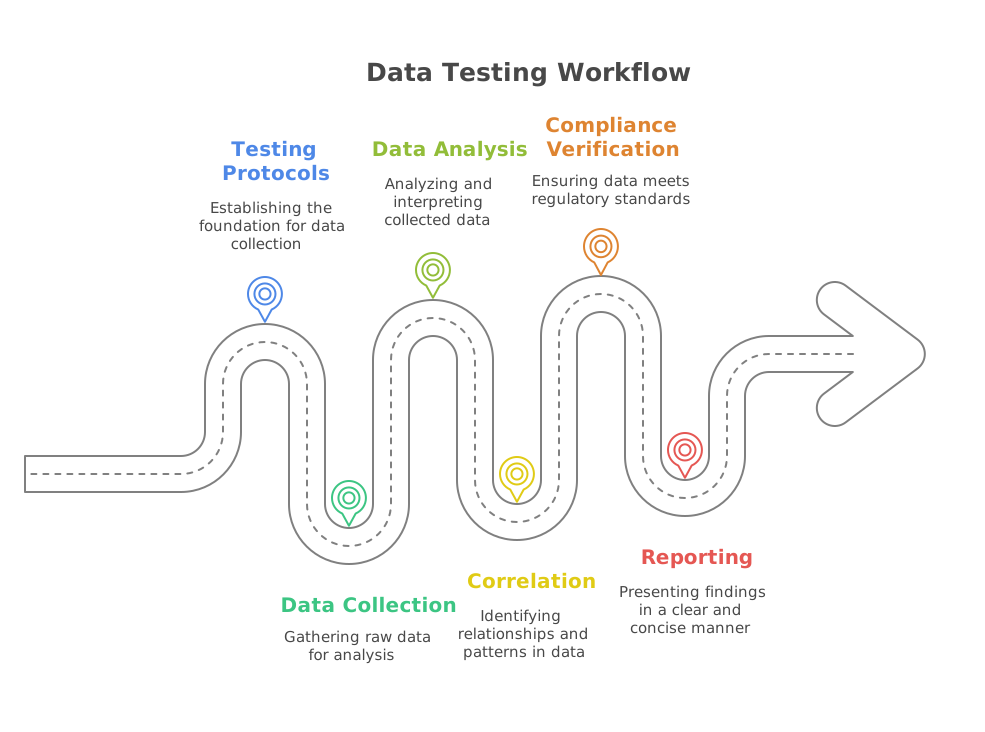
The management of testing data within technical compliance frameworks presents unique challenges that require sophisticated processing capabilities and comprehensive contextual understanding. Modern testing protocols generate vast amounts of data that must be integrated with technical specifications, correlated with regulatory requirements, and analyzed for compliance verification purposes. Traditional approaches to testing data management often struggle with the scale and complexity of contemporary testing programs, particularly when dealing with longitudinal studies, multi-parameter testing protocols, or comparative analyses that span multiple testing phases or product variants.
Document Chat's large file processing capabilities transform testing data management by enabling organizations to maintain comprehensive testing databases within unified document environments that preserve all contextual relationships and analytical frameworks. Rather than managing testing data as isolated datasets that must be separately correlated with applicable specifications, organizations can integrate complete testing programs within comprehensive technical documents that maintain awareness of all relationships between testing protocols, results, specifications, and compliance requirements. This integrated approach eliminates the data silos that often characterize traditional testing data management while ensuring that testing information is always accessible within appropriate contextual frameworks.
The conversational interface provided by Document Chat enables intuitive exploration of complex testing datasets through natural language queries that can address specific testing parameters, comparative analyses, trend assessments, or compliance verification questions. Users can ask sophisticated questions about testing data relationships, statistical significance, compliance implications, or comparative performance without requiring specialized knowledge of database query languages or complex search syntax. This accessibility is particularly valuable for cross-functional teams that include members with varying levels of technical expertise but who need to understand testing data implications for their specific areas of responsibility.
Statistical analysis capabilities within Document Chat enable sophisticated interrogation of testing data that goes beyond simple data retrieval to encompass trend analysis, comparative assessment, and predictive modeling based on historical testing results. Users can explore questions about testing data patterns, identify anomalies or outliers that may require investigation, and assess the implications of testing results for ongoing compliance requirements. The platform's ability to understand statistical relationships and significance enables more sophisticated analysis of testing data than traditional document processing approaches can provide.
Quality control integration represents another critical advantage of Document Chat's approach to testing data management, with the platform's comprehensive contextual understanding enabling automatic correlation of testing results with applicable quality standards, specification requirements, and regulatory compliance criteria. Users can quickly verify whether testing results demonstrate compliance with applicable standards, identify areas where additional testing may be required, or assess the implications of testing data for overall product quality and regulatory compliance. This integrated approach to quality control verification streamlines compliance management while reducing the risk of oversight or misinterpretation.
Operational guidelines represent a critical component of technical compliance frameworks, providing detailed procedures and protocols that ensure consistent implementation of technical specifications while maintaining compliance with applicable regulatory and quality requirements. These guidelines typically encompass manufacturing procedures, quality control protocols, safety procedures, maintenance requirements, and operational standards that translate technical specifications into actionable operational practices. The complexity of modern operational guidelines reflects the sophistication of contemporary operational environments and the increasing emphasis on standardization, quality assurance, and regulatory compliance across industries.
The integration of operational guidelines with technical specifications and testing data creates comprehensive operational frameworks that enable consistent, compliant operations while facilitating continuous improvement and optimization. However, this integration also creates significant challenges for traditional document management approaches, which often struggle to maintain awareness of the relationships between operational procedures and related technical requirements. Changes to technical specifications can have cascading effects on operational guidelines, while operational experience may identify opportunities for specification improvements or testing protocol enhancements.
Document Chat's large file processing capabilities enable organizations to maintain comprehensive operational documentation that integrates guidelines, specifications, and testing data within unified environments that preserve all contextual relationships and dependencies. This integrated approach ensures that operational personnel have access to complete information about the technical foundations of operational procedures while enabling technical personnel to understand the operational implications of specification requirements. The conversational interface facilitates exploration of these relationships through natural language queries that can address operational questions, compliance verification requirements, or the implications of potential changes to specifications or procedures.
Procedure verification capabilities within Document Chat enable systematic assessment of operational guideline compliance with applicable technical specifications and regulatory requirements. Users can verify that operational procedures properly implement technical requirements, identify potential gaps or inconsistencies between guidelines and specifications, and assess the compliance implications of operational practices. This verification capability is particularly valuable for organizations operating in highly regulated environments where operational compliance is subject to regular audit and verification requirements.
Change management integration represents another critical advantage of Document Chat's approach to operational guidelines management, with the platform's comprehensive contextual understanding enabling impact analysis for potential changes to specifications, procedures, or regulatory requirements. Users can assess the operational implications of proposed technical changes, identify operational guidelines that may require updating, and evaluate the resource requirements for implementing procedural changes. This integrated approach to change management reduces the risk of implementation issues while ensuring that operational capabilities remain aligned with technical requirements and regulatory expectations.
The verification of compliance across complex technical documentation systems requires sophisticated analytical capabilities that can assess requirement implementation, identify potential gaps or conflicts, and provide comprehensive audit trails that demonstrate compliance with applicable standards and regulations. Traditional approaches to compliance verification often rely on manual review processes and checklist-based assessments that may miss subtle compliance issues or fail to identify conflicts between different requirement sources. The scale and complexity of modern technical documentation make comprehensive manual compliance verification increasingly impractical while increasing the risk of compliance oversight.
Document Chat's comprehensive processing capabilities transform compliance verification by enabling systematic analysis of complete documentation systems that can identify compliance gaps, assess requirement implementation, and provide detailed audit trails that demonstrate comprehensive compliance management. The platform's ability to understand relationships between different documents, specifications, and requirements enables sophisticated compliance analysis that goes beyond simple checklist verification to encompass comprehensive assessment of requirement integration and implementation consistency.
Audit preparation capabilities within Document Chat enable organizations to rapidly generate comprehensive compliance documentation that demonstrates systematic attention to regulatory requirements and quality standards. The conversational interface allows audit preparation teams to quickly identify relevant documentation, extract specific compliance evidence, and generate comprehensive responses to audit inquiries without requiring extensive manual document review. This capability is particularly valuable for organizations subject to frequent regulatory audits or those operating in multiple jurisdictions with varying compliance requirements.
Gap analysis functionality enables systematic identification of potential compliance deficiencies or areas where documentation may be incomplete or inconsistent with applicable requirements. Users can assess whether technical specifications adequately address all applicable regulatory requirements, identify areas where testing data may be insufficient to demonstrate compliance, or evaluate whether operational guidelines properly implement technical requirements. This proactive approach to gap identification enables organizations to address potential compliance issues before they become audit findings or regulatory concerns.
Regulatory change management represents another critical capability enabled by Document Chat's comprehensive processing approach, with the platform's contextual understanding enabling rapid assessment of the implications of regulatory changes for existing documentation systems. When new regulations are introduced or existing requirements are modified, users can quickly identify affected documents, assess the scope of required changes, and develop implementation plans that ensure continued compliance. This capability is essential for organizations operating in dynamic regulatory environments where staying current with regulatory changes is critical for maintaining compliance and operational authorization.
The versatility of Document Chat's large file processing capabilities enables specialized applications across diverse industries, each with unique technical documentation requirements and compliance challenges. The pharmaceutical industry, characterized by extensive regulatory oversight and complex technical requirements, benefits significantly from Document Chat's ability to process comprehensive regulatory submission documents that can exceed hundreds of megabytes in size while maintaining complete contextual understanding of complex regulatory relationships and cross-references.
Pharmaceutical technical specifications typically integrate multiple types of information including chemical formulations, manufacturing processes, quality control procedures, stability testing data, clinical trial results, and regulatory compliance documentation. The interconnected nature of this information requires processing capabilities that can maintain awareness of relationships between different data types while enabling sophisticated analysis of compliance implications. Document Chat's conversational interface enables pharmaceutical professionals to explore complex regulatory questions, assess compliance requirements across multiple jurisdictions, and verify that technical documentation adequately supports regulatory submissions.
The aerospace and defense industries present unique challenges related to complex technical specifications that must demonstrate compliance with stringent safety and performance requirements while addressing security considerations and export control regulations. Aerospace technical specifications often integrate detailed engineering requirements, testing protocols, certification procedures, maintenance specifications, and operational limitations within comprehensive documents that serve multiple stakeholder groups including manufacturers, operators, and regulatory authorities.
Document Chat's ability to process large, complex aerospace documentation enables comprehensive analysis of technical requirements while maintaining awareness of safety implications, regulatory compliance requirements, and operational constraints. The conversational interface facilitates exploration of complex technical relationships, assessment of design requirement compliance, and verification of maintenance procedure adequacy. This capability is particularly valuable for aerospace organizations managing complex certification processes or those involved in international collaboration where technical documentation must address multiple regulatory frameworks.
Manufacturing industries benefit from Document Chat's capabilities for managing complex technical specifications that integrate product design requirements, manufacturing processes, quality control procedures, and regulatory compliance documentation. Modern manufacturing operations often involve sophisticated supply chains, multiple production facilities, and complex quality management systems that require comprehensive documentation management and compliance verification capabilities.
The automotive industry exemplifies the complexity of modern manufacturing documentation requirements, with technical specifications that must address safety regulations, environmental standards, performance requirements, and quality management system requirements across multiple jurisdictions. Document Chat's large file processing capabilities enable automotive manufacturers to maintain comprehensive technical documentation that integrates all relevant requirements while facilitating efficient compliance verification and audit preparation.
The adoption of advanced document processing technologies like Document Chat represents a strategic transformation in how organizations approach technical compliance management, with implications that extend far beyond simple efficiency improvements to encompass fundamental changes in compliance capabilities, risk management, and operational excellence. Organizations that successfully integrate these technologies into their compliance management frameworks gain significant competitive advantages through improved compliance accuracy, reduced regulatory risk, and enhanced operational efficiency.
The scalability advantages provided by large file processing capabilities enable organizations to manage increasingly complex technical documentation requirements without proportional increases in human resources or compliance management overhead. As regulatory requirements continue to evolve and become more complex, organizations with advanced document processing capabilities will be better positioned to adapt to changing requirements while maintaining comprehensive compliance management. This scalability advantage becomes particularly important for organizations pursuing growth strategies that involve expansion into new markets, product lines, or regulatory jurisdictions.
Risk mitigation represents another critical strategic advantage enabled by comprehensive document processing capabilities, with organizations able to identify potential compliance issues before they become audit findings, regulatory violations, or operational problems. The proactive risk identification capabilities enabled by Document Chat's comprehensive analysis allow organizations to address compliance gaps systematically while building robust compliance management systems that can withstand regulatory scrutiny and operational challenges.
The integration capabilities provided by advanced document processing platforms enable organizations to develop more sophisticated compliance management systems that integrate technical specifications, operational procedures, and quality management requirements within unified frameworks. This integration facilitates more effective compliance management while enabling continuous improvement processes that leverage insights from across the organization's technical documentation ecosystem.
Innovation acceleration represents an additional strategic advantage enabled by efficient technical documentation management, with organizations able to focus technical resources on value-creating activities rather than administrative compliance management tasks. The time and resource savings achieved through automated compliance verification and sophisticated document analysis enable organizations to pursue more ambitious technical development programs while maintaining comprehensive compliance management.
The competitive differentiation enabled by superior compliance management capabilities becomes increasingly important as regulatory requirements continue to expand and become more sophisticated. Organizations with advanced document processing capabilities can respond more quickly to regulatory changes, pursue opportunities in highly regulated markets, and maintain operational excellence standards that differentiate them from competitors with less sophisticated compliance management capabilities.
The transformation of technical compliance management through advanced document processing technologies represents a fundamental shift in how organizations approach the complex challenges of modern regulatory environments and technical documentation requirements. Artificio's Document Chat platform exemplifies the revolutionary potential of these technologies, enabling organizations to process documents up to 500MB in size while maintaining complete contextual understanding and facilitating intuitive exploration through conversational interfaces. This breakthrough capability addresses the core limitations of traditional document processing approaches while providing organizations with unprecedented capabilities for compliance management, risk mitigation, and operational excellence.
The implications of this technological advancement extend far beyond simple efficiency improvements to encompass strategic advantages that will become increasingly important as regulatory environments continue to evolve and become more complex. Organizations that successfully integrate advanced document processing capabilities into their compliance management frameworks position themselves for sustained competitive advantage through superior compliance management, reduced regulatory risk, and enhanced operational capabilities that enable growth and innovation in highly regulated environments.
The future of technical compliance management will be defined by organizations' ability to leverage advanced technologies to manage increasing complexity while maintaining the accuracy, thoroughness, and reliability that regulatory compliance demands. Document Chat's large file processing capabilities represent a critical step toward this future, providing organizations with the tools they need to excel in environments where comprehensive compliance management is essential for operational success and competitive differentiation. As these technologies continue to evolve and mature, they will undoubtedly play an increasingly central role in enabling organizations to achieve compliance excellence while pursuing ambitious operational and strategic objectives.

Head IT Operations - Co Founder of Artificio
See it in your SAP environment
Bring us a document, a process, or a bottleneck. We'll show how Artificio captures, validates, and posts into SAP — then scale from there.
Security & compliance
ISO 27001:2013 certified, SOC 2 Type 2 compliant, GDPR and HIPAA ready. Every agent action is logged, auditable, and runs in isolated environments.