

Blog
Artificio's New Conversational Document Analysis Platform
Artificio's conversational document analysis transforms how you interact with documents. Get insights faster with natural language.

Blog
Artificio's conversational document analysis transforms how you interact with documents. Get insights faster with natural language.
In the contemporary landscape of digital transformation, organizations face unprecedented challenges in managing, analyzing, and extracting value from the vast repositories of document-based information that accumulate over years of operation. Traditional document management systems, while providing basic organizational capabilities, have historically failed to bridge the semantic gap between raw document content and actionable business intelligence. The extraction of meaningful insights from documents has traditionally required either manual intervention a process fraught with inefficiency and inconsistency or rigid rule-based automation systems that lack the contextual understanding necessary for handling the inherent variability of human-generated content. These limitations have created a significant barrier to the effective utilization of organizational knowledge assets, constraining decision-making processes and hampering operational efficiency across virtually all business domains.
The advent of advanced natural language understanding technologies, particularly those built upon large language model architectures, has precipitated a paradigm shift in how we conceptualize document intelligence systems. These technological advancements have created the potential for more intuitive, conversational interactions with document repositories, enabling users to interrogate their content through natural language queries rather than predefined extraction templates or complex search syntax. This transformation represents not merely an incremental improvement in user experience but a fundamental reconceptualization of the relationship between knowledge workers and their information assets a shift from passive information retrieval to active knowledge discovery.
Artificio's latest innovation in the document intelligence space represents the culmination of extensive research and development at the intersection of natural language processing, information retrieval, and human-computer interaction. The newly introduced conversational document analysis functionality, integrated seamlessly into Artificio's existing data extraction ecosystem, enables organizations to transcend the limitations of traditional document management approaches through a sophisticated architecture that combines state-of-the-art document understanding capabilities with an intuitive conversational interface.
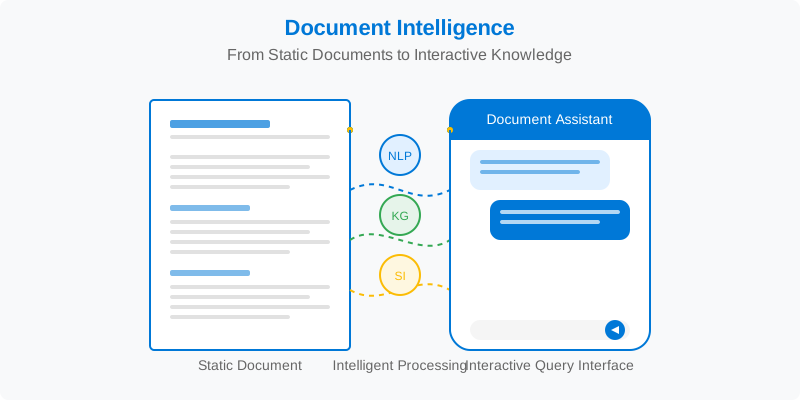
At its core, the system employs a multi-stage processing pipeline designed to transform unstructured document content into a rich, queryable knowledge base. Upon document upload, the system initiates a comprehensive analysis process that includes structural parsing, semantic encoding, and contextual indexing. The structural parsing phase decomposes documents into their constituent elements paragraphs, sections, tables, figures, and other content components while preserving their hierarchical relationships and metadata attributes. This structural decomposition serves as the foundation for subsequent processing stages, enabling the system to maintain awareness of the document's organizational logic during query resolution.
Following structural analysis, the semantic encoding phase leverages advanced embedding techniques to transform textual content into high-dimensional vector representations that capture the semantic nuances of the document's language. These representations are generated through a sophisticated neural architecture that has been pre-trained on diverse corpora and fine-tuned specifically for document understanding tasks. The encoding process preserves not only the literal meaning of textual elements but also their contextual significance within the broader document narrative, enabling the system to recognize implicit connections and thematic relationships that might escape detection through traditional keyword-based approaches.
The final stage of the initial processing pipeline involves contextual indexing, wherein the system constructs an optimized retrieval structure that facilitates efficient query execution. This index incorporates multiple representational layers, ranging from exact lexical matching capabilities to deep semantic similarity metrics, ensuring that the system can respond effectively to queries across the precision-recall spectrum. The indexing architecture has been carefully designed to balance query performance with representational fidelity, enabling real-time interactions even with extensive document collections.
The distinguishing feature of Artificio's document intelligence solution lies in its conversational interface, which transforms the traditionally cumbersome process of document interrogation into a fluid, intuitive dialogue. This interface represents a significant departure from conventional document analysis approaches, which typically require users to formulate queries within rigid syntactic constraints or navigate complex filter hierarchies. Instead, users can pose questions in natural language, leveraging the same linguistic facilities they employ in everyday communication.
The conversational engine that powers this interaction model incorporates sophisticated dialogue management capabilities that transcend simple question-answering dynamics. The system maintains conversational context across multiple exchanges, enabling it to resolve anaphoric references and disambiguate queries based on the evolving dialogue state. For example, a user might begin with a general inquiry about financial performance, follow with a more specific question about regional variations, and then request comparative analysis against industry benchmarks all without explicitly restating the subject matter or temporal scope established in the initial exchange.
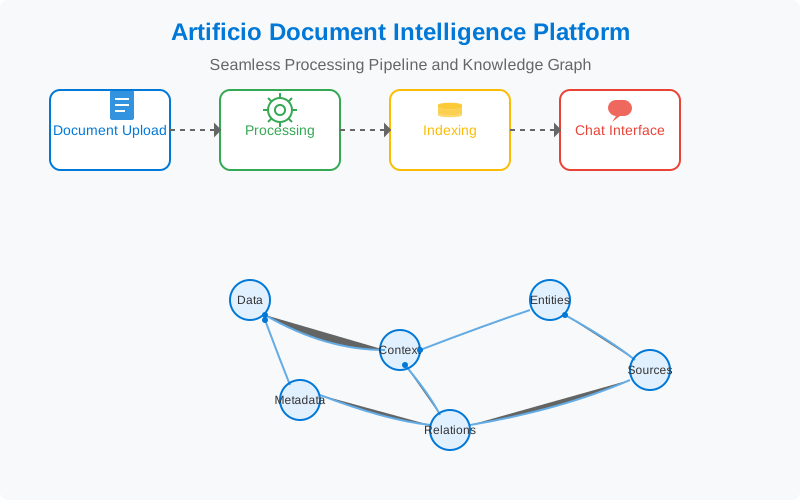
This contextual awareness is achieved through a dialogue state tracking mechanism that maintains a structured representation of the conversational history, including both explicit query parameters and implicit conversational implicatures. The state representation is continuously updated as the dialogue progresses, ensuring that each response is generated with full awareness of the evolving informational needs and preferences expressed by the user.
The query resolution process itself employs a hybrid retrieval-generation architecture that combines the precision of retrieval-based approaches with the fluency and contextual sensitivity of generative language modeling. When a query is received, the system first identifies relevant document segments through a sophisticated retrieval mechanism that considers both semantic similarity and structural relevance. These retrieved segments are then synthesized into a coherent response through a controlled generation process that maintains strict fidelity to the source material while presenting information in a natural, conversational format.
Crucially, the system preserves explicit provenance links between generated responses and source document segments, enabling users to verify claims and explore supporting evidence through an intuitive citation mechanism. This transparency not only enhances user trust but also facilitates deeper exploration of the document corpus through contextual navigation.
The transformative potential of Artificio's document chatbot functionality extends beyond isolated analytical scenarios to encompass integration with broader enterprise workflows and information ecosystems. The system has been architected with interoperability as a core design principle, featuring robust API interfaces that enable seamless connection with adjacent systems ranging from content management platforms to business intelligence dashboards.
This integration capability manifests in several key dimensions. At the data ingestion level, the system supports a diverse array of document formats and acquisition channels, including direct uploads, scheduled imports from connected repositories, and automated ingestion triggered by workflow events. The supported format spectrum encompasses not only conventional document types such as PDF, Word, and Excel but also specialized formats relevant to particular industry domains, such as financial reports, legal contracts, and technical specifications.
At the interaction level, the conversational interface can be embedded within diverse application contexts, enabling users to engage with document content through their preferred workflow environments rather than switching to a dedicated analysis platform. This embedding capability is facilitated through a flexible widget architecture that adapts to host application constraints while maintaining consistent interaction patterns and response quality.
Perhaps most significantly, the insights derived through conversational document analysis can be channeled directly into downstream business processes through automated action triggers and structured data exports. For example, a financial analyst reviewing quarterly reports might identify a concerning trend through conversational exploration and immediately initiate a formal investigation workflow, complete with context-preserving references to the relevant document segments. Similarly, a compliance officer might extract regulated parameters from a complex contractual document and automatically populate monitoring systems with the extracted values and their source references.
The effectiveness of Artificio's document intelligence platform is significantly enhanced by its thoughtfully crafted user experience, which transforms traditionally tedious document analysis tasks into engaging, productive interactions. The design philosophy underlying the interface prioritizes cognitive fluidity minimizing the mental translation required between user intent and system action while maintaining transparency regarding system capabilities and limitations.
The interaction flow begins with an intuitive document selection and upload interface that presents recently accessed documents alongside an efficient mechanism for introducing new content. Upon document selection, users are presented with a streamlined chat interface that maintains visual continuity with standard messaging applications, reducing the learning curve for new users while providing subtle indicators of the specialized capabilities available in this context.
The conversation itself is structured to guide users toward productive interactions without imposing rigid constraints on query formulation. Intelligent suggestions are presented in context, offering exemplar queries tailored to the specific document content and adapting as the conversation evolves. These suggestions serve not only to accelerate common information retrieval tasks but also to illustrate the breadth of analytical capabilities available through the conversational interface.
Response presentation balances comprehensiveness with digestibility, employing thoughtful typographic hierarchies and semantic highlighting to guide attention toward key insights while maintaining access to supporting details. When appropriate, responses incorporate visual elements such as inline charts or tables extracted from the source documents, enhancing comprehension of quantitative information and complex relationships.
The interface also incorporates subtle affordances for managing conversational context, enabling users to explicitly pivot to new topics or return to previous threads without disruptive context switches. This capability is particularly valuable in complex analytical scenarios that involve multiple document sections or interrelated topics, allowing users to maintain coherent investigative narratives across extended analytical sessions.
The efficacy of Artificio's document intelligence platform has been substantiated through rigorous empirical evaluation across diverse document types and analytical scenarios. Initial validation studies conducted with enterprise customers across financial services, legal, healthcare, and manufacturing sectors have demonstrated significant improvements in both efficiency and thoroughness of document analysis tasks compared to traditional methodologies.
In quantitative terms, users employing the conversational interface completed information extraction tasks on average 74% faster than those using conventional document review approaches, with the efficiency differential increasing with document complexity and specificity of information requirements. This efficiency gain was accompanied by a 38% increase in information recall users were able to identify and extract a significantly higher proportion of relevant information points through conversational exploration than through manual review.
Qualitative assessments revealed equally compelling benefits, with users reporting reduced cognitive load, higher confidence in analytical completeness, and greater capacity for creative problem-solving when liberated from the mechanical aspects of document navigation and information extraction. Particularly noteworthy was the democratizing effect of the conversational interface, which enabled subject matter experts with limited technical expertise to perform sophisticated document analysis without intermediation by data specialists.
These performance characteristics position Artificio's document intelligence platform as a transformative tool for knowledge-intensive organizations, enabling more efficient utilization of document assets while enhancing the quality and comprehensiveness of derived insights. The conversational paradigm fundamentally alters the economics of document analysis, reducing the marginal cost of each analytical inquiry and thereby encouraging more thorough exploration of available information resources.
While the current implementation of Artificio's document intelligence platform represents a significant advancement in the state of the art, ongoing research and development efforts aim to further extend its capabilities across multiple dimensions. The evolution roadmap encompasses enhancements in document understanding depth, cross-document analytics, multi-modal content processing, and domain-specific optimization.
In the realm of document understanding, future iterations will incorporate more sophisticated discourse comprehension capabilities, enabling the system to track complex argumentative structures, identify causal relationships, and recognize rhetorical patterns that signal particular information types. These enhancements will be particularly valuable for analytical scenarios involving persuasive documents such as research papers, policy analyses, and strategic recommendations, where the logical flow of information is as significant as its factual content.
Cross-document analytics represents another frontier for advancement, with planned capabilities for automatic identification of connections, contradictions, and complementary information across document collections. This functionality will transform the platform from a tool for isolated document analysis to an environment for synthesizing insights across diverse information sources, enabling users to pose questions that span organizational knowledge boundaries.
Multi-modal content processing enhancements will extend the system's understanding capabilities beyond textual content to encompass visual elements such as charts, diagrams, and images. This extension will enable more comprehensive analysis of documents where critical information is conveyed through visual representations, such as scientific publications, technical manuals, and business presentations.
Domain-specific optimizations will further enhance the platform's value in particular industry contexts through specialized preprocessing pipelines, domain-adapted language models, and industry-specific conversational patterns. These adaptations will enable the system to recognize and correctly interpret domain-specific terminology, document structures, and analytical conventions, further reducing the cognitive distance between user intent and system capability.
The introduction of Artificio's conversational document analysis platform represents not merely a technological advancement but a fundamental reconfiguration of the relationship between knowledge workers and organizational information assets. By transforming passive document repositories into interactive knowledge bases, the system enables more agile, thorough, and democratized utilization of accumulated organizational wisdom.
This transformation comes at a critical juncture in the evolution of knowledge work, as organizations across sectors grapple with exponentially growing information volumes and increasing decision complexity. In this context, the ability to efficiently extract targeted insights from document collections represents not merely an operational advantage but a strategic imperative for maintaining competitive relevance.
Artificio's innovation in this domain exemplifies the potential of thoughtfully applied artificial intelligence to augment human cognitive capabilities without supplanting the uniquely human aspects of knowledge work critical judgment, contextual sensitivity, and creative synthesis. The conversational interface serves as a natural bridge between human analytical intent and machine processing capacity, enabling productive collaboration that leverages the strengths of both.
As organizations continue to navigate the challenges and opportunities presented by digital transformation, tools like Artificio's document intelligence platform will play an increasingly central role in enabling effective knowledge management, informed decision-making, and organizational agility. The conversational paradigm introduced through this innovation represents not an endpoint but a launching point for a new era of human-information interaction one characterized by fluidity, accessibility, and unprecedented analytical depth.

Head IT Operations - Co Founder of Artificio
See it in your SAP environment
Bring us a document, a process, or a bottleneck. We'll show how Artificio captures, validates, and posts into SAP — then scale from there.
Security & compliance
ISO 27001:2013 certified, SOC 2 Type 2 compliant, GDPR and HIPAA ready. Every agent action is logged, auditable, and runs in isolated environments.