

Blog
Impact of Automation on Reimbursement Claim Processing
Automated claim processing boosts efficiency with AI, ML, RPA, and OCR. Reduces errors, costs, and speeds up reimbursement.

Blog
Automated claim processing boosts efficiency with AI, ML, RPA, and OCR. Reduces errors, costs, and speeds up reimbursement.
The reimbursement claim processing landscape has undergone a remarkable transformation in recent years, primarily driven by technological advancements and the growing need for operational efficiency. Traditional manual claim processing methods, characterized by paper-based documentation, human data entry, and manual verification processes, have long been associated with significant challenges including processing delays, high error rates, and substantial administrative costs. These inefficiencies not only impact the operational capabilities of healthcare providers and insurance companies but also affect patient satisfaction and financial outcomes. In response to these challenges, automation has emerged as a critical solution, fundamentally altering the reimbursement ecosystem through the implementation of advanced technologies such as Artificial Intelligence (AI), Machine Learning (ML), Robotic Process Automation (RPA), and Optical Character Recognition (OCR). This technological revolution is redefining the entire claims management lifecycle, from initial submission to final reimbursement, creating more streamlined, accurate, and cost-effective processes. This comprehensive analysis examines the multifaceted impact of automation on reimbursement claim processing, exploring the technologies driving this transformation, the benefits realized across the healthcare and insurance sectors, and the challenges and considerations that organizations must address when implementing automated solutions.
Reimbursement claim processing has historically been a labor-intensive and time-consuming function within healthcare and insurance organizations. The traditional approach involved numerous manual touchpoints, from the initial receipt of paper forms to the final disbursement of payments. Claims professionals were required to manually enter data from physical documents into processing systems, verify policyholder information against internal databases, assess claim validity through manual reviews, and process payments through separate financial systems. This fragmented approach created significant operational bottlenecks, with the average claim taking weeks or even months to process, particularly in complex medical cases requiring extensive documentation and clinical review.
The significant drawbacks of manual claim processing became increasingly apparent as healthcare costs escalated and patient expectations evolved. Error rates in manual claim processing typically ranged from 5% to 10%, with some studies indicating even higher rates in complex medical billing scenarios. These errors frequently resulted in claim denials, resubmissions, and payment delays, creating financial strain for both providers and patients. Additionally, the administrative cost associated with manual claim processing represented a substantial portion of overall healthcare expenditure, with estimates suggesting that up to 25% of healthcare costs in some markets were attributable to administrative functions, including claims management.
The digital transformation of claims processing began in the late 1990s and early 2000s with the introduction of electronic data interchange (EDI) and basic claims management software. However, these early systems primarily digitized existing workflows rather than fundamentally redesigning them. The true automation revolution emerged in the mid-2010s with the advent of more sophisticated technologies capable of not only digitizing information but also analyzing it, making decisions based on predefined rules, and continuously improving through machine learning algorithms. This transition from digitization to true automation marked a watershed moment in claims processing evolution, enabling organizations to move beyond simply replacing paper with digital forms to implementing intelligent systems capable of automating entire processing workflows.
Optical Character Recognition (OCR) technology serves as a foundational element in automated claims processing by converting physical and digital documents into machine-readable text. Advanced OCR solutions have evolved significantly from their early iterations, now capable of recognizing various document formats, handwritten text, and complex layouts with high accuracy rates. When integrated with Intelligent Document Processing (IDP) systems, OCR becomes even more powerful, enabling the automated extraction of relevant data points from diverse document types including claim forms, medical records, invoices, and supporting documentation.
Modern IDP systems leverage computer vision and machine learning algorithms to understand document context and structure, allowing them to identify and extract specific information such as patient details, service codes, diagnosis information, and billing amounts even when documents vary in format or structure. These systems can process thousands of documents per hour, dramatically reducing the time required for data entry while maintaining accuracy rates that typically exceed 95% for well-structured documents. Furthermore, continuous learning capabilities enable these systems to improve over time, gradually reducing the need for human verification and exception handling as they encounter and adapt to new document variations.
The implementation of OCR and IDP technologies has transformed the initial stages of the claims process, converting what was once a significant data entry bottleneck into a streamlined, automated workflow. Healthcare providers and insurance companies have reported reductions in data entry time by up to 80% following the implementation of these technologies, allowing claims professionals to redirect their focus from manual data entry to higher-value tasks such as complex claim assessment and customer service.
Natural Language Processing (NLP) has emerged as a critical technology in the automated analysis and understanding of unstructured text data within claims documentation. Unlike structured data that fits neatly into predefined fields, medical records, physician notes, and patient descriptions often contain narrative text that requires contextual understanding for proper claim assessment. NLP algorithms are designed to analyze this unstructured content, extracting relevant clinical information, identifying key medical terms, and understanding relationships between different elements of the documentation.
In the context of claims processing, NLP enables automated systems to perform several complex functions that were previously exclusive to human reviewers. These systems can automatically identify and extract diagnosis codes and procedure information from clinical narratives, determine the medical necessity of treatments based on documented symptoms and conditions, identify potential coding discrepancies or documentation gaps that might lead to claim denials, and flag cases that may require additional review based on the complexity or ambiguity of the documented information.
Advanced NLP implementations in claims processing now incorporate medical ontologies and specialized healthcare vocabularies such as SNOMED CT, ICD-10, and CPT, allowing them to accurately interpret medical terminology and coding conventions. Some systems also employ sentiment analysis to assess subjective elements in patient or provider narratives that might impact claim validity. The integration of NLP with other automation technologies creates powerful processing ecosystems capable of understanding both structured and unstructured claim information, significantly enhancing the scope and effectiveness of automated claims assessment.
Robotic Process Automation (RPA) represents a transformative technology in claims processing, enabling the automation of repetitive, rule-based tasks across multiple systems and applications. Unlike traditional automation that typically requires deep integration between systems, RPA operates at the user interface level, mimicking human actions to navigate systems, input data, extract information, and perform processing functions. This approach is particularly valuable in claims environments where legacy systems, third-party platforms, and disparate databases must interact as part of the processing workflow.
In reimbursement claim processing, RPA "bots" can be deployed to perform numerous functions across the claims lifecycle. These automated agents can extract claim information from emails, portals, and submission systems; validate policyholder information against multiple databases; populate claims processing systems with relevant data; apply processing rules to determine claim eligibility and payment amounts; generate correspondence to claimants regarding claim status or additional information requirements; and update financial systems for payment processing. The non-invasive nature of RPA enables organizations to implement automation without significant changes to existing systems, making it an attractive option for entities with complex technology landscapes or legacy infrastructure.
RPA implementation in claims processing typically delivers substantial efficiency gains, with organizations reporting 40-70% reductions in processing time for standard claims. The technology also offers exceptional accuracy, eliminating the transcription errors and inconsistencies that commonly occur during manual data transfer between systems. Furthermore, RPA provides comprehensive audit trails and processing logs, enhancing transparency and supporting compliance requirements in regulated insurance and healthcare environments. As RPA technology continues to evolve, many solutions now incorporate AI capabilities such as computer vision and machine learning, expanding their ability to handle more complex scenarios and adapt to changing conditions.
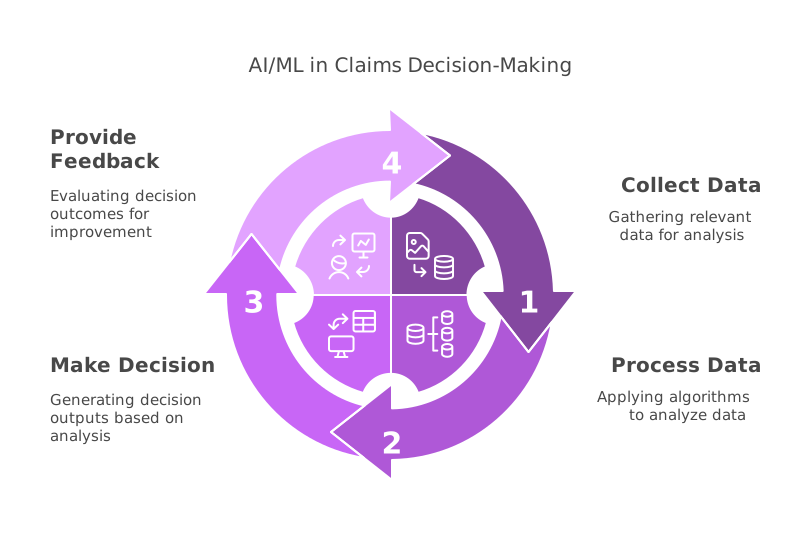
Artificial Intelligence and Machine Learning represent perhaps the most transformative technologies in modern claims processing, enabling systems to move beyond simple rule execution to more sophisticated analysis, pattern recognition, and decision-making. Unlike traditional rule-based systems that follow explicit, predefined logic, AI and ML algorithms can analyze vast datasets to identify patterns, relationships, and anomalies that might not be immediately apparent to human reviewers. This capability is particularly valuable in claims processing, where complex interactions between diagnosis codes, treatment protocols, policy provisions, and reimbursement rules create multifaceted decision scenarios.
In the context of reimbursement claims, AI and ML applications span numerous functional areas. Predictive models can assess the likelihood of claim approval based on historical patterns and current claim characteristics, allowing for more efficient resource allocation and processing prioritization. Classification algorithms can automatically categorize claims according to complexity, potential value, or processing requirements, creating more efficient workflow routing. Anomaly detection systems can identify potential fraud indicators or unusual billing patterns that warrant additional investigation. Natural language understanding models can interpret clinical documentation to determine medical necessity and appropriate coding. Reinforcement learning algorithms continuously optimize processing rules based on outcomes and changing conditions, ensuring that the system evolves with emerging patterns and requirements.
The implementation of AI and ML in claims processing delivers several significant advantages over traditional approaches. These systems can process and analyze vastly more information than human reviewers, considering hundreds or thousands of variables simultaneously when making assessments. They can identify subtle patterns and relationships that might escape human notice, potentially uncovering processing inefficiencies or fraud indicators. They maintain consistency in decision-making, applying the same analytical rigor to every claim regardless of volume or complexity. Perhaps most importantly, they continuously improve through feedback loops, with each processed claim contributing to the system's knowledge base and refining its decision models.
Organizations implementing AI and ML in claims processing report significant improvements in both efficiency and effectiveness metrics. Processing time reductions of 30-50% are common for AI-enhanced systems, with some organizations reporting even greater gains for specific claim types. Accuracy improvements are equally impressive, with properly trained systems achieving decision accuracy rates that match or exceed those of experienced human reviewers. The combination of speed and accuracy delivers substantial financial benefits, reducing administrative costs while simultaneously improving payment accuracy and reducing improper claim approvals or denials.
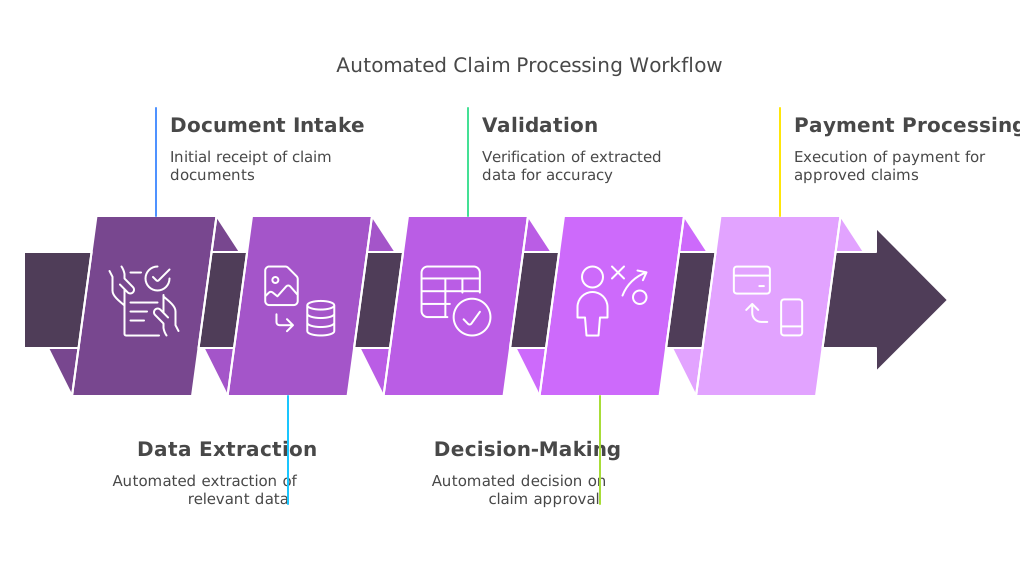
The claims intake process has traditionally represented a significant bottleneck in reimbursement processing, particularly for organizations dealing with high volumes of claims submitted through diverse channels including paper forms, emails, fax transmissions, web portals, and electronic data interchange (EDI). Automation technologies have fundamentally transformed this initial phase, creating more efficient, accurate, and scalable intake capabilities that establish a strong foundation for subsequent processing steps.
Modern automated intake systems employ a multi-channel approach that can receive and standardize claims regardless of submission format. Digital mailroom technologies utilizing OCR and document classification algorithms automatically process incoming paper claims, converting them to digital format and extracting relevant data. API integrations and EDI connections enable direct system-to-system transmission of claim information from provider systems to processing platforms. Web portals with structured submission forms capture claim details in standardized formats that can be directly integrated into processing workflows. Mobile applications allow for real-time claim submission, often incorporating features such as photo documentation and location verification to enhance claim validity.
Once claims are received, automated preprocessing systems perform initial validation and enrichment functions that prepare the claim for core processing. These systems verify claim completeness, ensuring all required fields and documentation are present before routing the claim for detailed processing. They standardize information formats, converting varied date formats, address structures, and code notations into consistent formats for system processing. They enhance claim data through integration with internal and external data sources, automatically appending relevant policyholder information, provider details, or benefit specifications. They assign priority and routing based on claim characteristics, ensuring appropriate handling based on complexity, value, or special processing requirements.
The impact of automated intake and preprocessing on overall claims efficiency is substantial. Organizations implementing comprehensive intake automation typically report 60-80% reductions in manual data entry requirements, 30-50% improvements in first-pass processing rates due to enhanced data quality, and significant reductions in claim cycle time, with some entities achieving same-day processing for claims that previously required multiple days just to enter the system. These improvements not only reduce administrative costs but also enhance customer satisfaction by accelerating the entire reimbursement timeline.
Claim verification and validation processes are particularly well-suited for automation due to their rule-based nature and reliance on data comparison across multiple sources. Traditional manual verification approaches required claims professionals to review submission details against policy provisions, provider contracts, service eligibility rules, and other verification points a time-consuming process prone to inconsistency and oversight. Automated verification systems now perform these functions with greater speed, thoroughness, and accuracy, significantly enhancing both processing efficiency and payment integrity.
Comprehensive automated verification encompasses multiple dimensions of claim validity assessment. Eligibility verification confirms that the claimant was covered under the relevant policy at the time of service, automatically checking effective dates, policy status, and specific coverage provisions. Benefit verification determines whether the claimed services or items are covered under the policy terms, often incorporating complex rule engines that assess coverage based on diagnosis codes, procedure types, and policy-specific exclusions or limitations. Provider verification confirms that the servicing provider is appropriately credentialed, contracted, and authorized to perform the billed services, reducing the risk of payment for unauthorized or out-of-network care. Pricing verification ensures that the billed amounts align with contracted rates or fee schedules, automatically adjusting reimbursement amounts based on applicable payment rules, modifiers, and bundling requirements.
Beyond these basic verification functions, advanced automated systems perform deeper validation analyses that identify potential issues requiring attention. These systems can detect duplicate claims by comparing submission details against processing history, preventing double payment for the same service. They can identify coding discrepancies or upcoding patterns that might indicate billing errors or potentially fraudulent practices. They can flag claims with unusual service patterns or combinations that deviate from clinical norms or treatment protocols. They can detect coordination of benefits scenarios where multiple insurance policies may share payment responsibility, ensuring appropriate primary/secondary determination.
The automation of verification and validation functions delivers multiple benefits to claims operations. Processing throughput increases dramatically, with automated systems capable of performing comprehensive verification on hundreds or thousands of claims per hour compared to the dozens that human reviewers might complete in the same timeframe. Verification accuracy improves through the elimination of oversight and inconsistency issues that affect manual review processes. Payment accuracy enhances through the consistent application of complex reimbursement rules that might be challenging for human reviewers to apply correctly in all scenarios. Exception handling becomes more focused and effective, with automation identifying specifically which verification points failed rather than requiring complete manual review of rejected claims.
The core adjudication phase of claims processing, where approval/denial decisions are made and payment amounts are determined, has historically been considered the domain of experienced claims professionals who apply judgment and expertise to complex reimbursement scenarios. However, advances in rule-based processing engines, machine learning, and artificial intelligence have increasingly enabled the automation of many adjudication functions, particularly for routine claims that follow standard processing patterns. This automation enables organizations to reserve human judgment for truly complex or exceptional cases while processing the majority of claims through automated channels.
Modern automated adjudication systems employ sophisticated decisioning frameworks that incorporate multiple components working in concert. Rule engines form the foundation of these systems, applying explicit business logic to claim characteristics and verification results to determine approval status and payment amounts. These engines can incorporate thousands of interrelated rules addressing policy provisions, benefit calculations, service limitations, and regulatory requirements. Predictive models enhance rule-based processing by assessing the probability of claim validity based on historical patterns and claim characteristics, enabling more nuanced routing decisions for claims with uncertain elements. Machine learning algorithms continuously refine decision parameters based on outcomes and feedback, gradually improving decision accuracy without requiring explicit rule modifications.
The sophistication of automated adjudication varies significantly based on claim complexity and organizational requirements. In straightforward scenarios such as pharmacy claims or simple medical services, straight-through processing (STP) enables claims to progress from submission to payment without human intervention, typically achieving automation rates of 80-90%. For moderately complex claims involving multiple services or potential policy interactions, automated systems might perform initial adjudication while routing specific aspects for human review, creating a hybrid processing model that balances efficiency with judgment. In highly complex scenarios such as major medical claims or specialized insurance lines, automation might focus on preprocessing and information organization, providing human adjudicators with structured information and recommendations while leaving final decisions to professional judgment.
The implementation of automated adjudication delivers substantial efficiency gains across multiple dimensions. Processing time reductions of 50-70% are common for claims suited to automated adjudication, with some organizations achieving same-day or next-day payment for claims that previously required weeks to process. Resource allocation improves through the concentration of human expertise on complex cases requiring judgment while handling routine claims through automated channels. Decision consistency enhances through the application of standardized rules and evaluation criteria across all claims, reducing variability in outcomes for similar cases. Most significantly, the combination of speed and consistency dramatically improves the customer experience, accelerating reimbursement timelines while reducing the frustration associated with unexplained denials or processing delays.
The final phase of the reimbursement lifecycle payment processing and financial reconciliation presents significant automation opportunities that many organizations have yet to fully realize. Traditional payment processes often involve manual handoffs between claims systems and financial platforms, paper check generation and mailing, manual reconciliation of payments against claim records, and fragmented communication regarding payment status. Automated payment and reconciliation systems address these inefficiencies, creating seamless financial workflows that reduce administrative costs while accelerating payment delivery to providers and claimants.
Comprehensive payment automation incorporates multiple technologies and approaches to create an integrated reimbursement ecosystem. Electronic payment processing enables direct disbursement through ACH transfers, virtual card payments, or real-time payment networks, eliminating the delays and costs associated with paper checks. Payment aggregation capabilities consolidate multiple claim payments to the same provider into single transactions with detailed remittance information, simplifying reconciliation for both the payer and provider. Automated reconciliation systems match payments against claim records in real-time, identifying and resolving discrepancies without manual intervention. Integration with provider financial systems through standardized formats such as 835 transactions enables straight-through processing on the receiving end, allowing automatic posting of payments to patient accounts.
Beyond these core functions, advanced payment automation incorporates additional capabilities that further enhance financial operations. Dynamic payment optimization algorithms can select the most advantageous payment method based on recipient preferences, processing costs, and timing requirements. Automated denial management systems generate structured explanation of benefits (EOB) information and facilitate electronic appeal submissions when claims are partially or fully denied. Payment tracking and visualization tools provide real-time visibility into disbursement status, enabling more effective financial management and stakeholder communication. Integration with accounting systems ensures proper financial categorization and reporting without manual data transfer or reconciliation.
The benefits of payment automation extend to all stakeholders in the reimbursement ecosystem. For payers, automated payment processes reduce disbursement costs by 50-70% compared to paper checks, accelerate financial close processes through real-time reconciliation, and improve provider relations through faster, more transparent payment delivery. For providers, electronic payment receipt reduces manual posting requirements, accelerates cash flow through faster payment delivery, and enhances revenue cycle management through detailed, structured remittance information. For patients, automated payment processes for direct reimbursements reduce wait times for funds, provide clearer explanation of payment decisions, and offer multiple options for receiving reimbursement based on personal preferences.
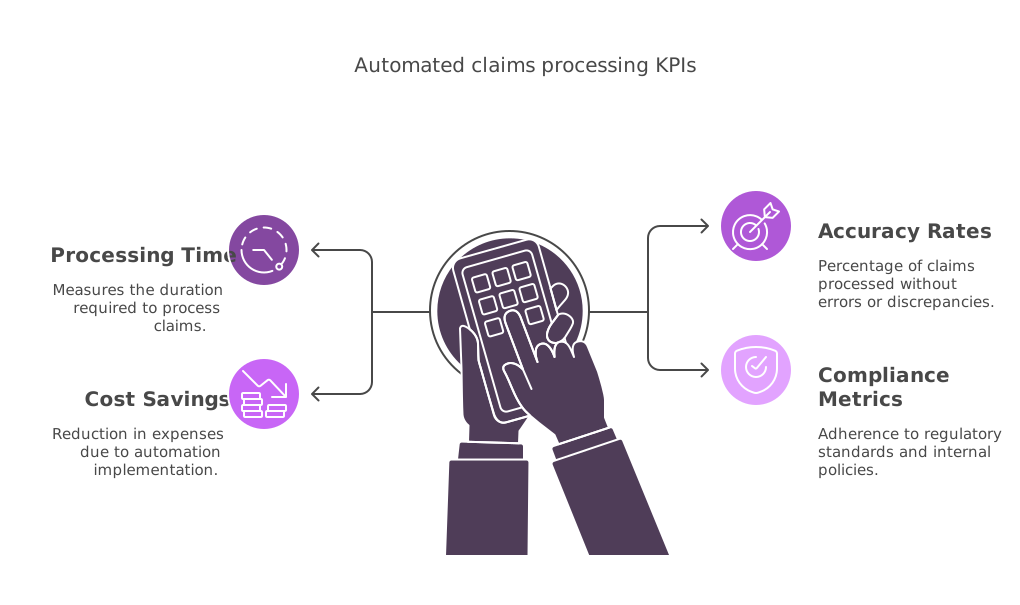
The implementation of comprehensive claims automation delivers transformative efficiency improvements across all processing dimensions, fundamentally altering operational capabilities and resource requirements. These gains extend beyond simple cost reduction, enabling organizations to handle growing claim volumes, meet accelerated processing expectations, and adapt to increasingly complex reimbursement environments without proportional staff increases. Quantitative assessments of automation implementations across multiple insurance and healthcare organizations reveal consistent patterns of improvement that demonstrate the substantial impact of these technologies.
Processing time reductions represent the most immediately visible efficiency gain, with automated systems dramatically accelerating claims handling across all complexity levels. For straightforward claims processed through straight-through processing channels, cycle times typically decrease by 70-90%, with many organizations achieving same-day or next-day processing for claims that previously required multiple days or weeks. Even for complex claims requiring partial human review, automation of preprocessing, data organization, and routine verification steps typically reduces overall processing time by 30-50%, creating more responsive reimbursement timelines for all claim categories.
Resource productivity improves substantially through the reallocation of human effort from routine processing to exception handling and complex case management. Organizations implementing comprehensive automation typically report that the same claims staff can handle 3-5 times more claims through automated systems compared to manual processes, with some achieving even higher productivity gains in specific process areas. This productivity enhancement enables staffing models that concentrate expertise on high-value activities requiring judgment while handling routine processing through technology platforms, creating more engaging work environments while simultaneously reducing per-claim handling costs.
Scalability represents perhaps the most significant operational advantage of automated claims processing, enabling organizations to accommodate volume fluctuations and growth without proportional resource expansion. Automated systems can typically handle significant volume increases with minimal incremental cost, requiring additional computing resources rather than staffing adjustments to accommodate growth. This scalability is particularly valuable in reimbursement environments characterized by seasonal variation, enrollment growth, or sudden volume increases due to external factors such as public health events or natural disasters that generate surge claim volumes.
Beyond operational efficiency, automation delivers substantial improvements in processing accuracy and error reduction, addressing one of the most significant challenges in traditional claims management. Manual claim processing is inherently prone to various error types, including data entry mistakes, oversight of policy provisions, inconsistent rule application, and processing variations between individual claims handlers. These errors create numerous downstream consequences including payment inaccuracies, denial management challenges, provider disputes, member dissatisfaction, and compliance risks. Automated processing systems address these issues through consistent application of rules, elimination of manual data handling, and sophisticated validation capabilities.
Data accuracy represents a foundational improvement area, with automated data capture and validation eliminating the transcription errors and information gaps common in manual data entry. Organizations implementing comprehensive intake automation typically report 80-90% reductions in data entry errors, creating a more reliable information foundation for subsequent processing steps. This enhanced data quality dramatically improves first-pass processing rates, reducing the rework and correction cycles that consume substantial resources in manual environments.
Processing consistency improves through the application of standardized rules and evaluation criteria across all claims, regardless of volume, complexity, or handling staff. Unlike human processing where interpretation variations, knowledge gaps, or simple oversight might lead to different outcomes for similar claims, automated systems apply the same analytical rigor and rule sets to every submission. This consistency not only improves overall accuracy but also enhances fairness and transparency, reducing the perception of arbitrary or unexplained decisions that often generates provider and member dissatisfaction.
Payment accuracy ensuring that reimbursements precisely match policy provisions, contracted rates, and regulatory requirements represents a particularly valuable improvement area with direct financial implications. Studies of automation implementations suggest that advanced systems can reduce payment errors by 30-50% compared to manual processing, particularly for complex claims involving multiple services, tiered benefits, or sophisticated reimbursement formulas. These improvements directly impact the bottom line by reducing both overpayments that create unnecessary costs and underpayments that generate appeals and provider disputes.
The financial impact of claims automation extends beyond simple operational cost reduction, encompassing multiple value dimensions including administrative efficiency, payment accuracy, resource optimization, and enhanced recovery capabilities. Comprehensive assessments of automation implementations across various insurance and healthcare organizations suggest potential return on investment (ROI) ranging from 200% to 500% over a three-year period, with some organizations achieving even higher returns in specific process areas or claim categories.
Administrative cost reduction represents the most direct financial benefit, with organizations typically reporting 25-40% decreases in per-claim processing costs following comprehensive automation implementation. These savings derive from multiple sources including reduced manual data entry requirements, accelerated processing timelines, decreased rework necessitated by errors or incomplete information, and lower document management costs through digital transformation. For large insurers or healthcare systems processing millions of claims annually, these efficiency gains can translate to tens of millions of dollars in annual administrative savings.
Payment accuracy improvements deliver substantial financial benefits through the reduction of both overpayments and underpayments. Overpayment prevention through enhanced verification and precise benefit calculation directly improves the bottom line by ensuring that disbursements align with policy provisions and contracted rates. Underpayment reduction, while seemingly counterintuitive from a cost perspective, actually generates significant financial benefits by decreasing the substantial administrative costs associated with appeals, provider disputes, and reprocessing requirements. Organizations with mature automation implementations typically report 3-5% improvements in overall payment accuracy, translating to substantial financial impact in high-volume processing environments.
Resource optimization through more effective staff allocation creates additional financial benefits beyond simple headcount reduction. By automating routine processing functions, organizations can redirect professional resources toward higher-value activities such as complex case management, provider relationship development, benefit design optimization, and member experience enhancement. This optimization not only improves operational efficiency but also enhances revenue opportunities through better contract management, more effective network development, and improved member retention resulting from superior service experiences.
Recovery enhancement represents a frequently overlooked financial benefit of claims automation, particularly when systems incorporate advanced analytics capabilities. Automated identification of subrogation opportunities, coordination of benefits scenarios, provider billing errors, and potential fraud indicators enables more effective recovery operations that can recapture inappropriate payments. Organizations implementing advanced recovery automation typically report 15-25% increases in identified recovery opportunities and 10-20% improvements in recovery success rates, creating a substantial financial impact that directly enhances the bottom line.
The regulatory environment surrounding healthcare and insurance reimbursement continues to grow more complex, with organizations facing numerous compliance requirements related to processing timeliness, notification obligations, data security, information privacy, and payment accuracy. Manual processing environments often struggle to consistently meet these requirements, creating compliance risks that can result in financial penalties, regulatory scrutiny, and reputational damage. Automated claims processing significantly enhances compliance capabilities through standardized workflows, consistent rule application, comprehensive documentation, and sophisticated monitoring systems.
Processing timeliness compliance represents a fundamental advantage of automated systems, addressing regulatory requirements that establish maximum timeframes for claim acknowledgment, initial determination, and payment disbursement. Unlike manual environments where processing backlogs or resource constraints might lead to missed deadlines, automated systems incorporate workflow management capabilities that track processing timelines for each claim, prioritize cases approaching deadline thresholds, and escalate potential compliance issues before violations occur. Organizations implementing comprehensive automation typically report 80-90% reductions in timeliness violations, substantially decreasing exposure to penalties and regulatory criticism.
Documentation compliance improves through the automatic generation and preservation of processing records, ensuring that all claim decisions, verification steps, and communications are thoroughly documented in readily accessible formats. This comprehensive documentation not only supports potential regulatory audits but also enhances the organization's ability to defend processing decisions in appeal scenarios or legal challenges. Advanced systems incorporate specific documentation features addressing unique regulatory requirements in different jurisdictions or insurance lines, ensuring compliance with varied documentation standards across complex operational environments.
Privacy and security compliance represents an increasingly critical advantage of well-designed automated systems, particularly those processing protected health information subject to HIPAA regulations or financial data governed by payment card industry (PCI) standards. Automated processing reduces privacy risks by minimizing human exposure to sensitive information, implementing role-based access controls, applying consistent data protection protocols, and maintaining comprehensive audit trails of information access and utilization. These capabilities are particularly valuable in environments where remote or distributed workforces create additional privacy and security challenges.
Fraud prevention compliance enhances through the implementation of sophisticated detection algorithms that identify potential fraudulent claims, suspicious billing patterns, or unusual provider behaviors that might indicate abusive practices. Unlike manual review processes that might inconsistently apply fraud indicators or overlook subtle patterns across multiple claims, automated systems can systematically analyze every submission against comprehensive fraud models, ensuring consistent compliance with regulatory expectations regarding fraud prevention and detection. Organizations with advanced fraud detection automation typically report 20-30% increases in identified suspicious claims and 15-25% improvements in successful fraud interventions, demonstrating enhanced compliance with regulatory expectations regarding payment integrity.
The automation of reimbursement claim processing represents one of the most significant operational transformations in the healthcare and insurance sectors, fundamentally altering traditional approaches to information handling, decision-making, and stakeholder interaction. This transformation extends far beyond simple efficiency improvements, enabling new operational models, enhanced service capabilities, and innovative approaches to long-standing reimbursement challenges. As technology continues to evolve and implementation experience grows, automation will increasingly become not merely an operational enhancement but a strategic necessity for organizations seeking to thrive in increasingly complex and competitive reimbursement environments.
The core technologies driving this transformation optical character recognition, natural language processing, robotic process automation, artificial intelligence, and machine learning have reached maturity levels enabling reliable implementation across diverse processing environments. These technologies deliver consistent and substantial benefits including dramatic efficiency improvements, enhanced accuracy, significant cost reductions, and improved compliance capabilities. When implemented through thoughtful approaches addressing technology integration, data quality, workforce transition, and performance measurement, these solutions create sustainable operational advantages that directly impact financial performance, competitive positioning, and stakeholder satisfaction.
Looking forward, the reimbursement automation journey continues to evolve toward increasingly sophisticated capabilities including advanced analytics enabling predictive processing and proactive intervention; blockchain applications establishing shared transaction records and automated contract execution; and conversational interfaces creating more intuitive, accessible interaction experiences. These emerging technologies will gradually shift reimbursement systems from reactive processing focused on accurate transaction handling to proactive ecosystems emphasizing optimal outcomes, personalized experiences, and value-based models requiring sophisticated data analysis and stakeholder engagement.
For organizations embarking on or continuing their automation journey, several principles can guide successful implementation and sustainable value creation. Comprehensive strategy development aligning automation initiatives with broader organizational objectives ensures that technology investments deliver meaningful business impact rather than isolated process improvements. Thoughtful technology selection focusing on integration capabilities and evolutionary potential creates sustainable solutions that can adapt to changing requirements and emerging opportunities. Balanced implementation approaches addressing both technology deployment and organizational adoption enable successful transitions that deliver benefits while maintaining operational stability. Perhaps most importantly, continuous innovation cultures encouraging ongoing exploration, experimentation, and evolution ensure that organizations remain at the forefront of reimbursement automation as technologies and capabilities continue to advance.
The transformation of reimbursement claim processing through automation represents not merely an operational enhancement but a fundamental reimagining of how healthcare and insurance organizations manage one of their most critical functions. By embracing this transformation through strategic planning, thoughtful implementation, and continuous innovation, organizations can create significant advantages while enhancing experiences for all participants in the reimbursement ecosystem providers, payers, and most importantly, the patients and members they ultimately serve.

Head IT Operations - Co Founder of Artificio
See it in your SAP environment
Bring us a document, a process, or a bottleneck. We'll show how Artificio captures, validates, and posts into SAP — then scale from there.
Security & compliance
ISO 27001:2013 certified, SOC 2 Type 2 compliant, GDPR and HIPAA ready. Every agent action is logged, auditable, and runs in isolated environments.