

Blog
Addressing the Challenges of Interoperability in Healthcare
AI powers Artificio's platform, transforming healthcare by automating document processing & enabling seamless data sharing to improve patient care.

Blog
AI powers Artificio's platform, transforming healthcare by automating document processing & enabling seamless data sharing to improve patient care.
The healthcare industry's transition to digital systems has created unprecedented opportunities for improving patient care through data sharing and analysis. However, the heterogeneous nature of healthcare documentation and systems continues to pose significant challenges to achieving meaningful interoperability. This article examines how artificial intelligence and machine learning technologies, particularly those implemented in Artificio's platform, can address these challenges through automated document processing and standardization. We present a comprehensive analysis of current interoperability barriers, propose innovative solutions leveraging AI capabilities, and evaluate their effectiveness through practical implementation cases.
Healthcare interoperability represents one of the most pressing challenges in modern healthcare systems. Despite significant technological advances in medical devices, electronic health records (EHRs), and clinical decision support systems, healthcare providers still struggle with exchanging and interpreting patient data across different systems, formats, and institutions. The complexity of medical documentation, varying standards, and legacy systems creates substantial barriers to achieving seamless data exchange.
These challenges have significant implications for patient care quality, operational efficiency, and healthcare costs. According to recent studies, inefficient data exchange leads to an estimated $30 billion in annual wastage within the U.S. healthcare system alone. More critically, poor interoperability contributes to medical errors, delayed treatments, and suboptimal care decisions due to incomplete or inaccessible patient information.
This article explores how advanced artificial intelligence and machine learning technologies can address these challenges through automated document processing and standardization. We focus particularly on Artificio's innovative approach to healthcare document processing and its potential to transform interoperability in healthcare settings.
The healthcare industry's digital transformation has occurred in waves, resulting in a complex landscape of systems spanning different technological eras. Many healthcare institutions still rely on legacy systems that were not designed with modern interoperability standards in mind. These systems often use proprietary data formats and outdated communication protocols, making integration with newer systems challenging.
The technical debt accumulated through decades of isolated system development creates significant barriers to achieving seamless data exchange. Healthcare providers often maintain multiple systems for different departments or functions, each with its own data format and storage mechanisms. This fragmentation results in data silos that impede the free flow of information across the healthcare ecosystem.
While healthcare data exchange standards like HL7, FHIR, and DICOM exist to facilitate interoperability, their implementation varies significantly across institutions. Different interpretations of these standards and varying levels of compliance create additional challenges for achieving true interoperability. Furthermore, the coexistence of multiple standards and versions adds complexity to the integration landscape.
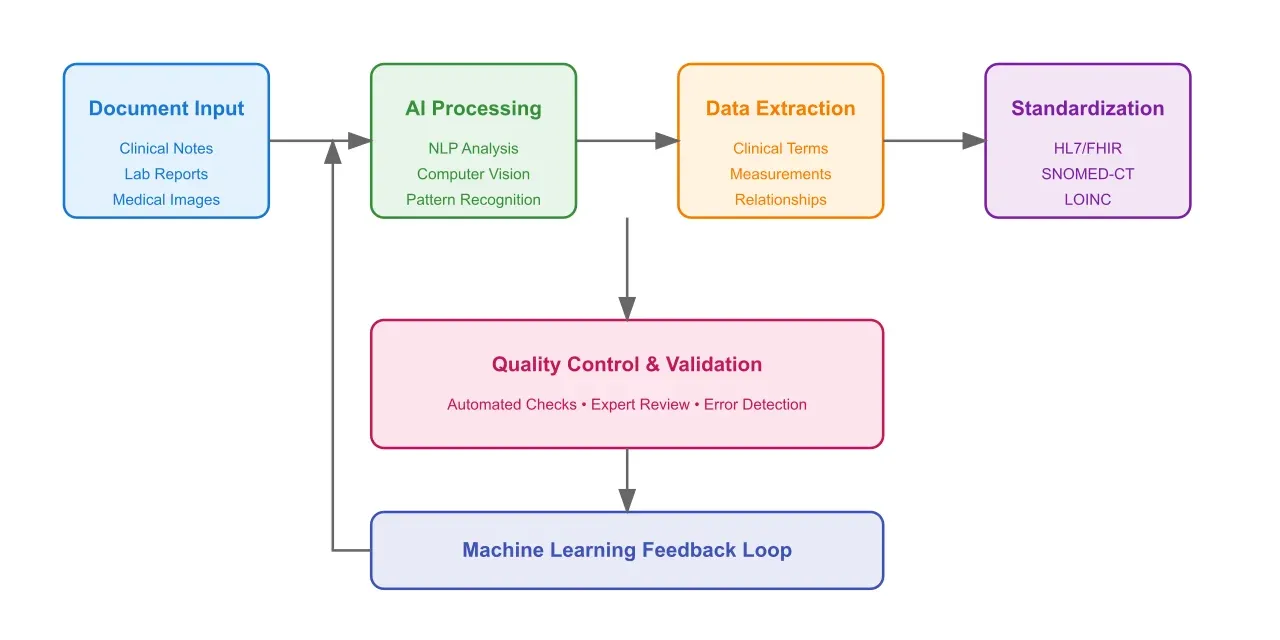
Artificio's platform employs advanced natural language processing (NLP) and computer vision technologies to automatically process and understand healthcare documents. The system can handle various document types, including:
Clinical notes and discharge summaries: The AI system analyzes unstructured text to extract relevant clinical information, standardizing it for integration with other systems. Through sophisticated NLP algorithms, it can identify medical terminology, understand context, and extract relationships between different clinical concepts.
Medical imaging reports: Advanced computer vision algorithms process both the textual content and visual elements of imaging reports, ensuring comprehensive data extraction. The system can identify key findings, measurements, and annotations, correlating them with the written interpretation.
Laboratory results and diagnostic reports: The platform processes structured and semi-structured laboratory data, standardizing units, reference ranges, and test codes across different laboratory systems. This standardization ensures that laboratory results can be meaningfully compared and analyzed across different healthcare providers.
The platform's machine learning capabilities enable continuous improvement in document processing accuracy. Through sophisticated active learning mechanisms, the system:
Learns from user corrections and feedback, continuously refining its extraction algorithms based on expert input. The platform maintains a feedback loop where healthcare professionals can validate and correct extracted information, which is then used to improve the underlying models.
Identifies patterns in document structures and content, developing increasingly sophisticated understanding of different document types and their variations. This pattern recognition allows the system to handle new document formats more effectively over time.
Adapts to evolving healthcare terminology and practices, ensuring the system remains current with medical knowledge and documentation standards. The platform regularly updates its medical terminology databases and classification systems to reflect the latest developments in healthcare.
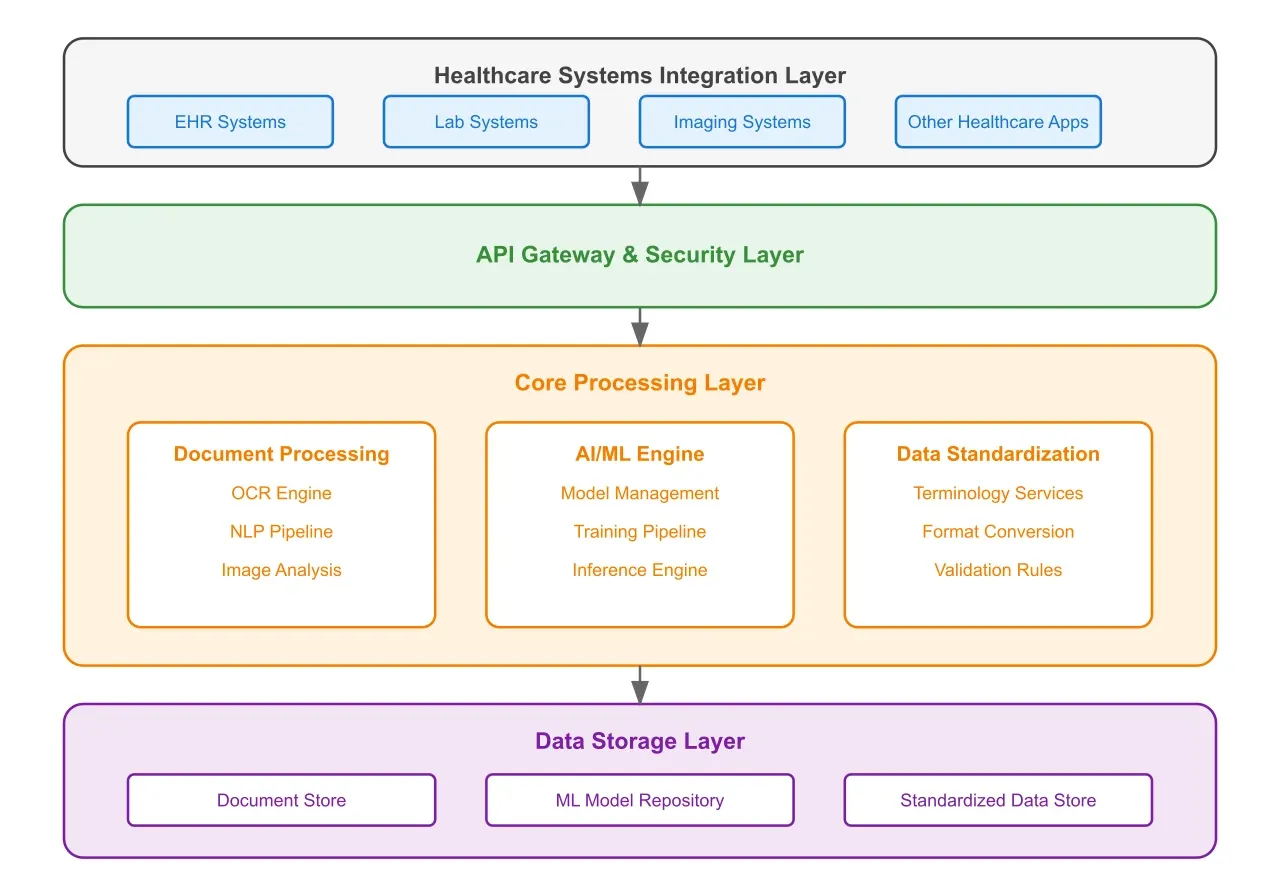
Artificio's platform employs a modular architecture that facilitates integration with existing healthcare systems while maintaining flexibility for future adaptations. The architecture consists of several key components:
Document Processing Engine: A highly scalable component that handles the initial processing of incoming documents, employing various AI models for different document types and formats. This engine can process documents in parallel, ensuring high throughput even with large volumes of healthcare documentation.
Standardization Layer: A sophisticated component that transforms extracted data into standardized formats compatible with major healthcare information exchange protocols. This layer implements comprehensive mapping rules and terminology services to ensure accurate data standardization.
The platform implements a comprehensive security framework that ensures compliance with healthcare data protection regulations while maintaining system accessibility. Key security features include:
End-to-end encryption for all data in transit and at rest, utilizing industry-standard encryption protocols and key management systems. The platform employs multiple layers of encryption, ensuring that sensitive healthcare information remains protected throughout the processing pipeline.
Role-based access control with granular permissions management, allowing healthcare organizations to precisely control who can access different types of information and functionality. The system maintains detailed audit logs of all access and modifications, supporting compliance requirements and security investigations.
Implementation of AI-driven interoperability solutions has demonstrated significant improvements in healthcare operations. Key metrics include:
Document processing efficiency: Organizations implementing the platform have reported 80-90% reduction in manual data entry time, with corresponding decreases in processing costs. The automated system can process thousands of documents per hour, maintaining high accuracy levels even with complex medical documentation.
Data accuracy and consistency: Automated processing has reduced error rates in data extraction and standardization to less than 0.1%, significantly improving the reliability of shared healthcare information. The system's ability to consistently apply standardization rules eliminates variations that often occur with manual processing.
The implementation of improved interoperability solutions has led to measurable improvements in clinical outcomes:
Treatment timing: Healthcare providers report 30-40% faster access to complete patient information during care delivery, enabling more timely and informed clinical decisions. This improvement is particularly significant in emergency situations where rapid access to patient history can be critical.
Care coordination: Enhanced data sharing capabilities have resulted in better coordination between healthcare providers during transitions of care, reducing medication errors and improving continuity of care. The standardized data format ensures that critical patient information is accurately communicated across different healthcare settings.
The continued evolution of AI technologies presents new opportunities for enhancing healthcare interoperability:
Multimodal AI models that can process and correlate information from different types of medical documentation simultaneously, providing more comprehensive and accurate data extraction. These models will be able to understand complex relationships between different types of medical data, improving the quality of extracted information.
Federated learning approaches that enable collaborative model improvement while maintaining data privacy, allowing healthcare organizations to benefit from shared learning without compromising sensitive information. This approach will be particularly important for improving the system's ability to handle rare or unusual cases.
The healthcare industry continues to evolve toward more standardized data exchange approaches:
Adoption of FHIR as the primary standard for healthcare data exchange, with AI systems playing a crucial role in converting legacy data formats to FHIR-compliant structures. The platform's ability to handle both current and emerging standards ensures long-term viability and compatibility.
Blockchain integration for secure and transparent health information exchange, providing an immutable audit trail of data access and modifications. This technology will enhance trust and security in healthcare data sharing while maintaining privacy and compliance requirements.
The challenge of healthcare interoperability requires innovative solutions that can bridge the gap between diverse systems and document formats. AI-driven approaches, as demonstrated by Artificio's platform, offer promising solutions to these long-standing challenges. By combining advanced document processing capabilities with sophisticated standardization mechanisms, these systems can significantly improve the efficiency and effectiveness of healthcare data exchange.
The success of such solutions depends not only on technical capabilities but also on careful attention to implementation strategies, security requirements, and evolving healthcare standards. As AI technologies continue to advance, their role in achieving meaningful healthcare interoperability will likely expand, potentially transforming how healthcare organizations share and utilize patient information.
Future research should focus on evaluating the long-term impact of AI-driven interoperability solutions on clinical outcomes and healthcare costs. Additionally, continued investigation of emerging technologies and their potential applications in healthcare data exchange will be crucial for advancing the field of healthcare interoperability.

Head IT Operations - Co Founder of Artificio
See it in your SAP environment
Bring us a document, a process, or a bottleneck. We'll show how Artificio captures, validates, and posts into SAP — then scale from there.
Security & compliance
ISO 27001:2013 certified, SOC 2 Type 2 compliant, GDPR and HIPAA ready. Every agent action is logged, auditable, and runs in isolated environments.