

Blog
The Transformative Power of Intelligent Agents in Document Management
Explore how AI-driven Intelligent Agents transform document handling with automated classification and search.

Blog
Explore how AI-driven Intelligent Agents transform document handling with automated classification and search.
Intelligent Agents differ fundamentally from their predecessors in the document automation space. Where traditional systems rely on rigid templates, explicit rules, and extensive human configuration, IAs exhibit adaptive learning capabilities that allow them to understand documents at a semantic level. This deeper comprehension enables them to:
The technological foundation of this revolution rests on the convergence of multiple AI disciplines. Modern Intelligent Agents integrate natural language processing (NLP) to understand textual content, computer vision to interpret visual elements, machine learning to identify patterns, and knowledge representation frameworks to establish contextual relationships. This multi-modal approach allows IAs to process documents with a level of comprehension previously possible only through human cognition.
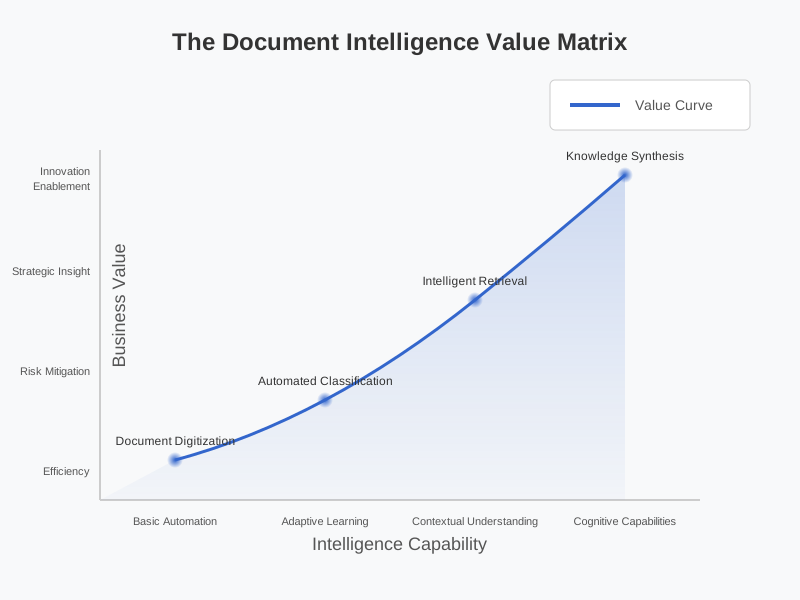
Consider the traditional approach to invoice processing. Conventional automation required pre-configured templates for each vendor format, manual exception handling, and limited ability to adapt to new formats. In contrast, an IA-powered system can analyze an invoice it has never encountered before, identify it as an invoice (rather than another document type), extract relevant information fields, validate that information against historical records, and route it appropriately all without human intervention.
The implications of this capability extend far beyond simple task automation. By transforming documents from static information containers into dynamic, context-aware knowledge assets, Intelligent Agents are redefining how organizations capture, manage, and extract value from their information resources. This transformation is particularly evident when examining the impact of IA on document categorization processes.
Document categorization represents one of the most foundational yet challenging aspects of information management. Traditional approaches have relied heavily on manual classification, predefined folder structures, and basic metadata tagging methods that become increasingly unsustainable as document volumes expand. Intelligent Agents have fundamentally reimagined this process by introducing capabilities that transcend the limitations of conventional categorization systems.
At the core of IA's categorization capabilities is automated classification a sophisticated process that analyzes document content, structure, and context to determine appropriate categories without human intervention. Unlike simple rule-based classification systems, Intelligent Agents employ multiple analytical dimensions simultaneously:
Content analysis examines the actual text, images, and data within documents to identify key themes, entities, and information types. Context evaluation considers the document's relationship to other documents, its creation circumstances, and organizational workflows. Pattern recognition identifies similarities with previously categorized documents to apply consistent classification principles. Intent analysis attempts to understand the document's purpose and expected use within organizational processes.
The integration of these analytical dimensions enables remarkably precise categorization across diverse document types. For example, a leading financial services organization implemented an IA-powered categorization system that correctly classified over 97% of incoming documents across 87 distinct categories a task that previously required a dedicated team of document specialists reviewing each item individually.
Beyond accuracy, automated classification delivers significant operational advantages. Processing times drop from minutes to seconds per document. Classification consistency improves dramatically by eliminating the subjective variations inherent in manual processing. Perhaps most importantly, the classification system becomes scalable, handling volume surges without corresponding increases in personnel resources.
What truly distinguishes Intelligent Agents from earlier automation approaches is their capacity for adaptive learning. Traditional document management systems maintain static classification rules unless manually updated by administrators. In contrast, IA systems continually refine their classification models through multiple learning mechanisms:
Supervised learning incorporates explicit feedback from users, who can confirm or correct classification decisions. This feedback loop allows the system to recalibrate its models based on verified examples. Unsupervised learning identifies emerging patterns within document collections without explicit instruction, helping the system discover natural document categories. Transfer learning enables the system to apply knowledge gained from one document type to similar but previously unencountered formats. Active learning identifies classification uncertainties and intelligently requests human guidance only for those specific cases, maximizing learning efficiency.
As depicted in Figure 2: The Adaptive Learning Cycle in Document Intelligence, these learning mechanisms create a virtuous cycle of continuous improvement. The system's classification accuracy increases over time, even as document formats evolve, and new categories emerge. This adaptability is particularly valuable in industries experiencing rapid document evolution due to regulatory changes, business transformation, or technological advancement.
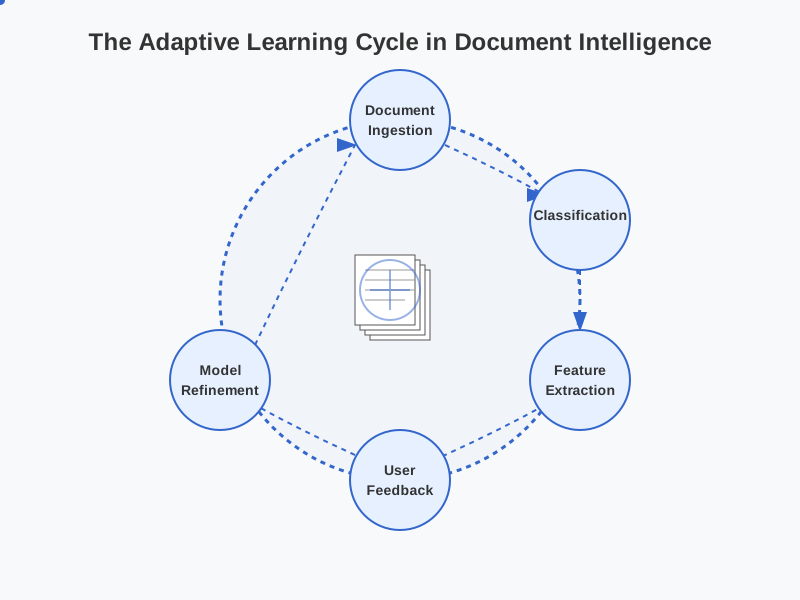
A pharmaceutical company leveraging adaptive document intelligence saw classification accuracy improve from 82% to 96% over an 18-month period, despite introducing 14 new document categories during that time. The system adapted to these changes with minimal human intervention, learning from limited examples to recognize new document types while maintaining performance on existing categories.
The transformative potential of intelligent classification becomes evident when examining implementation outcomes. A global insurance provider struggled with document categorization challenges that threatened both operational efficiency and regulatory compliance. The company processed over 40,000 documents daily across 120+ document types, ranging from policy applications and claims forms to medical records and legal correspondence.
Their traditional document management system relied on a combination of manual classification and basic rule-based automation. This approach resulted in numerous challenges: Classification accuracy hovered at approximately 76%, with significant variations between document types. Processing delays created bottlenecks in critical workflows, with some documents waiting 48+ hours for proper classification. Classification inconsistencies led to compliance vulnerabilities, particularly for regulated document types requiring specific handling protocols. The classification system struggled to adapt to new document formats introduced through business acquisitions and regulatory changes.
After implementing an Intelligent Agent solution focused on document categorization, the organization experienced dramatic improvements across all metrics:
Classification accuracy increased to 94% within three months, with particularly significant improvements for complex document types. Processing times dropped to an average of 38 seconds per document, with 97% of documents classified in under two minutes. The system seamlessly incorporated 27 new document types introduced through a major business acquisition, learning to identify them with minimal training examples. Compliance exceptions decreased by 76% due to consistent application of classification rules and automated routing to appropriate handling processes.
Beyond these quantitative improvements, the organization reported significant qualitative benefits. Knowledge workers spent less time searching for information and more time on value-added activities. Customer service representatives accessed relevant documentation more quickly, improving response times and service quality. Compliance teams gained greater confidence in document handling practices, reducing regulatory risk.
This case study illustrates how intelligent categorization transcends simple automation to deliver transformative business outcomes. By applying sophisticated machine learning to the fundamental challenge of document classification, Intelligent Agents establish the foundation for next-generation document management capabilities, particularly in the realms of storage and retrieval.
While enhanced categorization establishes the foundation for intelligent document management, the true value emerges in how organizations store and retrieve information. Traditional document repositories often function as sophisticated digital filing cabinets organized but fundamentally passive systems that store documents according to predefined structures and return results based on explicit search parameters. Intelligent Agents transform this paradigm by creating dynamic, context-aware systems that fundamentally redefine the relationship between users and their information assets.
Traditional document indexing relies primarily on explicit metadata fields and keyword extraction an approach that captures only a fraction of a document's informational value. Intelligent Agents implement a fundamentally different approach to indexing that we might call "semantic fingerprinting." This process analyzes documents along multiple dimensions to create comprehensive representations of their content, context, and relationships.
Content indexing extends far beyond simple keyword extraction. Modern IA systems analyze document text using natural language processing to identify key concepts, entities, relationships, and intentions. This semantic analysis enables the system to understand what a document is about rather than simply what words it contains. For example, a contract might be indexed not just by the term "indemnification" but by the specific coverage conditions, exclusions, and responsibilities it establishes.
Visual indexing applies computer vision to extract information from non-textual elements such as charts, diagrams, logos, and images. This capability proves particularly valuable for technical documentation, marketing materials, and multimodal communications that combine textual and visual information.
Relationship indexing maps connections between different documents based on content similarities, references, shared entities, and sequential dependencies. These relationships create a knowledge graph that represents not just individual documents but the broader information ecosystem they inhabit.
Contextual indexing captures metadata about document usage patterns, including who accesses documents, under what circumstances, and for what purposes. This usage context becomes a powerful dimension for future retrieval operations.
The combined effect of these indexing approaches is a multidimensional representation of document content that extends far beyond traditional metadata. This rich indexing enables retrieval capabilities that were previously impossible with conventional document management systems.
The limitations of traditional document retrieval become apparent when observing knowledge workers in action. Users frequently struggle to formulate effective search queries, abandon searches after reviewing only a handful of results, and resort to browsing through folder structures when search fails. These behaviors reflect fundamental limitations in conventional retrieval systems rather than user shortcomings.
Intelligent Agents implement a fundamentally different approach to information retrieval one that bridges the gap between what users can articulate and what they actually need. This approach manifests through several innovative retrieval mechanisms:
Intent-based retrieval understands the purpose behind search queries rather than merely matching keywords. By analyzing query context, user history, and current workflows, the system infers search intent and delivers results that address the underlying need rather than simply matching query terms.
Natural language querying allows users to express information needs conversationally rather than through artificial query syntax. Users can ask questions like "Show me all contracts with automatic renewal clauses expiring this quarter" rather than constructing complex Boolean queries.
Conceptual retrieval returns documents based on their semantic content rather than exact term matches. A query for "employee benefits changes" might return documents discussing "healthcare plan updates" even if they don't explicitly use the term "benefits."
Relationship-based discovery leverages the knowledge graph created during indexing to suggest related documents beyond the immediate search results. After accessing a product specification, users might be automatically presented with related testing procedures, customer feedback, and design iterations.
Figure 3: Evolution of Document Retrieval Paradigms illustrates the progression from simple keyword matching through modern intelligent retrieval systems. Each evolutionary stage incorporates more contextual understanding and delivers more relevant results.
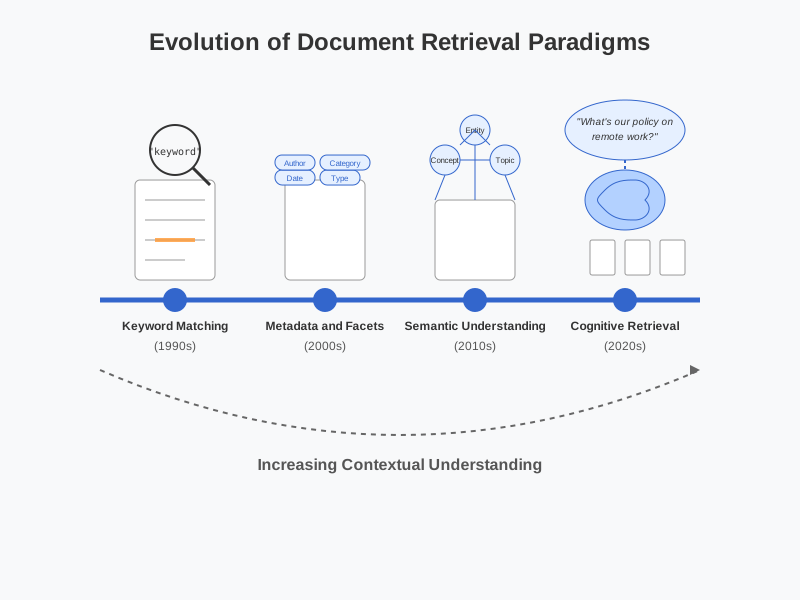
The impact of these advanced retrieval capabilities extends far beyond simple efficiency improvements. Organizations implementing intelligent retrieval systems report significant transformations in information utilization patterns:
A professional services firm saw a 64% decrease in time spent searching for information after implementing an intelligent retrieval system, allowing consultants to redirect approximately 7.2 hours weekly to billable client work.
A manufacturing organization reduced new employee onboarding time by 37% by implementing context-aware document retrieval that guided new hires to relevant procedures and documentation based on their specific role and current training stage.
A healthcare provider reported a 42% increase in the utilization of clinical best practice documentation after implementing an intelligent retrieval system that proactively suggested relevant protocols based on patient conditions and treatment contexts.
Perhaps the most transformative aspect of intelligent storage and retrieval systems is their ability to bridge traditional information silos. In conventional document management architectures, information typically remains trapped within departmental systems, application-specific repositories, or disconnected storage locations. This fragmentation creates significant organizational inefficiencies and decision-making challenges.
Intelligent Agents address this challenge through federated indexing and retrieval capabilities that span traditional system boundaries. Rather than requiring document consolidation within a single repository, these systems create unified semantic indexes that integrate information across disparate sources. Users can retrieve relevant information regardless of where it resides whether in a document management system, email server, collaboration platform, or specialized application.
This unified approach to information access delivers particular value for complex business processes that span departmental boundaries. For example, a customer inquiry might require information from sales contracts, support tickets, product specifications, and shipping records documents typically stored in different systems managed by different departments. An intelligent retrieval system can assemble this information coherently, presenting a unified view that would be nearly impossible to construct manually.
Beyond technical integration, intelligent retrieval systems help bridge organizational knowledge silos by surfacing relevant information regardless of its origin. Knowledge generated in one business unit becomes discoverable to others who might benefit from it, even if they wouldn't know to look for it explicitly. This emergent knowledge sharing represents one of the most valuable yet difficult-to-quantify benefits of intelligent document systems.
The combination of enhanced categorization with intelligent storage and retrieval creates a foundation for transforming document-intensive processes across industries. These capabilities manifest differently in various sectors, each leveraging the core strengths of Intelligent Agents to address industry-specific challenges.
The fundamental capabilities of Intelligent Agents enhanced categorization, efficient storage, and intelligent retrieval manifest differently across industries. Each sector faces unique document challenges, regulatory requirements, and process complexities that shape how IA technologies deliver value. Understanding these industry-specific applications provides insight into the versatility and transformative potential of intelligent document systems.
Financial institutions operate in one of the most document-intensive environments across all industries. From loan applications and account statements to regulatory filings and investment prospectuses, financial operations generate and consume vast quantities of structured and unstructured documents. This document volume, combined with stringent regulatory requirements and the critical nature of financial data accuracy, creates a perfect storm of document management challenges.
Intelligent Agents are transforming financial document processes across several dimensions. Invoice processing represents one of the most widely adopted applications, with IA systems automatically extracting critical data points including vendor information, line items, tax calculations, and payment terms from diverse invoice formats. Leading implementations achieve straight-through processing rates exceeding 85% for invoices, dramatically reducing processing costs while improving vendor relationships through faster payment cycles.
Loan processing presents even more complex document challenges, typically involving dozens of document types from multiple sources. Traditional approaches require manual review of application forms, credit reports, income verifications, property appraisals, and numerous disclosures a process that typically takes weeks. Intelligent Agents streamline this process by automatically categorizing incoming documents, extracting relevant information, flagging discrepancies, and assembling complete application packages for underwriter review. Early adopters report loan processing time reductions of 60-70% while simultaneously improving compliance and reducing errors.
Regulatory compliance represents perhaps the most significant document challenge for financial institutions. Regulations like Dodd-Frank, GDPR, and CCPA impose complex requirements for document retention, privacy protection, and information governance. Intelligent Agents help financial institutions navigate these requirements by automatically identifying regulated information, applying appropriate retention policies, managing consent documentation, and facilitating audit processes. This automated compliance not only reduces regulatory risk but also transforms compliance from a cost center into a competitive advantage through improved information governance.
A major retail bank implemented an intelligent document system that reduced mortgage processing time from 37 days to 11 days on average while improving compliance verification accuracy by 76%. The system automatically identified and categorized more than 70 distinct document types within mortgage applications, extracted over 300 specific data points for verification, and routed exceptions to appropriate specialists based on the specific discrepancies identified. Beyond operational improvements, the system dramatically enhanced the customer experience by providing real-time visibility into application status and reducing the need for repeated document submissions.
Healthcare organizations face document management challenges that directly impact patient outcomes. Medical records combine structured data elements with narrative clinical notes, diagnostic images, lab results, and correspondence—all of which must be accessible at the point of care while maintaining strict privacy protections. The transition to electronic health records (EHRs) has digitized this information but often without implementing the intelligent systems needed to maximize its utility.
Intelligent Agents are transforming healthcare document management across the care continuum. Clinical documentation intelligence systems analyze physician notes, extracting key diagnostic information, treatment decisions, and outcome measures. This extracted information populates structured data fields while maintaining the original narrative context, enabling both efficient data analysis and comprehensive clinical understanding. Leading implementations reduce physician documentation time by 25-30% while improving the completeness and accuracy of medical records.
Medical records management represents another high-value application domain. Healthcare organizations typically maintain separate record systems for different departments and care settings, creating fragmented views of patient information. Intelligent Agents bridge these silos by creating unified patient records that integrate information across systems while respecting access controls and privacy requirements. When a patient arrives at an emergency department, for example, the system can instantly assemble relevant information from previous encounters across the healthcare network, presenting a comprehensive view tailored to emergency care requirements.
Regulatory compliance in healthcare extends beyond privacy to encompass billing integrity, care quality measures, and numerous reporting requirements. Intelligent document systems automatically identify required quality measures from clinical documentation, flag potential compliance issues before submission, and maintain comprehensive audit trails for all information access. These capabilities transform compliance from a retrospective review process to a proactive quality assurance function.
A regional healthcare network implemented an intelligent document system that improved clinical documentation quality and accessibility across 17 care locations. The system automatically categorized and indexed over 50 million historical patient documents while maintaining real-time processing for new documentation. Physicians reported accessing relevant patient information 4x faster on average, with particularly significant improvements for complex patients with extensive medical histories. Perhaps most importantly, the organization documented a 22% reduction in duplicate diagnostic testing, attributed to improved access to previous test results at the point of care.
The legal profession remains one of the most document-centric disciplines, with law firms and corporate legal departments managing vast collections of contracts, pleadings, discovery materials, and regulatory content. The complexity of legal documents, combined with their critical importance and often tight deadlines, creates significant document management challenges that directly impact legal outcomes and business relationships.
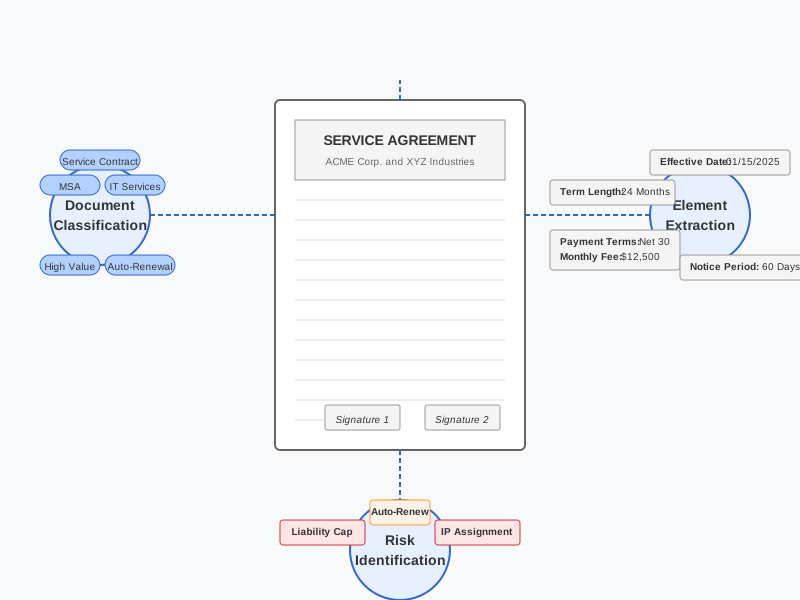
Contract management represents one of the most transformative applications of Intelligent Agents in legal contexts. Traditional contract management processes rely heavily on manual review, making them time-consuming, inconsistent, and prone to oversight. Intelligent Agent systems transform this paradigm by automatically analyzing contract documents across multiple dimensions:
Contract classification and categorization automatically identifies document types, agreement structures, and governing law. Element extraction identifies and extracts key provisions, obligations, entitlements, limitations, and dependencies. Risk identification flags problematic clauses, ambiguous language, and potential compliance issues. Obligation tracking monitors deadlines, renewal requirements, and performance conditions throughout the contract lifecycle.
Figure 4: Contract Intelligence Matrix illustrates how these capabilities create a multidimensional understanding of contract documents that extends far beyond simple text storage. This intelligence enables legal teams to move from document management to genuine contract intelligence understanding not just what contracts say but what they mean for business operations.
The impact of this transformation extends well beyond the legal department. Procurement teams gain visibility into vendor commitment and performance obligations. Sales organizations access precise information about customer contractual entitlements. Finance departments track revenue recognition requirements and payment obligations. This cross-functional visibility transforms contracts from legal documents into operational business intelligence.
A global technology company implemented an intelligent contract management system that analyzed over 25,000 active contracts across 14 languages. The system identified approximately $18.5 million in missed entitlements from existing agreements, including volume discounts, rebate opportunities, and performance credits that had previously gone unclaimed. It also reduced new contract review time by 73% through automated comparison with standard templates and previous agreements. Perhaps most significantly, the system enabled the company to rapidly assess the impact of regulatory changes by automatically identifying affected agreements and specific provisions requiring modification.
Litigation support represents another high-value application domain for Intelligent Agents. Modern litigation often involves document collections numbering in the millions, making comprehensive manual review practically impossible. Intelligent document systems transform this process through advanced categorization, conceptual clustering, and relationship mapping. Rather than reviewing documents sequentially, legal teams can identify conceptual patterns, explore document relationships, and focus on the most relevant materials. Early adopters report reducing document review time by 60-80% while simultaneously improving the identification of critical evidence.
Beyond specific practice areas, Intelligent Agents are transforming knowledge management within legal organizations. They analyze work product to identify reusable components, connect practitioners working on similar issues, and surface relevant precedents even when searchers don't know the precise terminology to use. This intelligence turns the document repository from an archive into a dynamic knowledge resource that enhances legal reasoning and practitioner effectiveness.
Manufacturing organizations face unique document challenges related to technical specifications, operational procedures, compliance certifications, and institutional knowledge. These documents directly impact product quality, operational efficiency, and workplace safety. Traditional document management approaches struggle with the technical complexity and interrelationships characteristic of manufacturing documentation.
Intelligent Agents transform manufacturing document management through several industry-specific applications. Technical documentation intelligence systems automatically categorize and index engineering specifications, assembly procedures, quality standards, and maintenance protocols. The system understands not just document content but component relationships, process dependencies, and compliance requirements. When engineering changes occur, the system can automatically identify all affected documentation, ensuring that maintenance procedures reflect the latest equipment configurations and assembly instructions incorporate current design specifications.
Knowledge preservation represents a particularly critical application in manufacturing environments. Many organizations face significant knowledge loss through workforce retirements, with decades of experience documented primarily through unstructured notes and tribal knowledge. Intelligent document systems help capture and preserve this knowledge by analyzing historical documentation, identifying implicit relationships, and creating structured knowledge repositories. When maintenance technicians encounter unfamiliar equipment issues, for example, the system can surface relevant historical incidents, successful resolution approaches, and specific expertise within the organization.
Quality management documentation presents another high-value application domain. Manufacturing quality systems typically generate vast documentation through inspection records, non-conformance reports, corrective actions, and audit findings. Intelligent Agents analyze this documentation to identify recurring quality issues, root cause patterns, and effective resolution approaches. This intelligence transforms quality documentation from a compliance necessity into a strategic resource for continuous improvement.
A global aerospace manufacturer implemented an intelligent document system for technical documentation management across its engineering and manufacturing operations. The system managed over 12 million technical documents while processing approximately 5,000 engineering changes monthly. When engineering changes occurred, the system automatically identified affected assembly procedures, maintenance protocols, and certification documentation requiring updates. This intelligent change management reduced documentation update time by 71% while eliminating numerous quality issues previously caused by documentation inconsistencies. The organization attributed a 17% reduction in assembly errors directly to improved documentation accuracy and accessibility.
These industry examples illustrate how Intelligent Agents deliver transformation that extends far beyond generic document management improvements. By addressing industry-specific document challenges and integrating with sector-specific workflows, these systems become strategic business assets rather than merely improved storage systems. This strategic value becomes even more apparent when examining how Intelligent Agents enhance collaboration and knowledge sharing across organizational boundaries.
The true power of Intelligent Agents emerges not when they replace human document interactions but when they enhance them. The most successful implementations recognize that documents ultimately serve human purposes—supporting decisions, guiding actions, communicating intentions, and preserving knowledge. Intelligent Agents transform these interactions by creating more intuitive, responsive, and collaborative document environments.
Traditional document systems constrain collaboration through artificial boundaries. Files must be checked out and checked in. Documents exist in one location at a time. Access requires navigating complex folder hierarchies. These constraints create friction that impedes natural information flow.
Intelligent Agents remove these boundaries by fundamentally reimagining document accessibility. They create secure yet fluid information environments where the right documents find the right people at the right time. Several key capabilities enable this transformation:
Context-aware information delivery proactively surfaces relevant documents based on user context, workflow stage, and historical patterns. When a customer service representative opens a case, for example, the system automatically assembles relevant account information, recent interactions, and applicable policies even before the representative searches for them.
Unified access across devices and locations ensures consistent document experiences regardless of how and where users work. An insurance adjuster might begin reviewing a claim on a desktop computer, continue on a mobile device while visiting the damage site, and complete the process on a tablet during the commute home with consistent document access and functionality throughout.
Role-based intelligence adapts document presentations based on user roles and needs. A physician reviewing a patient record sees clinical information prioritized and presented in medical terminology. A billing specialist accessing the same record sees insurance and procedural coding information foregrounded. A patient accessing their own record sees explanations in approachable non-technical language. Each view draws from the same underlying document intelligence but presents it to serve different user needs.
Natural interface modalities extend beyond traditional text-based search to include voice interaction, visual querying, and conversational interfaces. Users can ask questions about documents in natural language, highlight images to find similar visual content, or engage in dialogue to refine and clarify information needs.
These capabilities transform document accessibility from a technical function into a genuine extension of human cognitive processes. Documents become responsive partners in work processes rather than static resources requiring explicit management.
Document collaboration has traditionally faced a fundamental tension between accessibility and control. Systems that maximize accessibility often sacrifice version integrity, while systems that prioritize version control typically constrain collaborative fluidity. Intelligent Agents resolve this tension by implementing sophisticated version intelligence that maintains both accessibility and integrity.
Traditional version control tracks document histories as linear sequences of discrete versions, requiring users to explicitly create, manage, and navigate these versions. This approach places substantial cognitive burden on users and often results in either excessive version proliferation or insufficient change tracking.
Intelligent version control reimagines this paradigm in several important ways:
Semantic versioning tracks changes at the content level rather than simply at the document level. The system understands which specific information elements have changed and how they've evolved over time. This granular understanding enables more precise version comparison, selective rollback of specific changes, and intelligent merging of concurrent modifications.
Intent preservation captures not just what changed but why it changed. By analyzing editing patterns, user annotations, and workflow context, the system preserves the reasoning behind document modifications. This intent context helps future users understand not just document history but the decision processes that shaped it.
Collaborative synchronization enables multiple users to work with documents simultaneously while maintaining coherence. Rather than implementing rigid locking mechanisms or requiring manual conflict resolution, intelligent systems facilitate natural collaboration by understanding how changes relate to one another and managing integration automatically.
Compliance-aware versioning applies appropriate governance controls based on document type, content sensitivity, and regulatory requirements. Financial records might maintain immutable audit trails, while marketing content allows more flexible version management. This context-sensitive approach ensures appropriate governance without imposing unnecessary constraints.
These intelligent versioning capabilities transform collaborative document processes in fundamental ways. Teams can work together more fluidly without sacrificing governance or losing critical context. Historical documents become not just records of what happened but repositories of organizational reasoning and decision processes.
A professional services organization implementing intelligent versioning reported that cross-functional teams completed complex client deliverables 47% faster on average. Team members attributed this improvement to reduced coordination overhead, elimination of version conflicts, and improved contextual understanding of changes made by colleagues from different practice areas.
Perhaps the most profound impact of Intelligent Agents on document collaboration comes through their ability to augment human cognitive capabilities. Rather than merely storing and retrieving information more efficiently, these systems actively enhance how knowledge workers interact with information and with one another.
Cognitive augmentation manifests through several transformative capabilities:
Knowledge synthesis helps users assimilate information across multiple documents and sources. Rather than requiring users to manually compile and integrate information from disparate sources, intelligent systems can synthesize comprehensive answers that draw from the entire document ecosystem. This synthesis capability proves particularly valuable for complex questions requiring information from multiple domains and document types.
Insight amplification identifies patterns, trends, and relationships that might escape human notice. By analyzing document collections at scale, intelligent systems can surface non-obvious connections, recurring themes, and emerging patterns. These insights help knowledge workers identify opportunities and risks that might otherwise remain hidden within document repositories.
Expertise location extends beyond finding documents to finding people with relevant knowledge. By analyzing document interactions, contributions, and content areas, intelligent systems can identify organizational expertise even when it isn't formally documented. When facing an unfamiliar challenge, users can find not just relevant documents but colleagues with experience addressing similar issues.
Cognitive complementarity enables intelligent systems to compensate for natural human cognitive limitations. Where humans excel at contextual understanding, creative thinking, and nuanced judgment, they struggle with comprehensive recall, systematic analysis of large information sets, and freedom from cognitive biases. Intelligent Agents complement these human capabilities by handling information-intensive tasks while leaving contextual judgment to human users.
These augmentation capabilities fundamentally transform knowledge work from document processing to genuine intelligence amplification. Rather than simply making existing workflows more efficient, they enable entirely new approaches to knowledge-intensive activities.
A research organization implementing cognitive augmentation capabilities analyzed its discovery process for new therapeutic compounds. The traditional approach required researchers to manually review scientific literature, internal research reports, and experimental data a process constrained by individual reading capacity and background knowledge. The intelligent system transformed this process by continuously analyzing the entire document corpus, identifying promising connections between compounds, mechanisms, and therapeutic applications. Researchers reported that 42% of new investigational pathways originated from system-identified connections that would have been unlikely to emerge through traditional literature review processes.
The collaborative intelligence enabled by Intelligent Agents represents a fundamental shift in how organizations leverage their document assets. By enhancing accessibility, reimagining version control, and augmenting human capabilities, these systems transform documents from static information containers into dynamic knowledge partners. This transformation delivers substantial economic value across multiple dimensions.
The business case for Intelligent Agents extends far beyond operational efficiency improvements. While cost reduction often provides the initial justification for implementation, the most significant benefits emerge through strategic advantages that transform organizational capabilities. Understanding this comprehensive economic impact requires a multidimensional assessment framework that encompasses both tangible and intangible value creation.
The most immediately quantifiable benefits of intelligent document systems typically appear in cost optimization metrics. Traditional document processes consume substantial resources through manual handling, information retrieval time, rework caused by errors, and compliance management overhead. Intelligent Agents address these costs through several complementary mechanisms:
Process automation reduces direct labor costs by eliminating manual document handling, data extraction, classification, and routing tasks. Organizations typically report labor savings between 60-85% for document-intensive processes like invoice processing, claims management, and contract administration.
Error reduction eliminates costs associated with document mistakes, including direct rework expenses, compliance penalties, and opportunity costs from delayed processes. Financial institutions implementing intelligent document systems report reduction in exception handling costs ranging from 45-70% depending on document complexity.
Storage optimization reduces infrastructure costs through more efficient document retention, elimination of duplicate content, and automated archiving of obsolete materials. While less substantial than process improvements, these savings can be significant for organizations with extensive document archives or regulatory retention requirements.
Compliance streamlining reduces costs associated with regulatory documentation, audit support, and remediation activities. Healthcare organizations report particularly significant savings in this domain, with reductions in compliance management costs ranging from 30-55%.
These direct cost optimizations typically provide the initial ROI justification for intelligent document implementations. However, the most substantial economic benefits emerge through strategic value creation that transforms organizational capabilities rather than merely reducing existing costs.
Beyond operational efficiencies, Intelligent Agents create strategic value through enhanced decision quality, accelerated response capabilities, improved customer experiences, and unlocked innovation potential. These benefits prove more challenging to quantify but ultimately deliver greater competitive advantage.
Decision quality improvements emerge when intelligence systems provide more comprehensive, accurate, and contextual information to decision makers. These improvements manifest as reduced risk exposure, better resource allocation, and improved strategic positioning. Financial services organizations report significant improvements in lending decisions, with one implementation documenting a 22% reduction in loan defaults while simultaneously increasing approval rates by 14%. This seemingly contradictory outcome resulted from more precise risk assessment enabled by comprehensive information integration.
Response agility represents another high-value strategic benefit. Organizations implementing intelligent document systems report dramatic improvements in response times for customer inquiries, competitive threats, regulatory changes, and market opportunities. A manufacturing organization reduced new product configuration time from 48 hours to 4 hours by implementing intelligent access to engineering specifications, supply chain capabilities, and production constraints. This improved responsiveness translated directly to competitive advantage in high-velocity market segments.
Customer experience enhancement delivers particularly significant value in service-intensive industries. Organizations implementing intelligent document systems report improvements in first-contact resolution rates, service speed, and customer satisfaction scores. A telecommunications provider implementing intelligent documentation access for customer service representatives reduced average handle time by 28% while simultaneously improving customer satisfaction scores by 17%. The system's ability to instantly assemble relevant account information, service history, and knowledge base content enabled representatives to resolve issues more effectively with less customer effort.
Innovation capacity expansion represents perhaps the most significant yet hardest-to-quantify strategic benefit. By liberating knowledge workers from routine document processing and improving access to organizational knowledge, intelligent systems create capacity for higher-value creative and strategic activities. Organizations report increased innovation output, accelerated product development cycles, and improved solution quality. While difficult to isolate causally, these innovation improvements often deliver the most substantial long-term competitive advantages.
Realizing the full economic potential of Intelligent Agents requires thoughtful implementation approaches that balance immediate returns with long-term transformation potential. Organizations that approach implementation strategically typically achieve substantially better outcomes than those pursuing purely tactical deployments.
Phased implementation approaches balance risk management with transformation momentum. Rather than attempting comprehensive document intelligence implementation across all processes simultaneously, successful organizations typically begin with high-value, well-defined use cases that deliver demonstrable ROI. These initial successes build organizational confidence while generating resources for expanded implementation.
A healthcare organization began with clinical documentation for a specific service line, demonstrating substantial quality improvements and physician time savings. With this success established, the organization progressively expanded to additional service lines and documentation types, eventually implementing a comprehensive clinical intelligence system across the entire care network.
Capability-based implementation roadmaps focus on building intelligent document capabilities progressively rather than implementing isolated point solutions. This approach establishes foundational capabilities like automated classification and intelligent retrieval that support multiple use cases and business processes. These capabilities compound in value as they extend across additional document types and organizational processes.
A financial services organization established core document intelligence capabilities for customer onboarding documentation. Once these capabilities demonstrated value, the organization extended them to account servicing, lending operations, and compliance processes. Each extension leveraged the existing intelligence foundation while adapting to specific process requirements, creating accelerating returns on the initial investment.
Change management integration recognizes that realizing full economic value requires not just technological implementation but organizational adaptation. Successful implementations integrate technology deployment with process redesign, workforce skill development, and performance management alignment. Organizations that neglect these human dimensions typically achieve only a fraction of the potential economic value.
A manufacturing organization implementing intelligent technical documentation discovered that experienced maintenance technicians initially resisted the system despite its demonstrable benefits. By involving these technicians in system configuration, incorporating their knowledge into the intelligence model, and recognizing their contributions when the system incorporated their expertise, the organization transformed resistance into enthusiastic adoption. The resulting system delivered substantially greater value by combining technological capabilities with human expertise.
The comprehensive economic impact of Intelligent Agents emerges through this combination of cost optimization and strategic value creation. Organizations that implement these systems strategically while addressing both technological and human dimensions consistently report returns on investment exceeding 300% over three-year horizons, with accelerating returns as capabilities expand across business processes.
The transformation of document management through Intelligent Agents represents a fundamental shift in how organizations capture, manage, and extract value from their information assets. This transformation extends far beyond simple efficiency improvements to create new capabilities, enhance human potential, and deliver sustainable competitive advantages.
As we look toward the future of intelligent document management, several emerging trends promise to further accelerate this transformation:
Multimodal intelligence will extend document understanding beyond text to encompass rich media content including images, audio, video, and interactive elements. This evolution will transform how organizations capture and leverage information in an increasingly visual and multimedia-rich business environment.
Knowledge graph integration will connect document intelligence with enterprise knowledge resources, creating unified semantic understanding across information sources. These integrated knowledge systems will enable even more sophisticated reasoning, recommendation, and discovery capabilities.
Collaborative intelligence will further enhance human-machine partnerships through advanced natural interfaces, adaptive learning capabilities, and predictive assistance. These capabilities will transform how knowledge workers interact with information resources and with one another.
Ethical intelligence frameworks will ensure that document systems implement appropriate governance, transparency, and privacy protections as their capabilities expand. These frameworks will be essential for maintaining trust and compliance as document intelligence becomes increasingly autonomous.
Organizations that embrace the intelligent document revolution position themselves not merely for operational improvement but for fundamental competitive advantage. By transforming how they manage, access, and leverage their information assets, these organizations create capabilities that extend across every aspect of their operations.
The journey toward intelligent document management begins not with technology selection but with strategic vision. Organizations must first understand how document intelligence can transform their specific business processes, enhance their distinctive capabilities, and create sustainable competitive advantages. With this vision established, they can implement the Intelligent Agent capabilities that will transform their document assets from administrative necessities into strategic resources.
In an economy increasingly defined by information advantage, intelligent document management has emerged as a critical capability for organizational success. The organizations that master this capability will find themselves not merely more efficient but fundamentally more insightful, responsive, and innovative than their competitors.

Head IT Operations - Co Founder of Artificio
See it in your SAP environment
Bring us a document, a process, or a bottleneck. We'll show how Artificio captures, validates, and posts into SAP — then scale from there.
Security & compliance
ISO 27001:2013 certified, SOC 2 Type 2 compliant, GDPR and HIPAA ready. Every agent action is logged, auditable, and runs in isolated environments.