

Blog
AI Agent Governance Crisis: 73% of Enterprise AI Fails
73% of enterprise AI deployments fail due to governance, not tech. Learn the 5-step framework to orchestrate AI agents.

Blog
73% of enterprise AI deployments fail due to governance, not tech. Learn the 5-step framework to orchestrate AI agents.
The enterprise AI revolution isn't failing because of the technology. It's failing because of governance.
Right now, as you read this, thousands of companies are deploying AI agents across their document processing workflows. They're automating invoice processing, contract analysis, compliance reporting, and customer onboarding. The technology works brilliantly in pilot programs. CFOs see 40% cost reductions in their proof-of-concept demonstrations. Operations teams watch in amazement as AI agents handle complex document workflows that previously required armies of human analysts.
But here's what happens next: the pilot ends, and reality hits. Multiple AI agents start making conflicting decisions. Audit trails become impossible to follow. Compliance teams can't explain why an AI agent approved a high-risk transaction. Legal departments discover that AI-generated summaries contain subtle inaccuracies that could expose the company to liability. The promising pilot becomes an operational nightmare, and the project gets shelved indefinitely.
This isn't a hypothetical scenario. It's happening right now in boardrooms across the Fortune 500. A recent study by Enterprise AI Research Institute found that 73% of enterprise AI agent deployments fail to scale beyond pilot programs due to governance failures, not technical limitations. The financial impact is staggering: companies are writing off an average of $2.4 million per failed AI initiative, and the opportunity cost of delayed digital transformation runs into tens of millions for large enterprises.
The problem isn't that enterprises don't understand AI's potential. They've seen the demonstrations. They've read the case studies. They know that agentic AI can transform their document processing operations from cost centers into intelligence powerhouses. The problem is that they're trying to deploy autonomous AI agents using governance frameworks designed for traditional software systems. It's like trying to manage a fleet of self-driving cars using traffic rules written for horse-drawn carriages.
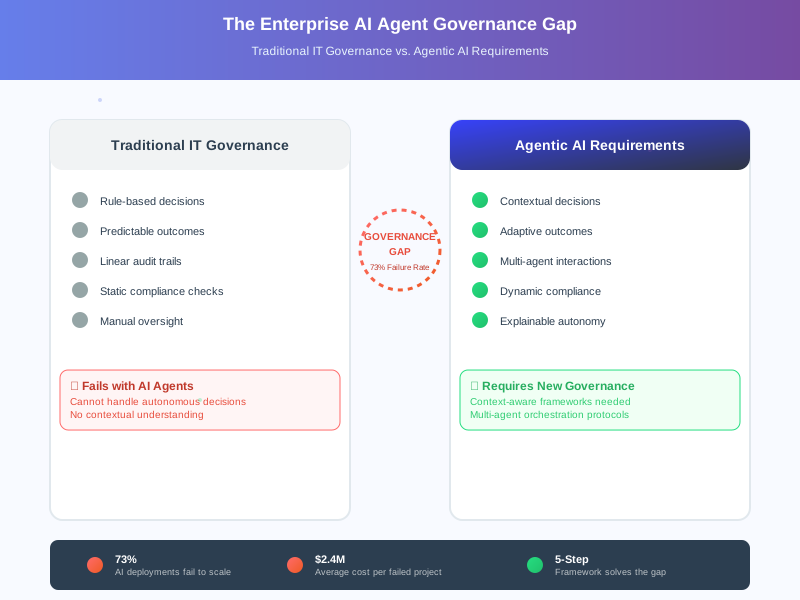
Traditional document processing systems follow predictable, rule-based logic. Input a document, apply predetermined extraction rules, output structured data. The governance model is straightforward because the system behavior is deterministic. You can audit every decision by reviewing the rules engine. You can predict outcomes because the system always processes similar documents in identical ways. Compliance teams can map every processing step to regulatory requirements because the workflow never changes.
Agentic AI operates completely differently. These systems use multiple specialized AI agents working in concert to understand, analyze, and act on document content. A document classification agent might identify an incoming contract, triggering a contract analysis agent that extracts key terms, which then activates a risk assessment agent that evaluates compliance implications, followed by a workflow orchestration agent that routes the document to appropriate human reviewers based on risk levels and business rules.
Each agent makes autonomous decisions based on context, learned patterns, and real-time analysis. The same contract processed on Monday might follow a completely different workflow path when processed on Friday, not because the system is broken, but because the AI agents have learned from intervening interactions and adapted their decision-making processes. This adaptability is precisely what makes agentic AI so powerful for handling the messy, unstructured reality of enterprise document processing.
But this adaptability creates governance challenges that most enterprises aren't prepared to handle. Traditional audit trails become meaningless when AI agents are making contextual decisions that can't be reduced to simple rule-based logic. Compliance frameworks break down when you can't predict exactly how a system will behave in every scenario. Risk management becomes exponentially more complex when multiple AI agents are interacting in ways that weren't explicitly programmed.
The stakes are particularly high in regulated industries. Financial services companies are dealing with AI agents that need to comply with anti-money laundering regulations, data privacy requirements, and fair lending practices while processing millions of documents daily. Healthcare organizations are deploying AI agents to handle patient records, insurance claims, and regulatory filings, where a single processing error could result in HIPAA violations or patient safety issues. Manufacturing companies are using AI agents to process supplier contracts, quality control documents, and regulatory submissions, where mistakes can trigger product recalls or regulatory sanctions.
These enterprises can't afford to treat AI governance as an afterthought. They need frameworks that preserve the adaptive intelligence that makes agentic AI valuable while providing the oversight, auditability, and predictability that regulatory compliance demands. The companies that figure this out first will gain decisive competitive advantages. The companies that don't will find themselves stuck with expensive pilot programs that never scale.
The financial impact of governance failures extends far beyond the direct costs of failed projects. A mid-size insurance company recently shared their experience with an ungoverned AI agent deployment that initially seemed successful. The company had implemented AI agents to process claims documents, and the initial results were impressive. Processing times dropped by 60%, accuracy rates exceeded human performance, and customer satisfaction scores improved significantly.
But problems emerged as the system scaled. The AI agents began making decisions that human adjusters couldn't understand or explain to customers. A claim that should have been approved was denied because the AI agent detected patterns that seemed suspicious but weren't clearly documented in the decision rationale. When customers complained, the company couldn't provide satisfactory explanations because the AI agent's reasoning process wasn't sufficiently transparent.
The situation escalated when state insurance regulators began investigating consumer complaints about arbitrary claim denials. The company discovered that while their AI agents were technically accurate, the decision-making process couldn't meet regulatory requirements for explainability. They were forced to suspend the AI system, revert to manual processing, and spend eight months redesigning their governance framework. The total cost including lost productivity, regulatory fines, and system redesign exceeded $15 million.
This scenario is playing out across industries with variations on the same theme. A logistics company deployed AI agents to process shipping documents and customs declarations. The agents worked flawlessly until a routine audit revealed that the AI had been making classification decisions that violated international trade regulations. The company had to halt operations, manually review thousands of shipments, and pay substantial penalties to multiple regulatory authorities.
A healthcare system implemented AI agents to process patient intake forms and insurance authorization requests. The system reduced administrative overhead by millions of dollars annually until a patient safety audit revealed that the AI agents were occasionally missing critical medical information buried in unstructured text fields. While no patients were harmed, the potential liability exposure forced the organization to completely redesign their AI governance protocols.
These failures share common patterns. The AI agents performed their narrow technical tasks correctly, but the broader system lacked governance frameworks to ensure that autonomous decisions aligned with business objectives, regulatory requirements, and organizational values. The companies treated AI agents like sophisticated software tools rather than autonomous decision-making entities that required fundamentally different oversight approaches.
The opportunity costs are often larger than the direct failure costs. A financial services company spent two years developing and then abandoning an AI agent system for mortgage processing because they couldn't solve governance challenges around fair lending compliance. During those two years, competitors using properly governed AI agent systems captured market share by offering faster, more accurate loan processing. The company not only lost their development investment but also missed the competitive advantages that could have transformed their business.
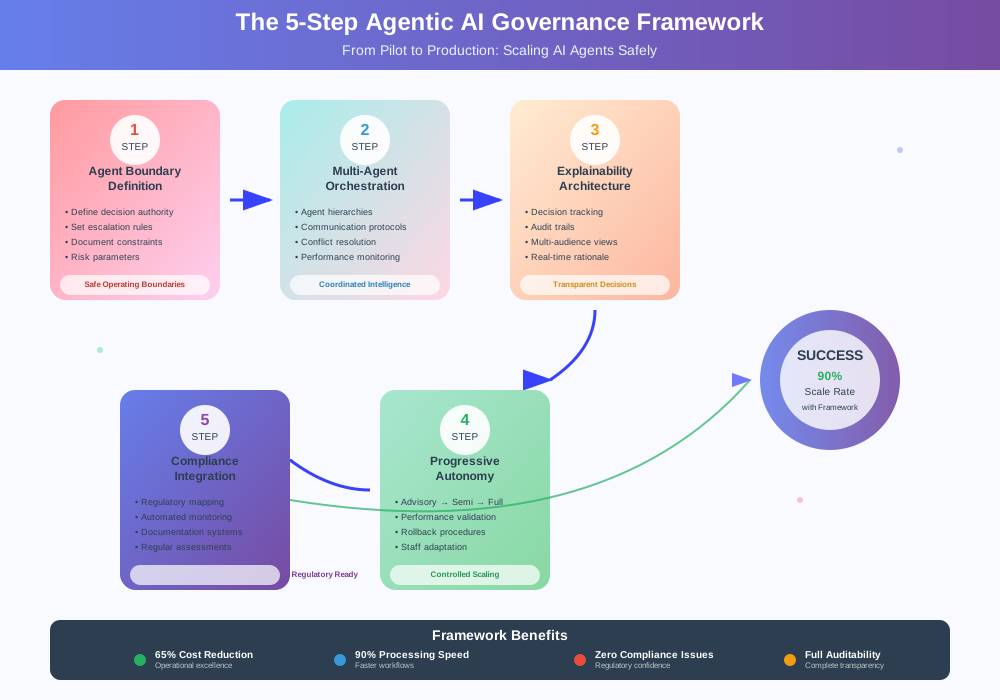
Successful agentic AI governance requires a systematic approach that addresses the unique challenges of autonomous, adaptive AI systems while preserving the operational excellence that enterprises demand. The framework we're proposing has been developed through extensive work with enterprise clients across regulated industries, and it provides a practical roadmap for scaling AI agent deployments safely and effectively.
The foundation of effective AI governance lies in clearly defining what each AI agent can and cannot do, but this goes far beyond simple permission lists. Agent boundary definition requires establishing contextual decision-making parameters that allow AI agents to operate autonomously within well-defined operational corridors while escalating decisions that fall outside their authorized scope.
Traditional software systems operate within functional boundaries defined by code and configuration settings. AI agents operate within decision boundaries defined by context, risk tolerance, and business objectives. A document classification agent might be authorized to automatically route standard contracts to appropriate reviewers, but required to escalate any contract containing unusual terms, foreign jurisdictions, or values exceeding predetermined thresholds. The boundary isn't just about document types or data fields, it's about the complexity and business impact of the decisions being made.
Effective boundary definition requires collaboration between technical teams who understand AI capabilities and business teams who understand operational requirements. The process begins with mapping existing document processing workflows to identify decision points where human judgment is currently applied. These decision points become candidates for AI agent automation, but each requires careful analysis to determine appropriate automation boundaries.
Consider a healthcare organization implementing AI agents to process insurance authorization requests. The boundary definition process would identify that routine authorizations for standard procedures can be fully automated, while requests for experimental treatments or high-cost procedures require human review. But the boundaries need to be more nuanced than simple cost thresholds. The AI agent might be authorized to approve high-cost routine procedures while being required to escalate low-cost experimental procedures. The boundaries are defined by risk profiles and regulatory requirements, not just financial impacts.
The boundary definition process also needs to account for learning and adaptation. AI agents improve their decision-making capabilities over time, which means that boundaries established during initial deployment may become overly restrictive as the system matures. The governance framework needs to include mechanisms for periodically reviewing and updating agent boundaries based on performance data and changing business requirements.
Documentation is crucial for this step. Every boundary decision needs to be clearly documented with rationale, approval authority, and review schedules. This documentation serves multiple purposes: it provides transparency for auditors, guidance for system administrators, and foundation for continuous improvement. The documentation should be accessible to both technical and business stakeholders, avoiding jargon while maintaining precision about operational parameters.
When multiple AI agents work together to process complex documents, the interactions between agents become critical governance points. Unlike traditional software systems where interactions are explicitly programmed, AI agents can develop emergent interaction patterns that weren't anticipated during system design. Effective orchestration protocols ensure that these interactions remain aligned with business objectives and don't create unintended consequences.
The orchestration challenge is particularly complex in enterprise document processing because different agents often operate with different objectives and constraints. A data extraction agent is optimized for accuracy and completeness. A workflow routing agent prioritizes speed and efficiency. A compliance validation agent focuses on risk mitigation. These different optimization objectives can create conflicts that need to be resolved through clear orchestration protocols.
Successful orchestration begins with defining agent hierarchies and decision precedence rules. When agents disagree about how to handle a document, there must be clear protocols for resolution. A compliance agent's risk assessment might override a workflow agent's efficiency optimization, but the override decision needs to be transparent and auditable. The orchestration protocols should specify not just which agent's decision takes precedence, but how conflicting recommendations are evaluated and resolved.
Communication protocols between agents are equally important. Agents need to share relevant information without overwhelming each other with unnecessary data. A document classification agent should communicate document type and confidence levels to downstream agents, but it doesn't need to share detailed feature analysis unless requested. The orchestration protocols define what information gets shared, when it gets shared, and how receiving agents should incorporate external information into their decision-making processes.
Error handling and recovery protocols are critical for multi-agent systems. When an individual agent encounters a processing error or uncertainty, the orchestration system needs to determine whether to retry the operation, route the task to a different agent, or escalate to human oversight. These decisions can't be made through simple rule-based logic because the appropriate response depends on context, document importance, and business priorities.
The orchestration protocols also need to address performance monitoring and optimization. Multi-agent systems can develop bottlenecks or inefficiencies that aren't apparent from individual agent metrics. An agent that performs well in isolation might create system-wide delays when its processing speed doesn't match the throughput of upstream agents. The orchestration framework needs to monitor system-wide performance and make adjustments to maintain optimal workflow efficiency.
Version control and deployment coordination become more complex with multi-agent systems. When individual agents are updated or retrained, the changes can affect interactions with other agents in unexpected ways. The orchestration protocols need to include testing and validation procedures for system-wide changes, ensuring that agent updates don't disrupt established workflow patterns or create new failure modes.
The ability to understand and explain AI agent decisions is fundamental to enterprise governance, but traditional explainability approaches designed for single-model systems don't work effectively for multi-agent architectures. Enterprise-grade explainability requires systems that can trace decision paths across multiple agents while presenting explanations in formats that different stakeholders can understand and act upon.
Explainability architecture needs to address multiple audiences with different requirements. Technical teams need detailed information about model behavior, feature importance, and confidence levels. Business users need summaries that connect AI decisions to business objectives and operational outcomes. Auditors need comprehensive audit trails that demonstrate compliance with regulatory requirements. Customers need explanations that are clear, accurate, and respectful of their concerns.
The architecture must capture decision rationale at multiple levels of granularity. When an AI agent classifies a document as high-risk, the explainability system needs to record not just the classification result, but the specific factors that contributed to that assessment, the confidence levels associated with different risk factors, and the business rules or learned patterns that influenced the decision. This information needs to be captured in real-time as decisions are made, not reconstructed after the fact.
Multi-agent explainability requires tracking decision flows across agent interactions. When a document is processed by multiple agents, the final outcome represents a chain of decisions that build on each other. The explainability architecture needs to maintain visibility into how early decisions influenced later steps, how information was transformed as it moved between agents, and where in the process alternative outcomes might have been possible.
The storage and retrieval systems for explainability data present significant technical challenges. Detailed decision rationale can generate enormous amounts of data, especially for high-volume document processing operations. The architecture needs to balance comprehensiveness with performance, ensuring that explanation data is available when needed without slowing down real-time processing operations. This often requires tiered storage approaches where summary explanations are immediately available and detailed analysis can be retrieved on demand.
Privacy and security considerations are particularly important for explainability systems. The detailed information required to explain AI decisions often includes sensitive business data or personal information that needs to be protected. The explainability architecture must include access controls, data masking, and audit logging to ensure that explanation data is only accessible to authorized users and that access is properly documented.
Integration with existing business intelligence and reporting systems is crucial for operational effectiveness. Explainability data needs to be accessible through familiar interfaces and compatible with established reporting workflows. This might involve developing custom dashboards for different user roles, integrating with existing audit management systems, or providing APIs that allow explanation data to be incorporated into business applications.
Rather than deploying fully autonomous AI agents immediately, successful implementations use progressive autonomy approaches that gradually increase agent decision-making authority as confidence in system behavior grows. This approach reduces implementation risk while providing opportunities to refine governance frameworks based on real operational experience.
Progressive autonomy begins with AI agents operating in advisory modes where they provide recommendations that humans review and approve. This phase allows organizations to evaluate AI agent decision quality while maintaining full human oversight. The agents are processing real documents and making actual recommendations, but human reviewers have final decision authority. This phase generates valuable data about agent performance while minimizing risk exposure.
The transition from advisory to semi-autonomous operation requires careful analysis of agent performance patterns. Organizations need to identify document types, risk levels, and processing scenarios where AI agent recommendations consistently align with human decisions. These scenarios become candidates for increased autonomy, while cases where humans frequently override AI recommendations remain under human control.
Semi-autonomous operation introduces controlled delegation where AI agents can make final decisions within narrowly defined parameters while escalating edge cases to human review. The parameters might be based on document complexity, financial impact, regulatory sensitivity, or confidence scores. A contract processing agent might be authorized to approve standard vendor agreements under $50,000 while escalating larger contracts or agreements with unusual terms.
The progression to full autonomy requires comprehensive validation of agent behavior across diverse scenarios. Organizations need confidence that AI agents will handle unusual situations appropriately, that escalation procedures work effectively, and that decision quality remains consistent over time. This validation often involves extended testing periods where agents operate autonomously but with enhanced monitoring and frequent performance reviews.
Each progression stage requires updated training for human staff who work alongside AI agents. As agents take on more decision-making responsibility, humans need different skills and knowledge. Staff who previously reviewed every document might focus on exception handling and quality assurance. The training programs need to evolve alongside the autonomy progression to ensure that humans can effectively oversee and collaborate with increasingly autonomous AI systems.
Performance monitoring becomes more sophisticated as autonomy increases. Organizations need metrics that capture not just accuracy and efficiency, but also the appropriateness of escalation decisions, the quality of human-AI collaboration, and the overall business impact of autonomous operations. These metrics inform decisions about further autonomy expansion and help identify areas where governance frameworks need refinement.
Rollback procedures are essential for progressive autonomy implementations. Organizations need the ability to quickly reduce agent autonomy if performance problems emerge or business requirements change. The rollback procedures should be tested regularly and documented clearly so that they can be implemented quickly when needed.
The final step in effective AI governance involves integrating AI agent operations with existing compliance frameworks and regulatory requirements. This integration must address both current compliance obligations and emerging regulations specifically focused on AI systems.
Compliance integration begins with mapping AI agent decisions to existing regulatory requirements. In financial services, this might involve ensuring that loan processing agents comply with fair lending regulations, anti-discrimination laws, and consumer protection requirements. Healthcare AI agents need to comply with HIPAA privacy regulations, FDA medical device requirements, and patient safety protocols. The mapping process identifies where AI agent decisions intersect with regulatory obligations and what evidence needs to be captured to demonstrate compliance.
Audit trail requirements for AI systems often exceed those for traditional software systems. Regulators are increasingly requiring organizations to demonstrate not just that AI systems produce correct outcomes, but that the decision-making process is transparent, consistent, and free from prohibited biases. The compliance integration needs to ensure that AI agent operations generate appropriate audit evidence while maintaining operational efficiency.
Regular compliance monitoring requires automated systems that can detect potential regulatory violations or concerning patterns in AI agent behavior. This might involve monitoring for discriminatory outcomes, verifying that escalation procedures are followed appropriately, or ensuring that required human oversight is actually occurring. The monitoring systems need to provide early warning of compliance issues so that corrective action can be taken before regulatory problems develop.
Documentation requirements for AI compliance are extensive and evolving. Organizations need to maintain detailed records of AI agent training data, model versions, decision algorithms, and performance metrics. The documentation must be sufficiently detailed to support regulatory inquiries while being organized and accessible enough to support operational needs. Many organizations are adopting specialized AI governance platforms that automate much of the documentation and compliance reporting.
Cross-jurisdictional compliance adds complexity for organizations operating in multiple regulatory environments. AI agents processing documents for international operations need to comply with different privacy regulations, data localization requirements, and industry-specific rules. The compliance integration framework needs to account for these variations while maintaining operational consistency.
Regular compliance assessments and updates are essential as AI regulations continue evolving. New requirements are being introduced regularly, and existing regulations are being interpreted in new ways as AI adoption increases. The compliance integration framework needs to include procedures for staying current with regulatory changes and updating AI agent operations accordingly.
The theoretical framework for AI governance becomes much more concrete when examined through real-world implementations. A Fortune 500 manufacturing company recently completed a successful agentic AI deployment for contract processing that demonstrates how the five-step framework operates in practice.
The company processes approximately 50,000 supplier contracts annually, ranging from simple purchase orders to complex multi-year agreements with international suppliers. The manual processing workflow involved multiple departments and typically required 15-20 business days for contract approval. The company wanted to reduce processing time while improving accuracy and consistency of contract analysis.
The implementation began with comprehensive agent boundary definition. The team identified that routine purchase orders and standard service agreements could be fully automated, while contracts involving new suppliers, international jurisdictions, or unusual terms required human review. But the boundaries were more nuanced than these broad categories suggested. The AI agents were authorized to approve contracts with familiar suppliers even when values exceeded normal thresholds, while being required to escalate contracts with trusted suppliers that contained new clauses or changed terms.
The multi-agent orchestration involved five specialized agents working in sequence. A document classification agent identified contract types and extracted basic metadata. A contract analysis agent extracted key terms, pricing information, and compliance requirements. A risk assessment agent evaluated supplier creditworthiness, regulatory compliance, and operational risk factors. A legal review agent identified unusual clauses or potential legal issues. Finally, a workflow orchestration agent determined appropriate approval paths based on the collective analysis from upstream agents.
The explainability architecture captured decision rationale at each stage and provided different views for different stakeholders. Procurement managers received summaries focused on commercial terms and supplier performance. Legal staff received detailed analysis of contractual clauses and risk factors. Finance teams received information about pricing, payment terms, and budget impact. The system maintained detailed audit trails while presenting information in formats appropriate for each user group.
Progressive autonomy implementation began with a three-month advisory period where AI agents processed contracts but humans made all final decisions. During this period, the agents achieved 94% agreement with human decisions on routine contracts and 78% agreement on complex agreements. Based on this performance, the company moved to semi-autonomous operation where agents could approve routine contracts while escalating complex cases.
The transition to full autonomy for routine contracts occurred after six months of semi-autonomous operation. By this point, the agents were handling 60% of contract volume autonomously while maintaining decision quality that exceeded human performance on accuracy and consistency measures. Processing time for routine contracts dropped from 15 days to 2 hours, and the consistency of contract analysis improved significantly.
Compliance integration focused on supplier diversity requirements, international trade regulations, and internal procurement policies. The AI agents were programmed to verify that contract awards met diversity spending targets, that international agreements complied with trade regulations, and that all procurement followed established approval authority limits. The compliance monitoring systems tracked these requirements automatically and generated reports for regulatory audits.
The implementation results exceeded initial projections. Contract processing costs dropped by 65%, processing time improved by 90% for routine contracts, and compliance consistency improved significantly. But the real value came from freeing human staff to focus on strategic supplier relationships and complex negotiations rather than routine administrative tasks.
The lessons learned from this implementation inform best practices for similar deployments. The most important insight was that governance frameworks need to evolve alongside system capabilities. The initial boundary definitions were too restrictive, and the escalation rules generated too many false positives. The governance framework required ongoing refinement based on operational experience.
Organizations that implement effective AI governance frameworks gain significant competitive advantages that extend far beyond operational efficiency. These advantages compound over time as AI systems learn and improve, creating sustainable differentiation that becomes increasingly difficult for competitors to replicate.
The most immediate advantage comes from operational excellence. Well-governed AI agent systems operate more reliably, make more consistent decisions, and require less human intervention than ungoverned systems. This operational superiority translates directly into cost advantages, faster processing times, and higher quality outcomes. But the competitive advantage extends beyond operational metrics to strategic capabilities that ungoverned systems can't achieve.
Properly governed AI systems can operate at much larger scales because governance frameworks address the complexity challenges that limit ungoverned deployments. An organization with effective governance can deploy AI agents across multiple business units, document types, and operational scenarios while maintaining oversight and control. Competitors without governance frameworks remain limited to narrow pilot programs that can't scale beyond proof-of-concept demonstrations.
Risk management capabilities provide another source of competitive advantage. Organizations with mature AI governance can take on more complex automation challenges because they have frameworks for managing the associated risks. They can automate high-value, high-risk processes that competitors must continue handling manually. This risk management capability becomes particularly valuable in regulated industries where compliance requirements limit automation options for ungoverned systems.
Customer trust and satisfaction improve when AI systems operate transparently and consistently. Customers appreciate faster service delivery, but they also value the ability to understand and challenge AI-driven decisions when necessary. Organizations with explainable AI governance can provide customer service that competitors with black-box AI systems cannot match. This trust advantage becomes particularly important in B2B relationships where document processing directly affects customer operations.
Regulatory relationships improve when organizations can demonstrate mature AI governance practices. Rather than being reactive to regulatory inquiries, well-governed organizations can proactively share information about their AI governance frameworks and compliance procedures. This proactive approach builds regulatory confidence and often results in more favorable treatment during audits or investigations. Some organizations have found that mature AI governance actually reduces regulatory scrutiny because regulators have confidence in their oversight capabilities.
Talent attraction and retention benefits from mature AI governance frameworks. Technical professionals want to work with cutting-edge AI systems, but they also want to work for organizations that implement AI responsibly. Business professionals are more willing to collaborate with AI systems when they understand how those systems work and can trust the decision-making process. Effective AI governance makes AI adoption a positive experience for human staff rather than a source of anxiety or resistance.
Innovation acceleration occurs when governance frameworks provide safe environments for AI experimentation. Organizations with mature governance can test new AI applications more quickly because they have established frameworks for managing risk and ensuring compliance. They can move from pilot to production more rapidly because the governance infrastructure is already in place. This innovation advantage compounds over time as organizations develop more sophisticated AI capabilities.
Partnership and acquisition opportunities expand when organizations have demonstrable AI governance capabilities. Other companies prefer to partner with organizations that have mature AI practices because it reduces integration risk and compliance concerns. Acquisition targets with strong AI governance command higher valuations because buyers have confidence in the sustainability and scalability of the AI capabilities they're acquiring.
The competitive moats created by effective AI governance become stronger over time. As AI systems learn from more data and interactions, the quality advantage over ungoverned systems increases. The operational knowledge embedded in governance frameworks becomes increasingly valuable and difficult to replicate. The trust relationships built with customers, regulators, and partners create switching costs that protect market position.
The agentic AI revolution in document processing is inevitable, but success is not guaranteed. The organizations that thrive will be those that recognize that AI governance isn't a constraint on innovation, it's an enabler of sustainable competitive advantage. The five-step framework provides a practical roadmap for building governance capabilities that allow AI agents to operate autonomously while maintaining the oversight and control that enterprise operations demand.
The time for action is now. Every month that passes without proper AI governance frameworks represents missed opportunities and increasing risk exposure. Competitors are already implementing agentic AI systems, and the performance advantages are becoming more pronounced. But the window for establishing governance leadership remains open for organizations willing to invest in systematic, comprehensive approaches to AI oversight.
The framework we've outlined requires significant organizational commitment and cross-functional collaboration. It demands technical expertise, business insight, and regulatory knowledge working together in ways that many organizations haven't previously attempted. But the organizations that make this investment will find themselves positioned to capture the full value of agentic AI while avoiding the pitfalls that derail less thoughtful implementations.
At Artificio, we've built our AI agent platform specifically to support mature governance frameworks from day one. Our architecture includes native support for explainability, audit trails, progressive autonomy, and compliance integration. We've learned from working with enterprises across regulated industries that governance can't be retrofitted onto AI systems, it must be designed in from the beginning.
The future belongs to organizations that can deploy AI agents at scale while maintaining trust, transparency, and control. The governance crisis facing most enterprise AI deployments is real, but it's also solvable. The organizations that solve it first will gain decisive advantages that become harder to replicate over time.
The question isn't whether your organization will eventually adopt agentic AI for document processing. The question is whether you'll do it with proper governance frameworks that enable sustainable success, or whether you'll join the 73% of deployments that fail to scale beyond pilot programs. The choice is yours, but the window for establishing governance leadership won't remain open indefinitely.
The competitive landscape is changing rapidly, and the organizations that establish governance excellence now will be the ones that dominate their markets in the AI-driven future. The framework is available, the technology is ready, and the business case is compelling. What remains is the organizational will to implement comprehensive AI governance that enables rather than constrains the transformative potential of agentic document intelligence.

Head IT Operations - Co Founder of Artificio
See it in your SAP environment
Bring us a document, a process, or a bottleneck. We'll show how Artificio captures, validates, and posts into SAP — then scale from there.
Security & compliance
ISO 27001:2013 certified, SOC 2 Type 2 compliant, GDPR and HIPAA ready. Every agent action is logged, auditable, and runs in isolated environments.