

Blog
How Agentic AI Transforms Document Classification at Enterprise Scale
Revolutionize document processing with Agentic AI: autonomous systems for intelligent classification, decision-making, and continuous learning.

Blog
Revolutionize document processing with Agentic AI: autonomous systems for intelligent classification, decision-making, and continuous learning.
The enterprise landscape stands at the threshold of a fundamental transformation in document processing and classification. While traditional artificial intelligence solutions have delivered incremental improvements in document handling, a revolutionary paradigm is emerging that promises to completely restructure how organizations approach document intelligence: agentic AI. This transformative approach transcends simple automation to create autonomous systems capable of independent decision-making, continuous learning, and strategic planning within document classification workflows.
Recent research from Gartner reveals a striking prediction: by 2028, approximately 15% of daily business decisions will be made autonomously by AI agents. This forecast represents more than a technological trend it signals a fundamental shift from human-assisted AI to truly autonomous systems that can operate with minimal human oversight. For enterprises currently wrestling with the complexity and volume of document processing requirements, this evolution presents both an unprecedented opportunity and a strategic imperative that cannot be ignored.
The distinction between conventional AI document processing and agentic AI capabilities extends far beyond incremental technological advancement. It represents a complete reimagining of how enterprises can approach document intelligence, moving from reactive systems that require constant human guidance to proactive agents that can understand context, make strategic decisions, and continuously improve their performance without human intervention. This transformation is particularly critical in an era where enterprises process millions of documents daily across multiple formats, languages, and business contexts.
Understanding this paradigm shift requires examining how current document classification systems operate and recognizing their fundamental limitations. Most existing solutions rely heavily on predefined rules, static machine learning models, and extensive human oversight to handle exceptions or process new document types. While these systems have improved efficiency compared to manual processing, they remain constrained by their inability to adapt dynamically to changing business requirements or learn from new patterns without explicit retraining cycles.
Agentic AI represents a sophisticated evolution from reactive AI systems to proactive, autonomous agents capable of complex reasoning and independent action. In document classification contexts, this translates to systems that can understand business context, make strategic decisions about processing priorities, adapt to new document types without requiring retraining, and continuously optimize their classification accuracy based on real-world performance feedback.
The foundational characteristics that distinguish agentic AI systems include autonomous goal pursuit, where agents can work toward complex business objectives without constant human guidance or intervention. These systems demonstrate adaptive learning capabilities that enable them to improve performance based on new data, changing business requirements, and emerging patterns in document flows. They possess contextual reasoning abilities that allow them to understand nuanced business relationships between different document types, processing priorities, and organizational workflows. Most importantly, they exhibit strategic planning capabilities that enable them to optimize resource allocation, workflow sequences, and processing priorities dynamically based on current business conditions and historical performance data.
Traditional AI document classification systems operate within rigid parameters that require extensive rule-based configurations and human oversight to handle exceptions or process new document types. These systems excel at processing standardized documents within well-defined categories but struggle when confronted with edge cases, new document formats, or changing business requirements. The fundamental limitation lies in their reactive nature they can only process what they have been explicitly trained to handle and cannot adapt to new situations without human intervention and system reconfiguration. 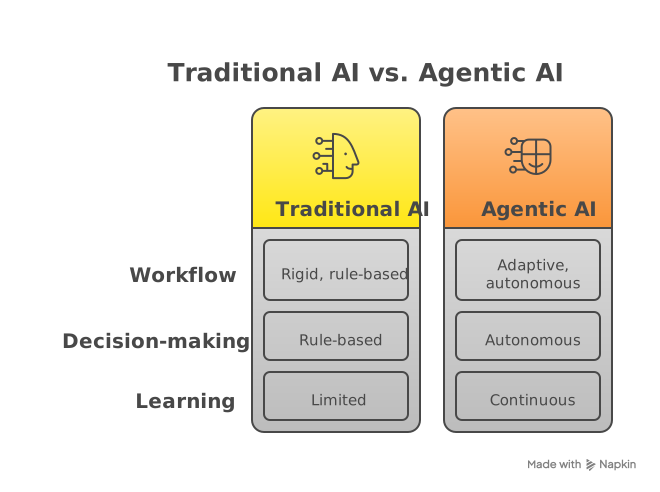
Agentic AI systems approach document classification through a fundamentally different lens. Rather than relying on static rules or fixed classification models, these systems employ autonomous agents that can analyze incoming documents, understand their business context, determine appropriate processing workflows, and make classification decisions based on learned patterns and current business priorities. When encountering new document types or formats, agentic systems can analyze their characteristics, identify similarities to existing categories, and create new classification approaches without requiring human intervention or system downtime for retraining.
The learning mechanisms employed by agentic AI systems represent another crucial differentiator. While traditional systems require batch retraining cycles that can take days or weeks to implement new learnings, agentic systems continuously incorporate new information and adapt their classification strategies in real-time. This continuous learning approach means that system performance improves constantly rather than in discrete jumps following retraining cycles.
The transformation that agentic AI brings to document classification operates across multiple dimensions that fundamentally alter how enterprises approach document processing workflows. The most immediate and visible change occurs in the system's ability to handle document variability and complexity without requiring extensive preprocessing or manual intervention.
Traditional document classification systems require significant effort to standardize input formats, create consistent naming conventions, and establish rigid taxonomies before processing can begin. Organizations often spend months developing classification schemas, training staff on consistent document handling procedures, and creating exception handling processes for documents that do not fit established categories. This approach creates bottlenecks in document processing workflows and requires constant maintenance as business requirements evolve.
Agentic AI systems approach this challenge through autonomous pattern recognition and contextual understanding that eliminates the need for extensive preprocessing and rigid taxonomies. These systems can analyze documents in their original formats, understand their business context through content analysis and metadata examination, and determine appropriate classification and routing decisions based on learned organizational patterns and current business priorities.
The autonomous decision-making capabilities of agentic AI extend beyond simple classification to encompass strategic workflow optimization. These systems can analyze current processing loads, identify bottlenecks in document workflows, and dynamically adjust processing priorities to optimize overall system performance. For example, during month-end financial reporting periods, an agentic system might automatically prioritize processing of financial documents while deferring less time-sensitive materials to maintain optimal processing speeds for critical business operations.
The continuous learning aspect of agentic AI creates a compounding value proposition that becomes more pronounced over time. As these systems process more documents and encounter new scenarios, they develop increasingly sophisticated understanding of organizational document patterns, business priorities, and optimal processing strategies. This learning extends beyond simple accuracy improvements to encompass strategic insights about document flows, processing bottlenecks, and optimization opportunities that can inform broader business process improvements.
Exception handling represents another area where agentic AI demonstrates significant advantages over traditional approaches. Rather than routing exceptions to human reviewers or halting processing for manual intervention, agentic systems can analyze exceptional cases, identify potential resolution strategies, and make processing decisions based on learned patterns from similar situations. When truly novel situations arise that require human input, these systems can provide detailed analysis and recommendations that significantly reduce the time and expertise required for human decision-making.
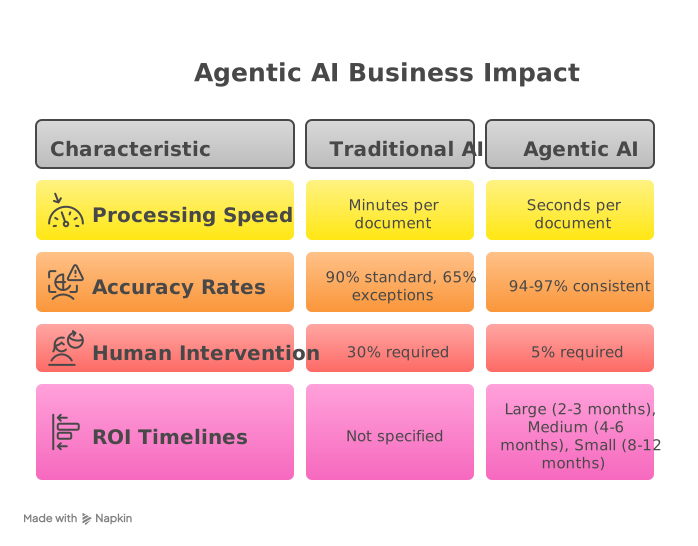
The implementation of agentic AI for document classification at enterprise scale delivers transformational benefits that extend far beyond simple efficiency improvements. The most significant advantage lies in the dramatic reduction of human intervention requirements without sacrificing processing accuracy or business control. Traditional AI systems require extensive human oversight, exception handling, and periodic retraining cycles that consume significant IT resources and create ongoing operational overhead.
Agentic AI systems operate with a level of autonomy that enables organizations to achieve true lights-out document processing for the majority of their document workflows. This autonomy does not mean a loss of business control rather, it represents a shift from operational oversight to strategic governance. IT teams can focus on defining business objectives, monitoring system performance, and optimizing strategic outcomes rather than managing daily operational exceptions and system maintenance tasks.
The scalability advantages of agentic AI become particularly pronounced in large enterprise environments where document volumes can fluctuate dramatically based on business cycles, regulatory requirements, or market conditions. Traditional systems require careful capacity planning and often struggle to handle unexpected volume spikes without performance degradation or processing delays. Agentic systems can dynamically adjust their processing strategies, optimize resource utilization, and maintain consistent performance levels regardless of volume fluctuations.
Cost optimization represents another significant enterprise benefit that extends beyond simple labor cost reductions. Agentic AI systems can optimize processing workflows to minimize computational resource consumption, reduce storage requirements through intelligent archiving decisions, and eliminate redundant processing steps that traditional systems cannot identify. These optimizations compound over time as the systems learn more efficient processing strategies and identify additional improvement opportunities.
The quality and consistency benefits of agentic AI implementation address critical enterprise concerns about maintaining processing standards across large document volumes and diverse document types. Traditional systems often exhibit performance degradation when processing volumes increase or when handling document types that differ from training data. Agentic systems maintain consistent processing quality regardless of volume or document variability because they continuously adapt their processing strategies based on current conditions and learned patterns.
Risk management and compliance represent crucial enterprise considerations where agentic AI delivers significant advantages over traditional approaches. These systems can continuously monitor processing decisions for compliance with regulatory requirements, identify potential risk indicators in document content, and adjust processing workflows to maintain compliance standards automatically. The autonomous nature of these systems ensures that compliance monitoring occurs consistently across all processed documents rather than relying on sampling approaches that traditional systems often employ.
The transformational impact of agentic AI in document classification becomes most apparent when examining specific industry applications where document processing complexity and volume create significant operational challenges. In financial services, organizations process millions of documents daily including loan applications, insurance claims, regulatory filings, and customer correspondence. Traditional AI systems require extensive customization for each document type and struggle to handle the regulatory complexity and variability inherent in financial documents.
Agentic AI systems approach financial document classification through autonomous understanding of regulatory context, business priority analysis, and dynamic workflow optimization that adapts to changing market conditions and regulatory requirements. These systems can analyze incoming loan applications and automatically route them through appropriate underwriting workflows based on risk assessment, current lending capacity, and regulatory compliance requirements. When regulatory requirements change, agentic systems can adapt their processing strategies automatically without requiring system reconfiguration or retraining cycles.
Healthcare organizations face unique document classification challenges due to the complexity of medical terminology, privacy requirements, and the critical nature of accurate document processing for patient care. Medical documents often contain unstructured data, handwritten notes, and complex medical imagery that traditional AI systems struggle to process consistently. The regulatory environment in healthcare requires strict adherence to privacy standards and audit trails that traditional systems can only maintain through extensive manual oversight.
Agentic AI systems designed for healthcare applications can autonomously navigate the complexity of medical document classification while maintaining strict privacy and compliance standards. These systems can analyze medical records and automatically classify them based on medical content, treatment categories, and privacy requirements without requiring human review of sensitive medical information. The continuous learning capabilities of these systems enable them to adapt to new medical terminology, treatment protocols, and regulatory requirements as they emerge.
Insurance companies represent another industry where agentic AI can deliver significant value through autonomous claims processing and policy document management. Insurance documents often require complex analysis that considers policy terms, coverage limits, regulatory requirements, and fraud detection indicators. Traditional systems require extensive rule-based programming to handle the variability in insurance documents and struggle to adapt when new policy types or coverage options are introduced.
Agentic AI systems can autonomously analyze insurance claims and policy documents to determine appropriate processing workflows based on coverage analysis, risk assessment, and fraud detection algorithms. These systems can continuously learn from claims outcomes to improve their fraud detection capabilities and processing accuracy without requiring explicit programming updates or human intervention.
The technical architecture underlying agentic AI systems for document classification represents a significant departure from traditional AI implementations. Rather than relying on monolithic machine learning models or rule-based engines, agentic systems employ distributed agent architectures that enable autonomous decision-making, continuous learning, and dynamic workflow optimization.
The core architecture consists of multiple specialized agents that work collaboratively to handle different aspects of document processing workflows. Document ingestion agents handle the initial processing of incoming documents, performing format analysis, metadata extraction, and preliminary content assessment. Classification agents analyze document content and context to determine appropriate categorization and routing decisions. Workflow orchestration agents manage processing priorities, resource allocation, and system optimization based on current conditions and historical performance data.
The communication and coordination mechanisms between agents represent critical architectural components that enable the autonomous behavior characteristic of agentic AI systems. These agents employ sophisticated messaging protocols and shared knowledge bases that allow them to coordinate processing decisions, share learning insights, and optimize collective performance without requiring centralized control mechanisms. 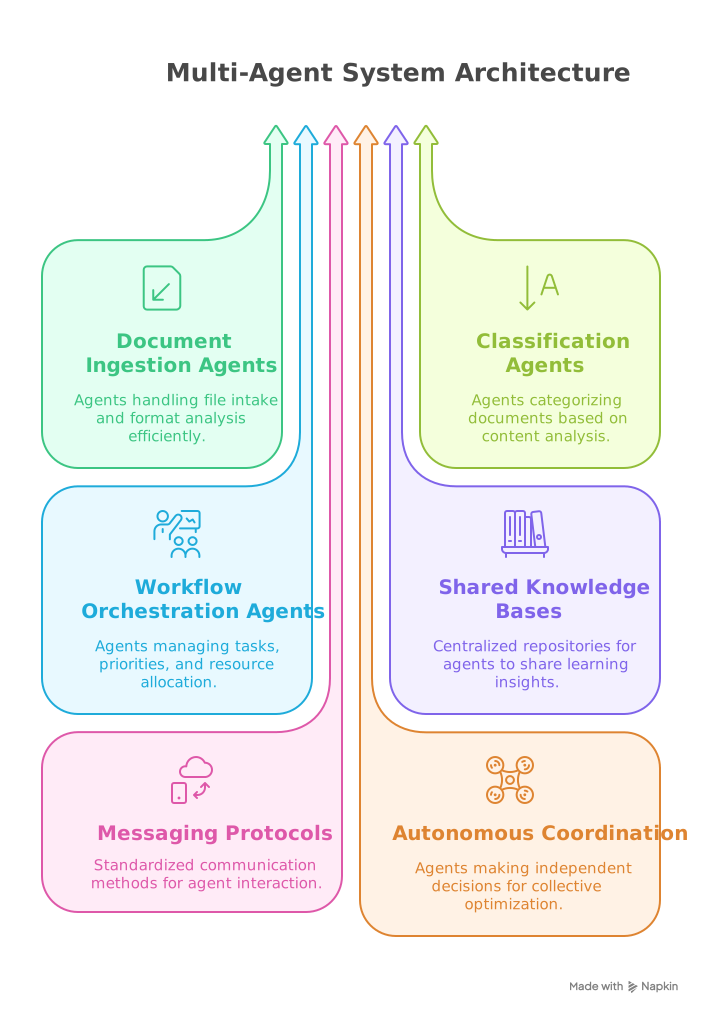
The learning infrastructure supporting agentic AI systems differs fundamentally from traditional machine learning implementations. Rather than employing batch learning cycles that require system downtime and extensive computational resources, agentic systems use continuous learning mechanisms that incorporate new information in real-time. This approach requires sophisticated data management capabilities that can handle streaming updates to learning models while maintaining system performance and processing consistency.
Data management and storage architectures for agentic AI systems must support both operational processing requirements and continuous learning capabilities. Traditional systems often separate operational data from training data, creating delays between system experiences and learning improvements. Agentic systems require integrated data architectures that enable immediate incorporation of processing experiences into system learning while maintaining data security and compliance requirements.
The integration capabilities of agentic AI systems represent another crucial technical consideration for enterprise implementations. These systems must seamlessly integrate with existing enterprise systems including content management platforms, workflow automation tools, and business intelligence systems. The autonomous nature of agentic systems requires robust API architectures and event-driven integration patterns that enable real-time communication with enterprise systems without requiring extensive custom development.
Security and compliance considerations for agentic AI systems require sophisticated approaches that maintain system autonomy while ensuring appropriate governance and oversight capabilities. Traditional AI systems rely on human oversight for security and compliance monitoring, but agentic systems must incorporate autonomous compliance monitoring and security management capabilities that operate without human intervention while providing appropriate audit trails and governance reporting.
The current competitive landscape for AI-powered document classification reveals a significant gap between traditional automation providers and true agentic AI capabilities. Major players like UiPath have begun discussing "agentic automation" concepts, but their implementations remain fundamentally rooted in robotic process automation evolution rather than true autonomous document intelligence. These approaches continue to rely on predefined workflows, extensive human oversight, and rule-based decision-making that limits their ability to adapt to changing business requirements or handle complex document processing scenarios autonomously.
Traditional RPA-based approaches to document classification focus primarily on automating existing manual processes rather than reimagining how document processing workflows could operate with autonomous intelligence. While these solutions can improve efficiency compared to manual processing, they retain the fundamental limitations of reactive systems that require extensive configuration, ongoing maintenance, and human intervention for exception handling.
The emergence of large language models and generative AI has created new opportunities for document classification improvements, but most current implementations employ these technologies as enhanced processing tools within traditional system architectures rather than as foundations for truly autonomous agent-based systems. This approach limits the potential benefits to incremental improvements in classification accuracy rather than fundamental transformation of document processing workflows.
Artificio's agent-based orchestration capabilities represent a significant advancement beyond current market offerings by implementing true agentic AI principles in document classification workflows. Rather than simply automating existing processes or enhancing traditional AI systems with newer technologies, Artificio's approach creates autonomous agents that can understand business context, make strategic processing decisions, and continuously optimize their performance based on real-world outcomes.
The technical sophistication of Artificio's agentic AI implementation extends beyond simple document classification to encompass strategic workflow optimization, autonomous exception handling, and continuous learning capabilities that compound value over time. This approach positions organizations to achieve true lights-out document processing for the majority of their workflows while maintaining the flexibility to adapt to changing business requirements without system reconfiguration or extensive retraining cycles.
The competitive differentiation becomes particularly pronounced when examining system adaptability and learning capabilities. While traditional systems require extensive customization and ongoing maintenance to handle new document types or changing business requirements, Artificio's agentic approach enables automatic adaptation to new scenarios through autonomous learning and reasoning capabilities. This difference represents a fundamental shift from reactive system maintenance to proactive system evolution that anticipates and adapts to changing business needs.
The successful implementation of agentic AI for document classification requires strategic planning that extends beyond technical deployment to encompass organizational change management, stakeholder education, and governance framework development. The autonomous nature of agentic systems represents a significant departure from traditional IT implementations where human oversight and control mechanisms are clearly defined and extensively documented.
Organizations must develop new governance frameworks that provide appropriate oversight and control over autonomous systems while allowing these systems the operational freedom necessary to deliver their full potential benefits. This balance requires careful consideration of decision-making authorities, escalation procedures, and performance monitoring mechanisms that maintain business control without constraining system autonomy.
The change management aspects of agentic AI implementation often present more significant challenges than the technical deployment itself. Staff members who have been responsible for document processing oversight, exception handling, and system maintenance may experience concerns about their role in autonomous processing environments. Successful implementations require comprehensive stakeholder communication that clearly explains how agentic AI enhances human capabilities rather than replacing human expertise.
Training and skill development programs represent crucial components of successful agentic AI implementations. While these systems reduce the need for operational oversight and maintenance activities, they create new requirements for strategic system management, performance optimization, and business objective definition. IT teams must develop new competencies in agent behavior analysis, autonomous system governance, and strategic performance optimization.
The measurement and optimization of agentic AI system performance require new metrics and monitoring approaches that extend beyond traditional accuracy and efficiency measurements. Organizations must develop capabilities to monitor autonomous decision-making quality, learning progression, and strategic alignment with business objectives. These monitoring capabilities enable continuous optimization of system performance and ensure that autonomous agents remain aligned with evolving business priorities.
Risk management considerations for agentic AI implementations require sophisticated approaches that account for the autonomous nature of these systems while maintaining appropriate business controls and compliance standards. Organizations must develop risk assessment frameworks that can evaluate autonomous decision-making patterns, identify potential issues before they impact business operations, and provide appropriate intervention mechanisms when necessary.
The trajectory toward increasingly autonomous AI systems in document classification represents more than a technological evolution it signals a fundamental transformation in how enterprises approach information management and business process optimization. Gartner's projection that 15% of daily business decisions will be made autonomously by 2028 suggests that organizations implementing agentic AI systems today are positioning themselves at the forefront of a broader shift toward autonomous business operations.
The strategic implications of this transformation extend beyond document processing efficiency to encompass competitive advantage through superior information utilization, reduced operational overhead, and enhanced adaptability to changing market conditions. Organizations that successfully implement agentic AI for document classification will develop capabilities that enable them to process and extract value from information more rapidly and accurately than competitors relying on traditional approaches.
The compound learning effects of agentic AI systems create increasing competitive advantages over time as these systems develop deeper understanding of organizational patterns, market dynamics, and optimal processing strategies. This learning compounds across all aspects of document processing, creating systematic advantages that become more pronounced as systems accumulate experience and knowledge.
The evolution toward enterprise-wide agentic AI implementation represents the natural progression from successful document classification deployments. Organizations that develop expertise in autonomous agent management through document processing applications will be positioned to extend these capabilities to other business processes including customer service, financial analysis, regulatory compliance, and strategic planning.
The integration potential between agentic AI systems creates opportunities for synergistic effects that multiply the value of individual implementations. Document classification agents can share learning and insights with agents responsible for other business processes, creating enterprise-wide intelligence networks that optimize business operations holistically rather than in isolated functional areas.
The transformation from traditional AI document processing to agentic AI represents a strategic inflection point that will define competitive positioning in the enterprise software landscape for the next decade. Organizations that recognize and act on this opportunity will develop autonomous capabilities that provide sustainable competitive advantages through superior information processing, reduced operational overhead, and enhanced adaptability to changing business requirements.
The technical sophistication and strategic value proposition of agentic AI in document classification extend far beyond incremental improvements to existing workflows. These systems enable fundamental transformation of how enterprises approach information management, creating autonomous capabilities that continuously improve their performance while reducing human intervention requirements and operational complexity.
The evidence supporting the transition to agentic AI is compelling across multiple dimensions including technical capability, economic value, and strategic positioning. Organizations that delay this transition risk falling behind competitors who leverage autonomous AI capabilities to process information more rapidly, accurately, and cost-effectively than traditional approaches allow.
The implementation of agentic AI for document classification represents an investment in future-ready capabilities that will become increasingly valuable as autonomous AI systems become standard expectations rather than competitive differentiators. Early adopters will benefit not only from immediate operational improvements but also from the learning and expertise development that positions them to lead in the broader transition toward autonomous business operations.
For CTOs and IT directors in finance, healthcare, and insurance industries, the question is not whether agentic AI will transform document processing workflows, but rather how quickly their organizations can implement these capabilities to maintain competitive positioning and operational efficiency in an increasingly autonomous business environment. The organizations that act decisively to implement agentic AI today will establish the foundations for sustained competitive advantage in tomorrow's autonomous enterprise landscape.

Head IT Operations - Co Founder of Artificio
See it in your SAP environment
Bring us a document, a process, or a bottleneck. We'll show how Artificio captures, validates, and posts into SAP — then scale from there.
Security & compliance
ISO 27001:2013 certified, SOC 2 Type 2 compliant, GDPR and HIPAA ready. Every agent action is logged, auditable, and runs in isolated environments.