

Blog
AI Document Classification: Common Use Cases & Industries
AI revolutionizes doc management. Learn how AI doc classification boosts efficiency across healthcare, finance, & more.

Blog
AI revolutionizes doc management. Learn how AI doc classification boosts efficiency across healthcare, finance, & more.
The implementation of artificial intelligence in document classification represents a transformative development in information management across diverse industrial sectors. This comprehensive analysis examines the practical applications and industry-specific implementations of AI document classification systems, highlighting their impact on operational efficiency, compliance management, and decision-making processes. Through detailed examination of use cases across healthcare, financial services, legal, and government sectors, this article provides insights into the evolving landscape of intelligent document processing.
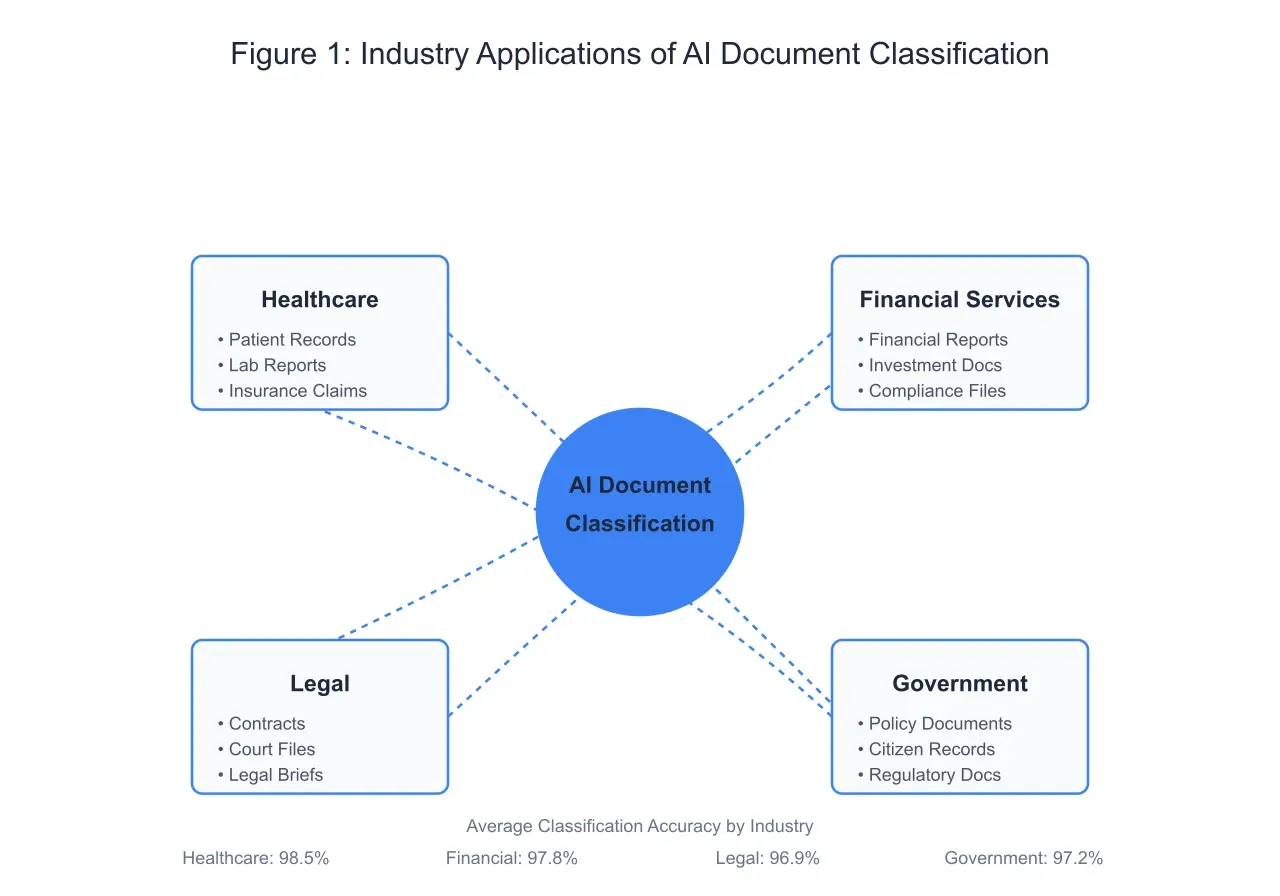
The proliferation of digital documents in modern enterprise environments has created an unprecedented need for sophisticated classification systems. Artificial intelligence-driven document classification has emerged as a crucial technology for managing this digital deluge, offering capabilities that extend far beyond traditional manual or rule-based classification methods. As illustrated in Figure 1, the application of AI document classification spans multiple industries, each with unique requirements and use cases that demonstrate the versatility and effectiveness of this technology.
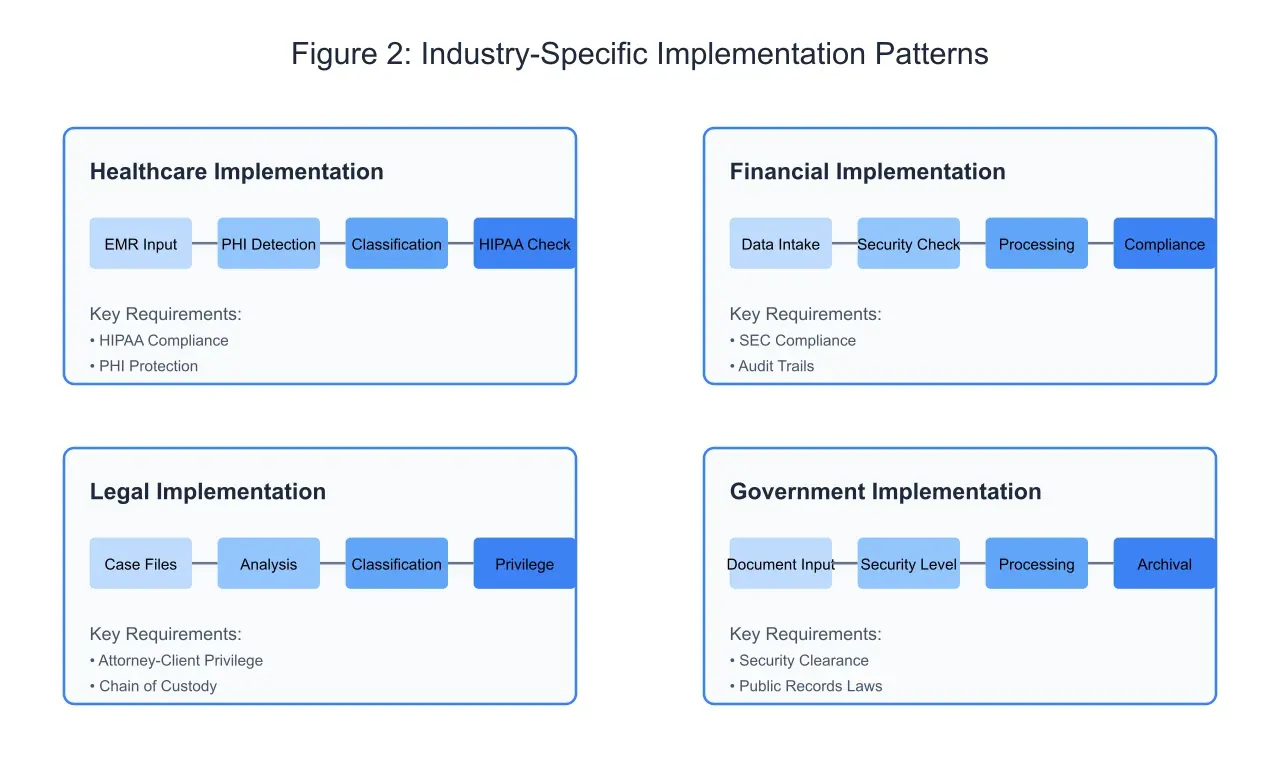
The implementation of AI document classification systems demonstrates distinct patterns across different industries, each shaped by unique regulatory requirements and operational needs (Figure 2). In the healthcare sector, the implementation pattern prioritizes Protected Health Information (PHI) detection and HIPAA compliance, establishing a multi-layered approach to document processing that begins with Electronic Medical Record (EMR) integration and concludes with rigorous compliance verification. This pattern ensures that sensitive patient information is appropriately identified and protected throughout the classification process.
Financial services institutions implement document classification systems with an emphasis on security and regulatory compliance, particularly in relation to SEC requirements and financial reporting standards. The implementation pattern in this sector includes sophisticated data intake procedures, multiple security checkpoints, and comprehensive audit trail maintenance. This approach is particularly crucial for organizations handling sensitive financial documents, investment records, and compliance-related materials, where accuracy and security are paramount concerns.
The legal sector presents a unique implementation pattern that emphasizes attorney-client privilege protection and chain of custody maintenance. Document classification systems in legal environments must accurately identify and appropriately handle privileged communications while maintaining detailed records of document access and modification. This pattern typically includes specialized workflows for different types of legal documents, from contracts and court filings to internal memoranda and client communications.
Government agencies implement document classification systems with a focus on security clearance levels and public records management. The implementation pattern in this sector must accommodate both classified information handling and public records requests, requiring sophisticated security controls and efficient archival processes. This dual requirement necessitates careful attention to document metadata and access control mechanisms.
The implementation of AI document classification systems across different industries reveals distinctive patterns of success and efficiency gains, as illustrated in Figure 3. Each sector demonstrates unique use cases with varying degrees of implementation success and operational improvements, reflecting the specific challenges and requirements of their respective domains.
In the healthcare sector, the classification of patient records demonstrates the highest success rate at 98.5%, with an accompanying 85% reduction in processing time. This remarkable efficiency gain is particularly significant given the sensitive nature of medical documentation and the strict regulatory requirements governing patient information handling. Laboratory report classification, while showing a slightly lower success rate of 97.8%, still achieves a substantial 78% reduction in processing time, enabling faster diagnostic and treatment decisions. Insurance claim documentation, with a 96.9% success rate and 82% time savings, represents a crucial intersection of healthcare administration and financial processing.
The financial services sector exhibits particularly impressive results in transaction report classification, achieving a 99.2% success rate with a 92% reduction in processing time. This exceptional performance can be attributed to the highly structured nature of financial documents and the sophisticated pattern recognition capabilities of AI systems. Compliance documentation classification, achieving a 97.5% success rate with 88% time savings, demonstrates the technology's ability to handle complex regulatory requirements. Investment record classification maintains high accuracy at 98.1% while delivering 85% time savings, crucial for maintaining market responsiveness and regulatory compliance.
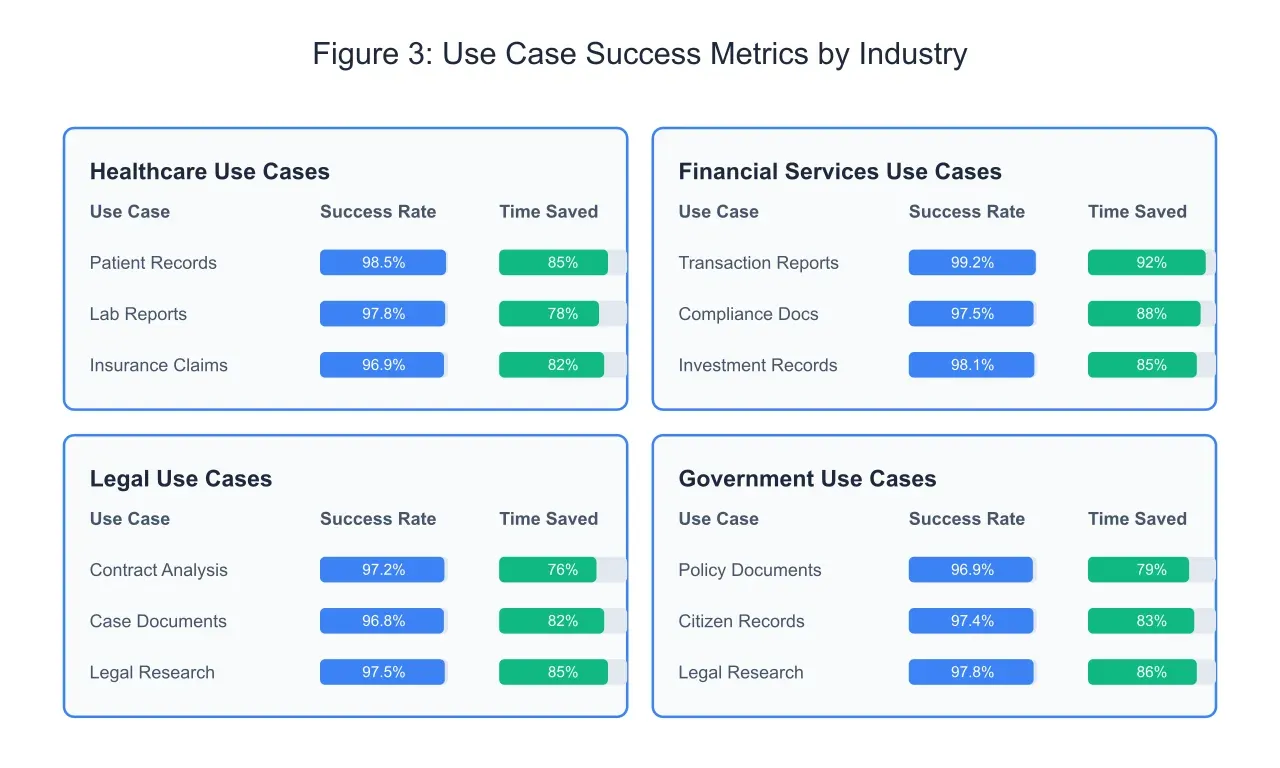
In the legal sector, AI document classification demonstrates particularly noteworthy results in contract analysis, achieving a 97.2% success rate while reducing processing time by 76%. This significant improvement in efficiency directly impacts law firms' ability to handle large-scale due diligence and contract review processes. Case document classification maintains strong performance with a 96.8% success rate and 82% time savings, enabling legal professionals to focus on strategic case analysis rather than document organization. Legal research documentation, with a 97.5% success rate and 85% time reduction, showcases the system's ability to handle complex, interconnected legal materials while maintaining high accuracy.
The government sector presents unique challenges and opportunities in document classification implementation. Policy document classification achieves a 96.9% success rate with 79% time savings, reflecting the complex nature of regulatory and policy materials. Citizen records processing demonstrates improved efficiency with a 97.4% success rate and 83% time reduction, crucial for maintaining accurate public records while ensuring data privacy. Public records management shows the highest performance in this sector with a 97.8% success rate and 86% time savings, facilitating improved transparency and accessibility of government documents.
The implementation of AI document classification systems across different sectors presents unique challenges that require carefully crafted solutions, as illustrated in Figure 4. These challenges can be categorized into four primary areas: data security, accuracy requirements, regulatory compliance, and system integration. Each of these areas demands specific attention and specialized solutions to ensure successful implementation.
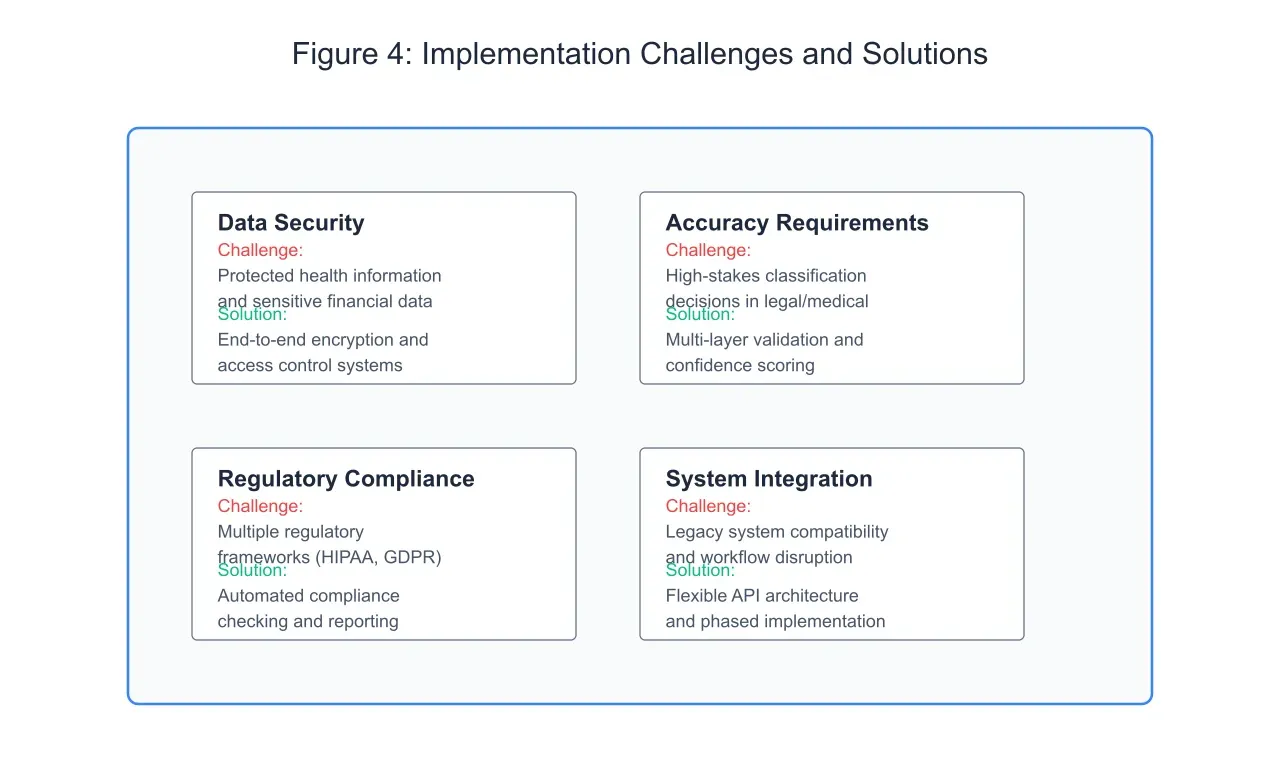
Data security emerges as a paramount concern, particularly in healthcare and financial services where protected health information and sensitive financial data must be safeguarded. The solution involves implementing end-to-end encryption systems and granular access control mechanisms that ensure data protection throughout the document lifecycle. These security measures must be balanced against the need for system accessibility and efficient document processing.
Accuracy requirements present another significant challenge, especially in legal and healthcare environments where classification errors can have serious consequences. The solution involves implementing multi-layer validation systems and confidence scoring mechanisms. When classification confidence falls below predetermined thresholds, documents are automatically routed for human review, ensuring maintaining high accuracy rates while optimizing human resource allocation.
Regulatory compliance presents a complex challenge across all sectors, with each industry subject to specific regulatory frameworks. Healthcare organizations must maintain HIPAA compliance, financial institutions need to adhere to SEC regulations and international banking standards, while government agencies must comply with public records laws and privacy regulations. The solution involves implementing automated compliance checking systems that continuously monitor document classification and handling processes. These systems maintain detailed audit trails and generate compliance reports, significantly reducing the risk of regulatory violations while streamlining the compliance documentation process.
System integration challenges often arise when implementing AI document classification systems within existing organizational infrastructures. Legacy systems, established workflows, and diverse document management platforms must be seamlessly integrated without disrupting ongoing operations. The solution involves developing flexible API architectures that can interface with multiple systems and adopting a phased implementation approach that allows for gradual transition and minimal operational disruption.
The future of AI document classification (Figure 5) points toward several transformative developments that will significantly impact document processing across industries. Advanced Natural Language Processing (NLP) capabilities are expected to emerge as a primary driver of improvement, enabling more sophisticated multi-language processing and deeper semantic understanding of document content. This evolution will particularly benefit organizations dealing with international documentation and complex technical content.
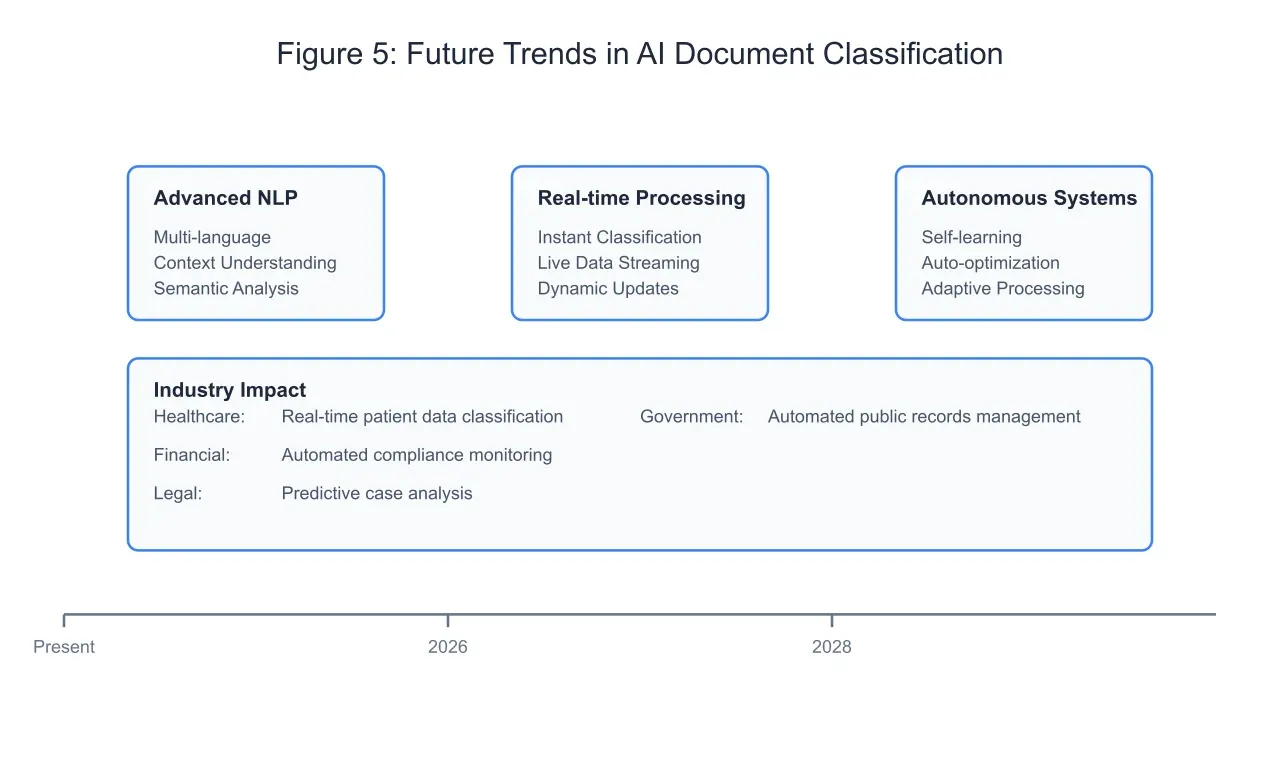
Real-time processing capabilities represent another significant advancement on the horizon. The ability to classify and process documents instantaneously as they enter the system will revolutionize workflow efficiency across sectors. In healthcare, this means immediate classification and routing of patient documentation, potentially improving treatment response times. Financial institutions will benefit from instant transaction document processing, enabling faster decision-making and risk assessment.
Autonomous systems represent the next frontier in document classification technology. These systems will possess self-learning capabilities, automatically adapting to new document types and evolving organizational needs without requiring manual reconfiguration. This advancement will be particularly impactful in government and legal sectors, where document types and classification requirements frequently change in response to new regulations and policies.
The implementation of these advanced capabilities will vary across industries, with each sector adapting the technology to address its specific challenges. Healthcare organizations will focus on integrating real-time classification with patient care systems, while financial institutions will emphasize autonomous compliance monitoring and risk assessment. Legal firms will benefit from predictive case analysis capabilities, and government agencies will achieve greater efficiency in public records management.
The evolution of AI document classification systems represents a fundamental shift in how organizations manage and process information. As demonstrated through our analysis of various industry implementations, these systems deliver substantial improvements in efficiency, accuracy, and compliance management. The future developments in this field, particularly in areas of advanced NLP, real-time processing, and autonomous systems, promise to further transform document management practices across all sectors.
The success of these implementations depends heavily on understanding and addressing industry-specific challenges while maintaining focus on core requirements of security, accuracy, and compliance. As organizations continue to generate increasing volumes of digital documents, the importance of sophisticated classification systems will only grow, making them an essential component of modern enterprise information management strategy.

Head IT Operations - Co Founder of Artificio
See it in your SAP environment
Bring us a document, a process, or a bottleneck. We'll show how Artificio captures, validates, and posts into SAP — then scale from there.
Security & compliance
ISO 27001:2013 certified, SOC 2 Type 2 compliant, GDPR and HIPAA ready. Every agent action is logged, auditable, and runs in isolated environments.