

Blog
Hyperautomation: The Next Frontier in Business Efficiency
Transform your business with hyperautomation. Discover how integrated AI, ML, and RPA boost efficiency and innovation.

Blog
Transform your business with hyperautomation. Discover how integrated AI, ML, and RPA boost efficiency and innovation.
The business world stands at a critical juncture where traditional automation approaches are no longer sufficient to meet the demands of modern digital transformation. While companies have spent years automating individual tasks and processes, the next evolutionary leap requires a more comprehensive approach. Enter hyperautomation, a transformative strategy that's reshaping how organizations think about efficiency, productivity, and competitive advantage in 2025 and beyond.
Hyperautomation represents the convergence of multiple advanced technologies working in harmony to create intelligent, self-optimizing business ecosystems. Unlike conventional automation that focuses on replacing manual tasks with software, hyperautomation creates interconnected networks of automated processes that can adapt, learn, and improve continuously. This approach doesn't just eliminate human intervention in isolated workflows; it transforms entire business operations into dynamic, responsive systems that can handle complexity and variation with unprecedented sophistication.
At its essence, hyperautomation combines Robotic Process Automation (RPA), Artificial Intelligence (AI), Machine Learning (ML), and process mining technologies to create comprehensive automation solutions that extend far beyond what any single technology could achieve alone. This integrated approach enables organizations to automate not just routine tasks, but entire business processes that involve decision-making, exception handling, and complex data analysis.
Robotic Process Automation serves as the foundation layer, handling structured, rule-based tasks that previously required human intervention. RPA bots can navigate software applications, manipulate data, trigger responses, and communicate with other systems just as human workers would, but with perfect consistency and around-the-clock availability. However, RPA alone has limitations when processes involve unstructured data, require judgment calls, or need to adapt to changing conditions.
This is where Artificial Intelligence and Machine Learning become crucial components. AI technologies can process unstructured data like emails, documents, images, and voice communications, extracting meaningful information and making intelligent decisions based on patterns and context. Machine Learning algorithms continuously improve these capabilities by learning from historical data and outcomes, enabling the system to become more accurate and efficient over time without manual reprogramming.
Process mining adds another critical dimension by providing deep visibility into how business processes actually function in practice. This technology analyzes event logs from various systems to create detailed maps of process flows, identifying bottlenecks, inefficiencies, and opportunities for optimization. Process mining doesn't just show you what should happen according to your documented procedures; it reveals what actually happens, including all the variations, exceptions, and workarounds that occur in real-world operations.
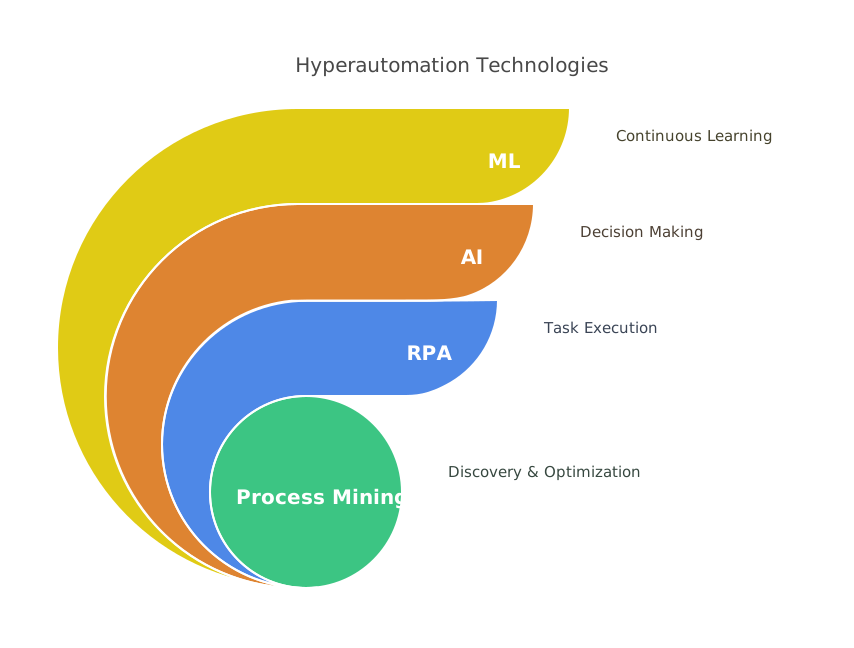
When these technologies work together in a hyperautomation framework, they create intelligent automation ecosystems that can handle end-to-end business processes with minimal human oversight. The system can automatically discover processes through mining, design optimal automation solutions using AI, implement them through RPA, and continuously optimize performance through machine learning feedback loops.
Traditional automation initiatives typically focus on specific, well-defined tasks that follow predictable patterns. Organizations might automate invoice processing, customer onboarding, or inventory updates as standalone projects, achieving efficiency gains in isolated areas while leaving broader workflow inefficiencies untouched. This piecemeal approach, while beneficial, creates automation islands that don't communicate effectively with each other and fail to address the complex interdependencies that characterize modern business operations.
Hyperautomation takes a fundamentally different approach by viewing entire workflows as interconnected systems that can be optimized holistically. Instead of automating individual tasks, hyperautomation identifies and transforms complete business processes that may span multiple departments, systems, and decision points. This comprehensive perspective enables organizations to eliminate handoffs, reduce wait times, and create seamless experiences for both employees and customers.
Consider how hyperautomation transforms customer service operations. Rather than simply automating ticket creation or response templates, a hyperautomation approach would integrate customer communication channels, analyze inquiry patterns using AI, automatically route complex issues to appropriate specialists, update CRM systems in real-time, and trigger follow-up processes based on resolution outcomes. The entire customer journey becomes a coordinated, intelligent process that adapts to individual customer needs while maintaining consistent service quality.
This transformation extends to back-office operations as well. Financial close processes, for example, can be reimagined as integrated workflows where data collection, reconciliation, analysis, and reporting happen simultaneously across multiple systems. Instead of waiting for one step to complete before beginning the next, hyperautomation enables parallel processing and real-time validation, dramatically reducing cycle times while improving accuracy and compliance.
The key to successful workflow transformation lies in understanding that hyperautomation isn't about replacing human workers with technology, but rather about augmenting human capabilities and focusing human expertise on high-value activities that require creativity, strategic thinking, and relationship building. Hyperautomation handles the routine, repetitive, and data-intensive aspects of workflows, freeing human workers to focus on innovation, problem-solving, and customer relationships.
Implementing hyperautomation successfully requires a structured approach that balances ambition with pragmatism. Organizations need to build capabilities systematically while delivering tangible value throughout the journey. The most successful hyperautomation initiatives begin with comprehensive process discovery and assessment, establishing a clear understanding of current state operations before designing future state solutions.
The first critical step involves conducting thorough process mining analysis across key business functions. This discovery phase reveals not just documented procedures, but actual process variations, bottlenecks, and efficiency opportunities that may not be visible through traditional process mapping exercises. Process mining tools analyze system logs, transaction records, and workflow data to create detailed visualizations of how work actually flows through the organization, providing the factual foundation necessary for informed automation decisions.
Following process discovery, organizations need to prioritize automation opportunities based on potential impact, implementation complexity, and strategic alignment. The most effective approach typically involves identifying processes that combine high transaction volumes, clear business rules, and significant manual effort. These "sweet spot" processes offer the best return on investment while providing learning opportunities that inform subsequent automation initiatives.
Technology selection and architecture design represent the next crucial phase. Organizations must choose platforms and tools that can integrate effectively with existing systems while providing scalability for future expansion. This requires careful evaluation of RPA platforms, AI/ML capabilities, process mining tools, and integration technologies to ensure they can work together seamlessly. The architecture must also accommodate data security, governance, and compliance requirements that are critical for enterprise operations.
Building internal capabilities is equally important as selecting technology. Successful hyperautomation requires teams with diverse skills spanning process analysis, automation development, data science, and change management. Organizations need to invest in training existing staff while potentially recruiting new talent with specialized expertise. Creating centers of excellence or automation competency centers helps coordinate efforts, share best practices, and maintain standards across the organization.
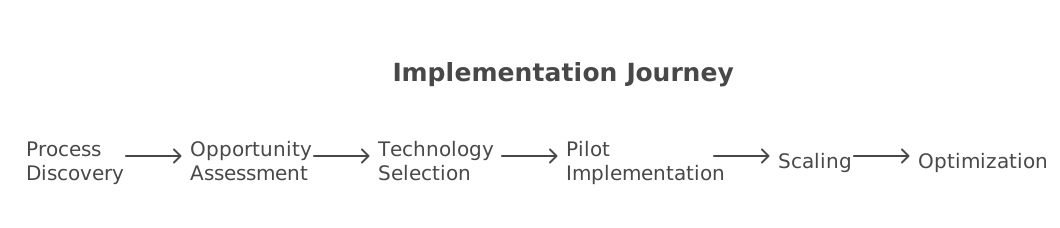
Pilot implementation should focus on proving concepts and refining approaches before broader deployment. Starting with well-defined, contained processes allows teams to learn and adapt methodologies while demonstrating value to stakeholders. Successful pilots provide concrete evidence of hyperautomation benefits while identifying implementation challenges that need to be addressed during scaling phases.
Healthcare organizations are leveraging hyperautomation to transform patient care delivery and administrative operations. Hospital systems use integrated automation platforms to streamline patient admissions, automatically verify insurance coverage, schedule appointments across multiple departments, and coordinate care team communications. AI-powered systems can analyze patient symptoms and medical histories to recommend treatment protocols, while RPA handles insurance pre-authorizations and billing processes. Process mining reveals patterns in patient flow and resource utilization, enabling hospitals to optimize staffing and equipment allocation dynamically.
One major health system implemented hyperautomation for their revenue cycle management, integrating patient registration, insurance verification, coding, billing, and collections into a seamless automated workflow. The system automatically identifies coding discrepancies, flags potential denials, and routes complex cases to human specialists for review. Machine learning algorithms continuously improve coding accuracy by learning from historical claim outcomes, while process mining identifies bottlenecks in the revenue cycle that impact cash flow.
Retail organizations are using hyperautomation to create responsive, customer-centric operations that can adapt quickly to changing market conditions. Modern retail hyperautomation integrates demand forecasting, inventory management, supply chain coordination, and customer service into unified systems that respond automatically to market signals. AI algorithms analyze purchasing patterns, social media trends, and external factors like weather or events to predict demand fluctuations, while automated systems adjust inventory levels, trigger supplier orders, and optimize distribution strategies accordingly.
A leading fashion retailer implemented hyperautomation across their entire product lifecycle, from trend analysis and design conceptualization through manufacturing coordination and customer delivery. Their system monitors fashion influencers and social media trends using AI, automatically generates design concepts based on predicted preferences, coordinates with suppliers for rapid prototyping, and manages production schedules to minimize time-to-market. Customer service operations integrate seamlessly with inventory systems, providing real-time product availability and automated styling recommendations based on individual customer preferences and purchase history.
Financial services institutions are deploying hyperautomation to enhance customer experiences while managing regulatory compliance and risk more effectively. Banks use integrated automation platforms to process loan applications, conduct risk assessments, perform regulatory reporting, and manage customer communications throughout the entire relationship lifecycle. AI-powered systems can analyze creditworthiness using alternative data sources, while RPA handles document processing and regulatory submissions automatically. 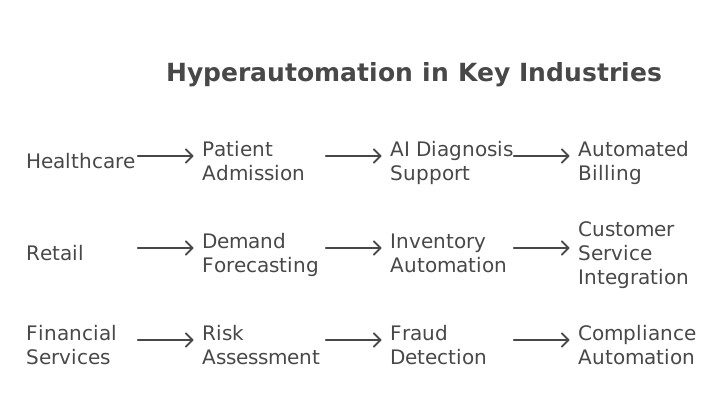
Investment management firms are implementing hyperautomation for portfolio management, risk monitoring, and client reporting. These systems continuously analyze market conditions, automatically rebalance portfolios based on predefined strategies, generate compliance reports, and provide personalized investment recommendations to clients. Process mining helps identify inefficiencies in trade settlement, regulatory reporting, and client onboarding processes, enabling firms to reduce operational costs while improving service quality.
Artificio's comprehensive automation platform provides the integrated technology foundation that organizations need to implement hyperautomation successfully across their operations. Unlike point solutions that address individual automation needs, Artificio's platform combines advanced RPA capabilities, AI-powered decision engines, machine learning optimization, and process intelligence into a unified environment that supports end-to-end workflow transformation.
The platform's process discovery capabilities automatically map existing workflows by analyzing system interactions, document flows, and user activities across enterprise applications. This automated discovery approach provides comprehensive visibility into actual process performance, revealing optimization opportunities that traditional manual mapping exercises often miss. Organizations can quickly identify automation candidates and understand their interconnections with other business processes, enabling informed decision-making about automation priorities and sequencing.
Artificio's AI-powered automation engine handles both structured and unstructured data processing, enabling organizations to automate complex processes that involve document analysis, email processing, and decision-making based on multiple variables. The platform's machine learning capabilities continuously improve automation performance by analyzing outcomes and adjusting process parameters automatically, reducing the need for manual maintenance and optimization.
Integration capabilities are central to Artificio's hyperautomation approach. The platform connects seamlessly with existing enterprise systems, cloud applications, and data sources, enabling automated workflows that span multiple technology environments. This comprehensive integration eliminates the data silos and system disconnects that limit traditional automation initiatives, creating truly end-to-end automated processes.
The platform's governance and monitoring features provide the visibility and control that enterprises require for large-scale automation deployments. Administrators can track automation performance in real-time, identify exceptions and bottlenecks, and adjust process parameters as business requirements evolve. Built-in compliance and audit capabilities ensure that automated processes meet regulatory requirements while maintaining the documentation and controls necessary for enterprise risk management.
Artificio's collaborative development environment enables both technical and business users to participate in automation creation and optimization. Business analysts can design process flows using intuitive visual tools, while developers can implement complex logic and integrations using advanced programming capabilities. This collaborative approach accelerates automation development while ensuring that solutions meet actual business requirements rather than technical assumptions.
The platform's scalability architecture supports organizations as they expand hyperautomation across departments and business functions. Cloud-native design enables rapid deployment of new automation capabilities, while enterprise-grade security and performance ensure that automated processes can handle production workloads reliably. Organizations can start with focused automation initiatives and scale systematically to enterprise-wide hyperautomation without technology constraints.
Hyperautomation represents more than a technological advancement; it's a fundamental shift toward intelligent, adaptive business operations that can respond dynamically to changing market conditions, customer needs, and competitive pressures. Organizations that embrace hyperautomation gain significant advantages in agility, efficiency, and innovation capacity that compound over time as their automated systems become more sophisticated and comprehensive.
The competitive implications are substantial. Companies with mature hyperautomation capabilities can respond to market opportunities faster, deliver more consistent customer experiences, and operate with lower costs than competitors relying on traditional manual processes. These advantages become more pronounced as business environments become more complex and fast-paced, creating sustainable differentiation for organizations that invest in hyperautomation capabilities now.
As artificial intelligence and machine learning technologies continue advancing, hyperautomation platforms will become even more powerful and accessible. Future developments in natural language processing, computer vision, and predictive analytics will enable automated systems to handle increasingly sophisticated tasks while requiring less technical expertise to implement and maintain. This democratization of automation capabilities will accelerate adoption across organizations of all sizes and industries.
The organizations that will thrive in this automated future are those that start building hyperautomation capabilities today. By partnering with platforms like Artificio and investing in the processes, technologies, and skills necessary for comprehensive automation, businesses can position themselves to capitalize on the tremendous opportunities that hyperautomation creates while staying ahead of competitors who delay their automation transformation.
Hyperautomation isn't just about improving current operations; it's about reimagining what's possible when intelligent systems handle routine work, freeing human creativity and expertise to focus on innovation, strategy, and relationship building. The future belongs to organizations that can harness this potential effectively, and that future is already beginning to unfold.

Head IT Operations - Co Founder of Artificio
See it in your SAP environment
Bring us a document, a process, or a bottleneck. We'll show how Artificio captures, validates, and posts into SAP — then scale from there.
Security & compliance
ISO 27001:2013 certified, SOC 2 Type 2 compliant, GDPR and HIPAA ready. Every agent action is logged, auditable, and runs in isolated environments.