

Blog
Instant Insights - Artificio's API Automates Retail Data Extraction
Automate retail document processing with AI. Extract key data from invoices, GRNs, & more. Improve efficiency.

Blog
Automate retail document processing with AI. Extract key data from invoices, GRNs, & more. Improve efficiency.
In today's data-driven retail landscape, businesses face an overwhelming challenge: extracting meaningful insights from the mountain of unstructured documents that flow through their operations daily. From supplier invoices to regulatory compliance certificates, these documents contain valuable information that, when properly harnessed, can drive strategic decision-making and operational efficiency. The embedded data within these documents represents a goldmine of operational intelligence supplier performance metrics, inventory movement patterns, financial obligations, and compliance status indicators that collectively form the foundation of retail decision support systems. However, the traditional approach of manual data entry and document processing creates bottlenecks, introduces errors, and ultimately prevents retailers from realizing the full potential of their information assets.
Artificio, a pioneering force in artificial intelligence and machine learning technologies, has developed a sophisticated API solution specifically designed to address this challenge. By leveraging advanced document processing capabilities, Artificio's API transforms unstructured retail documents into structured, actionable data that integrates seamlessly with existing business systems. This technological breakthrough not only streamlines operations but fundamentally changes how retail businesses interact with their document-based information.
Retail businesses operate in an environment where paper documents and digital documents constantly flow between suppliers, customers, regulatory bodies, and internal departments. Each document type serves a specific purpose in the retail ecosystem, but collectively, they create significant processing challenges:
A medium-sized retail operation may process thousands of documents monthly, spanning dozens of different formats and structures. This heterogeneity makes standardized processing exceptionally difficult. Consider the complexity: supplier invoices from different vendors utilize distinct templates with proprietary layouts; goods received notes might contain handwritten annotations alongside typed content; purchase orders generated by different departments may follow inconsistent internal conventions.
Even within a single document category, the structural variations are profound. Supplier invoices alone can vary dramatically in layout, terminology, information hierarchy, and data field positioning. Some suppliers might list tax information at the document header, while others place it at the footer; product codes might appear adjacent to descriptions in one format but separated in another; quantity and unit price fields might be arranged horizontally in some formats and vertically in others. This structural inconsistency creates a formidable challenge for traditional data extraction methodologies that rely on fixed templates or rigid rules.
Many retail documents contain time-sensitive information that directly impacts inventory management, financial reporting, and regulatory compliance. The temporal value of this information degrades rapidly as documents await processing. For example, a goods received note (GRN) that sits unprocessed for 24 hours represents a day during which inventory systems reflect inaccurate stock levels potentially triggering unnecessary reorders or missed sales opportunities due to falsely indicated stockouts.
Similarly, supplier invoices often include early payment discount terms (such as 2/10 net 30, offering a 2% discount if paid within 10 days), but these financial advantages can only be captured if the invoices are processed promptly enough to enable accounts payable departments to act within the discount window. Quality inspection reports containing information about product defects or approaching expiration dates require immediate attention to prevent compromised products from reaching consumers.
Delays in processing these documents can therefore lead to a cascade of operational consequences: stockouts leave customer needs unmet; overstocking ties up capital unnecessarily and increases storage costs; missed payment discounts directly impact profit margins; compliance violations may result in regulatory penalties or reputational damage all of which directly affect the bottom line in measurable, significant ways.
Manual document processing introduces numerous opportunities for error, creating what data scientists refer to as "error propagation chains." These chains represent how a single input error multiplies its impact as it travels through interconnected business systems. A single mistyped digit in an invoice amount (for instance, entering $1,500 as $15,000) can trigger a cascade of consequential problems throughout the supply chain and financial systems: incorrect accounting entries, distorted financial reports, erroneous tax calculations, and misallocated budgets.
Product code errors are particularly problematic in retail environments. Entering SKU "BLU-224" instead of "BLU-244" might seem minor, but this transposition can result in completely different products being ordered, stocked, or tracked. When such errors affect inventory management systems, they create phantom inventory (system records showing stock that doesn't physically exist) or hidden inventory (physical stock that isn't recognized in systems).
Quantity field errors directly impact inventory planning. If a goods received note recording a delivery of 200 units is entered as 20 units, the system will incorrectly show a significant shortage, potentially triggering emergency reorders and disrupting the entire supply chain rhythm.
These errors become increasingly difficult and costly to correct the longer they remain undetected. An invoice error discovered during same-day processing might be rectified with a simple adjustment; the same error discovered during month-end reconciliation might require extensive forensic accounting to untangle its effects across multiple systems; if discovered during yearly audits, it could necessitate formal restatements of financial reports and create compliance issues with regulatory bodies.
Traditional document processing requires significant human resources, creating both direct costs (salaries, benefits, workstations) and substantial opportunity costs. Quantitative studies in retail operations management have shown that administrative personnel spend between 30-60% of their working hours on document-related tasks. Retail back-office staff often dedicate entire shifts to manually inputting data from paper documents into digital systems transcribing line items from invoices, cross-checking delivery quantities against purchase orders, and manually updating inventory records based on stock adjustment forms.
The opportunity cost of this time allocation is profound. Consider a typical retail operation where skilled employees spend 20 hours weekly on manual document processing. Over a year, this represents over 1,000 hours per employee that could instead be directed toward value-generating activities: analyzing sales trends to optimize merchandising strategies, developing deeper supplier relationships to negotiate better terms, enhancing customer service interactions to build loyalty, or creating promotional campaigns to drive revenue growth.
Additionally, the cognitive load imposed by repetitive data entry tasks leads to employee fatigue and reduced job satisfaction. Research in retail human resources management indicates that administrative staff engaged primarily in document processing report lower engagement scores and higher turnover rates than those involved in more strategic activities. This creates secondary costs of continual recruitment, onboarding, and training cycles that further strain retail operations.
Artificio's API represents a paradigm shift in how retail businesses handle document processing. Rather than treating documents as simple information carriers that require manual interpretation, the API approaches them as structured data sources waiting to be unlocked through computational intelligence. The technical foundation of this solution combines several advanced technologies working in concert:
Artificio's system employs advanced optical character recognition (OCR) that goes beyond traditional text extraction. It utilizes deep learning models trained specifically on retail document formats to recognize not just characters but their contextual significance within document structures. This context-aware OCR can distinguish, for example, between a product code appearing in a header reference and the same code appearing in an item list a critical distinction that conventional OCR systems often miss.
The natural language processing (NLP) layer applies sophisticated entity recognition algorithms that identify key retail-specific concepts (products, quantities, prices, dates, supplier identifiers) even when they appear in unexpected formats or positions. This linguistic intelligence enables the system to correctly interpret ambiguous notations that would confuse simpler systems, such as distinguishing between "12/24 cases" (quantity) and "12/24" (date) based on contextual clues.
The machine learning foundation employs both supervised and unsupervised learning techniques. The supervised components leverage thousands of pre-annotated retail documents to recognize common patterns, while the unsupervised elements enable the system to adapt to previously unseen document formats through similarity detection and pattern generalization. This hybrid approach creates exceptional flexibility across document variations while maintaining high accuracy for critical data fields.
Through this technological orchestration, the API can:
This automation eliminates the inefficiencies and errors inherent in manual processing while dramatically accelerating the speed at which document information becomes available for operational use. Where manual processing might require hours or days, Artificio's solution typically delivers structured data within seconds or minutes of document receipt.
As illustrated in Figure 1, Artificio's solution creates a continuous flow from document receipt to actionable business intelligence, with minimal human intervention required. The system maintains a human-in-the-loop option for exception handling, but the vast majority of documents proceed through fully automated channels, freeing retail staff to focus on value-added activities while improving data accuracy and timeliness.
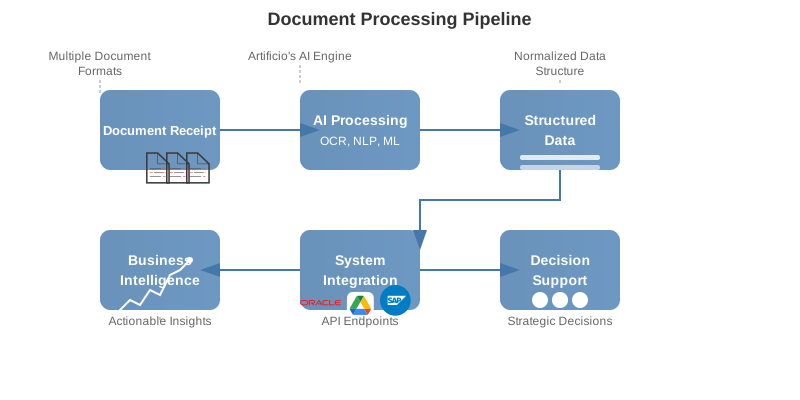
The retail document ecosystem encompasses a diverse array of information carriers, each serving specific business functions while collectively forming an interconnected information network. Artificio's API has been specifically engineered to address the unique challenges presented by each document category while maintaining a holistic view of their interrelationships. Understanding these document types and their operational significance illuminates the transformative potential of automated extraction.
Supplier invoices represent one of the most complex document types in the retail environment. These itemized bills from vendors contain multidimensional data spanning financial, inventory, and supplier relationship domains. A typical supplier invoice includes vendor identification details, payment terms, tax information, itemized product listings with quantities and prices, delivery dates, and reference numbers for associated documents like purchase orders.
The complexity of invoice processing stems from their hybrid nature they simultaneously serve as financial obligations, inventory confirmation records, and supplier performance indicators. When processed through Artificio's API, invoice data undergoes multi-dimensional transformation:
Financial dimension: Line items are aggregated into payment obligations with appropriate tax calculations, credit terms are identified to optimize cash flow, and early payment discount opportunities are flagged for accounts payable teams.
Inventory dimension: Product quantities are extracted and reconciled against purchase orders and goods received notes, identifying discrepancies that might indicate shipping errors or quality issues.
Supplier relationship dimension: Delivery timelines are compared against contractual commitments, pricing is verified against negotiated terms, and consistent performance metrics are established for vendor evaluation.
Without automated extraction, these multidimensional insights remain locked within paper documents or unstructured PDFs, accessible only through labor-intensive manual review. Artificio's system transforms these static documents into dynamic data assets that simultaneously update financial systems, inventory records, and supplier performance dashboards.
Goods Received Notes serve as the physical verification checkpoint in the retail supply chain. These documents confirm the actual receipt of inventory, recording what was physically delivered versus what was ordered. GRNs typically contain receiving date and time, carrier information, package condition notes, item-by-item quantity verification, and quality check indicators.
The critical business function of GRNs lies in their reconciliation value they form the bridge between what was ordered (Purchase Orders), what was billed (Supplier Invoices), and what was actually received. This three-way matching process forms the foundation of inventory accuracy and financial control.
Artificio's processing of GRNs creates immediate inventory visibility by:
The automated extraction of GRN data represents a particularly valuable improvement for retailers operating just-in-time inventory models, where real-time stock visibility directly impacts sales opportunities and customer satisfaction.
Purchase Orders establish the formal buying agreement between retailers and their suppliers, specifying products, quantities, prices, delivery expectations, and payment terms. As the initiating document in the procurement cycle, POs set the reference point against which all subsequent documents are measured.
The data structure of POs presents unique extraction challenges due to their forward-looking nature they contain anticipated delivery dates, expected quantities, and projected costs rather than confirmed actualities. Artificio's system applies temporal context awareness to distinguish between orders, amendments, and cancellations while maintaining referential integrity throughout the document lifecycle.
When processed through the API, PO data enables:
Automated PO processing creates particular value in dynamic retail environments where ordering patterns require frequent adjustment based on sales velocity, seasonal factors, or promotional activities. By maintaining a structured digital representation of all outstanding orders, retailers gain the ability to rapidly adjust supply chain commitments in response to changing market conditions.
Stock Adjustment Forms document manual inventory changes resulting from factors outside the standard receiving and sales processes including damage, theft, expiration, donations, or internal transfers. These documents often represent the most inconsistently formatted records in the retail ecosystem, frequently containing handwritten notations, manager signatures, and explanatory notes that challenge traditional extraction methods.
Artificio's system employs specialized handwriting recognition and contextual interpretation algorithms to capture both the quantitative adjustments and their qualitative justifications. This comprehensive extraction creates:
The business impact of automated stock adjustment processing extends beyond mere inventory accuracy it creates visibility into operational inefficiencies, identifies potential security vulnerabilities, and provides documentation for insurance claims related to inventory losses.
Delivery Challans serve as vendor-provided confirmation of shipment contents, essentially representing the supplier's declaration of what was sent. These documents typically accompany physical deliveries and include shipment date, transport details, itemized contents, and occasionally, quality certifications.
The extraction complexity for delivery challans stems from their origination outside the retailer's document ecosystem they follow supplier-specific formats rather than retailer-standardized templates. Artificio's system accommodates this variability through adaptive recognition patterns that identify common informational elements regardless of format disparities.
When processed through the API, delivery challan data enables:
In high-volume retail environments, automated delivery challan processing creates particular value by enabling receipt planning allowing warehouse operations to allocate appropriate resources based on anticipated delivery volumes and contents.
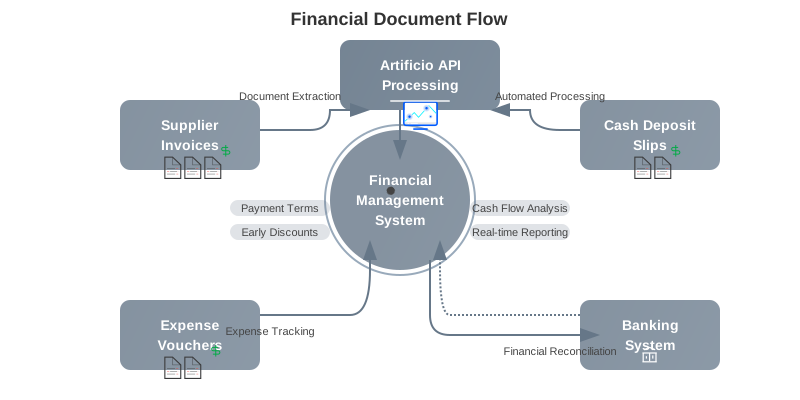
Cash Deposit Slips record the physical transfer of currency from retail locations to banking institutions. These documents contain deposit amounts, account information, transaction dates, denominations, and authentication references. In multi-location retail operations, cash deposit slips represent a critical control point for loss prevention and financial reconciliation.
The extraction challenges for these documents stem from their hybrid nature combining bank-standardized forms with retailer-specific annotations and often including physical authentication marks that must be digitally preserved for audit purposes.
Artificio's processing of cash deposit slips enables:
For retailers with significant cash transaction volumes, automated deposit slip processing creates particular value in accelerating cash-to-bank reconciliation cycles reducing the float time during which cash is recognized on physical records but not yet available in banking systems.
Expense Vouchers document the disbursement of petty cash or expense reimbursements for routine operational costs such as maintenance, supplies, or incidental expenses. These documents typically include expense date, amount, category, approver information, and often attach supplementary receipts as validation.
The extraction complexity for expense vouchers derives from their nested document structure the primary voucher often incorporates multiple secondary receipt images with varying formats and quality. Artificio's system applies hierarchical document analysis to maintain the relationship between primary vouchers and their supporting documentation while extracting relevant data from each component.
When processed through the API, expense voucher data enables:
The business impact of automated expense processing extends beyond simple record-keeping it creates visibility into discretionary spending patterns that might otherwise remain obscured within paper-based approval systems.
As illustrated in Figure 2, Artificio's solution creates an integrated financial documentation ecosystem, connecting physical currency movements, discretionary expenses, and formal banking records into a cohesive digital narrative that supports comprehensive financial oversight.
Vendor Registration Forms capture essential information about new suppliers entering the retail ecosystem, including company name, tax identification, contact details, banking information, product categories, and compliance certifications. These documents establish the foundational identity record upon which all subsequent supplier interactions build.
The extraction challenge for registration forms stems from their information density and validation requirements they contain numerous data fields that must be captured with perfect accuracy, particularly for sensitive information like banking details and tax identifiers that permit no margin for error.
Artificio's processing of vendor registration forms enables:
For retailers managing extensive supplier networks, automated registration processing creates particular value in accelerating the onboarding cycle reducing the time from initial contact to active purchasing relationship while ensuring complete and accurate supplier records.
Supplier Agreements document the formal business relationship between retailers and vendors, outlining supply terms, payment conditions, pricing structures, quality standards, exclusivity clauses, and performance expectations. These complex documents combine structured data elements (pricing tables, delivery schedules) with unstructured narrative content (legal clauses, service descriptions).
The extraction challenge for supplier agreements lies in their hybrid nature requiring both precise data field extraction and contextual interpretation of legal language. Artificio's system employs specialized natural language processing algorithms that identify contractual elements based on their semantic function rather than their structural position.
When processed through the API, supplier agreement data enables:
The business impact of automated contract processing extends beyond documentation it transforms static legal documents into dynamic relationship governance tools that actively monitor compliance and highlight optimization opportunities throughout the supplier lifecycle.
Quality Inspection Reports document the assessment of product condition, compliance with specifications, and validation of safety standards. These reports typically include inspection date, product identifiers, batch/lot numbers, measured quality parameters, pass/fail determinations, and inspector authentication.
The extraction complexity for inspection reports stems from their technical specificity they frequently contain industry-specific terminology, technical measurements, and specialized compliance references that require domain-aware interpretation.
Artificio's processing of quality inspection reports enables:
For retailers in categories with strict quality requirements (such as food, pharmaceuticals, or children's products), automated inspection report processing creates particular value in establishing unbroken documentation chains that demonstrate due diligence in consumer protection.
Regulatory Compliance Documents encompass a diverse category of certifications related to product safety, organic verification, fair trade practices, sustainable sourcing, and other regulated aspects of retail operations. These documents typically include certification type, issuing authority, validation dates, covered products, and compliance standards.
The extraction challenge for compliance documents lies in their authoritative nature they originate from numerous regulatory bodies with distinct formatting standards, validation mechanisms, and renewal requirements. Artificio's system maintains an evolving knowledge base of regulatory document structures that adapts to changing compliance landscapes.
When processed through the API, compliance document data enables:
Artificio's solution transforms static compliance documents into a dynamic regulatory assurance system that actively monitors certification status, alerts to upcoming renewals, and maintains comprehensive documentation trails for demonstrated compliance.
The business impact of automated compliance processing extends beyond risk mitigation it enables retailers to transform regulatory requirements from operational burdens into market differentiation opportunities by providing instant verification of compliance claims and supporting transparent communication of certification status to increasingly conscientious consumers.
While each document category serves specific operational functions, their true value emerges through their interconnections. Artificio's API doesn't merely process documents in isolation; it establishes and maintains the relational integrity between them. This holistic approach creates a digital thread that connects superficially disparate documents into coherent business narratives:
By maintaining these narrative connections, Artificio's system transforms document processing from a series of isolated administrative tasks into a strategic information framework that supports comprehensive business intelligence and operational optimization.
The technical architecture underlying Artificio's document processing capabilities represents a sophisticated orchestration of multiple artificial intelligence disciplines working in concert. Understanding this framework provides insight into how the system achieves its remarkable accuracy and adaptability across diverse retail document types.
At the initial layer of processing, Artificio employs advanced computer vision algorithms specifically optimized for document analysis. Unlike general-purpose image recognition systems, these algorithms have been trained on millions of retail-specific documents to recognize common structural patterns regardless of superficial formatting differences. The computer vision layer performs several critical functions:
Document orientation correction adjusts for skewed scanning or photography, ensuring that text alignment is properly normalized before subsequent processing. This seemingly simple step represents a significant advancement over traditional systems that often fail when documents are captured at non-standard angles or with inconsistent lighting.
Page segmentation identifies logical regions within documents, distinguishing headers, footers, tables, line items, and narrative sections. This spatial understanding creates the contextual framework for interpreting extracted data recognizing, for example, that a number appearing in a document header likely represents an invoice number rather than a quantity or price.
Table structure recognition identifies tabular data even when visual cues like cell borders are faint or inconsistent. This capability is particularly critical for retail documents where essential information often appears in complex multi-column layouts with variable cell structures.
For retail operations processing thousands of diverse documents daily, these computer vision capabilities eliminate the need for perfect scanning conditions or standardized document formats accepting the reality of how documents actually exist in busy retail environments rather than imposing artificial constraints on document capture.
Building upon the computer vision foundation, Artificio's specialized OCR engine converts visual text representations into machine-readable characters. This engine surpasses conventional OCR in several critical dimensions:
Multi-font recognition handles the diverse typography found across supplier documents without requiring pre-training on specific fonts. The system accurately processes everything from modern digital typography to legacy dot-matrix printer output that remains common in certain supply chain segments.
Handwriting interpretation recognizes both cursive and printed handwritten annotations a crucial capability for retail documents that frequently include handwritten quantity adjustments, approval signatures, or quality notes.
Contextual correction applies domain-specific knowledge to resolve ambiguous characters based on their expected values. For instance, when processing a product code field, the system can correctly distinguish between similar-looking characters (such as "0" versus "O" or "1" versus "I") based on known inventory coding patterns.
The practical impact of these advanced OCR capabilities is particularly evident in multi-national retail operations, where documents may contain multiple languages or specialized character sets. Artificio's system processes these multilingual documents without requiring separate configuration or specialized language models.
The NLP layer represents the semantic intelligence of the system, interpreting the meaning of extracted text rather than merely recognizing its characters. This layer applies several specialized capabilities to retail document interpretation:
Entity recognition identifies the business significance of text elements, distinguishing product descriptions from company names, quantities from reference numbers, and dates from monetary amounts. This contextual understanding enables accurate data categorization even when formatting provides limited structural clues.
Relationship extraction establishes connections between entities within documents, linking product codes to their descriptions, quantities to specific items, and discount terms to particular products or orders. These relationships form the foundation of structured data creation from unstructured sources.
Terminology normalization standardizes variant expressions into consistent representations converting diverse date formats into ISO standards, normalizing unit measurements across metric and imperial systems, and standardizing product descriptions that might appear differently across various supplier documents.
For retail businesses operating across regional boundaries or working with international suppliers, these NLP capabilities ensure consistent data interpretation regardless of linguistic or formatting variations in source documents.
The machine learning infrastructure underlying Artificio's system continuously improves its processing accuracy through several complementary approaches:
Supervised learning models have been trained on millions of annotated retail documents, establishing baseline recognition patterns for common document types and data fields. These models provide the foundation for accurate processing of standard document formats.
Unsupervised learning algorithms identify emergent patterns across document collections, recognizing similarities in previously unencountered formats and adapting extraction strategies accordingly. This capability enables the system to process new supplier documents without requiring explicit template creation.
Transfer learning applies knowledge gained from processing one document type to improve extraction from related formats. For example, insights from processing one supplier's invoices can enhance the interpretation of similar suppliers' documents, even with formatting differences.
Active learning incorporates user feedback into model refinement, rapidly improving accuracy for specific document types based on minimal correction examples. When users validate or correct extracted data, these interactions train the system to avoid similar errors in future processing.
The practical implication of this learning foundation is that Artificio's system becomes increasingly attuned to each retailer's specific document ecosystem over time. Initial implementation delivers strong baseline accuracy, but continuous operation creates a virtuous cycle of improving performance as the system processes more organization-specific documents.
Artificio's API has been architected for seamless integration into existing retail technology ecosystems, recognizing that document processing represents one component of broader business operations rather than an isolated function. The integration framework follows modern API design principles while accommodating the specific requirements of retail document workflows.
The API follows RESTful design patterns, organizing endpoints around business-relevant resource types rather than technical functions. This approach creates intuitive integration pathways that align with retail business processes:
Document submission endpoints accept various input formats (including PDF, TIFF, JPEG, and PNG) and support both synchronous processing for real-time applications and asynchronous processing for batch operations. This flexibility accommodates various retail scenarios from point-of-receipt processing at loading docks to overnight batch processing of accumulated documents.
Extraction result endpoints deliver processed data in standardized formats compatible with retail management systems. These endpoints support both complete document representations and filtered views that include only specific data categories relevant to particular business functions.
Feedback endpoints enable the submission of corrections or validations that continuously improve extraction accuracy. This interactive capability is particularly valuable during initial implementation phases when system familiarity with organization-specific document variations is still developing.
Document relationship endpoints maintain connections between associated documents, enabling applications to traverse the relationships between purchase orders, delivery receipts, and invoices without implementing custom correlation logic.
The business value of this RESTful structure extends beyond technical elegance it enables phased implementation approaches where retailers can begin with high-priority document types and gradually expand processing to additional categories without architectural changes.
Artificio's API supports multiple integration patterns, recognizing the diversity of retail technology environments and implementation constraints:
Direct integration enables real-time communication between retail applications and the document processing API. This pattern is ideal for scenarios requiring immediate processing feedback, such as receiving dock operations where inventory updates must reflect current stock positions.
Message queue integration supports asynchronous processing workflows where documents are submitted for processing and results are retrieved when available. This pattern accommodates high-volume processing scenarios where immediate results are less critical than overall throughput.
Webhook notifications enable event-driven architectures where retail systems receive proactive alerts when processed documents require attention. This pattern is particularly valuable for exception management, where anomalies detected during document processing trigger appropriate business responses.
Scheduled synchronization supports periodic data exchange between document repositories and retail systems. This pattern aligns with established business rhythms, such as daily financial reconciliation or weekly inventory adjustment processes.
By supporting these diverse integration patterns, Artificio's API accommodates both modern cloud-native retail platforms and legacy systems that may require more traditional integration approaches.
The API's security architecture addresses the specific requirements of retail document processing, where both commercial sensitivity and regulatory compliance demand comprehensive protection:
End-to-end encryption secures documents during transmission and storage, ensuring that sensitive supplier terms, pricing information, and financial details remain protected throughout the processing lifecycle.
Role-based access controls restrict document visibility and data access based on business function, ensuring that personnel can access only the document types and data fields necessary for their specific responsibilities.
Comprehensive audit trails record all document submissions, processing actions, and data access events, creating defensible evidence of appropriate information handling for regulatory compliance.
Data retention policies enforce appropriate document lifecycle management, automatically archiving or deleting processed documents according to regulatory requirements and business needs.
Geographical processing controls ensure that sensitive documents remain within specified regulatory jurisdictions, addressing cross-border data protection requirements that affect multinational retail operations.
For retailers operating in regulated industries or handling sensitive consumer information, these security capabilities transform document processing from a compliance risk into a compliance asset by creating comprehensive evidence of appropriate information management.
Artificio's API has been specifically designed to complement and enhance the capabilities of established retail management systems rather than replacing existing technology investments. This integration-focused approach recognizes the reality of retail technology environments, where multiple specialized systems must work in concert to support comprehensive operations.
Integration with POS systems enables the real-time reflection of document-derived information at the customer interface:
Inventory updates flow from processed goods received notes and stock adjustment forms directly into POS inventory modules, ensuring that sales staff and customers see accurate availability information.
Promotional terms extracted from supplier agreements automatically update POS pricing rules, ensuring that negotiated discounts and special terms are correctly reflected at the point of sale.
Product compliance status derived from regulatory documentation updates product availability flags in POS systems, preventing the sale of items that lack required certifications or have failed quality inspections.
These integration points transform static documents into dynamic inputs that directly influence the customer experience ensuring that frontline retail operations reflect back-office reality without manual synchronization efforts.
Integration with ERP systems creates bidirectional information flow between document processing and core business functions:
Financial modules receive structured data from processed invoices, enabling automated three-way matching against purchase orders and goods received notes without manual reconciliation.
Procurement modules incorporate delivery performance data extracted from goods received notes and delivery challans, creating supplier scorecards that inform vendor selection and negotiation strategies.
Inventory management modules receive comprehensive stock movement data from multiple document sources, maintaining accurate perpetual inventory without requiring separate data entry for document-driven transactions.
Compliance modules access regulatory documentation and certification status, ensuring that business operations remain within established parameters and identifying potential compliance gaps before they become regulatory issues.
These ERP integration capabilities are particularly valuable for retail operations seeking to reduce administrative overhead while improving data accuracy—addressing the dual challenges of cost control and information quality that drive many retail technology initiatives.
Integration with WMS platforms enables document-driven optimization of physical inventory operations:
Receiving operations receive advance notice from processed delivery challans, enabling appropriate resource allocation and space preparation before shipments arrive.
Put-away processes incorporate product information from goods received notes, ensuring that items are placed in appropriate locations based on their characteristics and anticipated demand patterns.
Inventory reconciliation activities incorporate data from stock adjustment forms and quality inspection reports, aligning system inventory records with physical reality without requiring separate data entry.
These WMS integration points create particular value in high-velocity retail environments, where timely and accurate inventory movement directly impacts operational efficiency and customer satisfaction.
Integration with CRM systems enables document-derived insights to enhance customer interactions:
Product availability data flowing from inventory documents updates customer-facing availability information, setting appropriate delivery expectations during the purchase process.
Quality inspection results from processed reports inform customer communications about product standards and certification status, supporting transparent disclosure of product attributes.
Regulatory compliance status extracted from certification documents supports customer-facing sustainability and responsibility claims, providing verification of marketing assertions.
These CRM integration capabilities are increasingly valuable as consumer expectations for transparency and responsibility drive retail differentiation strategies, creating verifiable connections between document-based compliance evidence and customer-facing communications.
Integration with BI platforms transforms document-derived data into strategic insights that inform executive decision-making:
Cross-document correlation creates comprehensive supplier performance analytics, combining delivery timeliness, product quality, price adherence, and regulatory compliance into holistic vendor scorecards.
Longitudinal document analysis identifies trends in inventory accuracy, supplier performance, and operational efficiency that might remain invisible when examining individual transactions.
Document flow analysis highlights process bottlenecks and optimization opportunities by mapping document processing timelines against business outcomes.
These BI integration capabilities transform document processing from an administrative function into a strategic intelligence asset that directly informs business planning and operational improvement initiatives.
The implementation of Artificio's API catalyzes fundamental business transformations that extend far beyond mere process automation. These transformational impacts reshape core retail operations while creating new strategic capabilities that would be unattainable through incremental improvement of manual processes.
While efficiency gains represent the most immediately visible benefit of automated document processing, the deeper operational transformation emerges from fundamental changes in how retail businesses interact with their information assets:
Artificio's solution enables a shift from periodic batch processing to continuous real-time operations across multiple business functions:
Inventory management transitions from daily or weekly reconciliation to perpetual real-time accuracy, with each document-driven transaction immediately reflected in stock positions.
Financial operations evolve from monthly close cycles to continuous closing capabilities, with each processed invoice automatically reconciled against its related documents.
Supplier performance monitoring shifts from quarterly reviews to continuous evaluation, with each delivery and quality event immediately incorporated into vendor scorecards.
This real-time paradigm creates particular value in competitive retail environments where rapid response to changing conditions directly impacts market position and customer satisfaction.
Automated document processing enables a transition from routine transaction handling to exception-based management that focuses human attention exclusively on anomalies requiring judgment:
Accounts payable staff shift from processing every invoice to managing only those with discrepancies that the system has identified and categorized.
Receiving personnel focus on shipments where delivered goods don't match expected quantities or quality standards rather than documenting routine deliveries.
Compliance managers address only those certification gaps or regulatory issues flagged by the system rather than manually reviewing all documentation.
This management focus shift creates compelling productivity benefits for retail organizations not merely reducing headcount requirements but redirecting skilled personnel toward higher-value activities that require human judgment.
The structured data created through automated document processing enables predictive capabilities that traditional approaches cannot support:
Supply chain operations anticipate potential disruptions based on emerging patterns in delivery performance, quality issues, or supplier communication.
Inventory management predicts potential stockouts or overstocks based on historical document flow patterns combined with current sales data.
Financial operations forecast cash requirements with greater precision by incorporating actual payment timing data extracted from historical invoice processing.
These predictive capabilities transform retail operations from reactive to proactive models, creating particular value in volatile market environments where anticipation of changing conditions determines competitive advantage.
Beyond operational improvements, Artificio's solution enables strategic transformations that create new business capabilities and competitive advantages:
Comprehensive document-derived data transforms supplier relationships from negotiation-focused interactions to collaborative partnerships based on shared performance insights:
Performance-based contracting becomes feasible when reliable, objective data demonstrates actual supplier performance against commitments.
Collaborative improvement initiatives target specific operational friction points identified through document pattern analysis.
Dynamic pricing models adjust based on actual delivery performance and quality metrics rather than theoretical service levels.
These data-driven relationships create mutual value for retailers and suppliers by reducing relationship friction, aligning incentives, and focusing improvement efforts on evidence-based opportunities.
Automated document processing dramatically reduces the information lag that typically constrains retail market responsiveness:
Product introductions accelerate when supplier documentation for new items flows immediately into retail systems without manual processing delays.
Promotional campaigns deploy more rapidly when pricing terms from supplier agreements automatically update across retail channels.
Market withdrawals execute more efficiently when quality issues identified in inspection reports immediately trigger appropriate actions across the retail network.
This responsiveness acceleration creates particular competitive advantage in fast-moving retail segments where timing directly impacts market opportunity capture.
The comprehensive document trail created through automated processing transforms regulatory compliance from a cost center into a potential competitive advantage:
Marketing claims regarding product attributes, sustainability practices, or ethical sourcing become verifiable through complete documentation chains.
Certification status becomes a proactive communication point rather than a reactive response to customer inquiries.
Regulatory inspections or audits become routine confirmations of well-documented practices rather than anxiety-inducing examinations.
This compliance advantage grows increasingly valuable as consumer preferences shift toward retailers who can substantiate responsibility claims with verifiable evidence rather than mere assertions.
The business case for implementing Artificio's solution encompasses multiple value dimensions that collectively drive compelling return on investment:
Immediate financial benefits emerge from several operational areas:
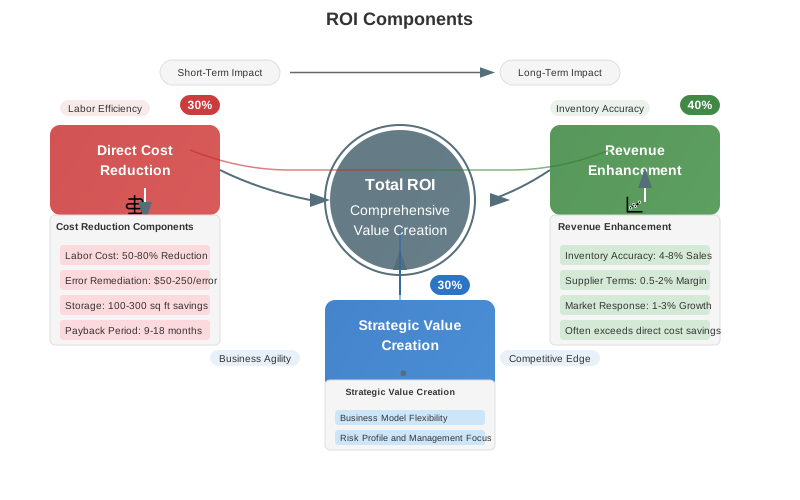
Labor cost reduction from automated processing typically ranges from 50-80% depending on document complexity and volume. For a mid-sized retail operation processing 50,000 documents annually, this can represent savings of 2-4 full-time equivalent positions.
Error remediation cost avoidance delivers significant savings by preventing downstream issues. Industry studies indicate that each data entry error costs between $50-$250 to correct when identified in subsequent processes; error rate reduction from typical manual levels (3-5%) to automated levels (0.5-1%) creates substantial cumulative savings.
Physical storage elimination for paper documents typically reduces occupancy costs by 100-300 square feet per 100,000 documents processed, creating both direct savings and space reallocation opportunities.
These direct financial benefits typically deliver payback periods of 9-18 months for medium-sized retail implementations, with larger operations achieving even faster returns due to scale economies.
Beyond cost reduction, revenue improvements emerge from several capability enhancements:
Inventory accuracy improvements reduce stockouts that typically cost retailers 4-8% of potential sales. Even modest improvements in in-stock positions directly enhance revenue capture.
Supplier relationship improvements enable more advantageous purchasing terms when backed by reliable performance data, typically enhancing gross margins by 0.5-2%.
Market responsiveness acceleration captures additional sales opportunities that would otherwise be missed due to information delays, with impact varying by retail segment but typically adding 1-3% to affected product categories.
These revenue enhancements often exceed direct cost savings in total financial impact, particularly for retailers operating in competitive or fast-moving market segments.
Beyond quantifiable financial returns, strategic value creation emerges from fundamental business capability enhancement:
Business model flexibility increases as document-based information flows more freely between organizations, enabling experimentation with novel approaches like consignment inventory, vendor-managed inventory, or dynamic pricing without prohibitive administrative overhead.
Risk profile improvement from enhanced compliance documentation and audit readiness reduces potential regulatory penalties and reputation damage from compliance failures.
Management focus reallocation from transaction processing to strategic initiatives delivers compounding returns as leadership attention shifts from routine operations to growth, innovation, and market differentiation.
While these strategic benefits resist precise quantification, they frequently represent the most significant long-term value derived from automated document processing implementations.
As illustrated in Figure 3, the comprehensive ROI framework encompasses immediate operational savings, near-term revenue enhancements, and long-term strategic value creation collectively establishing a compelling business case for retail investment in Artificio's document processing solution.
Implementing Artificio's document processing API represents more than a technical deployment it constitutes an organizational transformation journey that reshapes how retail businesses interact with their information assets. Understanding this journey helps retail leaders prepare for both the challenges and opportunities that arise during implementation.
The transformation journey begins with a comprehensive assessment of the current document ecosystem and processing workflows. This foundation-setting phase typically includes several key activities:
The first step involves cataloging the document types flowing through the retail operation, identifying their sources, volumes, and processing requirements. This mapping exercise reveals the full scope of the document landscape—often uncovering document categories that operate outside formal processes but contain valuable business information.
For most retail organizations, this mapping reveals surprising document diversity. A typical mid-sized retailer might discover 25-40 distinct document types with business significance, many of which receive inconsistent processing under manual systems. Document volumes often follow power-law distributions, with a small number of high-volume categories (invoices, goods received notes) accompanied by numerous low-volume but high-value document types (regulatory certifications, supplier agreements).
This discovery process also identifies document relationship networks the connections between related documents that collectively tell complete business stories. Understanding these relationships is crucial for designing a processing system that maintains narrative integrity rather than treating documents as isolated information sources.
Before implementing automated processing, organizations benefit from examining and optimizing their document workflows. This analysis identifies unnecessary steps, redundant validations, or approval bottlenecks that can be eliminated independently of automation.
Process analysis typically reveals significant opportunity for streamlining. In many retail operations, documents follow circuitous routes designed around physical paper movement rather than information flow. These legacy processes often include redundant steps that arose as workarounds for problems that automation will eliminate such as multiple verification checks designed to catch manual data entry errors.
The optimization effort focuses on designing ideal future-state processes that leverage automation capabilities rather than simply replicating existing workflows. This often involves shifting from sequential processes (where documents move through departments in series) to parallel processes (where multiple departments simultaneously access digital document representations).
With the document ecosystem mapped and processes analyzed, organizations can prioritize implementation targets based on value opportunity. This prioritization typically considers several dimensions:
Volume impact identifies document categories where high processing volumes create significant labor requirements under manual systems. For most retailers, supplier invoices typically represent the highest volume opportunity, often accounting for 30-50% of total document processing labor.
Error consequence evaluates the downstream business impact of processing errors in different document categories. While some errors create minor inconveniences, others can disrupt entire business functions. In retail environments, errors in regulatory compliance documentation often carry the highest consequence severity.
Strategic alignment considers how improved processing for specific document categories supports broader business initiatives. For retailers engaged in supply chain optimization, processing improvements for documents that enable vendor performance measurement (goods received notes, quality inspection reports) often carry outsized strategic importance.
This prioritization creates a phased implementation roadmap that delivers early wins while building toward comprehensive document ecosystem transformation.
With assessment and planning complete, the implementation phase focuses on deploying the technical solution and integrating it with existing systems. This phase typically includes several parallel workstreams:
The initial technical implementation involves configuring Artificio's API to recognize and process the organization's specific document formats. This configuration encompasses several activities:
Model training utilizes representative document samples to optimize extraction accuracy for organization-specific formats. While Artificio's pre-trained models provide strong baseline performance, customization for specific retail document variations enhances accuracy for unique formatting elements.
Validation rule configuration establishes automated quality checks that verify extracted data against business expectations. These rules might ensure that product codes follow established patterns, quantities fall within reasonable ranges, or dates conform to logical sequences.
Exception handling setup defines how the system manages documents that require human review due to low confidence scores, rule violations, or novel formats. This typically includes workflow rules that route exceptions to appropriate specialists based on document type and issue category.
The configuration process typically requires 4-8 weeks for initial implementation, with accuracy optimization continuing throughout the early operation phase as the system encounters the full diversity of document variations.
Parallel with document processing configuration, integration development connects Artificio's API with existing retail systems. This integration work typically focuses on several key connection points:
Data mapping establishes the relationships between extracted document fields and corresponding data elements in target systems. This mapping often reveals subtle differences in data representation across systems that must be harmonized during integration.
Workflow integration connects document processing events with appropriate business processes, ensuring that processed information triggers appropriate actions. For example, processed quality inspection reports might trigger inventory status updates in warehouse management systems.
Exception handling integration establishes how document processing exceptions flow into existing business workflows, ensuring appropriate human intervention when needed. This typically includes notification mechanisms, review interfaces, and correction pathways.
User interface enhancement adds document processing capabilities to existing business applications, enabling users to submit documents, review processing results, and manage exceptions within familiar interfaces rather than switching between systems.
For retailers with modern, API-capable systems, these integrations typically require 6-12 weeks of development effort. Legacy systems with limited integration capabilities may require additional adapter development to enable full connectivity.
Technical implementation must be accompanied by organizational change management to ensure successful adoption. This change management effort typically encompasses:
Process transition planning defines how operations will shift from manual to automated processing, including handling in-flight documents during cutover and managing backlog reduction during implementation.
Staff role evolution identifies how personnel currently engaged in document processing will transition to higher-value functions, including defining new responsibilities, developing required skills, and establishing performance expectations.
User training prepares personnel to interact effectively with the new system, focusing particularly on exception handling workflows that require human judgment. This training emphasizes the shift from routine processing to exception management as the primary human role.
Performance measurement establishes new metrics that reflect the changed operational model, replacing process-focused measures (documents processed per hour) with outcome-focused measures (processing accuracy, exception resolution speed).
Organizations that invest appropriately in change management typically achieve full adoption within 3-6 months, while those that neglect this dimension often experience prolonged hybrid operations that limit value realization.
Following initial implementation, the optimization and expansion phase focuses on refining performance and extending processing capabilities to additional document categories. This ongoing phase typically includes several continuing activities:
The initial operation period reveals opportunities to enhance processing accuracy and efficiency through several refinement approaches:
Model retraining incorporates processing results and exception corrections to continually improve extraction accuracy. This ongoing learning process typically yields accuracy improvements of 2-5 percentage points during the first year of operation.
Rule refinement adjusts validation parameters based on observed exception patterns, striking an appropriate balance between rigorous validation and excessive exception generation. This refinement reduces false positive exceptions that require unnecessary human review.
Workflow optimization streamlines exception handling processes based on operational experience, ensuring that human intervention focuses precisely on judgment-requiring issues rather than routine variations.
These optimization activities typically yield significant performance improvements during the first 3-6 months of operation, with incremental enhancements continuing thereafter.
With core document categories successfully automated, expansion efforts extend processing capabilities to additional document types. This expansion typically follows the prioritization framework established during the assessment phase, incorporating lessons from initial implementation to accelerate subsequent deployments.
Expansion phases often reveal unexpected synergies between document categories that were not apparent during initial assessment. For example, automated processing of supplier agreements often enhances invoice processing accuracy by providing structured reference data for validating pricing and terms.
Most retail organizations implement automated processing in 3-4 phases over 12-18 months, gradually expanding from core transactional documents to specialized categories with unique processing requirements.
As document processing capabilities mature, organizations discover opportunities for business innovation that leverage the newly available structured data:
New analytics initiatives utilize previously inaccessible document data to reveal insights about operational performance, supplier relationships, and compliance positioning.
Process reinvention moves beyond optimizing existing workflows to fundamentally rethinking business processes based on new information availability. For example, traditional three-way matching processes might evolve into continuous transaction verification models that eliminate batch reconciliation entirely.
Supplier collaboration programs leverage structured document data to create shared performance dashboards that align retailer and vendor activities toward common objectives.
These innovation opportunities often deliver greater long-term value than the initial efficiency improvements, transforming document processing from a cost center into a strategic capability enabler.
While current document processing capabilities deliver substantial business value, the technology landscape continues to evolve rapidly. Retail organizations implementing Artificio's solution position themselves to capitalize on several emerging developments that promise to further transform document-based business processes:
Emerging capabilities at the intersection of document processing and conversational AI will enable natural language interaction with document content. These capabilities will allow retail personnel to pose business questions directly to document collections rather than constructing formal queries:
"Which suppliers delivered late more than three times last quarter?" "Do we have current organic certifications for all our produce suppliers?" "Which store locations have the highest rate of inventory adjustments due to damage?"
This conversational interface will democratize access to document-derived insights, allowing business users without technical expertise to extract actionable information from the document ecosystem. For retail organizations, this capability will accelerate decision-making by reducing the friction between information needs and document-based answers.
Artificio's architecture establishes the foundational data structure necessary for these conversational capabilities, ensuring that retail organizations can readily adopt these interfaces as they mature.
Future developments will enable documents to function as semi-autonomous information agents that actively identify relationships, highlight discrepancies, and initiate appropriate business processes without explicit human direction.
In this emerging paradigm, a delivery challan might automatically:
These autonomous document networks will further reduce the need for human processing while accelerating information flow throughout the retail ecosystem. Organizations that establish structured digital document repositories through current implementation will possess the prerequisite foundation for these autonomous capabilities.
The ultimate evolution of document intelligence extends beyond organizational boundaries to create collaborative document ecosystems that span entire retail supply chains. In these ecosystems, documents exist as shared digital assets rather than organization-specific artifacts:
A supplier agreement becomes a jointly maintained digital asset that automatically enforces terms and conditions across organizational boundaries.
A quality certification propagates automatically through the supply chain, carrying its verification evidence and creating traceable provenance from source to retail shelf.
A shipping document functions as a living record that accumulates tracking data, condition monitoring, and transfer confirmations throughout its journey from supplier to retailer.
These cross-organizational document ecosystems will reduce friction in supply chain relationships while enhancing transparency, traceability, and efficiency. Retailers that establish internal document intelligence capabilities now will be well-positioned to participate in these broader ecosystems as they emerge.
The retail document ecosystem represents a vastly underutilized strategic asset in most organizations. Locked within thousands of invoices, delivery notes, inspection reports, and compliance certificates lies the detailed operational narrative that explains current business performance and indicates future opportunities. Artificio's API solution transforms these unstructured documents from administrative burdens into strategic intelligence assets that directly enable business insight and operational excellence.
The journey from manual document processing to automated intelligence requires thoughtful planning, technical expertise, and organizational adaptation. However, the transformation rewards extend far beyond mere efficiency gains. Retailers who successfully navigate this journey discover new capabilities that fundamentally change how they understand their operations, engage with suppliers, serve customers, and ensure compliance.
In an increasingly competitive retail landscape where operational excellence and data-driven decision-making determine market leadership, automated document processing represents not merely a technological advancement but a strategic necessity. The question for retail leaders is not whether to undertake this transformation, but how quickly they can implement it to capture the substantial advantages it offers.
By partnering with Artificio to implement API-driven document processing, retail organizations establish the foundation for a future where information flows seamlessly across physical and digital boundaries, where insights emerge automatically from operational documents, and where strategic decisions are informed by comprehensive, real-time understanding of the complete business narrative.
The document intelligence revolution has begun. Forward-thinking retailers are already transforming their approach to document processing, gaining advantages in operational efficiency, decision quality, and market responsiveness. Those who delay this transformation risk not merely operational inefficiency but strategic disadvantage in an industry where information agility increasingly determines competitive success.

Head IT Operations - Co Founder of Artificio
See it in your SAP environment
Bring us a document, a process, or a bottleneck. We'll show how Artificio captures, validates, and posts into SAP — then scale from there.
Security & compliance
ISO 27001:2013 certified, SOC 2 Type 2 compliant, GDPR and HIPAA ready. Every agent action is logged, auditable, and runs in isolated environments.