

Blog
What ChatGPT Won’t Say About Business Workflows Ahead
Discover how AI agents surpass traditional RPA limitations, offering adaptive, intelligent automation for modern business complexity.

Blog
Discover how AI agents surpass traditional RPA limitations, offering adaptive, intelligent automation for modern business complexity.
For decades, businesses have been chasing the dream of automation. From simple macros in Excel spreadsheets to sophisticated robotic process automation (RPA) platforms, companies have invested billions trying to eliminate manual work and streamline their operations. The promise was always the same: set it once, let it run forever, and watch your efficiency soar while costs plummet.
But here's what most executives discovered after implementing traditional automation solutions: they work beautifully until they don't. The moment something unexpected happens, when data comes in a slightly different format, or when business rules change, these systems break down faster than a house of cards in a windstorm. Suddenly, you're back to manual processes, frustrated IT teams, and wondering why you spent six months implementing something that can't handle the real world's messy complexity.
Now we're standing at the edge of a completely different kind of automation revolution. AI agents aren't just the next version of RPA with a shiny new interface. They represent a fundamental shift in how we think about business process automation, decision-making, and the relationship between humans and technology in the workplace. Where traditional automation follows rigid scripts, AI agents think, adapt, and learn. Where RPA fails when faced with unstructured data or unexpected scenarios, AI agents thrive in chaos and complexity.
This isn't another article hyping up the latest tech trend. This is about understanding why the automation tools that got us here won't get us where we need to go, and what business leaders need to know about making the transition from rule-based systems to intelligent, adaptive agents that can actually handle the unpredictable nature of modern business operations.
Traditional business process automation, particularly RPA and Business Process Management (BPM) systems, emerged from a simple but powerful insight: most business processes involve repetitive, rule-based tasks that humans shouldn't have to do manually. If you could map out exactly what steps a person takes to complete a task, you could theoretically teach a computer to do the same thing faster, more accurately, and without coffee breaks.
And for a while, this approach worked remarkably well. RPA solutions excelled at what they were designed for: highly structured, predictable processes with clear inputs and outputs. Think about invoice processing where every document comes in the same format, data entry where information always appears in the same fields, or report generation where the same calculations need to be performed on similar datasets. These systems could work 24/7 without getting tired, making fewer errors than humans, and handling volume spikes without breaking a sweat.
The beauty of traditional automation lay in its predictability and reliability. Once you programmed an RPA bot to handle a specific workflow, you could trust it to execute that exact sequence of actions thousands of times without deviation. IT departments loved these systems because they were deterministic. You knew exactly what they would do, when they would do it, and how they would respond to specific inputs. This predictability made them relatively easy to audit, troubleshoot, and maintain within existing enterprise architectures.
But the same characteristics that made traditional automation so reliable in controlled environments also created its biggest limitations. These systems are fundamentally brittle. They can only handle the exact scenarios they were programmed for, and they struggle dramatically when reality doesn't match their expectations. Change the format of an incoming email, add a new field to a form, or introduce an exception that wasn't anticipated during development, and suddenly your automated process becomes a very expensive way to generate error messages.
The problem runs deeper than just technical limitations. Traditional automation systems require extensive upfront analysis and mapping of existing processes. Teams spend months documenting every possible scenario, creating decision trees for different circumstances, and building elaborate exception-handling routines. By the time the system goes live, the business processes it was designed to automate have often already changed. The result is automation that's always playing catch-up with reality, requiring constant maintenance and updates just to keep functioning.
Perhaps most critically, traditional automation systems are terrible at handling unstructured data. While they can easily process a standardized invoice with clearly defined fields, they struggle with documents that vary in format, emails written in natural language, or images that contain important information. In today's business environment, where information comes from countless sources in countless formats, this limitation severely restricts what traditional automation can actually accomplish.
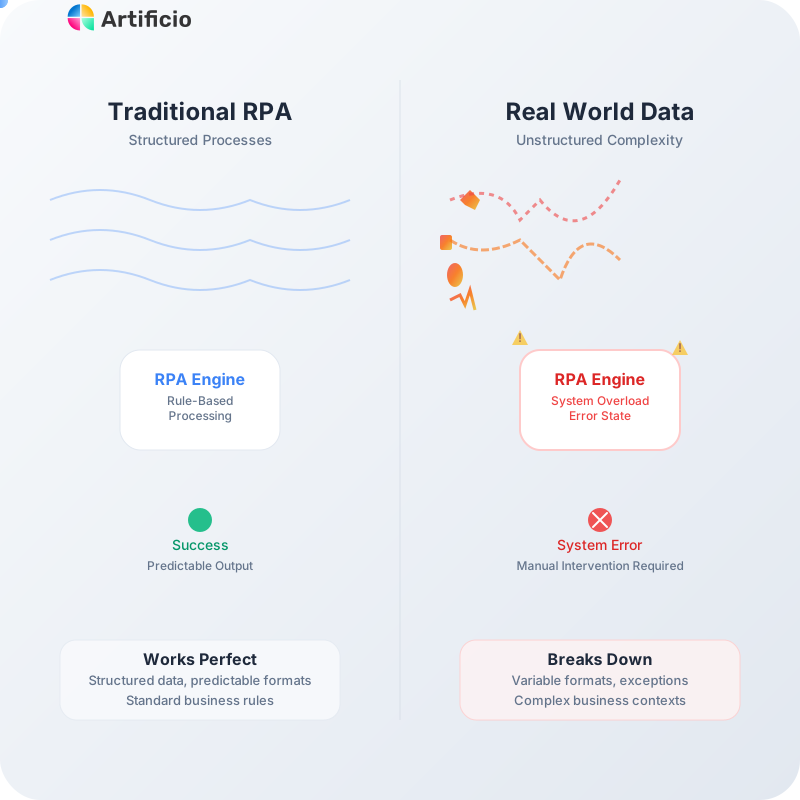
The maintenance burden of traditional automation has also proven to be much higher than initially expected. Every time a business process changes, every time a software vendor updates their interface, every time regulations require new compliance steps, someone needs to manually update the automation scripts. What started as a solution to reduce manual work often ends up creating a different kind of manual work: constantly maintaining and updating the automation itself.
These limitations don't make traditional automation worthless. There are still plenty of scenarios where rule-based, structured automation makes perfect sense. But they do explain why so many organizations have found themselves hitting a ceiling with their automation efforts. You can only optimize and streamline so much when your tools can't adapt to the messy, unpredictable nature of real business operations.
AI agents represent a completely different approach to automation, one that's built around adaptability and reasoning rather than rigid rule-following. Instead of requiring programmers to map out every possible scenario in advance, AI agents can analyze situations, make decisions, and adapt their behavior based on context and experience. They don't just execute predefined workflows; they understand the goals of those workflows and can figure out how to achieve them even when conditions change.
The fundamental difference lies in how these systems process information and make decisions. Traditional automation systems work like very sophisticated calculators. They can perform complex operations quickly and accurately, but only on the specific types of problems they were designed to solve. AI agents, on the other hand, work more like knowledgeable employees who understand not just what to do, but why they're doing it and how to adjust when circumstances change.
This cognitive flexibility allows AI agents to handle the kind of variability that breaks traditional automation systems. When an AI agent encounters a document in a format it hasn't seen before, it doesn't crash with an error message. Instead, it analyzes the document, identifies the relevant information, and figures out how to extract what it needs. When business rules change or exceptions arise, AI agents can often adapt their behavior without requiring reprogramming.
The technology stack behind AI agents is fundamentally different from traditional automation. While RPA systems rely on screen scraping, API calls, and predefined decision trees, AI agents leverage natural language processing, computer vision, machine learning models, and reasoning engines. They can read and understand text like a human would, analyze images and documents to extract meaning, and make decisions based on incomplete or ambiguous information.
Perhaps most importantly, AI agents can learn and improve over time. Traditional automation systems perform exactly the same way on day one as they do after running for years. AI agents, however, can identify patterns in their work, learn from corrections and feedback, and gradually become more effective at handling edge cases and unusual situations. This learning capability means that AI agent systems often become more valuable over time, rather than requiring constant maintenance to prevent degradation.
The conversational and interactive nature of AI agents also opens up entirely new possibilities for how humans and automation systems work together. Instead of requiring technical expertise to modify or update automated processes, business users can often communicate changes to AI agents using natural language. Need to adjust a workflow for a new regulatory requirement? You might be able to simply tell the AI agent about the change rather than hiring a developer to update code.
AI agents excel particularly in scenarios involving document understanding, decision-making with incomplete information, and processes that require contextual reasoning. They can read contracts and identify key terms without those contracts being in a standardized format. They can analyze customer communications and route requests appropriately even when the language is ambiguous or the request doesn't fit neatly into predefined categories. They can make judgment calls about exceptions and unusual situations based on understanding business context and objectives.
This doesn't mean AI agents are perfect or universally superior to traditional automation. They introduce new types of complexity, require different kinds of oversight and governance, and can sometimes make decisions that are difficult to explain or audit. But for many of the scenarios where traditional automation falls short, AI agents offer capabilities that simply weren't possible before.
The distinction between AI agents and traditional RPA goes far beyond just being "smarter" or "more advanced." These represent fundamentally different philosophies about how automation should work, what problems it should solve, and how it should integrate with human workflows.
The most significant difference lies in how these systems handle variability and exceptions. Traditional RPA systems are designed around the assumption that business processes can be standardized and that exceptions can be predicted and programmed for in advance. This works well in highly controlled environments where inputs are consistent and business rules are stable. But most real-world business processes are messier than this ideal suggests.
AI agents are built with the opposite assumption: that variability is the norm and that the most valuable automation systems are those that can handle unexpected situations gracefully. Instead of breaking down when they encounter something unfamiliar, AI agents try to reason through the situation using their understanding of context and objectives. This makes them much more robust in environments where standardization is difficult or impossible to achieve.
The difference in how these systems process information is equally important. Traditional RPA systems interact with other software applications the same way humans do, clicking buttons, filling in forms, and reading screens. This approach has the advantage of working with existing systems without requiring integration work, but it also means that RPA systems are fundamentally limited by the interfaces they interact with.
AI agents can work at a much deeper level, understanding the content and meaning of information rather than just its location on a screen. They can process documents, emails, and other unstructured data directly, extracting meaning and making decisions without needing that information to be presented in a specific format. This allows them to work with a much broader range of information sources and to adapt when those sources change format or structure.
The development and deployment processes for these two approaches are completely different as well. Traditional RPA implementations typically follow a waterfall model: extensive requirements gathering, detailed process mapping, development, testing, and deployment. Changes require going back through this cycle, often taking weeks or months to implement even simple modifications.
AI agent deployment can be much more iterative and adaptive. While initial setup still requires careful planning and configuration, ongoing refinements and improvements can often be made through training, feedback, and adjustment rather than reprogramming. This makes AI agent systems much more agile and responsive to changing business needs.
The skill sets required to manage and maintain these systems are also fundamentally different. Traditional RPA requires technical expertise in specific platforms and programming languages. Making changes typically requires developers or specialized RPA engineers. AI agents, while still requiring technical oversight, can often be managed and refined by business users who understand the processes and objectives but don't necessarily have deep technical skills.
Perhaps most importantly, the two approaches have completely different relationships with uncertainty and ambiguity. Traditional automation systems are designed to eliminate uncertainty by creating highly structured, predictable processes. When they encounter ambiguous situations, they either follow predetermined exception-handling rules or escalate to human operators.
AI agents are designed to work with uncertainty and ambiguity as natural parts of the business environment. They can make reasonable decisions based on incomplete information, learn from feedback when their decisions aren't optimal, and gradually improve their performance in ambiguous situations. This makes them much better suited to complex, knowledge-intensive processes where perfect standardization isn't possible or desirable.
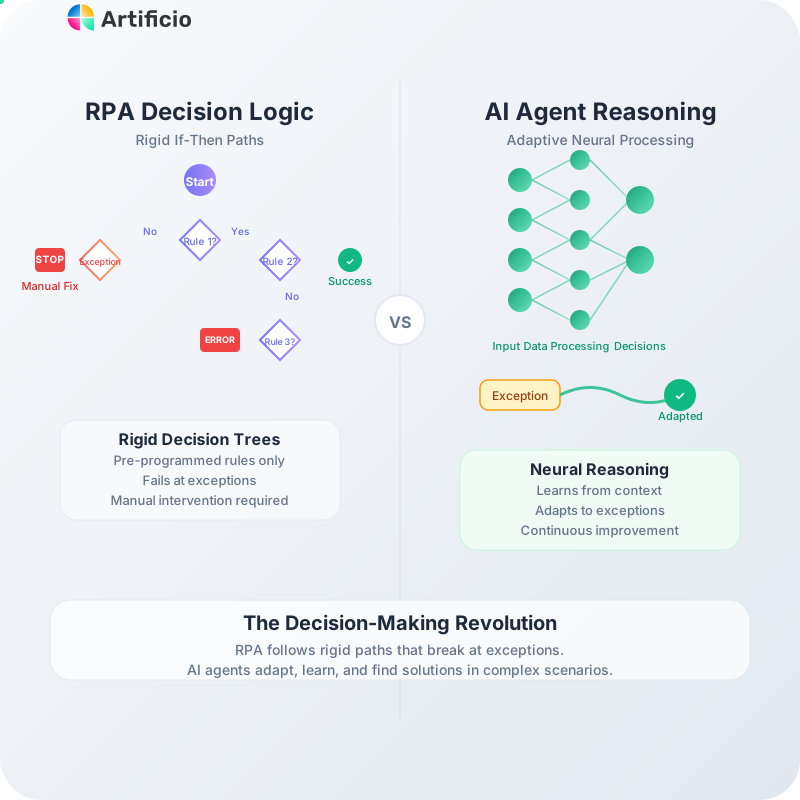
The economic models for these two approaches also differ significantly. Traditional RPA often requires substantial upfront investment in process analysis, system development, and integration, followed by ongoing costs for maintenance and updates. The return on investment comes primarily from replacing human labor with automated processes.
AI agents often have different cost structures and value propositions. While they may require significant initial investment in training and configuration, they can often be deployed more quickly and can provide value in scenarios where traditional automation isn't feasible. Their ability to handle complex, judgment-intensive tasks means they can automate processes that were previously considered too sophisticated for automation.
The governance and risk management requirements for these systems are also quite different. Traditional RPA systems, being deterministic and predictable, can be audited and controlled using established IT governance practices. AI agents, with their ability to learn and adapt, require new approaches to oversight, explainability, and risk management.
The true value of AI agents becomes apparent in specific business scenarios where traditional automation has consistently failed or been impractical to implement. These are typically processes that involve significant amounts of unstructured data, require contextual decision-making, or need to adapt to changing conditions without extensive reprogramming.
Loan origination represents one of the most compelling examples of where AI agents can transform operations. Traditional loan processing involves dozens of documents in various formats, complex eligibility criteria that depend on multiple factors, and numerous exceptions that require human judgment. RPA systems have struggled with this process because loan applications rarely come in standardized formats, supporting documents vary widely, and credit decisions often require understanding subtle contextual factors.
AI agents can read and understand loan applications regardless of format, extract relevant information from supporting documents like tax returns and bank statements, and apply complex lending criteria that consider multiple variables simultaneously. They can identify inconsistencies between different documents, flag potential fraud indicators, and even communicate with applicants to gather additional information when needed. Most importantly, they can handle the exceptions and edge cases that represent a significant portion of real loan applications.
The impact goes beyond just processing speed. AI agents can provide consistent decision-making across all applications, reducing bias and ensuring that lending criteria are applied fairly. They can also provide detailed explanations for their decisions, helping with regulatory compliance and giving loan officers the information they need to communicate with applicants about approval or denial reasons.
ERP and SAP integrations represent another area where AI agents excel. Large enterprises often have dozens of different systems that need to share data, but each system has its own data formats, business rules, and integration requirements. Traditional integration approaches require extensive custom development and break whenever any of the connected systems change.
AI agents can understand the business meaning of data across different systems and translate between different formats and structures automatically. When a new system is added to the environment or an existing system changes its data format, AI agents can often adapt without requiring new integration code. They can also handle data quality issues, resolve conflicts between systems, and ensure that business rules are consistently applied across the entire technology ecosystem.
Customer support and communication workflows showcase another strength of AI agents. While chatbots and automated response systems have been around for years, they've typically been limited to simple, scripted interactions. Customers quickly learn to ask for human agents when they have complex issues or questions that don't fit standard categories.
AI agents can engage in much more sophisticated customer interactions, understanding context and nuance in ways that traditional automation cannot. They can read customer history, understand the emotional tone of communications, and provide responses that address not just the literal question being asked but the underlying need or concern. They can also seamlessly escalate to human agents when appropriate, providing those agents with comprehensive context and suggested approaches for resolving the issue.
In insurance claims processing, AI agents can analyze photos of damage, read police reports and medical records, and apply complex coverage rules to determine claim validity and payment amounts. They can handle the vast majority of routine claims automatically while identifying the cases that require human expertise. This dramatically speeds up the claims process while ensuring that complex or unusual situations receive appropriate attention.
Supply chain management represents another transformative application. AI agents can monitor supplier performance, identify potential disruptions before they impact operations, and automatically adjust procurement strategies based on changing market conditions. They can read contracts and understand supplier terms, negotiate routine purchases within predefined parameters, and coordinate with multiple suppliers to optimize inventory levels and delivery schedules.
These use cases share common characteristics that make them ideal for AI agent automation. They involve large amounts of unstructured data, require contextual understanding and judgment, benefit from consistent application of complex rules, and need to adapt to changing conditions without extensive reprogramming. They also represent processes where the cost of manual handling is high, but traditional automation has been impractical due to complexity and variability.
The transformation these AI agents bring isn't just about efficiency or cost reduction. They enable entirely new approaches to business processes, allowing organizations to provide faster, more consistent, and more personalized experiences while reducing the burden on human workers to handle routine but complex tasks. This frees human employees to focus on higher-value activities that require creativity, relationship building, and strategic thinking.
While generative AI tools like ChatGPT have captured public imagination and demonstrated impressive capabilities, there are important differences between general-purpose AI models and purpose-built AI agents designed for specific business workflows. The hype around large language models has led many organizations to assume that deploying AI automation is simply a matter of connecting ChatGPT or similar tools to their existing systems.
The reality is more complex and nuanced. General-purpose AI models are trained on broad datasets to handle a wide variety of tasks reasonably well. They excel at generating human-like text, answering questions, and providing assistance with various knowledge-intensive tasks. But they're not optimized for the specific requirements of business process automation, where reliability, auditability, and consistent performance are often more important than conversational ability or creative output.
Purpose-built AI agents designed for business workflows incorporate specialized training on industry-specific data, business rules, and process requirements that general models lack. A loan processing AI agent, for example, would be trained on thousands of loan applications, lending regulations, risk assessment criteria, and industry best practices in ways that a general language model never would be. This specialized training allows them to understand nuances and context that would be missed by general-purpose models.
The reliability requirements for business automation are also fundamentally different from those for general AI assistance. When ChatGPT makes an error in a casual conversation or provides information that's not quite accurate, the consequences are usually minimal. When an AI agent processing insurance claims or loan applications makes similar errors, the financial and regulatory consequences can be severe. Purpose-built agents incorporate additional layers of validation, testing, and error correction that general models typically lack.
Integration capabilities represent another crucial difference. General-purpose AI models are designed primarily for text-based interactions with humans. Business AI agents need to integrate seamlessly with existing enterprise systems, databases, and workflows. They need to understand data formats, respect security protocols, maintain audit trails, and work within existing governance frameworks. These capabilities require specialized development and aren't typically present in general-purpose models.
The governance and explainability requirements for business automation also exceed what general AI models provide. Organizations need to understand not just what decisions their AI agents are making, but why they're making them and how those decisions align with business rules and regulatory requirements. General-purpose models often function as "black boxes" where the reasoning process isn't transparent or auditable. Business AI agents typically incorporate explainability features that allow organizations to understand and document decision-making processes.
There's also the question of data privacy and security. General-purpose AI models often process queries through cloud services where organizations have limited control over how their data is handled or stored. Business AI agents can be deployed in controlled environments where sensitive information never leaves the organization's systems. This is crucial for processes involving personal financial information, healthcare data, or other regulated content.
The cost structures are different as well. Using general-purpose AI models for high-volume business processes can quickly become expensive due to per-query pricing models. Purpose-built agents can be designed to optimize costs for specific use cases, potentially processing thousands of transactions for the same cost as a few dozen general AI queries.
Perhaps most importantly, general-purpose AI models lack the deep process understanding that effective business automation requires. They might be able to answer questions about loan eligibility criteria, but they can't effectively manage an end-to-end loan origination process that involves coordinating multiple systems, managing timelines, handling exceptions, and ensuring regulatory compliance. This process-level intelligence requires specialized design and training that goes beyond what general models provide.
The limitations of general-purpose models become particularly apparent when dealing with complex, multi-step business processes that span multiple systems and require coordination over time. While ChatGPT can provide excellent assistance with individual tasks within such processes, it lacks the persistent state management, system integration capabilities, and process orchestration features that business automation requires.
This doesn't mean that general-purpose AI models have no place in business automation. They can be valuable components within larger AI agent systems, providing natural language capabilities, content generation, or general reasoning abilities. But treating them as complete solutions for business process automation often leads to disappointment and failed implementations.
Organizations that understand these distinctions are better positioned to make strategic decisions about AI automation investments. Instead of trying to force general-purpose tools into business-specific roles, they can architect solutions that leverage the strengths of different AI technologies appropriately. This might involve using general models for human-facing interactions while relying on specialized agents for process automation, or integrating multiple AI capabilities into comprehensive workflows that deliver better results than any single technology could provide alone.
The future of business automation isn't about replacing human workers with AI agents, but about creating collaborative partnerships where each party contributes their unique strengths to achieve better outcomes than either could accomplish alone. This represents a fundamental shift from the traditional automation mindset, which focused primarily on eliminating human involvement in routine processes.
In this emerging model, AI agents handle the routine, data-intensive, and rule-based aspects of business processes, while humans focus on relationship building, creative problem-solving, strategic decision-making, and handling complex exceptions that require empathy, intuition, or specialized expertise. The result is workflows that are both more efficient and more human-centered than what either pure automation or purely manual processes could achieve.
The collaboration between humans and AI agents is becoming increasingly sophisticated and nuanced. Rather than simple handoffs where AI agents complete certain tasks and then escalate everything else to humans, we're seeing more dynamic partnerships where the two work together throughout complex processes. An AI agent might handle initial customer inquiries, gather relevant information, and propose solutions, while a human agent reviews the recommendations, adds personal insight, and manages the relationship aspects of the interaction.
This collaborative approach is particularly powerful in knowledge-intensive workflows where success depends on combining analytical capabilities with human judgment. In legal document review, for example, AI agents can quickly identify relevant passages, flag potential issues, and categorize content, while lawyers focus on interpreting significance, developing strategies, and making nuanced judgments about legal implications. The AI handles the time-consuming analytical work, allowing lawyers to spend more time on the high-value strategic thinking that clients actually pay for.
The invisibility of effective AI agent automation is becoming a key characteristic of mature implementations. Instead of requiring users to learn new systems or change their workflows dramatically, the best AI agent solutions work behind the scenes, augmenting existing processes in ways that feel natural and seamless. Users might not even be aware that AI agents are handling certain aspects of their work, they just notice that information appears more quickly, decisions are more consistent, and fewer routine tasks require their direct attention.
This invisible automation extends to system integrations and data management. AI agents can work continuously to keep different systems synchronized, resolve data conflicts, and ensure that information is available where and when it's needed without requiring human intervention. Users experience this as systems that "just work" rather than as additional automation tools they need to manage.
The adaptive nature of AI agents is enabling workflows that can evolve and improve over time without requiring extensive redesign. As business conditions change, new regulations are introduced, or organizational priorities shift, AI agents can adapt their behavior automatically or with minimal reconfiguration. This makes business processes much more resilient and responsive to change than traditional automation allowed.
Personalization is becoming another key advantage of AI agent-enhanced workflows. Because AI agents can understand context, preferences, and individual work patterns, they can customize their interactions and recommendations for different users. A sales AI agent might present information differently to senior executives than to junior salespeople, or adjust its recommendations based on each user's success patterns and preferences.
The learning capabilities of AI agents are creating feedback loops that continuously improve process effectiveness. As AI agents handle more cases and receive feedback on their performance, they become better at identifying patterns, predicting outcomes, and making recommendations. This means that workflows become more effective over time, rather than gradually degrading as business conditions change.
The human oversight and governance of AI agent workflows is also evolving. Instead of requiring constant monitoring and intervention, mature AI agent systems provide summary reports, exception notifications, and performance metrics that allow humans to maintain appropriate oversight without micromanaging every decision. Humans can set parameters, review outcomes, and make strategic adjustments while trusting AI agents to handle routine execution.
The economic implications of this collaborative model are significant. Organizations can achieve much higher levels of process automation without the massive upfront investments and ongoing maintenance requirements of traditional approaches. They can also adapt more quickly to changing market conditions and customer expectations because their workflows are inherently more flexible and responsive.
Perhaps most importantly, this collaborative approach addresses many of the concerns about AI replacing human workers. Instead of eliminating jobs, effective AI agent implementations often make existing roles more interesting and valuable by removing routine drudgework and enabling humans to focus on activities that require uniquely human capabilities. The result is often higher job satisfaction, better career development opportunities, and more strategic business impact from human employees.
The transition from traditional automation to AI-native business operations represents one of the most significant technological shifts in modern business. Organizations that understand and navigate this transition effectively will gain substantial competitive advantages, while those that cling to outdated automation approaches risk falling behind in rapidly evolving markets.
The key insight driving this transformation is that the complexity and unpredictability of modern business environments require automation systems that can think, adapt, and learn rather than simply execute predefined scripts. Traditional RPA and BPM systems, while valuable in specific contexts, are fundamentally limited by their inability to handle the variability and exceptions that characterize real-world business processes.
AI agents represent a completely different approach to business automation, one that embraces complexity rather than trying to eliminate it. By building systems that can understand context, make reasoned decisions, and adapt to changing conditions, organizations can automate processes that were previously too complex or variable for traditional approaches. This opens up entirely new possibilities for efficiency, consistency, and scalability in business operations.
The transformation isn't just about technology, it's about reimagining how work gets done and how humans and intelligent systems can collaborate effectively. The most successful implementations don't try to replace human workers with AI agents, but rather create partnerships where each contributes their unique strengths. This collaborative approach delivers better outcomes while creating more meaningful and strategic roles for human employees.
The competitive implications are substantial. Organizations that successfully deploy AI agent automation can respond more quickly to market changes, provide more consistent customer experiences, and scale their operations without proportional increases in staff. They can enter new markets faster, adapt to regulatory changes more efficiently, and offer personalized services at scale that would be impossible with traditional approaches.
At Artificio, we understand that the transition to AI-native business operations requires more than just implementing new technology. It requires rethinking processes, retraining teams, and reimagining what's possible when intelligent systems become true partners in business operations. Our approach focuses on building bridges between existing business processes and AI-native capabilities, ensuring that organizations can capture the benefits of AI agents while maintaining the reliability and governance that business-critical processes require.
The future of business workflows is already emerging in forward-thinking organizations around the world. Companies are discovering that AI agents can handle complex processes they never thought could be automated, provide insights they never knew they needed, and create efficiencies they never imagined possible. The question isn't whether this transformation will happen, but how quickly organizations can adapt to take advantage of these new capabilities.
The organizations that thrive in this new environment will be those that move beyond thinking about automation as simply a way to replace human labor, and instead embrace it as a way to amplify human capability and create entirely new possibilities for business value. They'll build systems that learn and adapt, processes that improve over time, and workflows that seamlessly blend human creativity with artificial intelligence.
If you're ready to explore what AI-native business operations could mean for your organization, Artificio is here to help you build that bridge. Our team combines deep expertise in traditional business processes with cutting-edge capabilities in AI agent development, ensuring that your transformation delivers real business value while managing the risks and challenges that come with any significant technological change.
The future of business workflows isn't about choosing between humans and AI agents. It's about creating partnerships that leverage the best of both to achieve results that neither could accomplish alone. That future is closer than you think, and it starts with understanding the real differences between yesterday's automation and tomorrow's intelligent business systems.

Head IT Operations - Co Founder of Artificio
See it in your SAP environment
Bring us a document, a process, or a bottleneck. We'll show how Artificio captures, validates, and posts into SAP — then scale from there.
Security & compliance
ISO 27001:2013 certified, SOC 2 Type 2 compliant, GDPR and HIPAA ready. Every agent action is logged, auditable, and runs in isolated environments.