

Blog
AI Form Automation: End-to-End Workflow Intelligence
Discover how AI form automation transforms static data capture into intelligent workflows, boosting efficiency & cutting costs.

Blog
Discover how AI form automation transforms static data capture into intelligent workflows, boosting efficiency & cutting costs.
For decades, forms have served as nothing more than digital data entry points. Static fields waiting to be filled, submitted, and then manually processed by someone down the line. But this approach creates a fundamental bottleneck that costs enterprises millions of dollars annually in lost productivity, errors, and delays.
Think about the last time you filled out an important business form. Maybe it was a loan application, vendor registration, or customer onboarding document. You probably spent time entering information that already exists in other systems, waited days or weeks for approval, and received follow-up requests for additional documentation that could have been anticipated from the start. This is the reality of traditional form processing, where data capture is just the beginning of a long, manual workflow.
The problem isn't just inefficiency. When forms exist in isolation from the systems and processes they're meant to feed, organizations lose the opportunity to create truly intelligent, responsive workflows. Manual reviews become the norm, errors slip through validation, and what should be seamless automation turns into a series of human-dependent checkpoints.
This is where AI form automation represents a fundamental shift in how we think about data collection and workflow initiation. Instead of treating forms as passive collection points, AI-powered forms become the intelligent front door to your entire business ecosystem. They don't just capture information – they understand context, validate data in real time, trigger automated processes, and connect seamlessly with downstream systems to create what we call intelligent forms.
The transformation from static data capture to smart automation isn't just about making forms better. It's about reimagining how businesses can eliminate friction, reduce errors, and accelerate decision-making right from the first point of customer or vendor interaction. When done correctly, AI form automation becomes the foundation for enterprise workflow automation that can dramatically reshape operational efficiency.
AI form automation goes far beyond digitizing paper forms or creating basic online interfaces. These are intelligent systems that apply artificial intelligence to understand, validate, and act on the information being submitted. Unlike traditional digital forms that simply collect and store data, AI-powered forms actively participate in business processes by making real-time decisions about data quality, triggering appropriate workflows, and connecting with enterprise systems without human intervention.
At its core, AI form automation combines several advanced technologies. Natural Language Processing (NLP) helps forms understand unstructured text inputs and extract meaningful entities from free-form responses. Machine learning algorithms provide predictive suggestions and autofill capabilities based on context and historical data. Real-time validation engines cross-reference submitted information against multiple databases, CRM systems, and external data sources to ensure accuracy and completeness.
The difference becomes clear when you consider what happens after someone clicks "submit." Traditional digital forms send data to a database or email inbox where humans must review, validate, and manually enter information into various systems. This creates delays, introduces errors, and requires significant manual effort to complete what should be automated processes.
AI-powered forms, on the other hand, immediately begin working on the submitted data. They validate customer IDs against existing records, check for completeness based on business rules, and can even request additional documentation when gaps are detected. If a customer submits a loan application, an intelligent form might instantly verify employment information, run preliminary credit checks, and route the application to the appropriate decision engine – all while the customer is still on the page.
These adaptive digital forms learn from each interaction. They understand which fields typically require follow-up, which combinations of data indicate higher risk or priority, and how to guide users toward successful submissions. This intelligence transforms forms from simple data collection tools into sophisticated business agents that can handle complex scenarios without constant human oversight.
The real power emerges when AI forms integrate with existing enterprise systems. Instead of creating another data silo, they become part of a connected ecosystem where information flows seamlessly between CRM platforms, ERP systems, compliance databases, and decision engines. This integration capability is what enables true smart forms for business applications that can handle enterprise-scale complexity.
Despite the widespread adoption of digital forms, most organizations still struggle with fundamental limitations that prevent them from achieving true automation. These limitations create costly bottlenecks that multiply across large enterprises, affecting everything from customer onboarding to vendor management.
Manual verification represents the most significant bottleneck in traditional form processing. Every submission, regardless of how straightforward it appears, must be reviewed by a human to check for accuracy, completeness, and compliance with business rules. This manual review process often takes days or weeks, especially when forms require approval from multiple departments or when supporting documentation needs to be collected separately.
The lack of real-time validation means errors often aren't caught until much later in the process. A customer might submit an application with an incorrect account number, misspelled company name, or invalid reference information. Instead of catching these issues immediately and allowing for correction, traditional forms accept whatever is submitted and pass the problem downstream. By the time someone identifies the error, the customer has moved on, making correction more difficult and time-consuming.
Traditional forms also lack the intelligence to understand context or make decisions about what information is actually needed. They can't adapt based on the type of customer, the complexity of the request, or the specific requirements of different business scenarios. This creates a one-size-fits-all approach that either overwhelms users with unnecessary fields or fails to collect critical information needed for processing.
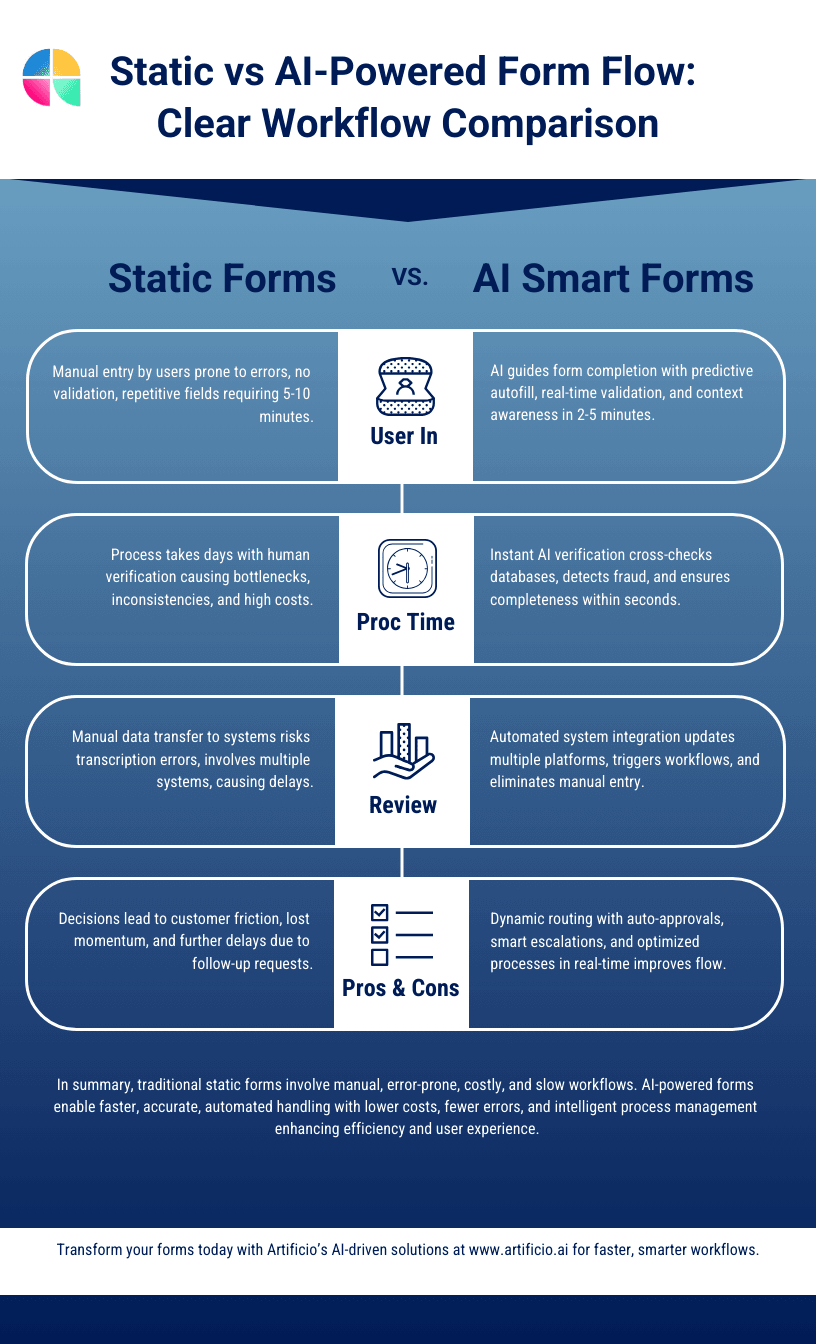
The isolation of traditional forms from enterprise systems creates another layer of inefficiency. Form data typically gets exported to spreadsheets, sent via email, or entered manually into various systems. This disconnected approach not only wastes time but also increases the risk of transcription errors and data inconsistencies across platforms.
Perhaps most frustratingly, traditional forms provide no visibility into processing status or next steps. Users submit information and then wait in a black box, not knowing whether their submission was received, what additional information might be needed, or when they can expect a response. This lack of transparency creates additional communication overhead as users follow up on submissions that might be stuck in manual review queues.
These limitations compound in enterprise environments where form submissions can number in the thousands daily. What might seem like minor inefficiencies in individual cases become major operational challenges that affect customer satisfaction, employee productivity, and bottom-line results.
The most immediate benefit of AI form automation comes from its ability to validate information as users enter it, rather than waiting for post-submission review. This real-time validation capability draws on multiple data sources to ensure accuracy and completeness before the form is even submitted.
When a customer enters their company registration number, for example, an AI-powered form can instantly cross-reference this information against government databases to verify the company exists, pull in additional details like official company name and address, and even flag any compliance issues associated with that entity. This level of AI-powered data validation eliminates the back-and-forth communication that typically occurs when manual reviewers discover discrepancies weeks later.
The sophistication of real-time validation extends beyond simple database lookups. Advanced AI forms can detect patterns that indicate potential fraud, identify when information seems inconsistent across different fields, and even use predictive algorithms to suggest corrections for common data entry errors. If someone enters a phone number with too many digits, the form can suggest the correct format. If a postal code doesn't match the entered city, it can flag this discrepancy immediately.
For enterprise applications, this real-time validation often connects with internal systems like CRM platforms and ERP databases. A vendor onboarding form might check whether the submitting company is already in the system, verify contact information against existing records, and automatically populate known details to reduce data entry burden. This integration prevents duplicate records and ensures data consistency across all business systems.
One of the most powerful features of AI form automation is its ability to intelligently request supporting documentation based on the information provided. Rather than asking for every possible document upfront or discovering missing materials during manual review, AI forms can dynamically determine what additional evidence or verification is needed.
This smart document triggering works by analyzing the submitted information against business rules and compliance requirements. A loan application form might determine that additional income verification is needed based on the employment type selected, or that specific licenses must be provided based on the industry category chosen. The form can immediately request these documents while the user is still engaged, rather than sending follow-up emails days later.
The AI component learns which combinations of information typically require specific documentation, becoming more accurate over time at predicting what will be needed. This predictive capability reduces the number of incomplete submissions and speeds up overall processing time by ensuring all necessary materials are collected in the initial interaction.
Context-aware completion capabilities represent another significant advance in form filling automation. AI-powered forms can analyze partial inputs and provide intelligent suggestions that speed up completion while reducing errors. This goes beyond simple browser autofill to include business-context suggestions based on the specific form being completed and the user's apparent role or industry.
For returning customers or users, these forms can prepopulate information from previous interactions while still allowing for updates or corrections. A customer updating their business information might see their previous address filled in automatically, but with the ability to modify details that have changed. This balance between convenience and accuracy makes forms more user-friendly while maintaining data integrity.
The predictive capabilities extend to understanding what information is likely needed based on context. If someone indicates they're applying for a specific type of business license, the form can automatically request the standard supporting documentation for that license type, even if those requirements aren't explicitly programmed for every possible scenario.
This level of intelligence transforms form completion from a tedious, error-prone process into a guided experience that helps users provide exactly what's needed for successful processing. The result is higher completion rates, fewer errors, and faster processing times for both users and the organizations managing these workflows.
The most significant paradigm shift in AI form automation comes from recognizing that forms aren't endpoints for data collection, but rather starting points for comprehensive business processes. This perspective transforms every form submission into a workflow trigger that can initiate complex, multi-step procedures across various enterprise systems.
Traditional forms end with submission. AI forms begin with it. When properly implemented, these intelligent intake points become the launchpad for zero-touch workflows that can handle entire business processes with minimal human intervention. The submitted information doesn't just get stored somewhere – it actively drives business decisions and actions.
Consider a comprehensive loan origination scenario. When a potential borrower submits their application through an AI-powered form, the system can immediately initiate a series of automated processes. It might start with instant credit checks through multiple bureaus, verify employment information against third-party databases, assess property values using automated valuation models, and even begin preliminary underwriting analysis using machine learning algorithms trained on historical loan performance data.
This loan origination form automation doesn't require human intervention at each step. Instead, the AI system manages the entire workflow, making decisions about which additional verifications are needed, when to request supplementary documentation, and how to route applications based on risk profiles and approval criteria. The human element enters the process only when exceptions are detected or final approval decisions need to be made.
Vendor onboarding represents another powerful example of AI forms serving as workflow triggers. A new supplier filling out a registration form initiates a comprehensive process that includes compliance screening against various watchlists, financial stability assessment, insurance verification, and integration with procurement systems. The form submission automatically creates vendor records in the ERP system, sets up payment terms based on risk assessment, and notifies relevant departments about the new supplier relationship.
The sophistication of these workflow triggers extends to understanding context and adapting processes accordingly. A high-value vendor might trigger additional due diligence procedures, while a small supplier for standard services follows a streamlined approval path. The AI system makes these routing decisions based on the information provided and learned patterns from previous interactions.
This approach to enterprise workflow automation eliminates the traditional handoffs between departments that often create delays and communication gaps. Instead of form data being manually forwarded from intake to processing to approval departments, the AI system orchestrates the entire workflow, ensuring information flows seamlessly between systems and stakeholders get notified at appropriate points in the process.
The result is dramatically reduced processing times, fewer errors from manual handoffs, and improved visibility into workflow status for both internal teams and external participants. Organizations report processing time reductions of 60-80% for complex workflows when AI forms effectively serve as intelligent workflow triggers.
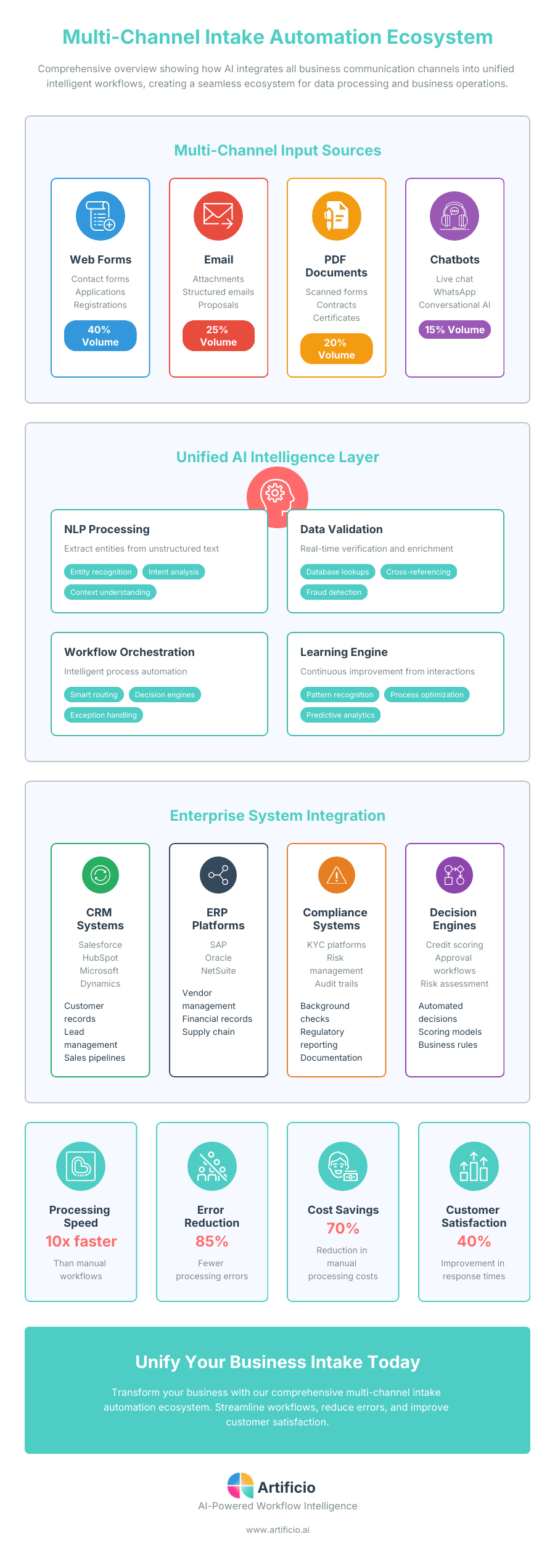
Modern businesses interact with customers, vendors, and partners across multiple channels, and AI form automation becomes even more powerful when it's part of a unified multi-channel intake automation strategy. The same artificial intelligence that powers smart forms can be applied to emails, PDF documents, chatbot conversations, and other communication channels to create a comprehensive intake layer that captures and processes information regardless of how it arrives.
This unified approach addresses a common enterprise challenge where different departments handle similar information through different channels, creating inconsistencies and inefficiencies. Sales might receive vendor proposals via email, procurement might get supplier information through forms, and customer service might collect the same business details through chat interactions. Without integration, this leads to duplicate data entry, inconsistent validation standards, and missed opportunities for automation.
AI-powered multi-channel intake systems solve this problem by applying the same intelligence across all interaction points. Whether a vendor submits information through a formal onboarding form or sends details via email, the AI system can extract the same data fields, apply the same validation rules, and trigger the same automated workflows. This consistency ensures that all business relationships start with the same high-quality data and follow the same efficient processes.
Document and form processing capabilities extend this intelligence to handle PDF attachments, scanned documents, and other file formats that often accompany form submissions. The AI system can extract structured information from unstructured documents, cross-reference details against form inputs, and automatically file supporting materials in appropriate systems. This eliminates the manual document processing that often becomes a bottleneck in complex workflows.
Email processing represents a particularly powerful application of this multi-channel approach. Business emails often contain structured information that could be automatically extracted and processed, but traditionally require human intervention to identify and act upon. AI systems can analyze email content to identify potential form submissions, extract relevant data fields, and either auto-populate forms for sender review or directly initiate appropriate workflows when confidence levels are sufficient.
Chatbot integration creates opportunities for guided data collection that feels more natural than traditional form completion. Users can provide information conversationally, with the AI system asking follow-up questions to ensure completeness and accuracy. This approach can be particularly effective for complex processes where users might need guidance on what information is required or how to find specific details.
The power of unified multi-channel intake becomes apparent in customer onboarding scenarios. A potential customer might start the process by filling out a contact form on the company website, continue the conversation through a chatbot, submit supporting documentation via email, and complete final verification through a formal application form. Instead of treating these as separate interactions requiring manual coordination, the AI system maintains context across all channels and builds a complete customer profile that drives appropriate automated workflows.
This comprehensive approach to digital onboarding automation ensures consistent data quality and processing efficiency regardless of how customers choose to interact with the organization. It also provides better visibility into the complete customer journey, helping organizations identify optimization opportunities and improve overall experience quality.
The business case for AI form automation has never been stronger, driven by increasing pressure to improve operational efficiency while delivering better customer experiences. Organizations that delay implementation risk falling behind competitors who are already realizing significant benefits from intelligent workflow automation.
The most immediate impact comes from dramatic reductions in manual processing costs. Large enterprises often employ dozens of staff members whose primary responsibility is reviewing, validating, and entering form data into various systems. These manual processes typically cost between $15-25 per form submission when all labor costs are considered, including initial review, error correction, follow-up communications, and system entry time.
AI form automation can reduce these costs by 70-90% while improving accuracy and processing speed. Automated data capture and validation eliminate most manual review requirements, while intelligent workflow triggers ensure information flows seamlessly into appropriate systems without human intervention. Organizations report typical payback periods of 6-12 months on AI form automation investments, with ongoing cost savings that compound over time.
Data quality improvements represent another significant benefit that extends beyond immediate cost savings. Manual data entry introduces errors that can persist in business systems for years, affecting everything from customer communications to financial reporting. AI-powered data validation catches errors at the point of entry, when correction is easiest and least expensive.
The compliance benefits of automated validation are particularly valuable in regulated industries. Financial services firms can ensure loan applications include all required information and supporting documentation before processing begins. Healthcare organizations can verify that patient intake forms include necessary insurance information and meet regulatory requirements. Government agencies can validate that permit applications include all required supporting materials and fee payments.
These compliance automation capabilities reduce regulatory risk while accelerating approval processes. Instead of discovering missing requirements during manual review, AI forms ensure completeness upfront and can even guide applicants through complex regulatory requirements in real-time.
Speed improvements in processing times create competitive advantages that extend beyond cost savings. Faster loan approvals help financial institutions win business from competitors. Quicker vendor onboarding enables procurement teams to work with preferred suppliers sooner. Accelerated customer onboarding improves satisfaction and reduces abandonment rates.
The cumulative effect of these improvements creates what we call smart data pipelines that enable faster, more accurate business decisions. When high-quality, validated information flows seamlessly from intake through processing systems, organizations can respond more quickly to opportunities and challenges.
Perhaps most importantly, AI form automation frees human workers to focus on higher-value activities that require judgment, creativity, and relationship management. Instead of spending time on data entry and validation tasks, employees can focus on customer consultation, complex problem-solving, and strategic initiatives that drive business growth.
Organizations that implement comprehensive AI form automation report improvements in employee satisfaction as mundane tasks are eliminated and work becomes more engaging. This benefit becomes increasingly important in competitive talent markets where attracting and retaining skilled workers depends partly on providing meaningful, challenging work experiences.
While many vendors offer basic form automation capabilities, Artificio's approach distinguishes itself through sophisticated orchestration using AI agents for forms that can handle complex business scenarios requiring multiple system interactions and decision points.
Traditional form automation solutions typically work within the constraints of predefined workflows and simple rule-based logic. They can validate individual fields and trigger basic actions, but struggle with scenarios that require contextual understanding, multi-step decision making, or dynamic adaptation based on changing conditions.
Artificio's AI agents approach treats each form submission as a complete business scenario that might require various types of intelligence and system interactions to resolve properly. These agents can analyze submitted information, determine what additional data or verification is needed, coordinate with multiple enterprise systems to gather relevant context, and make intelligent decisions about appropriate next steps.
The orchestration capability becomes particularly powerful in complex scenarios like comprehensive vendor evaluation or multi-product customer onboarding. An AI agent handling vendor registration might need to verify business credentials through government databases, assess financial stability using third-party credit services, check references with other customers, evaluate insurance coverage adequacy, and coordinate with legal teams for contract review – all based on information provided in the initial form submission.
This level of autonomous data intake goes beyond simple workflow automation to provide genuine business intelligence that can handle exceptions, adapt to changing requirements, and learn from outcomes to improve future performance. The AI agents understand business context well enough to make judgment calls about priorities, risk levels, and appropriate escalation paths.
Artificio's pre-trained Named Entity Recognition (NER) models provide another significant advantage for enterprise deployment. These models have been trained on industry-specific datasets to recognize and extract relevant business entities from various types of inputs. Whether processing financial services forms, healthcare intake documents, or manufacturing supplier registrations, the system understands domain-specific terminology and requirements.
This industry specialization eliminates the lengthy training and configuration periods typically required for AI implementations. Organizations can deploy sophisticated AI form automation capabilities quickly, with models that already understand their business context and requirements.
The plug-and-play integration capability with existing ERP, CRM, and Line of Business (LOS) systems ensures that AI form automation enhances rather than disrupts existing technology investments. Artificio's approach recognizes that enterprises have complex technology ecosystems that have evolved over years or decades, and new automation capabilities must work within these constraints.
Rather than requiring wholesale system replacements, Artificio's solution integrates seamlessly with popular enterprise platforms, maintaining data flow and business process continuity while adding intelligent automation capabilities. This integration approach reduces implementation risk and time-to-value for AI form automation projects.
The combination of AI agent orchestration, pre-trained industry models, and seamless enterprise integration creates what Artificio positions as "self-driving workflows" – comprehensive automation that can handle complex business processes from initial intake through final resolution with minimal human intervention.
This approach transforms forms from simple data collection interfaces into sophisticated business process automation tools that can adapt to changing requirements, learn from experience, and continuously improve performance over time.
The evolution of AI form automation points toward a future where data collection and processing become completely autonomous, creating what we call self-driving workflows that can handle complex business processes with minimal human oversight.
Current AI form automation already demonstrates impressive capabilities in validation, processing, and workflow initiation, but the next generation will add adaptive learning and autonomous decision-making that rivals human judgment in many business scenarios. These systems won't just follow predefined rules – they'll learn from each interaction to improve performance and adapt to changing business requirements.
Self-driving workflows will understand business context well enough to make nuanced decisions about risk, priority, and appropriate processing paths. A loan application system might learn that certain combinations of applicant characteristics typically require additional verification, automatically adjusting its requirements without explicit programming. A vendor onboarding workflow might recognize patterns indicating higher-risk suppliers and automatically initiate enhanced due diligence procedures.
The predictive capabilities of future AI forms will extend beyond individual submissions to provide strategic business insights. These systems will identify trends in application patterns, predict processing bottlenecks before they occur, and suggest process improvements based on outcome analysis. Organizations will gain visibility not just into individual workflows, but into the overall health and efficiency of their business processes.
Autonomous data intake will eliminate the last remaining manual touchpoints in complex workflows. Instead of requiring human review for exceptions or edge cases, AI systems will develop sophisticated enough understanding to handle unusual scenarios independently. They'll know when to request additional information, when to escalate to human decision-makers, and when to proceed with processing based on acceptable risk levels.
The integration between different business systems will become more sophisticated, with AI agents capable of orchestrating complex multi-system workflows that might involve dozens of applications and databases. These agents will understand the dependencies between different systems and can coordinate complex processes that currently require manual project management.
End-to-end intelligent processing will extend beyond traditional business boundaries to include supplier systems, customer platforms, and regulatory databases. A comprehensive workflow might automatically coordinate with external systems to verify information, request additional documentation, and provide status updates to all relevant parties without any internal processing delays.
This vision of completely autonomous business process automation represents a fundamental shift in how organizations think about operational efficiency. Instead of optimizing individual tasks or departments, self-driving workflows enable optimization of entire business processes from initial customer contact through final service delivery.
The implications extend beyond cost savings and efficiency improvements to enable new business models and customer experiences that wouldn't be possible with traditional manual processing. Organizations will be able to offer instant approvals, real-time pricing, and immediate service delivery for complex products and services that currently require lengthy processing periods.
The transformation from static data collection to intelligent workflow automation represents more than a technological upgrade – it's a strategic imperative for organizations that want to remain competitive in an increasingly digital business environment. AI-powered forms serve as the intelligent front door to modern enterprise operations, turning every customer interaction into an opportunity for automated efficiency and improved experience quality.
Organizations that continue to rely on traditional form processing accept unnecessary costs, risks, and competitive disadvantages that compound over time. Manual review processes, data entry errors, and workflow delays create friction that affects customer satisfaction, employee productivity, and bottom-line results. These inefficiencies become more pronounced as business volumes grow and customer expectations for instant, accurate service continue to rise.
The evidence for AI form automation benefits is compelling across multiple dimensions. Cost reductions of 70-90% in form processing expenses provide immediate ROI, while quality improvements and faster processing times create competitive advantages that extend far beyond immediate savings. Organizations report not just operational improvements, but fundamental changes in their ability to serve customers and respond to market opportunities.
The technology has matured to the point where implementation risks are minimal while potential benefits are substantial. Modern AI form automation solutions integrate seamlessly with existing enterprise systems, require minimal training periods, and provide measurable results quickly. The question for most organizations isn't whether to implement AI form automation, but how quickly they can realize its benefits.
The future belongs to organizations that can combine human judgment and creativity with AI-powered automation to create superior business processes and customer experiences. Forms represent the perfect starting point for this transformation because they touch every aspect of business operations while offering clear opportunities for intelligent automation.
Ready to turn your forms into automation engines? Discover how Artificio makes it possible with AI agents that orchestrate complete business processes, pre-trained models that understand your industry, and seamless integration that enhances your existing systems. The transformation from data capture to intelligent workflow automation starts with a single form – but it changes everything about how your organization operates.
The shift toward self-driving workflows isn't just coming – it's already here for organizations ready to embrace it. The only question remaining is whether your organization will lead this transformation or spend the next several years catching up to competitors who acted sooner. The time for AI form automation is now.

Head IT Operations - Co Founder of Artificio
See it in your SAP environment
Bring us a document, a process, or a bottleneck. We'll show how Artificio captures, validates, and posts into SAP — then scale from there.
Security & compliance
ISO 27001:2013 certified, SOC 2 Type 2 compliant, GDPR and HIPAA ready. Every agent action is logged, auditable, and runs in isolated environments.