

Blog
Why Artificio's Free AI Forms Outperform Paid Software
Discover why businesses are ditching expensive form software for Artificio's free AI-powered solution. Get better tools for less.

Blog
Discover why businesses are ditching expensive form software for Artificio's free AI-powered solution. Get better tools for less.
Here's a question that's keeping CFOs awake at night: Why are we paying enterprise prices for form software when Artificio offers better AI-powered tools free forever for small businesses?
The answer is uncomfortable. Most businesses are trapped in expensive contracts with legacy form providers, paying thousands monthly for tools that barely scratch the surface of what modern AI can do. Meanwhile, small and growing companies using Artificio's free plan are processing forms faster, with fewer errors, and at zero cost until they scale significantly.
This isn't about finding a "good enough" free alternative. This is about discovering that the free option is actually superior to what you're overpaying for. And the financial implications are staggering.
Let's talk real numbers. Enterprise form software typically costs between $500-2,000 monthly for mid-sized businesses. Salesforce Forms costs $150 per user monthly. Microsoft Power Apps runs $20 per user monthly. JotForm's enterprise plan hits $99 monthly for basic features. Add implementation costs, training expenses, and ongoing support fees, and you're looking at $10,000-25,000 annually.
But here's what really hurts: these expensive platforms still require manual data entry. You're paying premium prices for digital versions of paper forms. The AI features, if they exist at all, come with additional per-transaction fees.
Now picture this: A regional law firm processes 300 client intake forms monthly using a $1,200 monthly form platform. Each form still requires 12 minutes of manual data entry because their "advanced" software can't extract information from uploaded documents. That's 60 hours of paralegal time monthly at $35 per hour, adding $2,100 in labor costs. Total monthly expense: $3,300. Annual cost: $39,600.
The same law firm could switch to Artificio's free plan tomorrow. With 300 forms monthly, they're comfortably within the generous free tier designed specifically for small businesses. The AI automatically extracts client information from uploaded documents, reducing processing time to under 3 minutes per form. Manual labor drops to 15 hours monthly, saving $1,575 in labor costs. Software costs drop to zero, saving $14,400 annually. Total annual savings: $33,900.
That's not a typo. Artificio's free plan saved this firm $33,900 annually while improving efficiency and accuracy. Even if they eventually grow beyond the free tier, the paid plans remain dramatically cheaper than traditional alternatives.
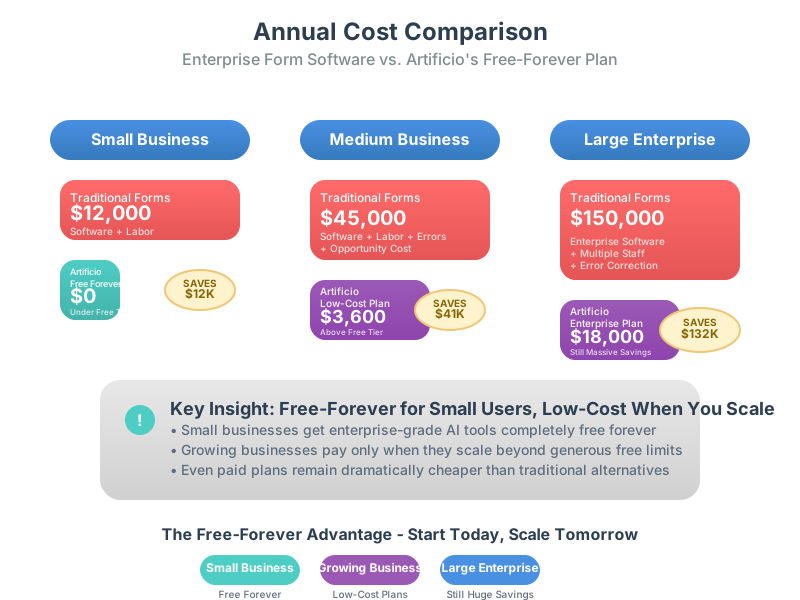
The dirty secret of the form software industry is that most "premium" features are artificially restricted to justify high prices. Basic conditional logic, file uploads, and email notifications are standard features that cost pennies to provide, yet companies charge hundreds monthly for access from day one.
Artificio's free plan exposes this pricing scam by offering genuinely advanced AI features at no cost for small businesses. We're talking about machine learning algorithms that learn from your data, intelligent document processing that eliminates manual entry, and sophisticated automation that adapts to your business processes. These aren't stripped-down versions of paid features. They're often more advanced than what expensive platforms offer their paying customers.
Consider document processing capabilities. Most enterprise form platforms charge extra fees for document uploads and require manual data extraction even for paying customers. Artificio's free plan automatically reads uploaded documents, extracts relevant information, and populates form fields with over 95% accuracy. This single feature eliminates hours of manual work per day for document-heavy small businesses.
The conditional logic capabilities tell a similar story. Paid platforms typically limit the number of conditional rules or charge per rule beyond basic limits. Artificio's free plan provides unlimited conditional logic because the computational cost is negligible. Small businesses can create complex, branching forms that adapt intelligently to user responses without worrying about hitting artificial limits or surprise charges.
The psychological shift is profound: instead of paying from day one for basic functionality, small businesses get enterprise-grade AI tools immediately and only pay when they've grown large enough to afford it. This approach removes the financial barrier to trying advanced form automation.
There's a psychological bias that equates expensive with better, and free with inferior. In the form software world, this bias is costing businesses fortunes while delivering worse results. Artificio's free plan isn't cutting corners to reduce costs. It's leveraging modern technology architectures that make advanced features genuinely inexpensive to provide for smaller volumes.
Traditional form software companies built their platforms 10-15 years ago using expensive, labor-intensive development approaches. They need high prices from every customer to maintain legacy codebases and support outdated architectures. Artificio starts with modern cloud infrastructure, automated scaling, and machine learning frameworks that dramatically reduce operational costs.
The result: a free plan can offer superior functionality because it's not burdened by technical debt and inflated operational costs. When Artificio provides free AI-powered document processing to small businesses, they're not losing money on each transaction. The marginal cost of processing forms approaches zero with modern cloud architecture.
This economic reality creates a competitive advantage that traditional software companies can't match without completely rebuilding their platforms. They're stuck charging high prices to every customer from day one while free alternatives provide better service at sustainable zero-cost models for smaller users.
The beauty of this approach is that it grows with businesses. Small companies benefit from free access to enterprise-grade tools. As they scale and can afford to pay, the pricing remains dramatically lower than traditional alternatives because of the efficient underlying architecture.
Even businesses using "affordable" form solutions face massive hidden costs that make Artificio's free plan financially compelling. Basic form builders like Google Forms or Microsoft Forms appear inexpensive but create substantial downstream expenses.
Manual data entry represents the largest hidden cost. A healthcare practice using Google Forms for patient intake still needs staff to manually transfer information into their practice management system. Each patient form requires 8-10 minutes of data entry time. Processing 200 forms monthly (well within Artificio's free tier) costs 33 hours of staff time, roughly $1,000 monthly in labor expenses at $30 per hour.
Error correction adds another layer of expense. Manual data entry creates transcription mistakes that require time to identify and correct. Each error takes 5-10 minutes to fix, including time to locate source documents and verify corrections. With typical error rates of 1-2% for manual entry, a practice processing 200 forms monthly faces 2-4 errors requiring 20-40 minutes of correction time weekly.
Artificio's free plan eliminates both categories of hidden costs for small businesses. Automated data extraction removes manual entry requirements entirely. AI accuracy rates above 95% virtually eliminate transcription errors. The labor savings alone often exceed $800-2,000 monthly for form-heavy small businesses, even those comfortably within the free tier.
Customer experience costs represent another hidden expense of traditional forms. Lengthy, repetitive forms create customer frustration and abandonment. Complex forms that require multiple steps or duplicate information entry result in incomplete submissions and lost business opportunities.
Free AI platforms improve customer experience through intelligent form design and auto-population features. When customers upload documents, AI automatically fills relevant fields, reducing form completion time and improving submission rates. Better customer experience translates directly to increased conversion rates and revenue growth, benefits that small businesses get immediately without any software investment.
Perhaps the most compelling argument for Artificio's free approach emerges when small businesses scale operations. Traditional form processing creates linear cost relationships from day one: process any forms, pay monthly fees. This scaling pattern makes even modest growth expensive and limits expansion opportunities.
A consulting firm processing 100 client onboarding forms monthly using traditional methods faces immediate monthly software costs plus roughly 25 hours of administrative time for data entry and processing. Expanding to 500 forms monthly would incur higher software tiers plus 125 hours of processing time, equivalent to nearly one additional full-time employee. The scaling costs become prohibitive before the revenue benefits materialize.
Artificio's free plan breaks this linear scaling relationship for small businesses entirely. The same AI algorithms that process 100 forms can handle 500 forms with no additional software costs (assuming they remain within the generous free tier) and minimal additional processing time. Growth transforms from a cost center into pure profit opportunity.
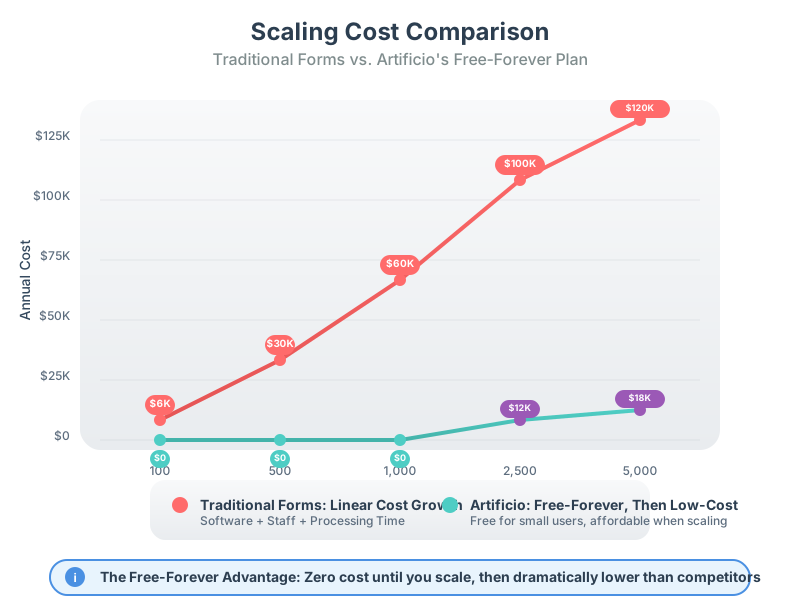
Even when businesses eventually grow beyond the free tier, the paid plans remain dramatically cheaper than traditional alternatives. The scaling advantage continues because the underlying technology is more efficient, not because features are artificially restricted.
International expansion provides another compelling scaling example. Traditional form processing requires local staff in each market to handle language differences and regional form requirements. Artificio's free plan can process forms in multiple languages and adapt to local requirements without additional staffing needs. Global expansion becomes operationally simple rather than prohibitively complex.
Enterprise security represents one area where Artificio's free plan often surpasses expensive alternatives. Legacy form software companies struggle with security because their platforms weren't designed with modern threat landscapes in mind. They're constantly patching vulnerabilities in older codebases while trying to meet evolving compliance requirements.
Free AI platforms start with security-first architectures. Modern cloud infrastructure provides enterprise-grade encryption, automated security updates, and compliance frameworks by default. Features like password-protected shareable URLs, access expiration dates, and granular user permissions come standard rather than as expensive add-ons.
The compliance story becomes particularly compelling for regulated industries. Healthcare organizations using traditional form software often pay thousands annually for HIPAA compliance features. Artificio's free plan provides these compliance capabilities as standard features because modern cloud platforms make compliance easier and less expensive to implement.
Data breach costs provide another security-related financial consideration. Traditional form platforms create multiple data storage locations and transfer points that increase breach vulnerability. Each additional system integration creates potential security gaps. Free AI platforms can process and store data within unified, highly secure environments that reduce breach risks and associated costs.
The average data breach costs businesses $4.45 million according to IBM's latest research. Any security improvement that reduces breach probability by even 1% provides substantial financial value. Artificio's free plan often delivers superior security while eliminating the software costs that strain small business budgets.
Let's examine specific examples of small businesses that switched from paid form software to Artificio's free plan. These aren't theoretical calculations but actual reported savings and efficiency improvements.
A regional accounting firm was paying $400 monthly for tax preparation form software that still required manual data entry from client documents. Processing 150 clients monthly (comfortably within the free tier), they switched to Artificio and eliminated the software cost while reducing client onboarding time from 45 minutes to 12 minutes per client. They saved 82.5 hours of staff time worth $3,300 at $40 per hour, plus $400 in software costs. Annual savings exceeded $19,600.
An insurance agency processing 80 claims monthly was using a $600 monthly platform that couldn't extract information from uploaded claim documents. Manual processing required 20 minutes per claim, consuming 27 hours monthly at $35 per hour for $945 in labor costs. After switching to Artificio's free plan, automated document processing reduced handling time to 5 minutes per claim, saving 20 hours monthly. Combined with eliminated software costs, annual savings reached $15,600.
A medical practice handling 250 patient intake forms monthly was paying $300 monthly for basic form software plus $1,500 monthly in data entry labor costs. Artificio's free plan eliminated manual data entry entirely, saving the full $1,500 monthly labor expense plus the $300 software cost. Annual savings: $21,600. The practice used these savings to hire additional support staff, directly improving patient care quality.
These examples share common patterns: immediate software cost elimination, dramatic labor savings, and improved service quality. The financial benefits compound over time as businesses reinvest savings into growth initiatives and customer service improvements. Even businesses that eventually outgrow the free tier maintain substantial cost advantages over traditional alternatives.
Understanding why Artificio can deliver superior results with a free model requires examining the underlying technology economics. Traditional form software companies built platforms using expensive development frameworks that require substantial ongoing maintenance and support costs from every customer. They need high margins to sustain operations.
Modern AI platforms leverage cloud computing, machine learning frameworks, and automated scaling technologies that dramatically reduce operational costs. Processing additional forms requires minimal computational resources because AI algorithms become more efficient with scale rather than less efficient.
The Intelligent document processing capabilities that eliminate manual data entry costs pennies per document to provide. Optical character recognition (OCR) and natural language processing (NLP) algorithms run efficiently on modern cloud infrastructure. The more documents processed across all users, the more accurate the AI becomes, creating a positive feedback loop that improves service quality while reducing per-unit costs.
Machine learning models improve automatically through use, requiring no additional development investment. Traditional software companies must manually program new features and capabilities, requiring expensive developer time and testing cycles. AI platforms enhance capabilities organically through accumulated data and algorithmic improvements.
This fundamental technology difference explains why free plans can provide superior capabilities. They're not cutting features to reduce costs but leveraging technology architectures that make advanced features genuinely inexpensive to provide at smaller scales.
The business model works because the small percentage of users who eventually scale beyond the free tier help subsidize the free usage of smaller businesses. This creates a virtuous cycle: more small businesses can access advanced tools, leading to innovation and growth, which eventually creates more paying customers.
Despite compelling financial arguments, many small businesses remain trapped in expensive form software contracts or hesitant to trust "free" solutions. The switching costs feel daunting, and the "too good to be true" mentality keeps organizations paying for inferior solutions.
The reality is that switching to Artificio's free plan is typically faster and easier than implementing traditional software. Modern platforms provide migration tools that import existing forms and data without manual recreation. The learning curve is gentler because AI handles complexity behind the scenes rather than requiring users to master complicated feature sets.
Training costs represent another switching concern that proves unfounded in practice. Traditional enterprise software requires extensive training because of interface complexity and feature limitations. Free AI platforms with intuitive drag-and-drop interfaces often require minimal training. Employees can become productive within hours rather than weeks.
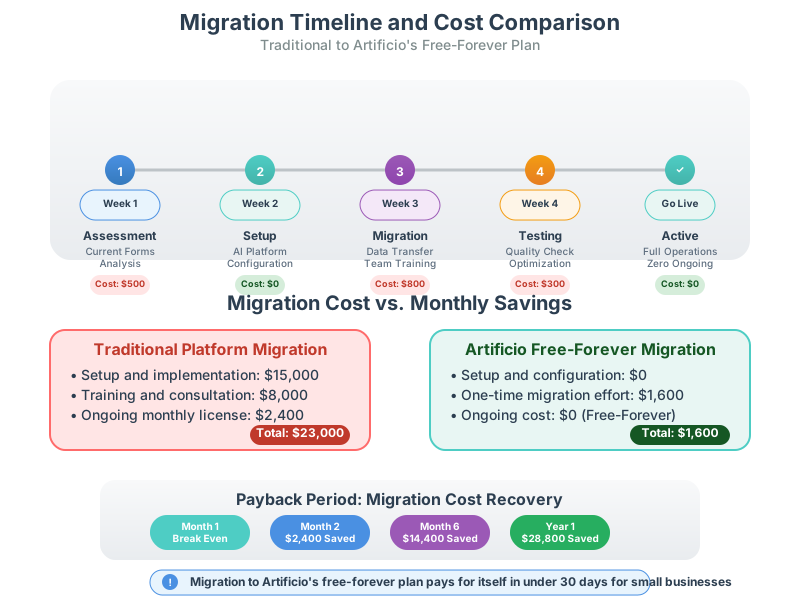
Contract obligations with existing providers create the primary switching barrier. Many small businesses discover they're locked into annual contracts with expensive cancellation penalties. The key is calculating whether the penalties plus remaining contract value exceed the savings from switching immediately versus waiting for contract expiration.
In most cases, immediate switching provides better financial outcomes even with penalty payments. The monthly savings from free plans typically exceed penalty costs within 2-4 months. Every month of delay represents continued unnecessary expenses.
The trust factor deserves addressing directly. Small businesses worry that "free forever" means inferior service or hidden costs. Artificio's approach builds trust through transparency: clear documentation of what's included in the free tier, straightforward explanation of when paid plans become necessary, and genuine commitment to supporting small business growth.
The trend toward generous free tiers and affordable paid plans for business software is accelerating, not slowing down. As cloud computing costs continue declining and AI algorithms become more sophisticated, the economic advantages of free plans will only increase.
Traditional software companies face an impossible choice: maintain high prices from day one and lose market share to free alternatives, or reduce prices and sacrifice profitability. This competitive pressure is already forcing price reductions across the industry, but the fundamental cost structure differences mean free platforms will maintain advantages.
Small businesses that adopt free AI platforms gain first-mover advantages in operational efficiency and cost structure. They can reinvest software savings into customer acquisition, service improvements, and market expansion while competitors remain burdened by expensive software costs from day one.
Machine learning capabilities will continue improving, making AI platforms increasingly superior to traditional alternatives. Document processing accuracy will approach 99%, conditional logic will become more sophisticated, and integration capabilities will expand. These improvements come automatically with free platforms while traditional software companies must charge additional fees for enhanced features.
The democratization of advanced business tools through free models creates opportunities for innovation and competition that weren't possible when expensive software created barriers to entry. Small businesses can now access the same quality tools as large enterprises, leveling the playing field in ways that benefit consumers and drive market innovation.
The mathematics are undeniable. Artificio's free plan doesn't just cost less than traditional alternatives for small businesses, it delivers superior functionality while eliminating the hidden costs that drain business resources.
Manual data entry costs disappear entirely through automated document processing. Error correction expenses vanish with AI accuracy rates above 95%. Scaling costs become negligible as AI handles volume increases within the generous free tier. Security and compliance capabilities match or exceed enterprise alternatives while eliminating licensing fees.
The psychological shift from viewing forms as a necessary expense to recognizing them as a competitive advantage transforms business strategy. When form processing becomes a profit center rather than a cost center, it opens possibilities for growth and customer service improvements that expensive software makes financially impossible for small businesses.
Smart businesses are making the switch not because free is cheaper, but because it's better. The question isn't whether you can afford to try Artificio's free plan. The question is whether you can afford not to.
The revolution in business software pricing isn't coming. It's here. The only question remaining is whether your business will be an early adopter reaping the benefits, or a late adopter paying catch-up costs while competitors pull ahead with superior efficiency and economics.
Free AI form processing isn't disrupting the market. It's creating an entirely new market where operational excellence and cost efficiency combine to deliver previously impossible competitive advantages. Small businesses that recognize this shift earliest will dominate their markets while others struggle with expensive, outdated alternatives.
For small businesses, the choice is clear: pay from day one for inferior tools, or access enterprise-grade AI capabilities free forever and only pay when success demands it. The businesses that choose wisely will shape the future of their industries.

Head IT Operations - Co Founder of Artificio
See it in your SAP environment
Bring us a document, a process, or a bottleneck. We'll show how Artificio captures, validates, and posts into SAP — then scale from there.
Security & compliance
ISO 27001:2013 certified, SOC 2 Type 2 compliant, GDPR and HIPAA ready. Every agent action is logged, auditable, and runs in isolated environments.