

Blog
Form Digitization: The Future with Artificio
Learn how Artificio is leading the way in form digitization, turning paper forms into intelligent, interactive systems.

Blog
Learn how Artificio is leading the way in form digitization, turning paper forms into intelligent, interactive systems.
The business world is experiencing a digital transformation unlike anything we've seen before. Companies across every industry are racing to modernize their operations, streamline workflows, and eliminate the inefficiencies that have plagued traditional paper-based processes for decades. At the heart of this transformation lies a critical challenge that affects virtually every organization: how to convert mountains of paper forms and static PDF documents into intelligent, interactive digital systems that can drive real business value.
This isn't just about going paperless for the sake of environmental consciousness or storage space, though those benefits are certainly welcome. The real driver behind the form digitization revolution is the desperate need for businesses to capture, process, and act on data more effectively than ever before. In today's hyper-competitive marketplace, the companies that can turn form data into actionable insights fastest are the ones that will thrive. Those that remain stuck in manual, paper-based processes will inevitably fall behind.
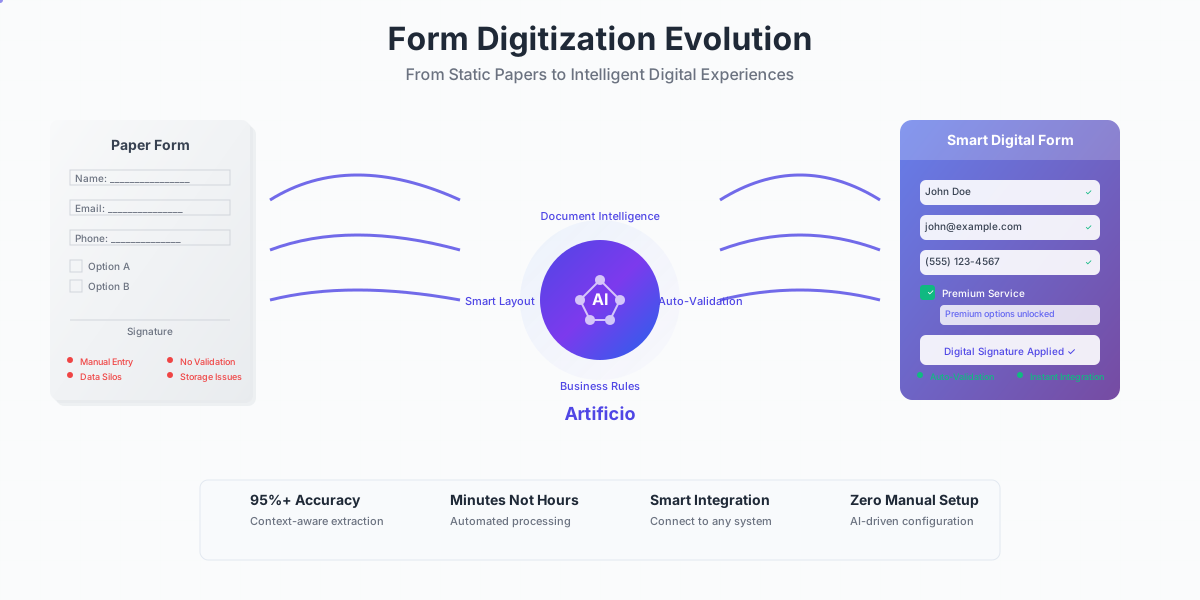
Consider the scale of this challenge. The average enterprise processes hundreds, if not thousands, of different types of forms every single day. These range from customer onboarding documents in financial services to patient intake forms in healthcare, from loan applications in banking to property listing agreements in real estate. Each of these forms contains valuable data that could fuel better decision-making, improve customer experiences, and drive operational efficiency. But when that data remains trapped in paper or static digital formats, it becomes virtually useless for modern business intelligence and automation systems.
The stakes are particularly high in heavily regulated industries where compliance, accuracy, and audit trails are non-negotiable. A mortgage lender processing hundreds of loan applications daily can't afford to have critical information lost in translation between paper forms and their loan origination system. A healthcare provider managing patient records must ensure that every piece of information is captured accurately and remains accessible for both treatment decisions and regulatory compliance. The margin for error in these scenarios is essentially zero.
What's driving this urgency even further is the explosive growth in data-driven decision making across all sectors. Modern businesses don't just want to collect information, they want to analyze it, correlate it with other data sources, and use it to predict future trends and customer behaviors. This requires form data to be not just digitized, but structured, validated, and immediately ready for integration with existing business systems. The old approach of simply scanning documents and storing them as images no longer meets the sophisticated demands of today's data-hungry organizations.
The COVID-19 pandemic accelerated these trends dramatically. Remote work became the norm overnight, forcing companies that had relied on paper-based processes to find digital alternatives in a matter of weeks rather than years. Organizations that had been putting off digitization initiatives suddenly found themselves unable to operate effectively without them. This shift created massive demand for form digitization solutions, but it also exposed the significant limitations of many existing platforms and approaches.
The current form digitization market is populated by a variety of solutions, each with its own approach and limitations. Understanding these existing options helps illustrate why a new paradigm is so desperately needed.
The most basic category consists of traditional OCR platforms that focus primarily on text extraction. These systems can scan a document and pull out individual words and characters with varying degrees of accuracy, but they struggle significantly when it comes to understanding context, structure, or the relationships between different pieces of information. An OCR system might successfully extract the text "John Smith" and "42" from a form, but it has no way of knowing that John Smith is the applicant's name and 42 represents their age rather than, say, their account number or the number of dependents they're claiming.
This fundamental limitation creates enormous downstream problems. Users of these systems often find themselves spending more time correcting and organizing the extracted data than they would have spent simply typing the information manually in the first place. The promise of automation becomes a frustrating reality of endless manual cleanup work.
PDF-to-form conversion tools represent another common approach, but they come with their own set of significant limitations. These platforms can often recognize that certain areas of a PDF should become form fields, and they might even maintain some of the visual layout of the original document. But they typically fail when it comes to implementing any kind of intelligent data validation, field dependencies, or business logic. The resulting forms are often little more than digital versions of paper forms, with no real improvement in functionality or user experience.
Even more problematic, most PDF-to-form tools struggle badly with complex layouts, multi-column designs, tables, and handwritten content. A mortgage application with its mix of checkboxes, signature lines, financial tables, and narrative sections often gets mangled beyond recognition. Users end up with forms that look nothing like the originals and require extensive manual reconstruction to be usable.
Perhaps the most sophisticated existing solutions are those that attempt to provide some level of manual mapping and customization. These platforms recognize that different organizations have different needs and try to provide tools for users to define how extracted data should be structured and validated. In theory, this sounds like a reasonable approach. In practice, it often requires users to become amateur developers, learning complex mapping interfaces and spending countless hours setting up rules and validations for each type of form they want to process.
The time investment required for these manual mapping approaches often defeats the entire purpose of automation. An organization might spend weeks or months setting up the rules for digitizing their loan application forms, only to discover that they need to start the process all over again when they update their forms or want to process a different type of document. The maintenance overhead becomes so significant that many organizations abandon these solutions after initial implementation.
Another major limitation across most existing platforms is their poor handling of truly complex forms. Many solutions work reasonably well for simple, single-column forms with straightforward text fields. But real-world business forms are rarely that simple. They contain tables with dynamic rows, conditional sections that should only appear based on previous answers, complex calculations that need to be performed automatically, and intricate validation rules that ensure data integrity.
Most existing solutions also fail when it comes to integration with broader business systems. Being able to digitize a form is only valuable if that digitized data can flow seamlessly into CRM systems, ERP platforms, loan origination systems, or whatever other business applications the organization relies on. Too many form digitization platforms treat integration as an afterthought, leaving organizations to figure out complex data export and import processes on their own.
The accuracy limitations of current solutions present perhaps the most serious challenge. OCR technology has improved significantly over the years, but it still struggles with anything other than perfectly clear, high-contrast text. Handwritten information, faded documents, complex layouts with overlapping elements, and forms that have been photocopied multiple times often result in error rates that make automated processing impractical.
When accuracy rates drop below about 95%, human review and correction become necessary for virtually every processed document. This not only eliminates most of the efficiency gains from automation, but actually creates additional work since someone now needs to review both the original document and the extracted data to identify and fix errors.
These accuracy problems are compounded by the fact that most existing systems provide little to no confidence scoring or intelligent error flagging. Users have no way of knowing which extracted data points are likely to be accurate and which ones need closer review. This forces them to manually verify everything, again defeating the purpose of automation.
The lack of contextual understanding in current solutions creates subtle but serious problems that often don't become apparent until systems have been in use for some time. A form might have multiple address fields for different purposes, like a mailing address and a property address. Traditional OCR systems extract all the address information but can't reliably distinguish between these different contexts. The result is mismatched data that can cause significant problems downstream in business processes.
Similarly, many forms contain information that looks similar but serves very different purposes. Dollar amounts, dates, percentages, and ID numbers might appear throughout a single form, but they need to be mapped to completely different data structures depending on their context. Current solutions largely fail at this kind of intelligent interpretation, leaving users to manually sort through and categorize extracted information.
Artificio represents a fundamental reimagining of what form digitization can and should accomplish. Rather than simply extracting text or creating basic digital copies of paper forms, Artificio's approach focuses on understanding the true intent and structure of business forms and recreating them as intelligent, interactive digital experiences that can drive real business value.
The foundation of Artificio's approach lies in its sophisticated document intelligence capabilities. Unlike traditional OCR systems that focus on character recognition, Artificio employs advanced Named Entity Recognition combined with Large Language Model orchestration to understand not just what text appears on a form, but what that text means in its specific context. When Artificio encounters a form with multiple people listed, it doesn't just extract names and contact information randomly. It understands the roles and relationships involved, correctly identifying primary applicants versus co-applicants, emergency contacts versus references, and business partners versus employees.
This contextual understanding extends far beyond simple text recognition. Artificio can analyze the visual structure of a form, understand the logical flow of information, and recognize implicit relationships between different sections and fields. When processing a loan application, for example, the system understands that employment information in one section relates to income verification in another section, and that both connect to the loan amount being requested. This holistic comprehension enables Artificio to create digitized forms that maintain the logical integrity of the original documents while adding powerful new capabilities.
One of the most significant differentiators in Artificio's approach is its smart layout reconstruction capability. Rather than simply converting paper forms into static digital copies, Artificio recreates forms as modern, responsive web interfaces that provide genuinely improved user experiences. The system analyzes the information flow and user interaction patterns implied by the original form design and translates them into intuitive digital interfaces that work seamlessly across desktop and mobile devices.
These reconstructed forms aren't just digitized versions of their paper predecessors, they're genuinely enhanced experiences. Conditional logic that might have required complex instructions on paper forms becomes seamless show-and-hide functionality in the digital version. Calculations that users previously had to perform manually become automatic updates as they enter information. Validation rules that might have been buried in fine print become real-time guidance that helps users complete forms correctly the first time.
The transformation goes even deeper with Artificio's ability to embed sophisticated business rules directly into the digitization process. Rather than requiring manual programming or complex mapping interfaces, the system can analyze existing forms and automatically suggest appropriate validation rules, field dependencies, and workflow logic. If a form shows that certain sections are only relevant for applicants over 18, Artificio can automatically implement age-based conditional logic. If employment information is required for loan amounts above a certain threshold, the system can build that requirement into the digital form's logic.
This automatic business rule detection and implementation represents a massive time savings compared to traditional approaches. Organizations don't need to spend weeks or months programming form logic, they simply provide Artificio with examples of their existing forms and the system generates intelligent digital versions that incorporate best practices for data validation and user experience.
Artificio's omni-format compatibility addresses another major pain point in the current market. Organizations typically deal with forms that come from many different sources and in many different formats. Some might be scanned paper documents, others might be PDF files created from word processing software, and still others might be images captured on mobile devices with varying levels of quality and clarity.
Traditional digitization platforms often require different processing approaches for different input formats, creating complex workflows and inconsistent results. Artificio treats all input formats with equal sophistication, applying the same advanced document intelligence and layout reconstruction capabilities regardless of whether the source is a high-resolution PDF or a smartphone photo of a crumpled paper form.
This format-agnostic approach extends to output capabilities as well. While many solutions lock users into proprietary formats or limited export options, Artificio can generate digitized forms in whatever format best serves the organization's needs. Whether that's modern web forms built on platforms like Form.io, integration-ready JSON structures, or compatibility with specific business applications, Artificio adapts to existing technology ecosystems rather than requiring organizations to adapt to it.
Perhaps most importantly, Artificio's AI-driven approach dramatically reduces the need for manual intervention and correction. Traditional digitization workflows often require human review and correction of virtually every processed document, but Artificio's accuracy rates and intelligent error detection make truly automated processing practical for most organizations.
The system provides detailed confidence scoring for every extracted data point, allowing organizations to implement automated processing for high-confidence extractions while flagging only uncertain elements for human review. This selective approach to manual oversight can reduce human intervention requirements by 80% or more compared to traditional solutions, while actually improving overall accuracy through more focused attention on genuinely problematic elements.
Artificio's approach to handling complex form structures sets it apart from virtually every other solution in the market. Rather than struggling with tables, multi-column layouts, and conditional sections, Artificio treats these complex structures as opportunities to create more sophisticated and useful digital experiences. Dynamic tables become interactive form sections where users can add or remove rows as needed. Multi-column layouts become responsive designs that adapt to different screen sizes and user preferences. Conditional sections become intelligent workflows that guide users through only the relevant portions of complex processes.
The system's understanding of business context allows it to make intelligent decisions about how to best represent complex information in digital formats. A financial statement with multiple years of data might become an interactive table where users can easily compare different time periods. A form with multiple signature requirements might become a workflow that routes to different stakeholders automatically based on the type of transaction being processed.
This transformation of complex paper forms into intelligent digital workflows represents one of the most significant value propositions of Artificio's approach. Organizations don't just get digital copies of their existing forms, they get enhanced processes that can improve accuracy, reduce completion time, and provide better experiences for both internal users and external customers or clients.
The integration capabilities built into Artificio's platform address another critical gap in the current market. Rather than treating integration as an afterthought, Artificio designs digitized forms with integration in mind from the beginning. The system can automatically generate API endpoints, webhook notifications, and data export formats that align with common business applications and industry standards.
For organizations using popular CRM platforms, loan origination systems, or ERP solutions, Artificio can often provide out-of-the-box integration capabilities that eliminate the need for custom development work. The digitized forms become immediate sources of structured data that flows seamlessly into existing business processes without requiring manual data entry or complex transformation steps.
When evaluating form digitization solutions, the differences between traditional approaches and Artificio's advanced methodology become stark when examined across key performance dimensions that matter most to real-world organizations.
OCR accuracy represents perhaps the most fundamental differentiator. Traditional platforms typically achieve text recognition rates in the 85-90% range under ideal conditions, and these rates drop significantly when dealing with handwritten content, poor image quality, or complex layouts. This level of accuracy might sound reasonable in theory, but in practice it creates massive operational challenges. With error rates of 10-15%, virtually every processed document requires human review and correction, often taking more time than manual data entry would have required in the first place.
Artificio's contextual and structural accuracy approach achieves recognition rates consistently above 95% across a wide range of document types and quality levels. More importantly, the system's confidence scoring allows organizations to automatically process the majority of documents that score above certain confidence thresholds while routing only genuinely problematic cases for human review. This selective approach to manual oversight typically reduces human intervention requirements by 80% or more while maintaining higher overall accuracy than manual processes.
The difference becomes even more pronounced when considering not just individual character recognition, but structural understanding. Traditional OCR might successfully extract "John" and "Smith" from a document, but have no understanding that these represent a first and last name that belong together, or which of several names on a form represents the primary applicant versus emergency contacts or references. Artificio's contextual understanding ensures that extracted information maintains its logical relationships and business meaning, eliminating the extensive cleanup and reorganization work that traditional solutions require.
Form layout recreation capabilities represent another area where the differences are dramatic. Basic digitization platforms often produce digital forms that bear little resemblance to their source documents, with fields scattered randomly across generic layouts that provide poor user experiences and often cause confusion about what information goes where. More sophisticated traditional platforms might maintain visual similarity to source documents, but typically fail to translate that into genuinely improved digital experiences.
Artificio's intelligent layout reconstruction doesn't just preserve the visual structure of original forms, but enhances them for digital interaction. Paper forms that might have been cramped or difficult to read become spacious, well-organized digital interfaces. Complex multi-page forms become streamlined workflows that guide users through logical sequences of information entry. Conditional logic that might have required confusing instructions on paper becomes seamless interactive behavior in the digital version.
The enhancement goes beyond visual improvements to include genuinely better functionality. Manual calculations become automatic updates, reducing errors and improving user confidence. Validation rules that might have been buried in fine print become real-time feedback that helps users complete forms correctly on their first attempt. Dependencies between different form sections become intelligent workflows that adapt to user input rather than requiring users to understand complex branching logic.
Business rule embedding capabilities showcase perhaps the most significant operational difference between approaches. Traditional platforms typically require extensive manual programming to implement even basic validation rules or field dependencies. Organizations often need to invest weeks or months of development time to set up logic for each type of form they want to process, and these setups require ongoing maintenance as business requirements evolve.
Artificio's AI-driven approach can analyze existing forms and automatically suggest appropriate business rules based on the structure and content patterns it identifies. If a form indicates that certain sections are only relevant for specific types of applicants, or that particular validations should apply to financial information, the system can implement these rules automatically during the digitization process. This eliminates the extensive setup and maintenance overhead that makes traditional solutions impractical for many organizations.
The sophistication of automatically generated business rules often exceeds what organizations would implement manually. The system can identify subtle patterns and dependencies that human developers might miss, and it can implement best practices for data validation and user experience that draw from analysis of thousands of similar forms across different industries.
Integration capabilities with existing business systems represent another critical differentiator. Many traditional platforms treat integration as an afterthought, providing basic export capabilities that require significant custom development work to connect with CRM systems, loan origination platforms, or ERP solutions. Organizations often find themselves needing to hire developers or system integrators to build custom connections between their digitization platform and their core business applications.
Artificio provides out-of-the-box integration capabilities for popular business platforms, with pre-built connectors that can automatically map form data to appropriate fields in destination systems. The platform can generate API endpoints, webhook notifications, and data export formats that align with industry standards and common integration patterns. For organizations using popular business applications, this can eliminate weeks or months of custom integration development while providing more reliable and maintainable connections than custom-built solutions.
The time required to digitize forms represents a practical concern that affects adoption and ongoing operational efficiency. Traditional approaches often require hours or days to process complex forms, particularly when manual mapping and rule setup are required. This extended timeline makes it impractical to digitize forms on-demand or to handle large volumes of different form types.
Artificio's automated approach can typically process most forms in minutes rather than hours or days. The combination of advanced AI capabilities and pre-trained models means that even complex, multi-page forms with sophisticated logic can be analyzed, understood, and converted to intelligent digital experiences in timeframes that support real-time operational needs. Organizations can digitize forms as they encounter them rather than requiring extensive advance planning and setup work.
Data validation and automatic mapping capabilities highlight another area where traditional solutions fall short of modern requirements. Basic platforms provide little or no validation beyond simple format checking, leaving organizations to implement their own data quality controls downstream. More sophisticated traditional solutions might allow manual setup of validation rules, but this requires significant technical expertise and ongoing maintenance.
Artificio's automatic validation and mapping draws from its contextual understanding of form content and business logic. The system can automatically implement appropriate data type validations, range checks, and consistency rules based on its analysis of form structure and content. Cross-field validations that ensure related information makes logical sense together become automatic features rather than requiring manual programming.
The automatic mapping capabilities extend to understanding how form data should flow into different business systems. Rather than requiring manual mapping of each form field to destination system fields, Artificio can often determine appropriate mappings automatically based on field names, data types, and business context. This dramatically reduces the setup time required for integration while providing more accurate and reliable data flow than manual mapping approaches.
When organizations evaluate the total cost of ownership for form digitization solutions, the differences between traditional approaches and Artificio's methodology become even more compelling. Traditional solutions might appear less expensive initially, but the ongoing costs of manual setup, correction, maintenance, and integration often make them significantly more expensive over time. The hidden costs of poor accuracy, failed integrations, and user frustration with inadequate digital experiences can easily exceed the direct licensing costs of digitization platforms.
Artificio's approach minimizes these hidden costs through higher accuracy, automated setup, reliable integrations, and superior user experiences that reduce support requirements and increase adoption rates. Organizations typically find that their total cost of ownership decreases significantly even as their capabilities and efficiency improve substantially.
The scalability differences between approaches become critical for organizations that need to process large volumes of forms or many different types of forms. Traditional solutions often require linear increases in setup and maintenance work as form types and volumes increase. Each new form type might require days or weeks of configuration work, and ongoing maintenance requirements can quickly overwhelm technical teams.
Artificio's AI-driven approach scales much more efficiently. The system's ability to automatically understand and digitize new form types means that organizations can handle increasing volumes and varieties of forms without proportional increases in setup and maintenance work. The automated learning capabilities mean that the system actually becomes more effective over time as it processes more examples of different form types and business contexts.
These scalability advantages become particularly important for organizations in industries like financial services, healthcare, or real estate where form processing requirements can vary significantly based on market conditions, regulatory changes, or business growth. Traditional solutions often require significant technical resources to adapt to changing requirements, while Artificio's approach provides the flexibility to handle evolving needs without major reinvestment in setup and configuration work.
The competitive advantages that Artificio provides extend beyond just operational efficiency to include strategic capabilities that can drive business growth and competitive differentiation. Organizations using Artificio's platform can offer better customer experiences, faster processing times, and more reliable service delivery than competitors using traditional approaches. They can also adapt more quickly to changing market conditions and regulatory requirements, providing agility that becomes increasingly valuable in dynamic business environments.
As the form digitization market continues to evolve, the differences between basic conversion approaches and sophisticated AI-driven platforms like Artificio will only become more pronounced. Organizations that invest in advanced capabilities now position themselves to take advantage of future developments in artificial intelligence, automation, and business process optimization, while those that settle for traditional approaches may find themselves needing to reinvest in platform replacements within just a few years.

Head IT Operations - Co Founder of Artificio
See it in your SAP environment
Bring us a document, a process, or a bottleneck. We'll show how Artificio captures, validates, and posts into SAP — then scale from there.
Security & compliance
ISO 27001:2013 certified, SOC 2 Type 2 compliant, GDPR and HIPAA ready. Every agent action is logged, auditable, and runs in isolated environments.