

Blog
How document chat is transforming research and development
Discover how LLM-powered document chat transforms R&D by enabling natural language interaction with vast knowledge, boosting efficiency.

Blog
Discover how LLM-powered document chat transforms R&D by enabling natural language interaction with vast knowledge, boosting efficiency.
In the fast paced world of research and development, information is the lifeblood that drives innovation. From pharmaceutical companies analyzing clinical trial data to aerospace engineers reviewing technical specifications, R&D professionals constantly navigate through mountains of documentation to extract critical insights. The traditional approach of manually searching through hundreds of pages, cross referencing multiple documents, and synthesizing complex information has become a bottleneck in the innovation pipeline.
Enter LLM based document chat technology, a revolutionary approach that's transforming how R&D teams interact with their knowledge repositories. Unlike conventional search tools that merely locate keywords, intelligent document chat systems enable natural language conversations with entire document collections, unlocking unprecedented efficiency and insight generation capabilities.
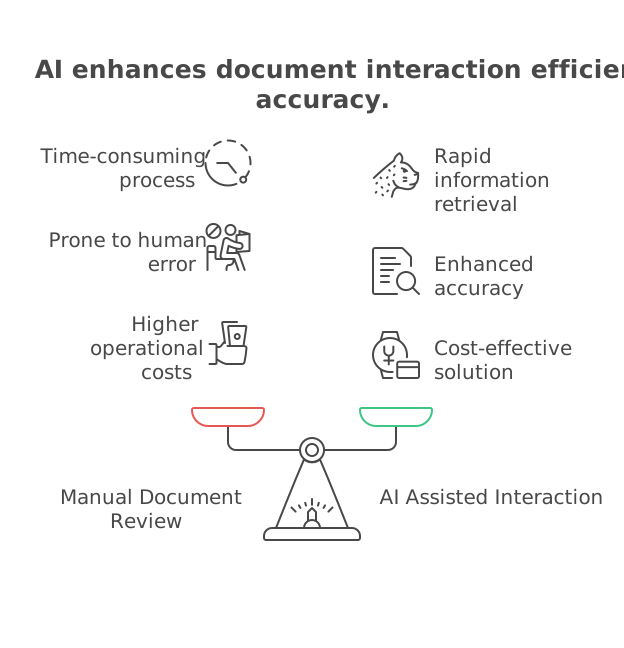
Research and development environments generate and consume vast amounts of documentation. A typical pharmaceutical R&D project might involve thousands of pages across clinical protocols, regulatory submissions, laboratory reports, literature reviews, and safety assessments. Similarly, engineering R&D teams work with extensive technical manuals, design specifications, test reports, and compliance documentation.
The challenges are multifaceted and increasingly complex. Traditional document management systems, while organized, still require researchers to know exactly what they're looking for and where to find it. This approach fails when researchers need to identify patterns across multiple documents, synthesize information from diverse sources, or explore tangential relationships that might spark innovative solutions.
Moreover, the sheer volume of information continues to grow exponentially. Scientific literature doubles approximately every 12 years, while technical documentation in industries like automotive and aerospace grows at similar rates. R&D professionals spend an estimated 30 40% of their time searching for and reviewing existing information rather than generating new insights, a significant drain on productivity that ultimately slows innovation cycles.
The cognitive load of processing this information is equally challenging. Researchers must maintain context across multiple documents, remember key findings from various sources, and identify subtle connections that might not be immediately apparent. This mental juggling act often leads to important insights being missed or delayed, potentially impacting project timelines and outcomes.
Large Language Models have fundamentally changed how we can interact with textual information. Unlike traditional search engines that match keywords and return ranked results, LLMs understand context, nuance, and relationships within text. They can comprehend complex queries, maintain conversational context, and generate human like responses based on their understanding of the source material.
When applied to document chat applications, LLMs create an entirely new paradigm for information interaction. Instead of searching for specific terms or phrases, researchers can ask sophisticated questions in natural language and receive comprehensive answers that synthesize information from across their document collection.
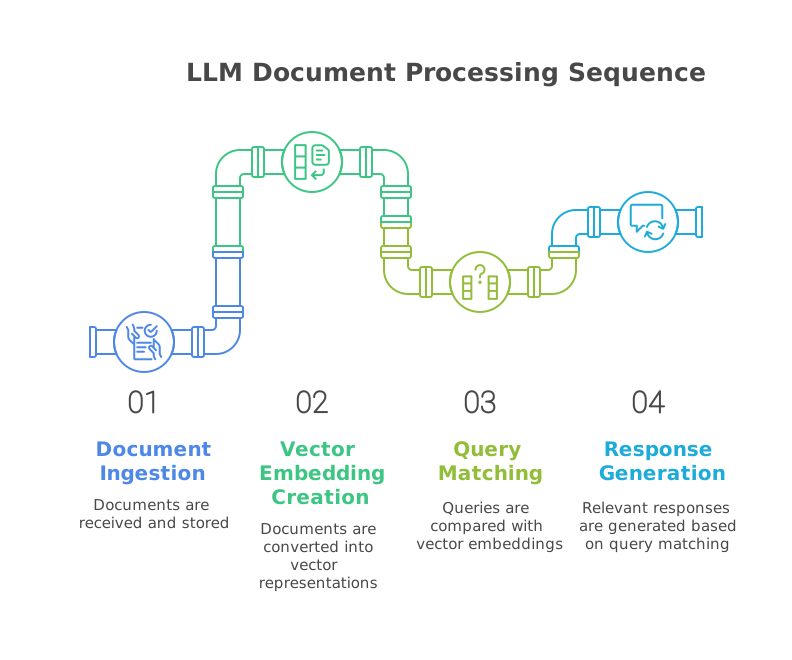
The technology works by first processing and indexing the uploaded documents, creating rich vector representations that capture semantic meaning rather than just literal text. When a user asks a question, the system identifies relevant passages across all documents and uses the LLM to synthesize a coherent response that directly addresses the query while citing specific sources.
This approach offers several distinct advantages over traditional methods. First, it democratizes access to information, researchers don't need to be experts in database queries or boolean search syntax to find what they need. Second, it enables exploratory research by allowing open ended questions that might reveal unexpected connections. Third, it maintains conversational context, allowing follow up questions that build on previous interactions.
While many web based LLM applications impose strict file size limitations, often restricting uploads to just a few megabytes, the R&D environment demands the ability to work with substantially larger documents. This limitation isn't merely inconvenient; it's fundamentally incompatible with the realities of modern research and development work.
Consider the scope of documentation typical in R&D environments. A comprehensive clinical study report might span 500 1000 pages with detailed statistical analyses, patient data, and regulatory compliance information. Engineering specifications for complex systems like aircraft engines or semiconductor manufacturing equipment routinely exceed hundreds of megabytes when they include detailed CAD drawings, simulation results, and testing data.
Artificio's capability to handle files up to 500MB represents a quantum leap in practical utility for R&D applications. This capacity means that entire research projects can be uploaded as single, cohesive knowledge bases rather than fragmented across multiple smaller files. The implications for workflow efficiency and analytical depth are profound.
When working with large, comprehensive documents, the AI system can identify relationships and patterns that span the entire document corpus. A researcher investigating potential drug interactions, for instance, can upload complete pharmacokinetic studies, safety databases, and clinical protocols as single files, enabling the AI to cross reference findings across all sections simultaneously.
The technical challenges of processing large files are significant but surmountable with proper architecture. Memory management, efficient indexing algorithms, and optimized vector storage all become critical factors. However, the payoff in terms of user experience and analytical capability justifies the engineering investment.
Large file capability also enables more sophisticated analytical workflows. Instead of breaking down complex documents into smaller chunks, potentially losing important context at the boundaries, researchers can maintain the full integrity of their source materials. This preservation of context is crucial for maintaining the accuracy and reliability of AI generated insights.
The pharmaceutical industry exemplifies the transformative potential of advanced document chat capabilities. Drug development involves navigating through extensive regulatory documentation, clinical trial protocols, safety reports, and scientific literature. Traditional approaches require specialized personnel to manually review and cross reference these materials, a time consuming process that can delay critical decisions.
With intelligent document chat, research teams can quickly query across complete clinical study reports to identify safety signals, compare efficacy outcomes across different patient populations, or investigate potential drug drug interactions. The system can instantly surface relevant information from thousands of pages of documentation, enabling faster and more informed decision making.
For example, a safety officer investigating an adverse event can ask the system to "identify all instances where patients with diabetes experienced cardiovascular events while taking the study drug, and compare these rates to the control group." The AI can immediately scan through complete clinical databases, statistical analysis plans, and safety reports to provide a comprehensive answer with specific citations.
The regulatory compliance aspect is equally valuable. When preparing submissions to regulatory agencies, teams can use document chat to ensure completeness and consistency across all required sections. The system can identify potential gaps, flag inconsistencies, and suggest areas where additional documentation might be needed.
Engineering R&D environments present unique challenges for information management. Technical specifications, design documents, test reports, and compliance certifications often exist in various formats and may include complex diagrams, tables, and mathematical formulations.
Advanced document chat systems excel in these environments by understanding technical terminology and maintaining context across related documents. An aerospace engineer working on a new propulsion system can query the system about specific materials performance under various temperature and pressure conditions, drawing from multiple technical reports, supplier specifications, and testing databases.
The ability to handle large files becomes particularly crucial when working with comprehensive system documentation. A complete avionics system specification might include hundreds of interconnected subsystems, each with detailed requirements and test procedures. Having all this information available in a single, queryable format enables systems engineers to quickly identify dependencies, potential conflicts, and optimization opportunities.
Manufacturing process optimization represents another key application area. Production engineers can upload complete process documentation, quality control reports, and equipment manuals, then query the system to identify correlations between process parameters and quality outcomes. This capability accelerates continuous improvement initiatives and helps identify root causes of quality issues.
Academic research institutions face the challenge of managing vast literature collections alongside their own generated research data. Graduate students and researchers often struggle to keep up with the exponential growth of published literature while also managing their own experimental data and analysis results.
Document chat technology enables researchers to create comprehensive knowledge bases that combine published literature with their own research findings. A materials science researcher, for example, can upload recent papers on nanomaterial synthesis alongside their own experimental results and analytical data. The AI system can then help identify novel research directions by finding connections between published findings and their own observations.
The collaborative aspect of academic research is particularly well served by this technology. Research groups can maintain shared knowledge bases that accumulate institutional knowledge over time. New team members can quickly get up to speed by conversing with the collective research history, while experienced researchers can identify patterns and opportunities they might have missed through manual review alone.
Cross disciplinary research benefits enormously from intelligent document chat capabilities. When working at the intersection of multiple fields, such as bioengineering or computational biology, researchers must synthesize knowledge from diverse domains. AI powered document chat can help bridge these knowledge gaps by identifying relevant concepts and methodologies across different scientific disciplines.
Most web based LLM applications impose significant constraints that render them inadequate for serious R&D applications. File size limitations, typically ranging from 10 50MB, immediately exclude most comprehensive technical documents. Privacy concerns around uploading sensitive proprietary information to third party services create additional barriers for commercial R&D organizations.
These limitations force researchers into suboptimal workarounds. They might extract only portions of documents, losing critical context and relationships. Alternatively, they might avoid using AI assistance altogether, falling back to inefficient manual processes. Neither approach realizes the full potential of AI enhanced research workflows.
Artificio's approach addresses these fundamental limitations through several key advantages. The 500MB file capacity accommodates virtually any research document, from comprehensive clinical study reports to complete technical manuals with embedded multimedia content. This capacity isn't just about convenience, it's about preserving the integrity and completeness of research materials.
The on premises or secure cloud deployment options address privacy and intellectual property concerns that are paramount in R&D environments. Organizations can realize the benefits of AI enhanced document interaction without compromising their confidential research data or violating regulatory requirements around data handling.
Performance optimization for large files requires sophisticated engineering but delivers proportional benefits. Advanced indexing algorithms ensure that query response times remain acceptable even when processing hundreds of megabytes of content. Intelligent caching and memory management enable smooth user experiences regardless of document size.
The economic implications are equally compelling. While web based services might appear cost effective for small scale usage, they become prohibitively expensive when scaling to handle the volume and size of documents typical in R&D environments. Self hosted solutions like Artificio provide predictable costs and unlimited scalability within organizational boundaries.
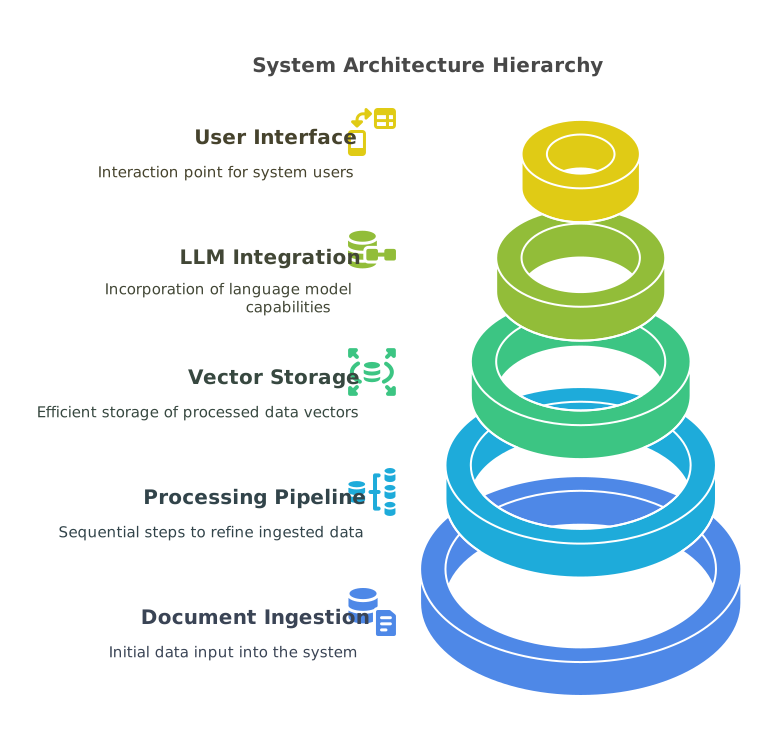
Implementing robust document chat capabilities for R&D environments requires careful attention to several technical considerations. The architecture must balance performance, scalability, and accuracy while handling the unique challenges posed by large, complex technical documents.
Document preprocessing represents the first critical stage. Unlike simple text documents, R&D materials often include tables, figures, mathematical formulations, and structured data that require specialized handling. Advanced preprocessing pipelines must extract and preserve this structured information while converting it into formats suitable for LLM processing.
Vector indexing strategies become crucial when dealing with large documents. Simple approaches that work for smaller files may become computationally prohibitive as document sizes increase. Hierarchical indexing, intelligent chunking strategies, and optimized storage formats all contribute to maintaining responsive query performance.
The LLM integration layer must handle context management carefully. Large documents often contain information that spans multiple sections or chapters, requiring the system to maintain awareness of these relationships when formulating responses. Advanced prompting strategies and context windowing techniques help ensure that responses remain accurate and relevant.
Quality assurance mechanisms become particularly important in R&D applications where accuracy is paramount. Citation tracking, confidence scoring, and inconsistency detection help users evaluate the reliability of AI generated responses. Integration with existing quality management systems ensures that AI assisted research maintains the same standards of rigor as traditional approaches.
R&D organizations operate under strict regulatory and compliance requirements that extend to their information management systems. Pharmaceutical companies must comply with FDA regulations around data integrity and audit trails. Defense contractors work under ITAR restrictions that limit how technical information can be stored and accessed. Academic institutions must protect student privacy and intellectual property rights.
Document chat systems for R&D must be designed with these compliance requirements as primary considerations rather than afterthoughts. This means implementing comprehensive audit logging, access controls, and data lineage tracking from the ground up.
Audit trails must capture not just what information was accessed, but how it was processed and what conclusions were drawn. When regulatory agencies review research decisions, they need to understand not just what data was considered, but how that data was analyzed and interpreted. AI enhanced systems must provide this level of transparency while maintaining the efficiency benefits that make them valuable.
Data residency and sovereignty considerations are particularly complex in global R&D environments. Research collaborations often span multiple countries, each with different data protection regulations. Document chat systems must provide flexible deployment options that accommodate these varying requirements while maintaining seamless user experiences.
Intellectual property protection adds another layer of complexity. R&D documents often contain trade secrets, patent applications, and proprietary methodologies that require the highest levels of security. The document chat system must ensure that this sensitive information remains protected while still enabling the collaborative benefits that make AI assistance valuable.
The business case for implementing advanced document chat capabilities in R&D environments rests on measurable improvements in efficiency, quality, and innovation outcomes. Organizations need clear metrics to evaluate the return on investment and guide ongoing optimization efforts.
Time savings represent the most immediately measurable benefit. Researchers who previously spent hours manually searching through documents can now get comprehensive answers in minutes. Studies of early adopters suggest productivity improvements of 40 60% for information intensive tasks. These improvements compound over project lifecycles, leading to faster development timelines and reduced costs.
Quality improvements are equally significant but often more difficult to quantify. AI enhanced document review can identify patterns and relationships that human reviewers might miss, leading to more thorough analyses and better informed decisions. In pharmaceutical development, this might translate to earlier identification of safety signals or more efficient patient population targeting.
Innovation acceleration occurs when researchers can quickly explore connections between disparate pieces of information. The ability to rapidly synthesize knowledge from across large document collections enables more creative problem solving and can lead to breakthrough discoveries. While difficult to measure directly, organizations often observe increased patent applications and publication rates following implementation.
Cost reduction extends beyond direct time savings to include reduced errors, fewer regulatory delays, and more efficient resource allocation. When research teams can quickly access comprehensive information about previous work, they avoid duplicating efforts and make more informed decisions about resource allocation.
The field of AI enhanced document interaction continues to evolve rapidly, with several emerging capabilities particularly relevant to R&D applications. Multimodal processing capabilities that can understand and analyze charts, diagrams, and mathematical formulations alongside text will further expand the utility of document chat systems.
Real time collaboration features will enable distributed research teams to collectively interact with shared knowledge bases, with AI assistance helping to maintain context and continuity across different team members' interactions. This capability is particularly valuable for large, complex projects that span multiple disciplines and locations.
Integration with laboratory information management systems (LIMS) and electronic laboratory notebooks (ELN) will create seamless workflows where researchers can query across both structured experimental data and unstructured documentation. This integration will enable more sophisticated analysis workflows that combine empirical results with literature knowledge.
Predictive capabilities represent perhaps the most exciting frontier. As AI systems become better at understanding research patterns and methodologies, they may begin to suggest novel research directions, identify potential risks or opportunities, and even propose experimental designs based on analysis of existing documentation.
Successfully implementing document chat capabilities in R&D environments requires careful planning and change management. Organizations must consider technical requirements, user training, and workflow integration to realize the full benefits of these technologies.
The implementation typically begins with pilot projects focused on specific use cases or research groups. This approach allows organizations to demonstrate value, refine processes, and build internal expertise before broader deployment. Successful pilots often focus on well defined problems where the benefits of AI assistance are immediately apparent.
User training and support are crucial for adoption success. Researchers need to understand not just how to use the technology, but how to formulate effective queries and interpret AI generated responses. Training programs should emphasize the collaborative nature of AI assistance rather than positioning it as a replacement for human expertise.
Integration with existing workflows and systems requires careful attention to user experience design. The document chat interface should feel natural and intuitive to researchers while providing powerful capabilities for complex analysis tasks. API integrations with existing research tools can help create seamless workflows that don't require users to switch between multiple applications.
Change management strategies must address natural concerns about AI reliability and the changing nature of research work. Transparent communication about system capabilities and limitations helps build appropriate trust and ensures that AI assistance enhances rather than replaces critical thinking skills.
The integration of LLM based document chat capabilities into R&D workflows represents more than just a technological upgrade, it's a fundamental transformation in how research organizations create, access, and leverage knowledge. By enabling natural language interaction with comprehensive document collections, these systems remove traditional barriers to information access and unlock new possibilities for innovation.
The advantages of systems like Artificio, with their ability to handle large files up to 500MB, extend far beyond simple convenience. They enable R&D organizations to work with complete, uncompromised datasets while maintaining the security and compliance standards required in regulated industries. This capability gap between enterprise grade solutions and web based alternatives will only widen as R&D documentation continues to grow in volume and complexity.
The early adopters of this technology are already realizing significant competitive advantages through faster research cycles, more thorough analyses, and improved innovation outcomes. As these capabilities mature and become more accessible, they will become essential tools for any R&D organization seeking to maintain its competitive edge in an increasingly complex and fast moving technological landscape.
The future of R&D lies not in replacing human expertise with artificial intelligence, but in creating powerful partnerships between human creativity and AI capability. Document chat systems represent a crucial component of this partnership, enabling researchers to focus on what they do best, generating insights, solving problems, and pushing the boundaries of human knowledge, while AI handles the increasingly complex task of managing and synthesizing vast amounts of information.
For R&D organizations evaluating their technology strategies, the question is not whether to adopt AI enhanced document interaction capabilities, but how quickly they can implement them effectively. The organizations that move first will establish sustainable advantages in efficiency, quality, and innovation that will compound over time, setting new standards for what's possible in research and development.
The transformation is already underway.
The question is whether your organization will lead it or follow it.

Head IT Operations - Co Founder of Artificio
See it in your SAP environment
Bring us a document, a process, or a bottleneck. We'll show how Artificio captures, validates, and posts into SAP — then scale from there.
Security & compliance
ISO 27001:2013 certified, SOC 2 Type 2 compliant, GDPR and HIPAA ready. Every agent action is logged, auditable, and runs in isolated environments.