

Blog
Invisible AI: The Future of Workflows You Don't Even See
Discover Invisible AI for zero-click workflows. Learn how AI can automate processes entirely, freeing your team to focus on high-value work.

Blog
Discover Invisible AI for zero-click workflows. Learn how AI can automate processes entirely, freeing your team to focus on high-value work.
Picture this: it's 9 AM on a Tuesday, and you're already drowning. Your inbox shows 47 unread emails, three approval requests are sitting in your dashboard, and that expense report you submitted last week is still "pending review" somewhere in the digital void. You click through form after form, copying data from one system to another, waiting for approvals that should take seconds but somehow stretch into days. Sound familiar?
Here's the cruel irony of modern workplace automation: even with all our advanced tools, we're still very much aware of the machine working. We see every robotic process automation (RPA) script running, every workflow step lighting up, every form field that needs our attention. We've built faster hamster wheels, but we're still running on them.
What if there was a different way? What if the most powerful automation was the kind you never actually see? Welcome to the era of Invisible AI, where the best workflows are the ones that completely disappear.
Let's be honest about where we are right now. Most companies have embraced automation, and that's great. RPA bots handle repetitive tasks, digital forms replace paper processes, and AI-powered tools help us work faster. But there's a catch that nobody talks about: all this automation still demands our attention.
Take a typical invoice approval process. Sure, the system might auto-populate some fields and route the invoice to the right manager, but you still need to log into a portal, review the details, click "approve," and maybe add a comment. The process is faster than paper, but you're still doing work. You're still part of the machine.
Even the smartest AI-driven forms require you to validate data, confirm selections, and hit submit buttons. You might spend less time typing, but you're still clicking, scrolling, and thinking about the process. The workflow hasn't disappeared; it's just gotten shinier.
This creates what I call the "automation paradox." We've automated individual tasks but haven't eliminated the work around those tasks. We've made humans more efficient at being cogs in the machine, rather than freeing them from the machine entirely. The result? Productivity bottlenecks persist because we're still stuck managing the automation instead of benefiting from it.
Think about your typical day. How many dashboards do you check? How many approval queues do you monitor? How many status updates do you review, not because they need your decision, but because the system thinks you should know about them? We've created a world where automation serves up endless information and choices, when what most of us really want is to focus on the work that actually matters.
Invisible AI represents a fundamental shift in how we think about automation. Instead of asking "How can we make this process faster?" we should ask "How can we make this process disappear entirely?"
At its core, Invisible AI creates zero-click workflows. The best workflow is one that happens without you knowing it happened. Instead of asking users to input data, validate information, or check status updates, Invisible AI operates on four key principles:
First, it detects what needs to happen. AI constantly monitors your business environment, recognizing patterns and triggers that indicate action is needed. When an invoice arrives, when a contract is approaching renewal, when a customer files a complaint, or when inventory hits a reorder point, the system knows immediately.
Second, it gathers and validates all necessary data automatically. Rather than asking you to fill out forms or confirm information, AI reaches across your entire technology stack. It pulls customer data from your CRM, financial information from your ERP system, compliance requirements from your policy management platform, and historical context from your document archives. All without opening a single interface.
Third, it makes decisions using the same logic, rules, and intelligence that your team would apply. The AI understands your approval hierarchies, compliance requirements, business rules, and even the nuanced judgment calls that experienced employees make. It doesn't just follow rigid if-then rules; it applies contextual intelligence to each situation.
Finally, it only involves humans when their input is genuinely needed. Instead of defaulting to human oversight for everything, Invisible AI flips the script. It handles routine decisions autonomously and escalates only true exceptions, complex edge cases, or situations that require creative problem-solving.
The difference is profound. Today's automation asks: "Can you please review this and click approve?" Invisible AI simply ensures the right outcome happens, then maybe sends you a quick notification: "Three invoices were processed and paid today. One unusual expense flagged for your review."
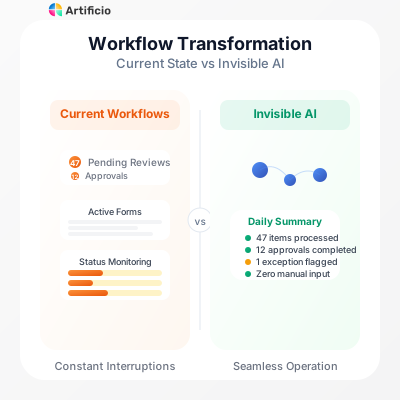
The magic of Invisible AI lies in its ability to understand context without explicit instruction. Traditional automation works like a sophisticated calculator, requiring precise inputs to generate outputs. Invisible AI works more like an experienced colleague who understands the business, knows what needs to happen, and just takes care of it.
Contextual triggers are the starting point. The AI doesn't wait for someone to start a process; it recognizes when processes should begin. When a new employee is hired, it doesn't wait for HR to remember to start onboarding. It detects the hire (from HRIS updates, contract signatures, or even calendar invites for first-day meetings) and immediately begins coordinating everything that needs to happen.
These triggers can be incredibly sophisticated. The AI might recognize that a major client's payment is three days late, cross-reference their payment history to determine if this is unusual, check recent communication for any mentions of cash flow issues, and automatically adjust the follow-up approach. All of this happens in seconds, without anyone needing to run reports or analyze patterns.
Data integration is where Invisible AI really shines. Most business processes fail because information lives in silos. You need customer data from the CRM, but the financial details are in the ERP, and the contract terms are buried in a shared drive somewhere. Invisible AI doesn't see silos; it sees a unified information ecosystem.
When processing an insurance claim, for example, the AI simultaneously accesses the policy management system, claims history database, medical records platform, and fraud detection tools. It correlates information across all these systems to build a complete picture, rather than asking a claims adjuster to manually gather data from multiple sources.
The decision-making capability is perhaps the most impressive aspect. Invisible AI doesn't just follow simple rules; it applies the same complex reasoning that skilled employees use. It considers historical precedent, regulatory requirements, business context, and even subtle indicators that might suggest exceptions to standard procedures.
Consider a purchase order approval. Traditional automation might check if the amount is under a threshold and the vendor is approved. Invisible AI looks deeper: Is this vendor typically reliable? Have similar purchases in this category been running over budget lately? Is this timing unusual given the department's typical buying patterns? Does the requesting manager have a good track record with similar purchases? The AI weighs all these factors just like an experienced procurement manager would.
The interface, when it exists at all, focuses on outcomes rather than processes. Instead of dashboards full of pending tasks and approval queues, users see simple summaries and exception alerts. "Today's supplier payments: 47 processed automatically, 2 flagged for review." Click the flag if you want details; otherwise, trust that everything else was handled correctly.
The practical applications of Invisible AI span every industry, but let's look at some concrete examples that show how dramatically different this approach can be.
In banking, loan processing typically involves officers manually reviewing applications, verifying documentation, cross-checking credit reports, and following up on missing information. With Invisible AI, the system detects new applications immediately, automatically gathers supporting documentation from various sources, validates information against multiple databases, applies risk assessment algorithms, and makes approval decisions for straightforward cases. The loan officer only gets involved when applications fall outside normal parameters or require complex judgment calls. A process that might take days becomes a matter of hours, with better consistency and accuracy.
Healthcare organizations deal with incredibly complex workflows around patient consent, insurance verification, and care coordination. Today, staff spend enormous amounts of time updating multiple systems, chasing down paperwork, and ensuring compliance across different platforms. Invisible AI can monitor patient admissions, automatically update consent forms across all relevant systems, verify insurance coverage in real-time, coordinate care plans between different providers, and ensure all compliance requirements are met. The clinical staff can focus on patient care instead of administrative overhead.
Supply chain management offers another compelling use case. Currently, someone needs to manually match purchase orders with invoices and shipping confirmations, a process that's time-consuming and error-prone. Invisible AI continuously monitors these three data streams, automatically identifies matches, flags discrepancies for human review, and processes payments for clean matches. What used to require dedicated staff can happen automatically, with humans only handling genuine exceptions.
HR onboarding is notoriously complex, requiring new employees to complete multiple forms, IT to set up accounts, facilities to prepare workspace, and managers to coordinate training schedules. Invisible AI can detect when someone accepts a job offer and immediately begin orchestrating all necessary steps. IT accounts get created, equipment gets ordered, workspace gets assigned, training schedules get coordinated, and compliance documentation gets prepared. The new employee shows up to find everything ready, and HR gets a simple confirmation that onboarding is complete.
The transformation isn't just about efficiency; it's about completely reimagining how work gets done. In each of these examples, skilled professionals stop spending time on administrative coordination and can focus entirely on the aspects of their jobs that require human judgment, creativity, and relationship-building.
The advantages of Invisible AI extend far beyond simple time savings. When workflows truly disappear, the entire nature of work changes in profound ways.
Zero friction is perhaps the most immediately noticeable benefit. Employees can focus entirely on outcomes rather than processes. A sales manager doesn't need to think about contract approvals, payment processing, or commission calculations. They can concentrate on building relationships and closing deals, knowing that everything else will be handled seamlessly in the background. This isn't just about saving time; it's about preserving mental energy and creative focus.
Speed becomes a natural byproduct rather than a forced optimization. When AI handles processes continuously in the background, there's no waiting for human availability, no delays for information gathering, and no bottlenecks created by approval queues. Decisions happen in real-time as soon as all necessary information is available. A customer request can be processed, approved, and fulfilled while they're still on the phone, rather than requiring days for internal coordination.
Accuracy improves dramatically because human error is removed from routine processes. There's no manual data entry to mess up, no overlooked steps in complex procedures, and no inconsistent application of business rules. The AI applies the same logic and attention to detail to every single transaction, whether it's the first one of the day or the thousandth.
Trust develops naturally when humans are involved only in situations that genuinely require their expertise. Instead of rubber-stamping routine approvals or double-checking data entry, people engage with real exceptions and complex decisions. This creates a much more satisfying work experience and ensures that human judgment is applied where it's most valuable.
Scalability becomes almost limitless. Traditional processes break down as volume increases because they require human oversight at multiple points. Invisible AI workflows actually get more efficient as they handle more volume, because the AI gets better at recognizing patterns and predicting outcomes. A company can double its transaction volume without needing to hire additional administrative staff.
The psychological impact can't be understated. When people aren't constantly interrupted by routine workflow tasks, they can enter deeper states of focus and creativity. The stress of managing multiple pending items decreases significantly. Work becomes more about solving interesting problems and less about keeping up with administrative demands.
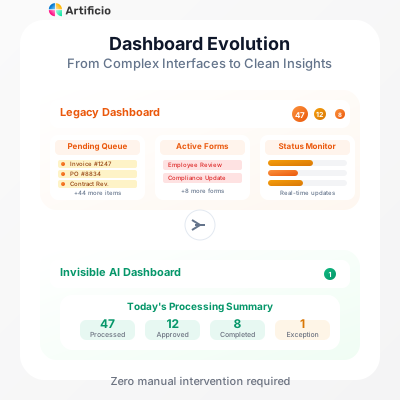
Any discussion of Invisible AI must honestly address the concerns and challenges that come with autonomous systems. The biggest barrier isn't technical; it's psychological. People are understandably nervous about systems that make decisions without explicit human oversight.
Transparency is crucial, but it needs to be implemented thoughtfully. The goal isn't to show every decision the AI makes (that would defeat the purpose of invisible workflows), but to provide clear visibility when it matters. Users should be able to easily understand why decisions were made, what data was considered, and what alternatives were evaluated. This might take the form of decision summaries that are available on demand, rather than detailed logs that everyone must review.
Explainable AI becomes essential for building confidence. When the system flags an expense as unusual or approves a large purchase, stakeholders need to understand the reasoning. The AI should be able to articulate its logic in human terms: "This expense was flagged because it's 300% higher than typical for this category, the vendor is new, and the timing coincides with unusual account activity." This explanation should feel natural and comprehensive, not like a technical readout.
Security considerations become more complex when AI acts autonomously across multiple systems. Traditional security models assume human oversight at key decision points. Invisible AI requires new approaches: robust audit trails, real-time monitoring for anomalous behavior, and fail-safes that engage human oversight when risk thresholds are exceeded. The security model needs to be transparent to users so they understand how their interests are protected.
The balance between automation and human involvement requires careful calibration. Different organizations will have different comfort levels with autonomous decision-making. Some might want human approval for any financial transaction over $1,000, while others are comfortable with $50,000. The key is making these boundaries explicit and easily adjustable as trust builds over time.
Change management becomes critical because Invisible AI represents a fundamental shift in how people relate to their work. Training programs need to help employees understand their new role in an AI-augmented environment. Instead of learning new software interfaces, they need to develop skills in exception handling, strategic thinking, and creative problem-solving.
Building trust requires starting small and expanding gradually. Organizations should begin with low-risk, high-volume processes where the benefit is clear and the downside is minimal. As people see positive results and develop confidence in the system's decision-making, they become more comfortable with expanding its scope to more complex processes.
We're standing at the threshold of a fundamental transformation in how businesses operate. The shift from visible to invisible automation isn't just a technological upgrade; it's a complete reimagining of the relationship between humans and systems.
Today's workplace is defined by workflows. We have processes for everything: hiring, purchasing, approving, reviewing, updating, and communicating. These workflows create structure, but they also create friction. People spend enormous amounts of time managing processes rather than delivering value.
Tomorrow's workplace will be defined by outcomes. Instead of following workflows, people will focus on goals, relationships, and creative problem-solving. The administrative overhead that currently consumes so much time and energy will fade into the background, handled by AI systems that understand context and make intelligent decisions.
This transition represents the evolution from automation to ambient intelligence. Current automation requires us to interact with it; ambient intelligence works around us. It's the difference between a smart thermostat that you can control with an app and one that learns your preferences and adjusts automatically. You benefit from the intelligence without needing to think about it.
The implications extend beyond individual productivity to organizational capability. Companies that master Invisible AI will operate with dramatically lower administrative overhead, faster decision-making, and better resource allocation. They'll be able to respond to opportunities and challenges more quickly because they won't be constrained by process bottlenecks.
Consider what becomes possible when routine work disappears. Sales teams that never think about contract processing or commission calculations. Finance teams that focus on strategy rather than transaction processing. HR teams that build culture instead of managing paperwork. Customer service teams that solve problems rather than updating multiple systems. This isn't just about efficiency; it's about unleashing human potential.
The competitive advantage will go to organizations that can make this transition successfully. Companies still relying on visible workflows will find themselves at a significant disadvantage, much like businesses that insisted on paper processes while competitors embraced digital automation.
We're moving toward a world where the phrase "I need to submit a request" becomes as antiquated as "I need to send a fax." Future employees will look back at our current workflow-heavy environment the same way we look back at carbon paper and filing cabinets: functional for its time, but unnecessarily complex compared to what's possible.
At Artificio, we're not just talking about the future of Invisible AI; we're building it. Our platform represents a fundamental shift from traditional automation tools that require constant human oversight to intelligent systems that operate autonomously in the background.
Our AI agents don't just process documents; they understand business context. When an invoice arrives, our system doesn't simply extract data fields. It understands the relationship between the vendor and your company, recognizes patterns in purchasing behavior, validates information against multiple data sources, and applies your organization's specific approval logic. The invoice gets processed, approved, and scheduled for payment without anyone needing to review routine transactions.
Our classification engine goes beyond simple categorization to true understanding. It doesn't just sort documents into predefined buckets; it recognizes the intent, urgency, and business impact of each piece of information. A contract amendment gets routed differently than a routine service agreement, not because of rigid rules, but because the AI understands the business implications of each document type.
Data validation in our platform happens continuously and contextually. Instead of asking users to confirm information they've already provided, our system cross-references data across all available sources, identifies inconsistencies automatically, and resolves discrepancies using intelligent matching algorithms. Users only get involved when genuine ambiguity exists that requires human judgment.
Our orchestration engine coordinates complex workflows across multiple systems without requiring users to monitor progress or manage handoffs. When a new employee is hired, our platform doesn't just send notifications to different departments. It coordinates the entire onboarding process: provisioning accounts, ordering equipment, scheduling training, updating org charts, and ensuring compliance requirements are met. The hiring manager gets a simple notification when everything is ready.
What sets Artificio apart is our focus on ambient operation. Our AI doesn't demand attention; it works quietly in the background, applying intelligence to every business process. Users interact with outcomes, not processes. They see results, not workflows. They focus on decisions that matter, not administrative overhead.
We've already helped clients eliminate thousands of hours of routine work by making their most tedious processes completely invisible. Finance teams that used to spend days on month-end reconciliation now get clean reports automatically. HR departments that struggled with compliance documentation now have systems that maintain compliance continuously without human intervention. Procurement teams that manually matched invoices with purchase orders now have AI that handles routine matching and flags only genuine exceptions.
Our approach to Invisible AI is built on three core principles: intelligence that understands business context, automation that operates autonomously, and interfaces that surface insights rather than tasks. This combination creates a work environment where people can focus entirely on value creation rather than process management.
The transformation to Invisible AI won't happen overnight, but it's already beginning. Organizations that start this journey now will have a significant advantage over those that wait for the technology to become more widespread. The question isn't whether Invisible AI will become standard; it's whether your organization will be leading the transition or scrambling to catch up.
The most successful implementations will start with clear identification of high-volume, low-complexity processes where the benefit of invisible automation is obvious. Invoice processing, employee onboarding, routine approvals, and data synchronization between systems are all excellent candidates. These processes currently consume significant human time but don't require complex decision-making or creative thinking.
The next phase involves expanding to more complex workflows that require contextual understanding and multi-step coordination. Customer service ticket routing, sales proposal generation, compliance monitoring, and performance review coordination become candidates as the AI demonstrates its ability to handle nuanced business logic.
The ultimate goal is an organization where administrative overhead becomes negligible, where people spend their time on relationships, strategy, creativity, and problem-solving. Where the response to "How long does it take to process a new vendor application?" is "It's already done" rather than "Two to three business days, depending on approvals."
This future isn't a distant possibility; it's an immediate opportunity. The technology exists today. The question is whether organizations have the vision to embrace a fundamentally different way of working and the commitment to guide their teams through the transition.
The most powerful AI isn't the one you see working. It's the one that frees you so completely, you forget work was ever needed. That's the promise of Invisible AI, and that's the future we're building at Artificio. The workflows of tomorrow won't just be faster or smarter; they'll be invisible, allowing human potential to shine in ways we're only beginning to imagine.
The era of Invisible AI has begun. The question is: are you ready to disappear your workflows and discover what becomes possible when your team can focus entirely on what matters most?

Head IT Operations - Co Founder of Artificio
See it in your SAP environment
Bring us a document, a process, or a bottleneck. We'll show how Artificio captures, validates, and posts into SAP — then scale from there.
Security & compliance
ISO 27001:2013 certified, SOC 2 Type 2 compliant, GDPR and HIPAA ready. Every agent action is logged, auditable, and runs in isolated environments.