

Blog
Form Digitization from physical forms to digital
Instantly digitize paper forms and PDFs with AI. Automate data capture, validation, and workflows for faster, accurate processing.

Blog
Instantly digitize paper forms and PDFs with AI. Automate data capture, validation, and workflows for faster, accurate processing.
We're living in an era where digital transformation has swept through virtually every industry, yet many organizations still find themselves drowning in paper forms and static PDFs. Walk into any bank, hospital, or government office, and you'll witness the same frustrating reality: employees manually transcribing handwritten information from paper forms into digital systems, one field at a time. This isn't just inefficient, it's a massive bottleneck that's costing businesses time, money, and accuracy.
The statistics paint a stark picture. Studies show that knowledge workers spend up to 40% of their time on manual data entry tasks, with form processing being one of the biggest culprits. In healthcare alone, administrative staff spend an average of 16 minutes per patient intake form, manually entering data that could be processed instantly with the right technology. Banking institutions process millions of loan applications annually, many still requiring multiple staff members to manually extract and verify information from paper documents. The hidden costs add up quickly: increased labor expenses, higher error rates, delayed processing times, and frustrated customers waiting for approvals that should take minutes, not days.
But what if there was a way to bridge this gap between the physical and digital worlds? What if you could take any paper form, PDF document, or scanned image and instantly transform it into a smart, automated digital workflow that not only captures data accurately but also triggers the right actions, validations, and approvals automatically? This isn't science fiction, it's the reality that AI-powered form digitization is making possible today.
At Artificio, we've developed a solution that eliminates the traditional barriers between paper-based processes and digital automation. Our AI form automation technology can scan or upload any form and convert it into a fully functional, intelligent digital workflow in minutes rather than weeks. This represents a fundamental shift in how organizations can approach their document processing challenges, moving from reactive manual entry to proactive automated intelligence.
The technology behind AI-powered form digitization combines advanced optical character recognition (OCR) with intelligent form recognition capabilities that go far beyond simple text extraction. When you upload a scanned document, PDF, or photograph of a physical form to Artificio's platform, our AI doesn't just read the text, it understands the context, structure, and relationships within the document.
Traditional OCR technology has been around for decades, but it typically produces unstructured text output that still requires significant manual intervention to organize and process. Modern AI form digitization takes this several steps further. Our system analyzes the visual layout of the document, identifies different types of form elements, and understands the logical relationships between them. It can distinguish between text input fields, checkboxes, radio buttons, dropdown menus, tables, and even complex conditional sections that depend on previous answers.
The process begins the moment you upload your document. Artificio's AI immediately starts analyzing the visual structure, looking for patterns that indicate form fields, labels, and data entry areas. It identifies text fields by recognizing blank spaces, underlines, or boxes designed for user input. Checkboxes and radio buttons are detected through their distinctive visual markers. Tables are recognized by their grid structure and column headers. Even handwritten content is processed and interpreted with impressive accuracy.
The real innovation lies in the contextual understanding. The AI doesn't just recognize that there's a text field, it understands what that field is for based on nearby labels, its position in the document, and common form patterns. A field labeled "Social Security Number" near the top of a government form is automatically configured with appropriate validation rules, formatting requirements, and security considerations. A date field is recognized not just as text, but as a date input that should include calendar controls and date range validations.
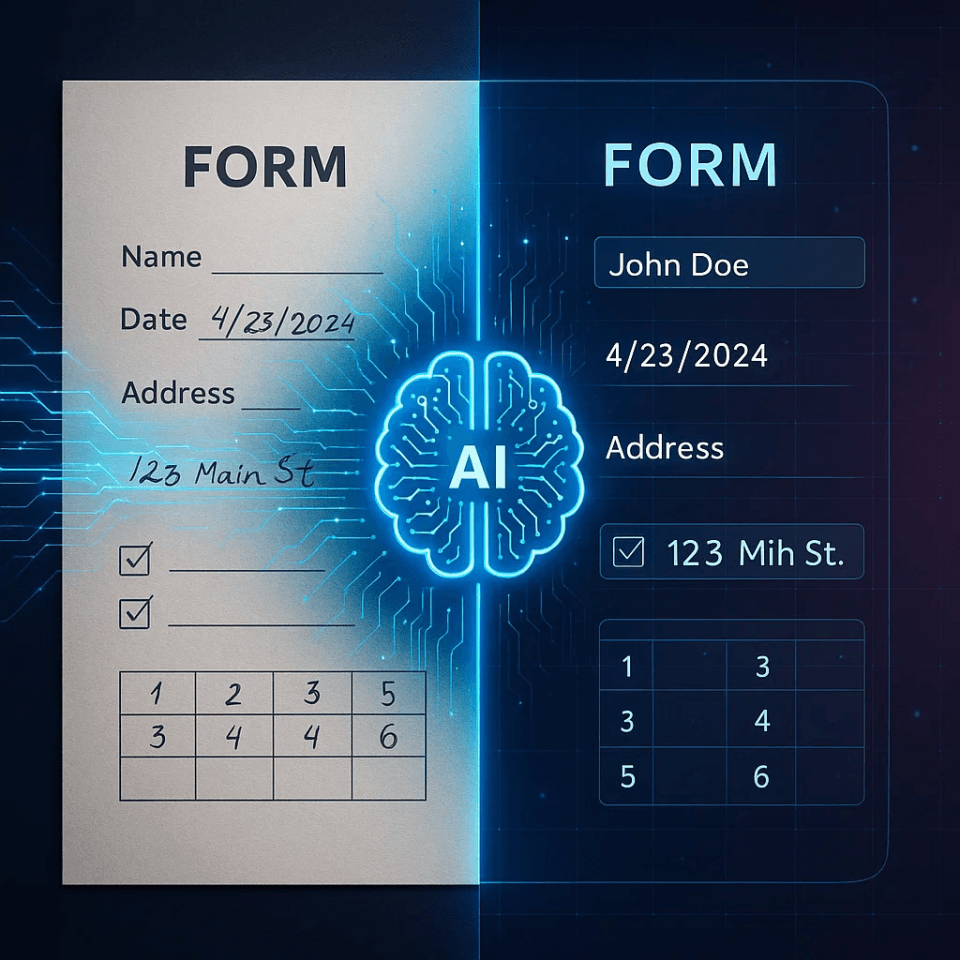
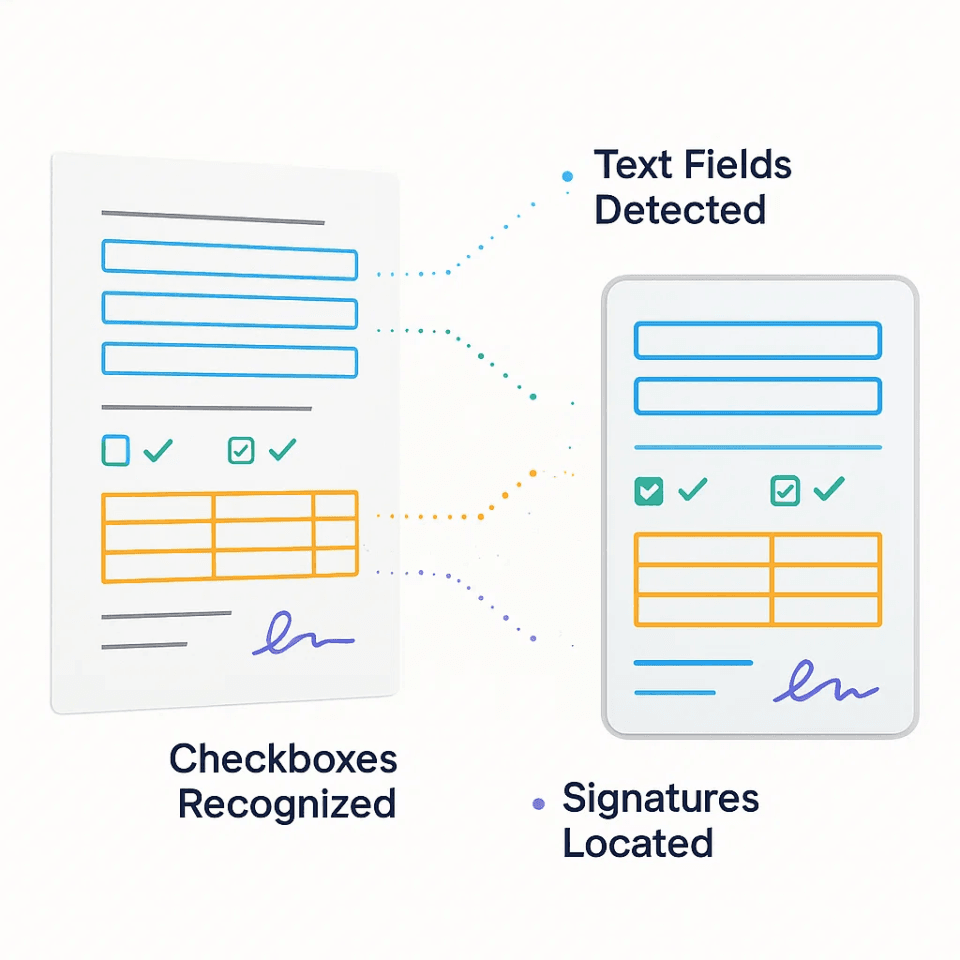
The output of this process is remarkable: a fully functional, editable digital form that maintains all the logic and structure of the original document. But it goes beyond mere replication. The digitized form includes smart validations, conditional logic, and integration capabilities that were impossible with the original paper version. Required fields are automatically marked, data types are enforced, and business rules are applied based on the form's apparent purpose and industry context.
This level of intelligent form recognition is made possible by machine learning models trained on millions of documents across various industries and use cases. The AI has learned to recognize patterns specific to loan applications, medical intake forms, government permits, HR onboarding documents, and countless other form types. This training allows it to make intelligent assumptions about field purposes, validation requirements, and workflow connections that would otherwise require hours of manual configuration.
The technology also handles complex scenarios that traditional digitization approaches struggle with. Multi-page forms are processed as cohesive units, with relationships maintained between sections. Conditional branching (where certain sections only appear based on previous answers) is detected and replicated in the digital version. Tables with dynamic rows are converted into flexible digital structures that can expand as needed. Even signature fields are identified and converted into digital signature capture areas.
The transformation from static paper document to dynamic digital workflow follows a streamlined process that democratizes automation for users regardless of their technical expertise. Understanding this journey reveals how AI form digitization can revolutionize document processing across any organization.
The process begins with the simplest possible action: uploading your document. Whether you're working with a crisp PDF file, a smartphone photo of a paper form, or a scanned document with less-than-perfect quality, Artificio's platform is designed to handle real-world scenarios. The upload interface accepts multiple file formats and automatically optimizes image quality for processing. Users can upload single documents or batch process hundreds of forms simultaneously, making it practical for both individual use cases and large-scale digitization projects.
The system is particularly robust when dealing with imperfect source materials. Forms that have been photocopied multiple times, documents with handwritten annotations, or forms captured with mobile phone cameras in suboptimal lighting conditions are all processed effectively. This flexibility is crucial because many organizations deal with forms that arrive through various channels and in various conditions.
Once uploaded, Artificio's AI begins its comprehensive analysis of the document. This phase involves multiple layers of processing that happen simultaneously. The visual analysis engine examines the layout, identifying form elements through pattern recognition. The text analysis component extracts and interprets all textual content, including labels, instructions, and any pre-filled information. The contextual analysis layer draws on industry-specific knowledge to understand the form's purpose and requirements.
During this phase, the AI also identifies relationships between different parts of the form. It recognizes when certain sections are dependent on answers in other sections, when fields should be grouped together for logical flow, and when specific validation rules should apply based on the form's apparent function. For example, if the AI identifies a form as a loan application, it automatically applies financial industry validation rules, compliance requirements, and typical workflow patterns associated with lending processes.
The intelligence extends to understanding implicit requirements that aren't explicitly stated in the original form. A field asking for an email address will automatically include email format validation. A phone number field will be configured to accept various phone number formats. Date fields will include appropriate range restrictions based on context. A birth date field will have different valid ranges than an application deadline field.
The output of the AI analysis is a sophisticated digital form that goes far beyond simple field replication. Each identified element is converted into an appropriate digital component with built-in intelligence. Text fields include format validation, character limits, and input guidance. Selection elements like checkboxes and radio buttons maintain their logical groupings and mutual exclusivity rules. Tables become dynamic structures that can expand or contract as needed.
Field mapping is automatically generated based on the AI's understanding of the form's structure and purpose. This mapping doesn't just connect form fields to database columns, it creates intelligent relationships that support advanced features like auto-population, cross-field validation, and conditional display logic. The system can recognize when multiple fields should be treated as a group, such as address components, and automatically configure them to work together.
Compliance validations are built in from the start. The AI recognizes form types that are subject to specific regulatory requirements and automatically applies appropriate validation rules. Healthcare forms include HIPAA compliance considerations, financial forms incorporate relevant banking regulations, and government forms include necessary verification steps. This automatic compliance configuration saves significant time and reduces the risk of overlooking critical requirements.
Conditional branching logic is one of the most powerful features of the digitization process. The AI can identify sections of the original form that should only appear under certain conditions and automatically configure the digital version to show or hide sections based on user responses. This creates a more intuitive user experience while maintaining the comprehensive nature of the original form.
The real power of AI form digitization becomes apparent when the newly created digital form is connected to automated workflows. Artificio's platform includes pre-built integrations with common business systems and the ability to create custom workflow connections through a visual, no-code interface. This means that form submissions can automatically trigger appropriate actions without any manual intervention.
Approval workflows are automatically suggested based on the form type and content. A loan application form might trigger a multi-stage approval process involving credit checks, document verification, and final approval decisions. An HR onboarding form could automatically initiate background checks, equipment ordering, and training schedule coordination. Government permit applications might trigger review processes that involve multiple departments and compliance checkpoints.
Notification systems are intelligently configured to keep relevant stakeholders informed at each stage of the process. Form submitters receive confirmation and status updates. Reviewers are notified when items require their attention. Managers receive summary reports on processing volumes and completion rates. All of these communications are automatically generated based on the form's purpose and organizational structure.
Analytics capabilities are built into every digitized form from day one. The system automatically tracks completion rates, identifies common points where users abandon the process, and measures processing times at each stage. This data provides valuable insights for continuous improvement and helps organizations optimize their processes over time.
While the AI-generated form is often ready to use immediately, Artificio's platform includes comprehensive customization capabilities that don't require programming skills. Users can refine field properties, adjust validation rules, modify workflow triggers, and enhance the user interface through an intuitive visual editor. This flexibility ensures that the digitized form can be adapted to specific organizational needs without requiring technical expertise.
The customization interface presents all available options in plain language, making it accessible to business users who understand their processes but may not have technical backgrounds. Changes can be made and tested in real-time, with immediate preview capabilities that show how modifications will affect the end-user experience. Version control ensures that changes can be rolled back if needed, and change tracking maintains an audit trail of all modifications.
The versatility of AI form digitization becomes clear when examining how different industries leverage this technology to solve specific challenges and improve operational efficiency. Each sector brings unique requirements, compliance considerations, and workflow complexities that demonstrate the adaptability and power of intelligent form automation.
Financial institutions process enormous volumes of forms daily, from simple account opening applications to complex loan documents spanning dozens of pages. Traditional processing requires specialized staff to manually review each document, extract relevant information, verify data accuracy, and input details into multiple systems. This approach is not only time-intensive but also prone to errors that can have significant compliance and customer satisfaction implications.
AI form digitization transforms this landscape dramatically. Loan application forms that previously required 45 minutes of manual processing can now be digitized and routed automatically in under two minutes. The AI recognizes standard financial form elements like income verification sections, asset declarations, and liability statements, automatically applying appropriate validation rules and compliance checks. Know Your Customer (KYC) forms are processed with built-in identity verification workflows that can trigger automated background checks and document verification processes.
The impact extends beyond simple time savings. Automated processing ensures consistent application of underwriting criteria, reducing the risk of human error in critical lending decisions. Compliance documentation is automatically generated and maintained, creating comprehensive audit trails that satisfy regulatory requirements. Customer experience improves dramatically as application status updates are provided in real-time, and approval decisions can be communicated much faster than traditional manual processes allow.
Credit card applications represent another area where AI form digitization delivers significant value. These forms often include complex conditional sections where additional information is required based on income levels, employment status, or credit history. The AI automatically configures these conditional logic patterns, ensuring that applicants only see relevant questions while maintaining comprehensive data collection for underwriting purposes.
Healthcare organizations face unique challenges in form processing, dealing with everything from patient intake forms to insurance claims and prior authorization requests. The stakes are particularly high in healthcare, where delays in processing can directly impact patient care, and accuracy requirements are stringent due to regulatory compliance and patient safety considerations.
Patient intake forms are often the first interaction between healthcare providers and patients, setting the tone for the entire care experience. Traditional paper-based intake processes create bottlenecks in waiting rooms and require significant staff time to transfer information into electronic health record systems. AI form digitization eliminates these bottlenecks by enabling patients to complete intake forms digitally, with responses automatically integrated into clinical systems.
The technology proves particularly valuable for complex medical forms that include conditional branching based on symptoms, medical history, or treatment requirements. A cardiology intake form might include different question sets based on whether the patient is experiencing chest pain, has a family history of heart disease, or is taking specific medications. The AI recognizes these patterns and automatically configures the digital form to present appropriate questions based on initial responses.
Insurance claim forms represent another significant use case where AI form digitization delivers measurable benefits. These forms often require detailed coding, prior authorization documentation, and precise formatting to ensure timely processing and payment. The AI can recognize standard claim form elements, automatically populate common fields based on patient and provider information, and ensure that all required documentation is collected before submission.
Prior authorization forms are particularly challenging in traditional manual processes, often requiring clinical staff to spend significant time completing repetitive documentation. AI form digitization can streamline these processes by automatically pulling relevant patient information from electronic health records, applying appropriate clinical coding, and ensuring that all regulatory requirements are met before submission to insurance providers.
Government agencies and educational institutions often manage some of the most complex form processing requirements, dealing with everything from permit applications to student enrollment forms. These organizations typically serve large, diverse populations with varying levels of technical comfort, making the transition from paper to digital forms particularly challenging.
Building permit applications exemplify the complexity that government agencies face in form processing. These applications often require detailed technical specifications, multiple approval stages, and coordination between various departments. Traditional processing can take weeks or months, involving multiple manual handoffs and frequent requests for additional information. AI form digitization can dramatically accelerate these processes by automatically routing applications to appropriate departments, flagging incomplete submissions before they enter the review process, and maintaining comprehensive status tracking throughout the approval workflow.
Educational institutions face similar challenges with enrollment and financial aid forms. These documents often include complex eligibility requirements, conditional sections based on residency or income status, and integration requirements with multiple administrative systems. The AI can recognize standard educational form patterns, automatically apply eligibility criteria, and trigger appropriate follow-up processes based on student responses.
Professional licensing applications represent another area where AI form digitization provides significant value. These forms often require extensive documentation of education, experience, and continuing education credits. The AI can recognize credential verification requirements, automatically check for completeness, and trigger appropriate verification processes with educational institutions and professional organizations.
Large enterprises face unique form processing challenges related to scale, standardization, and integration with existing business systems. HR departments alone might process thousands of forms annually, including new hire onboarding, performance reviews, training requests, and expense reports. The volume and variety of these forms make manual processing increasingly unsustainable as organizations grow.
HR onboarding forms provide an excellent example of how AI form digitization can streamline complex internal processes. New employee paperwork often includes dozens of forms covering everything from tax withholding to benefits enrollment and equipment requests. Traditional processing requires HR staff to manually review each form, verify information accuracy, and coordinate with multiple departments to complete the onboarding process. AI form digitization can automate much of this coordination, automatically triggering equipment orders, benefits enrollment, and training schedule coordination based on new hire responses.
Procurement forms represent another significant use case where AI form digitization delivers operational benefits. Purchase requisitions, vendor applications, and contract review forms often require approval workflows that involve multiple stakeholders and compliance checkpoints. The AI can automatically route these forms to appropriate reviewers based on dollar amounts, vendor categories, or contract terms, significantly accelerating procurement cycles while maintaining appropriate oversight.
Expense reporting is an area where AI form digitization can eliminate significant administrative overhead. Traditional expense reports require employees to manually categorize expenses, attach receipts, and obtain appropriate approvals. The AI can recognize common expense categories, automatically extract information from receipt images, and route reports to appropriate managers based on company policies and spending thresholds.

The transformation from paper-based processes to AI-driven workflows represents more than just technological advancement, it fundamentally changes how organizations operate, compete, and serve their stakeholders. Understanding the broader implications of this shift reveals why AI form digitization is becoming essential for modern business operations.
The most immediately apparent benefit of AI form digitization is the dramatic reduction in processing times. Where traditional manual processes might take days or weeks to complete, automated workflows can often finish the same tasks in minutes or hours. This acceleration isn't just about efficiency, it creates competitive advantages that can transform entire business models.
Consider the lending industry, where loan approval times directly impact customer satisfaction and market competitiveness. Banks that can process loan applications in hours rather than days gain significant advantages in customer acquisition and retention. The speed improvement comes not just from eliminating manual data entry, but from automating the entire workflow chain. Credit checks, income verification, and risk assessment can all be triggered automatically as soon as a complete application is submitted, with results compiled and reviewed without human intervention for straightforward cases.
The acceleration extends beyond individual transactions to organizational agility. Companies that can quickly adapt their forms and workflows to new business requirements, regulatory changes, or market opportunities gain significant competitive advantages. Traditional form development and deployment cycles that might take months can be compressed into days or weeks when AI handles the initial digitization and workflow configuration.
In customer-facing scenarios, speed improvements translate directly into enhanced customer experience. Healthcare patients no longer wait in long lines to complete paperwork, they can handle intake forms digitally before arriving for appointments. Government permit applicants can receive real-time status updates instead of waiting weeks for manual processing updates. Financial services customers can receive immediate application confirmations and much faster approval decisions.
Manual data entry is inherently error-prone, with studies showing error rates between 1% and 5% even among experienced data entry professionals. In high-stakes environments like healthcare or financial services, even small error rates can have significant consequences. AI form digitization dramatically reduces these error rates while simultaneously improving data quality and consistency.
The accuracy improvements come from multiple sources. Automated data extraction eliminates transcription errors that occur when humans manually transfer information from paper forms to digital systems. Intelligent validation rules catch errors at the point of entry rather than discovering them later in the process. Standardized data formats ensure consistency across all submissions, making downstream processing more reliable and efficient.
Beyond simple accuracy, AI form digitization improves data completeness and quality. The system can identify incomplete submissions before they enter processing workflows, automatically request missing information from submitters, and ensure that all required documentation is collected. This front-end validation prevents the delays and frustrations associated with incomplete submissions discovered late in the review process.
Compliance assurance represents another critical accuracy benefit. Different industries and jurisdictions have specific requirements for data collection, validation, and processing. AI form digitization can automatically apply these requirements, ensuring that forms meet regulatory standards without requiring specialized compliance expertise from end users. This automated compliance reduces legal risks while ensuring that organizations meet their regulatory obligations consistently.
Traditional form processing requires linear scaling. Processing twice as many forms typically requires twice as many staff members. AI form digitization breaks this linear relationship, enabling organizations to handle significantly increased volumes without proportional resource increases. This scalability advantage becomes particularly important during growth periods or seasonal volume spikes.
The scalability benefits extend beyond simple volume handling to encompass complexity and variety. Organizations can digitize and automate new form types without requiring additional specialized staff or extensive training programs. The AI handles the initial analysis and configuration, with business users providing guidance and refinement as needed. This capability enables organizations to expand their service offerings or enter new markets without massive administrative overhead increases.
Geographic scalability is another important consideration. Organizations operating across multiple locations or jurisdictions can standardize their form processing approaches while accommodating local requirements and regulations. The AI can be configured to apply location-specific validation rules and compliance requirements automatically, ensuring consistency while meeting local needs.
Perhaps the most strategic benefit of AI form digitization is its contribution to organizational resilience and adaptability. Traditional paper-based processes create brittleness, they're difficult to modify, scale, or adapt to changing requirements. Digital workflows, by contrast, can be modified quickly to accommodate new business needs, regulatory changes, or market opportunities.
The adaptability extends to integration capabilities. As organizations adopt new business systems or upgrade existing platforms, digitized forms can be reconnected to new systems with minimal disruption. This integration flexibility reduces the total cost of ownership for business systems while enabling organizations to take advantage of new technologies as they become available.
Remote work capabilities have become increasingly important, and AI form digitization provides the foundation for location-independent operations. Staff can process forms and manage workflows from anywhere with internet access, enabling business continuity during disruptions and access to global talent pools. This flexibility proved particularly valuable during recent global disruptions, when organizations with digital workflows could continue operating while those dependent on paper processes faced significant challenges.
Innovation enablement represents a longer-term strategic benefit. Organizations with comprehensive digital workflows can more easily implement new technologies like artificial intelligence, machine learning, and advanced analytics. The structured data generated by digitized forms provides the foundation for predictive analytics, process optimization, and automated decision-making that can drive continuous improvement and competitive advantage.
Embarking on your AI form digitization journey with Artificio is designed to be straightforward and immediately productive, regardless of your organization's size, technical expertise, or current level of digital maturity. The platform's approach prioritizes quick wins while building toward comprehensive workflow transformation.
The onboarding process begins with a simple upload action that immediately demonstrates the platform's capabilities. You don't need to start with your most complex forms or highest-volume processes. Beginning with a representative sample allows you to experience the technology's capabilities firsthand while building confidence in the approach. Many organizations start by digitizing forms that are causing immediate pain points, such as applications that require frequent manual follow-up or documents with high error rates in manual processing.
The upload interface is designed to handle real-world scenarios from day one. Whether you're working with crisp digital PDFs or smartphone photos of crumpled paper forms, the system provides consistent, reliable results. Batch upload capabilities mean you can process multiple related forms simultaneously, such as different versions of the same application or forms from different departments that serve similar functions.
Once uploaded, the AI analysis happens automatically in the background. You don't need to configure settings, train models, or specify field types. The system handles these technical details while providing transparent feedback about what it's discovering in your documents. The analysis typically completes within minutes, even for complex multi-page forms, giving you immediate insight into how the technology will transform your specific processes.
The customization phase is where business users can apply their domain expertise to refine the AI's initial analysis. The interface presents options in business terms rather than technical jargon, making it accessible to process owners who understand their workflows but may not have technical backgrounds. Changes are applied in real-time with immediate preview capabilities, so you can see exactly how modifications will affect the end-user experience.
The time savings delivered by AI form digitization compound quickly across organizational processes. Individual forms that previously required 30-45 minutes of manual processing can often be handled in 2-3 minutes with automated workflows. But the real transformation occurs when these time savings are multiplied across hundreds or thousands of form submissions annually.
Organizations typically see immediate productivity improvements in their first week of implementation. Staff members who previously spent hours each day on manual data entry can redirect their time toward higher-value activities like customer service, analysis, and process improvement. This productivity shift often pays for the technology investment within the first few months while delivering ongoing operational benefits.
The time savings extend beyond initial processing to downstream activities. Automated validation and compliance checking reduce the time spent on error correction and rework. Integrated workflows eliminate the handoff delays that occur when forms must be manually routed between departments or systems. Real-time status tracking reduces the time spent responding to status inquiries from customers or internal stakeholders.
Perhaps most importantly, the time savings enable faster response to business opportunities and challenges. Organizations can deploy new forms or modify existing processes in days rather than months, enabling rapid adaptation to market changes, regulatory requirements, or customer needs. This agility advantage becomes increasingly valuable in dynamic business environments where speed of response can determine competitive success.
Artificio's platform is designed to deliver immediate value while building toward comprehensive workflow transformation. Early implementations often focus on specific pain points or high-impact processes that can demonstrate clear benefits quickly. These initial successes build organizational confidence and provide the foundation for expanding automation to additional processes.
The platform's analytics capabilities provide continuous insight into process performance and improvement opportunities. You can track processing times, identify bottlenecks, and measure user satisfaction from day one. This data-driven approach enables continuous optimization and helps justify expanded implementation based on measurable results.
Integration capabilities ensure that your AI form digitization implementation can grow with your organization's needs. Starting with standalone forms that improve specific processes, you can gradually connect these forms to broader workflow automation, business intelligence, and customer relationship management systems. This evolutionary approach allows organizations to realize benefits immediately while building toward comprehensive digital transformation.
Training and support resources are designed to accelerate your success with the platform. Comprehensive documentation, video tutorials, and direct support access ensure that you can maximize the platform's capabilities from the beginning. Regular platform updates and new feature releases provide ongoing value without requiring additional investment or implementation effort.
The journey from paper-based processes to intelligent digital workflows represents one of the most impactful transformations available to modern organizations. With Artificio's AI form digitization platform, this transformation is not only possible but practical and immediate. The technology eliminates the traditional barriers that have prevented organizations from fully digitizing their processes while providing the intelligence and automation capabilities that drive real competitive advantage.
Whether you're processing dozens of forms monthly or thousands daily, whether you're working with simple applications or complex multi-stage approval workflows, AI form digitization can transform your operations. The combination of artificial intelligence, workflow automation, and no-code customization creates a powerful platform for organizational improvement that scales with your needs and adapts to your changing requirements.
The future belongs to organizations that can operate with the speed, accuracy, and agility that digital processes enable. AI form digitization with Artificio provides the foundation for this future, transforming static documents into intelligent workflows that drive productivity, compliance, and customer satisfaction. The question isn't whether to embrace this transformation, it's how quickly you can implement it to gain competitive advantage in your market.
Start your transformation today. Upload your first form, experience the AI analysis process, and see how quickly your organization can move from paper-based bottlenecks to intelligent automation. The technology is ready, the benefits are proven, and your competitive advantage is waiting to be unlocked.

Head IT Operations - Co Founder of Artificio
See it in your SAP environment
Bring us a document, a process, or a bottleneck. We'll show how Artificio captures, validates, and posts into SAP — then scale from there.
Security & compliance
ISO 27001:2013 certified, SOC 2 Type 2 compliant, GDPR and HIPAA ready. Every agent action is logged, auditable, and runs in isolated environments.