

Blog
Building a Digital Mailroom with AI Agents
Learn how an AI-powered Digital Mailroom transforms document processing by using AI agents for intelligent capture, classification, and routing.

Blog
Learn how an AI-powered Digital Mailroom transforms document processing by using AI agents for intelligent capture, classification, and routing.
In today's fast-paced business environment, organizations are drowning in a tsunami of documents arriving through multiple channels. Physical mail still lands on reception desks, email inboxes overflow with attachments, web portals collect digital submissions, and mobile apps generate a constant stream of documentation requests. Traditional mailrooms, once the nerve center of corporate communication, have become antiquated bottlenecks that can't keep pace with modern business demands. This is where the concept of a Digital Mailroom emerges as a strategic transformation that goes far beyond simple digitization.
A Digital Mailroom represents a fundamental reimagining of how organizations handle incoming documents and communications. It's not just about scanning paper documents or organizing email attachments. Instead, it's an intelligent ecosystem that uses artificial intelligence to automatically capture, classify, extract valuable data from, and route documents to the right people and systems at the right time. Think of it as having a team of highly skilled mail clerks who never sleep, never make mistakes, and can process thousands of documents simultaneously while learning and improving with each interaction.
The strategic importance of implementing a Digital Mailroom can't be overstated in our increasingly digital-first world. Organizations that cling to traditional mailroom operations find themselves at a significant competitive disadvantage, struggling with processing delays, compliance risks, and the mounting costs of manual document handling. Meanwhile, forward-thinking companies are leveraging AI-powered Digital Mailrooms to accelerate their document workflows, reduce operational costs, and create seamless experiences for both employees and customers.
What makes today's Digital Mailroom particularly powerful is the integration of specialized AI agents that work together like a well-orchestrated team. These aren't generic automation tools, but purpose-built intelligent systems that understand the nuances of document processing, from recognizing the difference between an invoice and a contract to knowing which approvals are needed for sensitive documents. The result is a transformation that touches every aspect of an organization's document lifecycle, creating ripple effects of efficiency that extend far beyond the mailroom itself.
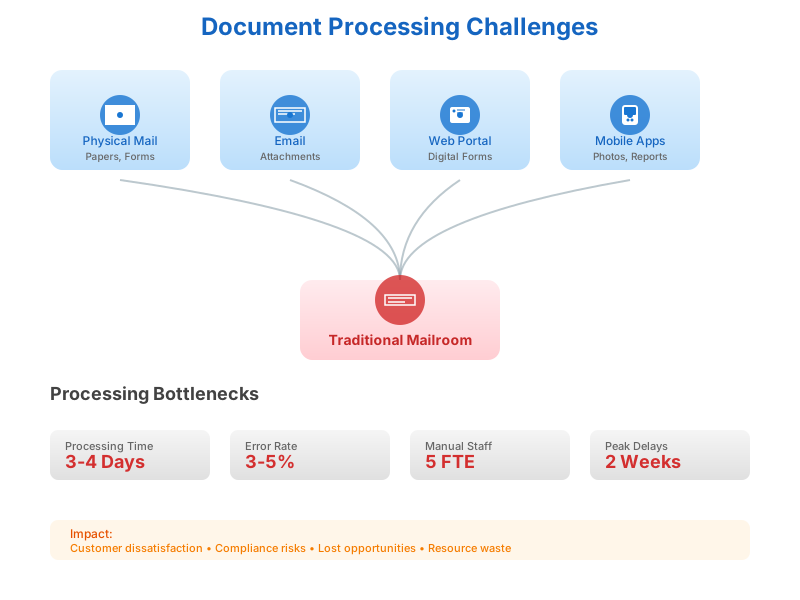
Modern businesses face an unprecedented challenge when it comes to document management. The sheer volume of incoming communications has exploded, but what's even more problematic is the fragmentation across multiple channels. A single customer might submit an insurance claim through a mobile app, follow up via email with additional documentation, and then call to provide verbal updates that need to be documented. Each of these touchpoints creates separate data streams that traditional mailroom operations struggle to connect and process cohesively.
Physical mail continues to play a significant role in many industries, particularly in sectors like healthcare, finance, and legal services where regulatory requirements or customer preferences still drive paper-based communications. These documents arrive in various formats, sizes, and conditions. Some are handwritten forms that require careful interpretation, while others are printed documents with varying quality that can challenge even the most sophisticated optical character recognition systems. The manual sorting, opening, scanning, and initial processing of these documents consumes enormous amounts of time and human resources.
Email attachments present their own unique set of challenges. Unlike physical mail that arrives in predictable batches, email flows continuously throughout the day, creating an always-on demand for processing attention. Employees spend countless hours downloading attachments, determining their relevance and priority, and then manually forwarding them to appropriate departments or systems. The lack of standardization in email formats means that critical information might be buried in the body of an email, contained within an attachment, or split across multiple messages in a conversation thread.
Digital portals and mobile applications have added another layer of complexity to the document intake process. While these channels were designed to streamline submissions, they often create their own silos of information. A customer service portal might capture support tickets with attached screenshots, a vendor portal might collect contract proposals with multiple supporting documents, and a mobile app might generate location-based reports with embedded images and data. Each system typically operates independently, making it difficult to create a unified view of all incoming documents and their processing status.
The bottlenecks created by these fragmented intake processes have far-reaching consequences that extend well beyond simple delays. When documents sit unprocessed or are misrouted to incorrect departments, customer satisfaction suffers, compliance deadlines are missed, and business opportunities can be lost. In regulated industries, the inability to quickly locate and process specific documents can result in substantial fines and regulatory sanctions. The manual effort required to track down documents, verify their authenticity, and ensure proper handling creates a constant drain on human resources that could be better utilized for strategic activities.
Classification and distribution errors represent another significant pain point in traditional mailroom operations. A single misclassified document can trigger a cascade of downstream problems. An urgent contract that gets filed as routine correspondence might miss critical signature deadlines. A compliance document that gets routed to the wrong department might result in missed regulatory reporting requirements. Customer complaints that are incorrectly categorized might not receive the appropriate level of attention and escalation. These errors are particularly costly because they often aren't discovered until significant time has passed, making remediation more difficult and expensive.
The audit and compliance challenges created by fragmented document processing can't be underestimated. Organizations need to maintain detailed records of when documents were received, how they were processed, who accessed them, and what actions were taken. Traditional mailroom operations often rely on manual logging systems or basic digital tracking that creates gaps in the audit trail. When regulators or auditors request specific documents or processing histories, organizations often struggle to provide comprehensive and timely responses, leading to extended audit periods and increased compliance costs.
Artificio's approach to solving the Digital Mailroom challenge centers on deploying specialized AI agents that work together to create a seamless, intelligent document processing ecosystem. Unlike monolithic automation solutions that try to handle every aspect of document processing with a single system, Artificio's multi-agent architecture recognizes that different aspects of mailroom operations require different types of intelligence and expertise.
The Multi-Channel Intake Agent serves as the first point of contact for all incoming documents, regardless of their source or format. This isn't simply a passive collection system, but an active intelligence that can adapt to different document types, sources, and formats in real-time. When a scanned physical document arrives, the agent immediately assesses its quality, orientation, and potential content type. For email attachments, it analyzes not just the attachment itself but also the context provided in the email body, sender information, and conversation history. Digital portal submissions are evaluated for completeness, format compliance, and relationship to other documents in the system.
What makes this intake process particularly powerful is the agent's ability to learn and adapt from each document it processes. Traditional mailroom systems require extensive upfront configuration and struggle to handle variations from expected formats. Artificio's Multi-Channel Intake Agent continuously improves its ability to recognize new document types, adapt to changes in formatting, and identify patterns that indicate priority or special handling requirements. This learning capability means that the system becomes more accurate and efficient over time, rather than requiring constant manual updates and maintenance.
The Document Intelligence Agent represents the analytical brain of the Digital Mailroom system. Once documents are captured by the intake agent, this specialized AI goes to work extracting meaningful information, identifying document types, and understanding the content structure. This goes far beyond simple optical character recognition or basic keyword matching. The agent understands context, can interpret handwritten notes, recognizes signatures and stamps, and can even identify when documents are incomplete or contain inconsistencies that require human attention.
Document classification using AI involves sophisticated pattern recognition that considers not just the text content but also visual layout, formatting patterns, and contextual clues. An invoice from a new vendor might have a completely different format than those from existing suppliers, but the Document Intelligence Agent can still identify it as an invoice based on characteristic patterns like itemized lists, tax calculations, and payment terms. Similarly, a contract amendment might be recognized not just by its content but by its relationship to existing contract documents in the system.
The extraction capabilities of the Document Intelligence Agent extend beyond simple data capture to intelligent interpretation. When processing an insurance claim, for example, the agent doesn't just extract the claim number and dollar amount. It understands the relationship between different data elements, can identify when supporting documentation is missing, and can flag potential inconsistencies that might indicate fraud or errors. This level of intelligent processing dramatically reduces the manual review time required while improving the accuracy and completeness of extracted data.
The Workflow Optimization Agent takes the classified and analyzed documents and makes intelligent routing decisions based on complex business rules, organizational structure, and current workload conditions. This isn't just about sending invoices to accounts payable or contracts to the legal department. The agent considers factors like document priority, approval requirements, current staff availability, and even seasonal workflow patterns to optimize the routing process.
Dynamic routing capabilities allow the system to adapt to changing business conditions in real-time. If a key approver is out of office, the agent can automatically route documents to designated alternates. If a particular department is experiencing high volume periods, the agent might temporarily redistribute workload to available resources in related departments. During audit periods or regulatory deadlines, the agent can automatically prioritize documents that require immediate attention while queuing less urgent items for later processing.
The integration between these three agents creates a synergistic effect where the combined intelligence far exceeds what any single system could achieve. The Multi-Channel Intake Agent's learning about document sources and formats informs the Document Intelligence Agent's classification algorithms. The Document Intelligence Agent's analysis of content complexity and urgency guides the Workflow Optimization Agent's routing decisions. This continuous feedback loop creates a system that becomes more intelligent and efficient with each processed document.
While AI agents can handle the vast majority of Digital Mailroom operations autonomously, the most effective implementations recognize that human expertise remains crucial for handling exceptions, making complex judgment calls, and providing oversight for continuous improvement. Artificio's Exception Resolution Agent is specifically designed to identify situations where human intervention is needed and to facilitate seamless collaboration between AI systems and human experts.
Exception handling in a Digital Mailroom context goes far beyond simply flagging documents that can't be processed automatically. The Exception Resolution Agent uses sophisticated algorithms to predict when human input would add value, even for documents that could be processed automatically. For example, a contract with unusual terms might be technically processable by the AI system, but the agent might recognize that the terms are sufficiently outside normal parameters to warrant human review before routing.
The human-in-the-loop approach implemented by Artificio ensures that people remain in control of critical decisions while allowing AI to handle routine processing tasks. When the Exception Resolution Agent identifies a situation requiring human input, it doesn't just present the raw document and ask for help. Instead, it provides context about why the exception was flagged, suggests possible resolution approaches based on similar past situations, and highlights the specific areas where human expertise is most needed.
This collaborative approach is particularly valuable for handling sensitive or high-value documents where the cost of errors is significant. Legal documents, major contracts, compliance filings, and customer complaints often require nuanced understanding that combines AI efficiency with human judgment. The Exception Resolution Agent can handle the initial processing, data extraction, and preliminary analysis, but then seamlessly hand off to human experts for final review and approval.
The learning aspect of human-AI collaboration creates a powerful feedback loop that continuously improves system performance. When human experts make decisions on exceptions, the Exception Resolution Agent captures not just the decision itself but the reasoning behind it. This information is fed back into the system's learning algorithms, helping to expand the range of situations that can be handled automatically in the future. Over time, this reduces the number of exceptions that require human intervention while ensuring that the AI system's decision-making becomes more aligned with organizational preferences and standards.
Training and change management become much more manageable when human experts can see exactly how AI agents are making decisions and can provide input to improve those decisions. Traditional automation systems often feel like black boxes to the people who work with them, creating resistance and limiting adoption. Artificio's transparent approach to AI decision-making helps build trust and encourages active participation in system improvement.
The Exception Resolution Agent also provides valuable analytics about exception patterns and trends. Organizations can identify recurring issues that might indicate the need for process improvements, training updates, or system configuration changes. This analytical capability transforms exception handling from a reactive process into a proactive tool for continuous improvement.
The implementation of an AI-powered Digital Mailroom delivers measurable benefits that extend far beyond simple processing speed improvements. Organizations typically see dramatic reductions in document processing time, with many routine documents moving from intake to appropriate destination in minutes rather than hours or days. This acceleration has cascading effects throughout the organization, enabling faster customer responses, quicker decision-making, and more agile business operations.
Cost reduction represents one of the most immediately visible benefits of Digital Mailroom implementation. The reduction in manual labor required for document processing can be substantial, but the savings go beyond simple staff time. Organizations often see reductions in physical storage requirements, printing and copying costs, and the overhead associated with managing multiple disparate document processing systems. The elimination of duplicate data entry, reduced error correction activities, and decreased time spent searching for misplaced documents all contribute to meaningful cost savings.
Compliance improvements and audit readiness represent critical benefits that can be difficult to quantify but have enormous potential impact. AI-powered Digital Mailrooms create comprehensive audit trails that automatically track every aspect of document processing from initial receipt through final disposition. This detailed logging makes regulatory compliance much more manageable and reduces the time and cost associated with audit preparation and response.
The ability to demonstrate consistent processing procedures and maintain complete documentation of decision-making processes becomes particularly valuable during regulatory examinations or legal proceedings. Organizations can quickly produce detailed reports showing exactly how specific documents were processed, who was involved in decision-making, and what approvals were obtained. This level of documentation sophistication often exceeds regulatory requirements and can provide competitive advantages in regulated industries.
Customer experience improvements often emerge as unexpected but highly valuable benefits of Digital Mailroom implementation. When customer documents are processed quickly and accurately, response times improve dramatically. Customers no longer need to wait days or weeks to hear that their submissions have been received and processed. The improved accuracy of AI-powered processing also reduces the number of times customers need to resubmit documents or provide clarifying information.
The analytical capabilities of AI-powered Digital Mailrooms provide insights that can drive strategic business improvements. Organizations gain visibility into document flow patterns, processing bottlenecks, seasonal variations, and resource utilization that was previously impossible to obtain. This data can inform decisions about staffing levels, process optimization, technology investments, and service level commitments.
Risk reduction represents another significant but often overlooked benefit of Digital Mailroom implementation. The consistent, rule-based processing provided by AI agents reduces the variability in document handling that can create compliance risks or operational vulnerabilities. Sensitive documents are consistently handled according to established protocols, access is automatically logged and controlled, and retention policies are enforced systematically.
The scalability benefits of AI-powered Digital Mailrooms become particularly valuable during periods of rapid business growth or seasonal volume spikes. Traditional mailroom operations require proportional increases in staff and infrastructure to handle volume increases. AI agents can handle dramatic volume increases without requiring additional resources, providing organizations with flexible capacity that can adapt to changing business demands.
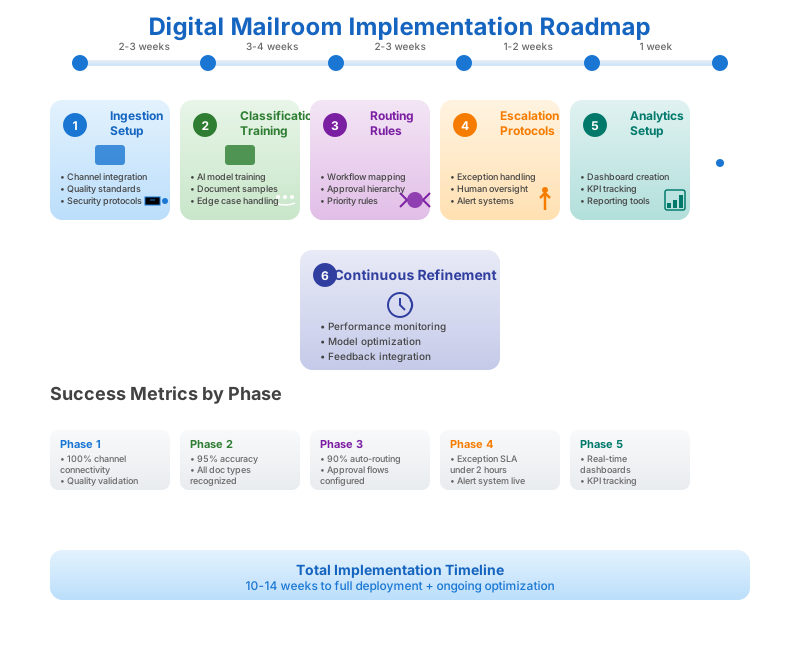
Successful Digital Mailroom implementation requires a strategic approach that goes beyond simply deploying technology. Organizations need to carefully plan their transformation journey, considering current processes, stakeholder needs, regulatory requirements, and long-term business objectives. Artificio's implementation methodology provides a structured approach that minimizes disruption while maximizing the benefits of AI-powered document processing.
The initial phase focuses on establishing robust ingestion channels that can capture documents from all existing sources while providing flexibility for future expansion. This involves more than just technical integration; it requires understanding the current document ecosystem, identifying all sources of incoming documents, and ensuring that the transition to digital processing doesn't create gaps or disruptions in document flow. Organizations often discover document sources they weren't fully aware of during this analysis phase, leading to more comprehensive solutions than originally anticipated.
Setting up ingestion channels requires careful attention to document quality, format standardization, and source authentication. Physical documents need to be scanned at appropriate resolution and format settings to ensure optimal AI processing. Email integration must account for different email systems, attachment formats, and security protocols. Digital portal integrations need to handle various file formats while maintaining data integrity and security standards.
The classification and extraction phase involves training the AI systems to recognize and process the specific types of documents that are most important to the organization. This isn't just about configuring software; it's about understanding the business context and requirements for each document type. Different industries and organizations have unique document processing requirements that must be reflected in the AI system's training and configuration.
Document classification training requires careful curation of sample documents that represent the full range of variations the system will encounter. This includes not just perfect examples of each document type, but also edge cases, poor-quality scans, partially completed forms, and documents that combine multiple types of information. The more comprehensive the training data, the more robust and reliable the AI system's performance will be in production.
Routing rules and approval workflows must be carefully designed to reflect current organizational structure and decision-making processes while providing flexibility for future changes. This involves mapping current approval hierarchies, understanding delegation protocols, and identifying situations where routing decisions require human oversight. The goal is to automate routine routing while ensuring that complex or sensitive documents receive appropriate human attention.
The establishment of escalation and approval protocols requires input from stakeholders throughout the organization. Different departments may have different requirements for document handling, approval processes, and exception management. Legal departments might require different protocols than finance departments, and customer service teams might have different priorities than compliance teams. The routing rules must be sophisticated enough to handle these variations while remaining manageable and auditable.
Analytics and continuous refinement capabilities must be built into the system from the beginning rather than added as an afterthought. Organizations need visibility into system performance, processing metrics, exception rates, and user satisfaction from day one. This data drives ongoing optimization efforts and helps identify opportunities for additional automation or process improvements.
Training and change management represent critical success factors that are often underestimated in Digital Mailroom implementations. Employees need to understand not just how to use the new system, but how their roles and responsibilities are changing. This is particularly important for staff who have been performing manual document processing tasks and need to transition to more strategic, analytical, or exception-handling roles.
The transition period requires careful planning to maintain business continuity while allowing staff to become comfortable with new processes and tools. Organizations often benefit from running parallel processes during initial implementation phases, gradually shifting more document types and volume to the AI-powered system as confidence and competence increase.
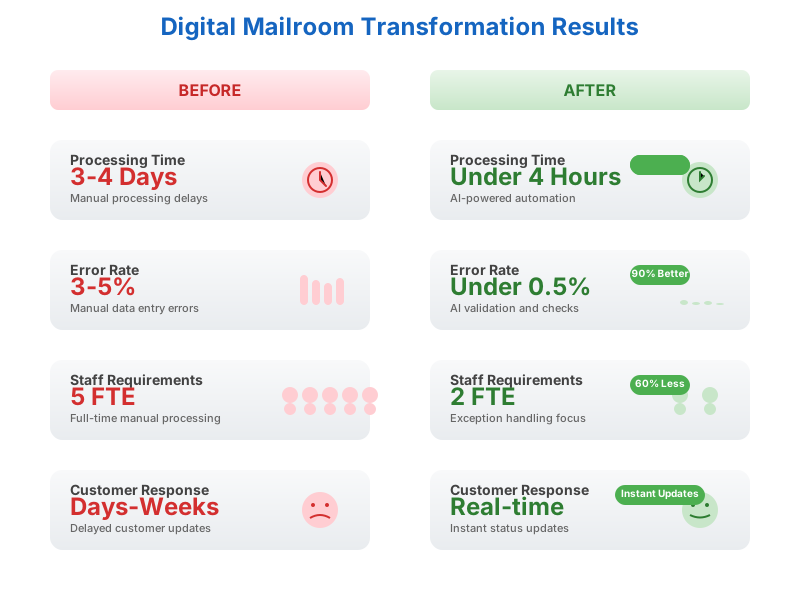
To illustrate the practical impact of AI-powered Digital Mailroom implementation, consider a typical finance department that processes a complex mix of incoming documents from multiple sources. Before implementing Artificio's solution, this department handled approximately 500 documents per day, including paper invoices delivered by mail, PDF invoices sent via email, expense reports submitted through a web portal, and various financial documents uploaded through a mobile application.
The traditional process required a team of five full-time employees to handle document intake, initial sorting, data entry, and routing to appropriate approvers. Paper documents arrived in daily mail batches that required manual opening, sorting, and scanning. Email attachments had to be downloaded, reviewed, and categorized before being entered into the accounting system. Web portal submissions required manual verification and data extraction, while mobile uploads often needed additional processing to handle image quality issues and varying formats.
Processing times for routine invoices averaged 3-4 days from receipt to entry into the accounting system, with more complex documents taking up to two weeks when exceptions or approvals were required. Error rates for manual data entry averaged 3-5%, requiring additional time for error correction and reconciliation. During peak periods, such as month-end or seasonal busy periods, processing delays could extend to several weeks, creating cash flow issues and vendor relationship problems.
The implementation of Artificio's Multi-Channel Intake Agent immediately streamlined the document capture process. Physical mail is now scanned using high-speed scanners integrated directly with the AI system, eliminating the manual sorting and individual document handling that previously consumed significant time. Email attachments are automatically captured and processed as soon as they arrive, removing the manual download and organization steps that created processing backlogs.
The Document Intelligence Agent transformed the classification and data extraction process. Invoice processing that previously required manual review and data entry now happens automatically for about 85% of documents. The AI system can handle variations in invoice formats from different vendors, extract key data elements like invoice numbers, amounts, due dates, and line item details, and even validate mathematical calculations to identify potential errors before they enter the accounting system.
More importantly, the Document Intelligence Agent learned to recognize patterns that indicate potential issues requiring human attention. Invoices with unusual terms, significant variations from historical patterns, or mathematical inconsistencies are automatically flagged for review. This proactive exception handling means that problems are identified and addressed much earlier in the process, reducing the downstream impact of errors or irregularities.
The Workflow Optimization Agent revolutionized the approval and routing process. Instead of documents sitting in physical or digital queues waiting for manual routing decisions, the AI system immediately identifies the appropriate approver based on document type, amount thresholds, vendor relationships, and current workload distribution. The system even learned to account for approver availability, automatically routing to designated alternates when primary approvers are unavailable.
Results from the first year of implementation demonstrated the transformative impact of the AI-powered Digital Mailroom. Average processing time for routine invoices dropped from 3-4 days to under 4 hours, with many documents moving from receipt to system entry in less than one hour. Error rates decreased from 3-5% to less than 0.5%, dramatically reducing the time spent on error correction and reconciliation activities.
The finance team was able to redeploy three of the five full-time employees who previously handled manual document processing to more strategic activities like vendor relationship management, financial analysis, and process improvement initiatives. The two remaining employees now focus on exception handling, system oversight, and the more complex financial documents that require human expertise and judgment.
Vendor relationships improved significantly due to faster processing times and reduced payment delays. The ability to provide real-time status updates on invoice processing created greater transparency and trust with key suppliers. Customer service improved as well, with the ability to quickly locate and provide information about any submitted document, regardless of its source or processing status.
The comprehensive audit trail created by the AI system proved invaluable during the annual audit process. Auditors were able to quickly access complete processing histories for any document, including timing data, approval records, and exception handling details. What previously required weeks of document gathering and explanation was completed in a few days, reducing audit costs and disruption to normal operations.
The implementation of an AI-powered Digital Mailroom represents more than just an operational efficiency improvement; it's a strategic investment in future-proofing an organization's document processing capabilities. As business environments continue to evolve, organizations with intelligent, adaptable document processing systems will be better positioned to handle new challenges and opportunities.
The learning capabilities built into Artificio's AI agents mean that the system becomes more valuable over time rather than becoming obsolete. As new document types emerge, business processes evolve, or regulatory requirements change, the AI system adapts and incorporates these changes into its processing algorithms. This adaptability provides a significant advantage over traditional automation solutions that require extensive reprogramming or replacement when business conditions change.
The data and insights generated by AI-powered Digital Mailrooms create opportunities for continuous business process improvement that extend far beyond document processing. Organizations gain unprecedented visibility into their document flows, processing patterns, and operational inefficiencies. This information can drive strategic decisions about business process optimization, resource allocation, and customer service improvements.
Integration capabilities with emerging technologies like blockchain for document authenticity verification, advanced analytics for predictive processing, and augmented reality for enhanced human-AI collaboration ensure that Digital Mailroom investments remain relevant as new technologies emerge. Artificio's platform is designed to accommodate these integrations without requiring complete system replacement or major disruption to existing operations.
The scalability and flexibility of AI-powered Digital Mailrooms provide organizations with the agility needed to respond to changing market conditions, regulatory requirements, or business growth opportunities. Whether handling sudden volume spikes, processing new document types, or adapting to organizational restructuring, the system provides the flexibility needed to maintain efficient operations during periods of change.
The transformation from traditional mailroom operations to AI-powered Digital Mailrooms represents a fundamental shift in how organizations handle their most critical business communications. Artificio's comprehensive approach, utilizing specialized AI agents that work together seamlessly, addresses every aspect of document processing from initial capture through final disposition and analysis.
The Multi-Channel Intake Agent, Document Intelligence Agent, and Workflow Optimization Agent work in concert to create a document processing ecosystem that is more efficient, accurate, and adaptable than traditional approaches. The integration of human expertise through the Exception Resolution Agent ensures that the benefits of AI automation are realized without sacrificing the judgment and oversight that complex business situations require.
The business benefits extend far beyond simple cost savings or efficiency improvements. Organizations implementing AI-powered Digital Mailrooms see improvements in compliance, customer service, audit readiness, and strategic agility that create competitive advantages in their markets. The comprehensive analytics and insights generated by these systems drive continuous improvement and strategic decision-making that impacts the entire organization.
Most importantly, AI-powered Digital Mailrooms represent a strategic investment in future-proofing document processing operations. As business environments continue to evolve and new challenges emerge, organizations with intelligent, adaptable document processing capabilities will be better positioned to respond effectively and maintain their competitive edge.
The era of traditional mailrooms, with their manual processes, paper-based workflows, and limited visibility, is rapidly coming to an end. Organizations that embrace the transformation to AI-powered Digital Mailrooms today will find themselves ahead of the curve, with more efficient operations, better customer service, and the agility needed to thrive in an increasingly complex business environment. The question is not whether this transformation will happen, but how quickly organizations can implement these intelligent systems to gain the benefits they provide.
Artificio's AI agent platform provides the comprehensive solution needed to make this transformation successful, combining cutting-edge artificial intelligence with practical business understanding to create Digital Mailrooms that don't just process documents more efficiently, but transform them into strategic assets that drive business success.

Head IT Operations - Co Founder of Artificio
See it in your SAP environment
Bring us a document, a process, or a bottleneck. We'll show how Artificio captures, validates, and posts into SAP — then scale from there.
Security & compliance
ISO 27001:2013 certified, SOC 2 Type 2 compliant, GDPR and HIPAA ready. Every agent action is logged, auditable, and runs in isolated environments.