

Blog
Behavioral Biometrics: The Real Signature Verification AI
Traditional AI only detects signatures. New behavioral biometrics verifies authenticity, stopping millions in fraud.

Blog
Traditional AI only detects signatures. New behavioral biometrics verifies authenticity, stopping millions in fraud.
Every document processing system can detect that a signature exists. Almost none can tell you if it's real. That's the gap where fraud happens, where forgeries slip through, and where businesses lose millions assuming that "signature detected" means the right person actually signed. The truth is, signature verification has always been the weakest link in document automation. Until recently, there wasn't much anyone could do about it.
Walk into any mortgage processing center and you'll see what I mean. Stacks of loan documents, each one requiring multiple signatures from borrowers, co-signers, witnesses, and notaries. Traditional document AI scans these forms and confidently reports back that signatures are present in all the right places. Check marks appear green across the dashboard. Everything looks perfect. But here's what the system can't tell you: whether the signature on page 47 actually belongs to the person whose name is printed underneath it, or if someone just traced over a copy they found on an earlier document.
This isn't a theoretical problem. A mid-sized regional bank discovered it the hard way when they processed 340 loan applications over six months, all apparently properly signed and verified by their document AI system. An internal audit later revealed that 11 of those applications contained forged signatures. The borrowers existed, the documents looked legitimate, and the AI had flagged nothing suspicious. The signatures were in the right spots, formed recognizable shapes, and passed every automated check the system ran. But they weren't authentic. The bank's exposure ran into millions, and the reputational damage proved harder to quantify.
The fundamental issue is this: signatures are paradoxically both highly variable and incredibly consistent. The same person never signs their name exactly the same way twice. Pen pressure changes, signing speed varies, the angle of the paper matters, and whether someone is sitting at a desk versus standing at a counter affects the result. Yet despite all this natural variation, authentic signatures from the same individual share deeper characteristics that persist across every instance. These characteristics exist below the surface level that traditional computer vision systems can analyze.
Traditional optical character recognition and computer vision approaches work brilliantly for printed text. Give these systems a typed document and they'll extract every word with near-perfect accuracy. They can handle different fonts, various sizes, and even degraded image quality. But signatures break all the rules that make OCR successful.
Printed text is designed for consistency. The letter "A" in Times New Roman always looks like an "A" in Times New Roman. Small variations in size or spacing don't fundamentally change the character. Computer vision systems can build reliable templates for every letter, number, and symbol, then match what they see against those templates. This approach has been refined over decades and works exceptionally well.
Signatures, on the other hand, exist in a completely different category. They're intentionally unique, deliberately inconsistent, and fundamentally tied to human motor patterns that change based on context. The way someone signs their name when they're rushing to catch a flight looks different from how they sign when carefully reviewing a legal contract. Both signatures are authentic, both are legally binding, but they might share only 60% visual similarity when compared pixel by pixel.
This creates an impossible situation for traditional computer vision. If you make the matching algorithm too strict, requiring high pixel-level similarity, you'll reject authentic signatures that happen to show normal variation. The system will flag real signatures as suspicious simply because the person was tired, or using an unfamiliar pen, or signing on a slightly different sized line. False positives skyrocket, legitimate documents get delayed, and frustrated users start bypassing the verification system entirely.
But if you loosen the matching requirements to accept natural variation, you open the door to fraud. A carefully traced forgery might match the original closely enough to pass verification. Someone could copy a signature from one document to another, and if the quality is good enough, the system accepts it without question. You've essentially created security theater, a system that looks like it's providing protection while actually offering very little.
Most document processing platforms have chosen to live with this limitation. Their signature verification features amount to "signature detected" checks rather than "signature authenticated" verifications. The AI confirms that something resembling a signature appears in the expected location, that it contains the rough shape of handwriting rather than printed text, and perhaps that it matches a certain size range. Beyond that, the system throws up its hands and leaves actual verification to human reviewers.
So what do humans do? Experienced document reviewers develop an intuition about signature authenticity that's hard to articulate. Show them ten signatures claiming to be from the same person, and they can often identify which ones look suspicious. They're not necessarily comparing pixel-level details or measuring precise angles. Instead, they're recognizing patterns in how the signature flows, noting the relative proportions between different parts of the name, and detecting when something feels traced or hesitant rather than natural and confident.
This works, to a point. But it doesn't scale. A single reviewer might examine 50 to 80 documents per day if they're working carefully. Speed up the process and accuracy drops. Bring in multiple reviewers to handle higher volumes and consistency becomes an issue. Different people have different thresholds for what looks suspicious. One reviewer might flag signatures that another would pass without a second thought. There's no standardization, no way to measure performance objectively, and no real ability to improve the process over time.
The mortgage industry alone processes millions of documents annually, each containing multiple signatures requiring verification. Healthcare facilities handle treatment authorization forms, insurance companies deal with claims documents, legal firms process contracts and court filings, real estate transactions involve closing packages with dozens of required signatures. The volume is massive, the stakes are high, and human verification simply cannot keep pace while maintaining the level of accuracy these industries require.
What's needed is a system that can match or exceed human pattern recognition abilities while bringing the speed, consistency, and scalability of automation. The solution can't rely on rigid pixel matching, but it also can't be so loose that it accepts obvious forgeries. It needs to understand signatures the way experienced human reviewers do, recognizing authentic variation while flagging unnatural inconsistencies.
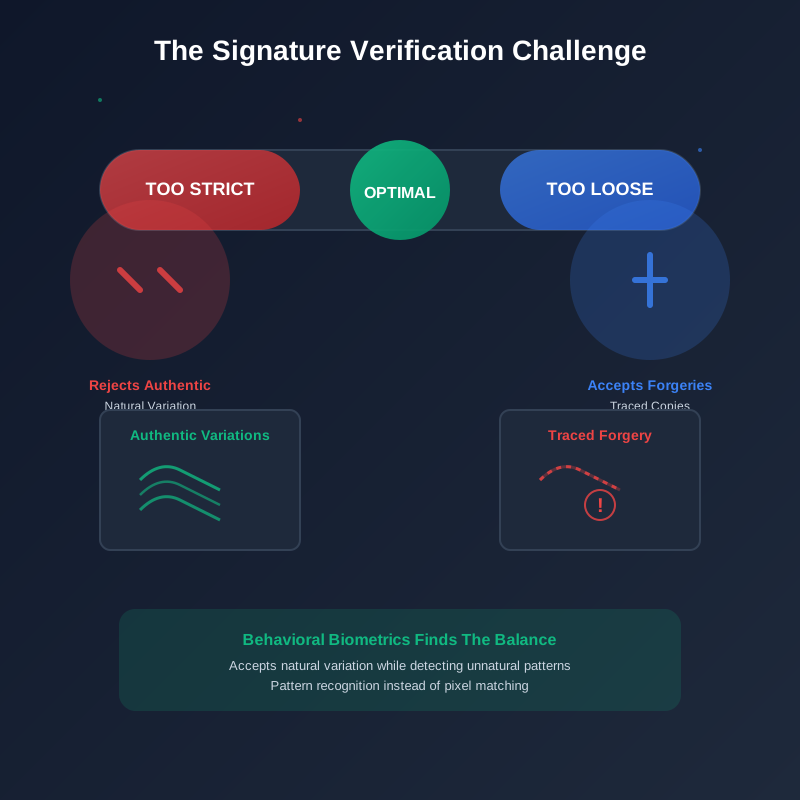
The breakthrough came from shifting perspective. Instead of trying to match signatures visually, what if the system learned to recognize the behavioral patterns that produce signatures? Every time you sign your name, you're executing a complex motor sequence involving dozens of muscles working in coordination. The exact visual output varies, but the underlying behavioral pattern remains remarkably consistent.
Think about how you type your password. You don't consciously think about which fingers press which keys. Your hands know the pattern, the rhythm, the timing. That's muscle memory, and it's extremely consistent even when the exact position of your fingers varies slightly. Signatures work the same way. Your brain has encoded a motor pattern for signing your name, and while the visual output changes based on circumstances, that core pattern remains stable.
Artificio's signature verification system captures and analyzes these behavioral patterns rather than just comparing images. When you provide reference signatures for verification (typically three to five authenticated examples), the system doesn't simply store them as pictures to match against later. Instead, it analyzes them to build a behavioral profile of how you sign.
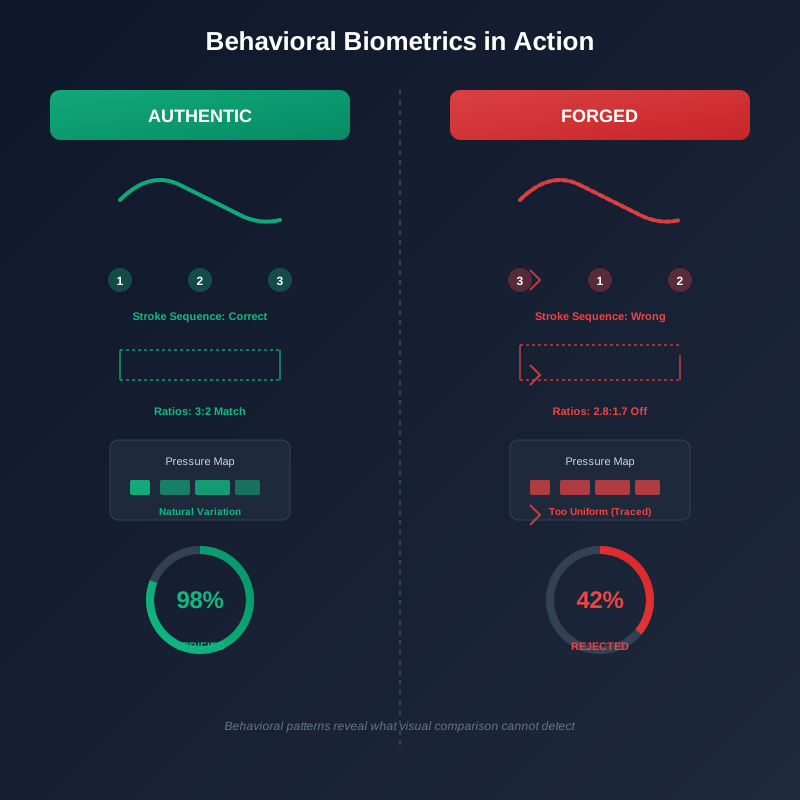
The system examines stroke patterns, looking at the sequence in which different parts of the signature are formed. Most people sign their names in a consistent order. If your signature includes a distinctive loop or flourish, you probably create it at the same point in the sequence every time. A forger might trace your signature carefully and reproduce the visual result accurately, but they're unlikely to match the exact stroke sequence unless they've specifically studied and practiced it.
Geometric ratios provide another layer of analysis. Even though your signature's absolute size might vary, the relative proportions between different elements stay consistent. If the loop in your "J" is typically about 40% of the height of the ascender in your "h," that ratio will persist across authentic signatures even as the overall size changes. You might sign larger on some documents and smaller on others, but those internal proportions remain stable because they're derived from your motor patterns, not from conscious decisions about size.
The system also analyzes writing flow, distinguishing between signatures that were written naturally and those that were traced or copied. Natural signatures show consistent pressure patterns, smooth acceleration and deceleration in pen movement, and connected strokes that flow naturally from one element to the next. Traced signatures, even very careful ones, tend to show hesitation marks, inconsistent pressure (often too uniform, ironically), and subtle breaks in the flow where the forger stopped to check their work against the original.
Contextual consistency adds a final dimension. The system learns that your signature tends to look one way on formal legal documents and slightly different on casual forms or receipts. These contextual variations are authentic and expected. But if your signature suddenly shows characteristics that don't match any of your typical patterns, that's a red flag. The system has learned what authentic variation looks like for you specifically, so it can distinguish between expected flexibility and suspicious deviation.
Setting up signature verification in Artificio is deliberately straightforward because the system does the heavy lifting of pattern analysis automatically. You start by uploading three to five authenticated signatures from each person whose signatures you need to verify. These reference signatures should show natural variation - don't use five identical copies if you can avoid it. Include signatures created on different days, with different pens, on different types of forms if possible.
The system ingests these reference signatures and begins its analysis. It's not creating a single template to match against, which was the fatal flaw of traditional approaches. Instead, it's building a multi-dimensional profile of what makes this person's signature distinctive. Think of it as learning the signature's DNA rather than memorizing its appearance.
The stroke pattern analysis comes first. The system traces how each reference signature was formed, identifying the sequence of strokes, the direction of each stroke, and the points where strokes connect or overlap. Even though you provided multiple signatures with natural visual variation, the stroke patterns will be remarkably consistent. This becomes part of the profile.
Next comes geometric analysis. The system identifies key landmarks in the signature - points where strokes change direction, loops begin and end, distinctive features like crosses on "t" letters or dots on "i" letters. It measures the distances and angles between these landmarks, then calculates ratios that represent the signature's internal proportions. These ratios persist across size variations, making them robust indicators of authenticity.
Pressure analysis adds another layer, though this requires decent image quality in the reference signatures. The system can detect variations in line thickness that correspond to pressure changes during signing. Natural signatures show characteristic pressure patterns - typically more pressure at the beginning of strokes, lighter pressure toward the end, variable pressure during loops or curves. These patterns are unconscious and extremely difficult to fake.
The system also learns contextual patterns if you provide signatures from different types of documents. Maybe your signature on formal contracts tends to be more carefully formed than your signature on routine forms. Maybe you sign differently when there's limited space versus generous space. The system captures these contextual variations and understands them as normal parts of your signature behavior.
What emerges is a comprehensive behavioral profile that describes your signature at a level far deeper than visual appearance. The system has learned not just what your signature looks like, but how it's created, what proportions define it, how pressure varies during formation, and what types of variation are normal for you. This profile becomes the basis for verifying future signatures.
When a new document arrives requiring signature verification, the system extracts the signature image and performs the same analytical process it used on the reference signatures. It determines stroke patterns, measures geometric ratios, analyzes pressure variations, and considers the document context. Then it compares these behavioral characteristics against the stored profile.
This is where the approach shows its power. A forged signature might visually resemble the authentic one, especially if the forger worked carefully. But matching the behavioral patterns is vastly more difficult. The stroke sequence probably won't match because the forger didn't know the correct order. The geometric ratios might be close but not quite right because the forger was working from visual memory rather than motor memory. The pressure patterns will likely be wrong because traced signatures show fundamentally different pressure characteristics than natural ones.
The system generates a confidence score based on how well the behavioral characteristics match the profile. This isn't a simple pass or fail, which is important because it allows for appropriate handling of edge cases. Very high confidence matches (typically 95% or above) are automatically approved. Very low confidence matches (below 85%) are flagged for human review. Matches in the middle range might be approved for routine documents but flagged for high-value transactions.
A regional mortgage company with about 150 employees implemented Artificio's signature verification six months ago. Before implementation, they were processing roughly 2,400 loan documents monthly, each containing an average of eight signatures that required verification. Their process involved manual review by three experienced processors who spent roughly 40% of their time on signature verification tasks.
The manual verification process worked like this: a processor would pull up the loan application with the borrower's signature on file, then visually compare it against the signature on each subsequent document in the package. They'd look for obvious discrepancies in size, style, or formation. If something looked questionable, they'd escalate it to a supervisor for secondary review. The supervisor might request additional verification, contact the borrower directly, or in some cases accept the signature based on their experience and judgment.
This approach caught some fraud. Over the previous two years, the manual review process had flagged and prevented three fraudulent applications where signatures had been forged. Those three catches probably saved the company somewhere between $800,000 and $1.2 million in potential losses, making the verification process seem worthwhile despite the time investment.
But the company's audit team suspected they weren't catching everything. Manual verification is inherently inconsistent. It depends on how rushed the processor is, how good their visual memory is, whether they're working at the end of a long day when fatigue affects judgment. There were also concerns about scalability. The company wanted to grow their loan origination business by 40% over the next 18 months, which would require either hiring more processors or finding ways to make the existing team more efficient.
After implementing Artificio's signature verification, the numbers changed dramatically. The three processors now spend roughly 6 minutes total on signature verification tasks across all monthly documents. The system automatically handles verification for all straightforward cases where signatures clearly match the behavioral profile. Only flagged signatures require human attention, and even then the processor starts with the system's analysis showing exactly why the signature was flagged and what aspects don't match the expected pattern.
The time savings were significant but actually weren't the most important benefit. The real value showed up in detection rates. In the six months since implementation, the system has flagged 14 questionable signatures across various loan applications. Human review confirmed that 11 of these were indeed fraudulent attempts - forgeries, copied signatures, or signatures from individuals not authorized to sign on behalf of the stated party. Three turned out to be false positives where signatures were authentic but showed unusual variation due to the signer being injured or ill.
That's 11 fraud attempts caught in six months, compared to the three they'd caught over the previous 24 months with manual review. The detection rate increased roughly 15-fold. More striking, when they went back and audited some of the applications processed during the last year before implementing automated verification, they found two instances of fraud that had slipped through manual review but that the new system would have flagged immediately based on stroke pattern inconsistencies.
The false positive rate of roughly 20% (three false positives out of 14 flags) is actually quite good for fraud detection systems. More importantly, those false positives didn't create problems because they were quickly resolved through human review. The processor could see exactly why the system flagged the signature, contact the signer to explain the situation, and often resolve it with a quick video call where the person signed again while visible on camera. The additional verification actually strengthened the company's audit trail without creating significant delays.
Beyond fraud detection, the company found unexpected benefits in dispute resolution. In two separate cases, borrowers later claimed they had never signed certain documents in their loan package. Before implementing automated signature verification, these claims would have triggered lengthy investigations with uncertain outcomes. With Artificio's system, the company could immediately pull up the behavioral analysis showing that the signatures matched the borrower's verified profile across multiple consistent parameters. While this didn't automatically prove the borrower's claim was false, it shifted the burden of evidence and in both cases led to quick resolution when the borrowers acknowledged they had indeed signed but simply didn't remember doing so.
What makes Artificio's approach fundamentally different from traditional signature verification attempts comes down to what the system actually learns and analyzes. Traditional computer vision systems, even sophisticated ones using machine learning, ultimately work with pixel-level features. They might learn to recognize that certain patterns of light and dark pixels correspond to certain signature elements, and they might even learn to accept some degree of variation in those patterns. But they're still operating at the visual surface level.
Artificio's signature verification works at a behavioral level. The system isn't asking "Does this image look like the reference images?" Instead, it's asking "Does this signature show the same behavioral characteristics as the reference signatures?" That shift in perspective changes everything.
Consider stroke patterns. When you sign your name, you create various strokes in a specific sequence. Maybe you start with the first letter, make a distinctive loop, then connect to the second letter with a particular type of connector stroke. This sequence is deeply ingrained in your motor memory. You don't think about it consciously, you just do it automatically every time.
A traditional computer vision system looking at the final signature can't easily determine the stroke sequence. It sees the complete image with all strokes present, but it has no direct evidence about which strokes were created first, second, and third. It might infer some ordering based on how strokes overlap, but this inference is uncertain and error-prone.
Artificio's system actually reconstructs the likely stroke sequence from the final image by analyzing a combination of factors - stroke overlaps, pen lift points, connection patterns, and comparison with reference signatures where the sequence has been learned. This reconstruction might seem like a minor technical detail, but it's crucial because stroke sequence is one of the hardest things for a forger to match. Someone copying your signature carefully might reproduce the visual result quite well, but they're almost certainly creating the strokes in a different order than you do naturally.
Geometric ratio analysis provides another example of the behavioral versus visual distinction. At the visual level, your signature might be 6 cm wide on one document and 4 cm wide on another - a 33% size difference that would cause simple template matching to fail. But at the behavioral level, the internal proportions remain constant. If certain elements of your signature are typically in a 3:2 ratio, that ratio persists regardless of absolute size because it reflects how your motor system executes the signing motion.
Traditional systems might try to normalize for size by scaling images before comparison, but this approach has limitations. If different parts of your signature scale differently under different signing conditions (which happens naturally - you might compress the width more than the height when signing in a narrow space), simple scaling normalization fails. Artificio's ratio-based analysis handles this naturally because it's measuring relationships within the signature rather than trying to match absolute dimensions.
The pressure analysis capability deserves special attention because it's often overlooked even by sophisticated systems. When you sign naturally, your pen pressure varies in characteristic ways throughout the signature. You might press harder at the start of strokes, ease up in the middle, then press again when changing direction. These pressure variations happen unconsciously and create visible patterns in line thickness even in relatively low-quality scans.
Traced or carefully copied signatures almost always show different pressure patterns. The forger is working visually, trying to match what they see, and while they might vary line thickness deliberately to make the forgery look more realistic, these variations won't match your natural pressure patterns. More commonly, traced signatures show unusually uniform pressure because the forger is concentrating on following the shape accurately and doesn't naturally replicate the pressure dynamics of authentic signing.
Artificio's system analyzes these pressure patterns by examining line thickness variations throughout the signature. This doesn't require high-resolution imaging or special sensors. Standard document scans at typical business quality (300 DPI or better) contain sufficient information to detect pressure patterns. The system learns your characteristic pressure profile from reference signatures, then checks whether new signatures show matching patterns.
The applicability of robust signature verification extends across virtually every industry that processes documents requiring authentication. The specific implementation details vary by industry, but the core need remains constant - reliably distinguishing authentic signatures from forgeries, copies, and unauthorized reproductions.
Real estate transactions represent one of the most signature-intensive business processes. A typical home purchase involves dozens of documents, each requiring signatures from buyers, sellers, agents, lenders, title company representatives, and various witnesses. Closing packages might contain 50 to 100 separate signature instances that all need verification. Time is usually critical since closings are scheduled with multiple parties coordinating their availability.
Artificio's signature verification integrates with real estate document management systems to automatically verify signatures as closing documents are assembled. The system knows which parties are authorized to sign which documents, has their signature profiles on file, and flags any inconsistencies immediately. This catches forged signatures before closing, preventing situations where a fraudulent transaction is discovered only after funds have transferred and ownership has changed hands.
The healthcare sector handles massive volumes of documents requiring patient signatures - treatment authorization forms, consent documents, privacy acknowledgments, insurance forms, and medical history documents. Many of these signatures carry legal and regulatory weight. A forged signature on a treatment authorization could expose the healthcare provider to liability. An unauthorized signature on insurance paperwork could constitute fraud.
Healthcare organizations using Artificio's verification typically integrate it with their electronic health record systems. When documents are scanned and entered into the EHR, signatures are automatically verified against the patient's profile. Flagged signatures trigger immediate follow-up while the patient is often still in the facility, allowing quick resolution through re-signing with a witness present. This prevents situations where questionable signatures are discovered weeks later during billing or audit processes when the patient is no longer readily available.
Banking and financial services have perhaps the highest stakes when it comes to signature verification. Loan documents, account opening forms, wire transfer authorizations, and countless other financial instruments rely on signatures as proof of agreement and authorization. A single forged signature on a wire transfer authorization could result in fraudulent movement of millions of dollars.
Financial institutions integrate signature verification at multiple checkpoints. Initial account opening documents are verified to establish the customer's signature profile. Subsequent transactions that require written authorization are automatically verified against this profile. High-value transactions might require additional verification layers, with the system flagging anything below a certain confidence threshold for human review regardless of dollar amount.
Legal firms and corporate legal departments deal with contracts, agreements, court filings, and various other documents where signature authenticity is crucial. Legal disputes sometimes hinge on whether a signature is authentic, and having robust verification with detailed behavioral analysis provides stronger evidence than simple human attestation that a signature "looks right."
Integration in legal contexts often involves creating a comprehensive audit trail. When a signature is verified, the system stores not just a pass/fail result but the complete behavioral analysis showing why the signature was accepted. This analysis can become evidence if the signature's authenticity is later challenged. Courts generally accept properly documented automated verification as more reliable than human testimony about signature comparison, especially when the automated system can demonstrate the specific behavioral patterns that were matched.
Government agencies at every level process enormous volumes of forms, applications, permits, and other documents requiring citizen signatures. Driver's license applications, passport renewals, benefit applications, tax documents, and regulatory filings all depend on signature verification to prevent fraud and ensure that the person submitting the document is actually who they claim to be.
Government integration often requires meeting specific security and audit standards. Artificio's system provides detailed logging of every verification attempt, stores the analysis parameters used, and can generate audit reports showing verification patterns over time. These capabilities help agencies demonstrate compliance with verification requirements and identify potential fraud patterns across large numbers of applications.
Getting signature verification operational follows a straightforward path that most organizations can complete in a few days. The process begins with identifying which document types require signature verification and which individuals' signatures need to be verified. This might be customers, employees, partners, or some combination depending on the use case.
For each individual requiring signature verification, the system needs three to five reference signatures. These should be authenticated signatures from known-good documents. Many organizations already have authenticated signatures on file - employment contracts, account opening documents, previous verified transactions. These existing authenticated signatures work perfectly as reference samples.
The reference signatures are uploaded to the system along with basic identifying information - the person's name and any relevant context about them (customer ID, employee number, role in the organization). The upload process accepts images in standard formats (PDF, JPEG, PNG) at typical document scanning resolution. The system doesn't require special imaging equipment or unusual file formats.
Once reference signatures are uploaded, Artificio's system performs its behavioral analysis automatically. This typically takes 30 seconds to two minutes per individual, depending on the number of reference signatures provided and their complexity. The result is a signature profile stored in the system and associated with the individual's identity.
Ongoing verification happens automatically as documents flow through the organization's normal processing pipeline. When a document arrives requiring signature verification, the system extracts the signature image (or someone flags which signature needs verification if the document hasn't gone through automated extraction), determines whose signature it should be based on context, and performs the verification against that person's profile.
The verification result includes a confidence score and detailed analysis of which behavioral characteristics were examined. For signatures that pass verification automatically (typically those scoring 95% confidence or higher), the document continues through the normal workflow without human intervention. For flagged signatures that fall below the automatic approval threshold, the system routes them to a human reviewer along with the detailed analysis showing exactly which aspects of the signature don't match expected patterns.
Organizations typically start with a supervised learning period where the system flags signatures for human review more aggressively than it will during normal operation. This allows the system to gather feedback on its verification decisions and refine its models. Human reviewers mark whether flagged signatures were correctly identified as suspicious or whether they're actually authentic signatures showing unusual but legitimate variation.
This feedback helps the system learn more nuanced patterns. Maybe a particular individual's signature varies more than typical when they're signing multiple documents in quick succession - perhaps they get progressively more casual. Or maybe certain document types consistently show different signature characteristics because of different signing conditions. The system incorporates this feedback and adjusts its thresholds accordingly.
After the supervised learning period, which usually lasts two to four weeks, most organizations switch to normal operation where only signatures below a specified confidence threshold are flagged for human review. The exact threshold depends on the organization's risk tolerance and the consequences of missing a forged signature versus the cost of false positives requiring human attention.
The performance metrics that matter most for signature verification are true positive rate (correctly identifying authentic signatures), false positive rate (incorrectly flagging authentic signatures as suspicious), and false negative rate (failing to flag forged signatures). These metrics exist in tension - increasing the threshold for automatic approval reduces false negatives but increases false positives, while lowering the threshold does the opposite.
In typical deployments after the initial learning period, Artificio's signature verification achieves true positive rates above 98%, meaning it correctly identifies and approves authentic signatures more than 98% of the time. False positive rates, where authentic signatures are incorrectly flagged as suspicious, run below 2%. False negative rates, the most critical metric representing forged signatures that pass verification incorrectly, run below 0.5%.
These figures represent averages across different deployment contexts and improve over time as the system learns from feedback. The false positive rate in particular tends to decrease as the system builds understanding of legitimate variation patterns for each individual. Early in deployment, the system might flag a signature simply because it shows variation that wasn't present in the reference samples. After learning that this variation is legitimate and consistent with the person's signing behavior, the system stops flagging similar signatures.
The false negative rate, while low, isn't zero, and organizations need to understand what this means in practical terms. A 0.5% false negative rate means that roughly one forged signature in 200 might pass verification incorrectly. For most organizations processing hundreds or thousands of signatures monthly, this translates to perhaps one missed forgery every few months.
This needs to be evaluated against the alternative. Manual signature verification by trained human reviewers typically achieves false negative rates between 3% and 7%, meaning humans miss forged signatures significantly more often than the automated system. The automated approach provides substantial improvement even though it's not perfect.
Moreover, the automated system's failures tend to be consistent and predictable. It struggles most with extremely sophisticated forgeries where someone has studied and practiced matching both the visual appearance and the stroke sequence of the authentic signature. These forgeries are rare because they require significant skill and effort. The automated system rarely misses simpler forgeries of the type that sometimes slip past human reviewers who are tired, rushed, or not paying close attention.
The continuous learning capability matters more than the initial metrics because signature verification improves over time in ways that static systems cannot. Each time a human reviewer evaluates a flagged signature, they're providing feedback that refines the system's understanding. Each time a signature is verified and the document proceeds without issues, that's additional confirmation that the system's behavioral profile is accurate.
This feedback loop operates at multiple levels. At the individual level, the system learns more about each person's signature patterns as it sees more examples. Someone whose reference signatures were all from formal legal documents might show different characteristics when signing routine paperwork, and the system learns to recognize both patterns as authentic. At the aggregate level, the system learns about signature variation patterns that are common across many individuals, making it better at distinguishing normal variation from suspicious deviation even for people who have fewer reference signatures on file.
The system also learns to recognize contextual patterns that indicate higher risk. Maybe signatures on certain types of documents show higher rates of irregularity, suggesting those document types are more frequently targeted by fraud attempts. Or maybe signatures scanned with certain types of equipment show characteristic artifacts that the system needs to ignore rather than treating as suspicious features. This meta-learning improves verification accuracy across the entire deployment.
Organizations can see this improvement through regular reporting on verification metrics. Artificio provides dashboards showing trends in approval rates, flag rates, false positive rates (determined by human review outcomes), and confidence score distributions. These metrics typically show improving performance over the first three to six months of deployment, then stabilize at high levels with occasional spikes when new document types are introduced or when the organization starts verifying signatures for new categories of individuals.
Signature verification might seem like a narrow capability, focused on one specific element of document authentication. But its implications extend into how organizations think about document processing more broadly. The same principles that make behavioral biometric signature verification work apply to other aspects of document analysis and authentication.
Consider handwriting verification more generally. Many documents contain handwritten notes, corrections, or form entries that aren't formal signatures but still carry authentication value. Artificio's behavioral approach can verify that handwritten content came from a specific individual by analyzing the same types of characteristics that distinguish signatures - stroke patterns, pressure variations, letter formation consistency, spacing patterns.
This matters for documents like medical forms where a doctor's handwritten notes authenticate their review and approval, or legal documents where handwritten dates or modifications need to be verified as coming from authorized parties. The same technology that verifies signatures extends naturally to verifying any handwritten content.
Document modification detection represents another application. When someone alters a document after it's been signed, perhaps changing numbers or text, those modifications leave behavioral traces. The handwriting or typing characteristics of the modification will likely differ from the original content. More subtly, if someone copies text from one part of a document and pastes it elsewhere, the copy-pasted content will show different characteristics than text that was originally entered in that location.
Artificio's behavioral analysis can detect these types of modifications by analyzing consistency throughout the document. Original content shows consistent behavioral characteristics because it was all created by the same person under similar conditions. Modified content shows different characteristics because it was created later, possibly by a different person, under different conditions. This provides organizations with automated tools for detecting document tampering beyond simple signature verification.
The authentication principles also extend to digital signatures and electronic signing processes. While traditional digital signatures use cryptographic methods to ensure authenticity, behavioral biometrics add an additional layer. When someone signs electronically using a stylus or touchscreen, the system can capture not just the visual signature but the complete behavioral profile - signing speed, pressure patterns, stroke sequence, hesitation points. This behavioral data becomes part of the electronic signature record, making it virtually impossible to repudiate later or to forge using another person's digital certificate.
Organizations implementing comprehensive document authentication increasingly combine multiple verification layers. Signature verification confirms the right person signed. Handwriting analysis verifies that handwritten content came from authorized individuals. Modification detection ensures nothing was changed after signing. Digital watermarking proves documents haven't been altered. Timestamp verification confirms when actions occurred. Together, these layers create audit trails robust enough to withstand legal challenges and sophisticated enough to detect increasingly clever fraud attempts.
The volume of documents requiring signature verification continues growing while the sophistication of fraud attempts increases. Digital document processing makes it easier than ever to scan, copy, and reproduce signatures. High-quality printers and scanners have become cheap and widely available. Photo editing software that once required expensive professional tools now runs on smartphones. These technological advances have democratized document fraud in concerning ways.
A decade ago, forging a signature convincingly enough to fool manual review required some skill. You needed to practice matching the signature's appearance, have reasonably steady hands, and produce something that would pass visual inspection. Today, someone with basic technical skills can scan an authentic signature, clean it up in editing software, and digitally paste it onto documents with near-perfect visual results.
This shift means organizations can't rely on human visual inspection as their primary defense against signature fraud. The forgeries are simply too good. What once required a skilled forger can now be accomplished by anyone with a laptop and an hour of YouTube tutorials. This democratization of fraud capabilities demands equally sophisticated automated defenses.
At the same time, the cost of signature fraud has increased dramatically. Financial transactions happen at larger scales, real estate values have risen substantially, healthcare costs have multiplied, and regulatory penalties for fraud have become more severe. A forged signature that enables unauthorized access to accounts, fraudulent property transfers, or fake insurance claims can create exposures running into millions of dollars. Organizations cannot accept the 3% to 7% false negative rates typical of manual review when a single missed forgery could threaten their financial stability.
The regulatory environment has also shifted. Data protection regulations, anti-money laundering requirements, know-your-customer rules, and various industry-specific compliance frameworks all demand stronger authentication of document signers. Organizations need to demonstrate they're using reasonable security measures, and as automated verification technology becomes available and proven effective, the definition of "reasonable" rises to include these capabilities.
Perhaps most importantly, customers and partners increasingly expect robust security. A business that suffers a fraud incident due to inadequate signature verification faces not just financial losses but reputational damage. Customers question whether they can trust an organization that couldn't prevent someone from forging signatures on important documents. Partners worry about their own exposure in transactions with an organization that has weak verification processes.
Artificio's signature verification addresses all these pressures simultaneously. It scales to handle document volumes far beyond what manual review could manage. It provides consistent, objective verification that doesn't depend on whether the reviewer is having a good day. It catches sophisticated forgeries that might fool human inspection. It creates detailed audit trails proving that proper verification was performed. It continues learning and improving rather than staying static. And it does all this while actually reducing the workload on human staff, who can focus their attention on genuinely questionable signatures rather than spending time on routine verification that the system handles automatically.
The technology has reached a point where not implementing automated signature verification represents an increasingly indefensible security gap. The costs have dropped, the accuracy has risen, the integration has become straightforward, and the alternatives have become less viable. Organizations serious about document security are moving beyond the "signature detected" era into an age of genuine behavioral verification that finally matches the sophistication of the fraud attempts they face.

Head IT Operations - Co Founder of Artificio
See it in your SAP environment
Bring us a document, a process, or a bottleneck. We'll show how Artificio captures, validates, and posts into SAP — then scale from there.
Security & compliance
ISO 27001:2013 certified, SOC 2 Type 2 compliant, GDPR and HIPAA ready. Every agent action is logged, auditable, and runs in isolated environments.