

Blog
Data Validation: Stop Post-Extraction Failures & Annual Loss
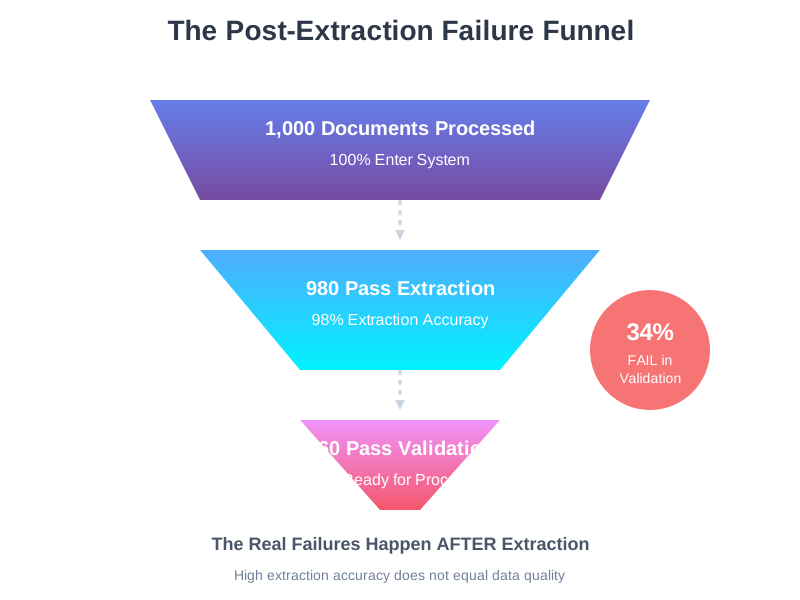
34% of document failures are post-extraction. Learn how smart validation prevents costly business losses.

Blog
34% of document failures are post-extraction. Learn how smart validation prevents costly business losses.
Picture this. Your document processing system just extracted data from 10,000 mortgage applications with 98% OCR accuracy. Your team celebrates. The vendor invoice gets paid. Six months later, you discover that 340 loans were approved with incorrect income calculations, 127 had mismatched property addresses across documents, and 89 applications slipped through with missing mandatory compliance fields. The cost? A conservative $890,000 in write-offs, regulatory penalties, and operational cleanup. And that's just one quarter.
This isn't hypothetical. This happens every day in organizations that confuse extraction accuracy with data validity. They're not the same thing, not even close. The uncomfortable truth that nobody in the document processing industry wants to talk about is that roughly one-third of all document processing failures happen after the extraction phase completes successfully. Your OCR worked perfectly. Your AI models identified every field. Your system extracted every character with precision. But the data itself? Fundamentally flawed.
Welcome to the post-extraction validation crisis, the silent data killer that's costing enterprises millions while flying completely under the radar of traditional document processing metrics.
Let's start with a story that probably sounds familiar. A mid-sized insurance company implemented a cutting-edge document processing solution for claims automation. The vendor demo was impressive. During the proof of concept, the system achieved 97% accuracy on test documents. The contract was signed, the system went live, and for the first three months, everything looked great on paper. Processing times dropped by 60%, manual data entry decreased dramatically, and the operations team finally had bandwidth to focus on exception handling instead of typing.
Then the complaints started. A policyholder called about a claim payment that was 30% lower than expected because the system had extracted the deductible amount correctly but failed to validate that it matched the policy terms. Another claim was delayed for weeks because the system extracted a valid-looking claim date that was actually six months in the future. A third claim triggered a fraud investigation because the system didn't catch that the repair shop address on the estimate didn't match the shop's verified location in the database.
The operations manager pulled the reports and discovered something shocking. The extraction accuracy was still at 97%. Every single piece of data that caused problems had been extracted correctly from the source documents. The system did exactly what it was designed to do: read text from images and PDFs with high accuracy. What it didn't do was validate whether that extracted data made any logical sense in the context of the business process it was supporting.
This is the post-extraction blind spot, and if you're measuring your document processing success purely on OCR accuracy metrics, you're driving blind. Extraction accuracy tells you whether the system can read the document. It says nothing about whether the data it read is actually usable, compliant, consistent, or even remotely correct within your business context.
Think about what extraction accuracy actually measures. It's comparing the text your system extracted against the text that actually appears on the document. If an invoice says the total is "$1,00" because of a typo, and your system extracts "$1,00" perfectly, that's 100% extraction accuracy. Congratulations. You've successfully captured garbage data with perfect precision. The downstream payment system that tries to process this will fail, the accounts payable team will spend 20 minutes investigating and correcting it, and nobody will blame the document processing system because technically it worked perfectly.
Or consider a more subtle scenario. A loan application has an applicant birth date of 01/15/1985 on the first page and 01/15/1895 on the supporting ID document (a scanning artifact turned the "9" into an "8"). Both dates are extracted with 100% accuracy. Your system now has two different birth dates for the same person, making the applicant either 40 years old or 130 years old depending on which document you trust. Without validation logic that checks for consistency across related documents and flags biologically impossible ages, this application moves forward in your pipeline until a human reviewer catches it days later, or worse, it doesn't get caught until the applicant shows up to closing.
The financial services industry has particularly painful examples of this blind spot. One regional bank implemented document processing for commercial loan applications and measured success by how many loan packages they could process per day. The number looked fantastic. Processing capacity tripled. Loan officers were thrilled. Then the audit happened. Examiners discovered that 18% of approved loans had income verification documents where the stated income on the application didn't match the actual income shown on the tax returns that were processed. The system had extracted both numbers perfectly. It just never validated that they matched. The bank faced regulatory sanctions, had to manually review every loan in the portfolio, and spent six months rebuilding trust with regulators.
Not all validation failures are equal. Understanding the different categories helps you build a comprehensive validation strategy that catches problems before they become expensive. Let's break down the five types that slip through extraction-only systems.
Format and Type Validation Failures are the most basic but cause surprisingly frustrating operational problems. A phone number extracted as "555.123.4567" when your system expects "555-123-4567" format. A date captured as "March 15, 2024" when your database requires "03/15/2024" format. A decimal number extracted with European-style comma separators when your system expects periods. These break integrations, cause database errors, and require manual intervention. A healthcare company processing patient intake forms experienced this when their document processor extracted birth dates perfectly but didn't normalize the format. The EHR system expected MM/DD/YYYY format exclusively. When dates arrived in DD/MM/YYYY format, the system rejected them. For six months, staff manually reformatted hundreds of dates per week.
Business Rule Validation Failures occur when extracted data is perfectly formatted but violates logical constraints. An employee claiming 200 hours of overtime in a week that has 168 total hours. A credit card transaction for $3 million at a coffee shop. An insurance claim for a car accident where the accident date is in the future. These extracted values might be accurate representations of what's on the document, but they violate basic constraints that should trigger review. A property management company learned this when their lease processing system didn't validate that security deposits complied with state regulations. They processed hundreds of leases with illegal security deposit amounts before a tenant complaint triggered an audit.
Cross-Document Consistency Failures happen when related documents should contain matching information but don't. In mortgage lending, an applicant's stated income on the application should align with income shown on pay stubs and tax returns. Property addresses should match across applications, appraisals, and title documents. One mortgage lender found that 19% of applications had income discrepancies exceeding 10% between the application and supporting documents. All documents had been extracted accurately, but nobody validated consistency across the package.
Anomaly Detection Failures are subtle problems that don't violate explicit rules but represent unusual patterns worth investigating. An expense report from an employee who typically submits $200-300 per month suddenly shows $8,000. A supplier who normally invoices $5,000-10,000 per order submits one for $150,000. A financial services firm using anomaly detection noticed certain branches submitted loan applications in bursts at month-end, with backdated application dates. This pattern suggested performance metric manipulation and triggered an investigation that revealed systemic problems.
Predictive Validation Failures identify what's conspicuously absent. A mortgage application that includes employment verification for the primary borrower but not the co-borrower might pass mandatory field validation, but a predictive model trained on complete applications recognizes that co-borrowers with claimed income need employment verification too. A government agency implementing this found that 8% of applications passing explicit validation were incomplete in ways that would cause processing delays later.
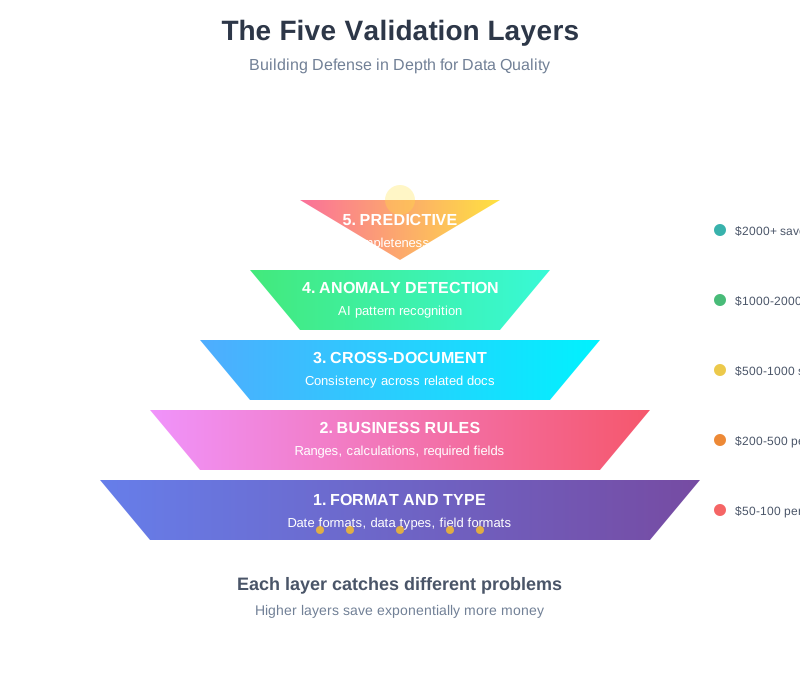
Effective validation requires a layered approach where each layer catches different problems. Start with format and type validation immediately after extraction. Define explicit format requirements for every field. Not just "this should be a date" but precisely "MM/DD/YYYY format where MM is 01-12, DD is 01-31, and YYYY is 1900-2100". A retail company implementing this for product catalog processing eliminated 70% of integration errors by normalizing product dimensions from various formats ("24 inches", "24in", "2 feet", "610mm") into a single standard.
Layer two adds business rule validation that checks whether data makes sense in your operational context. Define value ranges for numeric fields. An applicant age should be 18-120. Loan terms should be 1-30 years. Create allowed value lists for enumerated fields. State codes must come from the official list. Product codes must exist in your master data. Implement calculation checks for derived values. If a document shows line items and a total, verify the math. A financial services company found 15% of applications passing extraction violated basic business logic, like claiming zero income but requesting large credit lines.
Layer three implements cross-document validation checking consistency across related documents. Map which documents should contain matching information. For loan applications: applicant names should match across applications, IDs, tax returns, and bank statements. Addresses should match across applications, appraisals, and contracts. An insurance company found 22% of claims had consistency problems that went undetected, like claimant information not matching policy information or accident dates not aligning across police reports and medical records.
Layer four deploys AI-powered anomaly detection that learns normal patterns from historical data and flags significant deviations. Train models on your successful transactions to understand typical ranges and distributions. A logistics company's anomaly detection learned normal shipment patterns by route and customer. Manifests deviating significantly were flagged, catching data entry errors (weights in wrong units), potential fraud (declared values not matching commodity types), and process violations (hazardous materials not properly flagged).
Layer five implements predictive validation using machine learning to identify likely incompleteness. Train models on complete, successful transactions to learn what completeness looks like in practice. A mortgage lender implementing this reduced processing time by 8 days by proactively contacting applicants when the system predicted missing documentation, rather than discovering incompleteness during manual underwriting days later.
Healthcare Claims Processing: A medical practice processing insurance claims implemented comprehensive validation that checked format compliance (patient IDs, diagnosis codes), business rules (dates of service within coverage periods, providers in-network), cross-document consistency (patient names matching across forms, diagnosis codes supported by medical records), anomalies (procedures inconsistent with provider specialty), and predictive completeness (certain diagnoses typically require specific supporting documentation). They discovered 28% of claims had problems that would have caused denials. By catching these during validation before submission, they dramatically improved first-pass approval rates and eliminated costly appeal cycles.
Mortgage Underwriting: A lender implemented validation that normalized income reporting formats across different document types, validated that stated income aligned with verified income within tolerance, checked employment consistency across documents, and used anomaly detection to flag suspicious patterns like dramatic income increases without job change evidence. They found income discrepancies in 19% of applications, bank deposits not supporting claimed income in 7%, and employment history contradictions in 12%. The validation layer saved them approximately $1.2 million annually in prevented losses and efficiency gains.
Manufacturing ERP Data: A manufacturer automating SAP material master data creation from supplier catalogs achieved 96% extraction accuracy but had 40% of records fail when loading into SAP due to format incompatibilities. After implementing format validation and normalization, they eliminated this problem. They also discovered 15% of records had inconsistencies between engineering specifications and procurement data, causing quality problems and production issues.
Property Management: A company with 15,000 units processing lease agreements found that 8% had rent amounts on the first page not matching the payment schedule, 5% had tenant name variations across pages, and 3% had incorrectly calculated lease end dates. They also caught contradictions between maintenance responsibilities in main lease text versus addendums, preventing disputes. Anomaly detection flagged unusual rent amounts, suspicious lease terms, and multiple leases for the same property with overlapping dates.
Start with quick wins that create immediate value. Document format requirements for your top 10 document types and implement basic format validation. List essential mandatory fields for each major document type and implement checking that rejects incomplete documents. For one week, manually log every validation failure to reveal patterns justifying automated tracking. Create simple routing logic sending different failure types to appropriate review queues.
Within 90 days, implement comprehensive format and mandatory field validation across all document types. Encode your top 20 business rules as automated validation checks. Build basic cross-document validation for common document packages. Implement validation metrics tracking and reporting with dashboards showing pass rates, failure distributions, and trends.
Strategic initiatives over 6-12 months should include deploying AI-powered anomaly detection across all document types with feedback loops for continuous improvement. Develop predictive validation models identifying likely incompleteness with proactive notification workflows. Build comprehensive validation rule governance with clear ownership, documentation standards, and change management processes. Integrate validation deeply with upstream and downstream systems so problems are caught at the point of capture and validation status informs downstream exception handling.
Track validation pass rate as your north star metric: the percentage of extracted documents passing all validation checks and proceeding to automated processing. Calculate it as (documents passing validation / total extracted) × 100. Monitor overall and by document type, source, and submitter to identify where improvements will have the most impact. Realistic targets are around 80-85% for mature systems.
Measure validation failure distribution across your five layers to understand where problems concentrate. If 60% of failures are format issues, you need better normalization. If business rule violations dominate, you need revised guidelines or updated rules. Track how distribution changes as you improve validation logic and upstream processes.
Monitor false positive rates (legitimate data flagged incorrectly) and false negative rates (invalid data passing validation). High false positive rates waste review capacity. High false negative rates allow problems downstream where they cause more expensive failures. Balance these based on your risk tolerance and operational context.
Track time to correction comparing problems caught by validation versus those discovered downstream. Problems caught immediately should have much shorter resolution times. Measure rework reduction by comparing what percentage of documents required manual correction before versus after validation implementation. Calculate savings by multiplying rework reduction by average cost per rework instance.
Traditional document processing focuses obsessively on extraction accuracy. Vendors compete on OCR percentages. Teams celebrate 95% or 98% accuracy. Success metrics revolve around documents processed per hour and characters extracted correctly. This focus creates a dangerous blind spot because perfect extraction of flawed data is worthless.
The validation-first mindset asks a different question. Instead of "How accurately can we extract data?", ask "How can we ensure extracted data is ready for automated processing without human intervention?". This shifts focus from input quality (reading documents well) to output quality (data usability for downstream processes). It recognizes that perfect extraction of flawed data is worthless while imperfect extraction of validated data might be perfectly acceptable.
Measure success primarily by validation pass rate, not extraction accuracy. A system with 96% extraction accuracy but 85% validation pass rate is superior to one with 99% extraction accuracy but 70% validation pass rate because more documents ultimately process automatically. Track validation failure patterns systematically and treat them as your roadmap for continuous improvement. Create feedback loops between validation results and upstream processes to improve data quality at the point of capture.
Stop reporting "we processed 10,000 documents with 97% accuracy". Start reporting "we processed 10,000 documents with 82% passing full validation and proceeding to automated processing, while 18% required review. Format failures decreased 5% after improved normalization. Business rule violations decreased 8% after revised submission guidelines". This reporting drives continuous improvement by highlighting where problems occur and tracking progress.
The document processing industry has spent decades focused on extraction accuracy. This made sense when extraction was hard and human review was inevitable. But in modern workflows aiming for full automation, extraction is just the beginning. Data that's accurately extracted but never validated is a liability, not an asset.
The truth that 34% of document processing failures happen after extraction isn't an indictment of extraction technology. It's recognition that reading text from documents is fundamentally different from ensuring that text represents valid, consistent, actionable data. Extraction tells you what's on the page. Validation tells you whether that information is trustworthy enough to drive automated decisions.
Organizations embracing validation as a core capability transform document processing from a cost center that digitizes paper to an intelligence layer that ensures data quality. They shift from celebrating extraction accuracy to measuring validation effectiveness. They invest in comprehensive validation rules encoding business logic. They deploy AI capabilities that learn patterns and flag anomalies. They create feedback loops that continuously improve data quality.
The financial impact is substantial. For mid-sized organizations processing 100,000 documents annually, comprehensive validation typically represents $500,000 to $1.5 million in annual value from reduced rework, fewer downstream failures, improved cycle times, and prevented regulatory issues. For enterprises processing millions of documents, impact scales into tens of millions annually.
The strategic impact goes beyond cost savings. Organizations with mature validation capabilities can confidently automate processes competitors must handle manually because they can't trust their data quality. They offer faster service because problems are caught and corrected immediately rather than discovered weeks later. They face lower compliance risk because validation ensures data meets regulatory requirements. They make better decisions because their data is reliably accurate.
The path forward starts with recognizing that extraction accuracy isn't the destination. It's the foundation for building a validation layer ensuring data quality. Start with format and mandatory field validation. Add business rule validation. Implement cross-document checking. Deploy AI-powered anomaly detection. Build predictive validation. Measure effectiveness and continuously improve.
Most importantly, shift your organizational mindset from extraction-focused to validation-first. Stop celebrating high extraction accuracy as success. Start measuring validation pass rates, tracking failure patterns, and investing in validation capabilities that separate trustworthy data from accurately-extracted text not ready for automated processing.
The document processing systems that win in the next decade won't have the highest extraction accuracy. They'll have the most sophisticated validation capabilities ensuring extracted data is not just readable but reliable, not just present but provably correct, not just captured but truly intelligent. The silent data killer costing organizations millions doesn't have to remain silent or deadly. Comprehensive validation brings it into the light where it can be addressed systematically.
Your documents contain valuable information. Extraction unlocks that information from unstructured formats. But validation transforms it from raw text into trusted intelligence that can safely drive automated processes, inform confident decisions, and power efficient operations. The organizations that master both extraction and validation won't just process documents faster. They'll process them right, and that difference is worth far more than speed alone could ever deliver.

Head IT Operations - Co Founder of Artificio
See it in your SAP environment
Bring us a document, a process, or a bottleneck. We'll show how Artificio captures, validates, and posts into SAP — then scale from there.
Security & compliance
ISO 27001:2013 certified, SOC 2 Type 2 compliant, GDPR and HIPAA ready. Every agent action is logged, auditable, and runs in isolated environments.