

Blog
Three-Person Agency Processes 500 Claims/Week With AI Automation
See how a small insurance agency used AI to handle 5x more claims without hiring, burnout, or losing the personal touch.

Blog
See how a small insurance agency used AI to handle 5x more claims without hiring, burnout, or losing the personal touch.
It's 9:47 AM on a Tuesday, and the office manager is sitting at her desk, sipping her second coffee of the day. Her inbox shows 43 new claims that came in overnight. Two years ago, this moment would have triggered panic. She'd start doing mental math, calculating how many late nights it would take to clear the backlog, which clients would have to wait, and whether she'd need to beg her coworker to cancel Friday plans again.
Today? She clicks a button, watches her screen for about 30 seconds, and moves on to her actual job, talking to clients who need help.
This insurance agency isn't special because they're big. They're not. Three full-time employees serving about 800 policyholders in a mid-size suburban market. They're special because they figured out how to do the work of a team three times their size, without burning out, and without sacrificing the personal touch that keeps their clients around for decades.
The agency started in 2018 with a simple mission. The owner, a veteran insurance professional with 15 years at a large carrier, wanted to build something different. Not a call center where clients get bounced between departments. Not a faceless operation where policy numbers matter more than people. She wanted an agency where when clients called, they'd talk to someone who actually knew their situation.
For the first few years, it worked. The owner handled sales and complex client relationships. Her partner, another experienced agent, managed existing accounts and renewals. The office manager kept everything organized, handled incoming documents, and made sure nothing fell through the cracks. Together, they built a reputation. When local business owners needed insurance, they came here. When families bought their first home, friends referred them to this agency.
The team specialized in small business insurance and personal auto and home policies. Nothing exotic, nothing that required a massive infrastructure. They wrote about $2.3 million in annual premiums, enough to sustain three good salaries and keep the lights on. Their competitive advantage was never price. Bigger agencies and direct-to-consumer carriers could undercut them all day. Their edge was service. Real, human, responsive service.
"We're not trying to be State Farm," the owner explains. "Our clients choose us because when they call, they get me or my partner, not a call center in another state. That only works if we're not buried in paperwork."
But as the business grew, paperwork became the problem.
By their fourth year, the agency was processing about 80 to 100 claims per week. That might not sound like much to a large operation, but for three people, it was crushing. Every claim that came in meant someone had to stop what they were doing and shift into processing mode.
The workflow went like this. Claims arrived through every possible channel. Email attachments, fax machines (yes, some clients still used fax), uploads to the agency portal, even photos texted from phones at accident scenes. The office manager would print everything that could be printed, sort documents into physical folders, and prepare them for data entry.
Then came the real work. One of the agents would manually key claim information into the agency management system. Policy numbers, dates of loss, damage descriptions, coverage details. Every field had to be entered by hand. Next, they'd cross-reference the claim against the actual policy documents. Sometimes that meant pulling physical files from cabinets. Other times it meant digging through digital archives to find a policy issued three years ago.
After data entry came client communication. Calling or emailing to request missing information, clarifying details, explaining next steps. Finally, they'd prepare submission packages for the insurance carriers. Each carrier had different requirements, different forms, different portals. What worked for one wouldn't work for another.
On average, processing a single claim took 45 to 60 minutes of focused work. Multiply that by 80 or 100 claims per week, and you're looking at 60 to 100 hours of pure processing time. For a three-person team that also needed to answer phones, meet with clients, write new policies, and handle renewals, the math simply didn't work.
Friday afternoons regularly became Friday nights. Client calls went to voicemail during heavy processing periods. Mistakes crept in. When you're manually typing the same information for the 50th time that week, your brain starts to glaze over. A transposed digit here, a wrong date there, and suddenly a claim gets delayed by days.
The office manager started talking about looking for another job. She loved the team and the clients, but "normal hours" sounded pretty good. The owner faced an impossible choice. Hire another person (which their margins couldn't really support) or risk losing the employee who held everything together.
Then came the hailstorm.
Last March, severe weather hit three of their commercial clients on the same day. Suddenly, they weren't looking at 100 claims for the week. They had 200 claims in 48 hours. The owner and her partner looked at each other across the office, and the unspoken realization hung in the air. They couldn't do this. Not without losing clients or losing their minds.
They tried quick fixes first. Hired a temp worker from a local staffing agency. That lasted two weeks before it became clear the temp didn't understand insurance terminology well enough to be useful. The error rate was worse than just doing it themselves. They looked into virtual assistant services overseas. That created timezone problems and quality issues. Documents got misrouted. Clients got confused by responses that came at odd hours with strange phrasing.
They even demoed traditional OCR software, the kind that promises to "digitize your documents." It could read text from PDFs, sure. But it was completely rigid. It couldn't handle handwritten notes from contractors. It choked on phone photos taken at weird angles. And even when it extracted text successfully, someone still had to review every field, correct the mistakes, and manually enter everything into the management system anyway.
The owner remembers thinking they'd wasted more time trying to make the OCR software work than if they'd just processed the claims manually. That's when she started googling variations of "AI for insurance claims" and "document automation that actually works."
The agency found Artificio through a combination of search results and a recommendation from another agent at an industry conference. The owner was skeptical. They'd been burned by automation promises before. Every software vendor claims their product will "revolutionize your workflow" and "save you hours every day." Most of the time, it's marketing fluff wrapped around mediocre technology.
But she took the demo call anyway. What did they have to lose besides 30 minutes?
The Artificio team didn't start with a PowerPoint presentation about AI capabilities and market leadership. They asked to see real claims. Messy ones. The kinds of documents that actually crossed their desk every day, not sanitized examples created in a lab.
The owner sent over what she called "the nightmare claim." Water damage at a small restaurant. The submission package included handwritten estimates from three different contractors (each with different handwriting legibility), photos taken on an iPhone in poor lighting, a policy document from 2015 that had been scanned multiple times and looked like it went through a copy machine from the 1990s, and email threads with the client asking questions that contained additional details not in any formal document.
What happened next surprised her. The Artificio system ingested everything. It identified each document type automatically. It extracted the contractor estimates, even the handwritten parts. It pulled policy details from that degraded scan. It even parsed the relevant information from the email threads. In under two minutes, the system had created a structured data package with everything organized, validated against the policy terms, and ready for submission.
"When I saw that," the owner recalls, "I asked what's the catch? There had to be something. This seemed too good to be true."
The person running the demo was honest in a way that actually built trust. "This'll handle about 80 to 90 percent of your claims automatically. The other 10 to 20 percent will still need human review. We're not promising perfection. We're promising that instead of spending 45 minutes per claim, you'll spend 5 minutes reviewing the automated work, and maybe 30 minutes on the truly complex stuff."
That honesty sold her. She didn't need magic. She needed better.
The decision came down to a few key factors. First, the system proved it could handle their messy, real-world documents, not just clean PDFs. Second, it integrated with their existing agency management system. They wouldn't have to rip out their entire infrastructure and start over. Third, clients wouldn't notice any change in how they submitted claims. The AI worked behind the scenes. Fourth, the pricing made sense for a three-person operation. It cost less than hiring even a part-time employee. And fifth, Artificio offered a trial period. They could test it with real claims before committing.
The owner talked it over with her team that afternoon. The office manager was cautiously optimistic. "I'll believe it when I see it," she said. The other agent just wanted his Friday nights back. They agreed to try it.
Getting started was simpler than expected. Week one was setup. They connected their email inbox and document portal to the Artificio system. They mapped their data fields to match what their agency management system needed. The Artificio team asked them to provide 50 historical claims as training examples. These helped the system learn the specific patterns, terminology, and formatting their agency used.
Weeks two and three were the parallel processing phase. New claims came in and got processed two ways. The old manual way (so nothing fell through the cracks) and the new AI way (to build confidence). The team spot-checked everything. They'd process a claim manually, then see what the AI had done with the same documents.
The accuracy was unsettling at first. Not because it was wrong, but because it was right. The office manager kept finding that the AI had extracted information faster and often more accurately than she had. When you're manually typing data for hours, you miss things. Your eyes skip over details. The AI didn't have that problem.
By week four, they flipped the switch. New claims went straight to AI processing. But they kept safety nets in place. The office manager still reviewed every single extraction. That review took about 5 minutes per claim instead of 45, but she wasn't ready to fully let go yet.
"There wasn't much of a learning curve," she admits now. "The hard part wasn't learning the system. The hard part was learning to trust it. My coworker kept manually checking things for the first month even though the system was right every time."
What actually took adjustment wasn't the technology. It was psychological. For years, they'd been the safety net. They caught mistakes. They verified information. They were the ones who made sure everything was correct. Letting a machine do that felt risky, even when the machine was demonstrably better at it than they were.
The other adjustment was figuring out what to do with all the extra time. That sounds like a good problem to have, and it was. But when you've spent years in crisis mode, constantly behind on work, always racing to catch up, suddenly having spare capacity feels strange. They found themselves finishing the day's claims by lunch and looking around like, "Now what?"
The answer to "now what" turned out to be the best part of the whole transformation.
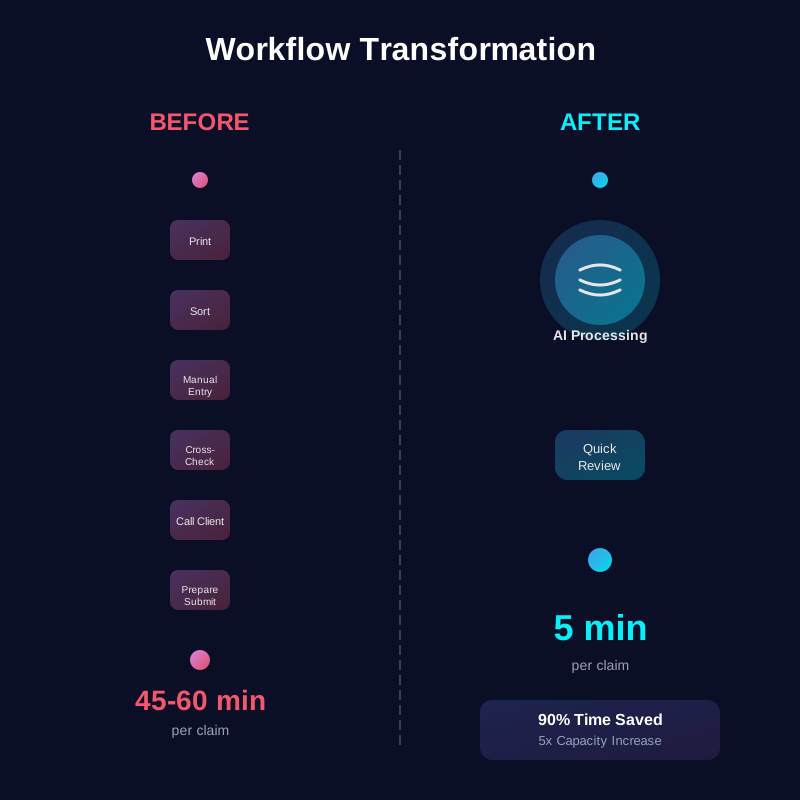
Eighteen months after implementation, the morning routine looks completely different. The office manager arrives around 8:30, makes coffee, and opens the Artificio dashboard. Overnight, while everyone was sleeping, the system processed 43 claims. Most came through email. A few through the portal. One client even texted photos of a fender bender at midnight (because that's when they remembered to do it).
The dashboard shows 39 claims with green status indicators. These were processed automatically, data extracted, validated against policy records, and loaded into the agency management system. The office manager scans through them in about 15 minutes, mostly just confirming nothing looks weird.
Four claims have yellow flags. These need human attention. Maybe the policy type is unusual, requiring special handling. Maybe a document is missing and the system can't complete processing without it. Maybe the claim amount is high enough to warrant extra scrutiny. These flagged items are exactly the cases where human judgment matters.
The office manager handles the four flagged claims in about 30 minutes total. She reaches out to one client for a missing document. She escalates a high-value claim to the owner for personal follow-up. She manually enters details for a policy type their system hasn't seen before (which will help the AI learn for next time).
By 9:30 AM, all 43 overnight claims are fully processed. Data is in the management system. Clients have received automatic confirmation messages saying their claims were received and are being handled. Carrier submissions are prepped and ready to send.
The workload that would have consumed the entire day (and probably bled into evening) is done before the first client call of the day.
What happens automatically is genuinely impressive. Documents arrive 24/7 through any channel. The AI classifies each one. Claim forms, repair estimates, photos, policy documents, correspondence. Everything gets sorted and understood contextually. Data extraction happens next. The system pulls relevant information from each document type. Policy numbers, dates of loss, damage descriptions, coverage amounts, deductibles, party information.
Then comes validation. The AI cross-references extracted data against the policy database. Does the claim fall within the policy period? Is the type of damage covered? Are the amounts consistent with coverage limits? This step catches errors and flags potential issues before they become problems.
Clients get automatic confirmation within minutes. "We received your claim for [description] and it's being processed. You should hear from us within 24 hours with next steps." This simple message dramatically reduced the "did you get my claim?" follow-up calls.
Finally, carrier submissions are prepped in each carrier's specific format. Different carriers want different data fields, different document arrangements, different submission methods. The AI handles all of that. What used to require the agent to learn and remember dozens of carrier-specific requirements now just happens.
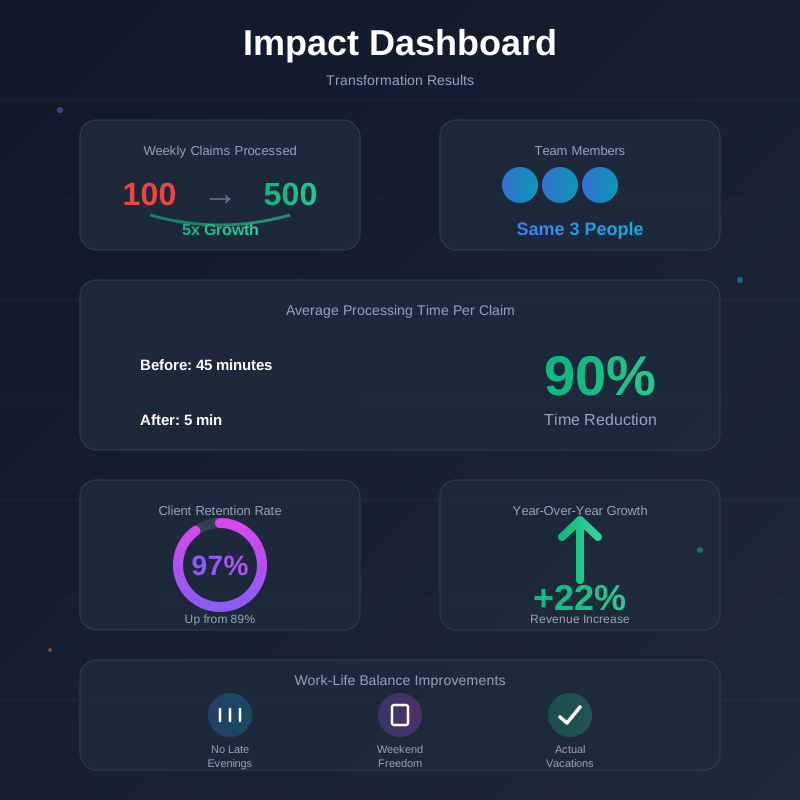
The agency now processes 400 to 500 claims per week with the same three-person team. Let that sink in. They went from drowning under 100 claims to smoothly handling 500. The math is striking. The old way would have required 375 hours per week just for claims processing (500 claims times 45 minutes each). That's more than nine full-time employees working 40-hour weeks. The new way requires about 19 hours per week. The time breakdown looks like this: 80 percent of claims process automatically with zero human time. Another 15 percent need quick review, about 5 minutes each. That's 75 claims times 5 minutes, or roughly 6 hours. The remaining 5 percent are truly complex and still require 30 minutes of human attention. That's 25 claims times 30 minutes, or about 12.5 hours. Add it up and you get around 19 hours of human time per week for 500 claims. That's a 95 percent reduction in processing time.
But the time savings number, dramatic as it is, doesn't capture the full transformation. What they do with that time tells the real story.
The owner now does check-in calls with every claim over a certain dollar amount. These aren't required by the carrier. They're not necessary for processing. They're relationship building. "Hey, I saw your claim came in. I know dealing with property damage is stressful. I just wanted to let you know I'm personally keeping an eye on this and we'll make sure you're taken care of." Clients remember those calls. They tell their friends about the agent who called just to check in.
Phone calls get returned the same day now instead of three days later. When clients email questions, responses come within hours. The agency's Google reviews started reflecting the change. "Most responsive agent I've ever worked with." "They actually answer when you call." "I submitted my claim at 10 PM and had a response by 9 AM the next morning."
The other agent, freed from processing obligations, now handles new business quotes. Before, he was always too buried to pursue new clients aggressively. Leads would come in and sit for days before anyone had time to follow up. Not anymore. The agency's book of business grew by 22 percent over the past year. They added a new niche specialty in short-term rental property insurance, something they never had bandwidth for before.
Work-life balance came back. The office manager leaves at 5 PM now. It used to be 7 or 8 PM regularly, sometimes later during busy periods. No more weekend catch-up sessions. No more skipping lunch to keep up with the workload. The owner took her first real vacation in three years. A full week, completely unplugged. The system ran while she was gone. Claims got processed. Clients got responses. Nothing caught fire.
"The crazy thing?" the owner reflects. "Our clients say our service got better. We're actually available now. Before, I was so buried in processing work that I couldn't do the relationship part of the job, which is literally why people hire independent agents instead of going direct to carriers."
Every case study mentions time savings and efficiency gains. Those are table stakes. What gets glossed over are the second-order effects, the benefits that only emerge after the immediate crisis is solved and you have breathing room to notice them.
First came competitive advantage in ways they didn't anticipate. Word spread in their local business community. Not through advertising, but through client conversations. "You need to talk to my insurance agent. She gets back to you in hours, not days." When a local business owner got frustrated with their big-name carrier's slow response times, they switched to this small agency specifically because of the reputation for responsiveness. The agency started winning clients from larger competitors who theoretically had more resources but couldn't match the speed and personal touch.
Second was data insights they never had time to develop before. When every minute is consumed by processing, you don't analyze trends. You just survive. Now they can see patterns. Which properties have recurring claims. Which types of businesses present higher risk. Seasonal trends in claims volume and types. They use these insights for better underwriting decisions and proactive client risk management. "We called a client last spring," the owner explains, "and told them we noticed their business had several slip-and-fall claims over the past two years. We suggested they review their floor maintenance procedures and offered to connect them with a safety consultant. They were blown away that we were looking out for them like that."
Third was the stress reduction benefit that's hard to quantify but impossible to ignore. When you're not in crisis mode all the time, you make better decisions. The owner caught a potential fraud case last month because she actually had time to notice something odd about a claim. In the old days, she would have just processed it quickly to clear the queue. Now she could slow down, ask questions, investigate. Turned out her instinct was right. That single catch probably saved the carrier tens of thousands of dollars and saved her agency from a potential E&O claim.
Fourth was employee retention. The office manager who was job-hunting? She's happy now. She tells friends that her boss "figured out how to use technology the right way." Taking vacation doesn't require weeks of preparation anymore. The system doesn't take days off. And here's something they didn't predict, hiring for growth instead of survival became possible. They're actually considering adding a fourth team member, not because they're drowning, but because they see opportunities to expand into new market segments.
Fifth came technology confidence. This team was initially skeptical about AI. They'd seen too many overhyped solutions that underdelivered. But once you experience AI that actually works, your whole perspective shifts. They recently added AI-powered customer communication tools. They're exploring AI-assisted policy comparison for quote generation. "Once you see AI actually work," the other agent notes, "you stop being scared of it. You start looking for other places it might help."
Every vendor case study makes implementation sound flawless. It never is. Being honest about challenges builds more credibility than pretending everything was smooth from day one.
The learning-to-trust phase was harder than anyone expected. The first month was brutal psychologically. The office manager compares it to teaching a teenager to drive. Intellectually, you know they're capable. But emotionally, you want to grab the wheel every five seconds. She had to resist the urge to manually review every single field on every single claim. That compulsion to double-check everything was almost physical. It took conscious effort to step back and let the system do its job.
Not every document is perfect. About 5 percent of claims still need significant human judgment. Handwritten notes from elderly clients sometimes require manual entry. Photos taken in extremely poor lighting might not be processable. Truly unusual claim types that fall outside normal patterns need human decision-making. But here's the key thing, the system flags these accurately. It doesn't silently process something wrong and create a mess. It says, "Hey, I'm not confident about this one. A human should look."
Client education took some effort. Several longtime clients were confused by instant confirmation emails. They called to ask if anyone had actually looked at their claim yet or if this was just an automated receipt. The agency had to explain that yes, the claim really had been received and processed that fast. Some clients remained skeptical until they saw how quickly they got actual updates and carrier responses.
The cost was real. AI-powered document processing isn't free. For a small operation watching every dollar, adding another monthly expense required justification. The owner did the math carefully. She compared it to hiring even a part-time employee. Salary, taxes, benefits, training time, management overhead. The AI cost less and worked 24/7 with perfect consistency. Put that way, the decision was obvious. But it still felt like a leap of faith initially.
The payback was clear by month two, but those first 60 days involved some nail-biting.
"I won't lie and say it's magic," the owner admits. "But the problems we have now are problems we want to have. Like figuring out how to grow strategically, not how to survive operationally."
When other small agencies or businesses ask for guidance, this team has learned what actually matters versus what sounds good in theory.
Start with your messiest process first. Don't begin with the easy stuff. Test AI on the chaos. If it can handle your nightmare scenarios, everything else is gravy. The owner wishes she'd sent over a dozen terrible examples during the demo instead of just one. "Make the vendor prove their system can handle your reality, not some sanitized version of your reality."
Run parallel systems for a bit. Don't just flip a switch and pray. The agency ran both manual and automated processing for two weeks until they trusted the AI's accuracy. That parallel phase cost extra time upfront but bought peace of mind. Worth every hour.
Don't wait until you're desperate. This team almost waited too long. If you're already drowning, it's harder to implement anything. You don't have mental bandwidth to evaluate solutions properly or time to manage a transition. Do it when you can still breathe. "We got lucky," the office manager reflects. "If that hailstorm had hit six months earlier, before we found Artificio, I honestly don't know if we would have survived it."
Small teams benefit most. Everyone assumes AI is for big enterprises with big budgets and big problems. That's backward. Big companies can hire more people. Throwing headcount at a problem is expensive but straightforward. Small teams can't do that. Margins don't support it. AI levels the playing field. It gives a three-person operation capabilities that used to require ten people.
Your clients will notice the difference in ways that matter. The owner thought automation would make their service seem less personal. The opposite happened. "Now I have time to be personal. I'm not rushing through calls because I have 50 claims waiting. I can actually listen, have real conversations, build relationships. That's what clients remember."
Eighteen months after implementation, the numbers tell part of the story. The agency processes over 2,200 claims per month with the same three-person team. They've actually considered adding a fourth person, but for growth opportunities, not survival necessity. Client retention hit 97 percent, up from 89 percent before. That difference represents dozens of policies that would have been lost to competitors. New business referrals are up 40 percent year-over-year. When clients are happy and feel well-served, they tell their friends.
But the numbers don't capture the full transformation. It's visible in small moments. The office manager eating lunch at her desk because she wants to, not because she has to. The owner taking a Wednesday afternoon off to watch her kid's school play. The other agent pursuing a professional certification he's been putting off for years because he finally has time to study.
The team is exploring what comes next. They're testing AI for policy renewals. They're considering opening a second location. The owner started mentoring other independent agents, teaching them how to run lean operations with smart technology. She's become an unofficial advocate in her professional circles for thinking differently about practice management.
"People ask me if I'm worried AI will replace insurance agents," she says. "I tell them AI didn't replace me. It let me actually be an agent instead of a data entry clerk. I'm doing the job I went into business to do."
This story isn't unique. Small agencies, law firms, medical practices, property management companies, mortgage brokers, and countless other document-heavy businesses face versions of the same challenge. Drowning in paperwork that prevents them from doing their actual jobs. Choosing between hiring people they can't afford or turning away business they need. Burning out trying to maintain quality while scaling operations.
The insight that changed everything for this insurance agency wasn't complicated. Documents don't need human intelligence. Document processing does. But once the intelligent processing is automated, humans can focus on the things that actually require human judgment, creativity, empathy, and relationship-building.
Technology that amplifies human capabilities instead of replacing them isn't just more effective. It's more sustainable. This team isn't working harder. They're working smarter, in the way that phrase is supposed to mean but rarely does.
They're processing five times more claims with the same team, serving clients better, growing the business, and going home at reasonable hours. Not because they found some secret hack or stumbled into unusual circumstances. Because they figured out what computers should do and what humans should do, then built a workflow where each does what it's best at.
That's not a story about AI replacing jobs. It's a story about AI creating space for people to do their jobs properly. And for a three-person insurance agency in a competitive market, that space made all the difference.

Head IT Operations - Co Founder of Artificio
See it in your SAP environment
Bring us a document, a process, or a bottleneck. We'll show how Artificio captures, validates, and posts into SAP — then scale from there.
Security & compliance
ISO 27001:2013 certified, SOC 2 Type 2 compliant, GDPR and HIPAA ready. Every agent action is logged, auditable, and runs in isolated environments.