

Blog
SOX Compliance: Intelligent Document Processing for Financial Reporting
Transform SOX compliance with intelligent document understanding. Reduce costs, mitigate risks, and enhance audit efficiency.

Blog
Transform SOX compliance with intelligent document understanding. Reduce costs, mitigate risks, and enhance audit efficiency.
The financial compliance landscape has undergone a dramatic transformation since the enactment of the Sarbanes-Oxley Act in 2002. What began as a regulatory response to corporate scandals has evolved into a comprehensive framework that demands unprecedented levels of documentation, internal controls, and audit trails. Today, publicly traded companies face an annual compliance burden averaging between $1.3 million and $5 million, with costs escalating year over year as regulatory requirements become increasingly complex and granular. The traditional approach of manual document review, basic optical character recognition (OCR), and workflow automation is proving inadequate for organizations that must demonstrate not just compliance, but intelligent understanding of regulatory context across thousands of financial documents.
The fundamental challenge lies in the nature of SOX compliance itself. Unlike other regulatory frameworks that focus primarily on specific data points or standardized reporting formats, SOX demands a holistic understanding of financial controls, risk assessments, and documentation integrity that spans multiple document types, formats, and contexts. A single quarterly filing might reference hundreds of supporting documents, each containing critical compliance information that must be interpreted within the broader regulatory framework. Traditional automation tools, while effective at extracting text and routing documents through predefined workflows, lack the sophisticated understanding necessary to interpret regulatory significance, identify compliance gaps, and ensure that documentation meets the nuanced requirements of SOX auditors.
This limitation becomes particularly acute when considering the evolving expectations of audit firms and regulatory bodies. Modern SOX audits require companies to demonstrate not just that they have collected the necessary documentation, but that they understand the regulatory implications of that documentation and can articulate how each piece of evidence supports their overall compliance posture. This level of sophisticated analysis demands document intelligence capabilities that go far beyond simple text extraction and pattern matching.
Traditional optical character recognition technology has served as the foundation for document digitization efforts across industries for decades. In the context of financial compliance, OCR systems have enabled organizations to convert paper-based records into searchable digital formats, facilitating basic keyword searches and rudimentary document categorization. However, the limitations of OCR become immediately apparent when applied to the complex requirements of SOX compliance automation.
OCR systems excel at identifying and extracting text characters from scanned documents, but they operate without understanding the meaning, context, or regulatory significance of that text. A typical OCR system might successfully extract the phrase "internal control deficiency" from a audit report, but it cannot interpret whether this represents a material weakness, a significant deficiency, or a minor observation that requires no immediate action. This lack of contextual understanding creates substantial gaps in compliance automation efforts, forcing organizations to rely on manual review processes that are both time-intensive and prone to human error.
The regulatory environment compounds these challenges by introducing layers of interpretive complexity that extend far beyond simple text recognition. SOX compliance requires understanding relationships between different types of documentation, recognizing when specific control activities are adequately documented, and identifying gaps or inconsistencies that might indicate compliance failures. A sophisticated document intelligence system must be capable of analyzing not just individual documents, but the relationships and dependencies between multiple documents within a broader compliance framework.
Modern document intelligence platforms address these limitations by incorporating advanced machine learning algorithms, natural language processing capabilities, and regulatory knowledge bases that enable contextual understanding of compliance-related content. These systems can analyze financial documents and automatically identify regulatory significance, categorize content according to SOX requirements, and flag potential compliance issues before they become audit findings. The distinction between basic OCR and intelligent document understanding represents a fundamental shift from reactive document processing to proactive compliance management. 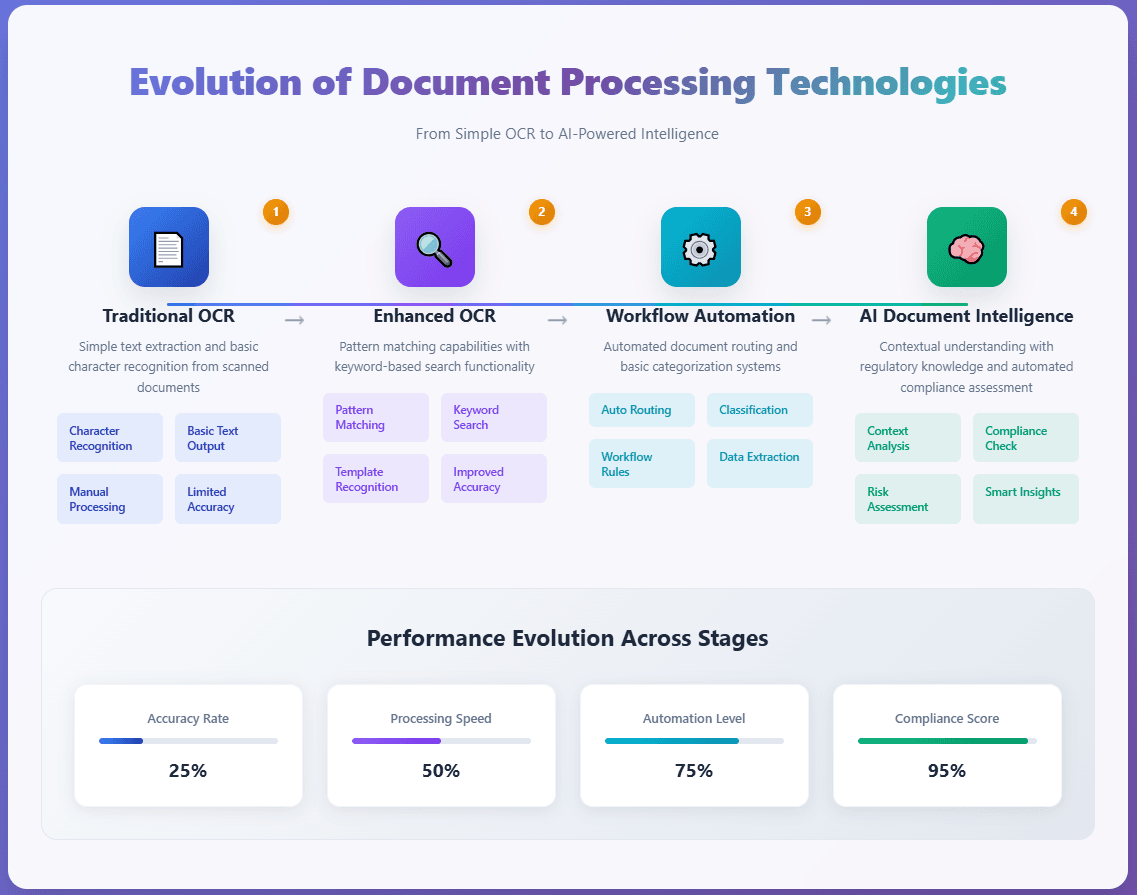
The Sarbanes-Oxley Act establishes a comprehensive framework for financial reporting and internal controls that generates substantial documentation requirements across multiple organizational functions. Section 302 requires principal executive and financial officers to certify the accuracy of financial statements and the effectiveness of internal controls, creating a cascade of supporting documentation that must be maintained, reviewed, and validated on an ongoing basis. Section 404 mandates annual assessments of internal control effectiveness, requiring detailed documentation of control design, implementation, and operational effectiveness testing.
These requirements translate into thousands of documents that must be created, maintained, and analyzed throughout each compliance cycle. Financial close procedures, journal entry documentation, segregation of duties matrices, risk assessments, control testing results, and remediation plans represent just a fraction of the documentation universe that organizations must manage. Each document type contains specific information that auditors expect to find, presented in formats that demonstrate compliance with relevant regulatory standards.
The complexity extends beyond individual document requirements to encompass the relationships and dependencies between different types of compliance documentation. A single control deficiency identified during testing might require updates to risk assessments, control descriptions, testing procedures, and management representations. These interconnected relationships create a web of documentation dependencies that must be maintained and validated to ensure overall compliance integrity.
Intelligent document processing systems must understand these regulatory nuances to provide meaningful automation benefits. The system must be capable of recognizing when a document contains information relevant to specific SOX requirements, understanding the regulatory context of that information, and identifying when documentation gaps or inconsistencies might create compliance risks. This level of sophisticated analysis requires deep integration of regulatory knowledge with advanced document processing capabilities.
The documentation lifecycle adds another layer of complexity to SOX compliance automation efforts. Documents must be created according to specific standards, reviewed and approved by appropriate personnel, maintained in accessible formats, and updated as business processes or regulatory requirements change. Throughout this lifecycle, organizations must demonstrate that their documentation provides adequate evidence of control effectiveness and compliance with SOX requirements. Intelligent document processing systems must support this entire lifecycle while maintaining the audit trails and version controls that auditors expect to find.
Generic workflow automation tools and basic document management systems have provided incremental improvements in compliance efficiency, but they fail to address the fundamental challenges of regulatory document intelligence. These traditional approaches typically focus on routing documents through predefined approval processes, maintaining basic audit trails, and providing simple search capabilities based on metadata or keyword matching. While these functions provide value for general business process automation, they prove inadequate when applied to the sophisticated requirements of SOX compliance.
The primary limitation of traditional automation lies in its inability to understand regulatory context and significance. A workflow system might successfully route a control testing document through the appropriate approval process, but it cannot analyze whether the testing procedures documented in that file are adequate to demonstrate control effectiveness under SOX requirements. This gap between process automation and regulatory intelligence forces organizations to rely on manual review processes for the most critical aspects of compliance management.
Traditional systems also struggle with the dynamic nature of regulatory interpretation and the evolving expectations of audit firms. SOX compliance requirements are not static; they evolve based on regulatory guidance, audit firm methodologies, and emerging best practices within the accounting profession. Generic automation tools cannot adapt to these changes without significant manual reconfiguration, creating ongoing maintenance burdens and potential compliance gaps when requirements change.
The documentation analysis capabilities of traditional systems present another significant limitation. Basic keyword searches and simple pattern matching cannot provide the sophisticated analysis required to identify compliance risks or validate regulatory adequacy. These systems might successfully locate all documents containing the phrase "control testing," but they cannot analyze whether the testing procedures documented in those files provide sufficient evidence of control effectiveness or identify when testing gaps might create audit risks.
Furthermore, traditional automation approaches typically operate in isolation from the broader compliance context that gives individual documents their regulatory significance. A single journal entry might be routine from a workflow perspective but highly significant from a compliance standpoint if it relates to a sensitive accounting estimate or a previously identified internal control deficiency. Generic automation systems cannot make these contextual connections, limiting their effectiveness for regulatory compliance applications. 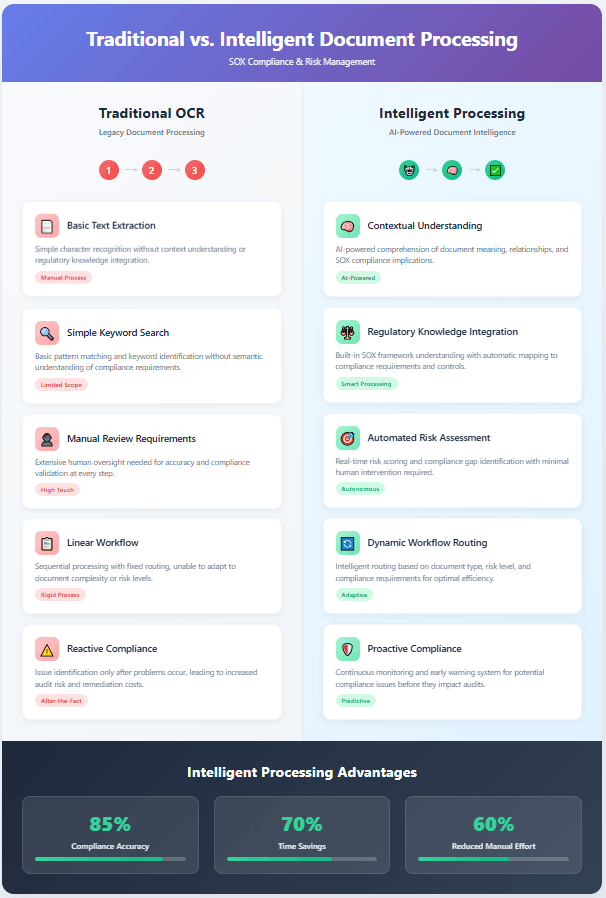
Context-aware document intelligence represents a fundamental evolution in how organizations approach regulatory compliance automation. Rather than simply extracting text or routing documents through predefined processes, these advanced systems analyze documents within their broader regulatory and business context to provide intelligent insights that support compliance decision-making. This paradigm shift enables organizations to move from reactive compliance management to proactive risk identification and mitigation.
The foundation of context-aware document intelligence lies in the integration of regulatory knowledge bases with sophisticated natural language processing capabilities. These systems maintain comprehensive understanding of SOX requirements, audit expectations, and regulatory best practices, enabling them to analyze documents not just for content, but for regulatory significance and compliance implications. When processing a control testing document, for example, the system can evaluate whether the testing procedures align with regulatory expectations, identify potential gaps or weaknesses, and suggest improvements based on established best practices.
Machine learning algorithms enable these systems to continuously improve their understanding of regulatory context and organizational-specific compliance patterns. As the system processes more documents and receives feedback on its analyses, it develops increasingly sophisticated understanding of how regulatory requirements apply within specific organizational contexts. This learning capability ensures that the system becomes more valuable over time, adapting to organizational nuances and evolving regulatory expectations.
The analytical capabilities of context-aware systems extend far beyond simple document categorization to encompass sophisticated compliance risk assessment and gap analysis. These systems can analyze relationships between different types of documentation, identify inconsistencies that might indicate control failures, and predict areas where compliance risks are most likely to emerge. This predictive capability enables organizations to address potential compliance issues before they become audit findings, reducing both compliance costs and regulatory risks.
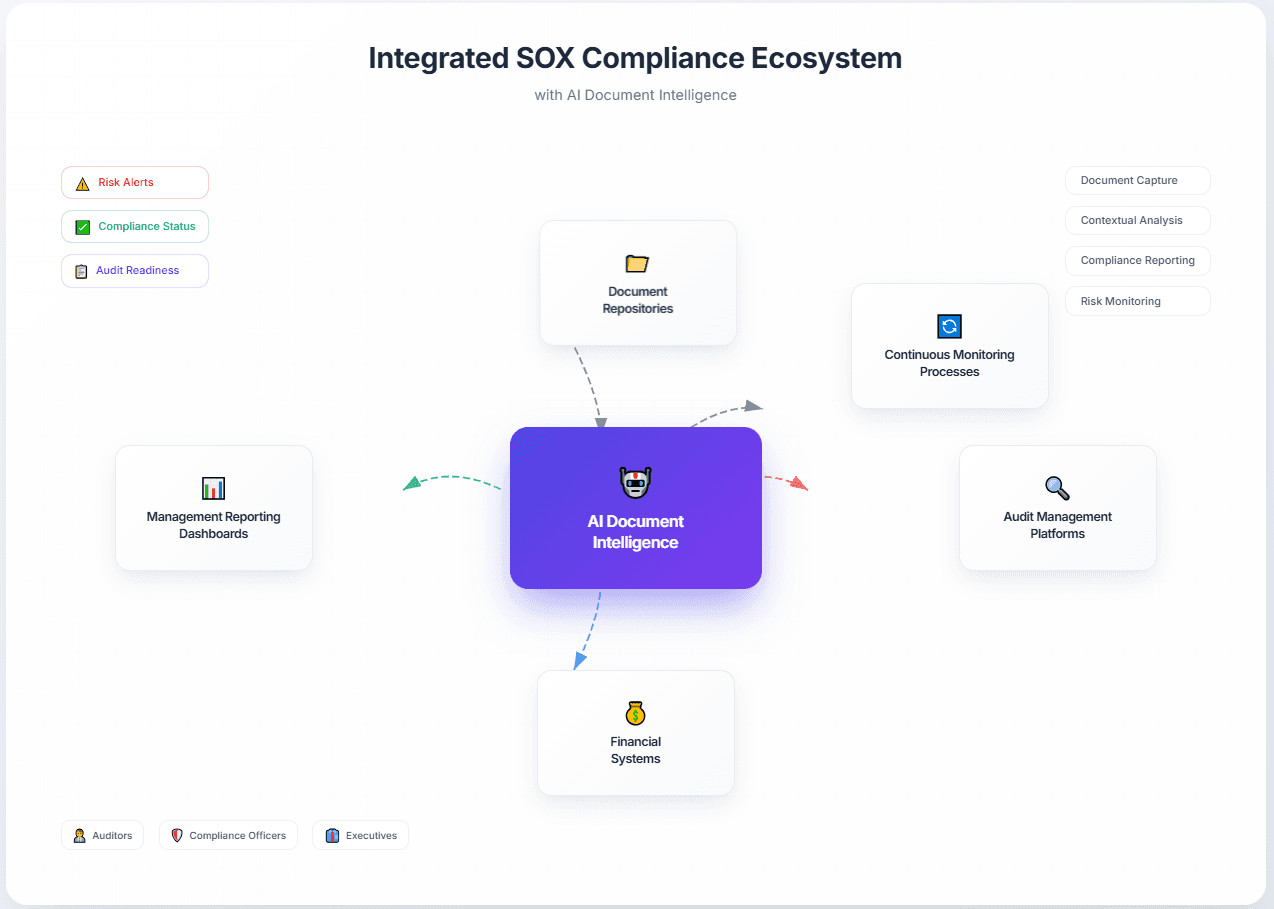
Integration capabilities represent another critical advantage of context-aware document intelligence platforms. These systems can connect with existing financial systems, audit management platforms, and compliance databases to provide comprehensive views of organizational compliance posture. This integration enables real-time compliance monitoring and provides the foundation for automated compliance reporting that meets both internal management and external audit requirements.
The ability to understand and interpret regulatory context distinguishes intelligent document processing systems from traditional automation tools and represents the most significant value proposition for SOX compliance applications. Regulatory context understanding encompasses not just knowledge of specific SOX requirements, but comprehension of how those requirements interact with broader financial reporting standards, audit methodologies, and industry-specific compliance considerations.
Effective regulatory context understanding requires sophisticated knowledge representation that captures the nuanced relationships between different compliance requirements. SOX Section 404 requirements for internal control assessment, for example, must be understood in conjunction with COSO framework principles, PCAOB audit standards, and SEC reporting requirements. A document intelligence system must understand these interconnected requirements to provide meaningful analysis of compliance documentation and identify potential gaps or inconsistencies.
The temporal dimension of regulatory context adds another layer of complexity that intelligent systems must address. Regulatory requirements evolve over time through new guidance, interpretive releases, and changes in audit firm methodologies. Document intelligence systems must maintain current understanding of these evolving requirements and apply appropriate interpretive frameworks based on the relevant time periods for specific documents or compliance assessments.
Industry-specific regulatory context represents another critical consideration for organizations operating in regulated sectors such as banking, healthcare, or energy. These organizations face additional compliance requirements beyond SOX that may interact with or influence internal control design and testing procedures. Intelligent document processing systems must understand these sector-specific requirements and their implications for SOX compliance to provide accurate and relevant analysis.
The system must also understand organizational context, including company size, complexity, business model, and risk profile, all of which influence how SOX requirements should be interpreted and applied. A large multinational corporation faces different compliance challenges and expectations than a smaller public company, and document intelligence systems must adapt their analysis accordingly. This organizational context understanding enables more precise compliance risk assessment and more relevant automation recommendations.
Intelligent document classification represents one of the most immediately valuable applications of context-aware document intelligence for SOX compliance automation. Traditional document management systems typically rely on manual tagging or simple folder structures to organize compliance documentation, creating significant inefficiencies and potential gaps in document organization. Advanced document intelligence systems can automatically classify documents according to SOX requirements, regulatory significance, and compliance risk levels.
The classification process begins with sophisticated analysis of document content, structure, and metadata to identify the type of compliance information contained within each document. The system must distinguish between different types of control documentation, testing procedures, risk assessments, and supporting evidence, each of which serves different purposes within the overall compliance framework. This classification accuracy is critical because it determines how documents are processed, reviewed, and utilized throughout the compliance cycle.
Risk assessment capabilities enable these systems to automatically evaluate the compliance significance of individual documents and identify potential areas of concern. A document containing evidence of control testing failures, for example, should be flagged for immediate management attention and potentially escalated through appropriate reporting channels. The system must understand the regulatory implications of different types of findings and apply appropriate risk assessment criteria based on materiality, scope, and potential impact on overall compliance posture.
The automated risk assessment process extends beyond individual document analysis to encompass portfolio-level evaluation of compliance documentation. The system can analyze patterns across multiple documents to identify systemic issues, control environment weaknesses, or areas where documentation may be insufficient to support compliance objectives. This portfolio analysis capability enables organizations to identify and address compliance risks at a strategic level rather than simply managing individual document-level issues.
Machine learning algorithms enable continuous improvement in classification accuracy and risk assessment precision. As the system processes more documents and receives feedback on its analyses, it develops increasingly sophisticated understanding of organizational-specific compliance patterns and risk indicators. This learning capability ensures that the automated classification and risk assessment processes become more accurate and valuable over time, reducing false positives and improving the relevance of compliance alerts and recommendations.
The value of context-aware document intelligence extends beyond document processing to encompass integration with broader audit workflows and management reporting processes. Modern SOX compliance requires seamless coordination between internal audit teams, external auditors, and management stakeholders, all of whom require access to relevant compliance documentation and analysis at different points in the compliance cycle.
Integration with audit management platforms enables document intelligence systems to automatically populate audit workpapers with relevant documentation and analysis, reducing the manual effort required to prepare for audit procedures. When auditors request documentation related to specific controls or business processes, the system can automatically identify and compile relevant documents while providing contextual analysis that helps auditors understand the regulatory significance of the information being provided.
The system can also support audit planning processes by analyzing historical compliance documentation to identify areas where audit procedures should be focused or enhanced. By understanding patterns in control testing results, management representations, and prior audit findings, the system can help audit teams allocate their resources more effectively and focus attention on areas where compliance risks are most significant.
Management reporting capabilities enable executive stakeholders to receive regular updates on compliance posture without requiring detailed involvement in day-to-day compliance activities. The system can automatically generate compliance dashboards, risk summaries, and trend analyses that provide senior management with the information needed to fulfill their SOX certification responsibilities. These reporting capabilities must be sophisticated enough to provide meaningful insights while remaining accessible to stakeholders who may not have detailed technical knowledge of specific compliance requirements.
Real-time monitoring capabilities enable continuous compliance oversight rather than periodic assessment approaches that characterize traditional compliance management. The system can continuously analyze new documents and transactions to identify potential compliance issues as they emerge, enabling proactive risk mitigation rather than reactive problem resolution. This continuous monitoring approach aligns with evolving regulatory expectations for robust internal control environments and proactive compliance management.
Successfully implementing context-aware document intelligence for SOX compliance requires careful consideration of organizational readiness, system integration requirements, and change management processes. Organizations must evaluate their current compliance documentation practices, technology infrastructure, and stakeholder requirements to develop implementation strategies that maximize value while minimizing disruption to existing compliance processes.
The assessment of current document management practices represents a critical first step in implementation planning. Organizations must understand the types of documents they currently maintain, how those documents are created and stored, and what manual processes are currently required to manage compliance documentation. This assessment provides the foundation for understanding potential automation benefits and identifying areas where intelligent document processing can provide the greatest value.
Technology integration considerations encompass both technical compatibility and process alignment requirements. The document intelligence system must integrate effectively with existing financial systems, audit management platforms, and compliance databases while supporting the workflow requirements of different stakeholder groups. This integration planning requires close collaboration between IT teams, compliance professionals, and audit stakeholders to ensure that the implemented solution supports all necessary use cases.
Change management processes are particularly critical for document intelligence implementations because they typically require modifications to established compliance procedures and may change how different stakeholders interact with compliance documentation. Training programs must address not just system functionality, but the underlying concepts of intelligent document analysis and how automated insights should be incorporated into compliance decision-making processes.
Data quality and governance considerations represent another critical implementation factor. Document intelligence systems require high-quality input data to provide accurate analysis and insights. Organizations must establish processes for ensuring that documents are captured in appropriate formats, maintain adequate metadata, and are updated as business processes or regulatory requirements change. These data governance processes are essential for maintaining system effectiveness over time.
The business case for context-aware document intelligence in SOX compliance must demonstrate both quantitative cost savings and qualitative improvements in compliance effectiveness and risk management. Traditional ROI calculations for compliance technology often focus primarily on labor cost reductions, but the value proposition for intelligent document processing extends far beyond simple efficiency gains to encompass risk mitigation, audit cost reduction, and strategic compliance capabilities.
Direct labor cost savings represent the most immediately quantifiable benefit of document intelligence automation. Organizations can measure reductions in manual document review time, compliance testing procedures, and audit preparation activities. These measurements should account for both internal staff time and external professional service costs, including audit fees that may be reduced through more efficient audit procedures enabled by intelligent document processing.
Compliance risk reduction represents a more complex but potentially more significant source of value. Organizations that implement effective document intelligence systems may experience fewer audit findings, reduced regulatory scrutiny, and lower compliance-related costs over time. While these benefits are more difficult to quantify precisely, they can be estimated based on historical compliance costs and industry benchmarks for compliance performance.
Audit efficiency improvements provide another measurable source of value through reduced audit fees and shortened audit timelines. When audit teams can access well-organized, intelligently analyzed compliance documentation, they can complete their procedures more efficiently while maintaining appropriate audit quality. These efficiency gains translate directly into cost savings for the organization and may also reduce the business disruption associated with extended audit procedures.
Strategic compliance capabilities enabled by document intelligence systems may provide the most significant long-term value but are also the most challenging to quantify. These capabilities include improved compliance risk management, more effective resource allocation, and enhanced ability to demonstrate compliance effectiveness to regulators and stakeholders. Organizations should develop qualitative metrics to track these strategic benefits alongside quantitative cost measurements.
The regulatory landscape continues to evolve, with new requirements, interpretive guidance, and audit methodologies emerging regularly. Organizations that invest in context-aware document intelligence position themselves to adapt more effectively to these changes while maintaining robust compliance postures. The adaptive capabilities of intelligent systems enable organizations to modify their compliance approaches without requiring complete system replacements or extensive manual reconfiguration.
Emerging regulatory trends suggest increasing emphasis on continuous compliance monitoring, real-time risk assessment, and proactive compliance management. Traditional periodic assessment approaches are giving way to continuous assurance models that require sophisticated technology capabilities to implement effectively. Document intelligence systems provide the foundation for these advanced compliance approaches by enabling automated analysis of ongoing business activities and transactions.
The integration of artificial intelligence capabilities into compliance management represents another significant trend that organizations must consider in their technology planning. As AI technologies continue to advance, document intelligence systems will become increasingly sophisticated in their ability to understand regulatory context, predict compliance risks, and recommend proactive risk mitigation strategies. Organizations that establish foundations with advanced document intelligence systems today will be better positioned to leverage these emerging capabilities as they become available.
Regulatory expectations for technology-enabled compliance continue to increase, with auditors and regulators expecting organizations to leverage available technologies to enhance their compliance effectiveness. Organizations that fail to adopt appropriate technology solutions may find themselves at a competitive disadvantage in demonstrating compliance effectiveness and may face increased scrutiny from auditors and regulators who expect to see evidence of sophisticated compliance management approaches.
The evolution of SOX compliance requirements and audit expectations has created a compelling business case for context-aware document intelligence that extends far beyond simple cost reduction or efficiency improvements. Organizations that continue to rely on traditional document processing approaches face increasing risks of compliance gaps, audit findings, and escalating compliance costs as regulatory requirements become more complex and sophisticated.
Context-aware document intelligence represents a fundamental shift from reactive compliance management to proactive risk identification and mitigation. By understanding regulatory context, analyzing compliance documentation intelligently, and integrating with broader audit and management processes, these systems enable organizations to transform their compliance operations while reducing costs and improving effectiveness.
The implementation of intelligent document processing for SOX compliance requires careful planning, stakeholder engagement, and change management, but the potential benefits justify the investment for organizations committed to compliance excellence. As regulatory requirements continue to evolve and audit expectations increase, the organizations that invest in sophisticated compliance technologies today will be best positioned to meet future challenges while maintaining competitive advantages through superior compliance management capabilities.
The question for CFOs, compliance officers, and audit directors is not whether to invest in intelligent document processing, but how quickly they can implement these capabilities to begin realizing the substantial benefits they provide. In an environment where compliance costs continue to escalate and regulatory expectations continue to increase, context-aware document intelligence represents both a strategic necessity and a competitive advantage for organizations committed to compliance excellence and operational efficiency.

Head IT Operations - Co Founder of Artificio
See it in your SAP environment
Bring us a document, a process, or a bottleneck. We'll show how Artificio captures, validates, and posts into SAP — then scale from there.
Security & compliance
ISO 27001:2013 certified, SOC 2 Type 2 compliant, GDPR and HIPAA ready. Every agent action is logged, auditable, and runs in isolated environments.