

Blog
How AI Agents Are Revolutionizing Business Workflows & Document Management
Discover how AI is revolutionizing document processing, automating workflows, and boosting efficiency across industries.

Blog
Discover how AI is revolutionizing document processing, automating workflows, and boosting efficiency across industries.
In today's data-driven business landscape, organizations across industries face the mounting challenge of processing vast volumes of documents efficiently. From invoices and contracts to medical records and insurance claims, the sheer quantity of paperwork that requires careful analysis, data extraction, and routing presents a significant operational burden. Traditional manual processing methods not only consume valuable time and resources but also introduce the risk of human error, inconsistency, and compliance issues.
Enter the era of AI-powered document processing a technological revolution that is fundamentally transforming how businesses handle information management. At the forefront of this transformation is Artificio, a cutting-edge platform leveraging artificial intelligence to autonomously analyze, understand, and extract relevant information from documents of all types. By automating critical tasks such as data classification, extraction, validation, and routing, Artificio is streamlining document processing workflows while significantly reducing the need for manual intervention.
This article explores the transformative impact of AI agents on document processing, examining how intelligent automation solutions like Artificio are revolutionizing business operations across multiple industries. We will delve into the underlying technologies, practical applications, measurable benefits, and future prospects of AI-driven document management. As illustrated in Figure 1, the evolution from manual to AI-powered document processing represents a paradigm shift in operational efficiency and data accuracy.
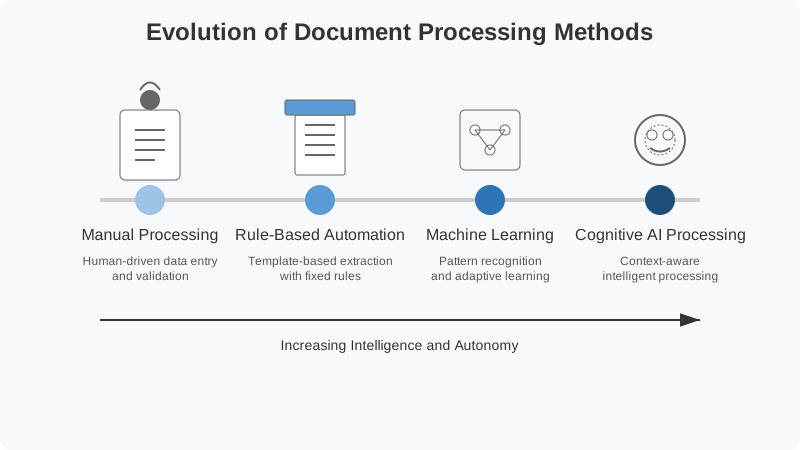
Before exploring the AI solution, it's important to understand the scale of the document processing challenge facing modern businesses. Organizations typically process thousands sometimes millions of documents annually, each containing critical information that must be accurately captured, validated, and integrated into various business systems.
The traditional approach to document processing involves a labor-intensive workflow where human operators manually review documents, extract relevant data, classify information according to predefined categories, and route documents to appropriate departments or systems. This process is not only time-consuming but also prone to inconsistencies and errors. According to recent industry research, manual data entry typically has an error rate between 1% and 4%, which might seem small until one considers the cumulative impact of these errors on business operations, customer satisfaction, and regulatory compliance.
Furthermore, the complexity of document processing has increased exponentially with the proliferation of document formats, communication channels, and regulatory requirements. Modern businesses must contend with a mix of physical and digital documents arriving through various channels email, web portals, mobile applications, and traditional mail each requiring consistent processing regardless of format or source.
The financial implications of inefficient document processing are substantial. Organizations allocate significant resources to document handling, with estimates suggesting that employees spend approximately 50% of their time searching for information and nearly 60% of their time handling document-related tasks. When combined with the costs associated with document storage, retrieval, and error correction, inefficient document processing represents a substantial drain on organizational resources.
This challenge is particularly acute in document-intensive industries such as healthcare, insurance, legal services, and financial services, where timely and accurate document processing is not merely an operational concern but a critical component of service delivery, compliance, and competitive advantage.
Artificial intelligence offers a powerful solution to the document processing challenge through a combination of advanced technologies working in concert to analyze, understand, and process documents with minimal human intervention. The Artificio platform exemplifies this approach by integrating multiple AI technologies into a cohesive document processing solution.
At the heart of AI-powered document processing are several key technologies:
Natural Language Processing (NLP): These algorithms enable systems to understand the context, meaning, and relationships within text. NLP allows AI agents to interpret documents in a manner similar to human reading, recognizing entities, sentiments, and intentions within the text. For example, an NLP-powered system can distinguish between a delivery address and a billing address on an invoice, understanding the functional difference between these similar data points.
Machine Learning: These algorithms allow systems to learn patterns and improve performance over time without explicit programming. In document processing, machine learning enables systems to recognize document types, identify relevant information, and make increasingly accurate predictions about where to find specific data points in different document formats.
Computer Vision: These algorithms allow systems to "see" and interpret visual elements within documents. Computer vision is particularly valuable for processing documents with complex layouts, tables, charts, or handwritten elements. It enables systems to recognize structural elements like form fields, checkboxes, and signatures, even when they appear in varying positions across different document versions.
Deep Learning: A subset of machine learning, deep learning uses neural networks with multiple layers to process data with a high degree of complexity. Deep learning excels at handling unstructured data and recognizing patterns that would be difficult to program explicitly. In document processing, deep learning enables systems to handle highly variable document formats and extract relevant information even when the exact location or format of that information changes.
These technologies converge in AI document processing platforms like Artificio to create intelligent agents capable of performing a variety of document-related tasks with remarkable speed and accuracy. As shown in Figure 2, the typical workflow of an AI-powered document processing system involves multiple stages of analysis and extraction, each leveraging specific AI capabilities to transform raw documents into structured, actionable data.
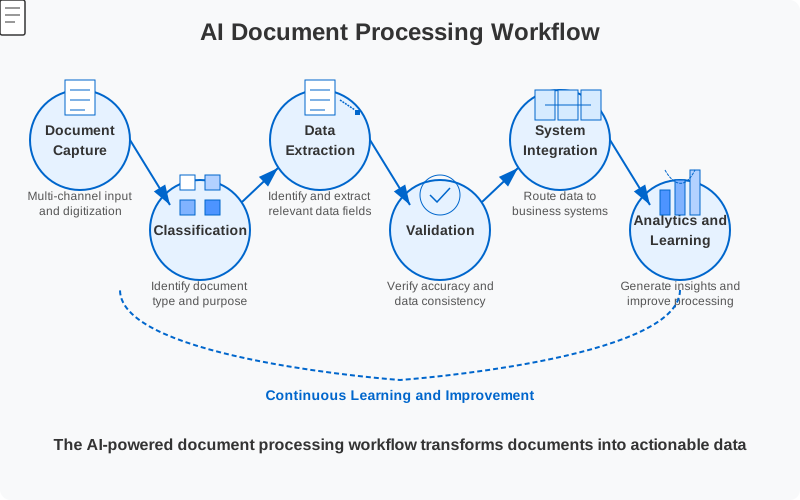
The process typically begins with document ingestion, where documents from various sources are captured and digitized if necessary. Next, AI agents classify the documents according to type, such as invoices, receipts, contracts, or forms. Once classified, documents undergo detailed analysis where AI extracts relevant data fields, validates the information against existing databases or rules, and routes the processed data to appropriate systems or workflows.
Throughout this process, the AI continuously learns and improves based on feedback and new examples, gradually increasing its accuracy and ability to handle edge cases without human intervention. This learning capacity represents a fundamental advantage over traditional rule-based automation, which lacks the flexibility to adapt to new document formats or unexpected variations.
The result is a document processing system that not only automates routine tasks but also augments human capabilities by handling complex analyses that would be time-consuming or error-prone when performed manually. By combining the pattern recognition capabilities of AI with the contextual understanding of NLP, platforms like Artificio can process documents with a level of intelligence that approaches—and in some cases exceeds—human performance.
In the next section, we will explore specific industry applications and examine the measurable benefits that organizations are realizing through AI-powered document processing.
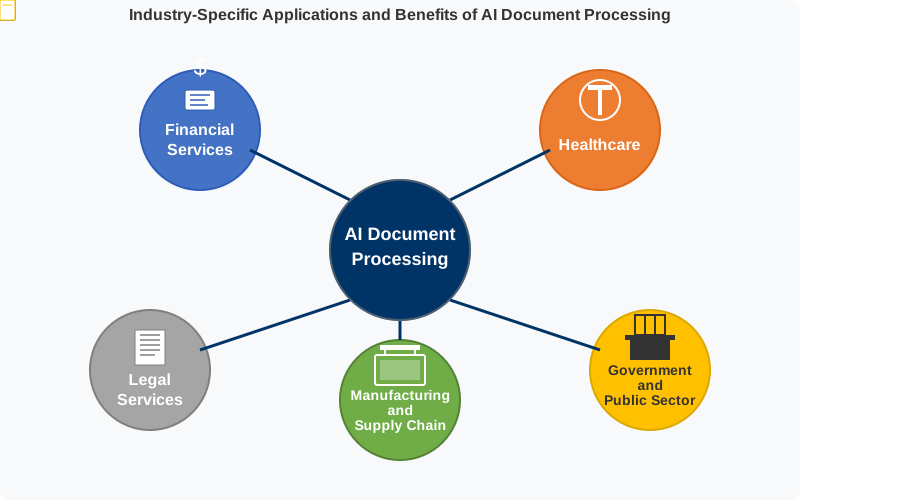
The transformative power of AI document processing extends across virtually every industry where document management plays a significant role. Let's examine how intelligent automation is reshaping document workflows in several key sectors:
In the financial sector, document processing is both voluminous and mission-critical. Banks, investment firms, and insurance companies handle millions of documents annually, from loan applications and policy documents to regulatory filings and customer correspondence. AI agents are particularly valuable in this context for several reasons.
For loan processing, AI document systems can extract relevant information from application forms, identity documents, income verification, and credit histories. This accelerates the loan approval process while maintaining rigorous compliance standards. A major commercial bank implemented Artificio's AI document processing system and reduced loan application processing time from an average of 7 days to less than 24 hours, while simultaneously decreasing processing errors by 63%.
In fraud detection, AI agents analyze transaction records, account statements, and supporting documentation to identify suspicious patterns or discrepancies. The system's ability to cross-reference information across multiple documents enables more sophisticated fraud detection than would be possible with manual review alone.
For regulatory compliance, financial institutions must maintain meticulous documentation and reporting processes. AI document processing enables automated extraction of relevant compliance data, ensuring consistent adherence to evolving regulatory standards. This is particularly valuable for global institutions operating across multiple jurisdictions with varying compliance requirements.
The healthcare industry faces unique document processing challenges due to the volume and complexity of patient records, insurance claims, clinical trial documentation, and regulatory filings. AI document processing offers compelling advantages in this context.
For patient record management, AI agents can extract and structure information from diverse sources including intake forms, physician notes, lab results, and imaging reports. This creates a comprehensive patient profile that supports informed clinical decision-making. The intelligent classification capabilities ensure that sensitive information is appropriately tagged and secured in compliance with privacy regulations like HIPAA.
In claims processing, healthcare providers and insurers leverage AI document systems to extract relevant diagnostic codes, treatment information, and billing details. This accelerates reimbursement cycles while reducing claim rejections due to coding errors or missing information. A regional healthcare network reported a 41% reduction in claims processing time and a 27% decrease in rejection rates after implementing AI-powered document processing.
For clinical research, pharmaceutical companies and research institutions use AI document systems to analyze research protocols, patient consent forms, and clinical observations. The ability to extract structured data from unstructured notes accelerates the research process while maintaining rigorous documentation standards.
Law firms and legal departments handle extensive document volumes, from contracts and court filings to evidence and discovery materials. AI document processing transforms legal workflows in several key areas.
Contract analysis represents a particularly valuable application, where AI agents can extract key terms, obligations, expiration dates, and conditional clauses from complex legal documents. This enables more efficient contract review and management, with one corporate legal department reporting a 70% reduction in time spent on routine contract review after implementing an AI document system.
In legal research, AI agents analyze case documents, statutory references, and procedural filings to identify relevant precedents and legal arguments. This accelerates the research process while ensuring comprehensive coverage of relevant legal sources.
For due diligence processes during mergers and acquisitions, AI document systems extract and organize critical information from financial statements, contracts, intellectual property documentation, and regulatory filings. This enables more thorough due diligence in compressed timeframes, supporting more informed decision-making during high-stakes transactions.
In manufacturing and supply chain operations, document processing plays a crucial role in procurement, quality control, inventory management, and logistics. AI document processing streamlines these functions in several ways.
For procurement processes, AI agents extract and validate information from purchase orders, invoices, delivery receipts, and supplier contracts. This ensures accurate matching of orders to deliveries and invoices, preventing payment errors and supply chain disruptions. A global manufacturing company implemented AI document processing and reduced invoice processing costs by 53% while decreasing payment errors by 78%.
In quality management, AI document systems analyze inspection reports, compliance certifications, and testing documentation. The automated extraction of quality parameters enables more consistent quality control and simplified regulatory reporting.
For logistics operations, AI agents process shipping manifests, customs documentation, and transportation records. The ability to extract and validate shipment details across multiple documents enables more efficient route planning and inventory management.
Government agencies at all levels face enormous document processing requirements for services ranging from tax collection and benefits administration to regulatory compliance and public records management. AI document processing offers significant efficiency gains in these contexts.
For tax processing, revenue agencies use AI document systems to extract and validate information from tax returns, supporting documentation, and historical filings. This accelerates assessment and refund processes while identifying potential discrepancies for further review. A state tax authority implemented AI document processing and increased processing throughput by 35% during peak tax season while improving accuracy by 22%.
In benefits administration, government agencies process applications and supporting documentation for programs ranging from unemployment insurance to healthcare subsidies. AI document processing enables faster assessment of eligibility while maintaining consistent application of program criteria.
For public records management, government agencies use AI document systems to classify, index, and extract information from the vast archives of public documents. This improves accessibility for both internal operations and public information requests.
As illustrated in Figure 3, AI document processing is delivering transformative benefits across multiple industries, with each sector leveraging the technology to address its specific document management challenges.
The adoption of AI document processing delivers measurable improvements across multiple performance dimensions. Understanding these benefits helps organizations build a compelling business case for implementing intelligent document automation solutions like Artificio.
The most immediate and visible benefit of AI document processing is the dramatic reduction in processing time compared to manual methods. Organizations implementing AI document systems typically report processing time reductions of 60-80% for routine document types. This acceleration occurs because AI systems can:
For example, a financial services company processing mortgage applications reduced average processing time from 45 minutes to 6 minutes per application after implementing AI document processing. This 87% reduction enabled the same team to handle a 140% increase in application volume without additional staffing.
The productivity implications extend beyond the document processing team itself. Faster document processing accelerates dependent workflows throughout the organization, from customer onboarding and service delivery to financial operations and regulatory reporting. This creates a multiplier effect where the efficiency gains in document processing yield additional productivity improvements downstream.
AI document processing generates substantial cost savings through multiple mechanisms:
Labor cost reduction: By automating routine document handling tasks, organizations can reallocate skilled personnel to higher-value activities. A healthcare provider implementing AI document processing for patient records reduced the document processing team from 12 full-time employees to 4, while improving processing throughput and accuracy.
Error remediation savings: Manual document processing typically produces error rates of 1-4%, with each error requiring costly investigation and correction. AI document systems achieve error rates below 0.5% for most document types, dramatically reducing remediation costs. An insurance company reported annual savings of $1.2 million in error correction costs after implementing AI document processing for claims handling.
Compliance penalty avoidance: In highly regulated industries, document processing errors can trigger substantial compliance penalties. By improving accuracy and consistency, AI document systems help organizations avoid these costs. A financial institution estimated annual compliance penalty avoidance of $3.7 million after implementing AI document processing for regulatory filings.
Physical storage reduction: Organizations leveraging AI document processing can more confidently transition to digital document management, reducing physical storage costs. A legal services firm eliminated 4,000 square feet of document storage space after implementing AI document processing, generating annual savings of $168,000 in real estate costs alone.
The combined cost benefits create a compelling return on investment case for AI document processing, with many organizations reporting full cost recovery within 12-18 months of implementation.
AI document processing systems consistently outperform human operators in accuracy for routine document tasks. While human accuracy typically ranges from 96-99% depending on document complexity and operator fatigue, AI systems regularly achieve accuracy rates above 99.5% for well-trained models.
This improvement may seem incremental until considered at scale. For an organization processing 1 million documents annually, the difference between 98% and 99.5% accuracy represents 15,000 fewer errors requiring investigation and correction.
Beyond statistical accuracy, AI document systems offer superior consistency in applying processing rules. Unlike human operators who may interpret guidelines differently or apply rules inconsistently when fatigued, AI systems apply the same processing logic consistently across all documents. This consistency is particularly valuable for regulatory compliance, where uniform application of processing standards is essential.
The customer experience benefits of AI document processing are substantial but often overlooked in the business case. Faster document processing translates directly to improved customer experiences through:
A property insurance company implementing AI document processing for claims handling reduced average claim settlement time from 23 days to 7 days, generating a 41% improvement in customer satisfaction scores for claims handling. This improvement translated to measurable benefits in customer retention and positive referrals.
Beyond operational efficiency, AI document processing transforms documents from static information repositories into dynamic data assets. By extracting structured data from unstructured documents, AI systems make document information available for analysis, reporting, and business intelligence.
This transformation enables organizations to:
For example, a manufacturing company implementing AI document processing for supplier invoices uncovered pricing inconsistencies that enabled $3.2 million in annual procurement savings. This strategic benefit would have been difficult to identify through traditional document processing methods where the data remained locked in unstructured formats.
In the next section, we will explore implementation considerations and best practices for organizations seeking to deploy AI document processing solutions effectively.
Successfully implementing AI document processing requires thoughtful planning and execution. Organizations that have successfully deployed platforms like Artificio typically follow a structured approach that balances technical considerations with organizational change management.
The implementation journey begins with a comprehensive assessment of current document processing workflows and identification of high-value automation opportunities. This assessment should consider:
Document volume and complexity: Organizations should catalog their document types by volume, complexity, and business impact. High-volume, standardized documents typically represent the most immediate automation opportunity, while complex, variable documents may require more sophisticated AI approaches.
Process dependencies: Document processing rarely exists in isolation but rather supports broader business processes. Understanding these dependencies helps organizations prioritize automation opportunities with the greatest downstream impact. A procurement team might prioritize invoice processing automation because faster invoice processing enables early payment discounts that generate immediate financial returns.
Data quality and accessibility: AI document processing requires access to historical document samples for training and validation. Organizations should assess the availability and quality of these document samples early in the planning process. Insufficient or poor-quality samples may necessitate a data collection phase before full implementation.
Integration requirements: Document processing systems must integrate with existing enterprise systems, from content management platforms to business process management tools. Mapping these integration requirements early helps organizations anticipate technical challenges and plan accordingly.
Based on this assessment, organizations should develop a phased implementation roadmap that prioritizes document types and processes with the highest potential return on investment. This roadmap should include clear success metrics that align with business objectives, from efficiency gains and cost savings to accuracy improvements and customer experience enhancements.
Selecting the right AI document processing platform requires careful evaluation of various options against organizational requirements. Key considerations include:
Processing capabilities: Different platforms excel at different document types and processing tasks. Organizations should evaluate each platform's capabilities for their specific document processing needs, from document classification and data extraction to validation and integration.
Trainability and adaptability: AI document systems improve over time with additional training samples and feedback. Organizations should assess how easily each platform can be trained for new document types or adapted to evolving document formats. Platforms like Artificio that offer intuitive annotation tools and automated learning mechanisms typically deliver faster time-to-value.
Integration flexibility: The selected platform must integrate seamlessly with existing enterprise systems, from content management and ERP systems to specialized line-of-business applications. Organizations should evaluate each platform's API capabilities, pre-built connectors, and integration tools.
Scalability and performance: As document processing volumes grow, the selected platform must scale accordingly without performance degradation. Organizations should assess each platform's scalability architecture and performance metrics under various load scenarios.
Security and compliance: Document processing often involves sensitive information subject to regulatory requirements. Organizations should evaluate each platform's security features, from data encryption and access controls to audit logging and compliance certifications.
Total cost of ownership: Beyond initial licensing or subscription costs, organizations should consider implementation, training, and ongoing operational costs when evaluating platforms. This comprehensive view helps organizations identify the solution with the most favorable long-term economics.
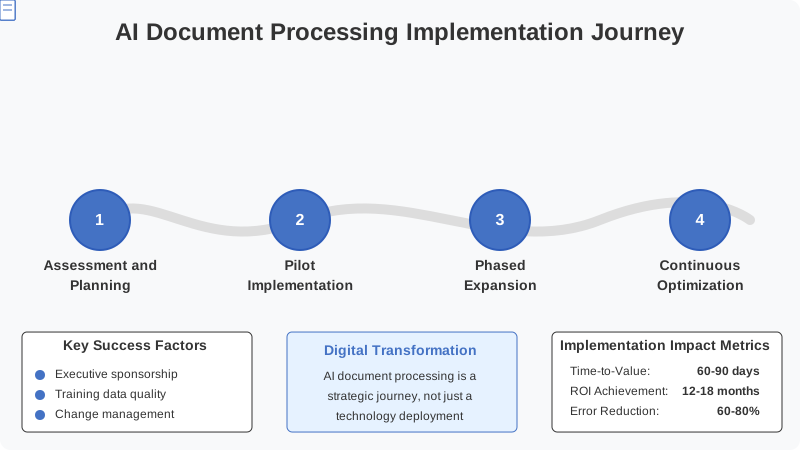
Successful AI document processing implementations typically follow an iterative approach that delivers incremental value while managing implementation risk:
Pilot implementation: Organizations should begin with a limited-scope pilot focused on a single document type or process. This pilot provides valuable learning while demonstrating the potential value of AI document processing. A financial services organization might pilot invoice processing automation before expanding to more complex document types like contracts or compliance filings.
Iterative expansion: Based on pilot results, organizations can expand implementation to additional document types or processes in prioritized phases. Each phase should build on lessons from previous implementations while addressing increasingly complex document processing challenges.
Continuous improvement: AI document processing is not a "set and forget" technology but rather a continuously evolving capability. Organizations should establish mechanisms for ongoing system training and refinement based on performance feedback and evolving document processing needs.
Change management: Successful implementation requires thoughtful change management to ensure user adoption and process integration. Organizations should develop comprehensive training programs, clear standard operating procedures, and appropriate governance mechanisms to support the transition to AI document processing.
As illustrated in Figure 4, the implementation journey follows a progressive path from initial assessment to continuous optimization, with each stage building on the foundation established in previous phases.
AI document processing delivers maximum value when seamlessly integrated with existing business workflows. This integration involves both technical connections and process alignment:
Upstream integration: Document capture systems, email servers, content management platforms, and other document sources must connect to the AI document processing system to enable automated document ingestion. These connections should support both batch processing for historical documents and real-time processing for newly arriving documents.
Core processing integration: The AI document processing system must integrate with relevant validation and enrichment systems, from customer relationship management platforms to enterprise resource planning systems. These integrations enable the AI system to validate extracted information against authoritative sources and enrich document data with contextual information.
Downstream integration: Processed document information must flow to appropriate downstream systems for action, from workflow management tools to specialized line-of-business applications. These integrations ensure that extracted document information triggers appropriate business processes without manual intervention.
Human-in-the-loop integration: While AI document processing automates routine tasks, human review remains essential for exception handling and quality assurance. Organizations should establish effective human-in-the-loop workflows where AI systems route exceptions to appropriate human operators for resolution.
Effective integration transforms AI document processing from an isolated technical capability to an integral component of end-to-end business processes. This integration maximizes the return on investment by ensuring that efficiency gains in document processing translate to broader operational improvements throughout the organization.
As AI document processing technology continues to mature, several emerging trends are shaping the future of this field:
The next generation of AI document processing systems will feature increasingly sophisticated cognitive capabilities that further reduce the need for human intervention:
Contextual understanding: Advanced natural language processing capabilities will enable AI systems to interpret documents within their broader business context, recognizing implied relationships and inferring missing information based on contextual cues. For example, a purchase order missing a delivery date might be processed using standard terms from the referenced master agreement.
Multimodal processing: Future AI document systems will seamlessly process text, tables, images, and diagrams within the same document, extracting and correlating information across these different modalities. This capability will be particularly valuable for technical documentation, scientific literature, and complex financial reports.
Reasoning and inference: AI document systems will increasingly incorporate reasoning capabilities that enable them to draw logical conclusions from document content. A system processing a series of related contracts might automatically identify conflicting terms or recognize implications for downstream business processes.
These enhanced cognitive capabilities will expand the range of documents and processing scenarios that can be automated, addressing increasingly complex document processing challenges that currently require human expertise.
Traditional AI document processing systems require substantial training data for each new document type, creating a significant barrier to rapid implementation for diverse document populations. Next-generation systems are advancing toward zero-shot and few-shot learning capabilities:
Zero-shot learning: These systems can process entirely new document types without specific training examples, leveraging their understanding of similar documents and general document principles. A system trained on various financial documents might automatically process a new tax form without explicit training for that specific form.
Few-shot learning: These systems require only a handful of examples to effectively process new document types, dramatically reducing the data requirements for implementation. A few-shot learning system might need only 5-10 examples of a new invoice format to achieve acceptable processing accuracy.
These capabilities will accelerate implementation timeframes and expand the accessibility of AI document processing to organizations with diverse or rapidly evolving document types.
Future AI document processing systems will feature more sophisticated autonomous learning capabilities:
Unsupervised pattern discovery: Systems will automatically identify patterns and relationships within document populations without explicit training, uncovering opportunities for processing optimization or business insight. A system might autonomously discover that invoices from a particular vendor consistently contain pricing discrepancies that warrant investigation.
Adaptive processing: Systems will continuously refine their processing approaches based on performance feedback, automatically adjusting extraction and validation strategies to optimize accuracy and efficiency. A system processing mortgage applications might autonomously adapt its extraction approach based on subtle variations in application formats from different origination channels.
Collaborative learning: Systems will leverage insights gained across multiple implementations, learning from diverse document processing scenarios to improve performance for all users. This collaborative learning approach accelerates capability development while respecting data privacy boundaries.
These autonomous learning capabilities will transform AI document processing from a static implementation to a continuously evolving capability that generates increasing value over time.
While automation will continue to advance, the most effective document processing approaches will leverage complementary human and AI capabilities:
Intelligent triage: AI systems will automatically route complex or exception documents to appropriate human specialists, focusing human expertise where it delivers maximum value. A system processing insurance claims might route potentially fraudulent claims to specialized investigators while automatically processing routine claims.
Interactive learning: AI systems will engage in active learning dialogues with human operators, asking targeted questions to resolve ambiguities or improve future processing. A system processing a complex contract might request human guidance on a novel clause structure, then apply that learning to similar clauses in future contracts.
Augmented intelligence: AI systems will serve as intelligent assistants to human knowledge workers, providing relevant context and insights that enhance human decision-making. A system supporting legal document review might highlight potentially problematic clauses and relevant precedents from similar agreements, accelerating the human review process.
These collaborative approaches recognize that human and AI capabilities are complementary rather than competitive, combining the pattern recognition and processing speed of AI with the contextual understanding and judgment of human experts.
As organizations navigate an increasingly digital and data-driven business landscape, the strategic importance of efficient, accurate document processing continues to grow. Documents remain the primary vehicle for business information exchange, from customer interactions and supplier relationships to regulatory compliance and internal operations. The ability to extract, analyze, and act upon document information with speed and accuracy represents a significant competitive advantage across virtually every industry.
AI document processing platforms like Artificio offer a transformative approach to this critical business function, combining the pattern recognition capabilities of artificial intelligence with the contextual understanding of natural language processing to automate routine document tasks while enabling more sophisticated document analytics. The measurable benefits of this approach—from dramatic efficiency improvements and cost savings to enhanced accuracy and data accessibility—create a compelling business case for implementation.
However, realizing these benefits requires more than merely deploying new technology. Organizations must approach AI document processing as a strategic initiative that encompasses technology selection, process redesign, change management, and continuous improvement. Those that do so position themselves to transform document processing from an operational burden to a strategic advantage, freeing human talent for higher-value activities while extracting maximum value from their document information assets.
As AI technology continues to advance, the capabilities of document processing systems will expand accordingly, addressing increasingly complex document types and processing scenarios. Organizations that establish strong AI document processing foundations today will be well-positioned to leverage these emerging capabilities, maintaining competitive advantage in an increasingly digital business environment.
The document processing revolution is well underway, with AI-powered automation transforming workflows across industries and functions. For forward-thinking organizations, the question is no longer whether to implement AI document processing but rather how quickly and effectively they can leverage this technology to transform their document-intensive operations. Those that answer this question successfully will enjoy significant advantages in operational efficiency, cost structure, and data accessibility that translate to sustainable competitive advantage in the digital economy.

Head IT Operations - Co Founder of Artificio
See it in your SAP environment
Bring us a document, a process, or a bottleneck. We'll show how Artificio captures, validates, and posts into SAP — then scale from there.
Security & compliance
ISO 27001:2013 certified, SOC 2 Type 2 compliant, GDPR and HIPAA ready. Every agent action is logged, auditable, and runs in isolated environments.